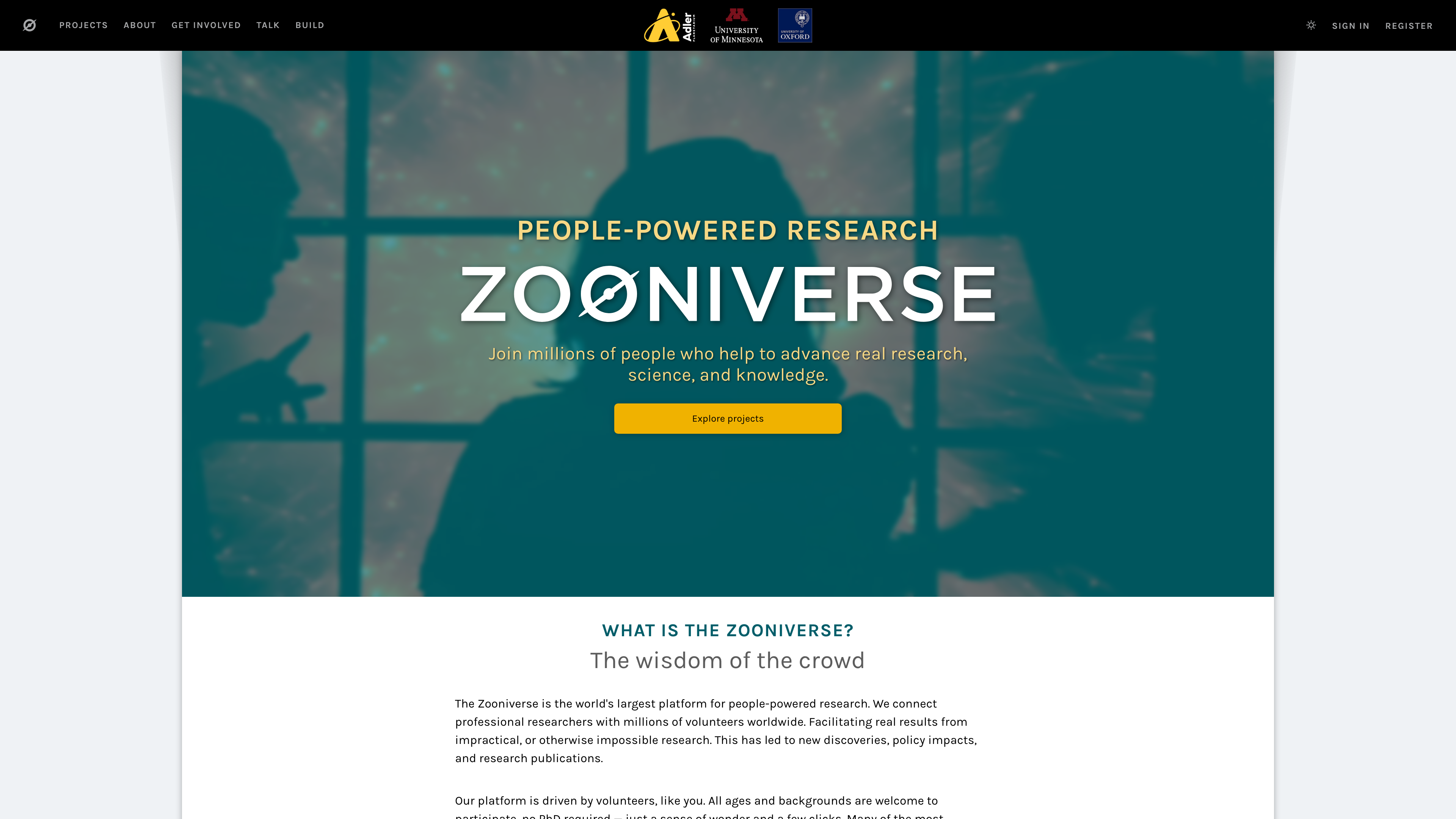
Zooniverse (www.zooniverse.org) lets the public take part in real research online: research teams upload images, audio, manuscripts, and other data, and volunteers complete guided classification tasks in the browser. Every item is classified independently by several people, and the results are aggregated into reliable conclusions — the "wisdom of the crowd" model behind what the team calls the world's largest people-powered research platform (About). Unlike directory-style portals such as SciStarter, Zooniverse combines project hosting and classification tooling in one place; unlike iNaturalist, which focuses on biodiversity observations, its projects span 11 disciplines, and researchers can build their own projects for free with the Project Builder (Help Center).
At a glance
- URL: https://www.zooniverse.org/
- Type: citizen science (people-powered research) platform
- Cost: entirely free, supported by research grants and partner institutions; donations accepted via the Adler Planetarium
- Account: browsing and most classification tasks work without registration; Talk posting, personal statistics, and volunteer certificates require one; a few projects (such as the current Galaxy Zoo) require sign-in before classifying
- Languages: 39 interface translations ship with the front end (including Simplified and Traditional Chinese); each project's content language is configured by its team, and most content is in English
- Mobile: free iOS and Android apps covering only the subset of "mobile-friendly" projects
Background
Zooniverse grew out of Galaxy Zoo, launched in 2007 when Oxford astronomer Chris Lintott invited the public to classify galaxy images from the Sloan Digital Sky Survey; as projects multiplied, the platform evolved from Galaxy Zoo into Zooniverse (University of Minnesota). It is not a company or a standalone nonprofit but a multi-institutional collaboration — in the team's current wording, co-founded by the Adler Planetarium and the University of Oxford, with the University of Minnesota as a key institutional partner; the data controller in its privacy policy is the University of Oxford (FAQ, Privacy Policy, Adler press release).
Milestones worth noting: in 2009 Galaxy Zoo volunteers discovered a new class of galaxies dubbed "Green Peas"; in 2023 the White House Office of Science and Technology Policy named Zooniverse a Champion of Open Science; and on 2026-06-29 the platform recorded its one-billionth classification — volunteer effort the team estimates at roughly 2,000 years of full-time work (official blog).
As of 2026-08-30, per the June 2026 official announcements: more than 3 million registered volunteers across 160 countries; over 550 projects launched to date, with roughly 60–70 active at any time; and more than 550 peer-reviewed publications based on platform data, listed per project on the Publications page. NASA separately reports that 31 of its funded projects are hosted on Zooniverse, producing 120 million classifications and 96 scientific publications since 2020 (NASA).
How participation works
The official guidance is "just start classifying" — no minimum time commitment: open a project's Task interface and follow the instructions in the right-hand panel. Most projects let you classify without an account (anonymous classifications are recorded in an anonymized form), though you will be prompted to register. An account unlocks personal statistics, data export, official volunteer certificates, and posting in each project's Talk discussion board — Talk requires registration. Volunteers under 16 need a parent or guardian's consent (Get Involved, FAQ).
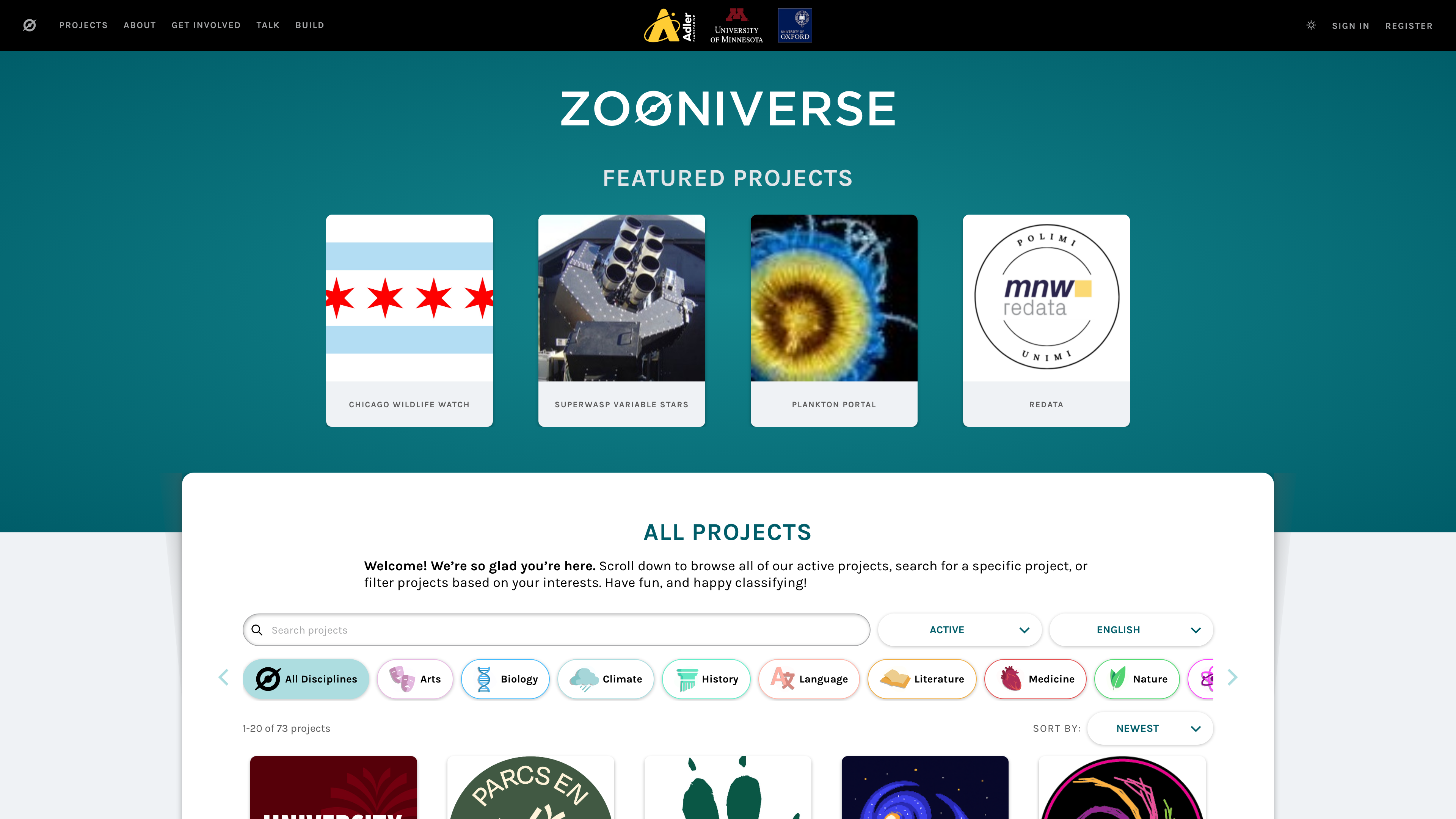
The project directory (above) spans 11 disciplines: Arts, Biology, Climate, History, Language, Literature, Medicine, Nature, Physics, Space, and Social Science. Representative projects include Galaxy Zoo, Planet Hunters TESS, and Gravity Spy (gravitational-wave signals) in astronomy; Snapshot Safari and Penguin Watch (whose 2018 evidence contributed to the expansion of the South Georgia marine protected area) in ecology; Operation War Diary and Shakespeare's World in the humanities; and Etch A Cell and Bash the Bug in medicine.
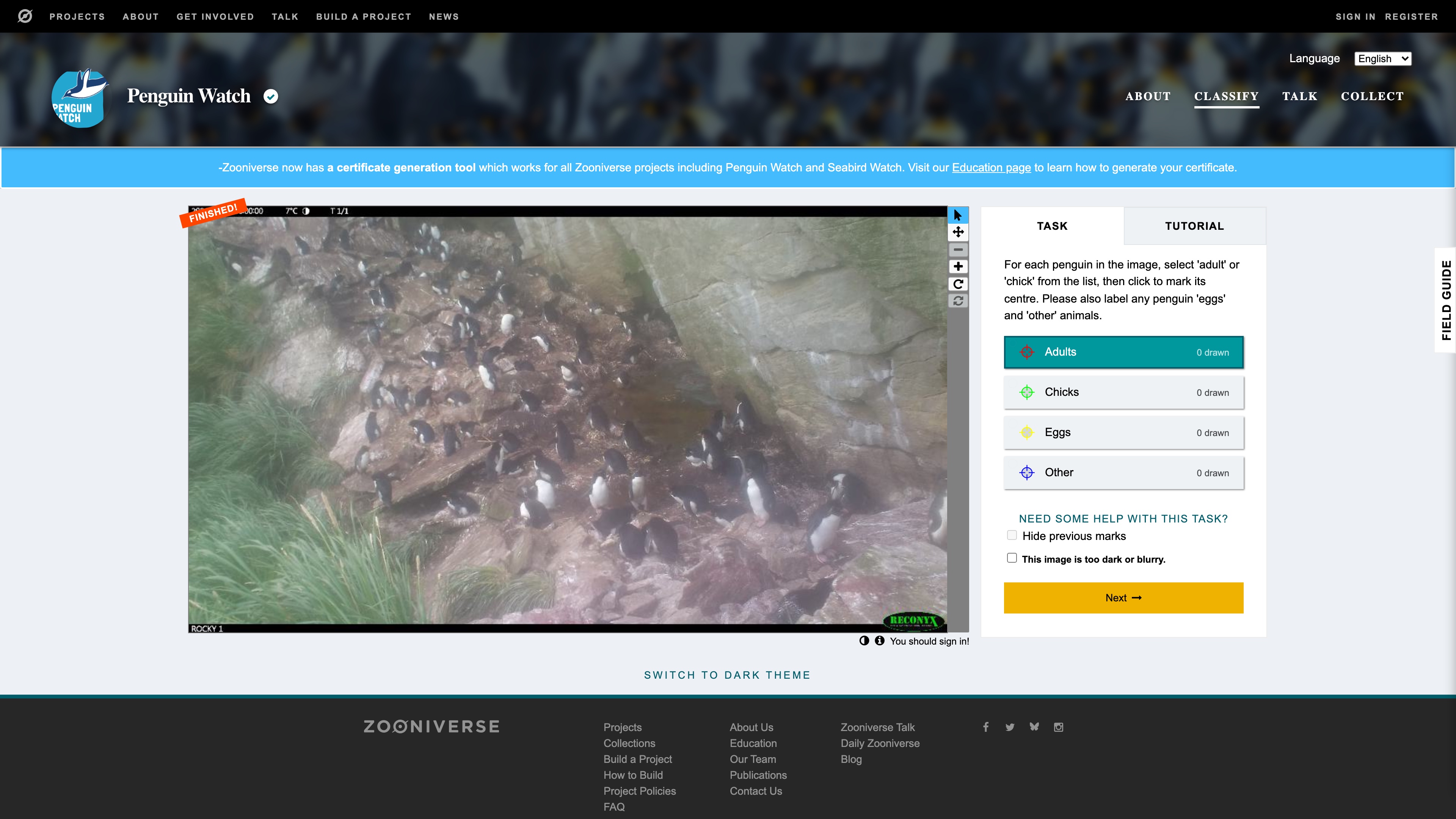
A typical classification interface (above, Penguin Watch) shows the subject on the left and the task on the right: a short tutorial gets you started, and each subject is classified by multiple volunteers to ensure reliability.
Open capabilities
- Public API: the Panoptes backend exposes a public read-only API (for example, project metadata queries) with no credentials required.
- Open source: the zooniverse GitHub organization hosts 375 public repositories (as of 2026-08-30); the core API, new front end, and mobile app are open-sourced mainly under Apache-2.0.
- Data access: project research teams can download all classification data for their projects; registered users can export their own classification history; some projects publish result datasets on the Publications page.
- Project Builder: anyone can build a crowdsourced research project for free; after review and beta testing it can become an official, promoted Zooniverse project.
Licensing and content policy
Under the User Agreement and Privacy Policy, classifications and Talk content you submit grant Zooniverse a perpetual, royalty-free, non-exclusive, sublicensable worldwide license; contributors keep ownership of their own contributions but do not own the aggregated dataset. Talk discussions are publicly visible. The platform operates under UK GDPR and the Data Protection Act 2018, with the University of Oxford as data controller and data stored on Microsoft Azure.
Who it suits
- Curious non-specialists who want to contribute to real research in spare minutes — tasks take minutes and require no credentials.
- Teachers and students: volunteer certificates can document service learning, and a dedicated classroom subdomain exists.
- Researchers with data-labeling needs but limited staff, who can launch projects for free via the Project Builder.
Limitations
- Project content is predominantly English; although the interface ships with 39 translations (including Chinese), task instructions and subject data are mostly in English, and other languages depend on per-project volunteer translation.
- The sign-in wall varies: browsing and most classification need no account, but Talk, personal statistics, and certificates do, and a few projects gate classification itself behind login.
- Multiple people classifying the same item is by design, not a bug — participants who want a sense of sole ownership may find it repetitive.
- The mobile apps cover only a subset of projects, and users have reported stale project lists in the app (Google Play reviews, 2026-08); classifications cannot be edited once submitted.
References
- About Zooniverse, FAQ, Get Involved
- One BILLION Classifications! (official blog, 2026-06-29)
- Adler Planetarium press release (2026-06-29)
- NASA: Volunteers Help Zooniverse Reach 1 Billion Classifications (2026-07-10)
- User Agreement and Privacy Policy
- Zooniverse Help Center (Project Builder)
- GitHub: zooniverse