Bluesky (bsky.app) is a microblogging social network that feels immediately familiar to anyone who has used X (formerly Twitter) — posts, replies, reposts, follows, direct messages — but it runs on an open protocol rather than a closed platform. That architecture produces several verifiable differences: your handle can be a domain name you own (e.g., @nytimes.com); your timeline is not dictated by a single ranking algorithm, because anyone can build a "custom feed" that others can install; account data lives in portable, cryptographically verifiable repositories, so you can change hosting providers without losing followers or posts; and a third-party app ecosystem called the Atmosphere has formed on top of the same protocol. The app is free, carries no advertising, and its public feeds can be browsed without an account. The problem Bluesky set out to solve is platform lock-in — in the company's words, users should always have "the right to leave," and developers should never be locked out of the ecosystem they helped build.
At a Glance
- URL: https://bsky.app/ (company site: bsky.social; protocol docs: atproto.com)
- Type: Decentralized microblogging social network + open protocol (AT Protocol) and app ecosystem
- Cost: Free, no ads. The company says Bluesky "will always be free to use" and that paying will never buy algorithmic boosts. Its first paid service was in-app custom domain purchases (via Namecheap, since 2023); subscriptions and creator payments were announced in October 2024 but had not launched as of 2026-09-12.
- Sign-up: An account is required to post (email registration, no invite code since February 2024, minimum age 13); public content can be browsed without logging in; video uploads require a verified email address.
- Interface languages: 42 languages in the web and mobile apps (per the language list in the open-source code), including English, Simplified and Traditional Chinese, Japanese, Korean, French, German, Spanish, and Portuguese.
- Launched: Invite-only iOS beta on February 17, 2023; open registration on February 6, 2024.
- Scale: Over 44 million registered users as of May 2026, per the official company FAQ.
Background
Bluesky began as a research project inside Twitter. In December 2019, then-CEO Jack Dorsey announced that Twitter would fund a small team to develop an open, decentralized standard for social media — an idea partly inspired by Mike Masnick's essay "Protocols, Not Platforms" (Masnick later joined Bluesky's board). In August 2021, decentralized-social developer Jay Graber was chosen to lead the project, and in late 2021 it was incorporated as an independent entity, Bluesky PBLLC, with $13 million in initial funding from Twitter. The first board members were Jack Dorsey, Jeremie Miller (inventor of Jabber/XMPP), and Jay Graber (official announcement, cross-checked against Wikipedia).
Key milestones since:
- Late 2022: After Elon Musk's acquisition of Twitter, Twitter terminated its service agreement with Bluesky, ending the relationship and the original vision of Twitter becoming an AT Protocol client (company account).
- 2023: Invite-only iOS beta in February, Android in April; the app was open-sourced (MIT license) and custom feeds launched in May; custom domain handles arrived in March; the company converted from a PBLLC to a public benefit corporation (Bluesky Social PBC) over the summer and raised an $8 million seed round led by Neo; it passed 1 million users in September.
- February 6, 2024: Invites were dropped and registration opened to everyone, at roughly 3 million users; more than a million joined within a week (official blog). On February 22, federation opened, letting anyone connect a self-hosted data server to the network.
- May 2024: Jack Dorsey left the board and later publicly criticized Bluesky's governance and moderation approach (per Wikipedia's summary of The Verge and TechCrunch reporting).
- October 2024: A $15 million Series A led by Blockchain Capital — announced alongside a commitment that the network will not use blockchains, cryptocurrency, tokens, or NFTs (official blog). The year ended with over 25.9 million users.
- April 2025: A $100 million Series B led by Bain Capital Crypto, with the Knight Foundation, True Ventures, and others participating (disclosed by the company in March 2026). Across 2025, the user base grew from 25 million to 41 million (2025 Transparency Report overview).
- March 2026: Jay Graber stepped back from the CEO role to become Chief Innovation Officer and board chair; Toni Schneider — founding CEO of Automattic (the company behind WordPress.com) and a True Ventures partner — became interim CEO, and was made permanent on July 10, 2026 (Graber's letter, appointment announcement).
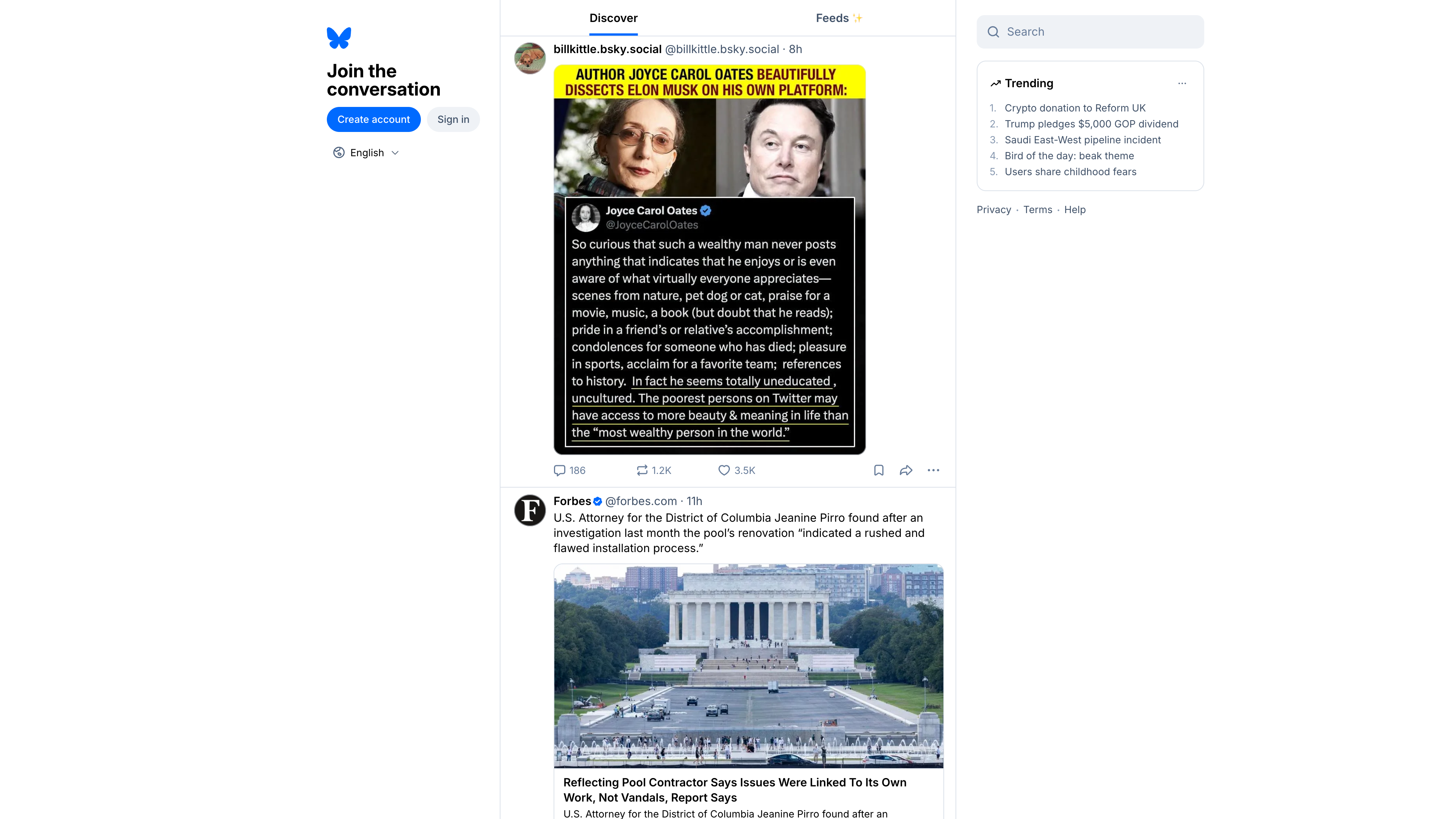
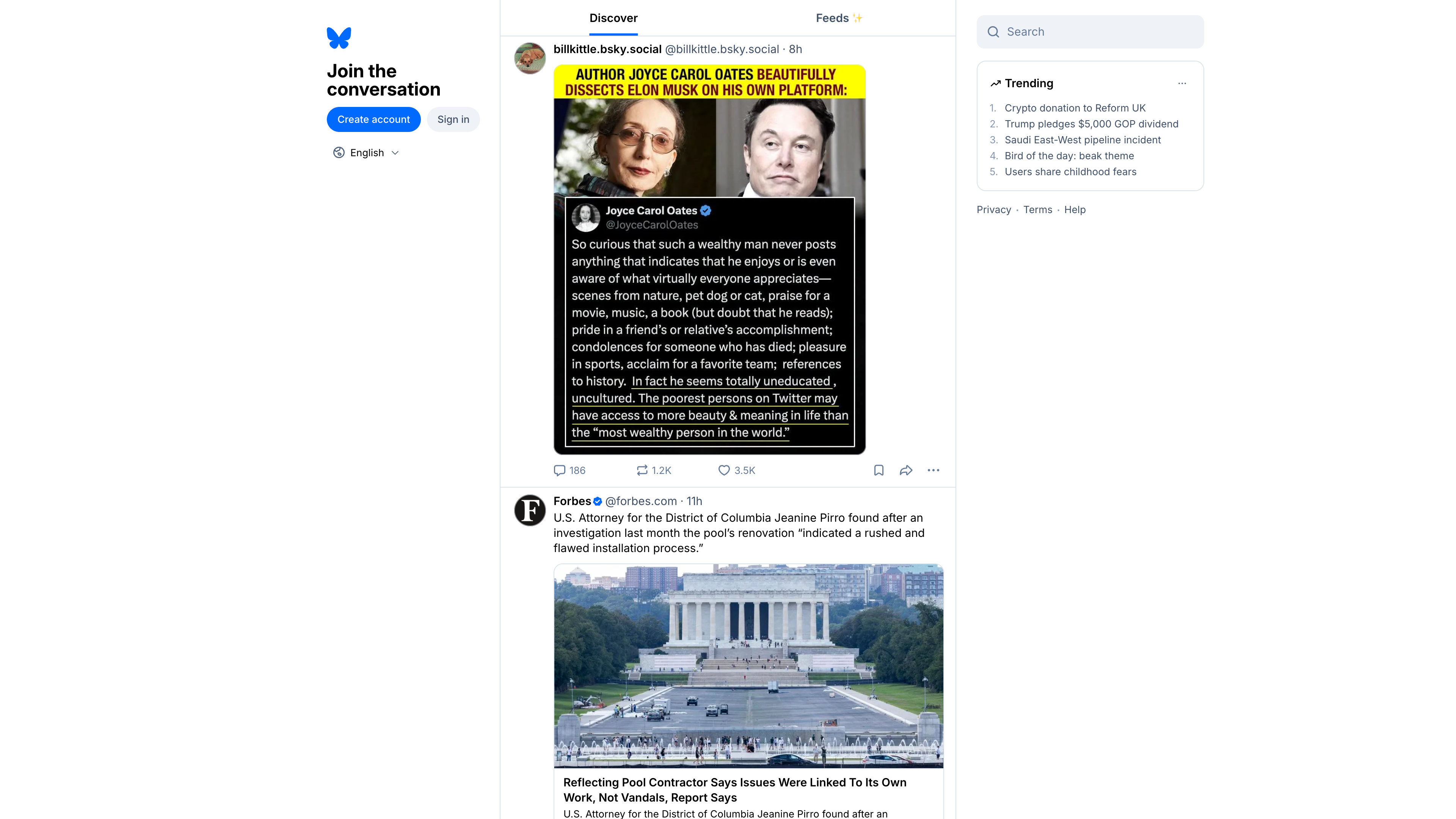
The screenshot above shows what a logged-out visitor sees at bsky.app: the algorithmic Discover feed and the Trending list are public, the left panel invites sign-up, and a language selector sits at the bottom left.
Core Features: Familiar Format, Open Mechanics
There is almost no learning curve for microblogging users — 300-character posts, up to four images per post, videos up to three minutes (per the company's January 2026 product post), hashtags, GIFs, DMs, drafts, and trending topics. The differences are in the mechanics underneath:
- Algorithmic choice (custom feeds): The defaults are Following (a chronological feed of accounts you follow) and Discover (a recommendation feed you can disable in settings). Beyond that, anyone can build and publish a feed, and users install feeds from an open marketplace — by topic, by mutuals, by live event, and so on. The company reported more than 40,000 custom feeds by February 2024 and over 50,000 by October 2024 (official introduction).
- Domain names as handles: Since March 2023, users can set a domain they own as their handle (e.g., @forbes.com) — both an identity and a decentralized form of authenticity. Domains can be bought in-app through a Namecheap partnership since July 2023. The company says over 270,000 accounts had linked a domain handle by April 2025 (official blog).
- Verification badges: In April 2025, Bluesky added a blue verification badge on top of the domain system, plus "Trusted Verifiers" — organizations such as The New York Times can directly verify their own journalists (marked with a scalloped badge), subject to review by Bluesky's moderation team.
- DMs and group chats: Direct messages launched in May 2024; per the privacy policy they are unencrypted and accessible to the Trust & Safety team. In the first half of 2026 the app added group chats, a "Live Now" badge for streamers (integrating with Twitch and others), and post drafts.
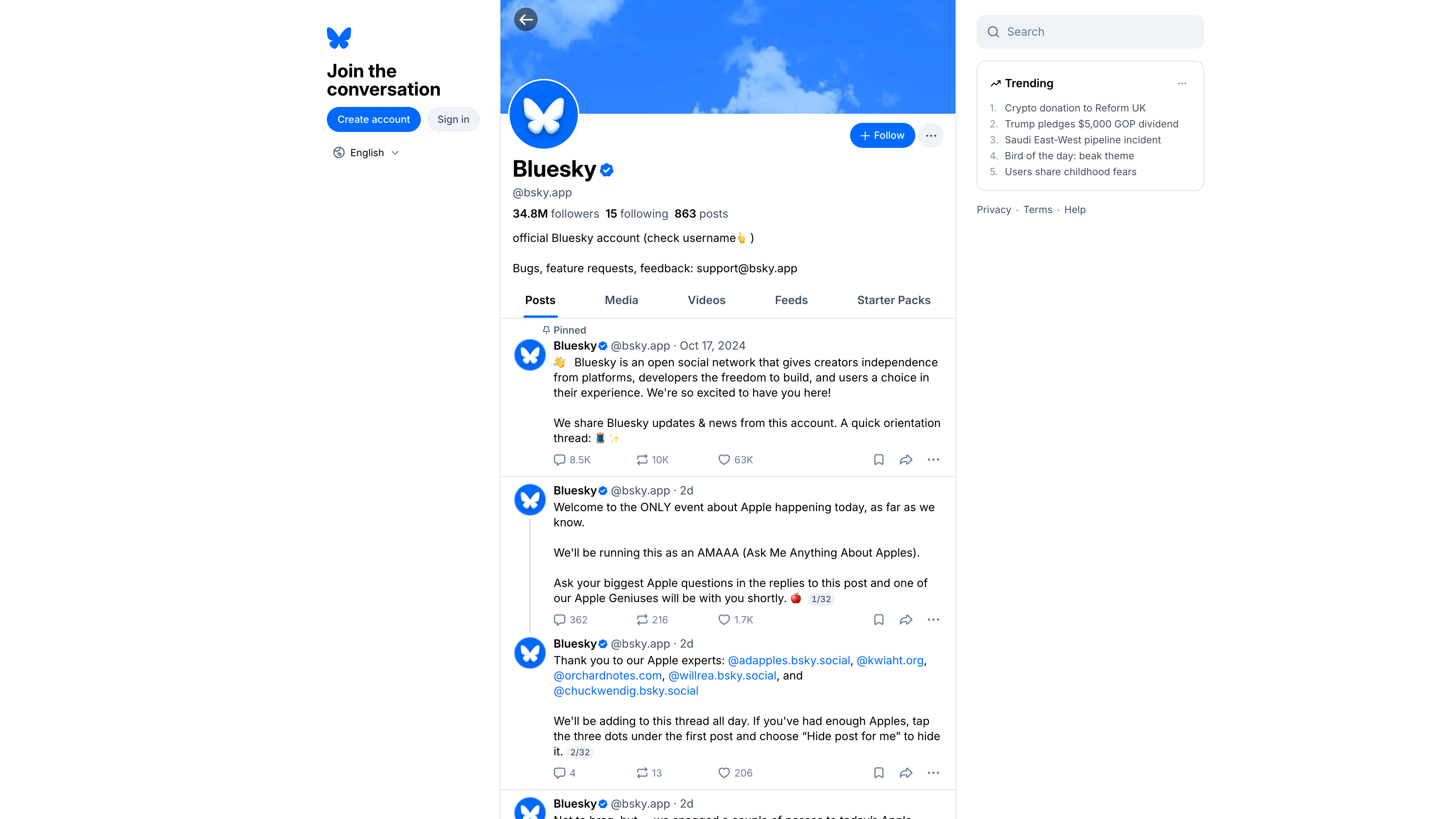
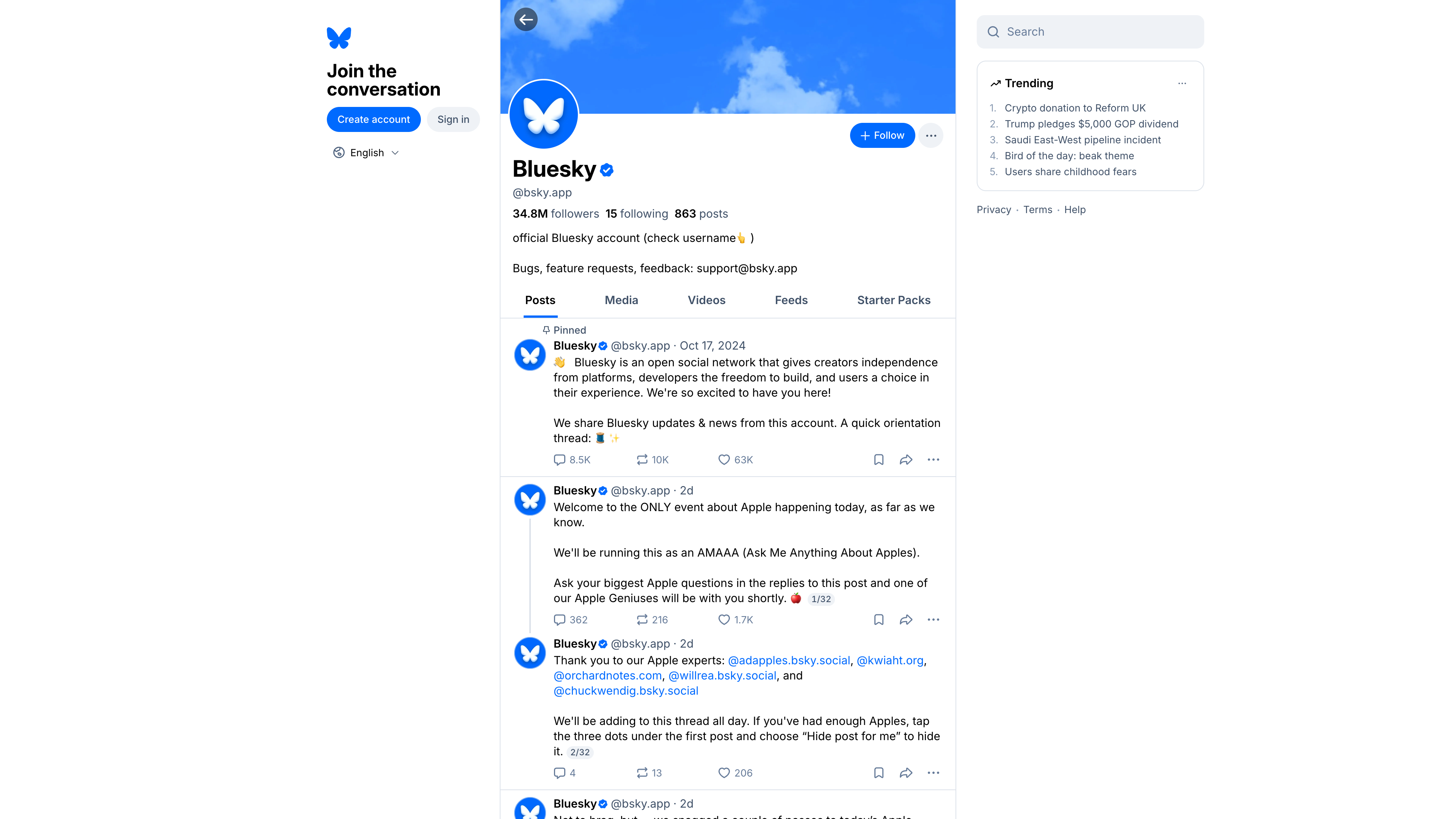
The official @bsky.app profile above illustrates the main elements of the Bluesky interface: the blue verification badge, the domain-style handle, follower counts, and tabs for Posts, Media, Feeds, and Starter Packs. It is publicly visible without an account.
The AT Protocol and the Open Ecosystem
The Bluesky app is the "reference client" for the AT Protocol, which is designed to underpin a whole generation of open social applications (protocol specification):
- Identity and data: Account control is rooted in persistent DID identifiers, while handles are mutable, DNS-based usernames. Public data — posts, likes, follows — lives in content-addressed, cryptographically verifiable personal repositories. Personal Data Servers (PDS) host accounts, Relays aggregate network-wide data, and App Views provide application-level services such as search.
- Account portability: Switching PDS providers keeps your handle, followers, and posts — the company compares it to keeping your phone number when changing carriers. Since federation opened in February 2024, the company reports more than 1,000 third-party data servers (as of October 2024).
- Developer ecosystem (the Atmosphere): Protocol documentation and SDKs are open, and the public firehose can be consumed without an API key. As of March 2026, the company says over a thousand atproto-based apps are used weekly, SDK downloads exceed 400,000 per month, and the network holds roughly 20 billion public records (Series B post). The ecosystem already includes long-form publishing (Leaflet, Offprint), code collaboration (Tangled), and live streaming (Streamplace). The Bluesky client itself is MIT-licensed open source (the bluesky-social/social-app repository, about 18,300 stars as of 2026-09-12).
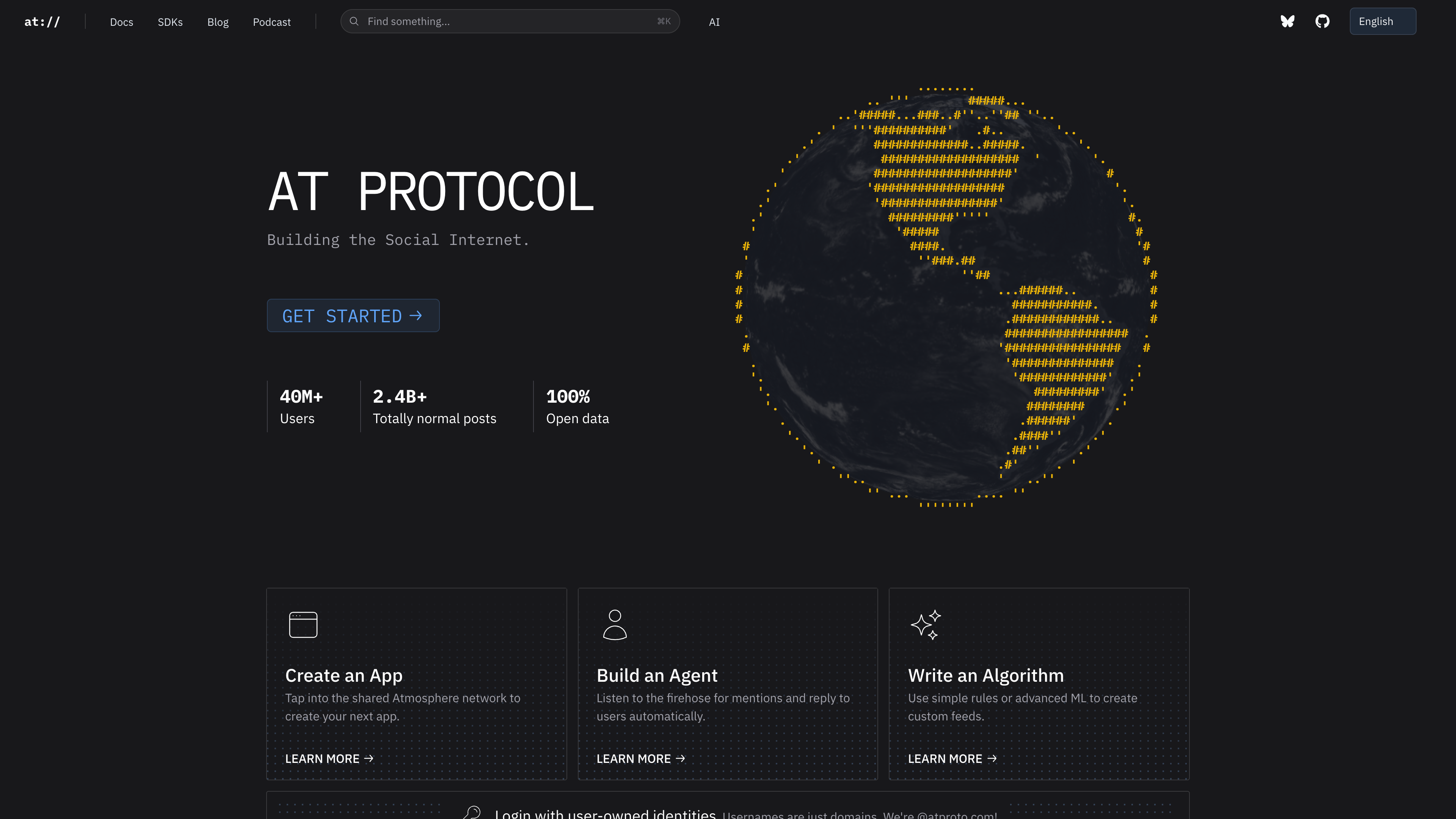
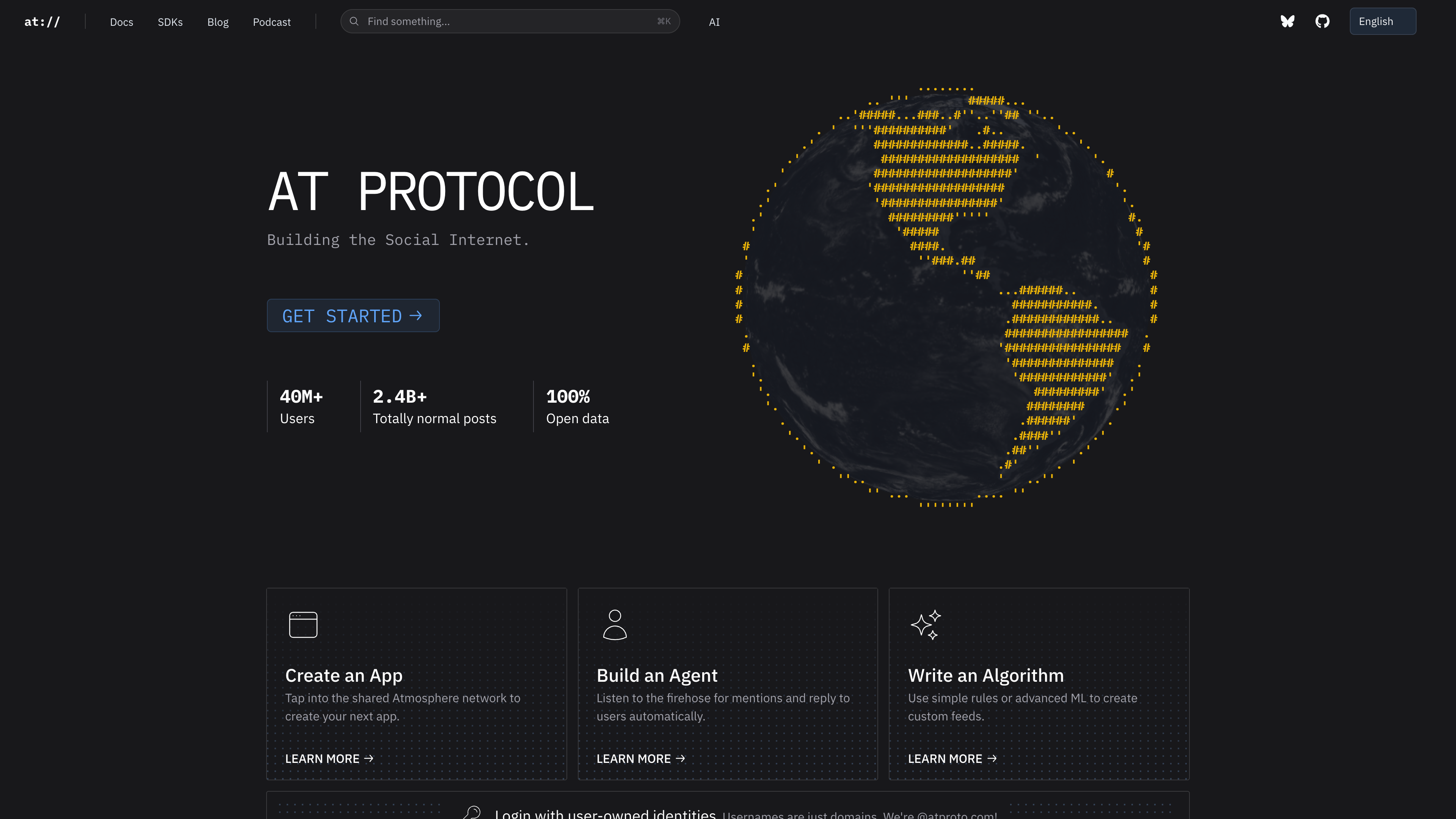
The atproto.com homepage is itself a piece of public data: when captured on 2026-09-12 it advertised 40M+ users, 2.4B+ posts, and 100% open data.
How Bluesky differs from Mastodon (ActivityPub) is a question the company answers directly in its FAQ. In short: on Mastodon, your instance (server) defines your community and is part of your identity, whereas a Bluesky server is just a data host and changing it does not affect your view of the network; Mastodon timelines show only accounts you follow, while Bluesky offers network-wide algorithmic feeds from an open marketplace; Mastodon governance leans on instance-level defederation, while Bluesky uses stackable labeling services; and moving instances on Mastodon means migrating your account, while Bluesky separates identity from hosting by design.
Copyright and Content Policies
As a UGC platform, Bluesky publishes four governing documents (all under bsky.social/about/support):
- Terms of Service (updated 2025-08-14): Users retain ownership of their content and grant Bluesky a limited, worldwide, non-exclusive, royalty-free license to operate, improve, and display the service; the terms state the company "will never sell your Content without getting your permission first." After account deletion the company makes "reasonable efforts" to remove content and notifies other services on the protocol, but — because the network is decentralized — complete deletion across the network is not guaranteed. The terms include binding arbitration and a class-action waiver.
- Community Guidelines (updated 2025-09-19): Four principles — Safety First, Respect Others, Be Authentic, Follow the Rules. Harassment, hate speech, and non-consensual intimate imagery (including synthetic media) are prohibited; consensual adult content is allowed when properly labeled.
- Copyright Policy (updated 2026-01-29): A DMCA-style takedown and counter-notification process.
- Privacy Policy (updated 2025-08-14): Registration collects an email address and date of birth; IP addresses, device data, and usage data are collected automatically; DMs are unencrypted and may be accessed for Trust & Safety purposes; some jurisdictions (the UK, Australia, and several US states) require third-party age assurance.
Moderation follows a "stackable" architecture: Bluesky's own team reviews reports around the clock (9.97 million reports handled and 2.45 million pieces of content removed in 2025), while anyone can run an independent labeling service that users can subscribe to — for example, one that hides pictures of spiders or flags misinformation. The company's 2025 transparency report credits its reply-filtering system with a 79% drop in reports of anti-social behavior by October 2025.
Good For
- People who want a Twitter-like public square not controlled by a single company: journalists, academics, open-source communities, and sports/live-event communities are notably active on Bluesky.
- Users who value account ownership: use your own domain as a handle, self-host your data, and keep your social graph when switching providers.
- Anyone who wants algorithmic transparency: pick or build the feeds that shape your timeline instead of accepting one default.
- Developers: build third-party clients, bots, feeds, or entirely new social apps on an open protocol with a keyless public firehose.
- Researchers: the network's public records and open labeling system make information spread observable (subject to ethics and terms).
Limitations
- Scale and engagement are still open questions: Registered users are a fraction of X's or Threads'. Third-party reporting compiled by Wikipedia put daily active users at about 1.5 million in September 2025, down roughly 40% from 2.5 million in March 2025. The company's own January 2026 product post concedes that many early users "tried it early on and didn't stick around," and that the basics of posting, discovery, and recommendations still need work.
- No truly private space: The protocol is designed for public conversation — posts, likes, and blocks are all public, and there are no private profiles. DMs are unencrypted and accessible to the platform; private data and encryption at the protocol level remain on the roadmap (per the official specification).
- Deletion is not guaranteed: Once content enters the decentralized network, deleting your account or posts does not ensure every copy disappears.
- Governance is unfinished: The protocol is still effectively steered by one company; the plan to bring it to a standards body such as the IETF has not materialized. Public-benefit-corporation status does not by itself prevent future shifts in direction.
- Small company, venture-funded: About 29 employees as of September 2025 (Wikipedia). The revenue model is still experimental — beyond domain services, the announced subscriptions and creator payments had not launched as of 2026-09-12 — so long-term sustainability is unproven.
- Reliability incidents: A sustained DDoS attack caused multi-day service interruptions in April 2026 (documented in four official incident posts).
- Community skew: Multiple reports and studies describe the user base as leaning liberal/left and technical, which shapes the conversation compared with general-audience platforms (a Wikipedia synthesis, not an official position).
- Regional friction: Users in the UK, Australia, and several US states must complete age verification to use DMs or view adult content.
Alternatives
- Mastodon: The established federated microblogging network built on ActivityPub, organized around instance communities and non-profit governance; frequently compared with Bluesky, though the architectures differ (see above).
- Threads: Meta's microblogging service — far larger, but a closed platform with limited progress toward ActivityPub integration.
- X: Bluesky's origin point and primary reference; a centralized platform where one company sets the algorithms and the rules.
References
- Bluesky company FAQ (checked 2026-09-12)
- Bluesky user FAQ (checked 2026-09-12)
- Announcing Bluesky PBLLC (Feb 2022) (checked 2026-09-12)
- Our Plan for a Sustainably Open Social Network (Jul 2023) (checked 2026-09-12)
- Algorithmic Choice with Custom Feeds (Jul 2023) (checked 2026-09-12)
- Domain Names as Handles in Bluesky (Mar 2023) (checked 2026-09-12)
- Reaching 1 Million Users (Sep 2023) (checked 2026-09-12)
- Join Bluesky Today (Bye, Invites!) (Feb 2024) (checked 2026-09-12)
- Bluesky: An Open Social Web (Feb 2024) (checked 2026-09-12)
- Bluesky Announces Series A (Oct 2024) (checked 2026-09-12)
- A New Form of Verification on Bluesky (Apr 2025) (checked 2026-09-12)
- 2025 Transparency Report Overview (Jan 2026) (checked 2026-09-12)
- What's Next at Bluesky (Jan 2026) (checked 2026-09-12)
- A New Chapter for Bluesky (Mar 2026) (checked 2026-09-12)
- Bluesky's 2025 $100M Series B (Mar 2026) (checked 2026-09-12)
- Bluesky names Toni Schneider CEO (Jul 2026) (checked 2026-09-12)
- AT Protocol specification (checked 2026-09-12)
- Bluesky Terms of Service (2025-08-14) (checked 2026-09-12)
- Bluesky Community Guidelines (2025-09-19) (checked 2026-09-12)
- Bluesky Copyright Policy (2026-01-29) (checked 2026-09-12)
- Bluesky Privacy Policy (2025-08-14) (checked 2026-09-12)
- Bluesky - Wikipedia (checked 2026-09-12)
- bluesky-social/social-app - GitHub (checked 2026-09-12)