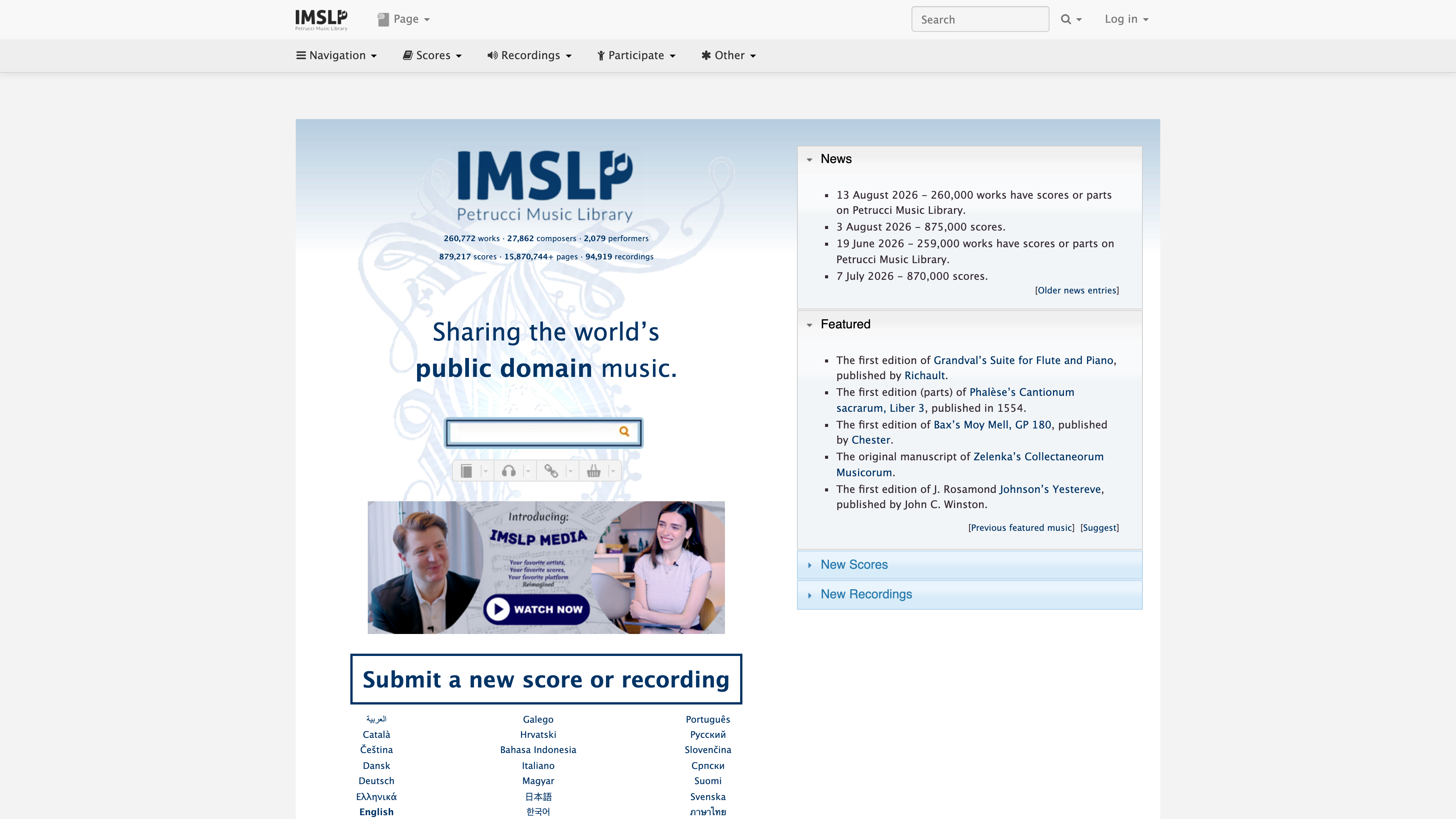
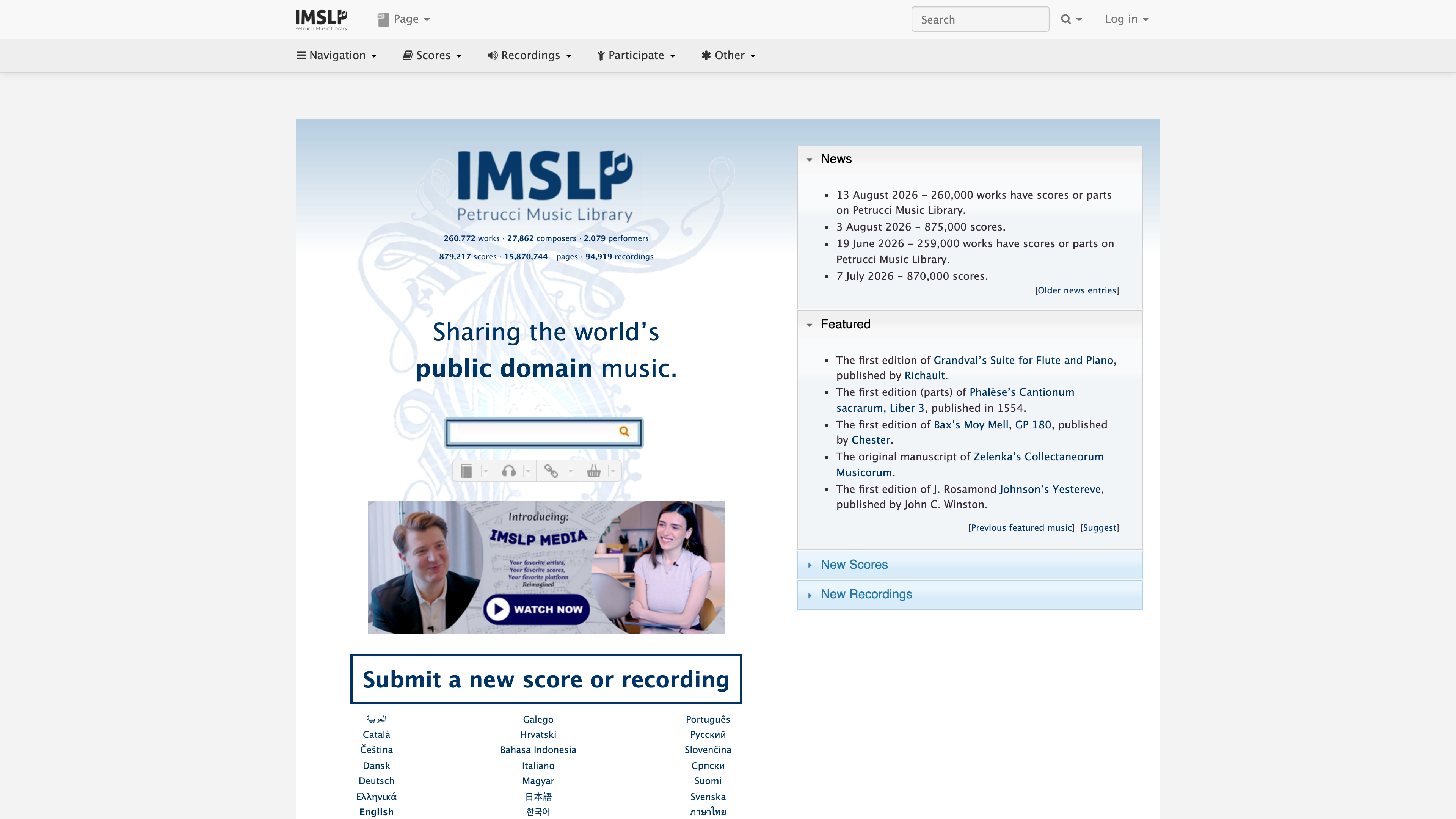
IMSLP (the International Music Score Library Project, also known as the Petrucci Music Library, at imslp.org) is a wiki-based library of public domain sheet music. The problem it addresses: once a score's copyright has expired or its rights holder has granted a free license, the scans and newly typeset digital editions scattered across libraries, publishers and private collections still need one searchable, traceable catalogue that anyone can use for free. The site went live in February 2006; registered users create composer and work pages and submit files, which are then reviewed one by one by a copyright review team before download is opened. Distinguishing, verifiable features compared with commercial score stores: every file carries a separate copyright status for Canada, the United States and the European Union; work pages include bibliographic detail such as first performance, first publication and plate numbers, linked to authority files like VIAF and GND; and the whole site runs on MediaWiki with page text under CC BY-SA 4.0. As of 2026-08-31 the homepage counter lists 260,772 works, 27,862 composers, 879,217 scores (more than 15.8 million pages) and 94,919 recordings.
Site at a glance
- URL: https://imslp.org/ (visitors are routed to regional mirror domains such as cn.imslp.org)
- Type: public domain sheet music and recordings sharing wiki
- Cost: browsing and downloads are free; the FAQ states that about one third of files show a 15-second wait before the download link appears, waived for subscribers along with ads (FAQ)
- Registration: not needed to browse or download; required to edit pages and upload files
- Interface language: primarily English, with 29 language entry points on the homepage including Traditional Chinese (as of 2026-08-31); some policy pages also have Simplified Chinese translations
- Collection size: 260,772 works / 27,862 composers / 879,217 scores / 94,919 recordings (homepage, as of 2026-08-31)
Background
The site launched on 16 February 2006, founded by Edward W. Guo (username Feldmahler). It is named after Ottaviano Petrucci, the Venetian printer who produced the first book of music set in movable type, the Harmonice Musices Odhecaton, in 1501; the capital A in the site logo is taken from that book (About).
In October 2007 the Austrian publisher Universal Edition sent a cease-and-desist letter citing the gap between Austrian and Canadian copyright terms, and the site went dark; it reopened on 30 June 2008 with the file-by-file copyright review process still in place today (Wikipedia). It is operated by Project Petrucci LLC, described on the About page as "a company created with the sole purpose of managing this site", registered in Delaware on 28 June 2008 with a registered-agent address in Wilmington. The main servers sit in Canada; the site states that it strives to comply with Canadian copyright law and provides a DMCA policy page for US rightsholders. In 2012 the Werner Icking Music Archive (WIMA) merged into IMSLP (Wikipedia).
Browsing and retrieval
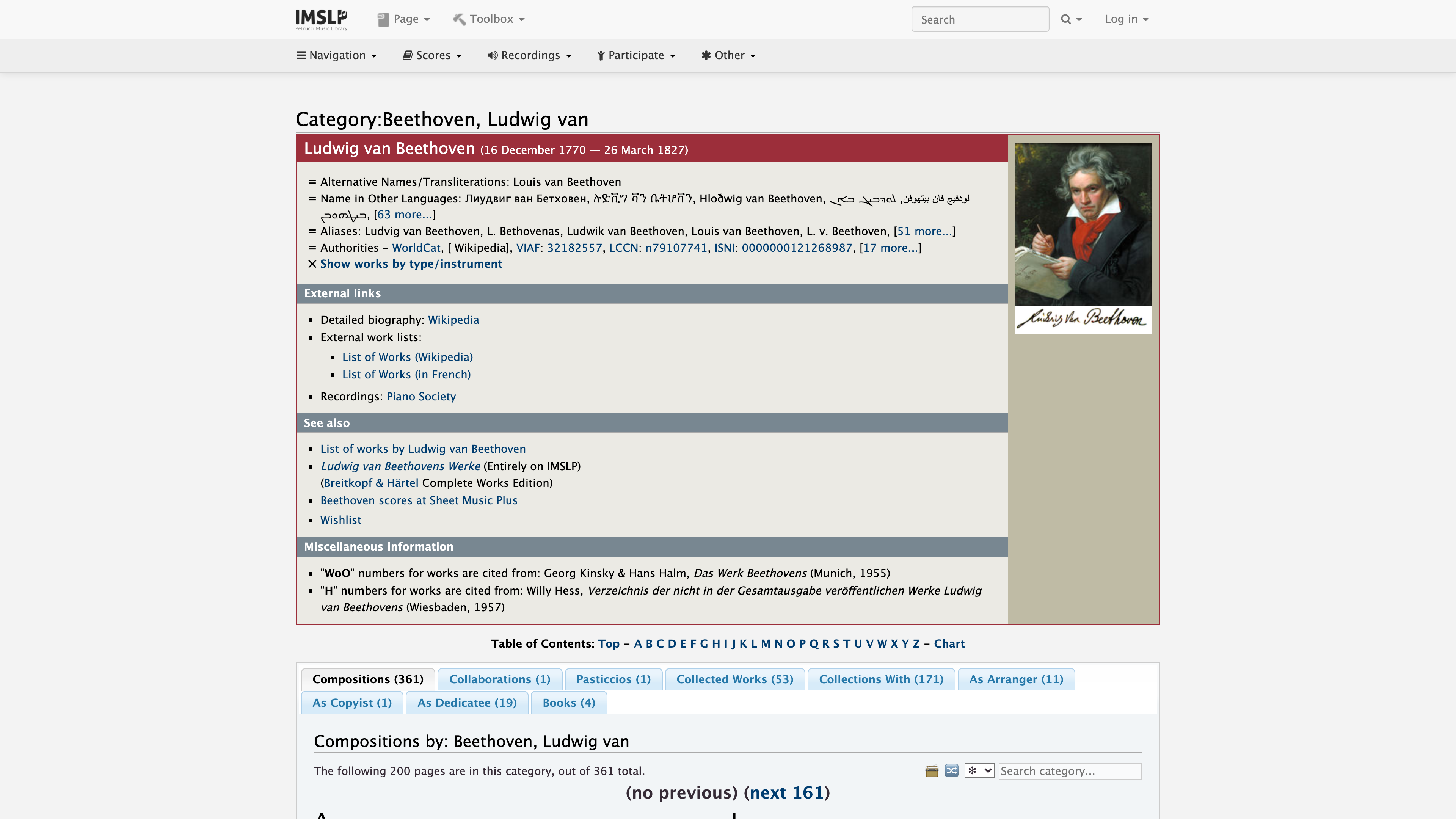
Navigation is organised by composer, all people, nationality, time period, instrumentation or genre, publisher, Braille scores, instrument difficulty and performers, with both a site search and an IMSLP index search. Composer pages carry life dates, aliases and multilingual names, authority control links (WorldCat, Wikipedia, VIAF, ISNI, GND and others) and filters by instrument or genre; the Beethoven page, for example, lists works alphabetically alongside categories for collaborations, collected volumes, arrangements and dedications, plus an entry point to the Breitkopf & Härtel complete-edition works hosted in full.
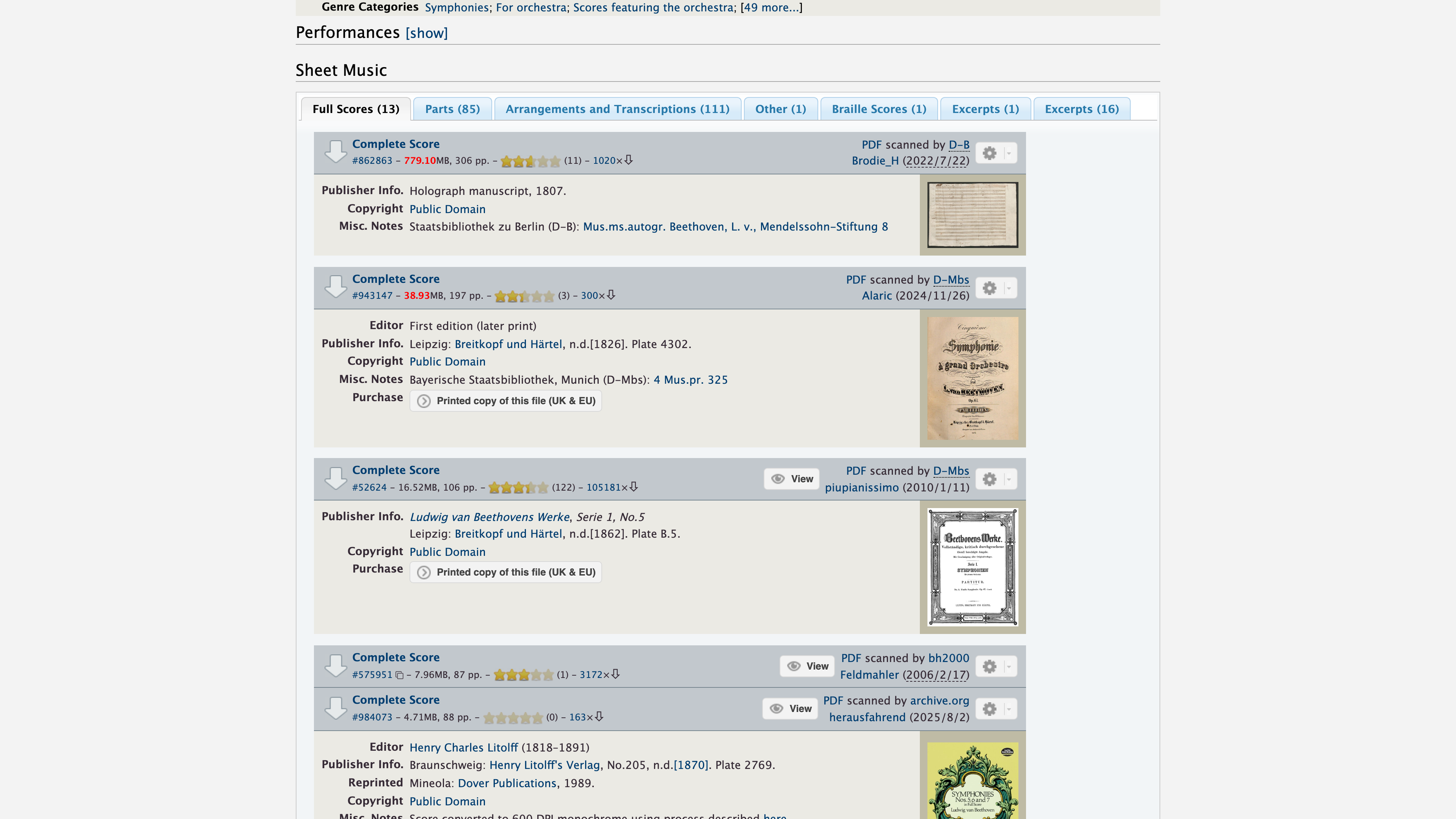
The work page is the site's basic unit, split into Performances (recordings) and Sheet Music sections, with sheet music further divided into tabs for full scores, parts, and arrangements and transcriptions. Each file entry lists an ID, file size, duration, user ratings, cumulative download counts, uploader and date, publisher information and notes, together with a copyright tag displayed in three columns for Canada, the US and the EU and a prominent red disclaimer.
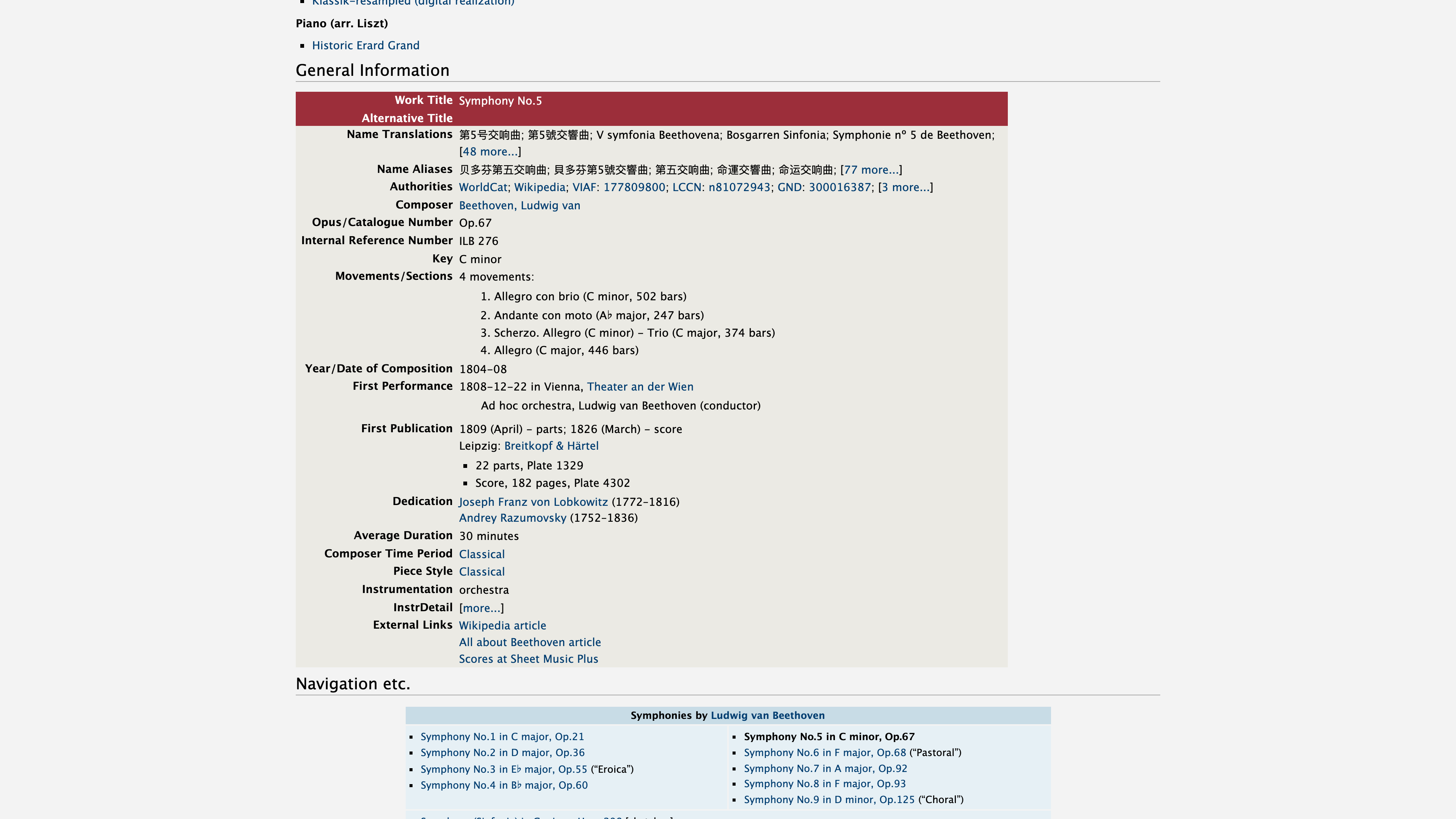
Every work page also carries a General Information table: title, its translations into dozens of languages, authority file numbers, catalogue number, key, movement structure, composition years, first performance (date, venue, conductor) and first publication (publisher and plate number). This makes the site useful as a bibliographic reference in its own right — the Symphony No. 5 page, for instance, records the April 1809 Breitkopf & Härtel parts and the plate number of the 1826 full score.
Recordings and related content
The Performances section of each work page collects recordings uploaded by registered users (mostly Creative Commons licensed) and synthesized or MIDI files; subscribers can also stream a licensed commercial recording library in full (subscriptions). There is a dedicated Braille score section and a difficulty-graded browse view for teaching. Official apps exist for iOS and Android, alongside MusikViewer, an open-source Android score viewer developed by the founder (Apps).
Accounts and community contribution
Accounts exist only for contributing: browsing and downloading never require login, while registration keeps page edits, uploads and discussions traceable and helps against vandalism (FAQ). Submitting a score means checking for duplicates, confirming the composer page exists (creating it if not), building the work page and then submitting files to it, after which the files enter the copyright review queue. The site is funded by donations and subscriptions (Stripe/PayPal) and displays ads; subscription benefits include no download waits, no ads, instant access to new uploads and commercial-recording streaming (subscriptions).
Copyright and content policy
This is the part of IMSLP most worth understanding. The findings below were checked against the official policy pages on 2026-08-31.
- Public domain plus free licenses are the basis of the collection. The licensing policy states that "public domain works are the bedrock of our collection"; copyrighted material is accepted only when the rights holder releases it under a free license. The site aligns its definitions with Wikimedia Commons and the Definition of Free Cultural Works: CC0, CC BY and CC BY-SA are recommended, new CC ND uploads are no longer accepted, CC NC is deprecated, and the Performance-Restricted option for composers is limited to users who can prove membership in a performing rights organisation such as ASCAP or BMI. Licenses are irrevocable once uploaded, and compliant files are not removed.
- Canadian law is the baseline, with per-jurisdiction offloading. The main servers are in Canada, so the usual condition for the main site is that the last contributor — composer, librettist, arranger or other — died in 1971 or earlier; Canada applies a 70-year post-mortem term to authors who died in 1972 or later. Works public domain only in the United States (generally published in 1930 or earlier) go to the legally separate PML-US mirror, and works public domain only in Taiwan (generally contributors who died in 1975 or earlier) go to PML-Asia; separate servers in the EU and Canada handle files whose status differs by country.
- New editions have their own rules. IMSLP voluntarily requires that critical, scientific or urtext editions be at least 25 years past publication, or already public domain in Germany, before upload. Computer typesets are treated in practice as new editions with the typesetter listed as editor, and must be released under a suitable license (copyright review guidelines).
- Uploads pass through a review queue. New submissions are first flagged [TB] (Technical Block) and stay closed to download until review; volunteer copyright reviewers then tag each file in three columns for Canada, the US and the EU — V for verified public domain, C for checked, N! for permission granted, a number for the year protection runs until, U for unresolved. The FAQ's wording is that "every score, except for very new scores, on IMSLP has been copyright reviewed by our team" (FAQ, review process).
- Regional restrictions are printed on the file. Each entry shows the conclusion per jurisdiction, files that cannot legally be downloaded in the EU are labelled as such, and entries marked "(EU)" — still protected in some jurisdictions — are visible in listings. Every entry carries the disclaimer "Please obey the copyright laws of your country. IMSLP does not assume any sort of legal responsibility or liability for the consequences of downloading files that are not in the public domain in your country." The site advises users to check their own law or consult a legal professional (public domain policy).
- Legal entity and location. The operator, Project Petrucci LLC, is registered in Delaware (registered agent address in Wilmington), the main servers are in Canada, and copyright and site matters are handled through the contact channels published on the About page (About).
Use cases
- Finding public domain PDFs of classical and early music: full scores, parts, piano arrangements and chamber reductions are often available side by side.
- Checking bibliographic detail — first-edition publishers, plate numbers, first performance dates and authority file IDs — as version leads for musicological work.
- Teaching situations that call for difficulty-graded repertoires or specific instrumentations, and blind users who need Braille scores.
- Composers distributing their own works under free licenses, and performers uploading CC-licensed recordings.
- Pairing with Project Gutenberg or LibriVox to find text, audiobook and score forms of the same underlying work.
Limitations
- Dated, dense interface. A customised MediaWiki skin with heavy professional fields (catalogue numbers, three-jurisdiction tags, nested tabs) makes the learning curve steep for readers outside classical cataloguing conventions.
- Copyright varies by country. The same file may be blocked in the EU or restricted in the US; the three-column tags must be interpreted by the reader, and the site explicitly takes no legal responsibility for downloads where a file is not yet public domain.
- Recent editions are protected. Urtext and critical editions published within the last 25 years are out of scope, and typesets whose editors are still within the protection term cannot be hosted — the newest authoritative editions generally still have to be bought.
- Limited modern coverage. Original works by authors who died in 1972 or later are generally absent from the main site unless the rights holder grants a free license.
- Download waits and ads. Around a third of popular files carry a 15-second wait (per the FAQ), and non-subscriber pages show advertising.
- Scan quality depends on volunteers. Missing or duplicated pages happen and can only be noted in file comments; verify before critical use.
- No public API: the official help and policy pages document no programming interface for bulk access, and the interface is English-first, with Simplified Chinese available only for some policy pages.
Comparable services
- Mutopia Project: a smaller free-licensed score library with high-quality LilyPond typesetting.
- Internet Archive: large-scale library score scans that complement IMSLP's holdings.
- Project Gutenberg and LibriVox: volunteer-run public domain projects covering text and audiobooks respectively.
References
All sources checked on 2026-08-31:
- IMSLP homepage (collection counter, news milestones, language entry points)
- IMSLP:About (operator, registered address, logo origin, library statistics)
- IMSLP:FAQ (launch date, free access and subscription mechanics, [TB] and review statements, hosting country)
- Public domain policy (Canada/US/EU/Taiwan rules, PML mirrors, 25-year rule, disclaimer)
- IMSLP:Licensing Policy and Guidelines (allowed and disallowed licenses, irrevocability)
- IMSLP:Copyright Reviewers (three-jurisdiction tagging system and review workflow)
- IMSLP:Subscriptions (subscription benefits and payment methods)
- IMSLP:Apps (mobile apps and MusikViewer)
- Wikipedia: International Music Score Library Project (2007 shutdown and 2008 reopening, company registration, WIMA merger, awards)
- Beethoven Symphony No. 5 work page and Beethoven composer page (page structure and metadata examples)