Zhihu (zhihu.com) is a Chinese-language online content community organized around questions and answers. Users post long-form answers, complemented by columns (articles), short "thoughts" (xiangfa), interest groups and time-boxed themed "roundtables", while paid memberships, one-on-one paid consultations and an AI search product called Zhihu Zhida extend the platform beyond free Q&A. The company describes itself on its investor relations site as "the largest Q&A-inspired online content community in China". Unlike utility-style Q&A products such as Baidu Zhidao, Zhihu built its reputation on in-depth answers and credentialed experts, and it hosts one of the largest pools of public Chinese-language Q&A content. The trade-off: the web version restricts anonymous browsing more aggressively than most Western equivalents — the homepage itself is a sign-in wall, as detailed in the hands-on notes below.
At a glance
- URL: https://www.zhihu.com/
- Type: Q&A community / UGC content platform
- Cost: Reading and posting are free; the Yanxuan membership costs CNY 19/month on auto-renewal, CNY 25 for a single month or CNY 53 per quarter (App Store in-app purchase listing, as of 2026-09-03); paid consultations are priced per question by each answerer (observed range CNY 40–200)
- Sign-up required for: posting content, the homepage feed, the hot list and Zhihu Zhida; the Explore page, roundtables, paid consultation and Zhihu Live pages are readable without an account (tested 2026-09-03)
- Interface language: Simplified Chinese only
- Mobile: iOS and Android apps, plus separate "Zhihu Yanxuan" and "Yanyan Story" apps
Background
Zhihu was founded by Yuan Zhou, who had previously started a search-marketing software company and was inspired by Quora to build a Chinese equivalent in 2010 (The Paper, in Chinese). The site entered an invite-only beta on December 19, 2010 with roughly 200 seed users — including prominent tech figures such as Kai-Fu Lee and Wang Xing — who produced about 8,000 questions and 20,000 answers in the first 40-odd days (Jiemian, in Chinese). It officially launched on January 26, 2011 (ifeng, in Chinese), and after registration opened to the public in March 2013, the user base grew from 400,000 to 4 million in under a year (ifeng, same report).
Zhihu listed on the New York Stock Exchange on March 26, 2021 (ticker ZH, IPO price US32.06 per share, official pricing announcement). The operating entity is Beijing Zhizhe Tianxia Technology Co., Ltd.
On the business side, the company reported its first full-year non-GAAP profit in 2025 (adjusted net income of RMB 37.9 million, FY2025 results). In Q2 2026 it posted RMB 690.1 million in revenue (up 5.9% quarter-over-quarter), an adjusted net loss of RMB 10.3 million, and 13.1 million average monthly subscribing members (Q2 2026 results). As of the end of Q2 2026, the platform hosted about 993 million cumulative pieces of content from 81.5 million cumulative creators (CNR, in Chinese, checked 2026-09-03). Zhihu no longer discloses monthly active users; its last public MAU figure was about 110 million in Q3 2023 (Caixin, in Chinese).
Q&A and the content ecosystem
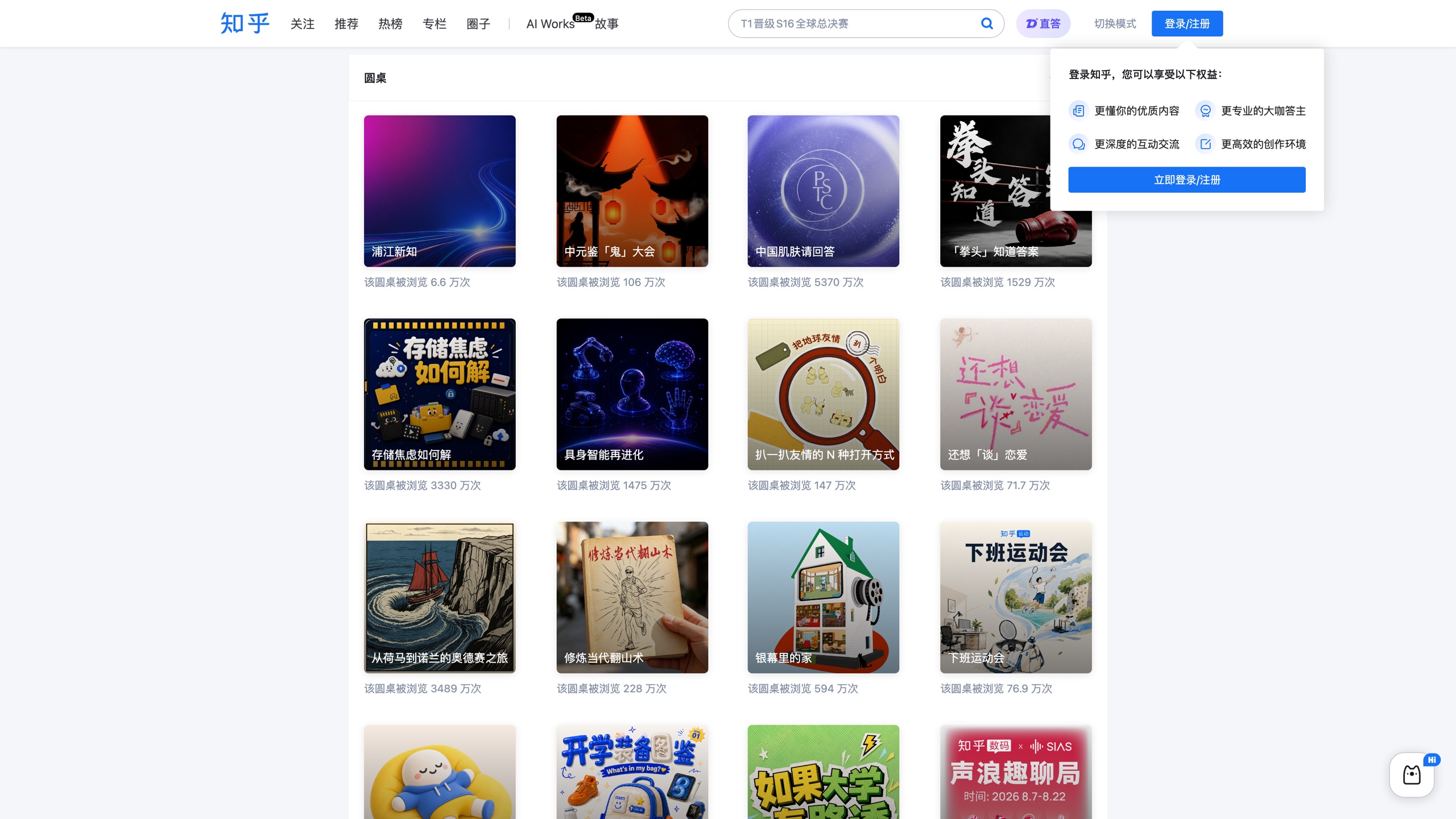
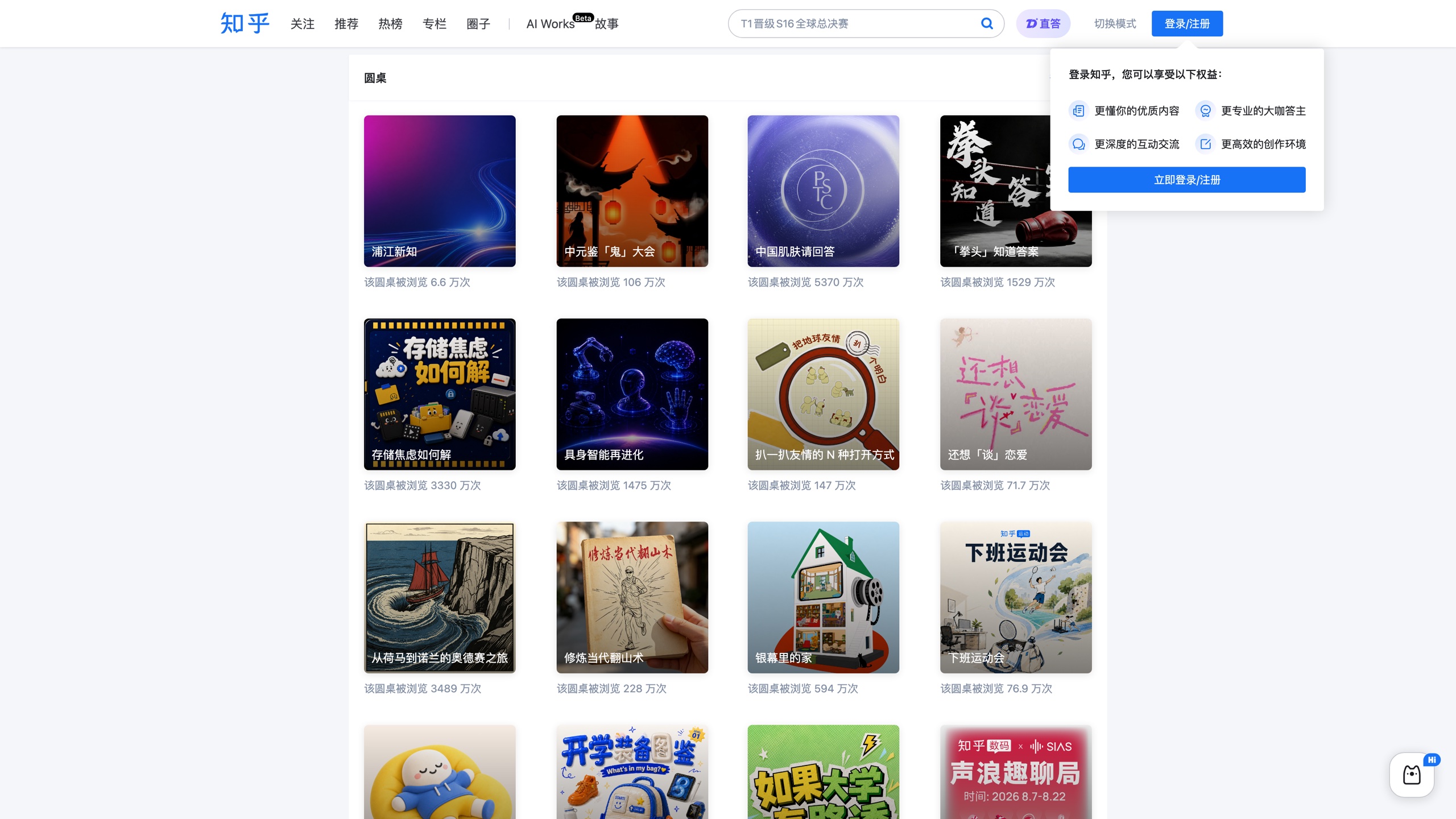
Q&A is Zhihu's basic unit of organization: a question page aggregates answers from many users, ranked by community signals such as upvotes and comments, while the question text itself can be edited collaboratively. Around that core sit columns for long-form articles, xiangfa for short posts, circles for interest-based groups, and roundtables — curated, time-boxed discussion events on a single theme. Roundtables have a public listing page showing view counts for each event (for example, a skincare roundtable displayed 53.7 million views), readable without an account.
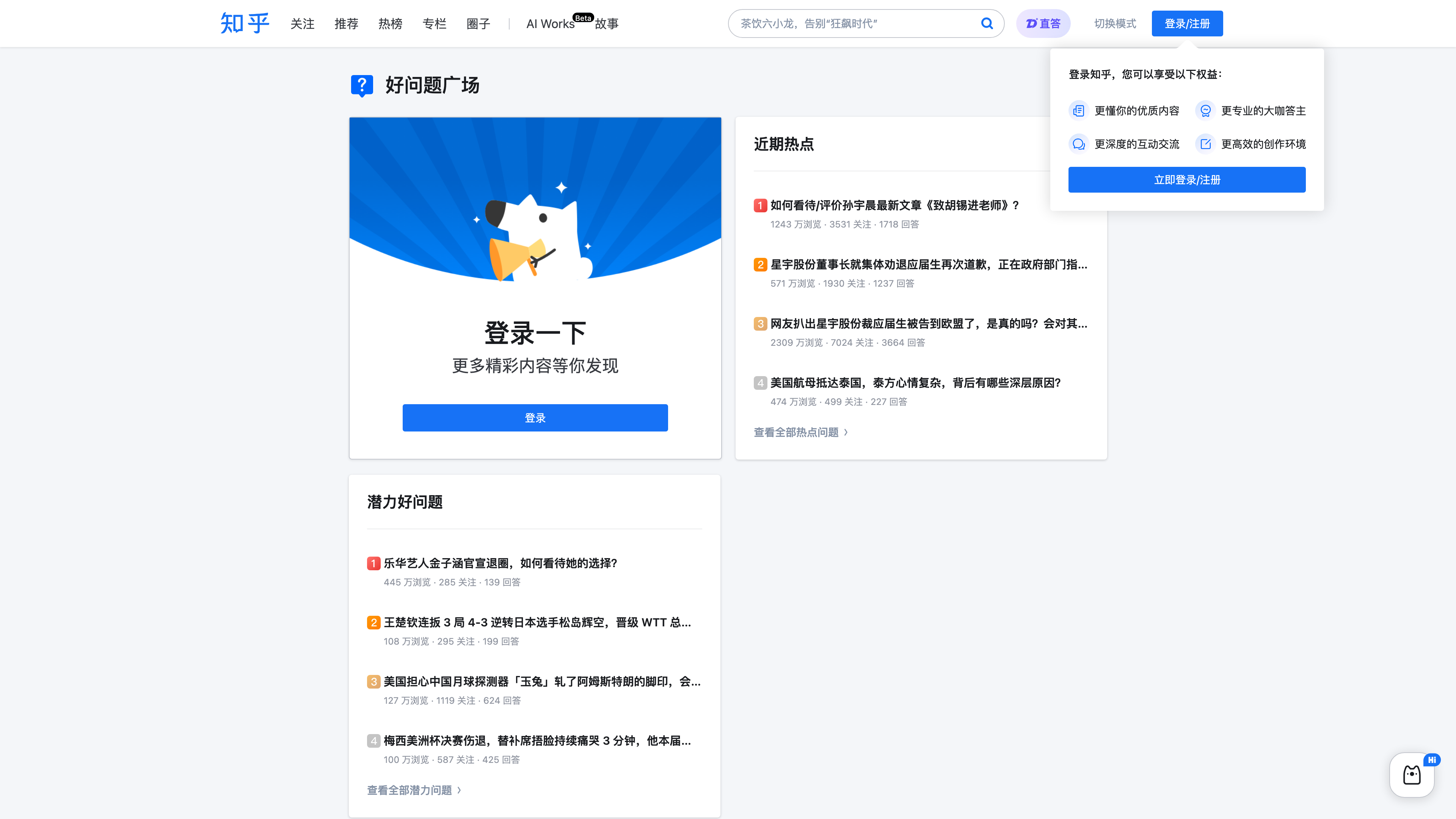
Distribution runs through a follow feed, a recommendation feed and a hot list. For anonymous visitors, the Explore page is the main public window: it surfaces trending and up-and-coming questions with answer previews, while persistently nudging the visitor to sign in.
For creators, Zhihu runs an incentive system built around a creator score and traffic tilt (the "Haiyan Plan"), a creator fund announced in 2022 with an initial pool of nearly RMB 100 million (the "Zhizhi Plan"), a commercial-collaboration marketplace and revenue sharing from the membership program (China.com.cn report, in Chinese). The company says the number of honorary certified creators grew 9.8% year-over-year in the first half of 2026 (CNR, same report).
Paid content: Yanxuan membership, Live and paid consultation
Zhihu's paid product line has been consolidated several times: the real-time audio Q&A product Zhihu Live launched in 2016; in March 2018 the company folded its earlier paid products into a single membership, which was upgraded to the "Yanxuan" (Salt Select) membership in March 2019; a higher "Super Yanxuan" tier followed in September 2022 (Sina Finance, in Chinese). The membership's core benefit is a library of paid columns and serialized stories; story content is now carried by a separate "Yanyan Story" app, whose IP has also been adapted into short dramas (seven released by the end of Q2 2026, per CNR). Pricing is app-centric: CNY 19/month on auto-renewal, CNY 25 for a single month, CNY 53 per quarter (App Store, as of 2026-09-03). Visiting /vip on the web simply redirects to an open-in-app page. Starting in Q1 2026, membership revenue is reported together with IP operations as "paid content and IP operations" — 61.7% of total revenue in Q2 2026, the company's largest income stream (Q2 2026 results).
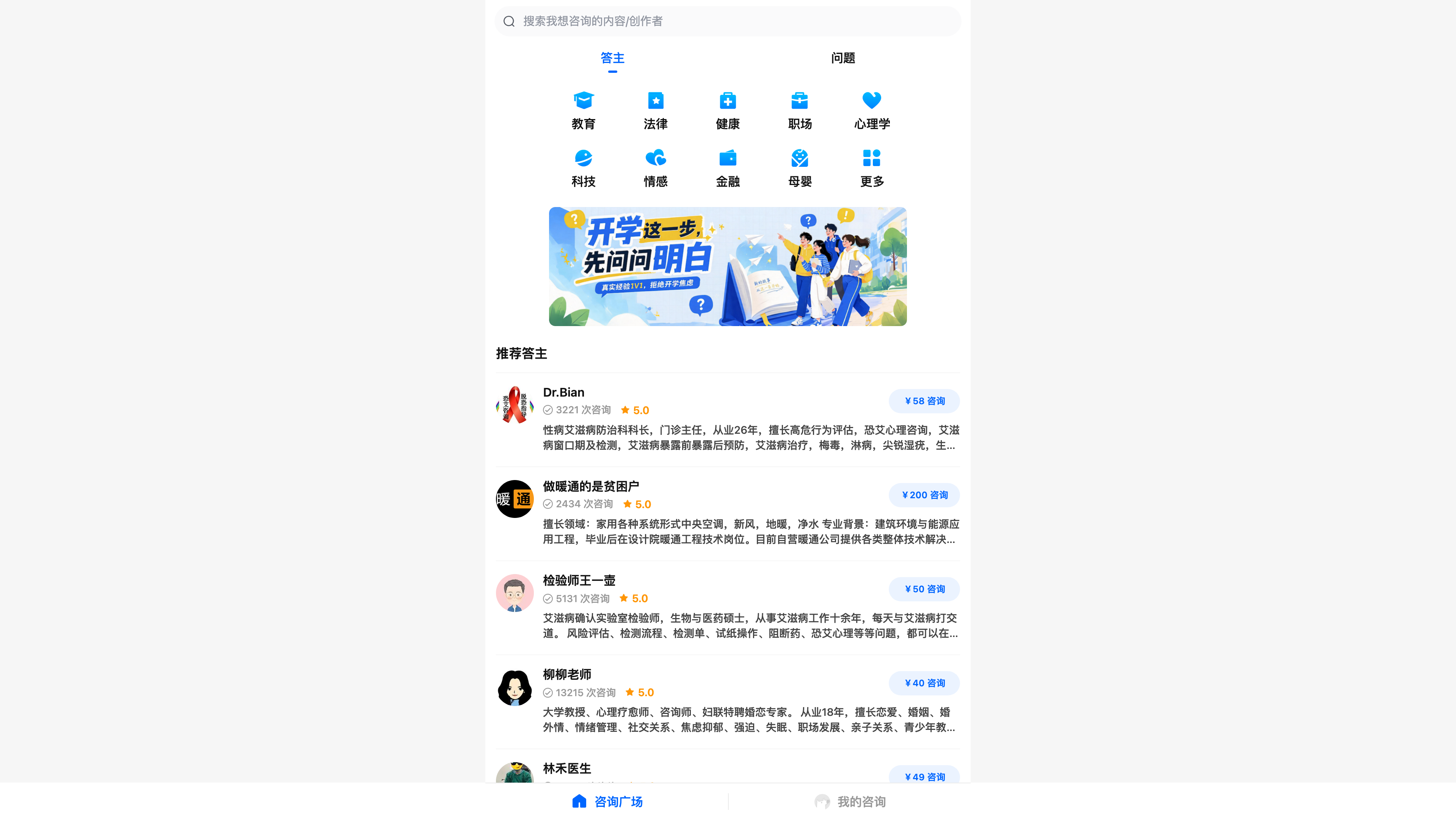
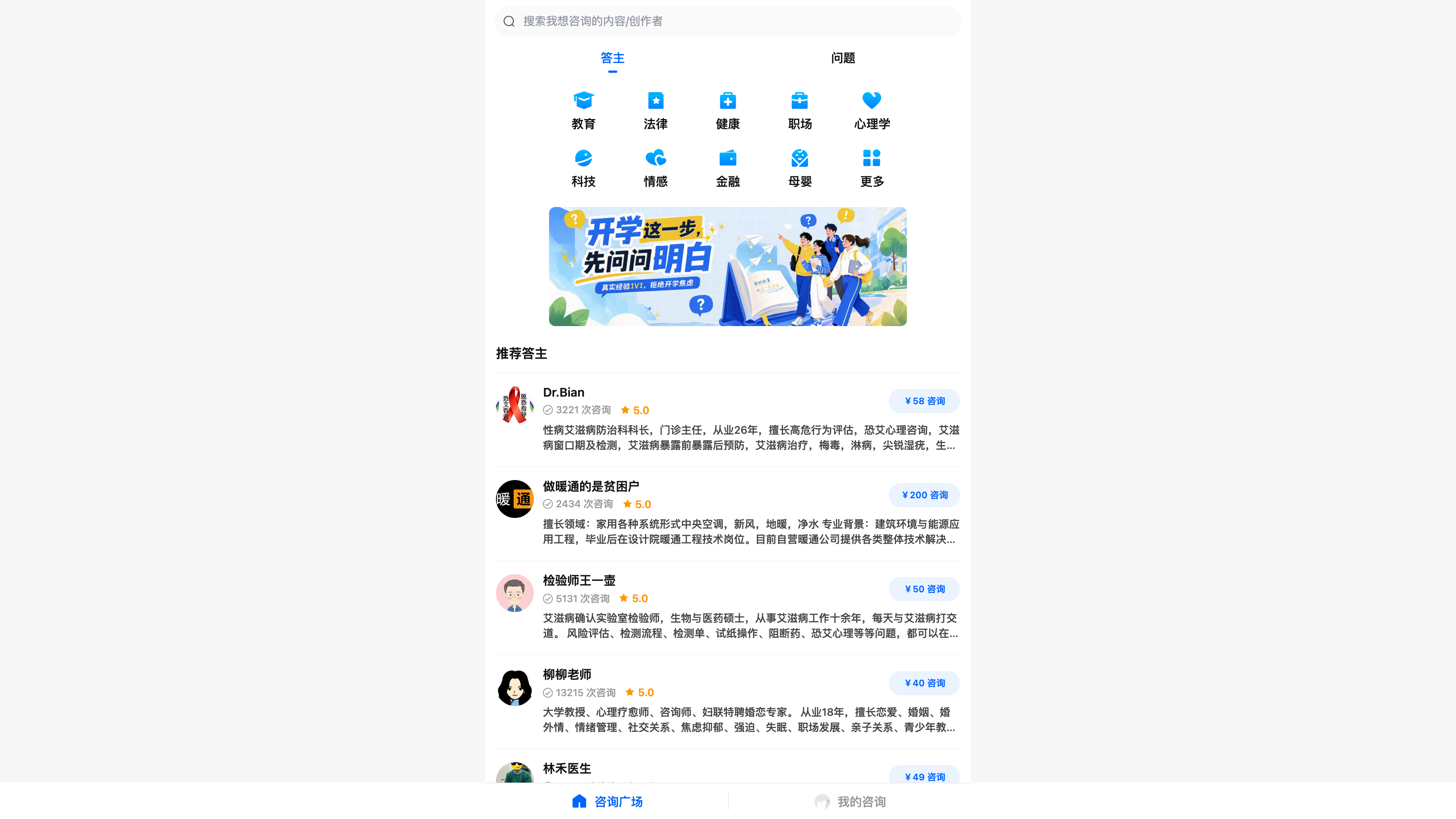
Zhihu Live and paid consultation are still operating with public pages. The paid consultation page is readable without an account: answerers are listed by category (education, law, health, careers, psychology, technology and more) with their consultation counts, ratings and per-question prices (observed range CNY 40–200). It is effectively one-on-one paid Q&A.
AI features: Zhihu Zhida and AI Kanshan
Zhihu released its self-developed large language model "Zhihaitu AI" in 2023, then launched a standalone AI search product, Zhihu Zhida ("Zhihu Direct Answer"), on June 29, 2024. Zhida generates cited answers grounded primarily in the community's content and added DeepSeek-R1 integration in February 2025 (Sina Finance, The Paper, in Chinese). Per the Zhihu terms, Zhida retrieves community content, licensed partner content, public web content and material users upload to a personal knowledge base; the same terms caution that its output is AI-generated, may contain errors and does not constitute professional advice. Note that the web version of Zhida (zhida.zhihu.com) required sign-in when tested on 2026-09-03.
The Zhihu app also includes "AI Kanshan", an assistant for summarizing long posts and extracting key points (per the App Store description). For developers, an "AI Works" project square (in beta) hosts over 2,600 AI projects, a data open platform reports more than 17,600 connected developers, and the company has released an agent tool called Zhihu CLI (CNR, as of 2026-09-03).
Accounts and platform access
Registration is phone-number based (defaulting to mainland China's +86 code), and publishing content additionally requires real-identity verification under Chinese regulations. The terms state that some basic features work without an account, but not the full experience, and that accounts inactive for six consecutive months may be frozen or reclaimed.
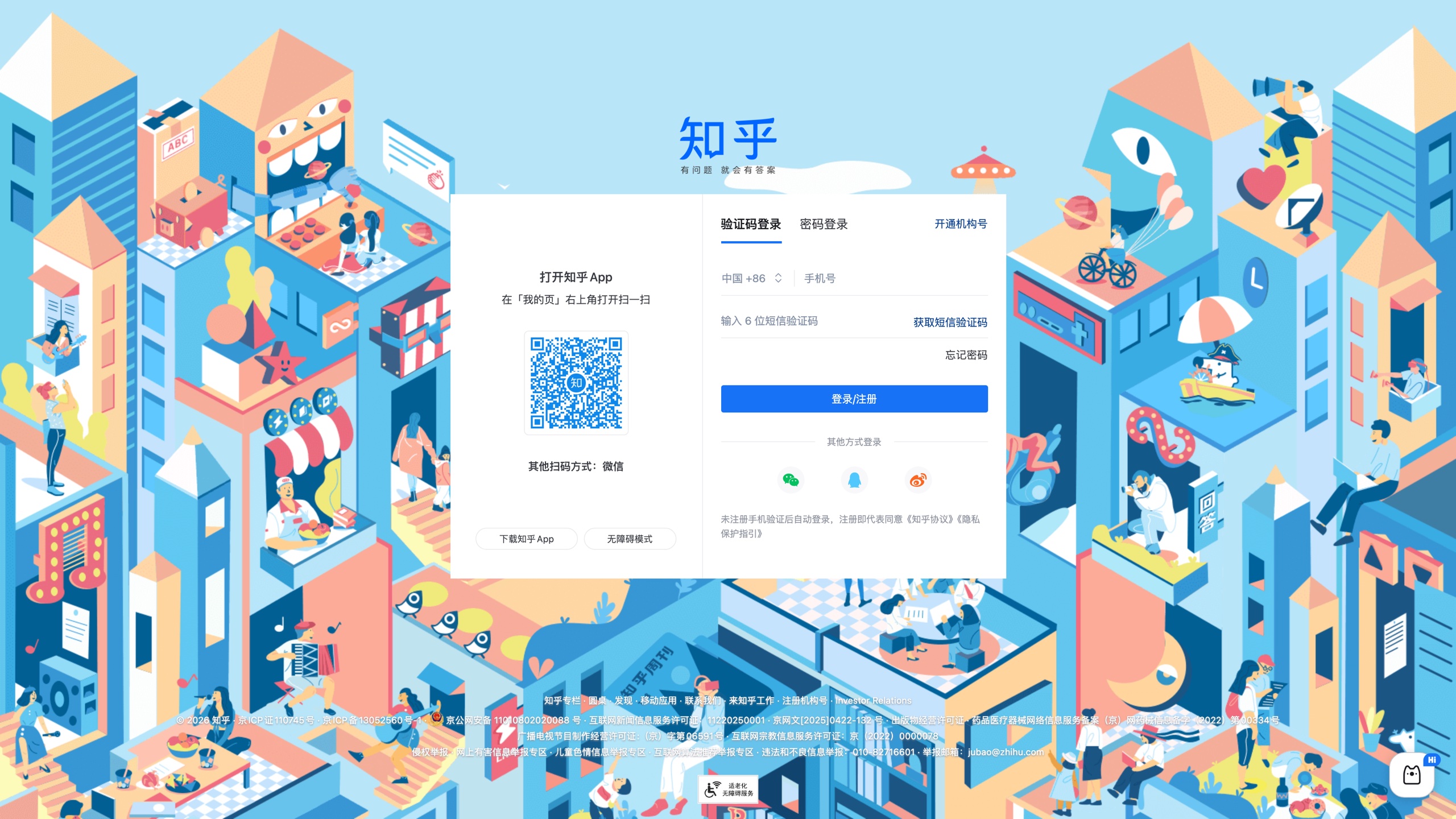
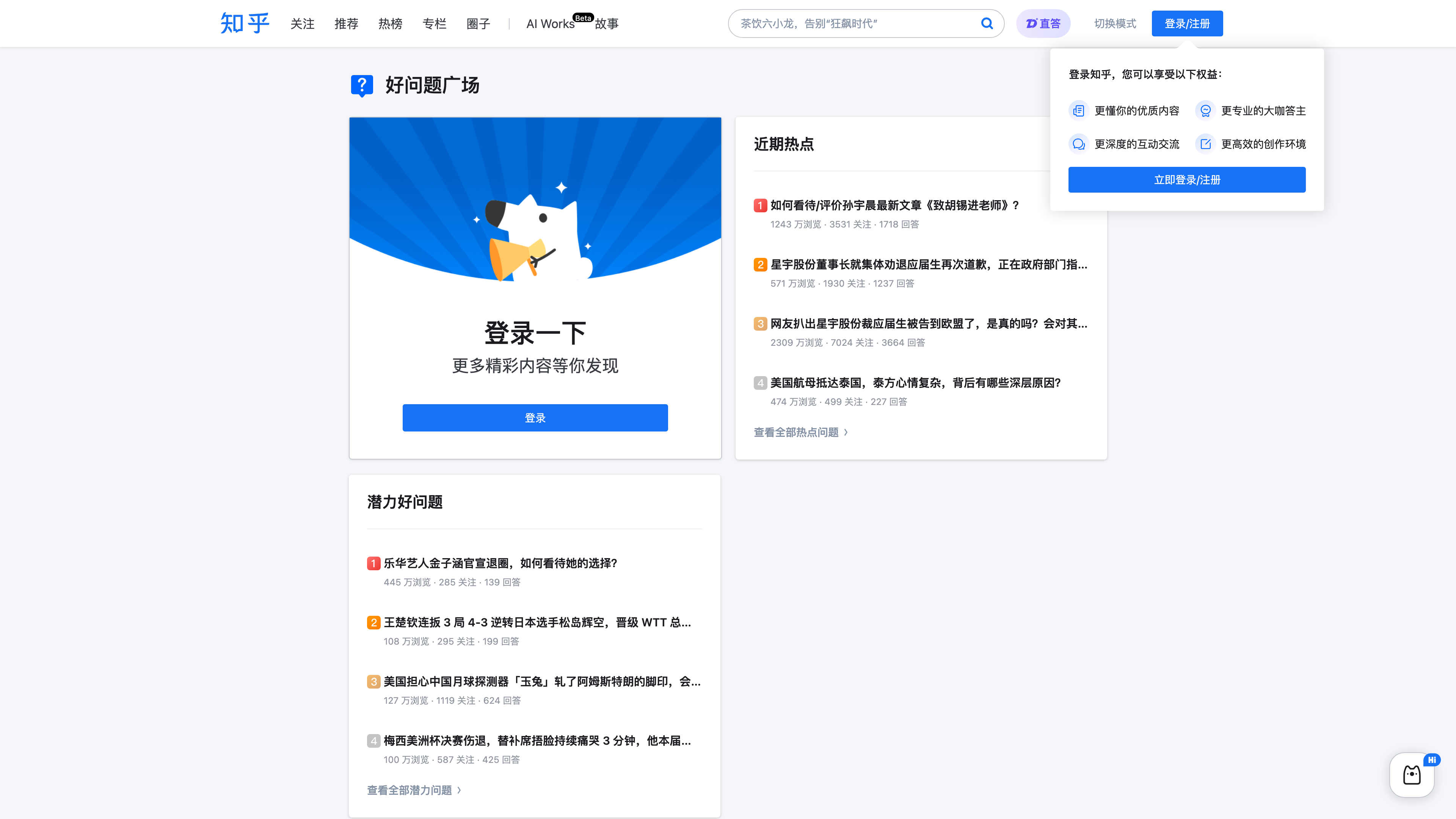
What an anonymous visitor can actually read (desktop web, tested 2026-09-03): the Explore page, the roundtable listing, paid consultation, Zhihu Live and the legal/terms pages all load directly. The homepage feed and the hot list, however, redirect to a sign-in/registration page — opening zhihu.com without an account presents the sign-in wall shown below.
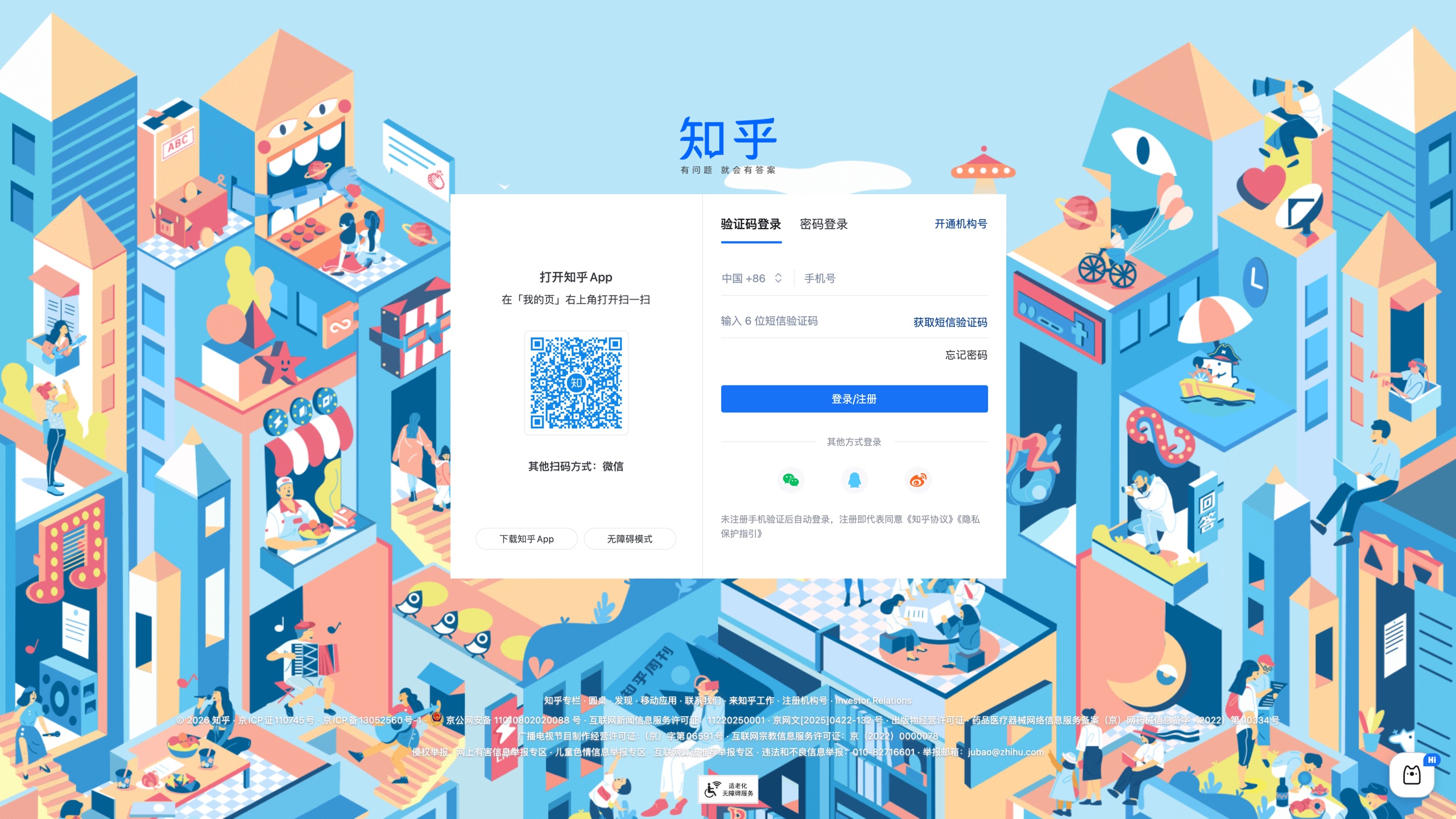
Individual question pages and column articles could not be verified from our test environment, where Zhihu's risk control returned HTTP 403 with an "abnormal request" notice. For context, press reports say Zhihu required sign-in to read full answers from May 2024 and removed that restriction in February 2025 (Sina Finance, in Chinese); the practical scope of anonymous reading may shift with the platform's risk-control policy.
There is no public read API. The developer-facing options are the data open platform and Zhihu CLI mentioned above, both requiring approval. The terms explicitly prohibit unauthorized scraping and forbid using site content to train large language models or other AI systems.
Copyright and content policy
Under the terms, users keep the copyright of their original content (answers, articles, thoughts, comments, columns, podcasts) and may license it to third parties themselves; in return, users grant Zhihu a worldwide, royalty-free, perpetual, irrevocable, non-exclusive, transferable and sublicensable license to that content. Collaboratively edited material such as question text and topic descriptions belongs to Zhihu. Republishing content outside the platform requires separate permission from the original author, with the author, the original link and "published on Zhihu" credited prominently at the top.
For moderation, the terms enumerate categories of illegal content and "undesirable information", and require AI-generated synthetic content to be clearly labeled; more detailed rules live in the official Community Norms and a "community rules center" column. A teen mode filters content for minors, and the App Store age rating is 16+. On the regulatory record: in December 2021 the Beijing cyberspace regulator summoned Zhihu and opened an administrative-penalty case over repeatedly hosting prohibited information (People's Daily Online, in Chinese), and in March 2022 an affiliate was fined RMB 30,000 after Yanxuan membership promotions in the app's hot-search list were not labeled as advertising (report citing the penalty decision, in Chinese).
Good for
- Finding Chinese-language experiential and opinionated answers — career planning, graduate-school applications, gadget reviews, home renovation — where Zhihu's density of long-form answers is hard to match in Chinese.
- Following multi-perspective discussion of trending events through the hot list and roundtables (sign-in required).
- Asking a specific expert a one-off question for a small fee via paid consultation.
- Reading paid columns and serialized fiction through the Yanxuan membership (primarily on mobile).
- Getting AI answers grounded in community content via Zhihu Zhida (sign-in required).
Limitations
- Restricted anonymous browsing: the homepage and hot list redirect to a sign-in wall, and Zhihu Zhida requires an account; how much of a question page an anonymous visitor can read depends on risk-control policy (test results above). Signing up is effectively a prerequisite for serious use.
- Uneven answer quality: the terms explicitly state that Zhihu does not guarantee the correctness of answers or comments. Soft marketing is mixed into answers and hot-search positions — the platform has been penalized over ad labeling — so readers should treat promotional content with care.
- Heavy paywall mix: paid content and IP operations now exceed 60% of revenue (Q2 2026 results), and many columns and stories are members-only. Observers have also noted a tilt toward web-fiction-style content that dilutes the original knowledge-Q&A positioning (Tencent News, in Chinese).
- App-centric purchasing: the web version does not even display membership prices; purchases and member benefits live on mobile.
- Privacy trade-offs: the App Store privacy label lists data types used for cross-app and cross-website tracking (location, identifiers, usage data, as of 2026-09-03).
- Simplified Chinese only: the interface and content ecosystem serve Chinese readers; there is no multilingual UI.
Alternatives
- Quora: the English-language Q&A community that inspired Zhihu (per The Paper's report) — a useful reference point for how the two ecosystems diverged.
- Douban (also catalogued on this site): a Chinese UGC interest community built around book/film/music entries and groups, with a different approach to community governance and monetization.
- Stack Overflow (also catalogued): a professional Q&A community for programming, showing how the Q&A format works in a vertical domain.
- Perplexity (also catalogued): an AI answer engine in the same "AI gives the answer directly" category as Zhihu Zhida, useful for comparing citation practices.
References
- Zhihu homepage (checked 2026-09-03)
- Zhihu Terms of Service (checked 2026-09-03)
- Zhihu Privacy Policy (checked 2026-09-03)
- Investor Relations | Zhihu (checked 2026-09-03)
- Zhihu Inc. Reports Unaudited Second Quarter 2026 Financial Results (checked 2026-09-03)
- Zhihu Inc. Reports Unaudited Fourth Quarter and Fiscal Year 2025 Financial Results (checked 2026-09-03)
- Zhihu Inc. Announces Pricing of Global Offering (checked 2026-09-03)
- Zhihu 424(b)(4) prospectus (SEC) (checked 2026-09-03)
- Zhihu's steady Q2 2026 and AI unlocking content-asset value - CNR (checked 2026-09-03)
- When a knowledge Q&A community meets the profitability question - ifeng (checked 2026-09-03)
- Yuan Zhou's "balancing act" - Jiemian (checked 2026-09-03)
- China's Quora goes public: Zhihu's ten-year monetization road - The Paper (checked 2026-09-03)
- Zhihu app - App Store (checked 2026-09-03)
- Zhihu removes the no-login-no-full-text restriction - Sina Finance (checked 2026-09-03)
- Zhihu launches AI search with licensed paper database - Sina Finance (checked 2026-09-03)
- Zhihu launches Super Yanxuan membership - Sina Finance (checked 2026-09-03)
- Beijing cyberspace regulator summons and penalizes Zhihu - People's Daily Online (checked 2026-09-03)
- Zhihu Q3 2023 results report - Caixin (checked 2026-09-03)