Zed (zed.dev) is an open-source code editor from Zed Industries, written from scratch in Rust with GPU-accelerated rendering and built around three pillars: speed, real-time collaboration with teammates, and collaboration with AI agents. Two things set it apart in verifiable terms. First, its entire self-built stack — the GPUI GPU-accelerated UI framework, Tree-sitter parsing, CRDT buffers — is public on GitHub rather than wrapped around Electron. Second, its AI layer is open instead of model-bound: you can use Zed-hosted models (subscription), your own API keys, local models, or external agents like Claude Agent and Codex CLI over an open protocol — or turn AI off entirely. The editor itself is free; you only pay for hosted AI and team controls. Since the 1.0 release in April 2026, macOS, Linux, and Windows have feature parity, making it a credible candidate for developers who care about both editor latency and AI optionality.
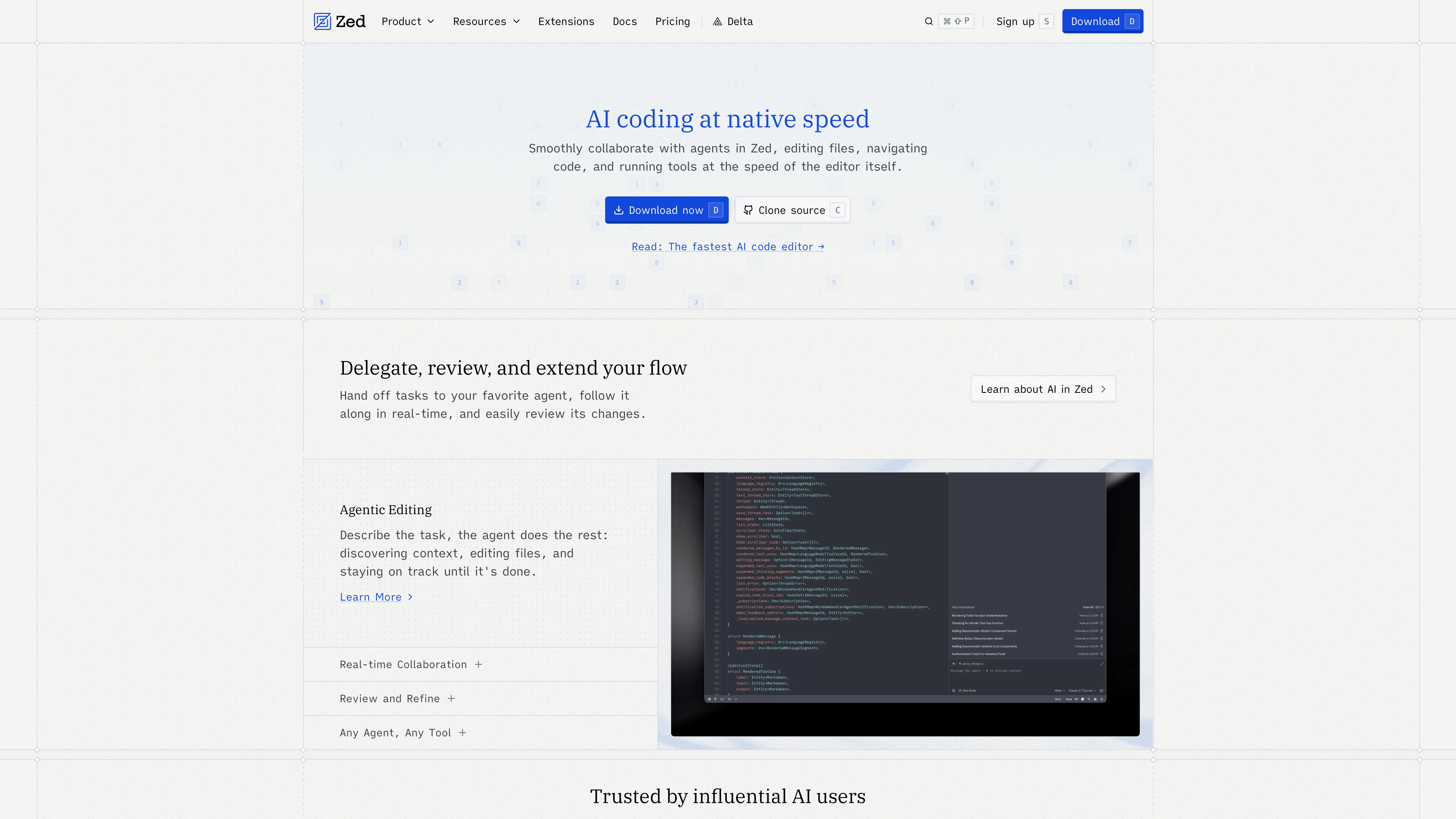
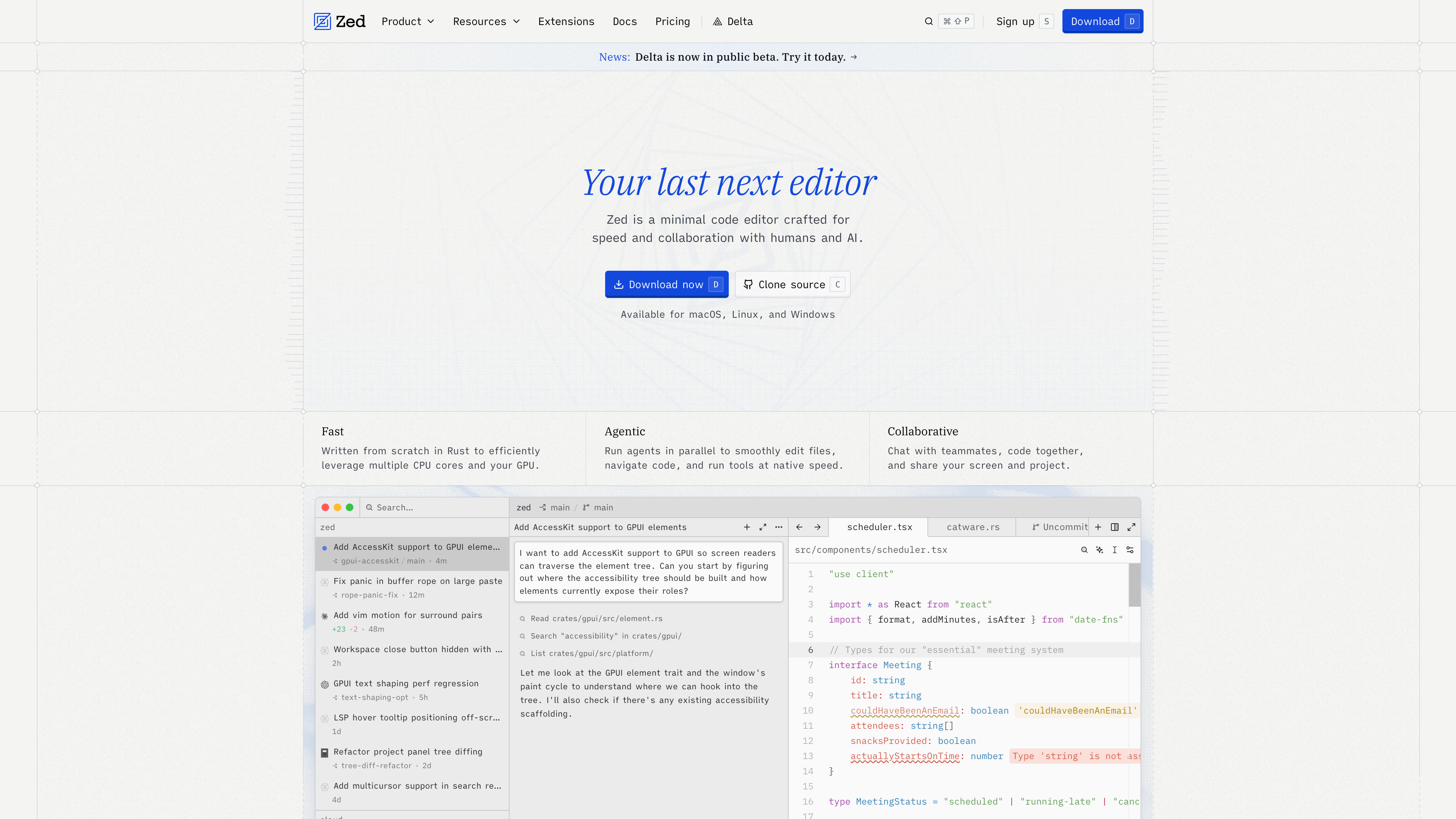
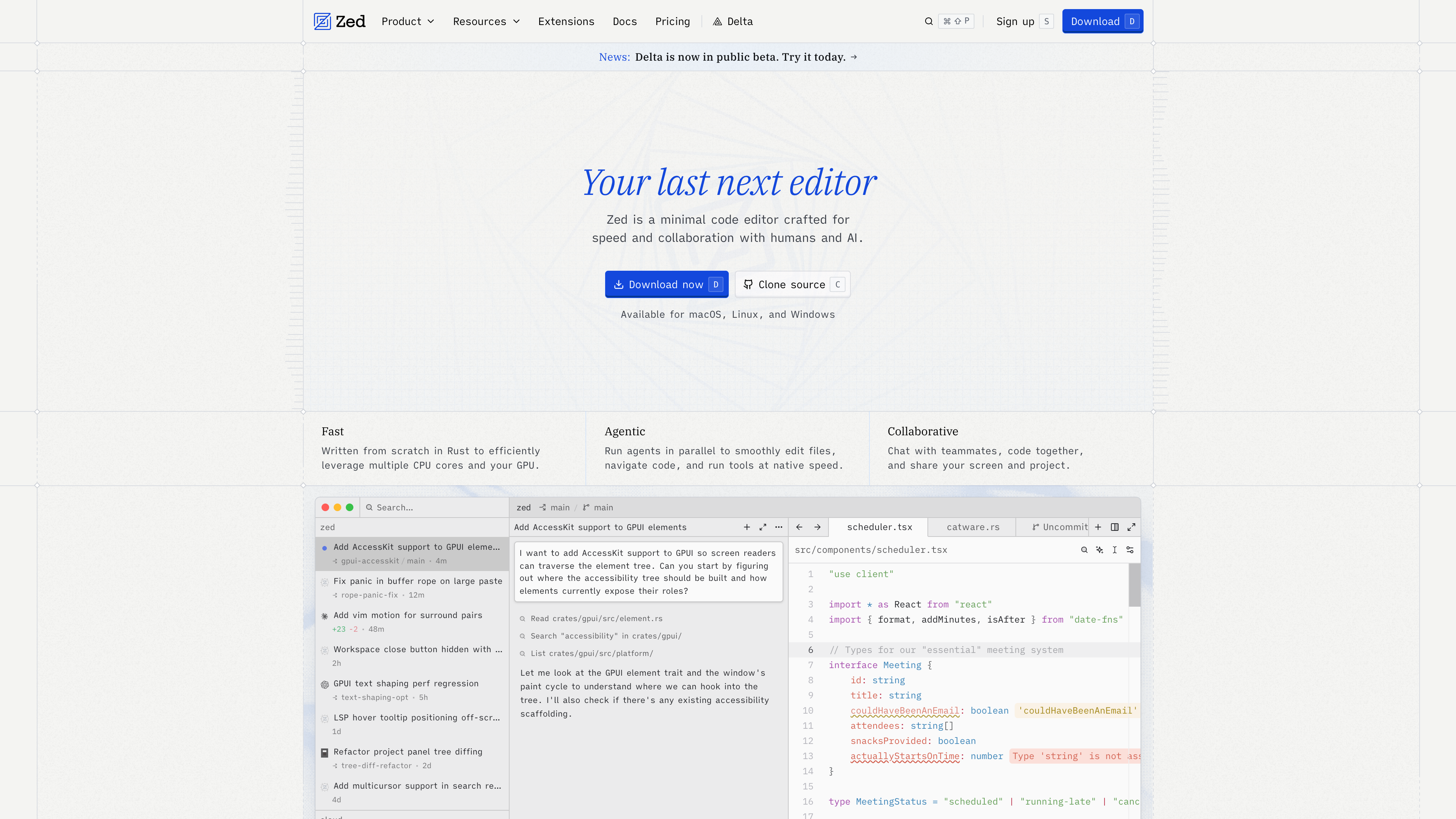
The screenshot below is the homepage: the tagline "Your last next editor" sits above the three pillars — Fast (Rust, multiple cores + GPU), Agentic (run agents in parallel), and Collaborative (chat, pair, share your screen) — followed by a live product mock:
At a Glance
- URL: https://zed.dev/
- Type: Open-source desktop code editor (Rust, GPU-accelerated) with built-in multiplayer collaboration and AI
- Pricing: Editor is free and open source; Pro 30/seat/month (org-level controls); 14-day Pro trial, no credit card required. As of 2026-09-19, see the official pricing page
- Account: The editor itself needs no sign-in; collaboration features and Zed-hosted AI require an account (collaboration docs)
- Platforms: macOS 10.15+ (screen sharing in collaboration needs macOS 12+), Linux (x86_64/aarch64, Vulkan 1.3 driver required), Windows 10 1903+/11 (DirectX 11 GPU required); FreeBSD can be built from source; no web or mobile version (installation docs)
- UI language: English only, with no official localization options (Wikipedia lists "Available in: English", consistent with our observation)
- License: Editor GPL-3.0-or-later, server components AGPL, GPUI framework Apache-2.0; the GitHub repo has 90.5k stars and 10.7k forks (GitHub, as of 2026-09-19)
Background
Zed Industries was founded in 2021 by Nathan Sobo, Antonio Scandurra, and Max Brunsfeld, who previously built the "hackable" Atom editor, the Electron desktop app framework, and the Tree-sitter incremental parsing framework at GitHub (About page, The New Stack). Zed is what the same team built after leaving the Electron approach behind and rewriting an editor in Rust. Key milestones:
- March 15, 2023: Public beta (official blog); the same month brought a 12.5M (FinSMEs).
- January 24, 2024: The project went fully open source — GPL for the editor, AGPL for server components, Apache-2.0 for GPUI (official blog, Phoronix).
- July 2024: Official Linux builds (official blog, The Register).
- August 2024: Zed AI, a hosted service built in collaboration with Anthropic around Claude (official blog).
- August 20, 2025: A 42M; the same post introduced DeltaDB, a planned version-control layer that tracks code evolution at operation-level granularity (official blog, Business Wire).
- October 15, 2025: Stable Windows release (official blog).
- April 29, 2026: Zed 1.0 — described by the team as the point where "most developers can feel quickly at home," with the three platforms reaching feature parity for the first time (Phoronix, heise).
- August 12, 2026: Private beta of Delta, a standalone DeltaDB-based app for multiplayer coding with agents, with Claude Code as the first third-party agent integration (official blog); as of 2026-09-19, the homepage banner says Delta is now in public beta (homepage observation).
The project ships weekly: as of 2026-09-19, the latest stable build is v1.20.2, released on 2026-09-17 (GitHub Releases).
Core Capabilities
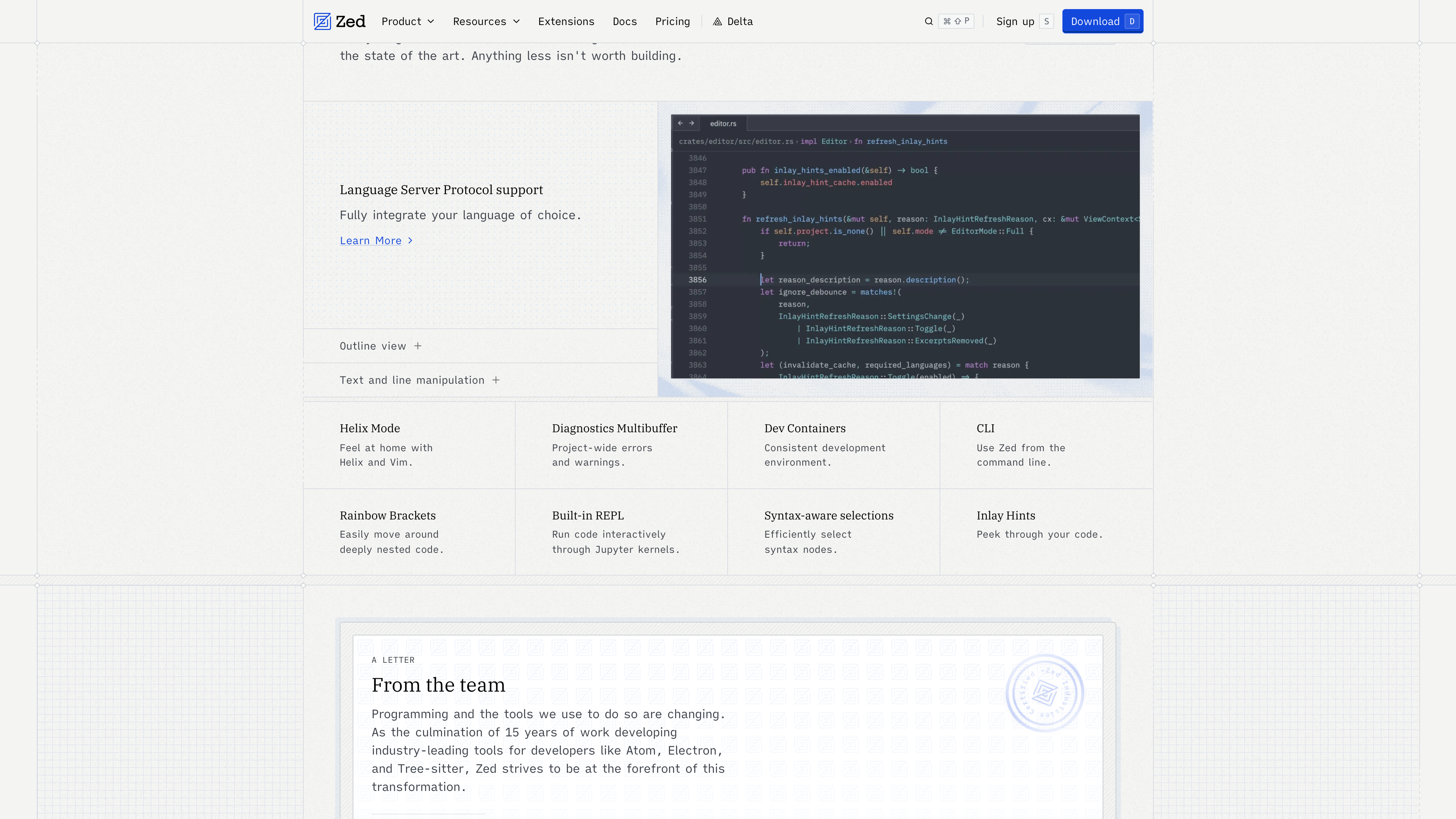
Editor fundamentals. Zed covers the full checklist of a modern editor: LSP language servers, Tree-sitter parsing, multibuffer editing, project-wide diagnostics, an integrated terminal, a debugger, Git integration, SSH remote development (your machine runs only the UI while the codebase lives on a remote server), Dev Containers, tasks, a built-in REPL on Jupyter kernels, and first-class Vim and Helix modes. Performance is the headline claim: the team targets input and cursor movement landing on the next display refresh (About page), and in practice that means fast startup and smooth large files — a point echoed by third-party developers quoted on the homepage, including Elixir creator José Valim, React core team member Dan Abramov, and D3 creator Mike Bostock.
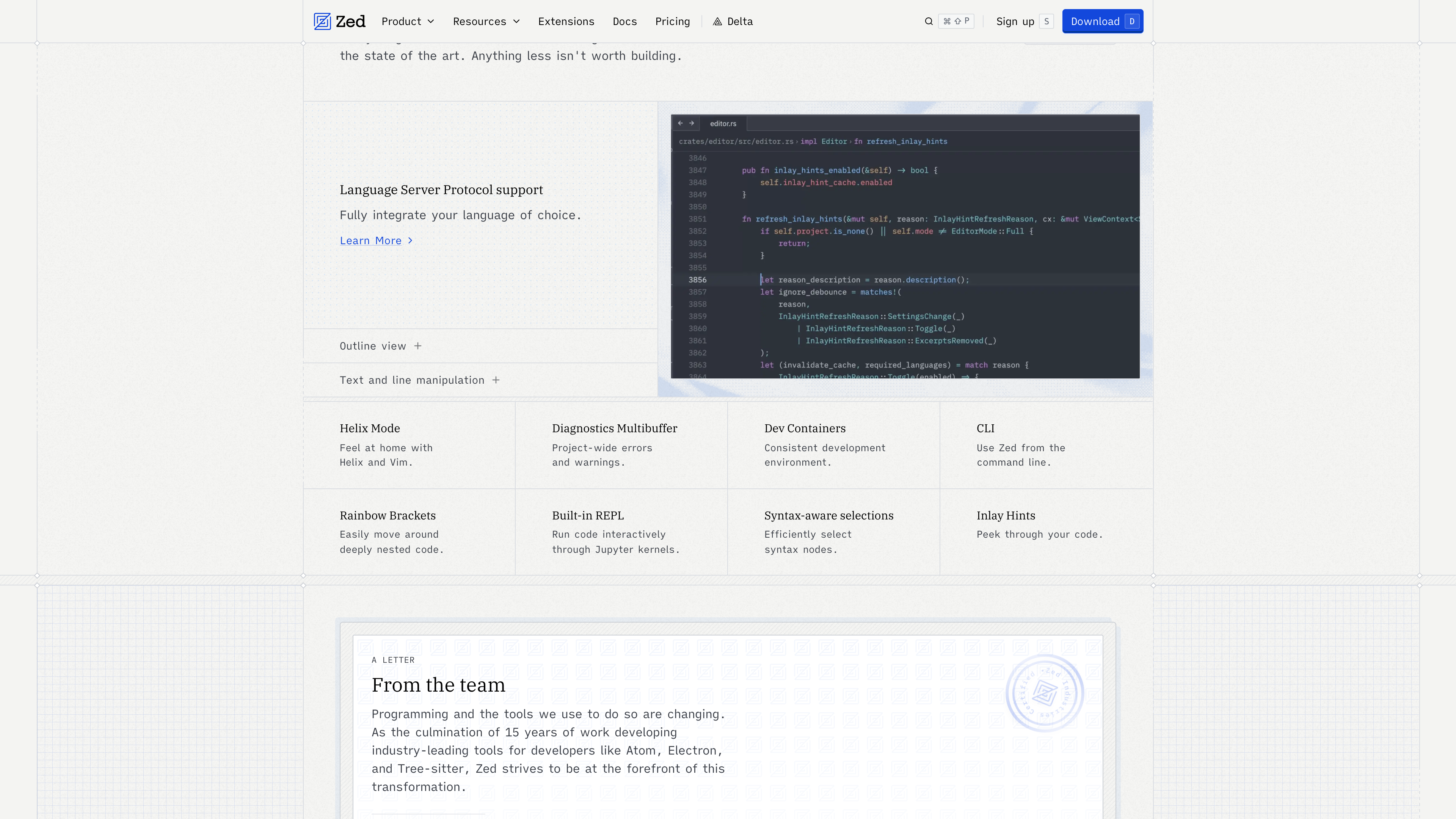
The screenshot above shows the "Built with ultimate care" feature grid and an LSP demo on the homepage.
AI as an open layer, not a bundled model. The Agent Panel turns agent sessions into threads inside the editor — you can run agents in parallel, follow their edits in real time, and review the diffs (AI page). An inline assistant (Cmd/Ctrl+Enter) handles in-place rewrites, and edit predictions come from Zeta, Zed's own model, which the company describes as open-weight and open-data, predicting your next edit at keystroke granularity. Model sourcing is entirely up to you: Zed-hosted models (including Claude and GPT families), your own API keys (Amazon Bedrock, Anthropic, GitHub Copilot, DeepSeek, Google AI, LM Studio, Mistral, Ollama, OpenAI, OpenRouter, Vercel, and more), local models via Ollama or LM Studio, or external agents such as Claude Agent and Codex CLI over ACP (Agent Client Protocol), an open protocol Zed initiated. If you want no AI at all, a single setting disables every AI feature (pricing FAQ).
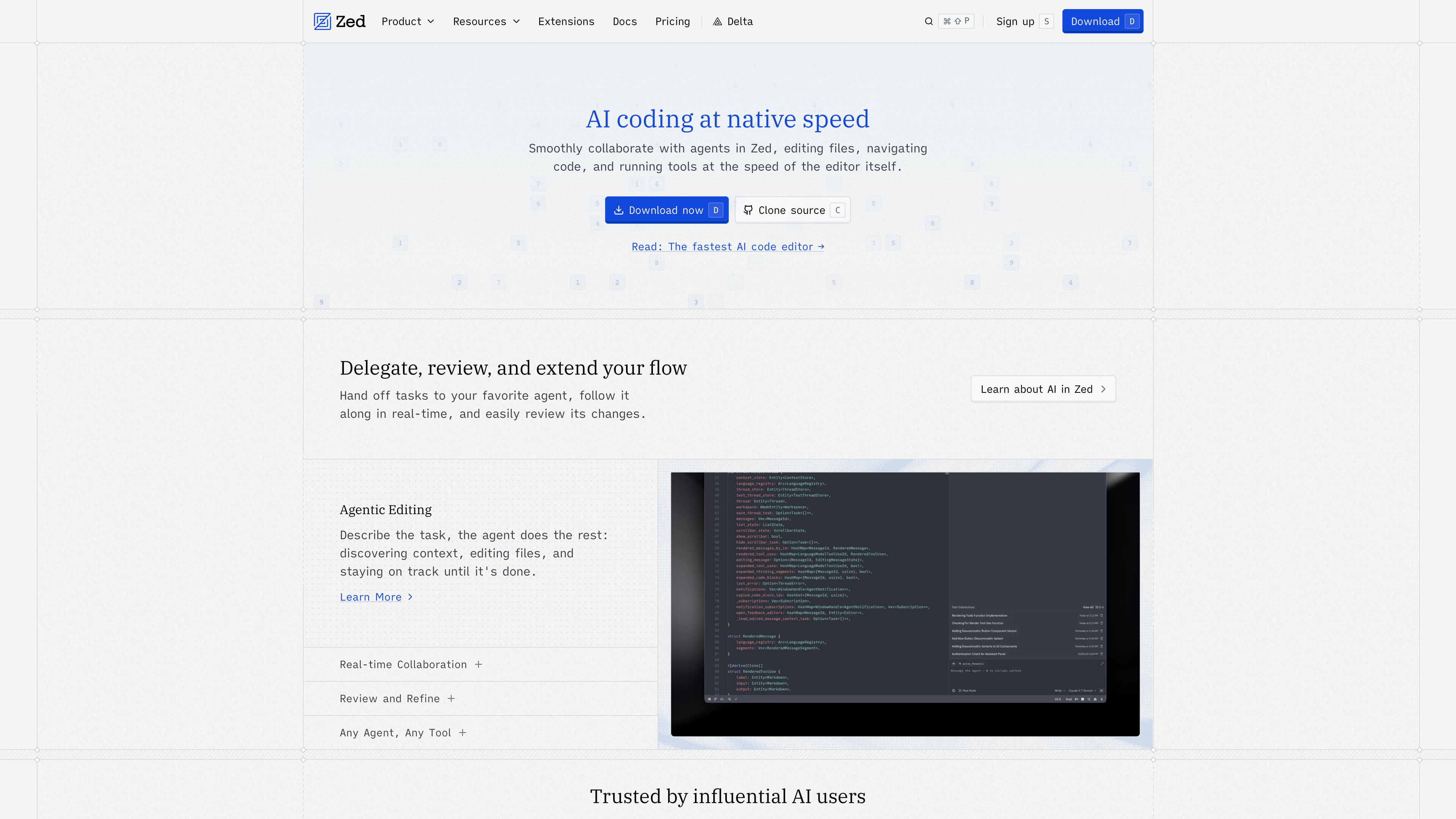
Multiplayer collaboration. Collaboration has been built in since day one: multiple people edit the same project in real time, seeing each other's cursors and edits. Channels are persistent project rooms with voice chat, alongside a contacts list, private calls, and screen sharing (collaboration docs). These features require sign-in, and the documentation warns explicitly: sharing a project gives collaborators access to your local file system within that project — only collaborate with people you trust.
Extensions. Extensions are WebAssembly-based and cover language support, themes, and icons. As of 2026-09-19, top registry entries like the HTML extension show ~6.8M downloads (extensions page, observation). The total catalog is on the order of a thousand — The Register counted about 1,000 extensions in May 2026 (report) — see Limitations.
Pricing and Accounts
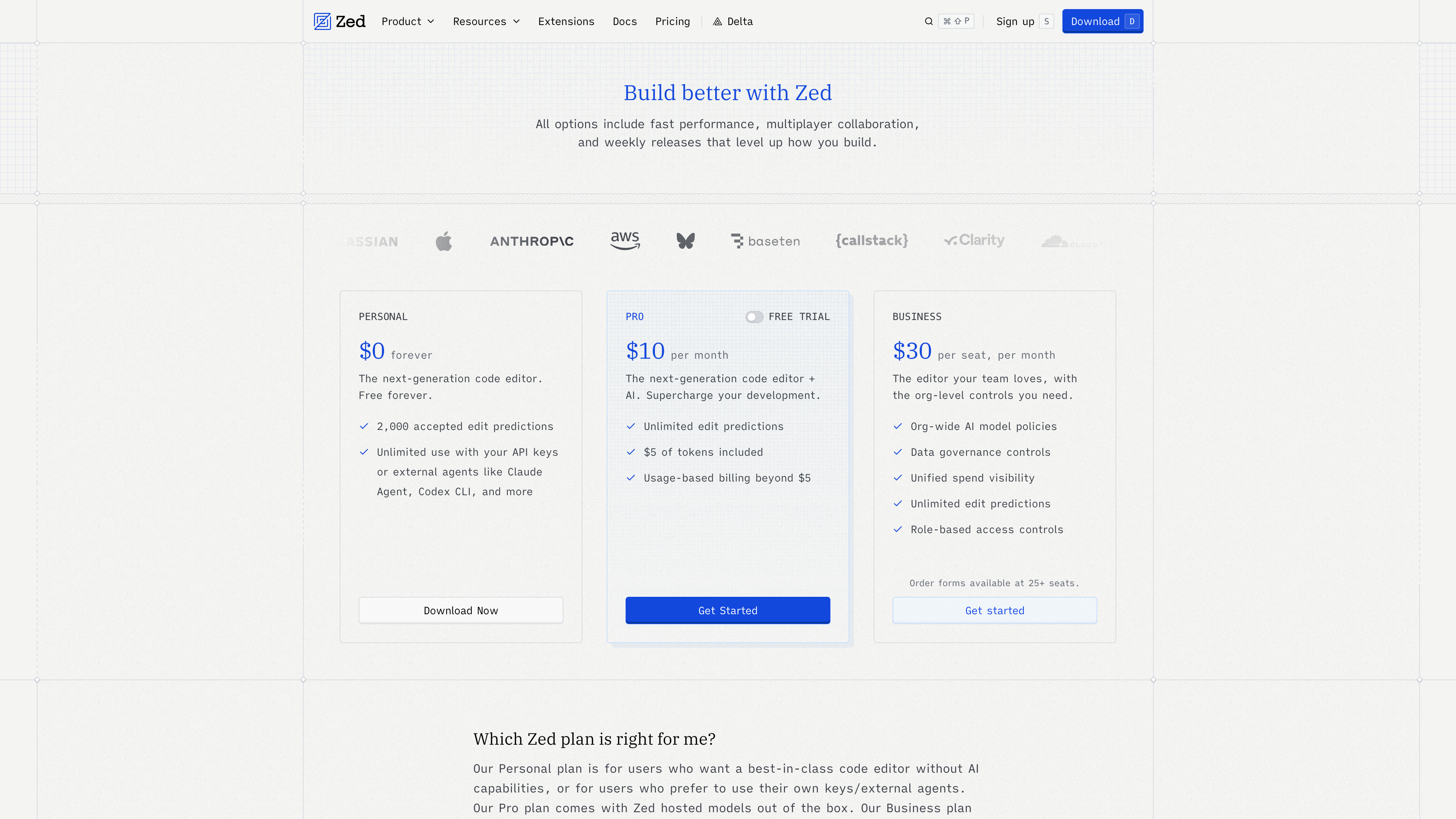
The screenshot below is the official pricing page as of 2026-09-19, with three tiers:
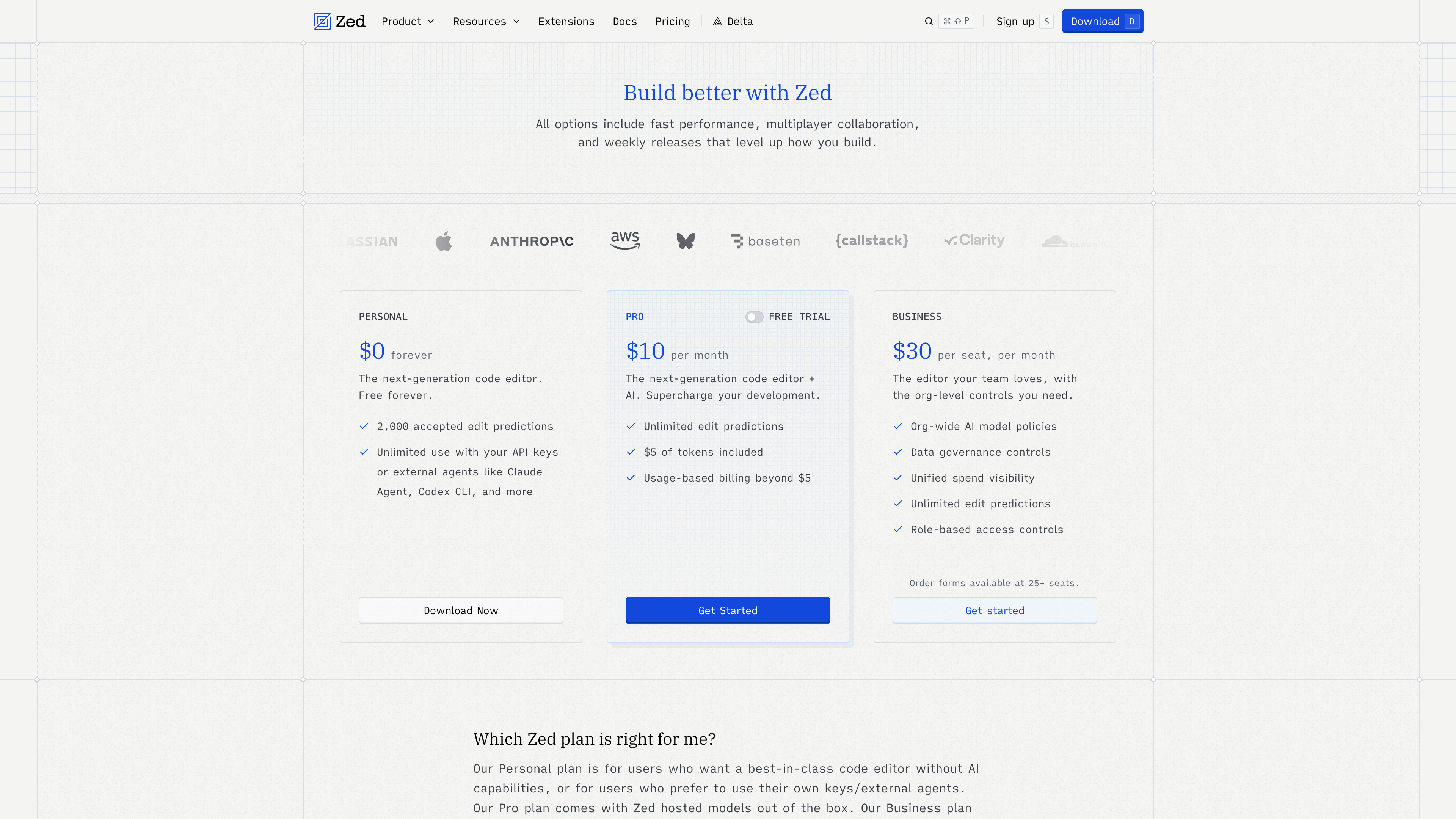
- Personal ($0, forever): The full editor plus 2,000 accepted edit predictions per month; AI usage with your own API keys or external agents is not metered by Zed.
- Pro ($10/month): Unlimited edit predictions plus Zed-hosted models out of the box; includes 10 accrues.
- Business ($30/seat/month): Org-level controls — restrict or disable hosted models per model, turn off edit predictions org-wide, lock data-sharing settings, unified billing, and role-based access controls; order-form contracts at 25+ seats; no bundled AI credits; SSO/SAML/SCIM are listed as planned but not currently available.
New users get a 14-day Pro trial with $5 of GPT-5.6 Luna usage and unlimited accepted edit predictions, no credit card required; the trial balance is shared between Zed and Delta. GitHub Sponsors is accepted as pure support — the company states it comes with no paid features or perks.
Accounts are only needed for collaboration and Zed-hosted AI; the editor runs fine without one. That boundary defines the business model: what is sold is hosted services, while the editor itself stays open source under the GPL family of licenses.
Privacy and AI Data
The official AI Privacy & Security doc (checked 2026-09-19) makes commitments that can be summarized as:
- No retention by default: Zed does not retain your prompts or code context, and hosted-model providers are bound by no-training and zero-data-retention agreements for inference requests.
- Safety-retention exception: Anthropic's designated Covered Models (such as Claude Fable 5) require at least 30 days of provider-side retention for trust and safety on every platform where they are offered; Zed cannot opt out, and switching to your own API key does not bypass it. If that matters to you, choose a non-designated model.
- Collected only when you opt in: Conversation feedback ratings and edit-prediction training data require explicit opt-in — the latter only for open-source projects with excludable files; telemetry can be disabled in settings.
- With your own keys, local models, or external agents, data handling is governed by the respective provider's terms; Zed does not sit in the model request path.
Who It's For
- Developers who put editor responsiveness first: If Electron-class input latency bothers you or you routinely work in large files and large repos, Zed's native Rust stack is aimed squarely at that pain.
- Teams that pair remotely: Built-in real-time collaboration, voice, and screen sharing suit teams that debug and review together often, without a separate "video call + screen share" setup.
- People who want AI without lock-in: Switch freely among hosted models, your own keys, local models, and external agents — or disable AI entirely. Teams with compliance constraints can combine this with Business-tier org controls.
- Vim/Helix users and open-source contributors: First-class modal editing, a GPL-family license, and a Rust codebase make reading the source or sending PRs relatively approachable.
- Observers of what comes next: DeltaDB/Delta is an experiment in recording conversations and code on the same timeline — worth tracking if you follow how version control evolves in the agent era.
Limitations
- A much smaller extension ecosystem: About 1,000 extensions as of May 2026 (The Register), versus 100,000+ on the VS Code Marketplace. If your workflow depends on specific IDE plugins (deep framework integrations, for example), check the registry before switching.
- English-only UI and docs: No official localization exists, which raises the onboarding bar for non-English-speaking team members (observation).
- Baseline hardware requirements: Linux needs a Vulkan 1.3 driver and Windows needs a DirectX 11 GPU; older machines and some VM setups may not run Zed properly (installation docs).
- No web or mobile version: The browser is explicitly unsupported, and FreeBSD requires building from source.
- Hosted-AI billing and retention details take reading: Beyond the included $5, token usage bills at API list price +10%, so heavy use scales with consumption; Anthropic Covered Models carry 30-day provider-side safety retention that no connection method can avoid.
- Collaboration has a wide trust boundary: Sharing a project exposes your local files within that project to collaborators, and collaboration requires signing in to Zed's service — there is no self-hosted collaboration backend in the current product.
- The community is split on AI: In March 2026, Gram — a fork motivated by removing the AI and chat features — was released (The Register), a reminder that part of Zed's audience chose it precisely because AI can be switched off. Whether the company's steady tilt toward agent collaboration (Delta as a separate app) dilutes investment in the core editor is worth watching.
Alternatives
- Visual Studio Code: The de facto free editor standard with the largest extension ecosystem; Zed competes on native performance and built-in collaboration rather than ecosystem breadth.
- Neovim: A mature modal editor in the terminal; Zed offers a GUI and a more complete out-of-the-box experience while supporting Vim keybindings.
- Cursor: A VS Code fork that binds AI models tightly into the product; Zed takes the "open access layer" route with an open-source editor core.
- Helix: Another modern modal editor written in Rust, terminal-first; Zed's Helix mode reuses its keybinding habits.
References
- Zed homepage (checked 2026-09-19)
- Zed About page (checked 2026-09-19)
- Zed AI page (checked 2026-09-19)
- Zed pricing and FAQ (checked 2026-09-19)
- Zed installation docs (system requirements) (checked 2026-09-19)
- Zed collaboration docs (checked 2026-09-19)
- Zed AI Privacy & Security docs (checked 2026-09-19)
- Zed blog: Introducing Zed (2023-03-15) (checked 2026-09-19)
- Zed blog: Zed is now open source (2024-01-24) (checked 2026-09-19)
- Zed blog: Sequoia Backs Zed's Vision (2025-08-20) (checked 2026-09-19)
- Zed blog: Zed for Windows is here (2025-10-15) (checked 2026-09-19)
- Zed blog: Zed is 1.0 (2026-04-29) (checked 2026-09-19)
- Zed blog: Introducing Delta (2026-08-12) (checked 2026-09-19)
- GitHub: zed-industries/zed repository and Releases (checked 2026-09-19)
- The Register: Zed team releases version 1.0 of Rust-built editor (2026-05-07) (checked 2026-09-19)
- The Register: Gram: Zed, but with AI and chat features removed (2026-03-04) (checked 2026-09-19)
- Business Wire: Zed Raises $32M Series B Led by Sequoia (2025-08-20) (checked 2026-09-19)
- FinSMEs: Zed Raises $10M in Series A Funding (2023-03-16) (checked 2026-09-19)
- The New Stack: Zed launches Delta because agents made pull requests obsolete (2026-09-16) (checked 2026-09-19)