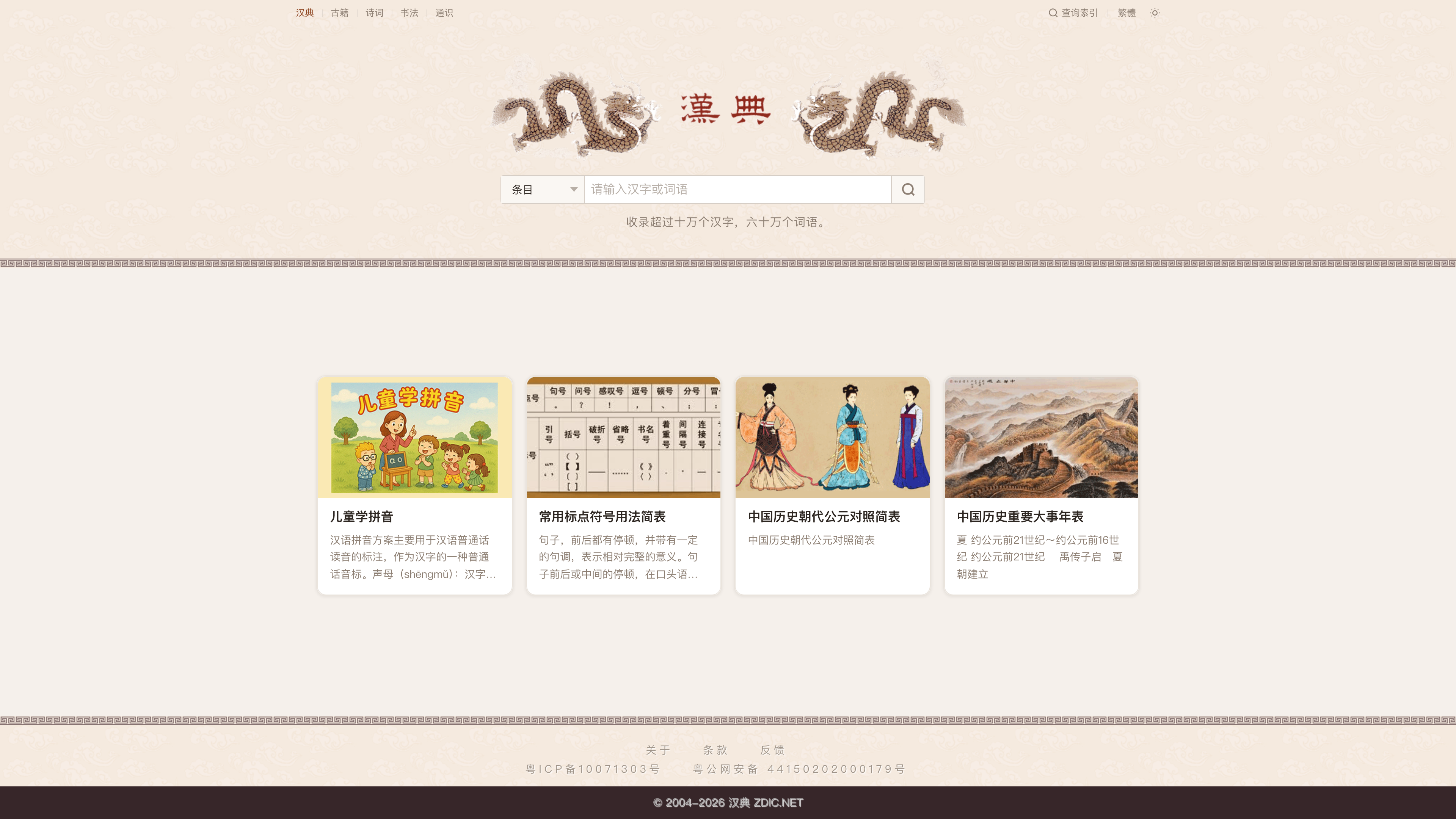
Zdic (汉典, zdic.net) is an online Chinese character and word dictionary launched in 2004: without registering, you can look up characters, words, and chengyu idioms, and each entry page aggregates seven categories of material — basic definitions, detailed explanations, Taiwan's Mandarin Dictionary (國語辭典), the Qing-era Kangxi Dictionary, the Han-era Shuowen Jiezi with Duan Yucai's commentary, historical phonology and dialect readings, and glyph origins. Placing modern lexicography and classical wordbooks side by side on a single page is its clearest difference from online dictionaries that only offer modern definitions. Beyond the dictionary, Zdic maintains three sub-sites for classical texts, poetry, and calligraphy. As of 2026-09-02, the official About page lists 102,986 characters, 661,561 words, and 32,868 idioms.
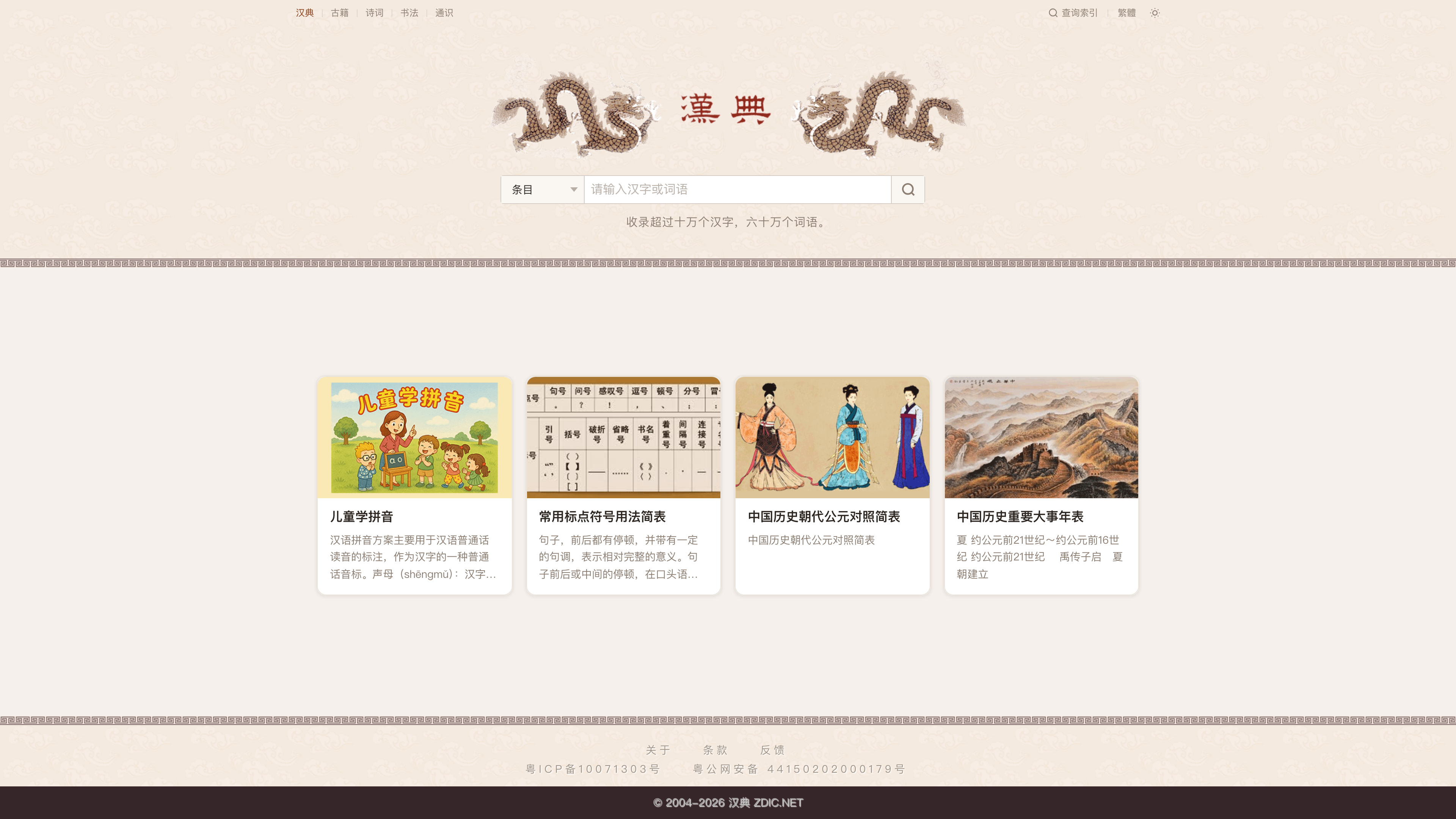
The screenshot above shows the Zdic homepage (redesigned in 2026): the search box notes "over one hundred thousand characters and six hundred thousand words," the lower part recommends knowledge articles from the site's "通識" (general knowledge) column, and the footer carries the © 2004-2026 notice and its Chinese ICP filing number.
At a Glance
- URL: https://www.zdic.net/ (301-redirects to zdic.net)
- Type: Online Chinese dictionary/lexicon with classical text, poetry, and calligraphy collections
- Cost: Basic lookup is free (pages carry ads); a paid membership removes ads and unlocks "full citation texts, historical example sentences, and synonym links" — as of 2026-09-02, ¥10 for 30 days, ¥30 for 90 days, or ¥120 for 365 days
- Registration: Not required for lookup; a free account and paid membership unlock more content
- Interface language: Chinese, with simplified/traditional switching and a dark mode; detailed explanations include English glosses
- Launched: 2004
- Operator: An individual ICP filing (粤ICP备10071303号); the site does not name its operator
Background
Zdic's About page states in classical Chinese that "in the year of Jiashen, Zdic was founded" — matching the footer's © 2004-2026, i.e., founded in 2004 — with a mission to "carry forward the Chinese written tradition, record history past and present, clarify the subtleties of language, answer learners' questions, and set standards for correct writing."
Public information about the operator is limited: the footer shows only an individual ICP filing and a police filing, with no company or team named. The Baidu Baike entry on Zdic and a Chinaz filing lookup both identify the founder as Li Wenting, also in 2004 — usable as secondary corroboration, though the site itself is unsigned. Public contact channels are the email admin@zdic.net, a QQ group, and a Tencent feedback forum.
What a Single Entry Page Offers
Zdic is organized around single-character entry pages. Taking the entry for 漢 as an example, the header gives pinyin, zhuyin (bopomofo), radical, total stroke count, Unicode code point (U+6F22), stroke-order numbering, and glyph structure, alongside the simplified form 汉 and variant characters.
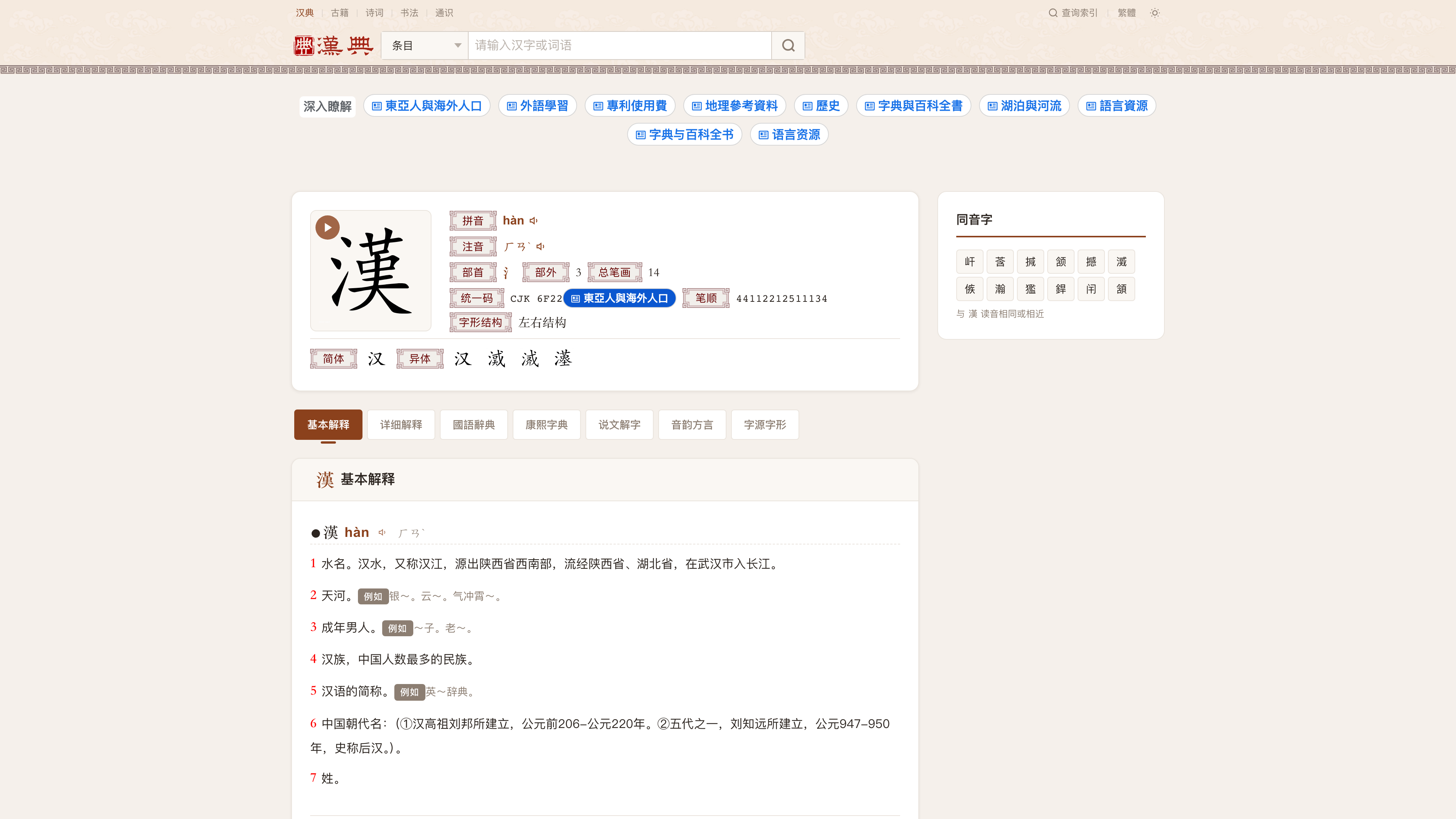
The screenshot shows the top of an entry page: seven tabs — basic definitions, detailed explanations, Mandarin Dictionary, Kangxi Dictionary, Shuowen Jiezi, phonology & dialects, and glyph origins. The detailed explanations carry English glosses for each sense and cite classical sources such as the Shuowen, the Book of Documents, and Han Feizi. The phonology & dialects tab lists IPA transcriptions, reconstructed Tang-era pronunciation, Sino-Japanese/Korean/Vietnamese readings, Cantonese and Hakka pronunciations, and Middle Chinese (Guangyun), Early Mandarin (Zhongyuan Yinyun), and Old Chinese (Wang Li's and Huang Kan's systems) reconstructions.
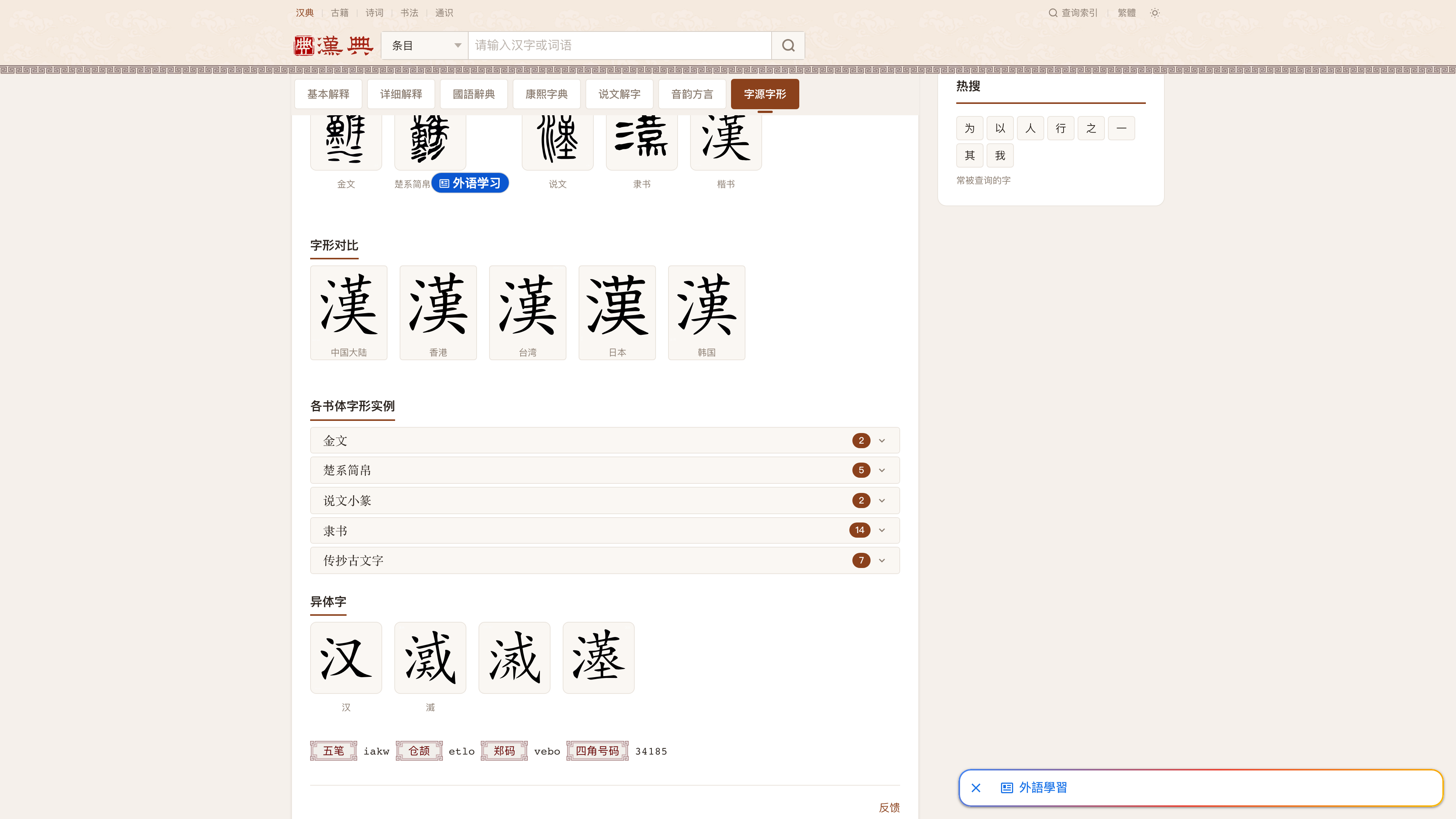
The screenshot above shows the glyph-origins tab: evolution charts across bronze script, Chu silk-and-bamboo script, Shuowen seal script, clerical script, and regular script; a comparison of standard glyph forms in mainland China, Hong Kong, Taiwan, Japan, and Korea; counts of instances per calligraphy style; variant-character groups; and input-method codes (Wubi, Cangjie, Zhengma, Four-Corner). It compresses the usual lookup items of a paleographic reference work into a single tab.
For finding characters, besides direct search of characters, words, and idioms, the site offers radical indexes (dictionary / traditional / Kangxi / Shuowen orderings), stroke-count, pinyin, and zhuyin indexes, and supports lookup by character decomposition, components, stroke order, Wubi, Cangjie, Four-Corner, and Unicode.
Classical Texts, Poetry, and Calligraphy Sub-sites
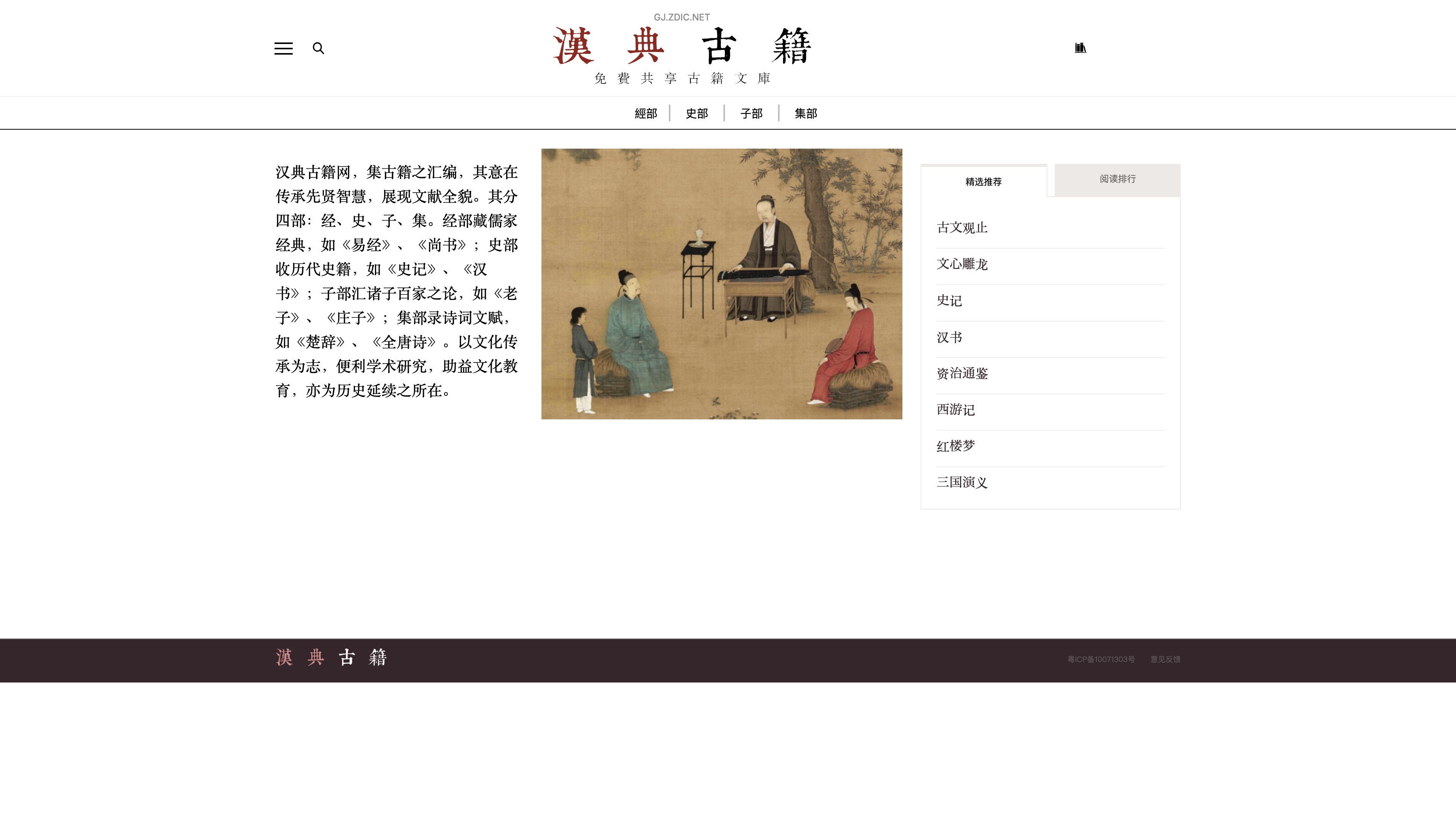
Zdic's classical texts site (gj.zdic.net) follows the traditional fourfold bibliographic classification — classics, histories, masters, and collections. The screenshot shows its homepage with the four divisions up top and featured recommendations such as Guwen Guanzhi, Records of the Grand Historian, Zizhi Tongjian, and Dream of the Red Chamber on the right. Sub-site figures published on the official About page (checked 2026-09-02): 1,055 classical works in 38,529 chapters, plus 203 prose pieces; the poetry site holds 268,886 poems organized by dynasty, genre, and reader submissions; the calligraphy site holds 135,804 ink rubbings searchable by script style (seal, clerical, regular, running, cursive) or calligrapher.
Content Sources and Copyright
The terms page itemizes the underlying sources: detailed explanations follow Wang Tongyi's Advanced Chinese Dictionary; the Mandarin Dictionary section is based on Taiwan's Revised Mandarin Dictionary; the Kangxi section uses the Qing Wuying Palace edition; Shuowen follows the Qing Chen Changzhi printing; phonology and dialects draw on the Xiaoxuetang database, Hanyu Da Zidian, Zhongwen Da Cidian, and rhyme books such as Guangyun and Jiyun; glyph origins come from Jiaguwen Bian, Jinwen Bian, Zhanguo Guwen Zidian, and Shuowen commentaries; stroke order and variant identification rely on Unicode data. The basic definitions are described as "broadly gathered from the web and encyclopedias." The terms also caution that the content "has been mined, combed, and corrected by many hands, with additions, deletions, and changes, and may not exactly match the original editions," advising readers to verify against the source texts.
On copyright, the terms page declares that Zdic adopts the CC0 1.0 waiver, dedicating its dictionary, classical text, poetry, and calligraphy content to the public and waiving copyright claims. Note, however, that its underlying sources include third-party copyrighted dictionaries (such as the Advanced Chinese Dictionary and the Revised Mandarin Dictionary), so the CC0 waiver can realistically only cover Zdic's own compilation labor. Verify the rights status of the underlying works before bulk scraping or commercial reuse.
Accounts, Ads, and Pricing
No registration is needed to look up words or read classical texts. The site serves ads via Google AdSense, including "related search" units inside entry pages and occasional full-page interstitials (one such interstitial appeared during this capture session); comments in the site's ad scripts note that ads are hidden automatically for logged-in paying members.
Registration is free. The membership upgrade page shows (checked 2026-09-02) that paying members get exclusive access to "full citation texts, historical example sentences, and synonym links," priced at ¥10 for 30 days, ¥30 for 90 days, and ¥120 for 365 days, reverting to a free registered account on expiry. The site's robots.txt lists internal /api/ paths, but there is no public developer API documentation.
When It's Useful
- Students and Chinese learners checking pronunciations, definitions, stroke order, and standard glyph forms
- Reading classical texts with the Kangxi Dictionary, Shuowen Jiezi, and Duan's commentary side by side on one page, instead of consulting several wordbooks
- Entry-level lookups of dialects, historical phonology, and glyph origins: Cantonese and Hakka readings, Middle and Old Chinese reconstructions, oracle-bone through clerical forms
- Calligraphy enthusiasts looking up how a character is written, by calligrapher or script style
Limitations
- Ads on the free tier: Google related-search units appear inside entry pages, and full-page interstitials occasionally interrupt navigation.
- Some content is paywalled: full citation texts, historical example sentences, and synonym links are reserved for paying members, so free users see an incomplete depth of material.
- Uneven editorial quality: the operator states that basic definitions are "broadly gathered from the web and encyclopedias" and that all content "may not exactly match the original editions." For academic citation, verify against the source works rather than relying on Zdic as a textual authority.
- Limited operator transparency: no company or team information — only an individual filing plus email and QQ-group contacts; founder details rest on secondary sources.
- No public API: the internal endpoints are not open to developers, and there is no official bulk export.
Comparable Sites
- Moedict (萌典): an open-source Mandarin dictionary maintained by Taiwan's g0v community, built on Ministry of Education dictionary data, with an open API.
- Chinese Text Project: a full-text library of transmitted classical Chinese works with character-by-character dictionary lookup — deeper for serious classical reading.
- Xiaoxuetang (小学堂): a paleographic database maintained by Academia Sinica, more scholarly for oracle-bone and bronze glyph research.
References
- Zdic About page (checked 2026-09-02: founding year, collection size, contact channels)
- Zdic terms page (content sources, the "may not match original editions" caveat, CC0 1.0 declaration)
- Entry page for 漢 (entry structure verification)
- Zdic classical texts, poetry, and calligraphy sub-sites (sub-site organization)
- Membership upgrade page (checked 2026-09-02: pricing and member benefits)
- Baidu Baike entry on Zdic and Chinaz filing lookup (secondary corroboration of founder and individual filing)