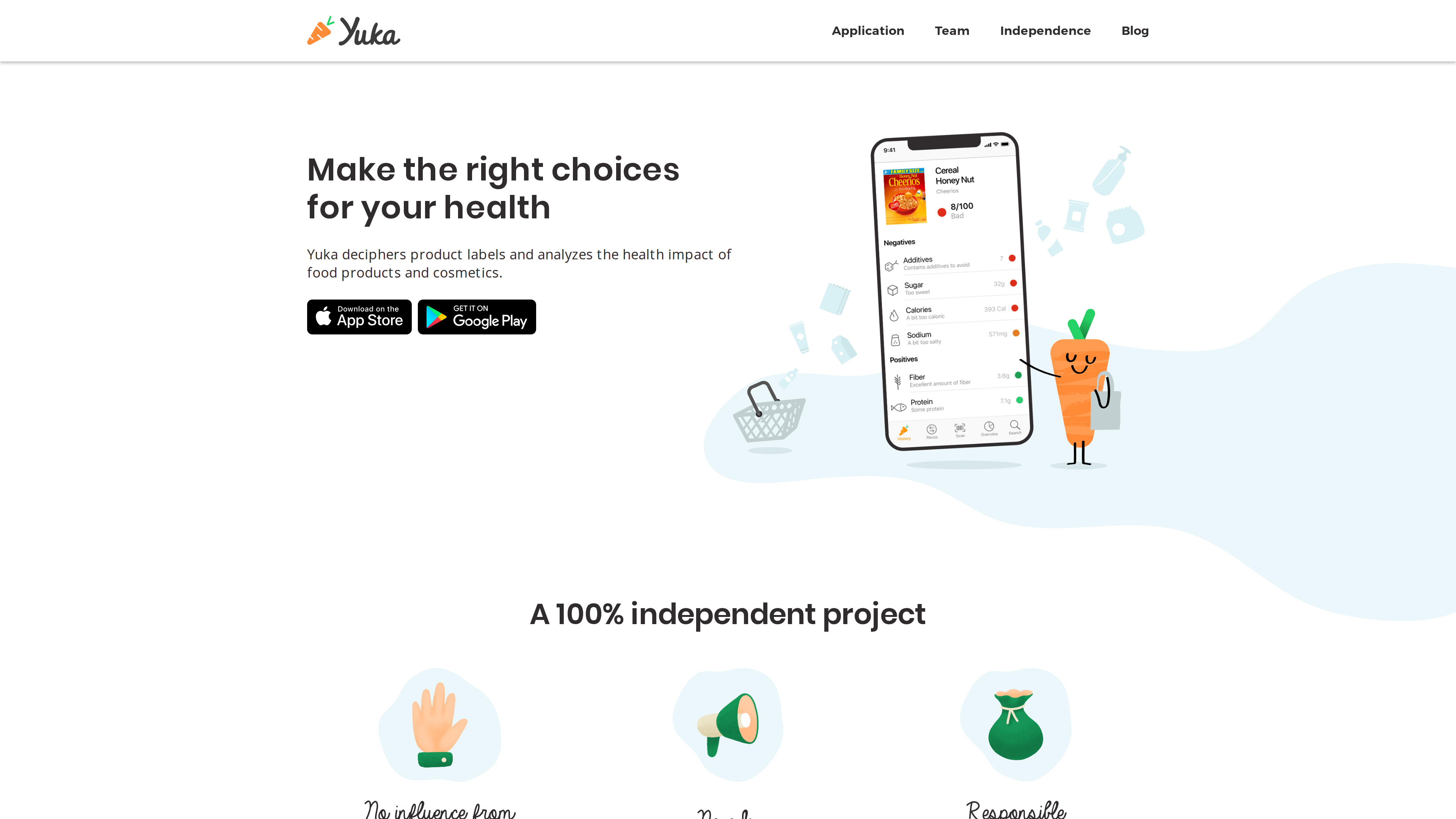
Yuka (yuka.io) is a French product-scanning app: point your phone camera at the barcode of a food or cosmetics product and it returns a 0–100 health score with itemized detail — sugar, salt, calories and additives for food; endocrine disruptors, carcinogens, allergens and irritants for cosmetics — and recommends healthier alternatives for products that score poorly (homepage, checked 2026-10-01).
Its defining trait is "100% independence": there are no ads in the app, brands cannot influence scores or recommendations in any way, and revenue comes mainly from a low-cost, pay-what-you-want membership. The live counter on the homepage showed about 89 million users on 2026-10-01 — an order of magnitude beyond most players in the food-transparency space.
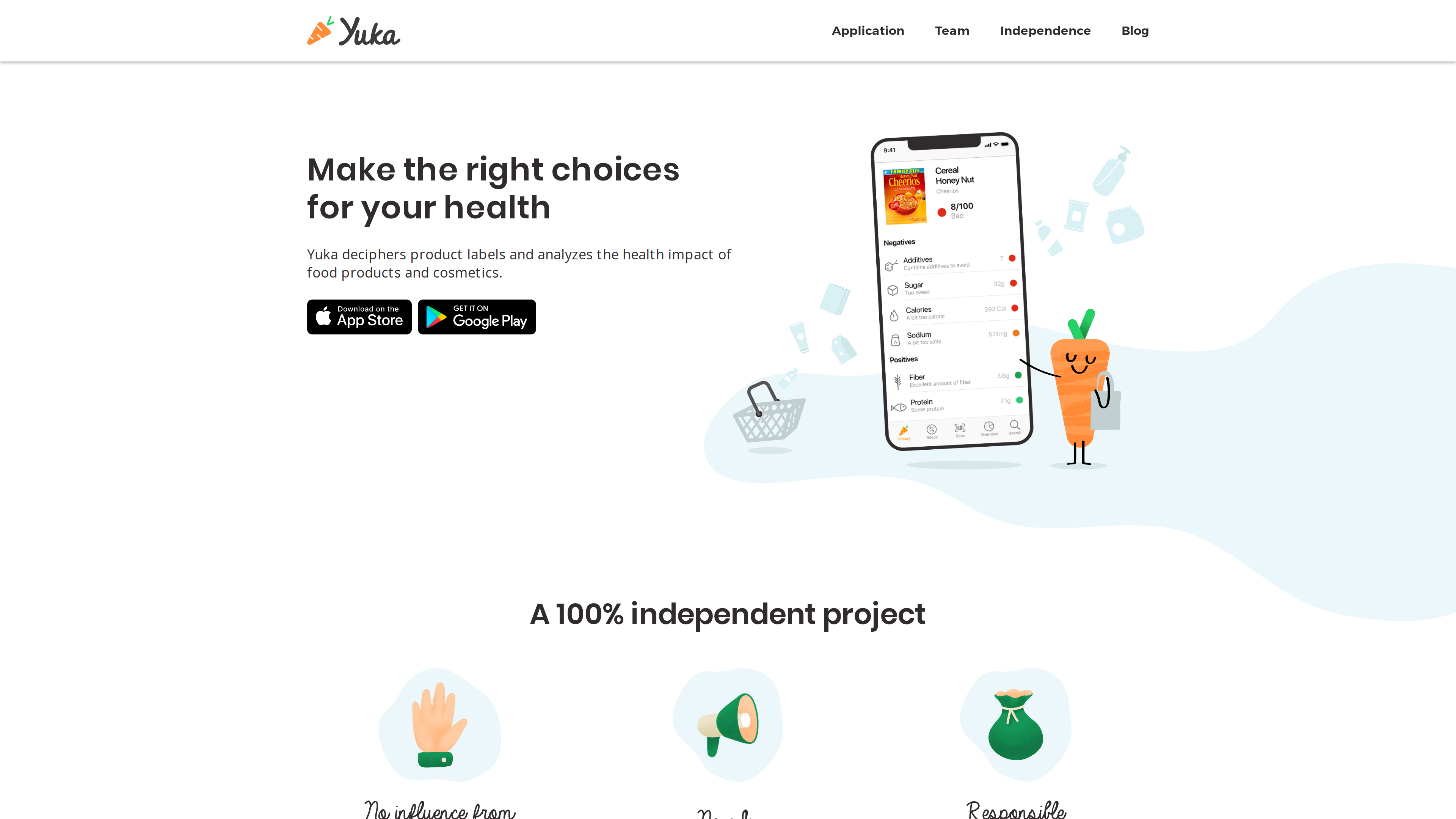
The homepage screenshot above (2026-10-01) shows a full product scorecard in the demo — red negatives (7 additives to avoid, too sweet, too caloric, too salty) versus green positives (fiber, protein) — with the "100% independent project" section directly below.
At a Glance
| Item | Details |
|---|---|
| URL | https://yuka.io/ |
| Type | Food and cosmetics barcode-scanning app (consumer health tool) |
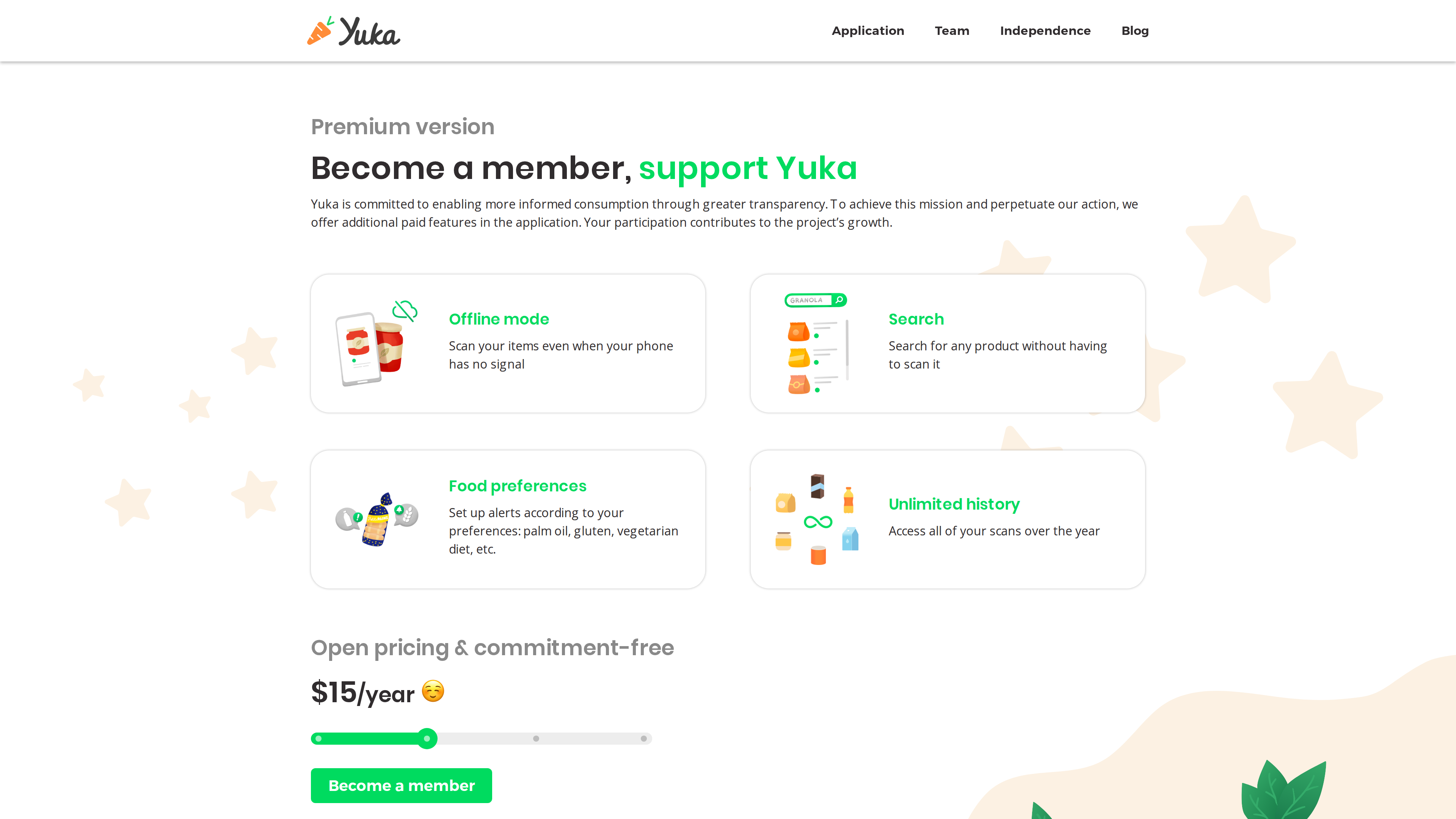
| Cost | Core scanning and scoring free; Premium membership from $10/year with open, pay-more-to-support pricing (help center, member page, as of 2026-10-01) |
| Sign-up | Used in-app (observed; onboarding flow not exhaustively verified) |
| Interface language | Website in French, English, Spanish and more; localized app-store listings |
| Clients | iOS and Android |
| Launched | January 9, 2017 in France (co-founder on LinkedIn) |
Background
- Founders: Yuka was launched in France on January 9, 2017 by three co-founders — Julie Chapon and brothers François and Benoit Martin — with a single Facebook post to a community of 1,500 followers (Chapon's 8-year retrospective, FoodNavigator five-year interview).
- Expansion: after taking off in France it rolled out across Belgium, Switzerland, Luxembourg, Spain and the UK, then launched in the US and Canada in January 2022 (official impact report, FoodNavigator).
- Data scale: the database holds roughly 3 million food and 2 million cosmetics products (NewsNation, citing the site); the homepage reports ~89 million users and a 4.8/5 rating across 500k reviews (homepage, as of 2026-10-01).
- Mission: "help consumers make better choices for their health and work together to compel manufacturers to improve the composition of their products" (impact report).
How Scoring Works
- Food score (0–100): three weighted criteria — nutritional quality at 60%, based on Nutri-Score, the science-backed label adopted by seven European countries (sugar, sodium, saturated fat, calories, protein, fiber, fruit and vegetable content); additives at 30%, graded by risk level; and organic certification at 10% as a bonus. Scores map to four color-coded bands: Excellent, Good, Poor and Bad (official scoring explainer, FoodNavigator 2019 analysis).
- Cosmetics score: ingredient-by-ingredient analysis flagging endocrine disruptors, carcinogens, allergens and irritants (homepage).
- Alternatives: poorly scoring products come with higher-scoring similar alternatives — closing the loop from "scored bad" to "swapped for better" (homepage).
- Expandable detail: every line item (sugar, salt, calories, additives) can be opened and is flagged red or green, so users can judge for themselves.
Independence and Business Model
This is the part Yuka most deserves credit for (Independence page, checked 2026-10-01):
- No ads: brands cannot pay to advertise inside the app.
- No brand influence: scores and alternative recommendations are produced by its internal methodology only.
- Transparent revenue: the Independence page discloses its revenue mix — Premium memberships (a figure of $11.88M is published), a nutrition program and a book — alongside an annual social impact report.
- Open pricing: Premium uses a sliding-scale price selector; all price points unlock exactly the same features, and paying more is framed purely as extra support (help center).
Pricing (as of 2026-10-01)
| Plan | Price | Notes |
|---|---|---|
| Free | $0 | Scanning, scores, ingredient detail and alternative recommendations |
| Premium member | From 25 CAD Canada, $20 AUD Australia) | Offline mode (scan with no signal), search without scanning, food-preference alerts (palm oil, gluten, lactose, vegetarian), unlimited scan history; sliding-scale pricing, commitment-free |
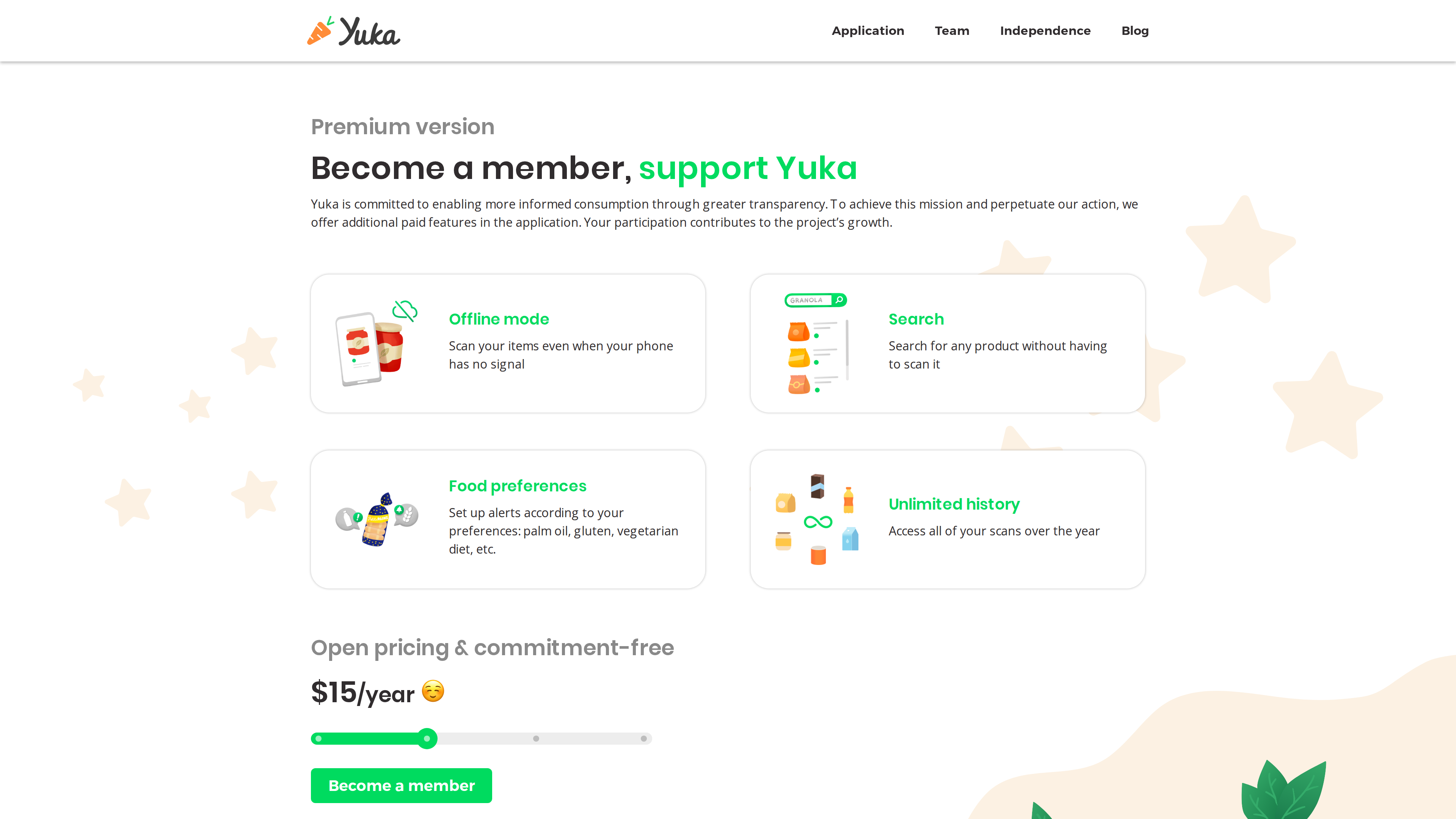
The Premium page screenshot above (2026-10-01) explains that paid features exist to keep the mission sustainable; the price area is a draggable open-pricing slider (shown at $15/year) and notes there is no commitment.
Who It's For
- Shoppers who want a quick verdict on whether a snack, cereal or drink is worth buying.
- Users sensitive to cosmetics ingredients (endocrine disruptors, allergens) — scan before you buy.
- People avoiding specific ingredients (palm oil, gluten, lactose): Premium's preference alerts warn automatically.
Limitations
- Scoring has boundaries: the food score builds on Nutri-Score, a deliberately simplified public-health label that cannot capture individual dietary needs (a person cutting sugar and an athlete need different things) — treat the score as a reference, not a verdict.
- Uneven geographic coverage: the database centers on US and European products; barcodes from local Chinese-market products are covered only to a limited extent (reasonable inference from its market footprint, not exhaustively verified).
- Convenience features are paid: offline mode and search-without-scanning sit behind the membership.
- Mobile only: no desktop or web scanning experience (observed).
- Cosmetics risk assessment relies on published ingredient lists; reformulations and individual skin differences still call for personal judgment.