Wolfram|Alpha (www.wolframalpha.com) is a computational knowledge engine: rather than searching the web and returning a list of links, it takes a question typed in natural language and computes an answer page — numbers, plots, tables and derivations — directly from its built-in knowledgebase. Its own FAQ draws the line explicitly: "it generates output by doing computations from the Wolfram Knowledgebase, instead of searching the web and returning links" (FAQ). The site is operated by Wolfram Alpha LLC, a spinoff of Wolfram Research, and officially launched on May 18, 2009. Basic queries are free and need no account. Its verifiable difference from a general search engine is where answers come from: continually curated data and built-in algorithms rather than an index of web pages, with a "Sources" button at the bottom of relevant result pages listing the background references behind an answer.
At a glance
- URL: https://www.wolframalpha.com/
- Type: computational knowledge engine (direct computed answers to math and factual questions)
- Cost: free for personal, non-commercial use, with ads on the page; a Pro subscription unlocks enhanced features (as of 2026-09-01: Pro 8.25/month on annual billing, pricing page)
- Account: no registration needed to query; a free Wolfram ID saves preferences; Pro is a paid subscription (FAQ)
- Interface languages: the site can understand questions in English, Japanese, Spanish, Korean and Simplified Chinese, based on browser language or the selected language preference (FAQ); in the Chinese interface, the Science & Technology, Society & Culture and Everyday Life topic groups are marked "under development" (observed 2026-09-01)
- Mobile: free iOS and Android apps; a Pro subscription signed in with a Wolfram ID unlocks enhanced features in the apps
Background
Wolfram|Alpha was built by a team led by scientist Stephen Wolfram, whose company Wolfram Research has been developing Mathematica and the Wolfram Language since 1986. The Wolfram|Alpha project itself started in 2005 with a pre-launch team of fewer than 100 people (FAQ). The site went live for testing on May 15, 2009, and Wolfram Alpha LLC announced general availability on May 18, calling it "the world's first computational knowledge engine" and describing four pillars: curated data, dynamic computation, intuitive language understanding and computational aesthetics (launch announcement).
The whole system is implemented in the Wolfram Language. Per the official FAQ, the code base is now more than 10 million lines of symbolic Wolfram Language code with many terabytes of data, and the knowledgebase holds "many trillions of elements" that keep growing through a large number of feeds (FAQ). For comparison, the 2009 launch configuration ran nearly six million lines of Mathematica code on about 10,000 processor cores (launch announcement). Wolfram Alpha LLC is a privately held spinoff of Wolfram Research, Inc. with no outside investors (FAQ).
Core capabilities
Mathematics and symbolic computation. Math is Wolfram|Alpha's strongest area: it can draw on Wolfram Language algorithms covering algebra, calculus, geometry, number theory, discrete math and more, and it covers the content of standard handbooks such as Abramowitz & Stegun; because it computes in real time instead of looking values up, it can derive results that appear in no handbook (FAQ). Input can be plain natural language (for example integrate x^2 sin(x)), an on-screen math palette, or Wolfram Language code.
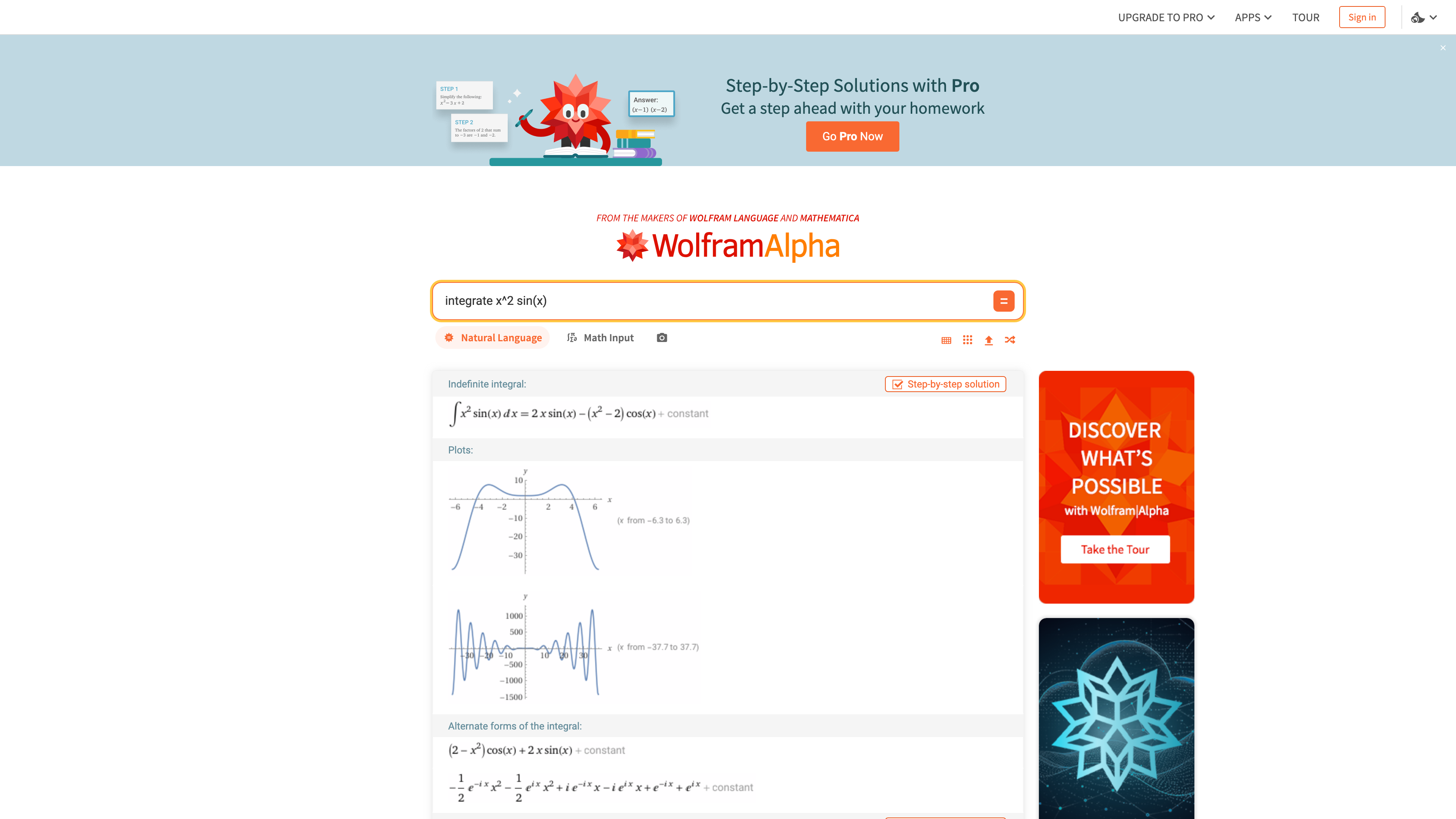
The image above shows an actual query for integrate x^2 sin(x). An answer page is made of "pods": the indefinite integral at the top, plots of the function over different ranges, and "Alternate forms" of the result. The "Step-by-step solution" button in the corner is a Pro feature. The official FAQ suggests checking Alternate forms when the answer doesn't match a textbook — different-looking forms can be mathematically equivalent (FAQ).
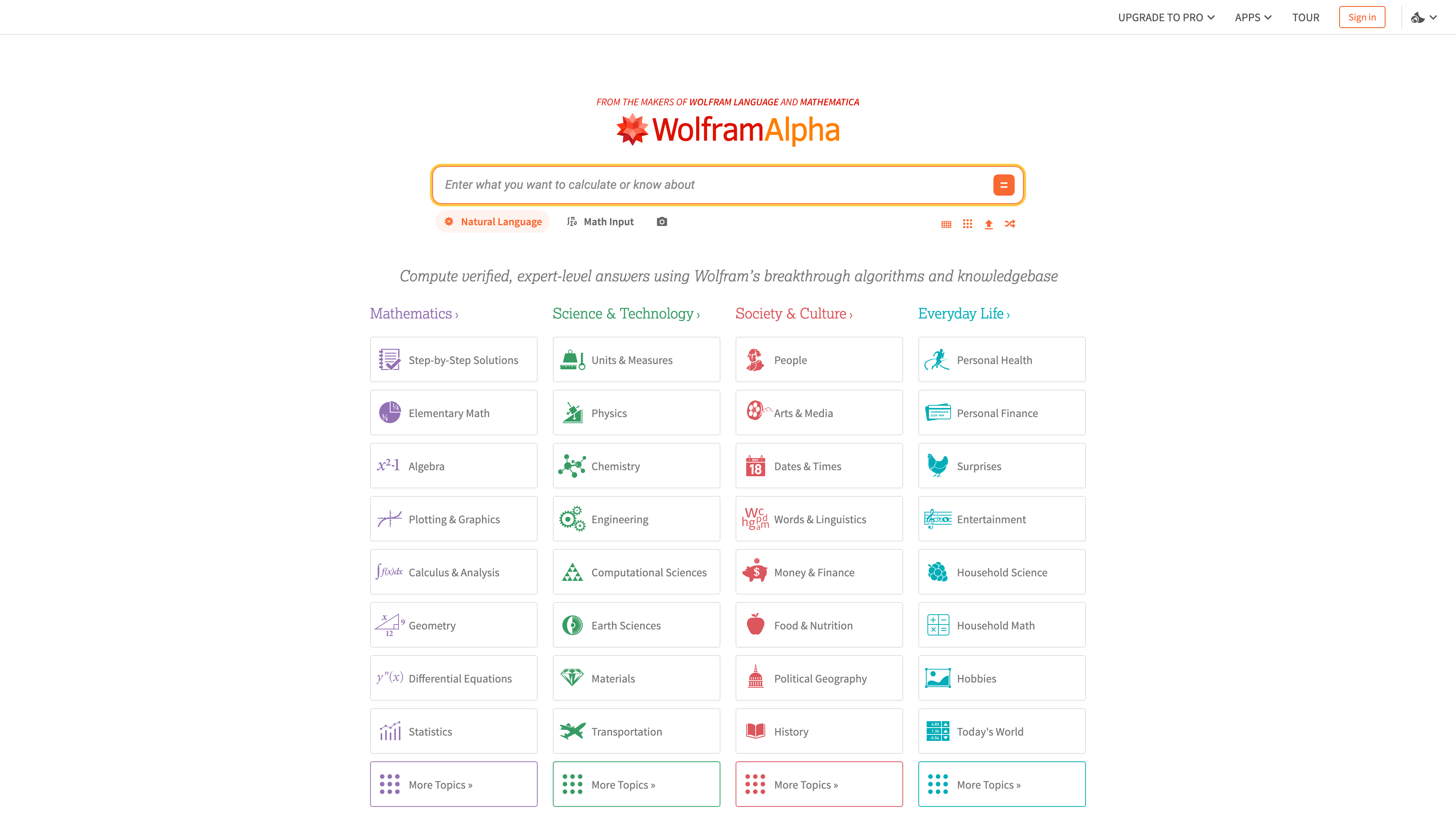
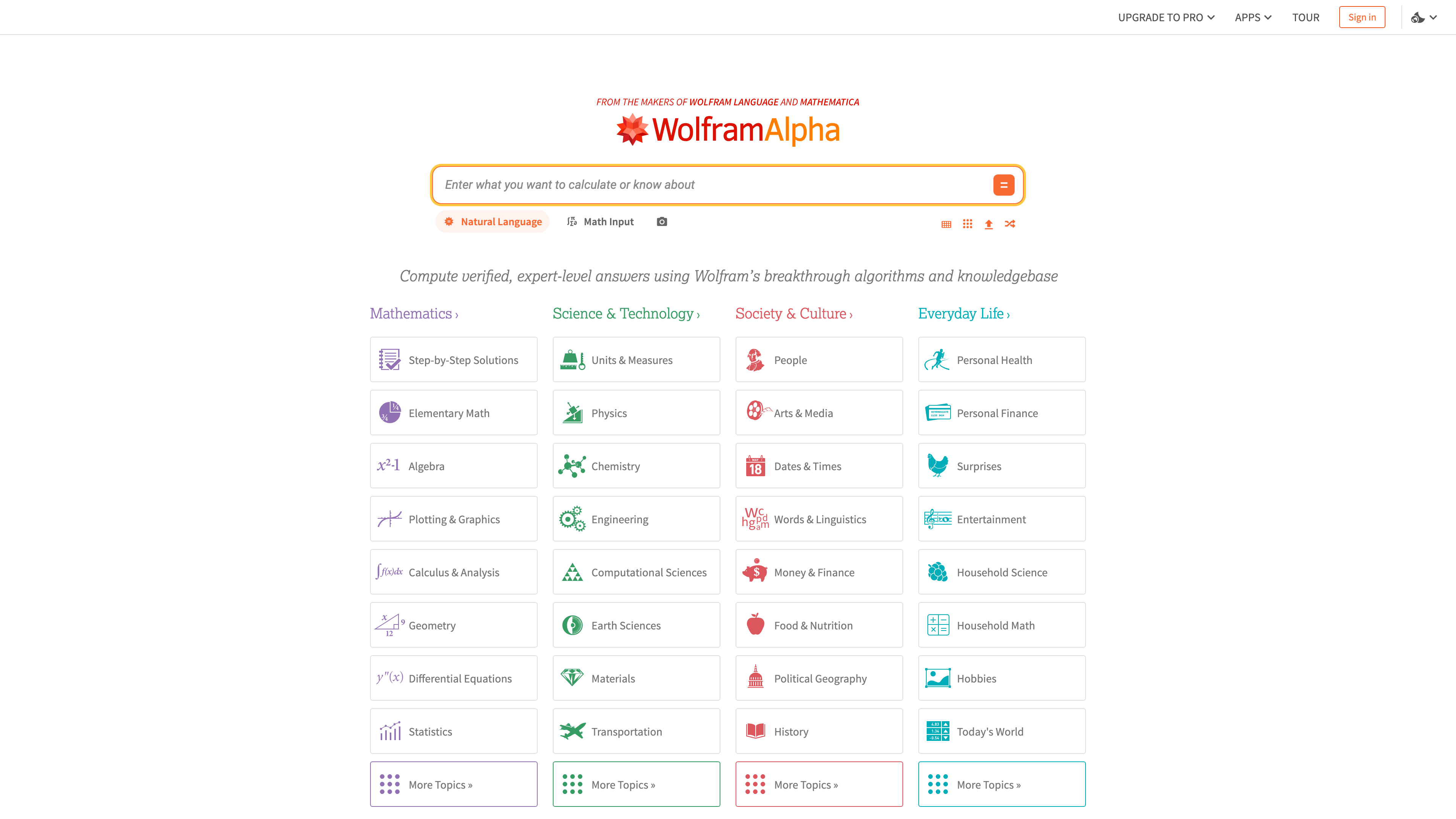
Factual knowledge queries. Beyond math, the site answers factual questions about science, society and everyday life. The homepage groups content into Mathematics, Science & Technology, Society & Culture and Everyday Life, with dozens of subtopics such as physics, chemistry, units and measures, people, dates and times, food and nutrition, and political geography (homepage). The image below is the English homepage: common subtopics are listed directly under the search box, organized by those four groups.
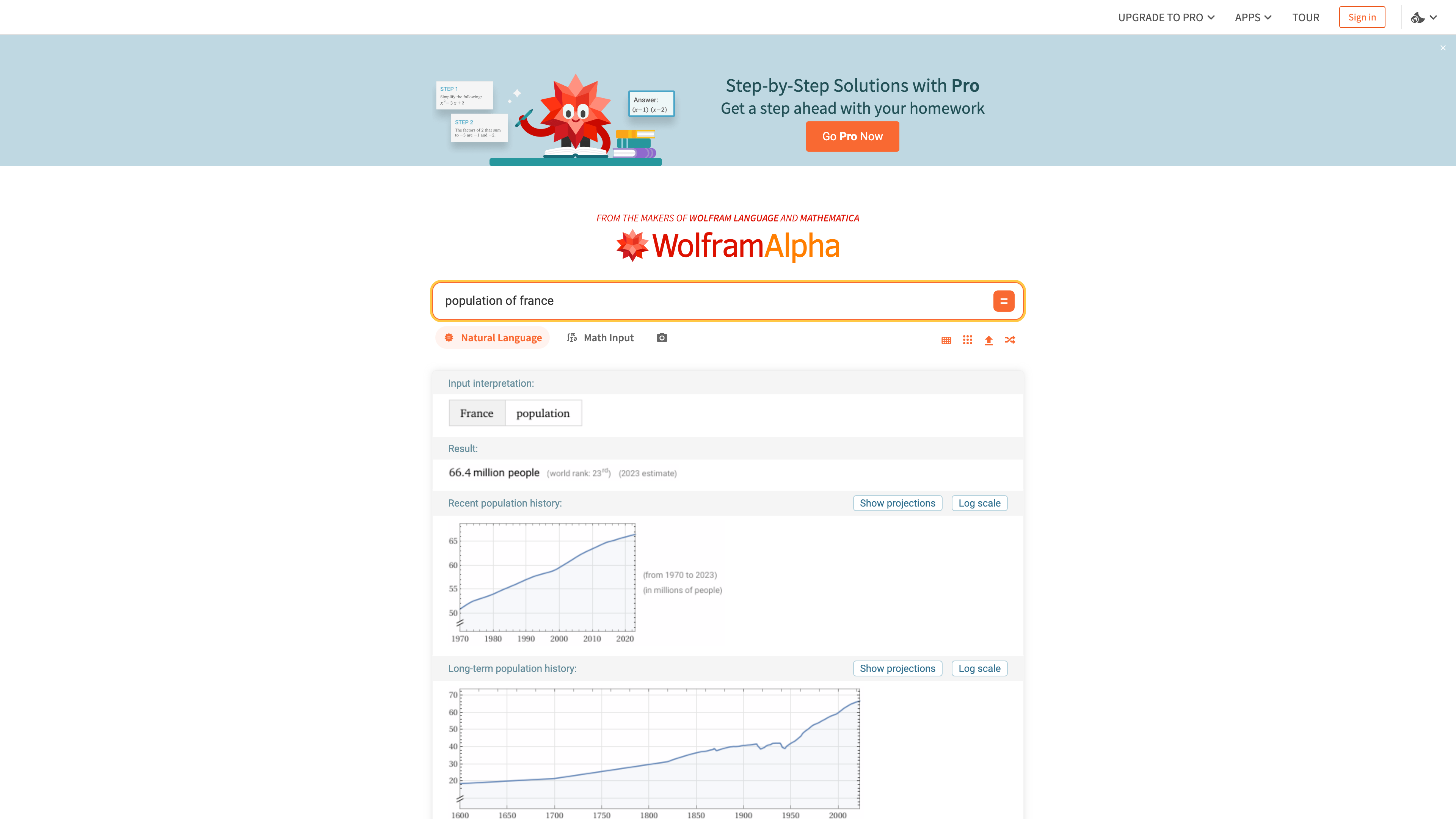
The image above is the actual result for "population of france" queried on 2026-09-01. It opens with the "input interpretation" (France | population), showing how the engine understood the question; the result, "66.4 million people," comes with a world rank and the estimate year (2023), followed by recent population history since 1970 and a long-term series back to 1600. This is exactly how it differs from a search engine: instead of finding a page that states France's population, it computes the figure and organizes it into charts. Financial quotes are updated in real time, and weather data goes back more than a century in some places (FAQ); the "Sources" button at the bottom of relevant result pages lists the background data references.
How results are organized. Each answer page consists of pods (which can contain subpods), with disambiguation prompts called "assumptions" at the top. The same query can return different results at different times or places — the site uses GeoIP to infer the visitor's location for defaults such as units, currency and geography-dependent computations (FAQ).
Accounts, Pro and open capabilities
Accounts. Querying needs no registration. A free Wolfram ID saves preferences such as unit system, currency and time zone, and is required before subscribing to Pro (FAQ).
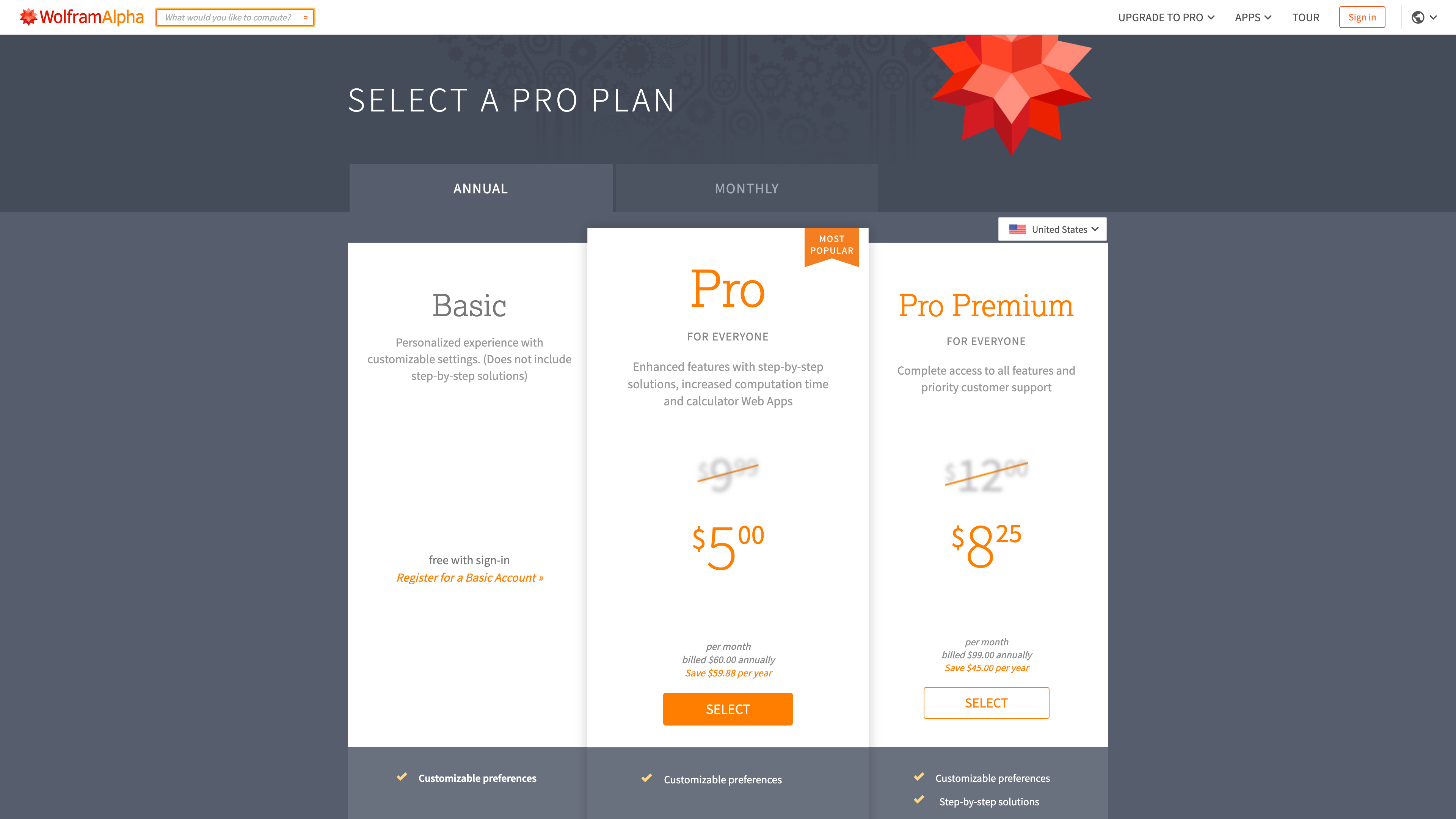
Pro subscription. As of 2026-09-01, the pricing page lists three tiers (annual billing): Basic is free with sign-in and includes customizable preferences but no step-by-step solutions; Pro lists at 5.00/month billed annually (12.00/month and costs 99.00/year), with 3× computation time, 5MB uploads and priority expert support. Separate pricing pages exist for students and educators. Pro also supports uploading data, images and files in more than 60 formats for instant analysis, downloading computed results as CSV, XLS and other formats, and the Wolfram Problem Generator (Pro page). The screenshot below shows the three plans on the pricing page in the annual view.
APIs. Eight pre-built APIs are offered to developers: Full Results, LLM, Simple, Short Answers, Fast Query Recognizer, Summary Boxes, Instant Calculators and Spoken Results (API products). Using them requires a Wolfram ID and a separate AppID per application registered in the developer portal. The LLM API is designed specifically for calls from large language models: a standard REST interface that returns at most 6,800 characters per response by default (LLM API documentation).
Connections to AI and the Wolfram ecosystem. On March 23, 2023, Wolfram and OpenAI launched a ChatGPT plugin that let ChatGPT call Wolfram|Alpha and the Wolfram Language; Stephen Wolfram's official post on the announcement also notes that OpenAI later discontinued plugins in favor of custom GPTs, with the Wolfram GPT available at gpt.wolfram.com (Stephen Wolfram Writings). Inside the Wolfram Language itself, the built-in WolframAlpha function runs free-form queries directly (FAQ).
Copyright and content policy
Under the Terms of Use, the free service is limited to ad hoc, personal, non-commercial use; systematic professional or commercial use requires a separate commercial license. Individual results may be reposted on non-commercial sites and blogs with attribution to Wolfram|Alpha (preferably a link to the specific query), but multiple results may not be reassembled into a database or data service. The terms also explicitly forbid querying by robot or script, data mining or reverse engineering the results, and systematically extracting results to build a raw data table, language model or AI system (except on an ad hoc basis for personal use). The images on result pages — plots, typeset formulas and tables — and the page layouts are copyrighted by Wolfram|Alpha at generation time; personal, academic and other non-commercial publications may use them under the terms, while commercial publications can request a low- or no-cost license through a form. Wolfram|Alpha also states that it is not a certified source for legal, financial, medical, life-safety or other critical purposes, and that important decisions should be independently verified; users under 18 need permission from a parent, legal guardian or teacher.
On privacy, the free service "does not collect or solicit personal information"; query inputs are stored in log files and used to evaluate performance and improve the system, but the company says it will not attempt to associate inputs with individual users (Terms of Use). The privacy policy that applies to Wolfram|Alpha (effective January 1, 2023) describes the collection of IP addresses (used for GeoIP, which affects default currency and units), query-related information and cookies, and states that personal information is not sold.
Who it suits
- Students and engineers doing math: symbolic integration, equation solving, plotting and unit conversion, with Alternate forms for checking equivalent expressions.
- Quickly verifying factual questions: computable data about countries and cities, historical dates, chemical element properties and the like, with the data's reference date shown.
- Developers embedding computation in their own products via the APIs or the Wolfram Language; LLM applications can call the LLM API for structured answers.
- Learners: Pro's step-by-step solutions, practice problems and Problem Generator are designed for study.
Limitations
- The official FAQ lists three boundaries: it can only know things that are known and public; it deals with facts, not opinions; and each query has a limited computation time (FAQ).
- Although the site can understand questions in Simplified Chinese and several other languages, three topic groups in the Chinese interface are still marked "under development"; English has the most complete coverage.
- Study-oriented features — step-by-step solutions, file upload, data download — sit behind Pro; the free tier shows final results only and carries ads.
- Results depend on the time and place of the query (GeoIP and real-time data), so the same question can be answered differently at different moments; the official guidance is to note the time and place of the query when citing it.
- It is not a certified source: medical, legal and financial use cases must be verified elsewhere.
- The free tier is tightly restricted: batch and programmatic queries are forbidden, so automation has to go through the APIs.
Alternatives and related sites
- Wikipedia: the comparison the official FAQ itself draws — Wikipedia provides narrative articles about topics, while Wolfram|Alpha computes answers to specific questions without narrative.
- MathWorld: the math encyclopedia in the same Wolfram family; Wolfram|Alpha incorporates much of its systematic knowledge in computable form and links to it from result sidebars (FAQ).
- Wolfram Language: the technology underneath Wolfram|Alpha; a separate product line when you need full programming and interactive notebooks.
References
- Wolfram|Alpha homepage (checked 2026-09-01)
- About Wolfram|Alpha (checked 2026-09-01)
- Wolfram|Alpha FAQs (checked 2026-09-01)
- Wolfram|Alpha Officially Launched (announcement, 2009-05-18) (checked 2026-09-01)
- Wolfram|Alpha Pro and Pro pricing (checked 2026-09-01)
- Wolfram|Alpha APIs and LLM API documentation (checked 2026-09-01)
- General Terms of Use (checked 2026-09-01)
- Wolfram Privacy Policy (checked 2026-09-01)
- ChatGPT Gets Its "Wolfram Superpowers"! — Stephen Wolfram Writings (checked 2026-09-01)