Wikivoyage is a free web-based travel guide that anyone can edit. Destination articles are organized in a geographic hierarchy from continents down to city districts, complemented by itineraries, phrasebooks and travel-topic articles. It is written by unpaid volunteers, carries no advertising, and has been hosted by the non-profit Wikimedia Foundation since 2013, making it a sister project of Wikipedia — it has been called the "Wikipedia of travel guides". The project traces its roots to the commercial site Wikitravel: the German and Italian communities forked in 2006 over dissatisfaction with the site's commercial owner, and the English community followed in 2012, merging into what is now Wikivoyage. As of September 2026, the project comprised 27 language editions with roughly 146,773 articles in total, with English the largest edition and Chinese home to about 5,600 articles.
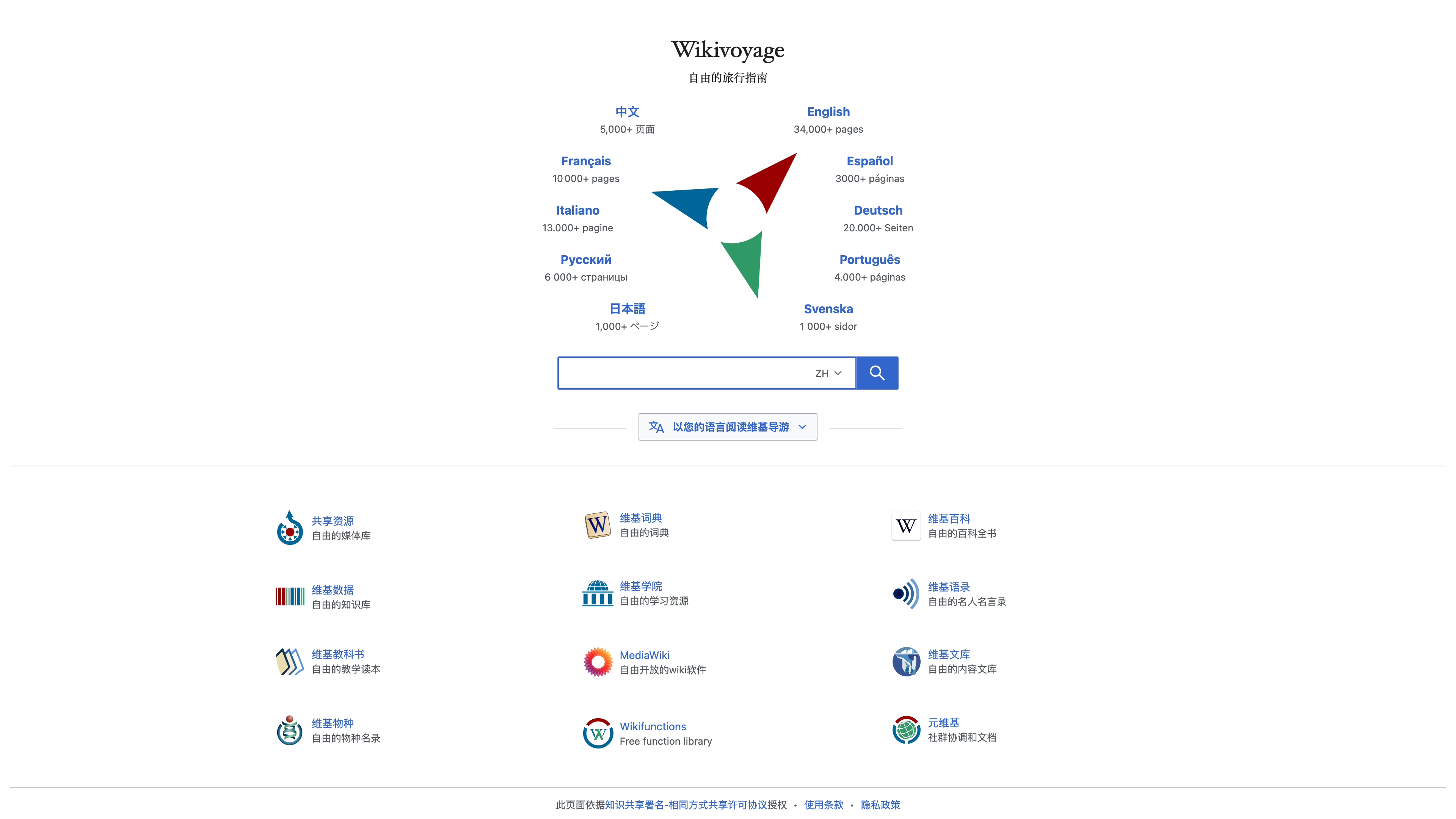
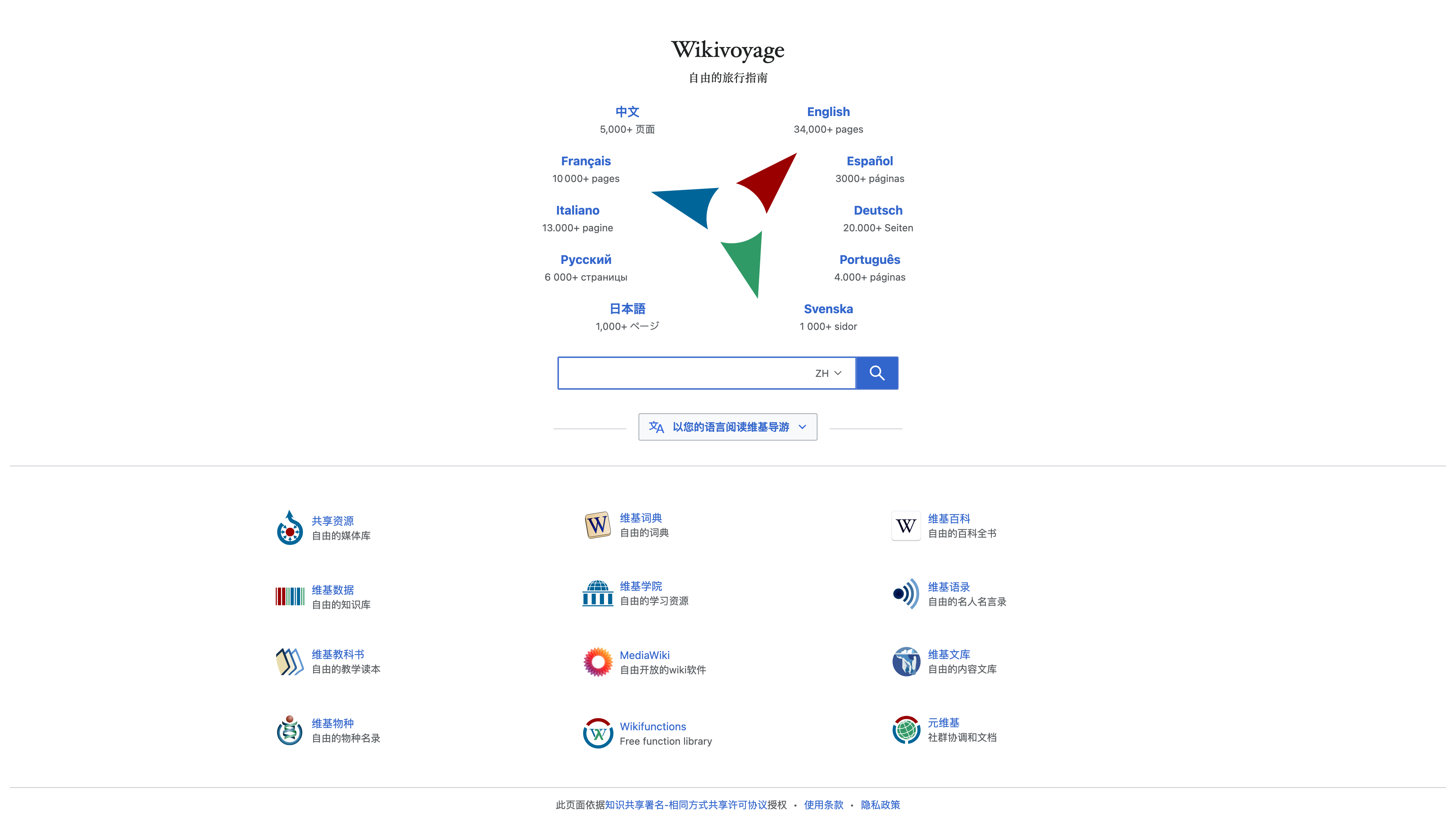
The image above shows the wikivoyage.org language portal. Around the red, green and blue compass logo, the largest editions are listed by article count (English 34,000+, German 20,000+, Italian 13,000+, Chinese 5,000+, and so on), with a cross-language search box in the middle. The footer links to sister projects such as Wikipedia and Wiktionary and notes that the page is published under a Creative Commons Attribution-ShareAlike license.
At a glance
- URL: https://www.wikivoyage.org/ (portal); individual editions follow the pattern https://en.wikivoyage.org, https://zh.wikivoyage.org
- Type: Multilingual travel guide (volunteer-written UGC)
- Cost: Free, no ads
- Registration: Not required for reading or editing; a registered account tracks contributions and provides attribution
- Languages: 27 editions, including Chinese
- Launched: December 10, 2006 (German edition); relaunched as a Wikimedia project on January 15, 2013
- Operator: Wikimedia Foundation; the German association Wikivoyage e.V. remains as an affiliated organization
- Content license: CC BY-SA 4.0 (text)
Background
Wikivoyage's history is closely intertwined with another travel wiki, Wikitravel. Wikitravel was founded by Evan Prodromou and Michele Ann Jenkins in July 2003 and was acquired about two years later by the for-profit company Internet Brands. Community discontent with the new owner's management grew, and in September 2006 the German- and Italian-language contributors decided to take the content and move on — a maneuver known in wiki culture as "forking", expressly permitted by the site's free license. They registered the non-profit association Wikivoyage e.V. in Germany, and the new site went live with German content on December 10, 2006; the Italian branch followed exactly one year later.
In 2012, the English Wikitravel community also decided to fork after years of friction with the host. This time the move was a two-way merge: the English community joined the existing Wikivoyage editions, and the whole project moved onto Wikimedia Foundation servers. The Wikimedia community discussion closed with 540 votes in favor and 152 against; the project entered beta on Foundation servers on November 10, 2012 and officially relaunched on January 15, 2013 — the 12th anniversary of Wikipedia — with about 50,000 articles. Along the way, Internet Brands sued two volunteers involved in the migration; the claims were dismissed by a U.S. federal court in November 2012 and the remaining dispute was settled in February 2013. The Chinese edition was created in January 2014.
The name "Wikivoyage" is a portmanteau of "wiki" and "voyage", chosen by community vote; the Russian edition keeps the older name Викигид (roughly "wiki guide").
Content and article structure
Wikivoyage content falls into four categories: destinations, itineraries, phrasebooks and travel topics. Destination articles sit in a geographic hierarchy — continent, continental section, country, region, city, district, national park — and the rule of thumb for whether a place merits its own article is "can you sleep there?". Hotels, restaurants and attractions do not get standalone articles; they are listed within the article for the place they belong to. A breadcrumb trail at the top of each article shows its position in the hierarchy.
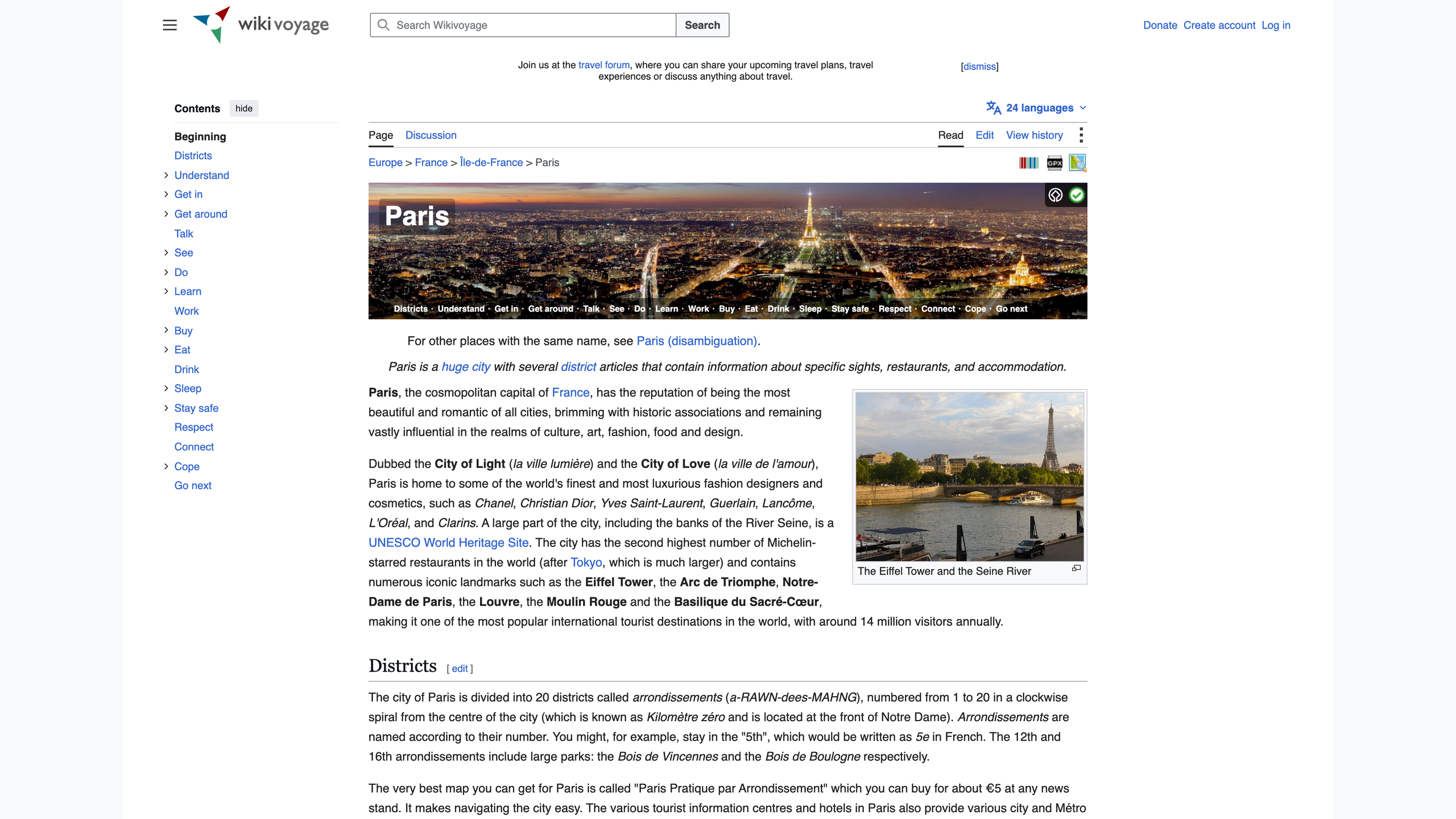
The screenshot above shows the top of the English article on Paris. The quick links under the page banner reveal the standard section structure of a city article — Districts, Understand, Get in, Get around, See, Do, Buy, Eat, Drink, Sleep, Stay safe, Go next — while the table of contents on the left and the blue in-text links tie the sections into a complete practical guide. Unlike Wikipedia, Wikivoyage positions itself as a practical guide for travelers rather than an encyclopedia: articles are allowed a fair, recommendatory tone and are not required to cite sources line by line.
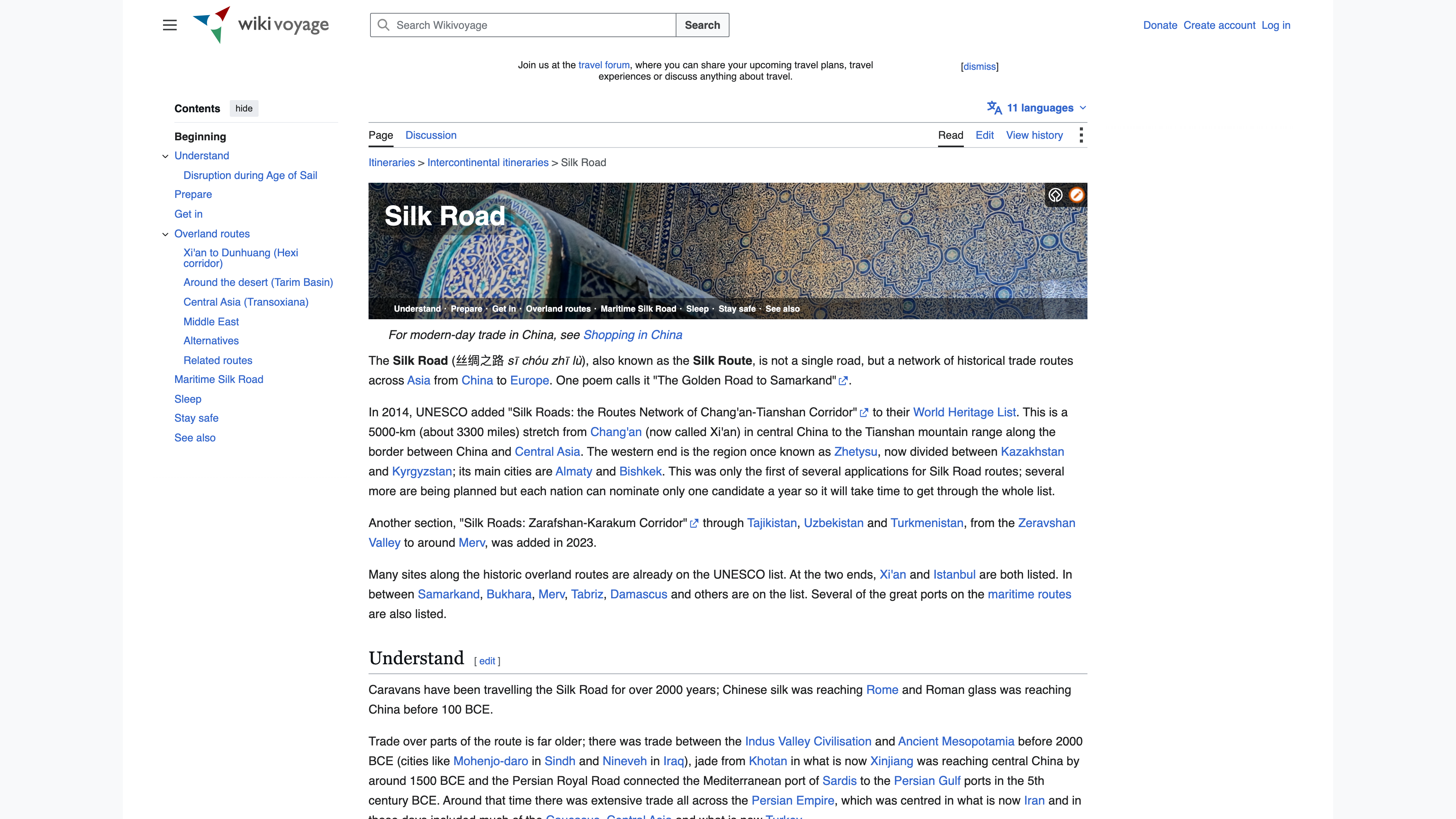
Itinerary articles are organized by time rather than space, laying out the sequence of stops on a journey with suggested durations and routes. The screenshot above shows the English "Silk Road" itinerary; the breadcrumb places it under "Itineraries > Intercontinental itineraries", and the body moves from historical background to a stage-by-stage route. Phrasebooks, meanwhile, provide pronunciation guides and survival phrases for foreign languages.
The Chinese edition today
The Chinese edition (维基导游) was created in January 2014 and, as of 2026-09-02, had 5,596 content pages and 43 users active in the last 30 days. Depth is the caveat: a notice on the edition's own main page states that around 4,571 of its articles remain "outline articles" awaiting expansion (checked 2026-09-02), so coverage beyond the most popular destinations is thin and often needs cross-checking against the English edition.
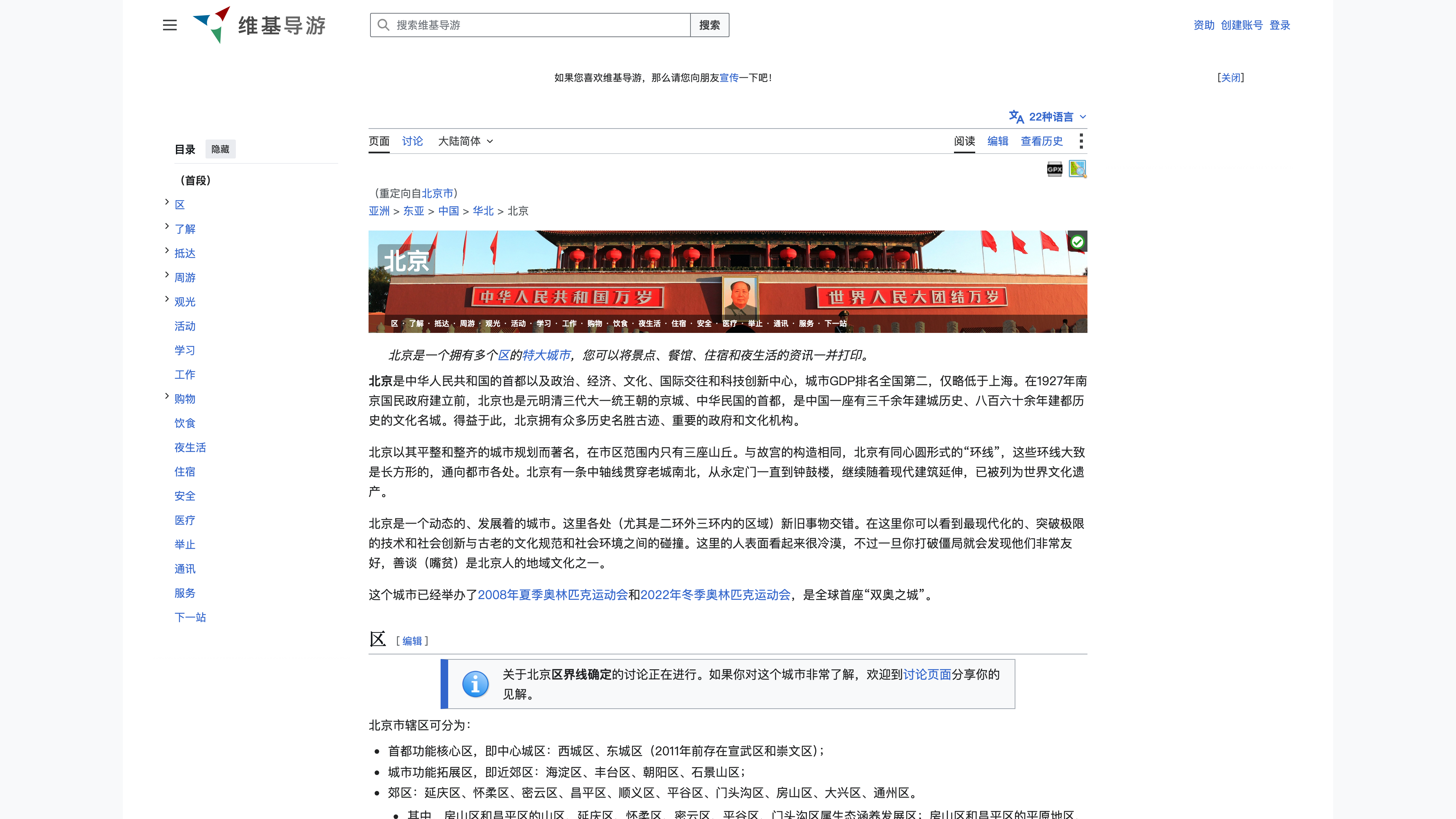
The screenshot above shows the Chinese article on Beijing. The breadcrumb reads "亚洲 > 东亚 > 中国 > 华北 > 北京" (Asia > East Asia > China > North China > Beijing), and the body follows the same section template as the English edition. Tabs at the top of the page switch between Simplified and Traditional Chinese variants. The editing community is small: about 20,000 registered users and 7 administrators.
Copyright and content policy
All text contributions to Wikivoyage are licensed under Creative Commons Attribution-ShareAlike 4.0 (CC BY-SA 4.0). Unlike Wikipedia, it is not dual-licensed under the GFDL — a deliberate choice to simplify compliance for printed publications. Anyone may copy, modify, print or even sell the guides, provided they credit the authors and share derivative works under the same terms; regular database dumps are published on the Wikimedia downloads site, and the content works offline with tools such as Kiwix. Images are mostly hosted on Wikimedia Commons under their own licenses, with a small number kept locally under Wikivoyage's non-free content policy.
Because it runs on the same MediaWiki software as Wikipedia, the editing barrier is low: most pages can be edited without an account, and vandalism is typically reverted within minutes. The project also states plainly that it offers no warranty of accuracy — hotels close, timetables change, and travelers should verify critical details before departure.
Good use cases
- Building a quick mental map of a destination before a trip: districts, transport, where to stay and safety notes on one page
- Printing or carrying offline: the free license permits printing, and database dumps support offline use
- Reading about destinations and niche topics that commercial guidebooks skip, such as a specific hiking route or visa strategy
- Survival phrases from the phrasebooks while on the road
- Reusing travel content freely in apps, datasets or print projects
Limitations
- Uneven depth: the English edition has over 34,000 articles, but even in the large editions, obscure destinations often remain "outline" stubs; roughly four in five of the Chinese edition's 5,596 articles are still outlines (checked 2026-09-02).
- Freshness depends on volunteers: restaurant listings, prices and visa rules are updated on no fixed schedule, and stale details persist until a passing editor notices them.
- No booking or reviews: Wikivoyage deliberately avoids hotel booking, user ratings and photo streams; readers used to Tripadvisor-style review ecosystems need to verify elsewhere.
- Promotional editing is a known risk: coverage at launch noted the incentive for businesses to plug themselves, so in-article recommendations deserve a critical eye.
- Small Chinese community: only a few dozen active editors, so Chinese-language content grows and gets maintained slowly.
Comparable sites
- Wikitravel: the "parent" site Wikivoyage forked from, still commercially operated by Internet Brands with advertising, and now less actively updated than Wikivoyage.
- Lonely Planet: a traditional guidebook publisher with professional authors and editorial review — a complementary model for depth and curation.
References
- Wikivoyage:About (project scope, fork history, editing model; checked 2026-09-02)
- Wikivoyage (English Wikipedia article) (Wikitravel origins, 2012 merger, 27 editions and 146,773 articles, lawsuit and settlement; checked 2026-09-02)
- Wikivoyage:Copyleft (CC BY-SA 4.0 licensing and disclaimer; checked 2026-09-02)
- Special:Statistics (English edition) (34,542 content pages; checked 2026-09-02)
- Special:Statistics (Chinese edition) (5,596 content pages, 43 active users; checked 2026-09-02)
- 维基导游:关于 (Chinese About page) (project self-description; checked 2026-09-02)