Wikipedia is a free online encyclopedia that anyone can edit: articles are readable without an account, and most can be modified by clicking "Edit." Its content is written by volunteers rather than a professional editorial staff. Launched on January 15, 2001, it has been hosted since 2003 by the Wikimedia Foundation, a U.S. nonprofit funded mainly by reader donations, and carries no advertising. As of 2026-09-02, Wikipedia comprises 348 language editions with 68,239,485 articles in total and draws more than 1.5 billion unique device visits per month, making it the largest reference work ever assembled.
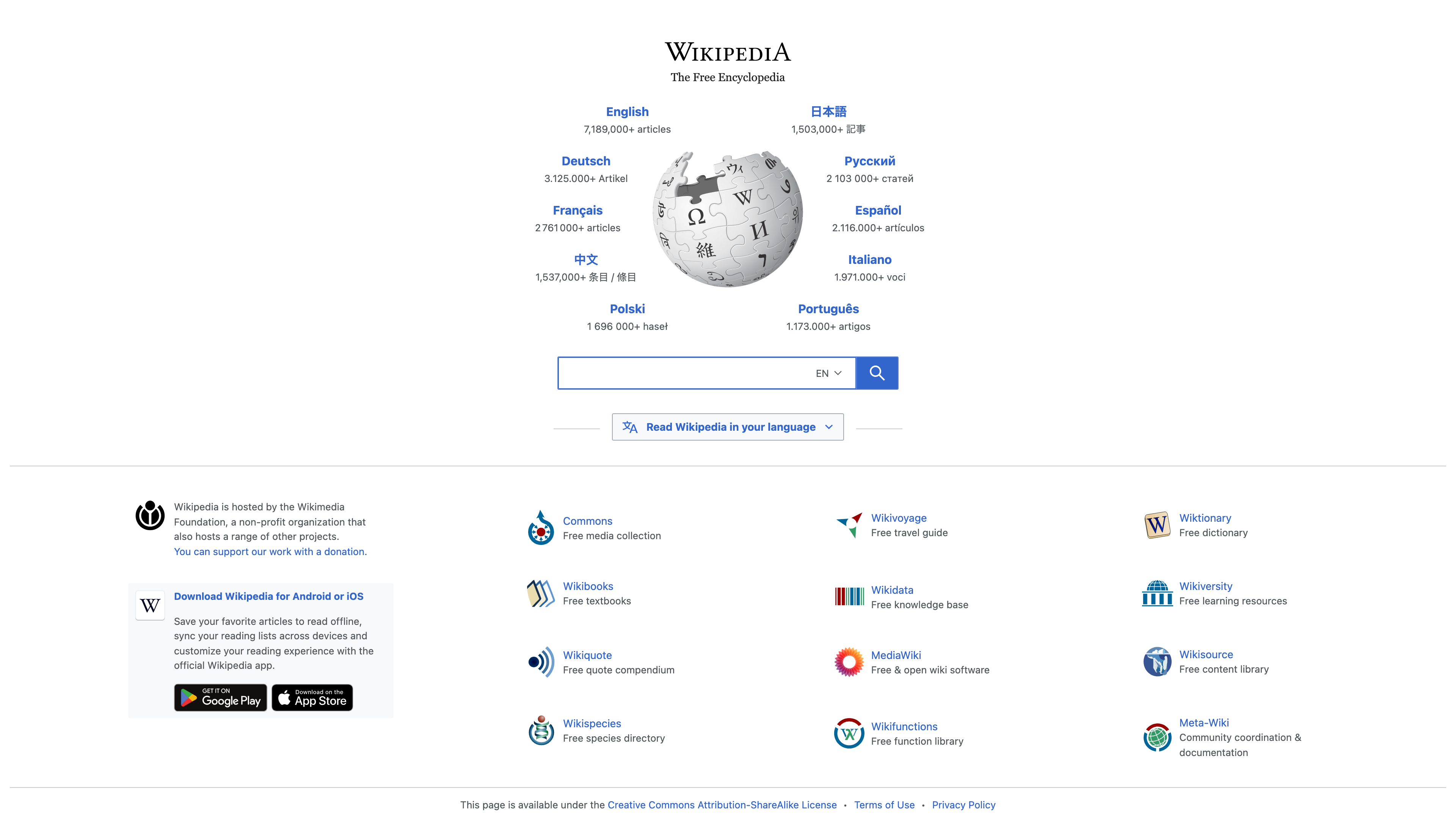
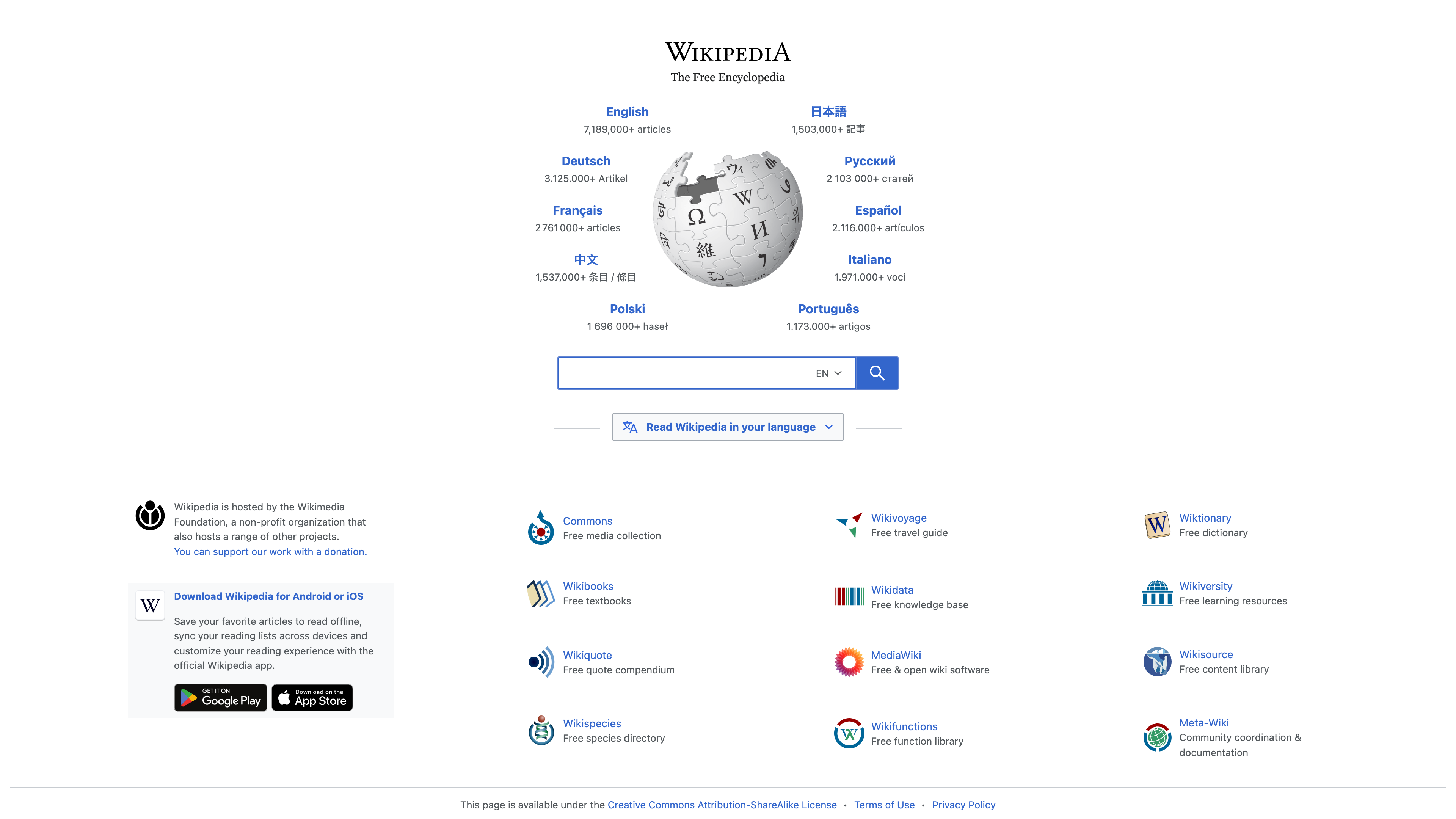
The image above shows the language portal at wikipedia.org: the puzzle globe is ringed by the largest editions by article count (English 7.18M+, Japanese 1.5M+, Chinese 1.53M+, and others), with a cross-language search box in the middle. Sister projects such as Wiktionary and Wikibooks are listed at the bottom, alongside a note that the site is hosted by the nonprofit Wikimedia Foundation.
At a glance
- URL: https://www.wikipedia.org/ (portal); individual editions follow the pattern https://en.wikipedia.org, https://zh.wikipedia.org
- Type: Multilingual online encyclopedia (volunteer-built UGC)
- Cost: Free, no advertising
- Registration: Not required for reading; most articles can be edited without an account, while registering unlocks additional editing and personalization features
- Languages: 348 language editions, including Chinese (with Simplified/Traditional conversion)
- Launched: January 15, 2001
- Operated by: Wikimedia Foundation, a U.S. 501(c)(3) nonprofit
Background
Wikipedia grew out of Nupedia, an earlier project of Jimmy Wales and colleagues that sought a free, expert-written encyclopedia but progressed slowly. On January 10, 2001, Larry Sanger proposed on the Nupedia mailing list a wiki-based "feeder" project; Wikipedia launched five days later as a single English edition at wikipedia.com, a date now celebrated as "Wikipedia Day." (Source: the Wikipedia article)
The Wikimedia Foundation was created in 2003 to take over hosting and infrastructure. It is a U.S. 501(c)(3) tax-exempt nonprofit that, in its own words, is funded "mostly by donations averaging $11 from readers," relies on neither advertising, subscription fees, nor selling user data, and has its financial statements audited annually by an independent firm.
Scale and composition
As of 2026-09-02, Wikipedia's 348 language editions hold 68,239,485 articles combined. The six largest editions are English, Cebuano, German, French, Swedish, and Dutch — the high article counts of editions like Cebuano coming largely from bot-created species and geography stubs. The English Wikipedia alone has 7,234,394 articles, and the Chinese Wikipedia has 1,553,143 (both checked on 2026-09-02).
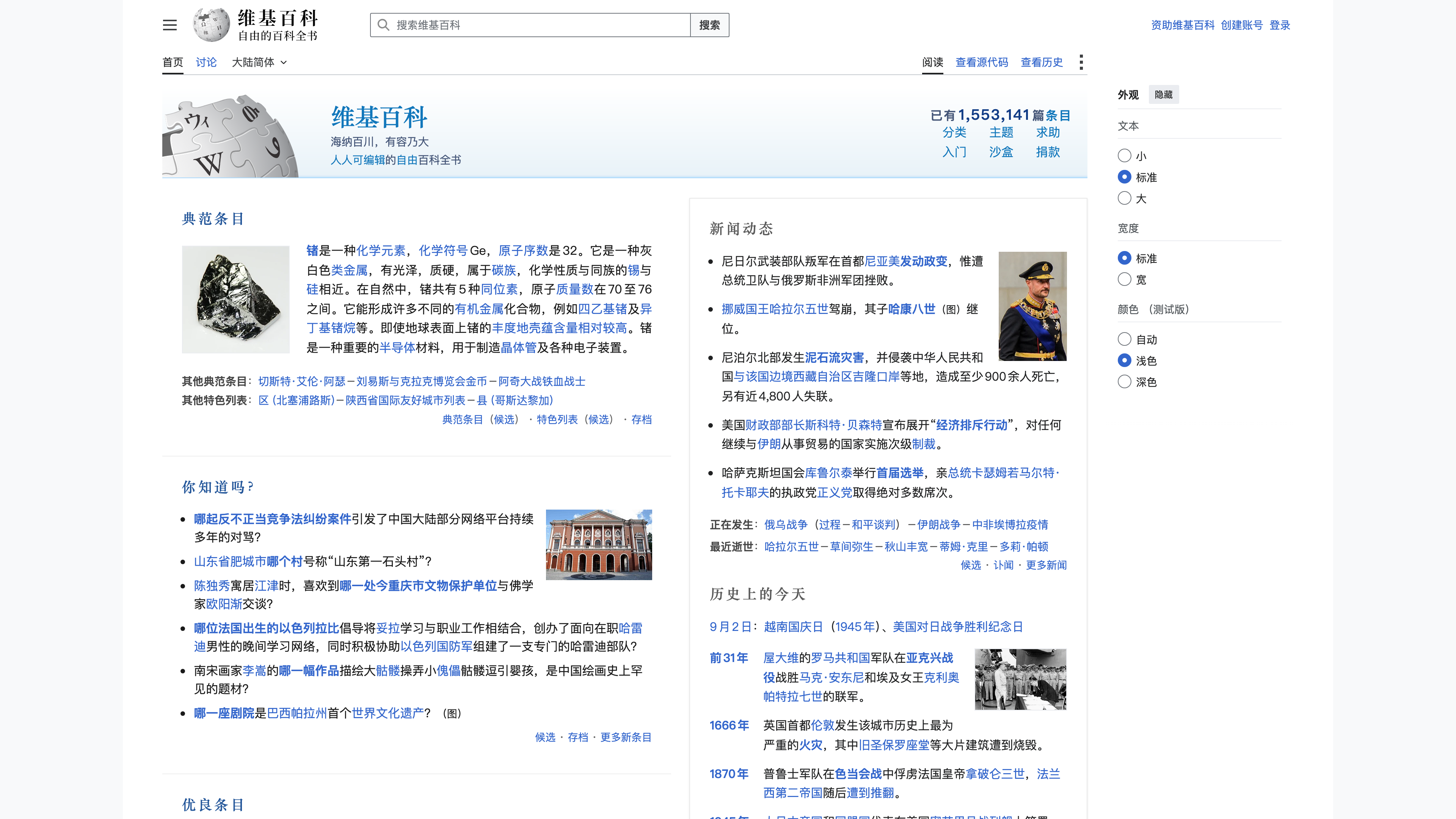
Each language edition is maintained independently rather than translated mechanically from one master copy. The image above shows the Chinese Wikipedia main page, with featured-article and "did you know" sections on the left, current news and historical anniversaries on the right, and tabs at the top to convert between Simplified and Traditional Chinese.
How content is written and maintained
Articles are written and curated by volunteers known as Wikipedians. Core content policies include a neutral point of view, verifiability through reliable sources, and no original research. Except for protected pages and a few other cases, anyone with internet access can edit an article; on the English and some other editions, creating a new article directly requires an account that is four days old with ten edits. Every revision is publicly logged, and disputes are worked out on discussion pages. (Source: Wikipedia:About)
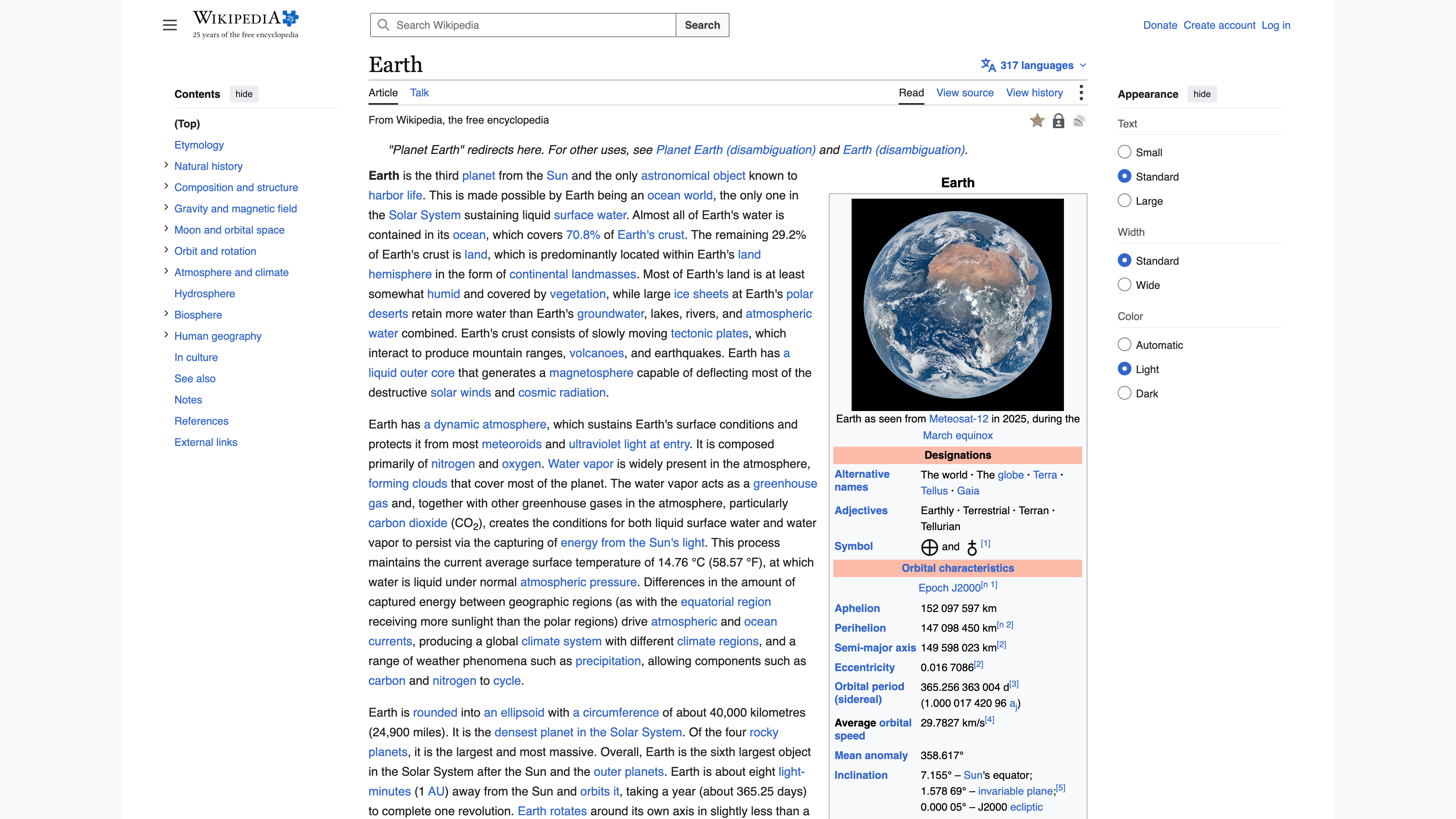
The image above shows the English article "Earth": a collapsible table of contents on the left, blue links to other articles throughout the text, an infobox summarizing key data on the right, and a "317 languages" link at the top to read the same topic in other editions.
Copyright and content policy
Wikipedia's text is licensed under Creative Commons Attribution-ShareAlike 4.0 (CC BY-SA 4.0), with most text also dual-licensed under the GNU Free Documentation License (GFDL); media files such as images carry individual licenses that must be checked one by one. In practice this means anyone may copy, modify, and republish article text as long as they credit the source and share derivatives under the same terms — which is why Wikipedia lawfully underpins countless mirrors, datasets, and training corpora.
Good for
- Getting a quick, sourced overview of an unfamiliar concept, person, or event
- Following an article's references to reach primary sources
- Comparing how different language editions cover the same topic
- Offline reading, by downloading the entire encyclopedia through tools like Kiwix
Limitations
- Not directly accessible in mainland China: the Chinese edition has been blocked since May 2015 and all language editions since April 2019; Myanmar has blocked the site since February 2021, and North Korea has no public internet access at all. (Source: Censorship of Wikipedia)
- Uneven quality: open editing means popular articles are usually well maintained, while obscure ones can be outdated, thin, or biased; academia generally discourages citing Wikipedia directly, though it is accepted as a starting point for research.
- Editorial disputes: hot-button topics can see long-running edit wars, and some pages end up locked or editing-restricted.
- Mixed media licensing: the article text is freely reusable, but each embedded image needs its own license check.
Alternatives
- Encyclopaedia Britannica: the expert-written, mostly subscription-based online edition of the traditional encyclopedia — a complement to Wikipedia's volunteer model.
- Baidu Baike: Baidu's Chinese-language encyclopedia, accessible in mainland China, with different review processes and a commercial operating model.
References
- Wikipedia language portal (checked 2026-09-02)
- Wikipedia:About (editing model and content policies)
- Wikipedia (English article) (history, 348 editions / 68,239,485 articles, monthly unique devices)
- Special:Statistics (English), Special:Statistics (Chinese) (article counts)
- Wikimedia Foundation: About (nonprofit status and donation model)
- Wikimedia Terms of Use (CC BY-SA 4.0 licensing)
- Censorship of Wikipedia (regional access restrictions)