WhoSampled is a database that documents how songs are connected through samples, cover versions and remixes: if a drum break or melody in a track sounds familiar, you can look up where it came from and who has reused it since. Founded by Nadav Poraz and launched in London on 1 October 2008, it differs from algorithm-based recognition services in that every entry is submitted by a community member and reviewed by a human moderator before going live. As of 2026-09-02, the homepage cites over 1,373,000 songs and 429,000 artists in the catalogue, built by more than 43,000 contributors, and the site describes itself as "the world's largest database of sampled music, remixes and cover songs". In November 2025, WhoSampled was acquired by Spotify; the site and brand continue to operate as a standalone platform.
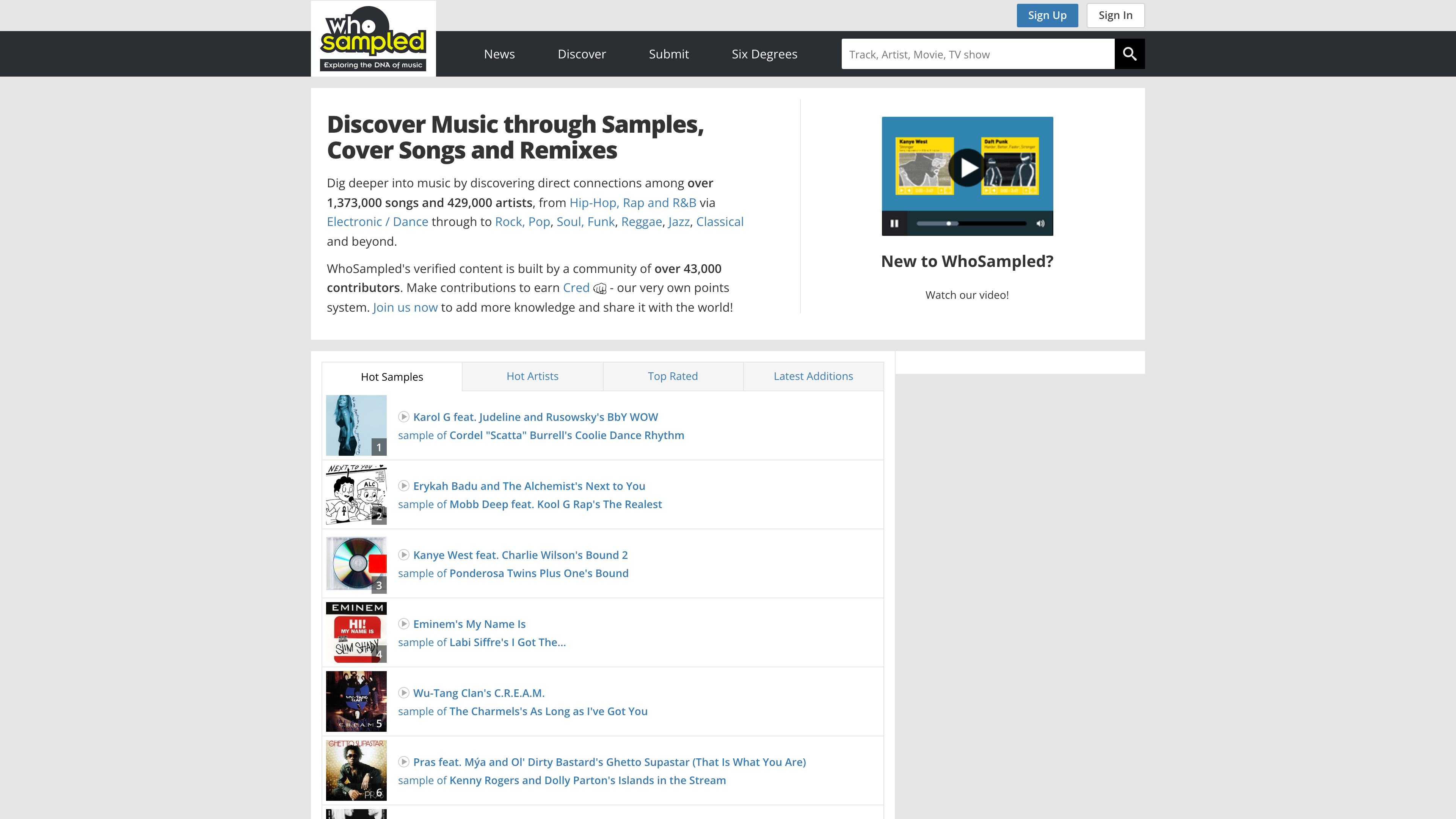
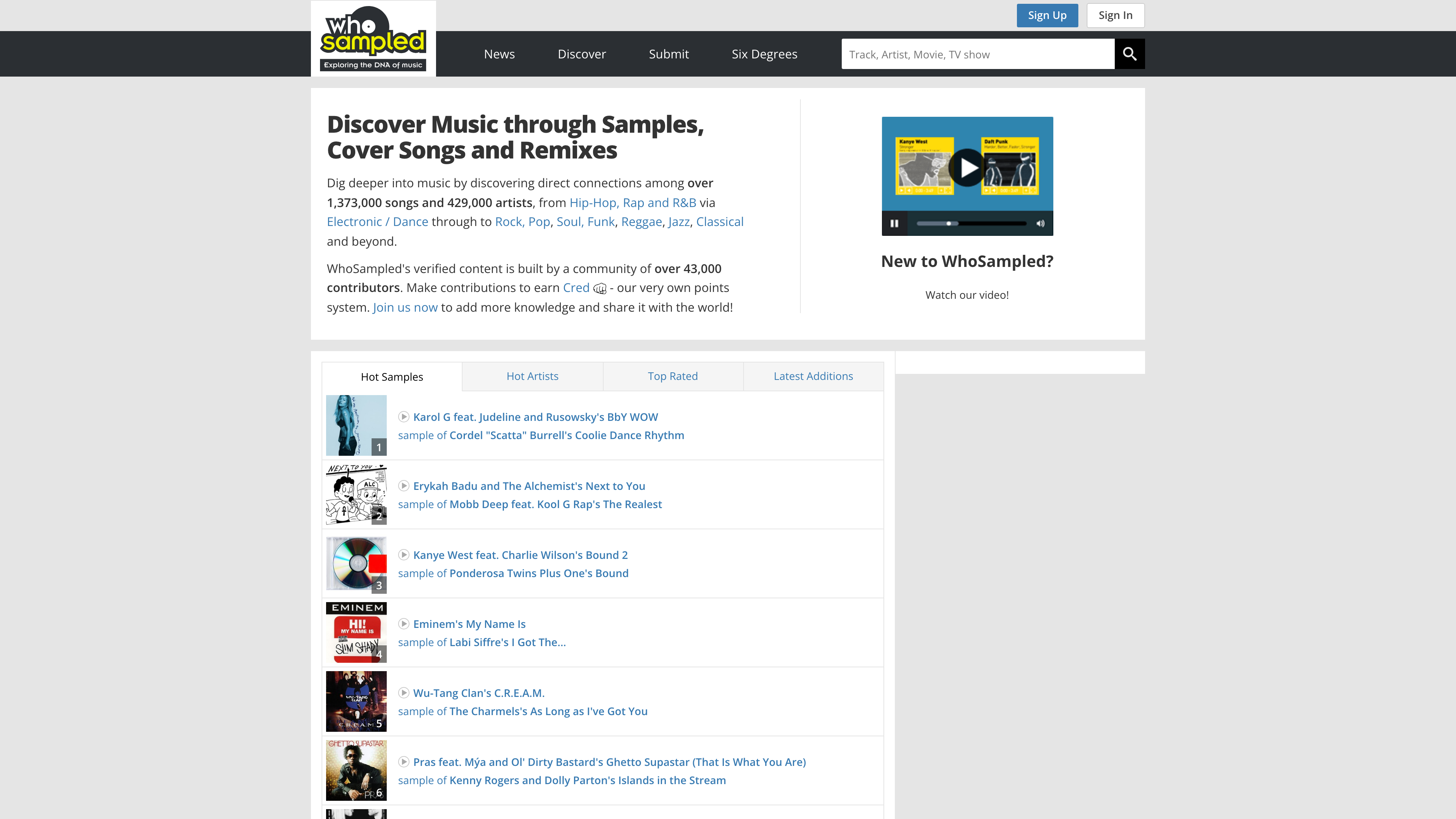
The screenshot above shows the homepage (captured 2026-09-02): the top navigation includes News, Discover, Submit and Six Degrees, and the search box accepts tracks, artists, movies and TV shows. The hero section states the catalogue's size (over 1.37 million songs, 429,000 artists, 43,000 contributors), while charts such as Hot Samples list trending connections — for example, Kanye West's Bound 2 sampling Bound by Ponderosa Twins Plus One. No display ads appear on the page, consistent with the acquisition announcement's promise that the site would go ad-free.
At a glance
- URL: https://www.whosampled.com/
- Type: music sample/cover/remix relationship database (community-submitted, human-moderated)
- Cost: free to browse; after the November 2025 acquisition the operators announced the removal of display ads and made the mobile apps free, including previously paid in-app subscriptions (formerly US$9.99/year, per MusicRadar)
- Registration: not required for browsing; an account is needed to submit entries, comment and rate
- Interface language: English only
- Launched: 1 October 2008, London
- Operator: a Spotify subsidiary since November 2025; the team remains in London
Background
Nadav Poraz started WhoSampled in London in 2008 to answer a question every music listener knows: "Where have I heard that sound before?" Key milestones below are sourced from the WhoSampled Wikipedia article and official pages:
- 1 October 2008: the site launches.
- 2012 / 2014: the iPhone and Android apps arrive.
- 2015: the database expands beyond music to samples taken from film and TV clips.
- 2016: a partnership with Spotify lets the app read users' Spotify playlists and saved tracks; the same year saw the launch of Six Degrees (6D), a game that maps how any two artists are linked through samples, covers and remixes.
- 19 November 2025: WhoSampled announces it is joining Spotify. The team of around ten and the entire database moved over; terms were not disclosed. At the time the catalogue held roughly 1.25 million songs, 622,000 samples, 460,000 covers and 140,000 remixes (per PPC Land). Promised changes included faster moderation, the removal of display ads within weeks, and free apps with free in-app subscriptions for everyone (per TechCrunch).
- From March 2026: Spotify's SongDNA began rolling out to Premium users, showing a song's collaborators, samples, interpolations and covers as an interactive map inside the Now Playing view — data Spotify says is partly "community-sourced", i.e. powered by WhoSampled.
What the database offers
Each track page classifies relationships into four types: direct samples (a portion of the actual source recording), interpolations or replayed samples (the melody is re-performed rather than lifted from the recording), covers and remixes; since 2015 the database also covers dialogue and score sampled from films and TV shows. Entries link to one another, so you can keep following the "samples of" and "sampled in" directions indefinitely.
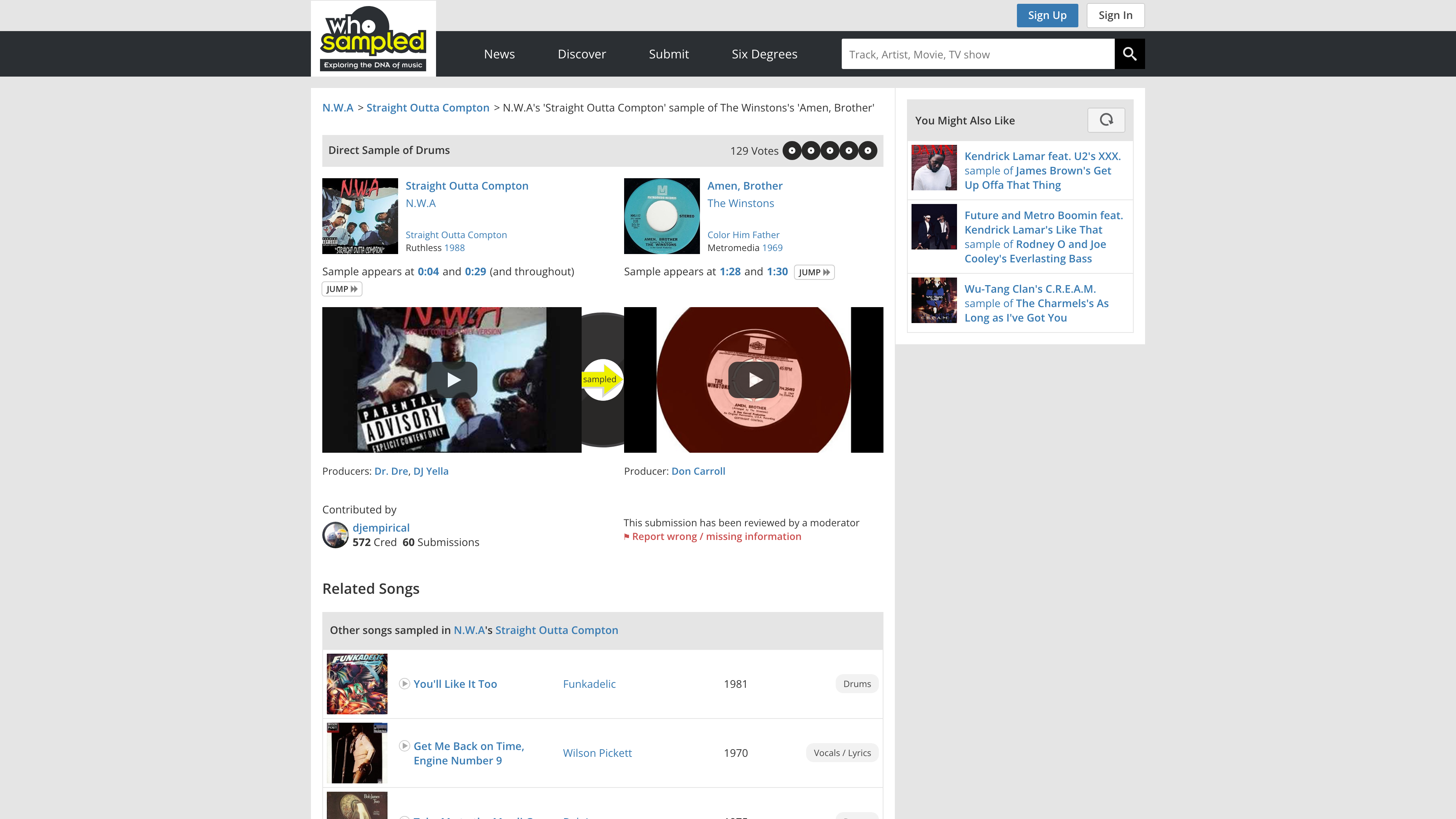
The screenshot above shows a typical sample entry (captured 2026-09-02): N.W.A's Straight Outta Compton (1988) on the left, The Winstons' Amen, Brother (1969) on the right, labelled Direct Sample of Drums, with the exact moments the sample appears in each recording (0:04 and 0:29 versus 1:28 and 1:30). Both tracks can be played inline for comparison, and the entry footer shows the contributor, their Cred score and a note that the submission "has been reviewed by a moderator".
The site's most famous case is Amen, Brother itself: its roughly six-second drum solo — the "Amen Break" — is regarded as the most sampled break in music history, and the track's page carries the tag Sampled in More Than 7000 Songs (confirmed in the 2026-09-02 screenshot). Official partner material describes James Brown as the most sampled artist of all time.
Beyond entry-by-entry lookup, the site offers:
- Six Degrees: enter any two artists and get the chain of samples, covers and remixes connecting them; permanently linked in the top navigation.
- Mobile apps (iPhone / Android): scan your device and streaming libraries to surface the connections behind songs you already own, and identify music playing around you (per the official Apps page).
- Charts and discovery: Hot Samples, Top Rated and Latest Additions on the homepage.
Community and moderation
All data is submitted by registered users, queued, and approved by volunteer moderators before going live; submitters are notified by email either way. Submission rules restrict entries to commercially released music, require direct samples to be clearly identifiable (single drum hits are not accepted), interpolations to be distinctive and clearly intentional, and covers to have artistic value. Embeds are limited to YouTube/VEVO, Spotify, SoundCloud, DailyMotion and Bandcamp, and must point to content made available under licence from the copyright holder. Contributions are tracked through a points system called Cred: an approved sample earns 10 points, a cover or remix 3, and moderating entries also earns Cred; points cannot be spent and are deducted if the content is later removed. (Source: the official FAQ.)
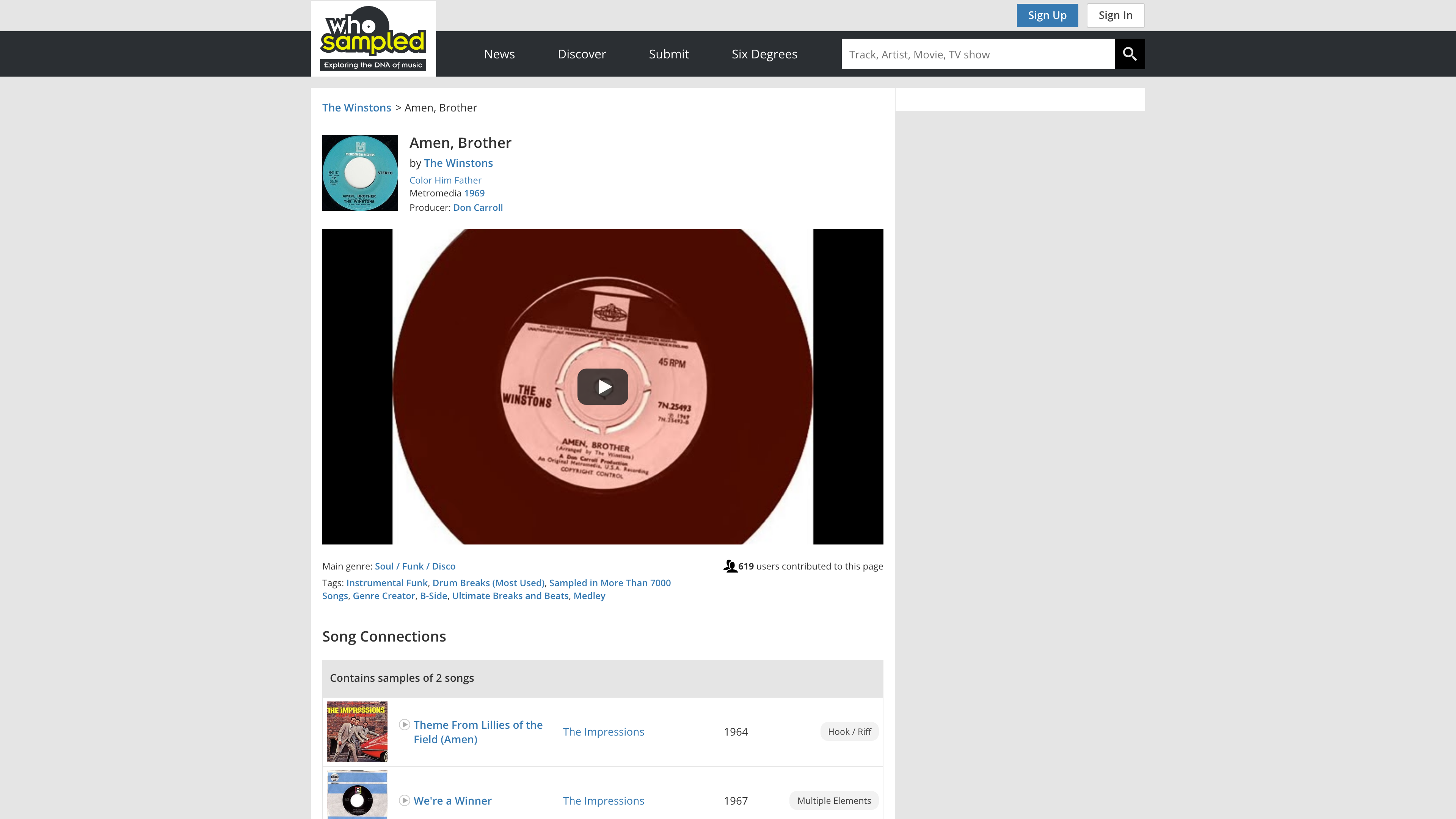
The screenshot above is the Amen, Brother track page (captured 2026-09-02): the counter reads 619 users contributed to this page, and the tag list includes Drum Breaks (Most Used), Sampled in More Than 7000 Songs and Ultimate Breaks and Beats. A 1969 B-side whose entry has been refined by hundreds of hands is a neat illustration of how the community model works in practice.
Copyright and content policy
WhoSampled does not host music files: in-page playback comes from licensed embeds on the whitelisted platforms above, and the entries themselves consist of factual metadata (who sampled whom, timestamps, release information) plus user discussion. A Copyright / DMCA page handles infringement notices, and the submission rules require users to link only to content authorised by the rights holder (source: the official FAQ).
One nuance worth knowing: the database records the fact that a sample exists, not that it was cleared. When the Spotify acquisition was announced, parts of the community raised a "sample snitching" concern — that under a large platform's ownership, the catalogue could make artists with uncleared samples easier for rights holders to pursue (per Mixmag Asia).
Where it fits
- Identifying the origin of a familiar break, riff or vocal you recognise in a newer track
- Producers and DJs researching classic breaks and the sources of sampled material
- Music fans crate-digging along sample chains, or playing Six Degrees for fun
- Writers, podcasters and researchers verifying "who sampled whom" and pinpointing exact timestamps for comparison
Limitations
- English only: the interface, discussions and submission rules are all in English.
- Coverage skews towards sample-heavy genres: hip-hop, electronic and R&B are deepest; coverage elsewhere depends on community interest.
- Moderation latency on new content: entries queue for human review, so relationships for brand-new releases may be incomplete; the operators say moderation has been accelerated since the acquisition.
- No public API: there is no developer API; bulk or commercial access happens only through bespoke partnerships (all examples on the official Apps page are custom collaborations).
- Community data can diverge from official records: entries are moderated but still occasionally disputed or corrected; every page offers a "Report wrong / missing information" link.
- Independence concerns under Spotify ownership: some community members remain uneasy about the data being held by a major streaming platform (see "Copyright and content policy" above).
Similar sites
- SecondHandSongs: a database focused on cover-version lineage, complementing WhoSampled's sample-centric view.
- Discogs: a community-built release database centred on physical pressings and the marketplace; it does not map sample relationships.
- Genius: a lyrics and annotation community where individual song notes may mention samples, but not in a structured database form.
References
- WhoSampled homepage (catalogue size and contributor count, checked 2026-09-02)
- WhoSampled FAQ (submission rules, moderation queue, Cred, embed whitelist and DMCA, checked 2026-09-02)
- WhoSampled Apps page (mobile app capabilities and official partnerships, checked 2026-09-02)
- WhoSampled is Joining Spotify! (acquisition announcement, 2025-11-19)
- TechCrunch: Spotify acquires music database WhoSampled (deal details and promised changes, 2025-11-19)
- Spotify newsroom: Meet SongDNA (SongDNA beta and data sourcing, 2026-03-24)
- WhoSampled on Wikipedia (founding date, app years, 2015 film/TV expansion, 2016 partnership and 6D)
- PPC Land: Spotify acquires WhoSampled music database (catalogue breakdown at acquisition time, 2025-11-19)