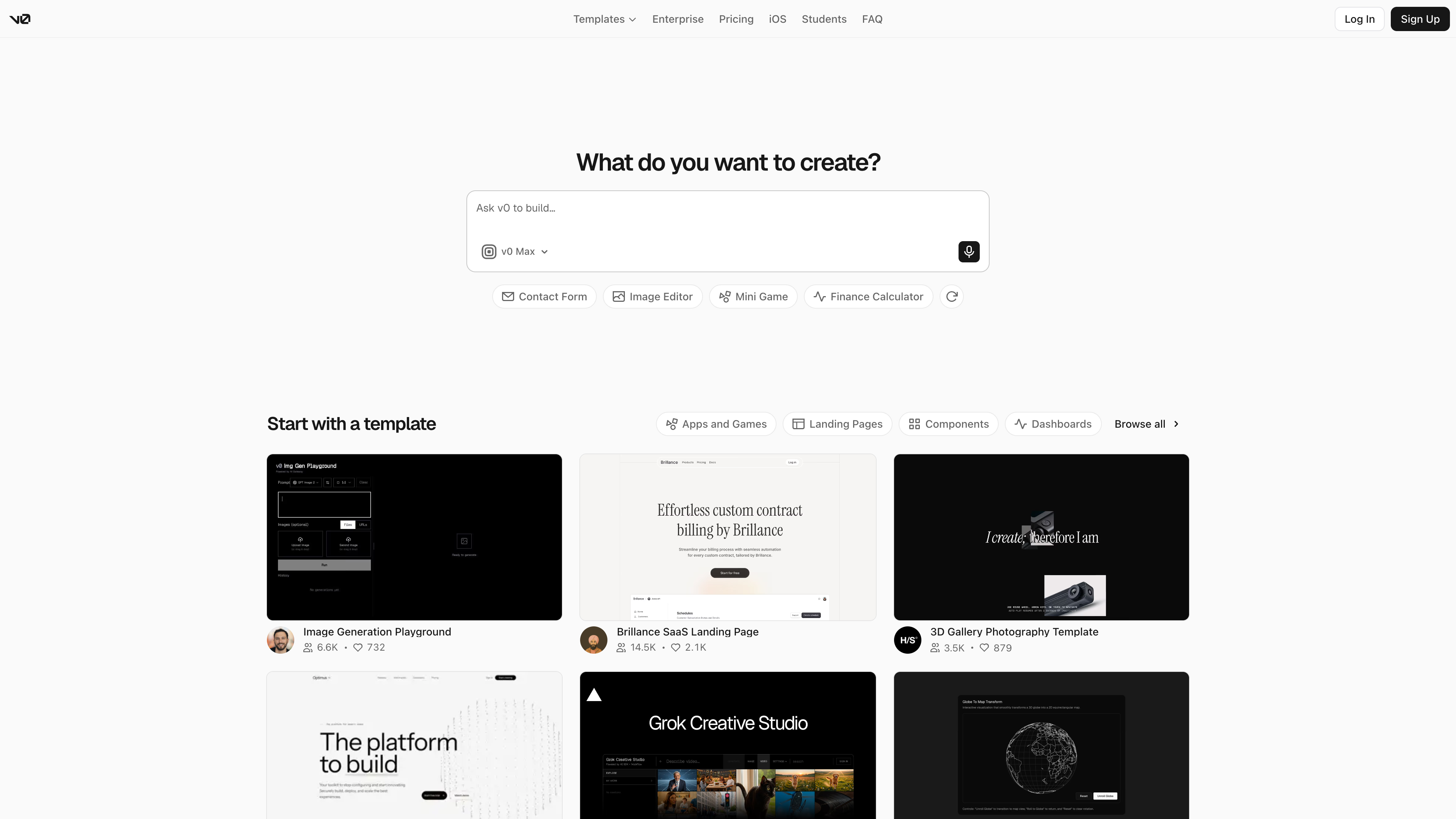
v0 (v0.app) is an AI development platform run by Vercel. You describe what you want in plain language — or upload a screenshot, wireframe, or Figma design — and it generates a working full-stack web application on a fixed stack of Next.js, React, TypeScript, Tailwind CSS, and shadcn/ui (official docs). The problem it tackles is compressing the entire idea-to-production path into one interface: what you get is not a code snippet but a complete project with a live preview, database integrations, and one-click deployment to Vercel's production infrastructure. Its verifiable differentiator among AI app builders is how deeply it is wired into the Vercel ecosystem: previews run in a Vercel Sandbox that matches production, publishing goes straight through Vercel's deployment pipeline, and the GitHub integration creates branches, commits, and merges pull requests automatically. The original v0.dev domain now 307-redirects to v0.app (checked 2026-09-16).
At a glance
- URL: https://v0.app (v0.dev redirects)
- Type: AI full-stack app builder (conversational generation + online editing + hosted deployment)
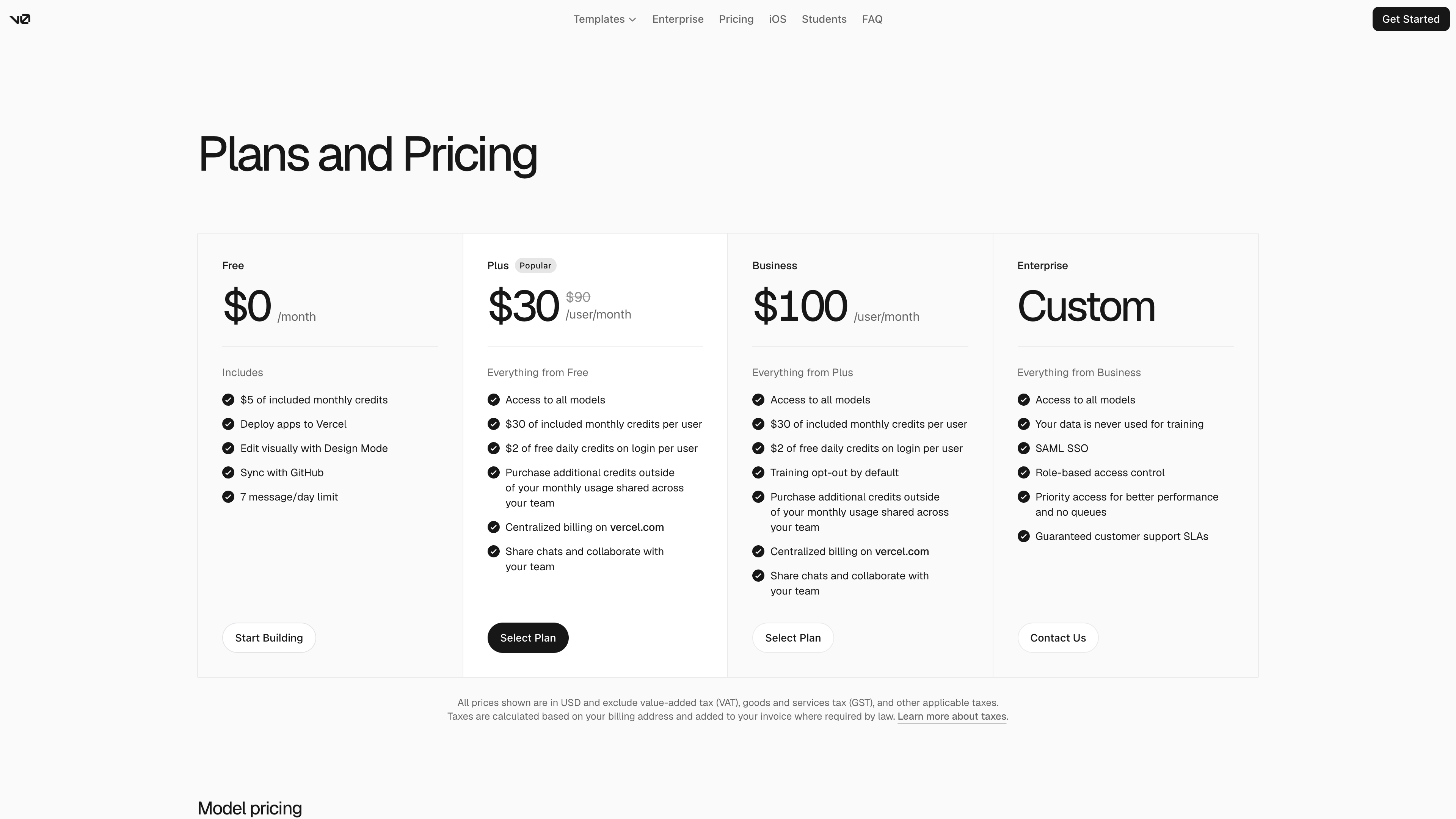
- Cost: Free plan at 5 of monthly credits); Plus 100/user/month; Enterprise custom — see the pricing page (as of 2026-09-16)
- Sign-up: Browsing the site, template gallery, and docs needs no account; generating apps requires sign-in, and an existing Vercel account works directly (official FAQ)
- Language: Interface and docs are English-only; prompts can be written in any language and v0 replies in the same language (official FAQ)
- Launched: Fall 2023 as v0.dev (moved from Alpha to Beta on 2023-10-11); renamed v0.app on 2025-08-12
Background
v0 comes from Vercel, the company behind the Next.js framework and the hosting platform of the same name. Its first incarnation was much narrower than today's product: it appeared in September 2023 as a waitlist-based Alpha called "Generative UI," whose pitch was producing interface code built with React, Tailwind CSS, and Shadcn UI from natural-language prompts, which you then copied into your own project. According to Vercel's blog, 100,000 people joined the waitlist within three weeks of the Alpha, and on 2023-10-11 v0 moved from Alpha to Beta and got its first subscription tiers (Vercel blog).
Two turning points reshaped it after that:
- August 12, 2025: v0.dev became v0.app, shifting from a UI generator to an agentic product that Vercel says can research, plan, and debug on its own — aimed not just at developers but at "founders, designers, marketers, sales" and other non-coding roles (Vercel blog).
- February 4, 2026: the release v0 calls the "New v0 Update" landed with four structural changes: Git integration (import an existing GitHub repo and v0 handles branching and commits), Projects (chats tied to real deployments, environment variables, and domains), a full VS Code-style editor built in, and new previews powered by Vercel Sandbox — the preview environment matches production, so server-side code, API routes, and databases actually run (official FAQ, last updated March 2026).
As of 2026-09-16, the official changelog still shows multiple updates per month; recent entries include team-workspace default sharing settings (Sep 10) and a unified branch-and-publish flow (Sep 1).
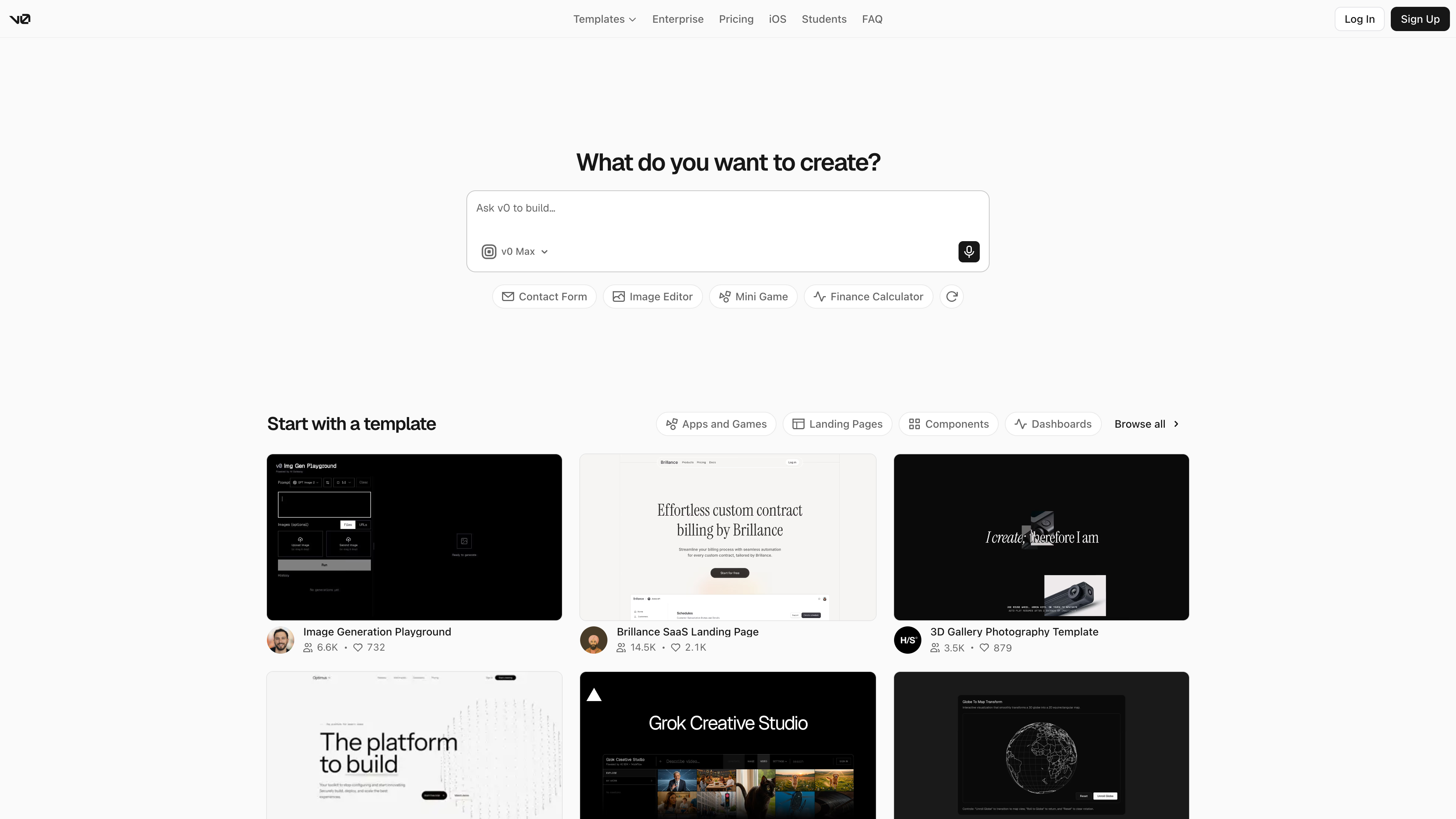
The homepage mirrors the product's shape: the core of the page is a single prompt box (with a model picker — v0 Max shown), followed by community templates you can copy to get started.
Core workflow: from one sentence to production
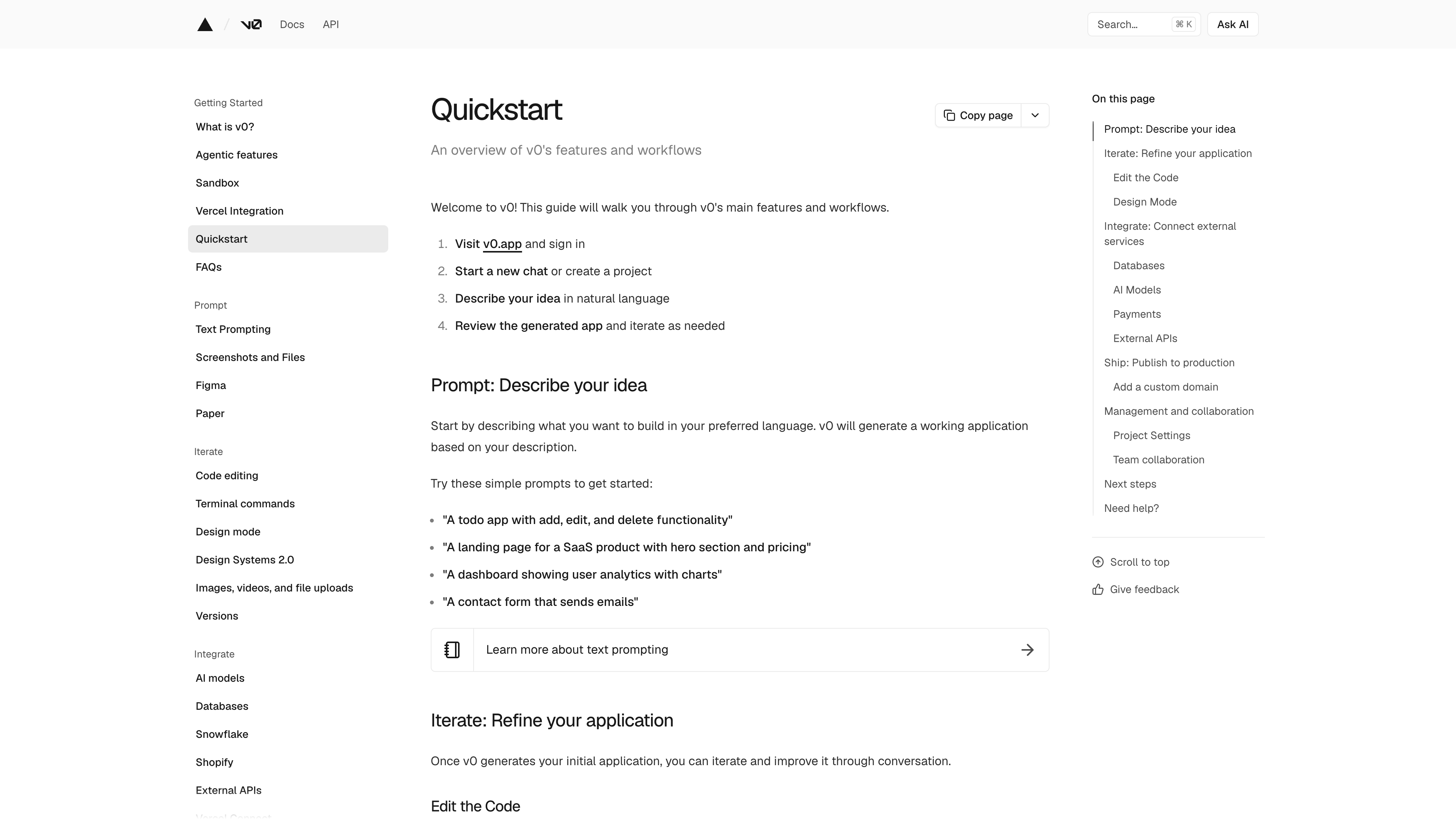
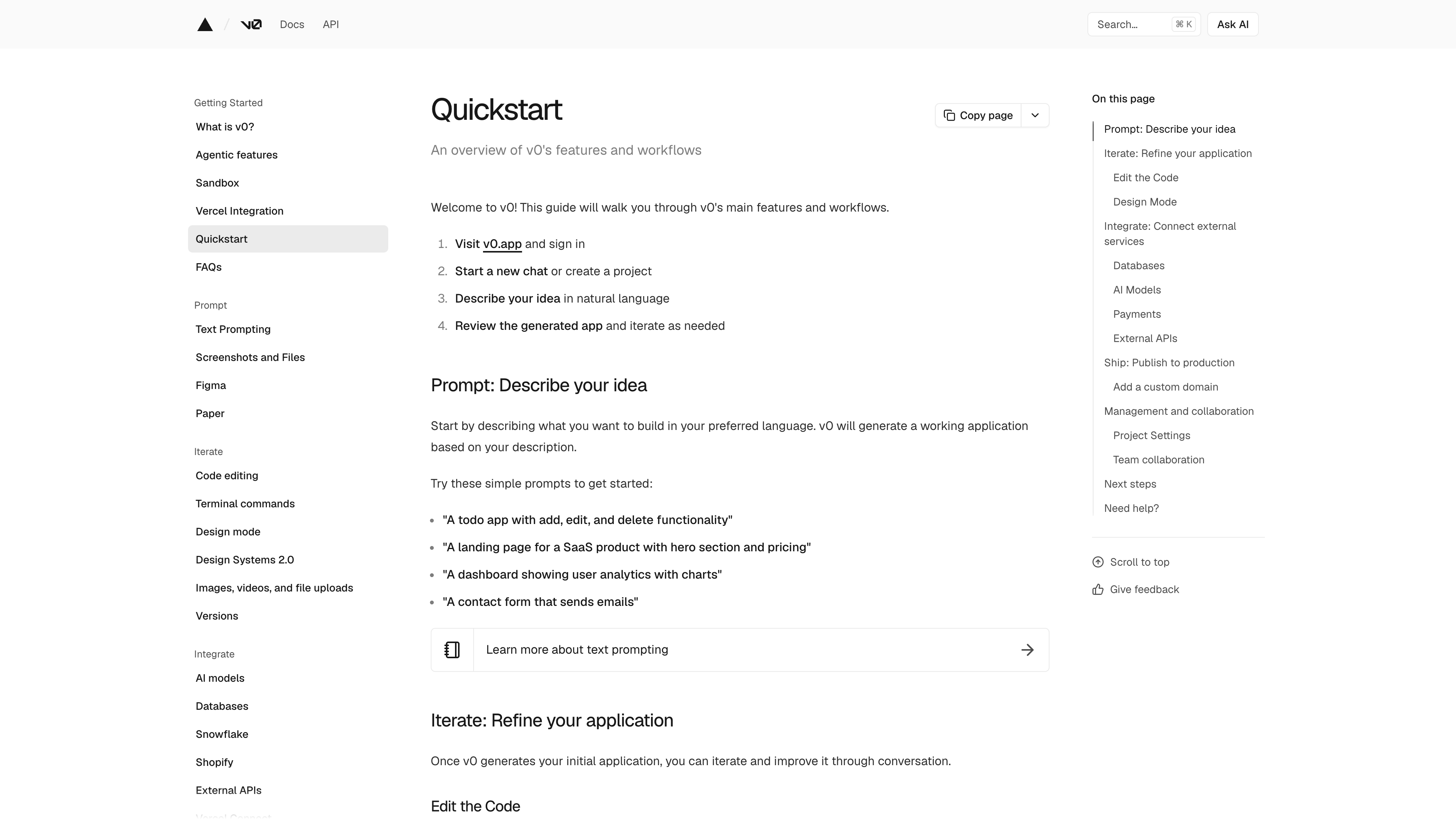
v0's full loop is "prompt, iterate, integrate, ship" (official quickstart):
- Describe the idea in your preferred language; alternatively upload screenshots, wireframes, or Figma designs, or duplicate a starter from the template gallery.
- Iterate conversationally: the generated app runs live in the preview, and you refine it with follow-up prompts; you can also switch to the Code view or the built-in editor to change code directly, with every step saved as a restorable version.
- Fine-tune visually in Design Mode: select any element in the preview and adjust typography, color, spacing, borders, radius, shadows, or even text content from a panel; for structural changes, type a natural-language instruction and v0 automatically attaches a screenshot of the selected element. When the project uses Tailwind CSS, the panel surfaces Tailwind-compatible values. Edits stay pending until you apply them back to the source code (Design Mode docs).
- Connect real services: one-click integrations from the project settings — databases (Neon, Supabase, Upstash Redis, Vercel Blob), payments (Stripe), AI features (Vercel AI Gateway configures keys automatically and exposes hundreds of models; Grok, fal, and Deep Infra install in one click), and arbitrary external APIs such as Twilio, with keys managed as environment variables.
- Publish: hit Publish to deploy to Vercel, with support for connecting or buying custom domains.
When a project is connected to GitHub, publishing becomes a full engineering pipeline: v0 creates a working branch per chat (named like v0/main-abc123) and commits each change; every branch gets its own Vercel preview deployment and CI checks. On Publish, v0 creates or reuses the pull request, merges it into the base branch, and waits for the production deploy — it never pushes to main directly, branch protections and required reviews still apply, and v0 can attempt to fix conflicts or CI failures (GitHub integration docs). Existing codebases can be imported from GitHub and worked on directly in v0.
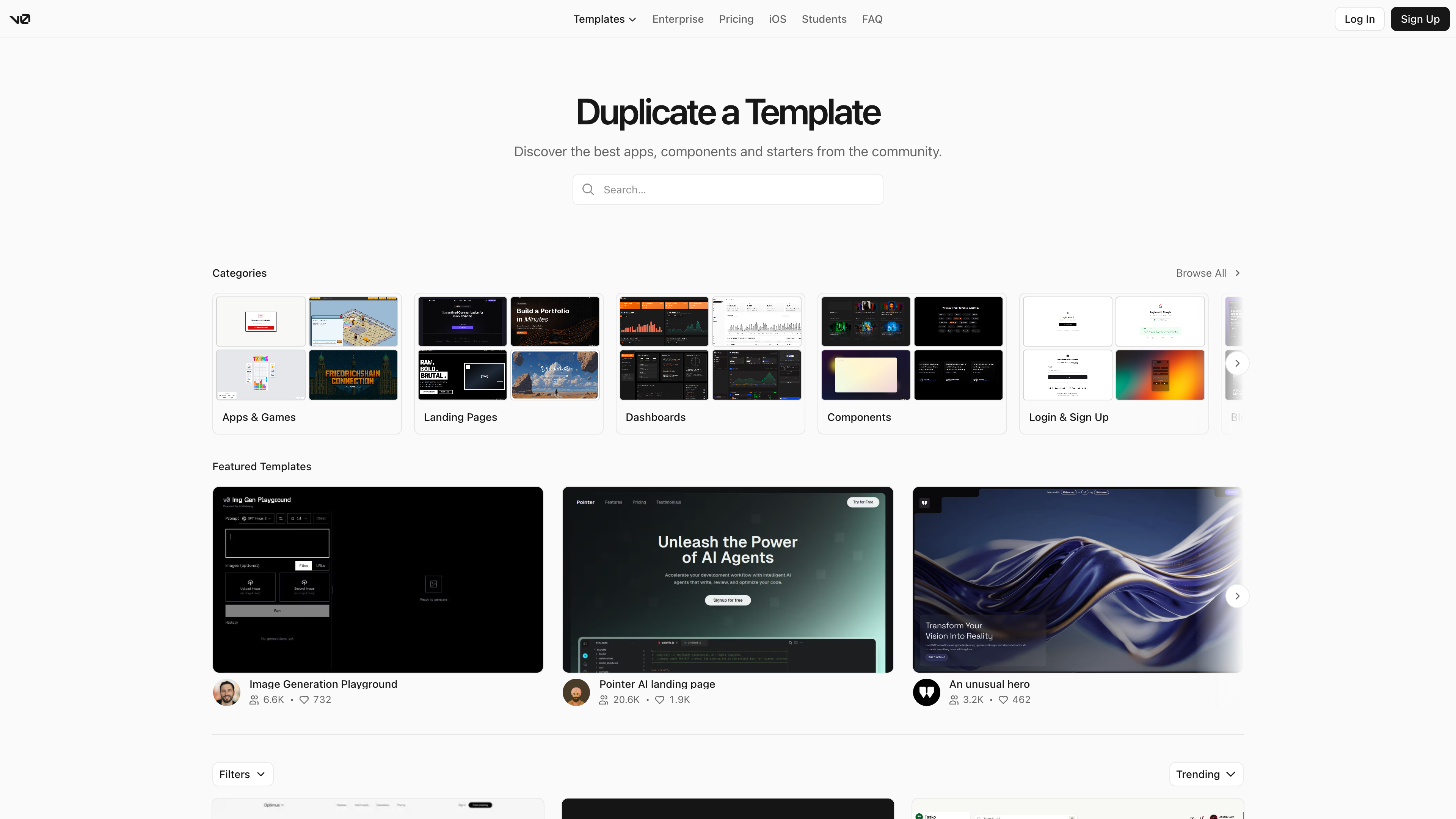
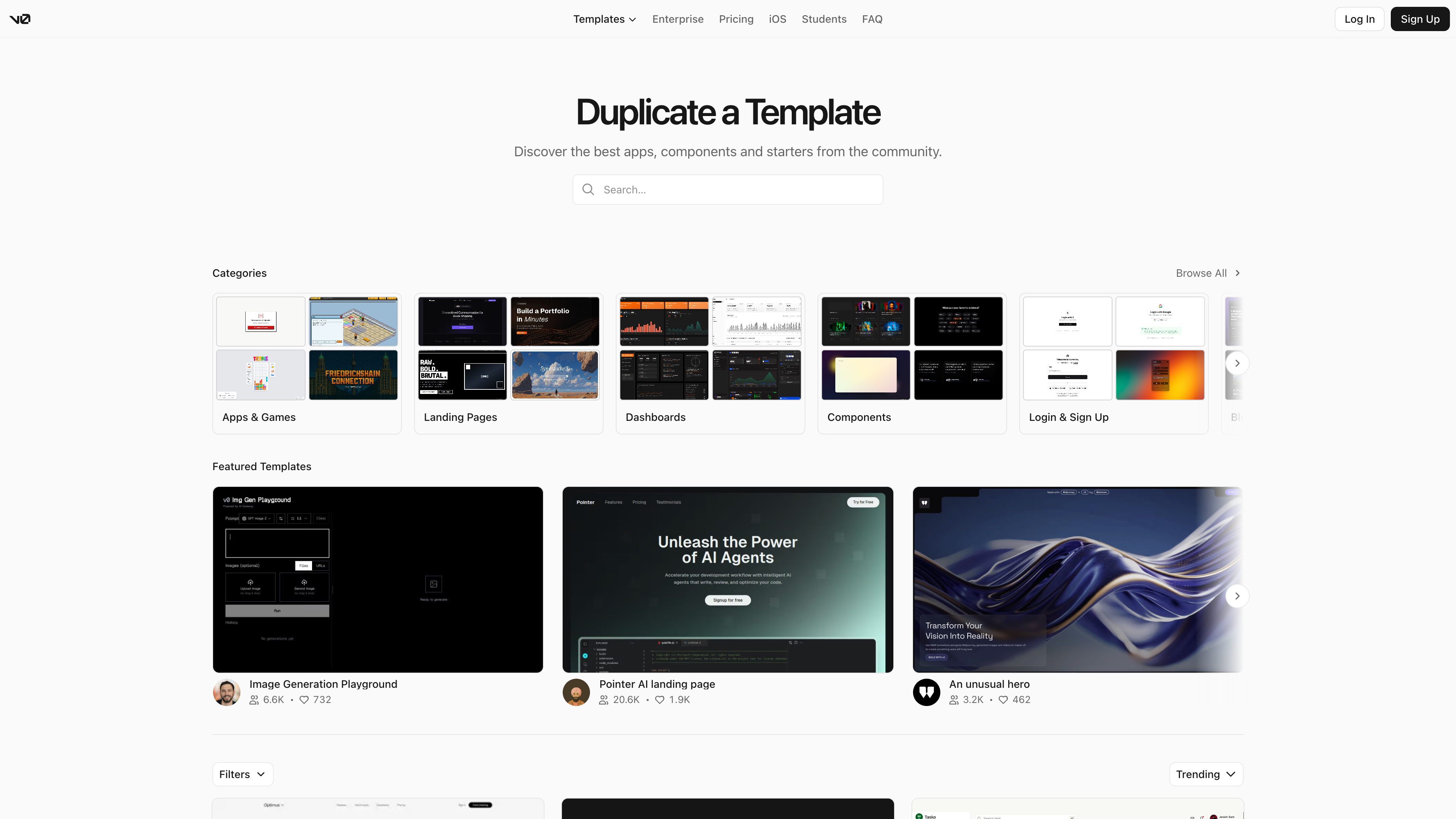
The public gallery (v0.app/templates) collects apps, components, and starters published by the community; anyone can duplicate one and keep building, and you can publish your own project as a template from its settings.
Accounts, API, and mobile
- Accounts: v0 shares Vercel's account system — an existing Vercel account signs straight in. Team collaboration (shared chats, centralized billing, per-seat pricing) is available on Plus and above; Enterprise adds SAML SSO and role-based access control.
- v0 API: the generation capability is exposed as an API — one call creates a complete app from a prompt, with the
@v0-sdk/reactcomponents, embeddable secure preview iframes, an MCP server, and annpx create-v0-sdk-appscaffold, so you can build "AI app generation" into your own product (v0 API docs). - Mobile: an official iOS app lets you start and continue chats, preview projects, manage environment variables, and connect GitHub from a phone; configuring new MCP servers still requires desktop (official FAQ).
- Docs: the documentation site (v0.app/docs) is fully readable without an account, from quickstart to security practices.
Pricing: subscriptions plus credits (as of 2026-09-16)
v0 meters usage through subscription tiers plus credits (pricing page; USD, taxes excluded):
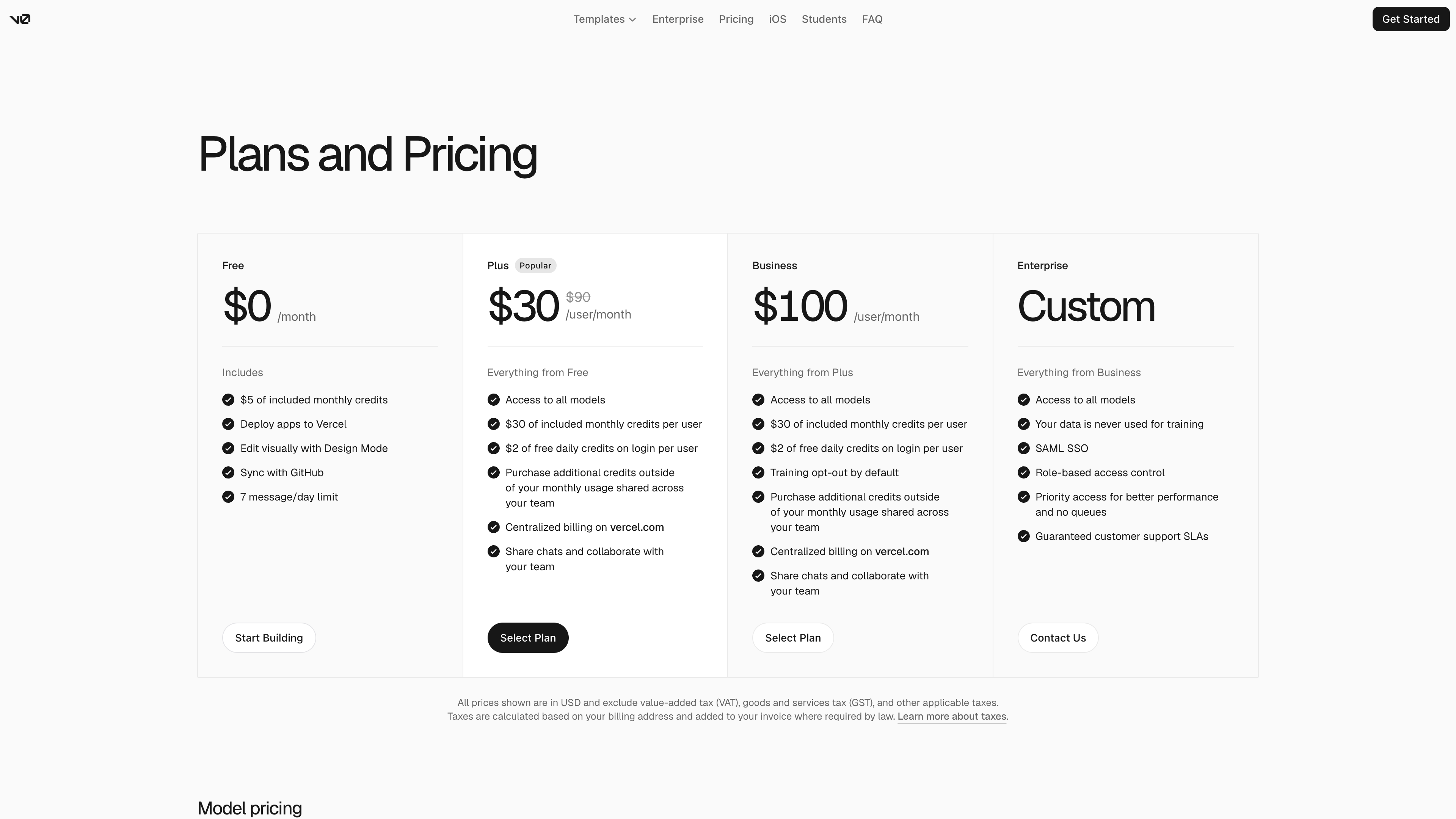
| Plan | Price | Highlights |
|---|---|---|
| Free | $0 | $5 of monthly credits, 7 messages/day; deploy to Vercel, Design Mode, GitHub sync included |
| Plus | $30/user/month | All models; 2 of free daily login credits; buy extra credits shared across the team; centralized billing on vercel.com; team collaboration |
| Business | $100/user/month | Everything in Plus; training opt-out by default |
| Enterprise | Custom | Data never used for training; SAML SSO; role-based access control; priority performance and support SLAs |
Model usage is billed from credits per token, across four model tiers: v0 Mini (1.20 output per 1M tokens), v0 Pro (10), v0 Max (25), and v0 Max Fast (50). The FAQ also mentions a $20/month Premium plan that "is in the process of being sunsetted and is no longer available to new users."
Data and generated-code policies
Two sets of terms are worth reading before adopting a platform like this (official FAQ and security docs):
- Training data: by default, v0 may use the prompts and content you submit to improve its models. Content from Enterprise customers is never used for training, the Business plan opts out by default, and other users can opt out manually in their Vercel settings. Data from Vercel's platform services — deployments, the CLI — is not used to train v0.
- Ownership of generated code: Vercel states it does not own the code generated from your prompts. It also notes that output may be similar to other users' output, may be incomplete, or contain bugs — you are responsible for judging whether it is fit for commercial use.
- Security and compliance: generated code is security-analyzed before execution and runs in isolated sandboxes; v0 is covered by Vercel's SOC 2 Type 2 attestation and states GDPR compliance.
Who it's for
- Product and design roles: build interactive, high-fidelity prototypes without writing code — the result is a running app, not a static mock, and Design Mode allows element-by-element styling without code.
- Engineers: skip scaffolding and boilerplate, generate a first version with v0, then move it into a normal engineering flow through GitHub PRs — or share one repository with local tools like Cursor or Claude Code.
- Teams on Next.js/React: v0's output is fixed to Next.js, React, TypeScript, Tailwind CSS, and shadcn/ui, so it connects to existing assets at the lowest cost for teams already on that stack.
- Developers embedding app generation in their own product: the v0 API and SDK are built for exactly that.
Limitations
- Tight free tier: 7 messages per day and $5 of monthly credits is enough for evaluation, not sustained use (as of 2026-09-16, pricing page).
- Vercel lock-in: the full experience — previews, environment variables, one-click deploys — depends on a Vercel project. Code can be exported and hosted elsewhere, but the integrated backend and publishing pipeline come with the platform.
- Fixed stack: output centers on Next.js/React, which makes it a poor fit for non-web projects or other stacks (the FAQ says popular frontend frameworks are supported, but best-in-class expertise is explicitly Next.js, React, Tailwind CSS, shadcn/ui, and the AI SDK).
- Output needs review: Vercel itself warns that generations may contain bugs or resemble other users' output; commercial use requires your own evaluation.
- Practical constraints: Design Mode is desktop-only; the platform requires an internet connection; the new previews run real builds and are admittedly a bit slower than the old browser-based ones; the UI and docs are English-only.
Alternatives
The closest peer already covered on this site is Lovable. The verifiable difference: Lovable bundles its backend (a Supabase-based stack) and hosting into its own platform and exports Vite + React code, while v0 runs natively on Vercel infrastructure with a fixed Next.js stack and offers an API for embedding app generation into third-party products. In Vercel's own comparison (FAQ): versus general-purpose LLMs, v0 produces deployable applications rather than code snippets; versus AI-augmented IDEs, it offers a conversational environment where the whole team can build.