Unsplash is a stock imagery platform built around free, high-resolution photography. It gives designers, developers, and content creators visuals they can use commercially without attribution, as an alternative to expensive licenses and restrictive terms at traditional stock agencies. Its verifiable distinguishing traits: images come from a community of over 429,000 contributors and are, according to the company, hand-selected by an editorial team; downloads do not require an account; and a free API powers integrations inside products like Medium, Trello, Squarespace, and Figma. Since March 2021, Unsplash has been owned by Getty Images and operates as a standalone brand and division within it.
At a Glance
- URL: https://unsplash.com/
- Type: Free stock photo and imagery platform (plus a paid Unsplash+ subscription)
- Cost: The free library costs nothing; Unsplash+ is 48/year (equivalent to $4/month, labeled a "Limited Launch Special" as of 2026-08-30)
- Registration: Optional — images can be downloaded without an account
- Interface languages: English and Spanish (no Chinese UI)
- Operator: Unsplash Inc., a Canadian corporation and Getty Images subsidiary
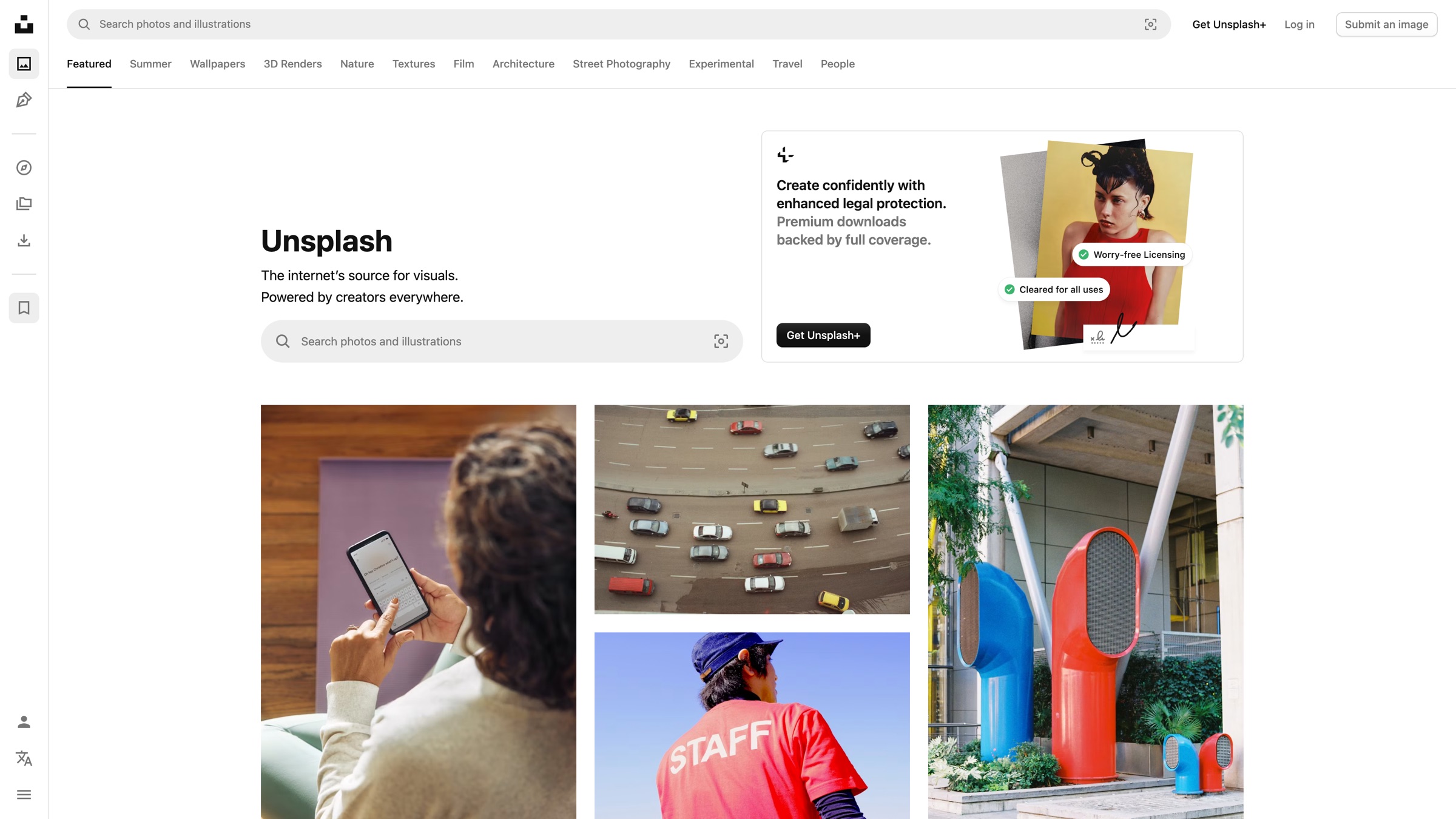
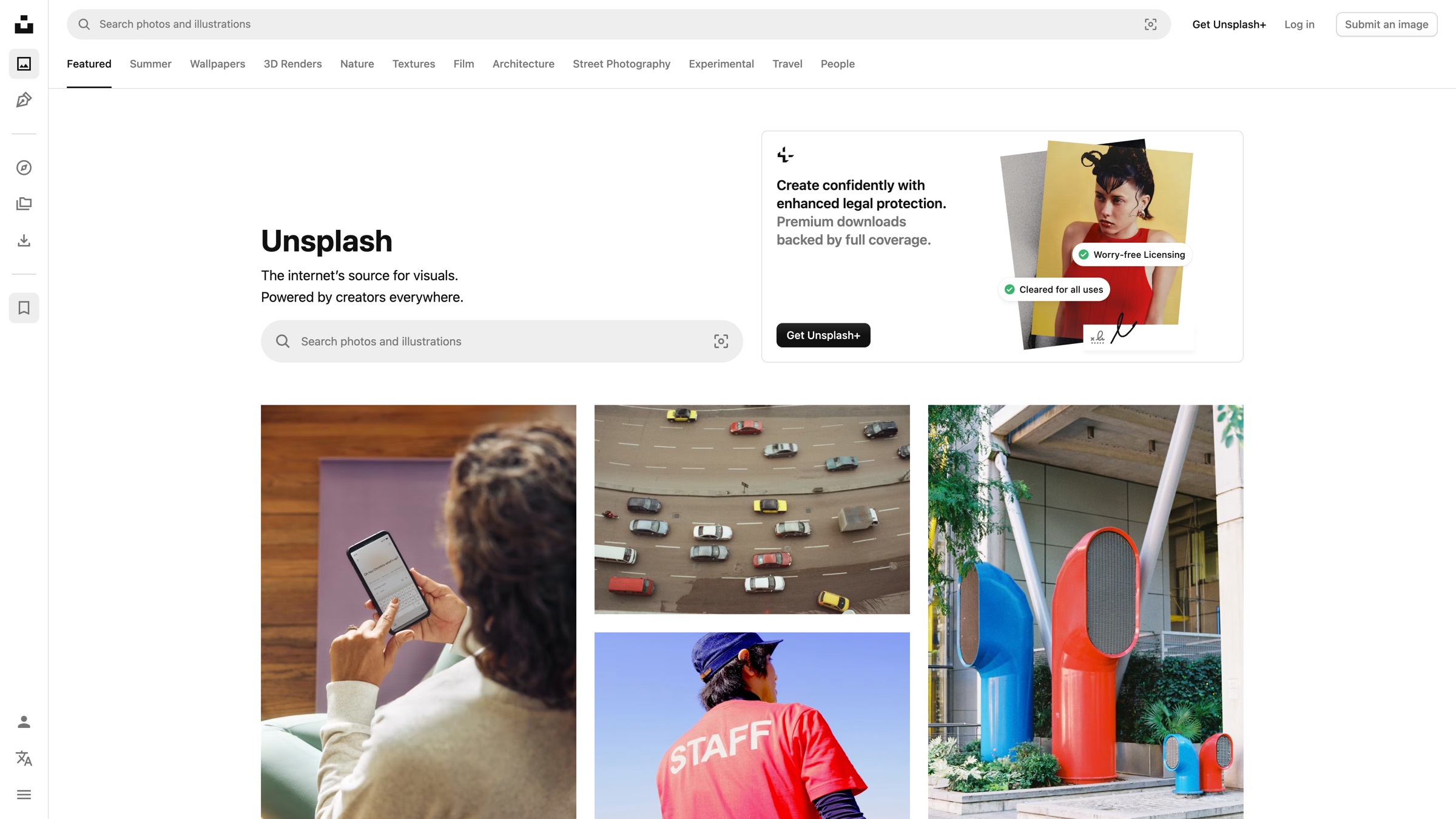
The homepage leads with a search bar and topic navigation (Nature, Architecture, Street Photography, 3D Renders, and more). The hero banner promotes the paid Unsplash+ subscription and its "enhanced legal protection"; the free library begins with the photo feed below.
Background
Unsplash launched in May 2013 as a side project of Crew, a startup based in Montreal, Canada: after a photo shoot for the company's own website, the team gave away ten unused photos alongside a $19 Tumblr theme, and the post hit the top of Hacker News on day one. The founders are Mikael Cho, Luke Chesser, Stephanie Liverani, and Angus Woodman. Key milestones, documented on the official History page:
- The free API launched in August 2015; Unsplash spun out of Crew as Unsplash, Inc. in January 2017 and announced an $8 million funding round in February 2018.
- On March 30, 2021, the company announced its acquisition by Getty Images for an undisclosed sum. The announcement stated Unsplash would continue operating as a standalone brand and division of Getty Images with the team staying on, a relationship also confirmed in a Getty Images newsroom release.
- The paid Unsplash+ subscription launched in October 2022, with an explicit promise that the free library "isn't going anywhere."
- On scale: the History page records 5 million images in April 2023 and one trillion cumulative image views in May 2023. The developers page lists, as of 2026-08-30, roughly 8.7 million images, 429,000 photographers, and over 29,000 integrated applications; the About page cites more than 7 billion cumulative downloads.
- Content types have expanded over time: 3D renders were accepted from October 2021, illustrations came to Unsplash+ in May 2024, and the free library began accepting vector illustrations in January 2025.
Core Features
Search and browsing: keyword search, topic-based browsing, and editorial curation. A Visual Search feature launched in January 2021 lets you drop in an image to find similar photos, topics, and the source image.
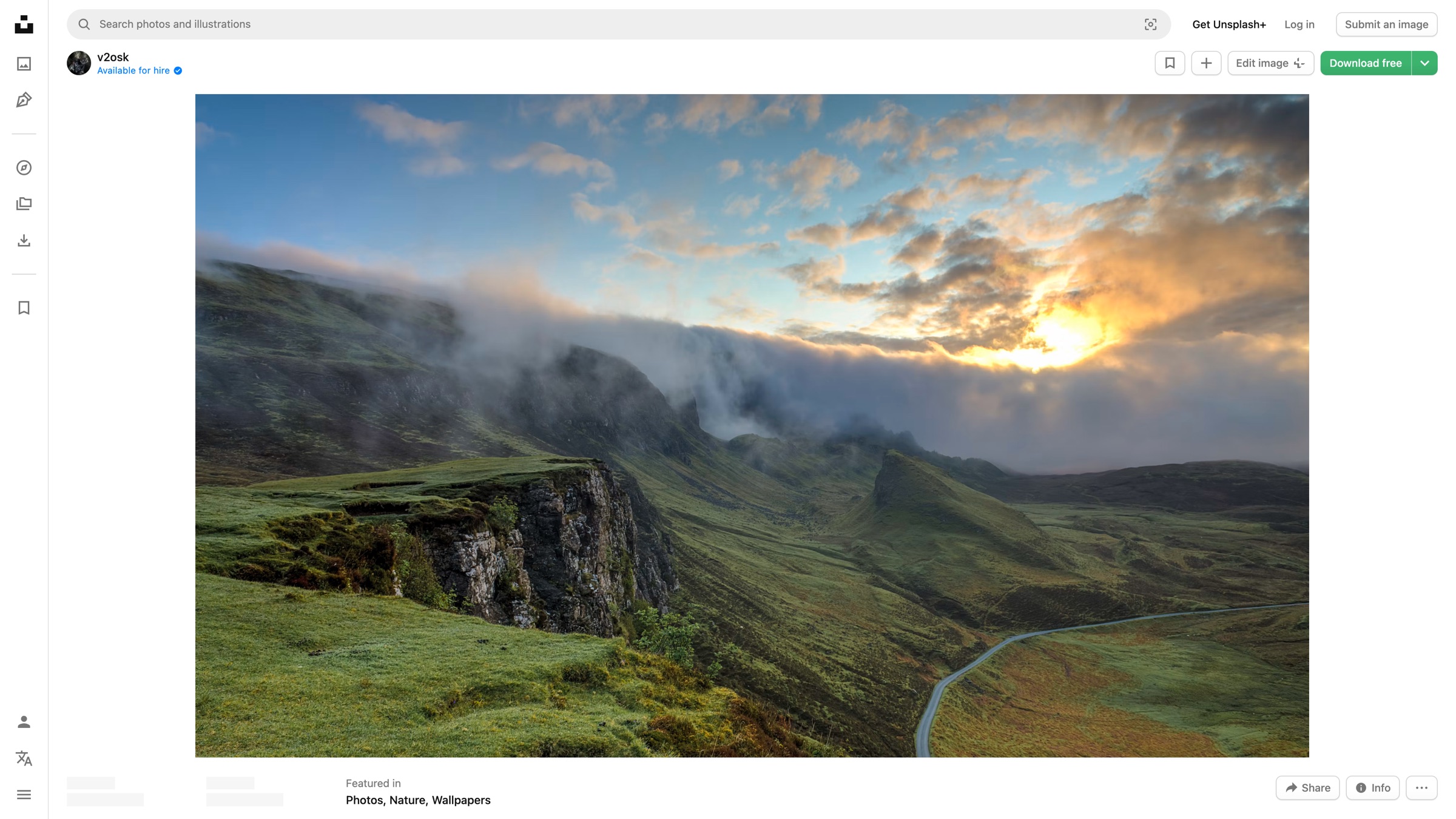
Downloads without an account: every photo page has a "Download free" button. Verified on 2026-08-30: in a logged-out session this button points to a working download URL with no registration wall. A free account adds likes, collections, and download history; photographers can submit work for exposure and display an "Available for hire" badge on their profiles.
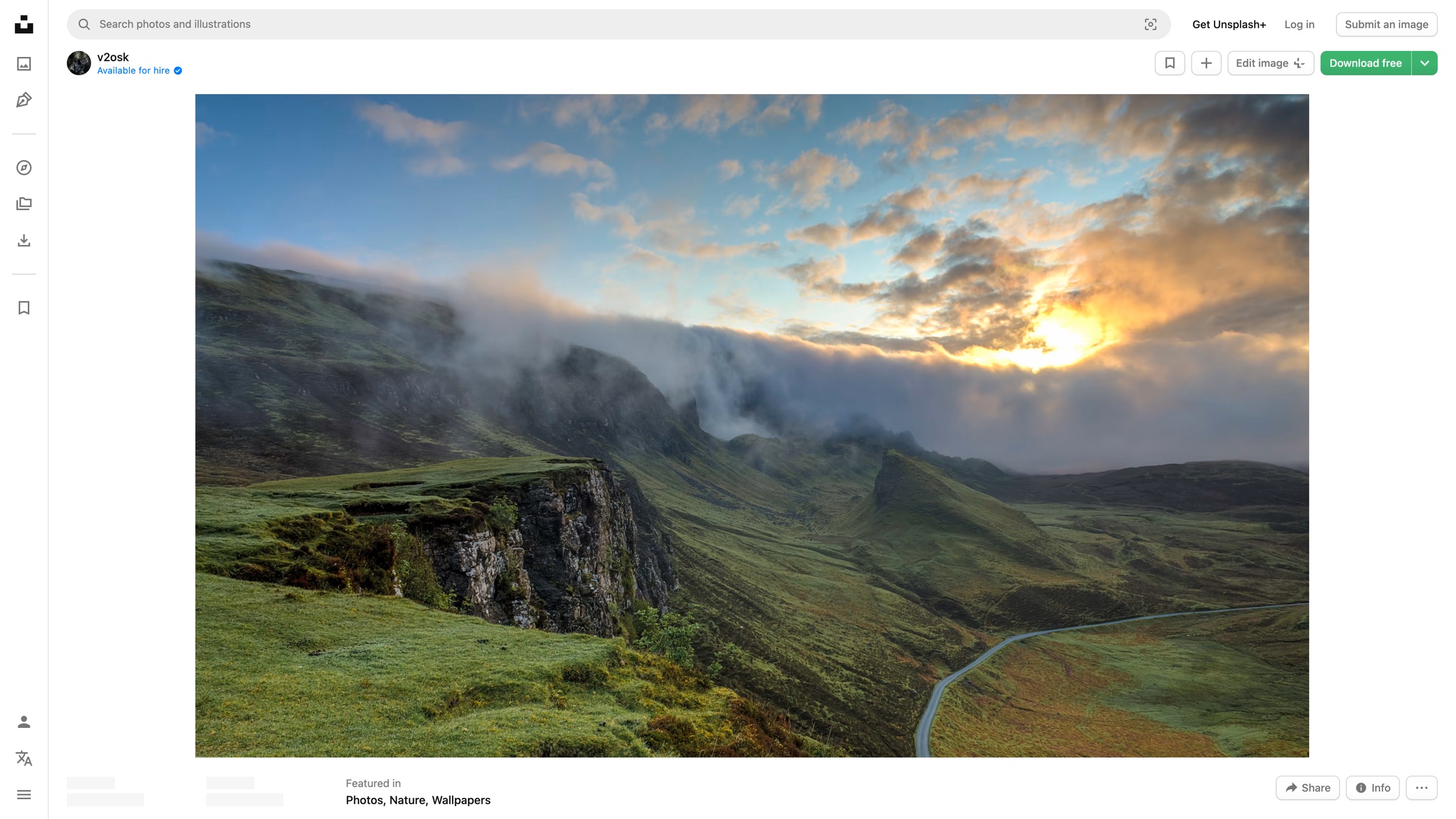
Content mix: primarily high-resolution photography, plus 3D renders and illustrations. The company states that every image is hand-selected by its editorial team.
Mobile: an official iOS app has existed since April 2018. The site footer lists only the iOS app; there is no official Android app.
Accounts and the API
The Unsplash API is a major source of the platform's reach, with rules spelled out in the API Terms:
- Free tier: register a developer account to access all endpoints, with a limit of 1,000 requests per hour and access to the full free library (listed as 8,735,276 images as of 2026-08-30).
- Mandatory rules: apps must hotlink the image URLs returned by the API rather than re-hosting files; every download must be reported back via the download endpoint; and apps displaying images must credit Unsplash and the photographer with a link to the photographer's profile — a stricter attribution requirement than the website license itself.
- Tooling: an OpenAPI specification and official libraries for JavaScript, PHP, and Ruby, plus community libraries for Go, Python, Swift, and others. Medium, Trello, Squarespace, Google Slides, Figma, Zoom, and Dropbox Paper all integrate Unsplash through the API.
- Enterprise tier: for teams needing access to Unsplash+ imagery, unlimited request volume, and priority support; contact sales.
The Unsplash+ Subscription
Launched in October 2022, Unsplash+ is a paid layer on top of the free library and does not change the availability of free content. As of 2026-08-30, the pricing page shows 48 billed yearly (equivalent to 144/year; a footnote warns that promotional pricing can change and renewals are not guaranteed at the promotional rate. Team plans save up to 15%.
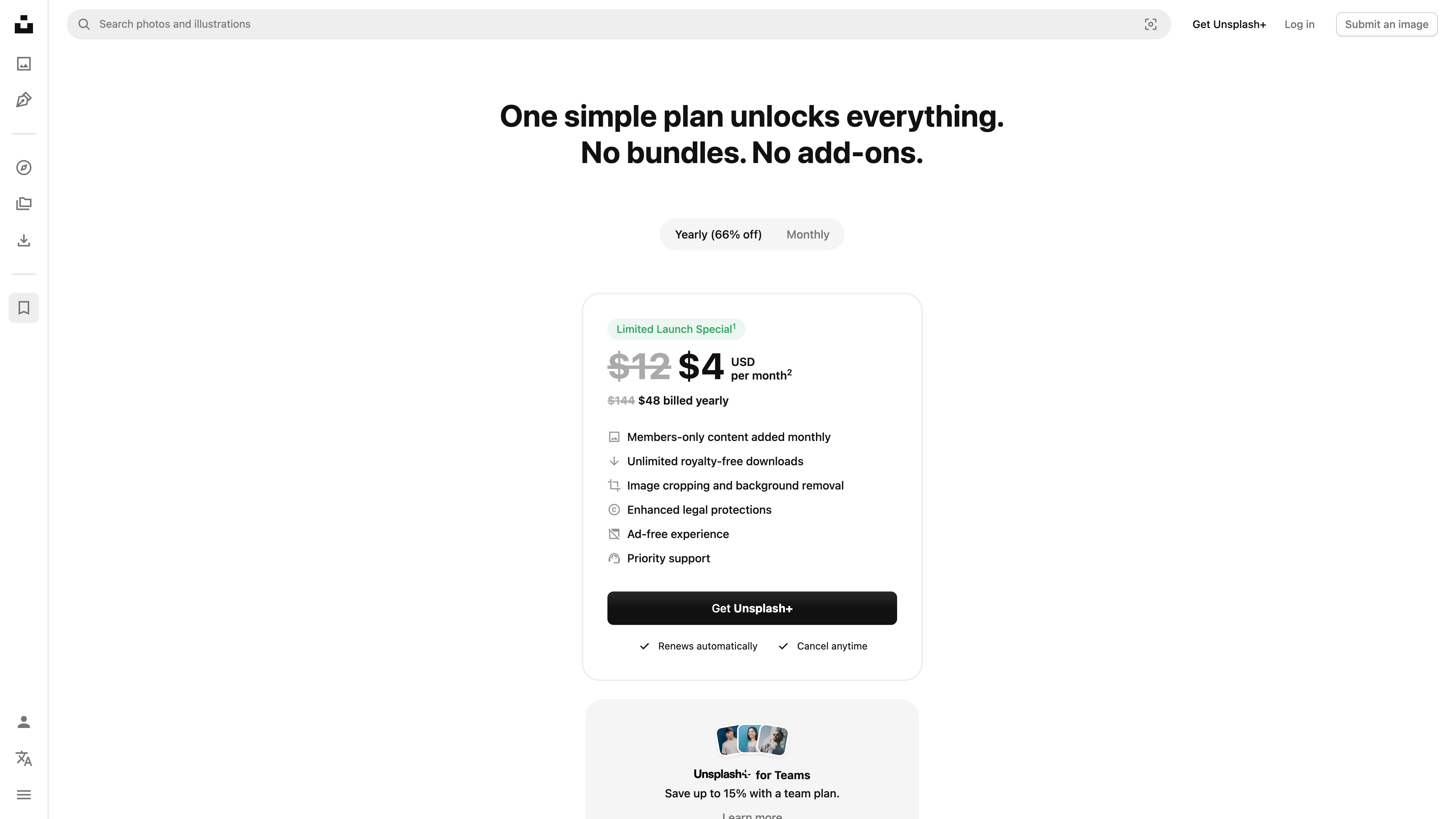
Benefits include members-only content added monthly, unlimited royalty-free downloads, image cropping and background removal, an ad-free experience, and priority support. The centerpiece is "enhanced legal protection": Unsplash+ images are model- and property-released and carry the Unsplash+ Warranty — if a third party claims infringement despite compliant use, Unsplash covers you up to US $10,000 per licensed photo. The Unsplash+ License has its own restrictions: no reselling images as-is, no compiling them into a competing service, no use in digital templates, machine learning/AI, or biometric tracking, and sensitive topics require a disclaimer (e.g., "posed by model").
Licensing and Content Policy
As a UGC platform, Unsplash's copyright framework combines the Unsplash License with its Terms & Conditions:
- Permitted: download, modify, distribute, and use images for free, for commercial and non-commercial purposes, without permission or attribution (credit is appreciated to support photographers).
- Two core restrictions: images cannot be sold without significant modification — including as prints or on physical goods — and images cannot be compiled to replicate a similar or competing service.
- Third-party rights excluded: the license does not extend to recognizable people, trademarks and brands, or works of art depicted in images. The terms explicitly warn that commercial use of such images may require separate permission; the free library carries no model or property release guarantee.
- No AI training: the terms prohibit using images in machine learning/AI datasets or for technologies designed to identify natural persons; data licensing for those purposes is handled separately.
- Not CC0: before June 2017, photos were published under CC0 (public domain dedication); the platform then switched to its own license, which remains in force. Existing images should not be treated as public domain — a nuance often missed in secondary coverage.
- Content governance: uploaders keep ownership of their work and grant Unsplash a worldwide, non-exclusive, royalty-free, sublicensable license; uploaders warrant that their work is original and does not infringe third-party rights. Unsplash complies with the DMCA, runs an infringement reporting channel, and terminates repeat infringers.
Where It Fits
- Content illustration: blog posts, presentations, and social media graphics, with no account, no attribution, and no cost for commercial use.
- In-product integration: embed image search and picking into your own app via the API, accepting the attribution, hotlinking, and download-callback rules.
- Design workflows: Figma, Sketch, and Framer have built-in Unsplash integrations for pulling images directly into mockups.
- Photographer exposure: contributors get download statistics and an "Available for hire" channel, but submissions are unpaid.
- Risk-sensitive commercial projects: clearance for people and brands in free images is your own responsibility; when you need platform-backed warranties and indemnification, consider Unsplash+ or a traditional paid agency.
Limitations
- No Chinese interface: the site is offered only in English and Spanish (confirmed by the help center, updated July 2026), and search works best with English keywords.
- No rights guarantee on free images: commercial use of images showing recognizable people, brands, or artworks carries clearance risk that stays with the user — a clear dividing line versus Unsplash+, which includes releases and a warranty.
- Resale restrictions: free images cannot be sold unmodified, including printed on merchandise.
- AI training prohibited: both the free license and the Unsplash+ license exclude machine learning and biometric uses.
- API constraints: the free tier caps at 1,000 requests per hour and requires hotlinking official image URLs plus attribution, which rules out architectures that need full control over image delivery.
- Promotional pricing may change: the current Unsplash+ yearly rate is a limited-time offer, and Unsplash explicitly reserves the right to adjust it.
Alternatives
- Pexels and Pixabay: comparable free stock libraries, each under its own license with different details on compilation limits, trademarked content, and attribution — check terms before mixing sources.
- Getty Images / iStock: Unsplash's parent company and its paid stock marketplace, offering full rights licensing and indemnification for risk-sensitive commercial work — a complement to the free model rather than a direct competitor.
References
- Unsplash homepage
- About - Unsplash
- The history of Unsplash
- Unsplash License
- Unsplash Terms & Conditions
- Unsplash for developers
- Unsplash API Terms
- Unsplash+ pricing
- Unsplash+ License
- Official announcement: Unsplash is being acquired by Getty Images
- Getty Images newsroom: Unsplash launches Unsplash+
- Help center: Language Settings
- Wikipedia: Unsplash