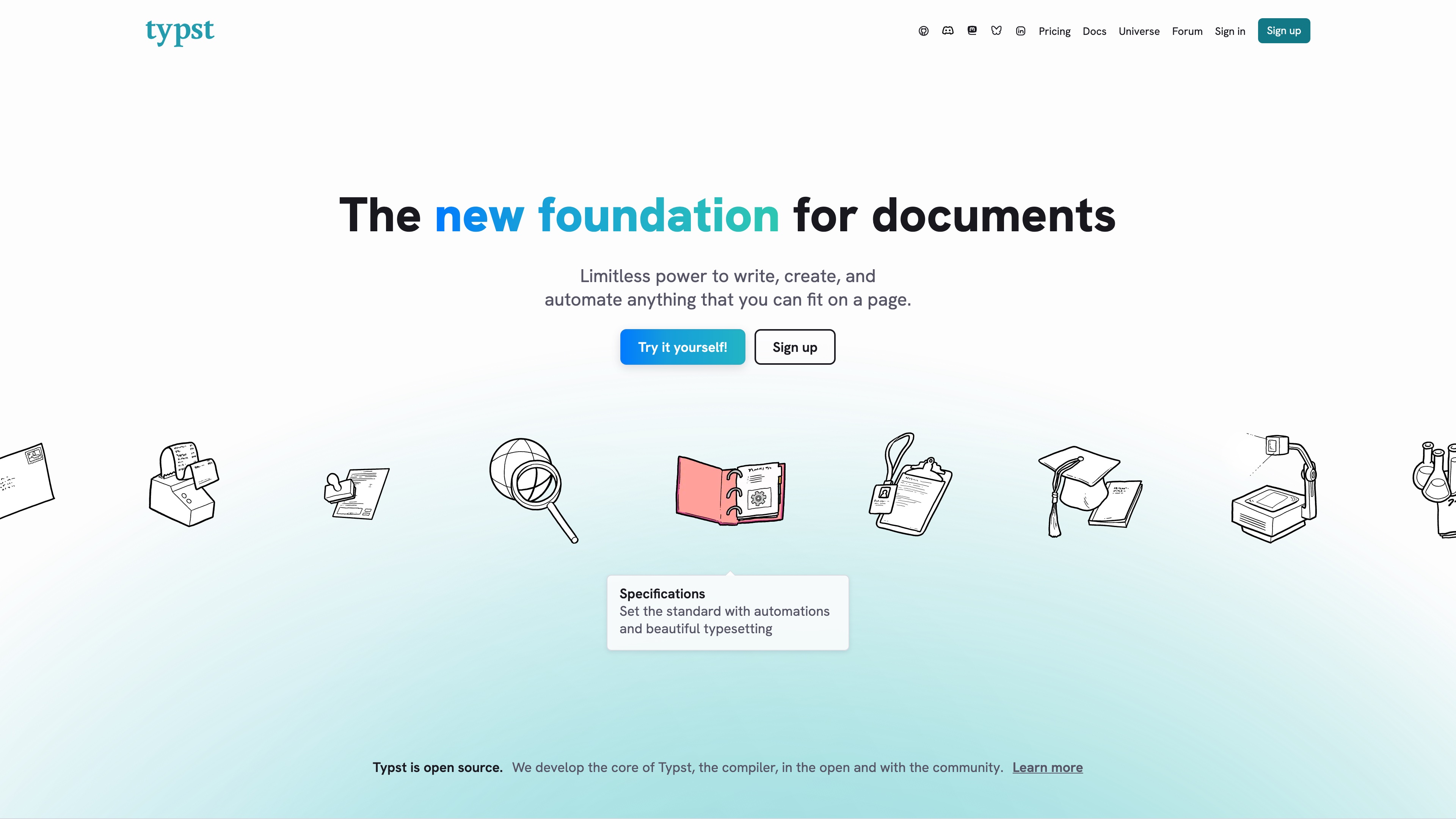
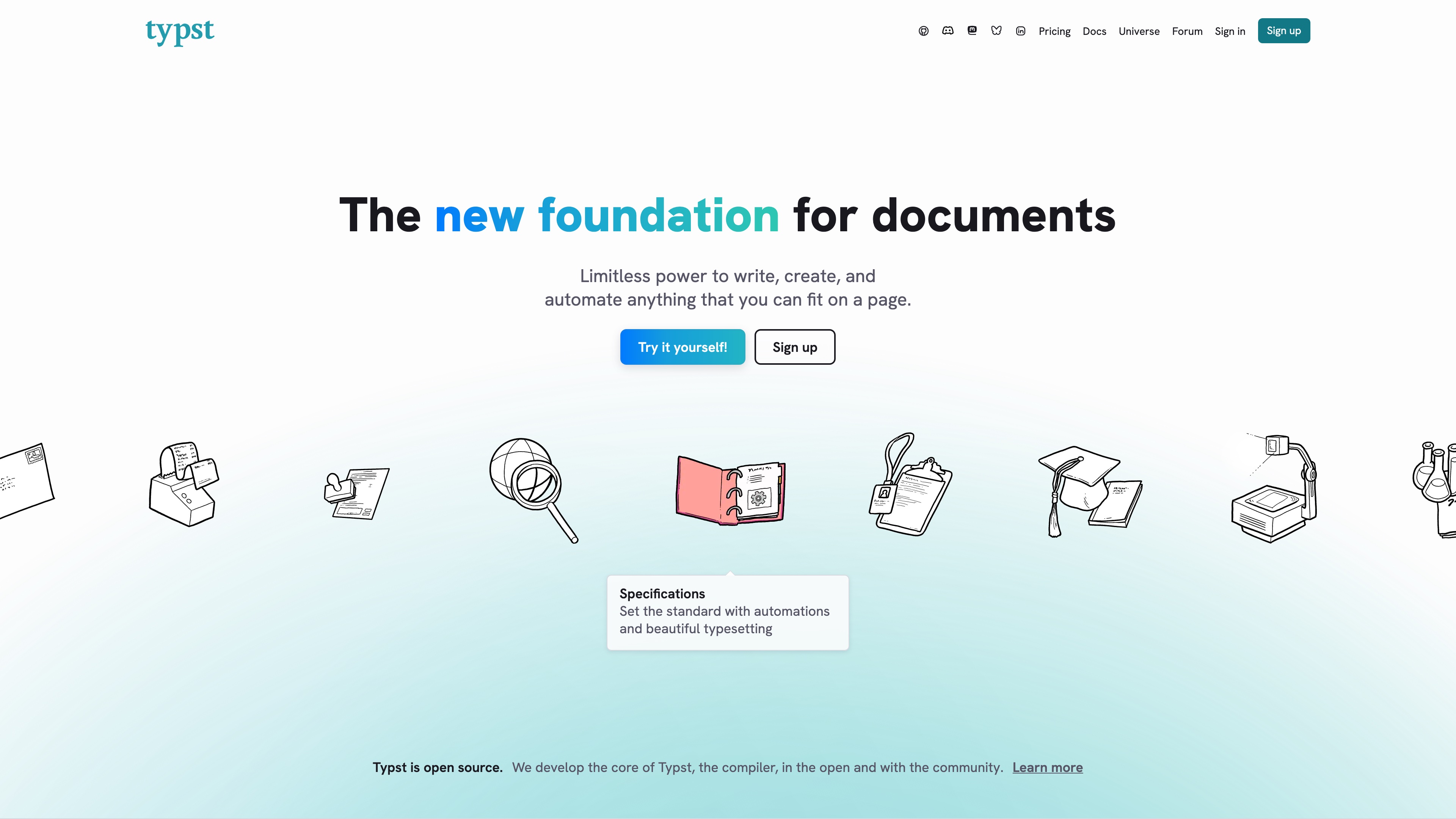
Typst is a markup-based typesetting system developed by Typst GmbH in Berlin, Germany. It consists of three parts: the Typst language, a compiler that turns that language into PDFs, images, or web pages, and a collaborative online editor (the Typst web app). The official documentation positions it as an alternative to both word processors like Word and to LaTeX: the syntax is simpler than LaTeX's, incremental compilation delivers previews in milliseconds, and error messages point to the exact problem with suggested fixes. The compiler is open source under Apache-2.0, and its GitHub repository had about 56K stars as of 2026-08-31, making it one of the most-watched open-source projects in typesetting.
At a glance
- URL: https://typst.app/
- Type: markup-based typesetting system + open-source compiler + collaborative online editor
- Cost: the compiler is free and open source (Apache-2.0); the web app comes in Free (7.99/month), and On-Premises (custom pricing) tiers — see the pricing page (as of 2026-08-31)
- Sign-up: the Playground works without an account; saving projects in the web app requires registration; the local compiler needs no account
- Interface language: English; the official documentation is in English as well
- Launch: public beta opened on March 21, 2023, with the compiler open-sourced the same day (official announcement)
Background
Typst was created by Laurenz Mädje and Martin Haug, who started building the typesetting stack around 2019 (About page), initially targeting scientific paper writing. After three months of closed preview testing, Typst opened its public beta on March 21, 2023, and open-sourced the compiler — then almost four years in the making — on the same day. The two founders incorporated Typst GmbH in Berlin later that year (legal notice).
According to the company's two-year retrospective published in August 2025, the team had grown to five members across three countries, and Typst was in use at more than 3,500 universities and laboratories as well as inside some Fortune 500 companies, including the bank UBS; the pricing page additionally notes over 1,000 business customers. Development is funded by commercial subscriptions, enterprise deployments, and open-source support contracts, with early funding from sources such as the NLnet Foundation and the Berlin Startup Scholarship (GitHub README).
Three ways to use it
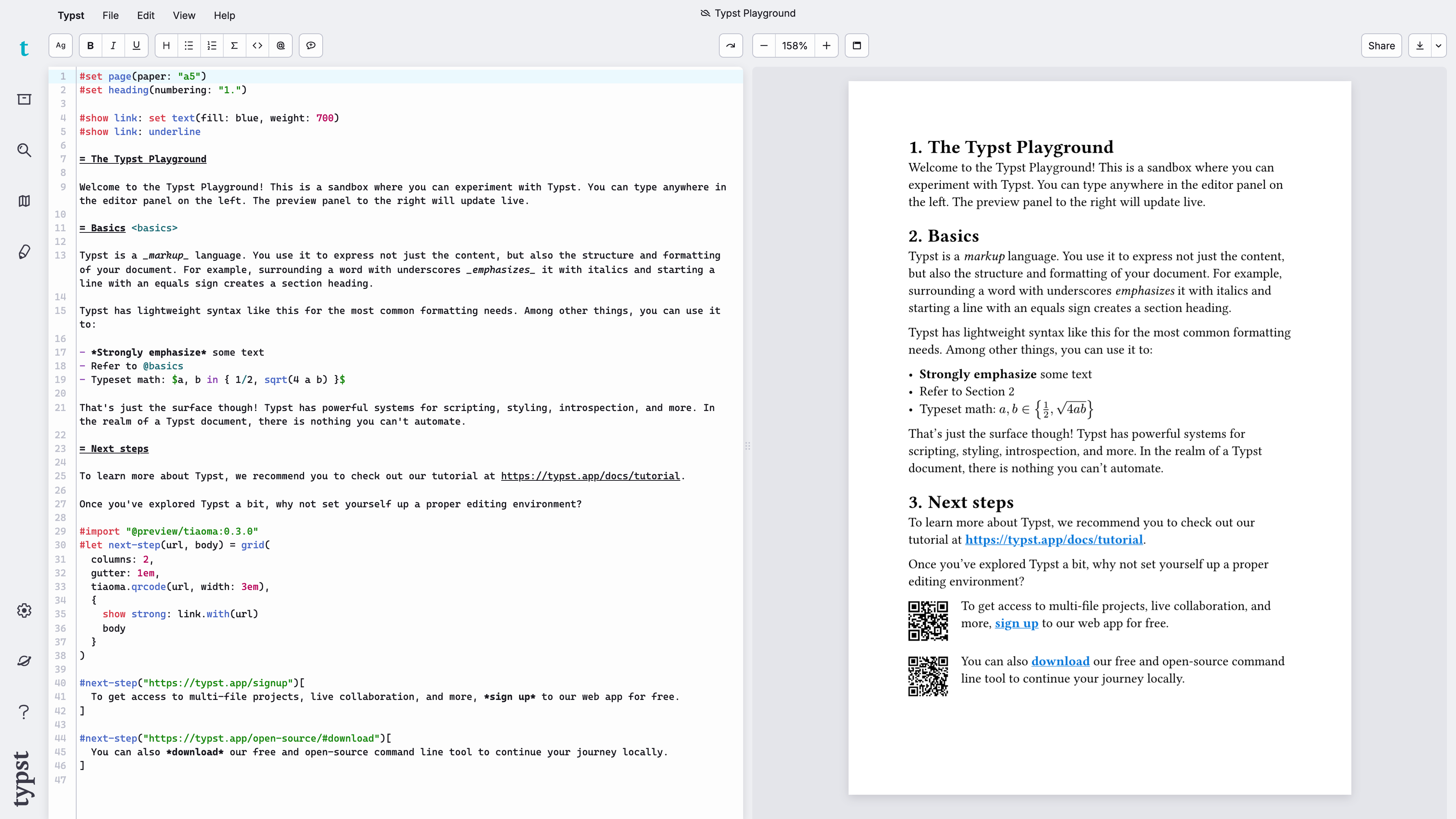
- Online Playground: typst.app/play lets you edit a sample document in the browser and watch the compiled preview update live — no account needed, which makes it the quickest way to evaluate the syntax and output quality.
- Web app: registering an account unlocks project management, sharing, comments, and templates. Typst states that web app data is stored in a data center in Germany (pricing page).
- Local compiler: install the
typstCLI via Homebrew, winget, cargo, or prebuilt binaries;typst watchrecompiles incrementally on every save. Editor integrations for VS Code, Neovim, and others are available through the community language server Tinymist. The compiler can also be embedded as a Rust library to generate PDFs on a server.
Core capabilities
- Lightweight markup with full scripting: headings, emphasis, and lists use concise syntax; functions are invoked with
#, with conditionals, loops, and recursion available; set and show rules separate content from styling and can redefine the appearance of any element globally. - Math and research writing: equations are a first-class citizen with a backslash-free syntax; BibTeX bibliographies and over 100 citation styles are supported, and the Pro tier syncs reference libraries from Zotero or Mendeley.
- Data-driven automation: documents can read JSON, CSV, or XML sources to generate tables, charts, or entire files — suited to batch-producing reports, certificates, or statements.
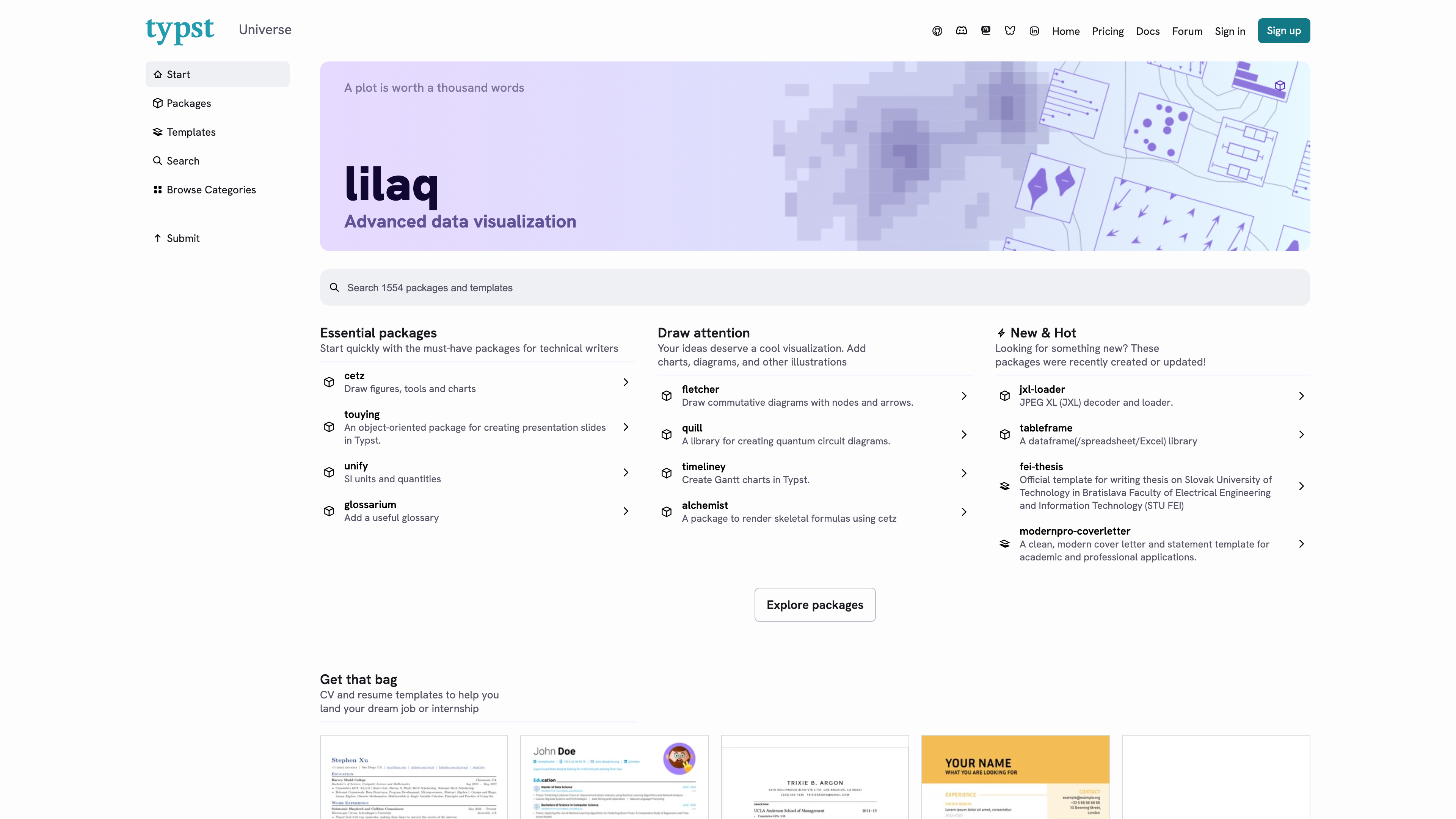
- Template and package ecosystem: the official Typst Universe registry hosts community templates and packages for drawing, slides, and more; its search bar showed 1,554 packages and templates as of 2026-08-31, all under open-source or Creative Commons licenses (open-source page).
- Output formats: PDF by default, plus PNG/SVG; since version 0.14 (October 2025), Typst produces tagged, accessible PDFs by default with optional PDF/UA-1 compliance; HTML export was still in preview as of 2026-08-31. The current compiler release is 0.15.1 (July 17, 2026).
- CJK typesetting: CJK support has improved since 0.4.0, with CJK–Latin spacing added in 0.9.0, so Chinese, Japanese, and Korean documents are supported.
Accounts, pricing, and data
The free web app tier includes project management, sharing and collaboration, community packages, and 200MB of storage with up to 100 files per project. Pro costs $7.99 per month (14% off with annual billing, full refund within 14 days for first-time subscribers) and adds comments, private packages, GitHub/GitLab sync (experimental), Zotero/Mendeley sync, slide presenting, and 2GB of storage. On-Premises targets organizations that need self-hosting, starts at five members, and supports LDAP integration (pricing page, prices as of 2026-08-31).
Per the official FAQ, documents are compiled in a sandbox: Typst code can only read files inside the project root and cannot access the network beyond fetching packages from the official registry. The compiler is open source while the web app is proprietary; Typst commits to keeping the language free of proprietary extensions, so the same source compiles identically in both environments (open-source FAQ).
Where it fits
- Papers, technical reports, and theses that need equations, bibliographies, and cross-references;
- automated document pipelines that generate PDFs from structured data (the compiler can be embedded server-side);
- writers who want LaTeX-grade output without its installation burden and error messages;
- team documents that benefit from shared templates, online collaboration, and review workflows.
Limitations
- Still 0.x: the language and features keep evolving, and upgrades occasionally require adjusting existing documents; HTML export has not left preview status.
- Proprietary web app: self-hosting is only available through the paid On-Premises plan (five seats minimum); there is no free self-hosted collaboration option.
- English-only interface and docs: there is no official localized UI; CJK typesetting works, but learning resources require English reading skills.
- Smaller ecosystem than LaTeX: official publisher and conference templates still predominantly target LaTeX, so Typst submissions usually rely on community templates; some journals have begun accepting Typst natively — the company blog covered the journal IJIMAI doing so in April 2025.
- Limited mobile experience: in our spot check, the Playground opened in a phone browser and allowed viewing and editing source, but the editor falls back to a single-column layout; the side-by-side write-and-preview workflow is clearly designed for desktop screens.
- Free tier quotas: 200MB of storage and 100 files per project can feel tight for large or image-heavy projects.
Comparable tools
Compared with Overleaf (a collaborative LaTeX platform), Typst offers friendlier syntax, error messages, and compile speeds, while LaTeX retains a clear lead in publisher templates and accumulated resources. Compared with Word or Google Docs, Typst manages formatting as source code and is far more automatable, but collaborators unfamiliar with markup languages cannot simply click and edit.