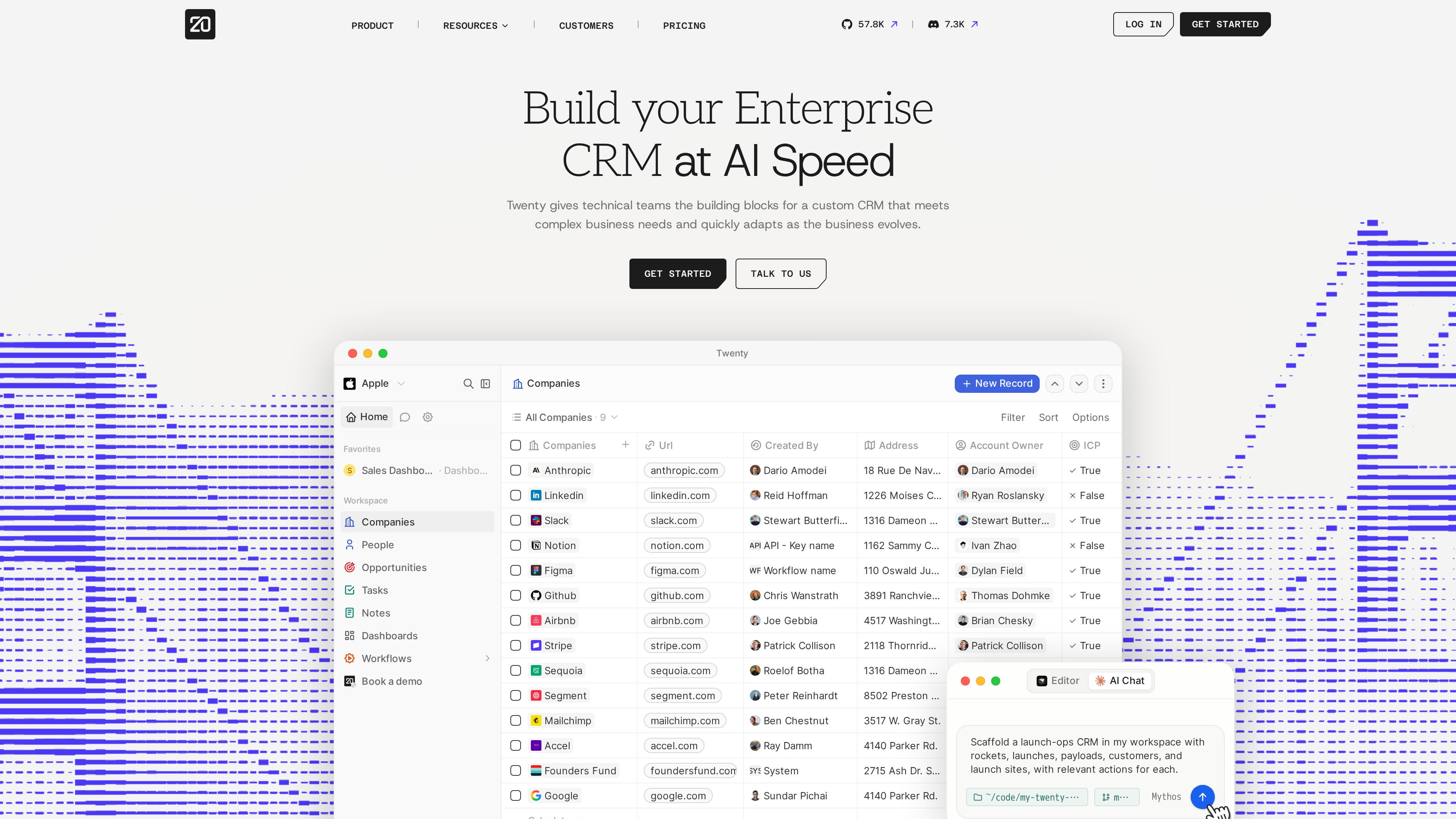
Twenty (twenty.com) is an open-source customer relationship management (CRM) platform. Its GitHub repository describes it as "The open alternative to Salesforce, designed for AI," while the website pitches "Build your Enterprise CRM at AI Speed." Standard CRM objects — companies, people, opportunities, tasks, notes — form the base, which teams can reshape with custom objects and fields; email and calendar sync, workflow automation, AI agents, and a developer-facing API and app framework ship in the same product. Against incumbents like Salesforce, its verifiable differences are that the code is mostly AGPLv3 open source, the whole stack can be self-hosted, and extensions are written in TypeScript rather than a proprietary language. Against most open-source CRMs, its interface is notably more modern — the company says it is "built to feel like Notion" (homepage, GitHub repo, checked 2026-10-01).
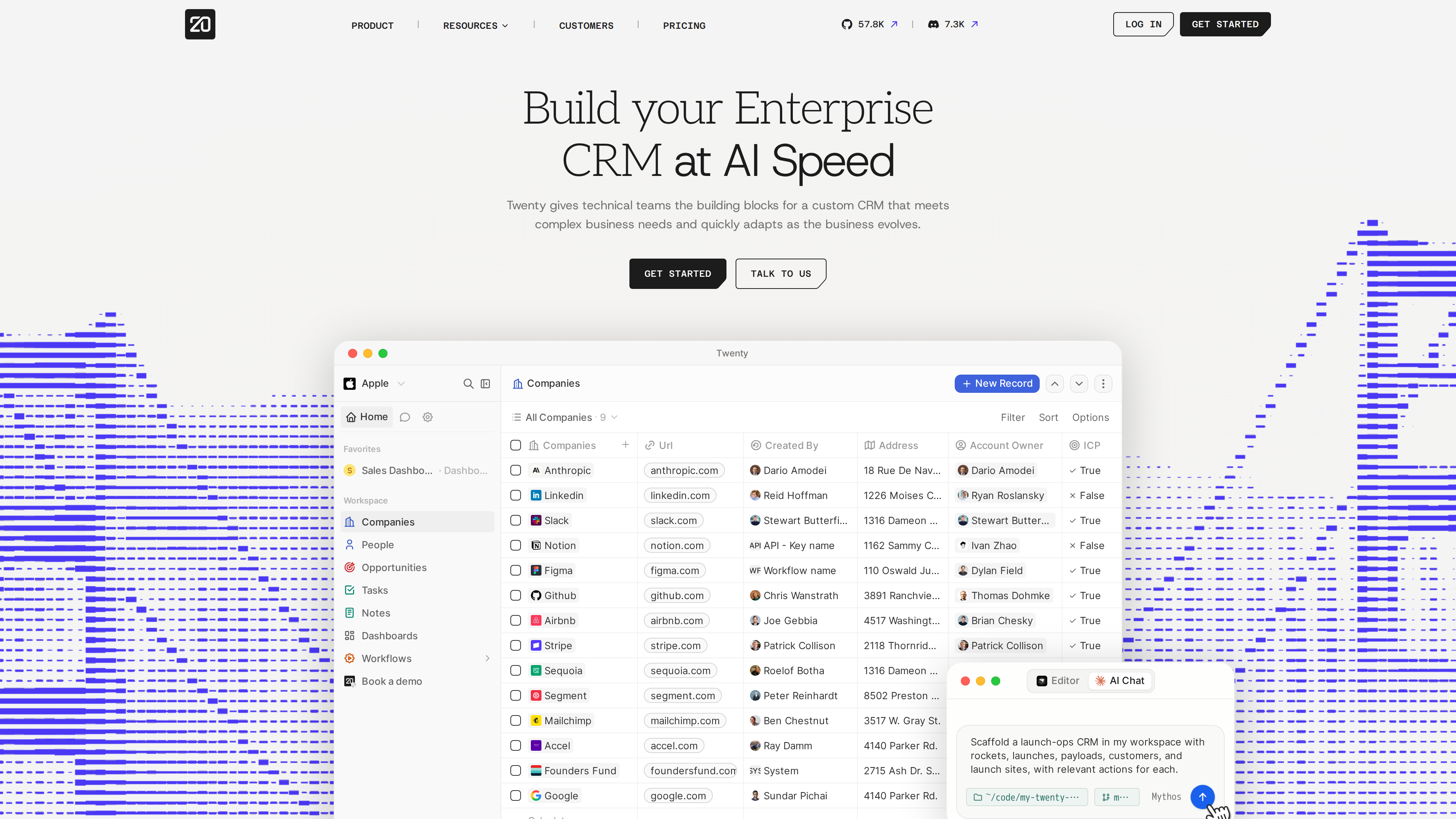
The screenshot above shows the homepage: the hero promises technical teams the "building blocks" for a custom CRM; below it, the product UI shows the Companies table view, a sidebar with People / Opportunities / Tasks / Notes / Dashboards / Workflows, and an AI Chat panel that can scaffold a data model in the workspace from a natural-language prompt.
At a Glance
| Item | Details |
|---|---|
| URL | https://twenty.com/ (cloud app at app.twenty.com) |
| Type | Open-source CRM platform (managed cloud + self-hosted) |
| Pricing | Cloud Pro from 0; Organization and Enterprise tiers available (pricing, as of 2026-10-01) |
| Sign-up | Cloud requires an account (Google, Microsoft, or email); 7-day trial without a credit card, 30-day trial with one; self-hosting needs no account |
| UI languages | Pricing feature table lists 30+ languages (as of 2026-10-01) |
| Source code | github.com/twentyhq/twenty, ~57.8k stars (as of 2026-10-01) |
Background
- The operator is Twenty.com PBC, a public benefit corporation incorporated in Delaware, USA (Terms of Service, effective 2026-08-07).
- According to its Y Combinator profile, the company was founded in 2023, joined the YC Summer 2023 batch, is based in Paris, France, has a team of 11, and was founded by Félix Malfait, Charles Bochet, and Thomas des Francs (YC company page, checked 2026-10-01).
- The GitHub repository was created in December 2022 and, as of 2026-10-01, counts 57,777 stars and 9,381 forks (GitHub API); the site header also shows a Discord community of roughly 7,300 members. Development is active: the latest release, v2.44.0, shipped on 2026-09-30 (GitHub Releases, checked 2026-10-01).
- Customer stories on the homepage include W3villa, which used Twenty as a production-grade framework, and AC&T, which moved from a discontinued commercial CRM to self-hosted Twenty and claims CRM costs fell by more than 90% (vendor-published case studies, homepage).
Core Capabilities: A Reshapable Data Model on a Full CRM Base
- Standard objects and pipelines: built-in Companies, People, Opportunities, Tasks, and Notes, with opportunities shown as a kanban sales pipeline. Views come in three types — table, kanban, and calendar — with AND/OR filters, multi-field sorting, grouping, and saved custom views (Key Features, checked 2026-10-01).
- Custom data model: custom objects and 20+ field types can be created directly in Settings, with relations between any objects; every plan includes unlimited objects, fields, views, and records. The docs recommend extending People / Companies / Opportunities rather than creating parallel objects, because only those three surface synced emails and meetings (Quickstart, checked 2026-10-01).
- Email and calendar sync: connect Google Workspace or Microsoft 365 and emails are automatically linked to matching company and people timelines; users can send mail from inside Twenty, attach multiple mailboxes, and limit imports by date range or sender. Other providers are supported via SMTP for mailboxes and CalDAV for calendars (Calendar & Email, checked 2026-10-01).
- Workflow automation: a visual builder with triggers for record events, manual buttons, schedules (cron), and inbound webhooks; actions can call any external HTTP API. Cloud Pro includes 50 workflow credits per year (Workflows, pricing, checked 2026-10-01).
- Dashboards and permissions: unlimited real-time dashboards; role-based access control with field-level permissions on all plans, while row-level permissions, SAML/OIDC SSO, audit logs, and encryption-key rotation require Organization or above, and SCIM requires Enterprise. Two-factor authentication is available on every tier (pricing feature table, as of 2026-10-01).
- Data migration: CSV import (officially recommended at up to 10k records per file) and API import for 50,000+ records; data can be exported at any time (site FAQ, checked 2026-10-01).
AI and Developer-Facing Extensibility
- AI Chat and AI Agents: ask questions about CRM data in natural language; agents can autonomously run multi-step tasks inside the permission model — enriching records, drafting follow-up emails, or flagging at-risk deals (AI docs, checked 2026-10-01).
- APIs: schema-per-tenant REST and GraphQL endpoints generated from each workspace's data model — a new custom object immediately gets the same endpoints as built-in objects. A Core API handles record CRUD and a Metadata API manages the schema itself. Authentication uses API keys that can be scoped to roles; batch operations accept 60 records per call; rate limits are 50 requests/minute on Pro and 100 on Organization (API docs, pricing, checked 2026-10-01).
- Webhooks: record creates, updates, and deletes on any object (including custom ones) trigger an HTTP POST to a public URL; event-type filtering is not yet supported (Webhooks docs, checked 2026-10-01).
- MCP server: every cloud workspace ships with a native MCP server; after connecting via OAuth, AI clients such as Claude, ChatGPT, and Cursor can read and write CRM data in natural language (site FAQ, checked 2026-10-01).
- Apps framework:
npx create-twenty-appscaffolds TypeScript apps defining custom objects, server-side logic functions, React components rendered inside Twenty's UI, AI skills and agents; apps can be published privately or shared via npm. Official agent skills target Claude Code, Codex, Cursor, Pi, and similar coding agents (README, checked 2026-10-01). - For no-code integration, the docs list Zapier (5,000+ apps) and workflow HTTP actions.
Licensing: Mostly AGPLv3, with Commercial and MIT Parts
The repository LICENSE file states the project is mostly licensed under AGPLv3, with three nuances worth knowing (LICENSE, checked 2026-10-01 — this mixed model is also why the GitHub API reports the license as NOASSERTION):
- Files marked
/* @license Enterprise */at the top fall under a commercial license printed at the end of the LICENSE file, not the AGPLv3. These correspond to paid capabilities such as SSO and row-level permissions. - The application development toolkit (twenty-sdk, twenty-client-sdk, create-twenty-app, twenty-shared), the twenty-ui component library, and the apps under packages/twenty-apps are MIT-licensed.
- An additional permission under AGPLv3 Section 7 (the "Twenty Application Exception") ensures that applications built solely through the published APIs, webhooks, SDKs, and related interfaces are not subject to the AGPLv3 and may be licensed however their authors choose, including proprietary terms. Modifying Twenty's own source code, however, keeps the AGPLv3 Section 13 network-use obligations in force.
The Terms of Service add that using the free self-hosted edition is governed by the open-source licenses, while commercial features of the self-hosted edition require a per-seat license key purchased from Twenty (Terms of Service, checked 2026-10-01).
Cloud Pricing (as of 2026-10-01)
The cloud has no permanent free tier. New users pick a 30-day trial (credit card required) or a 7-day trial (no card), both with full access (Quickstart). Paid plans (pricing):
| Plan | Yearly billing | Monthly billing | Key differences |
|---|---|---|---|
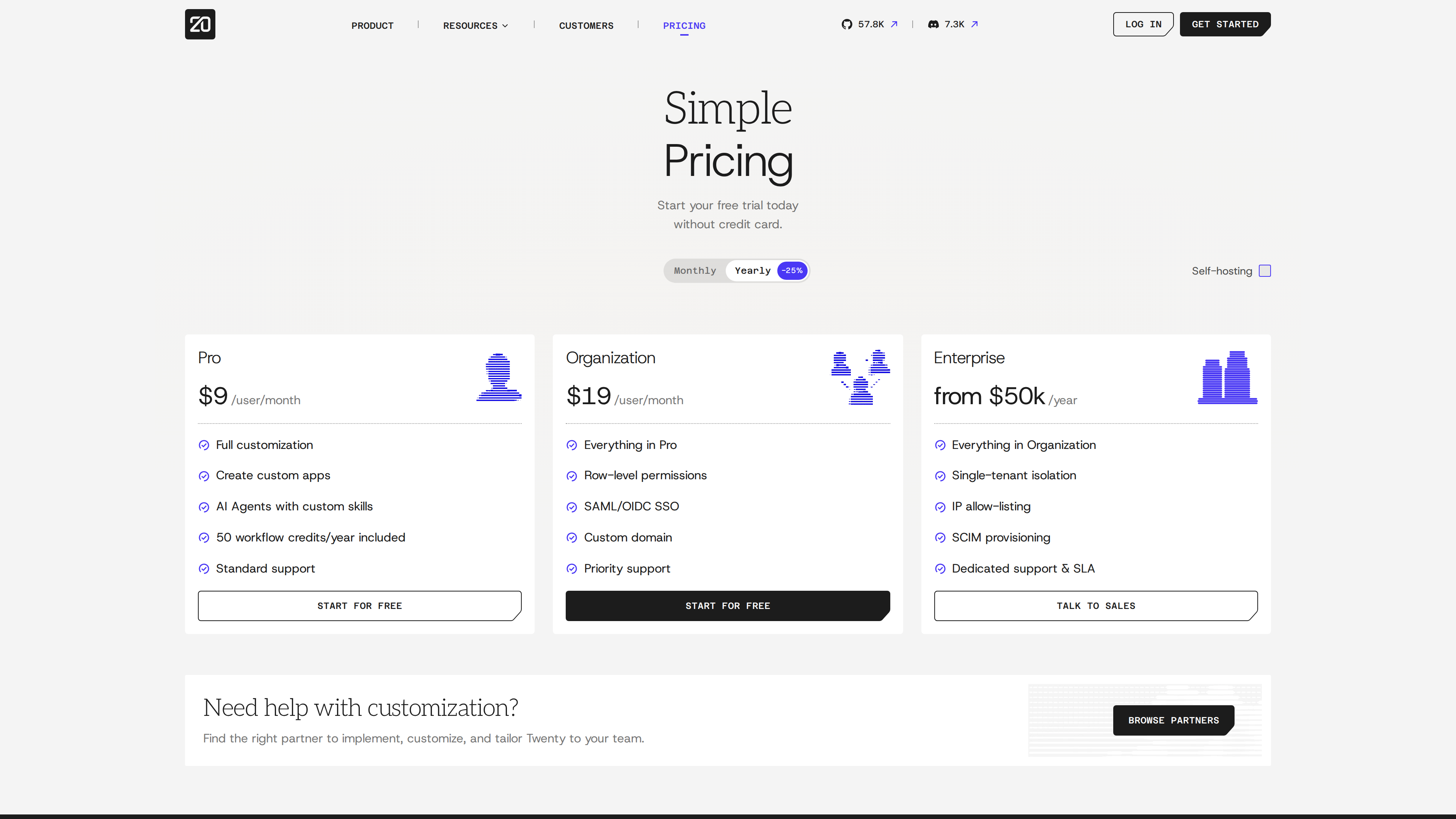
| Pro | $9/user/month | $12/user/month | Full customization, custom apps, AI agents, 50 workflow credits/year, standard support |
| Organization | $19/user/month | $25/user/month | Adds row-level permissions, SAML/OIDC SSO, custom domain, priority support |
| Enterprise | from $50,000/year | — | Single-tenant isolation, IP allow-listing, SCIM, dedicated support & SLA |
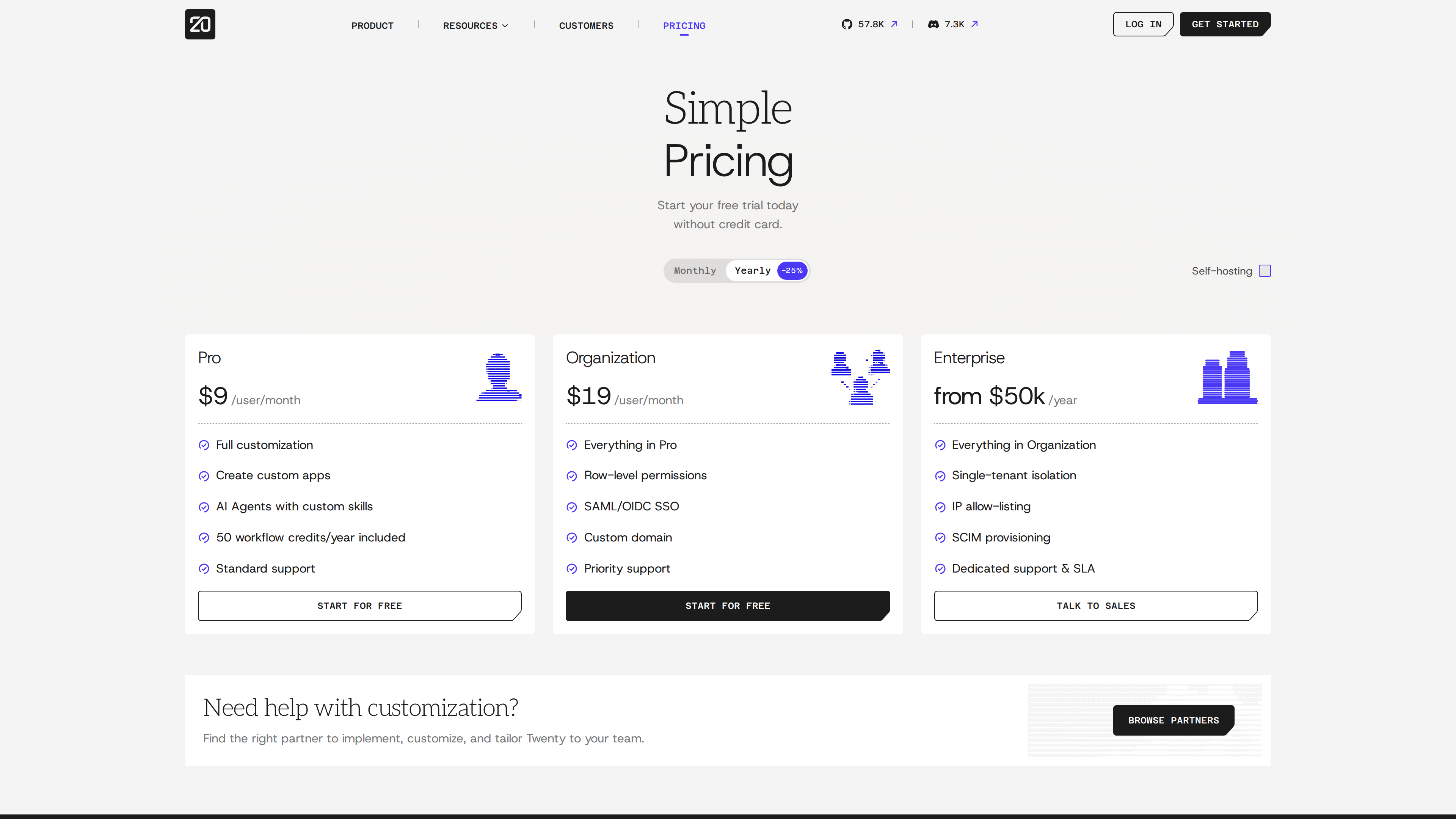
The screenshot above shows the pricing page with yearly billing selected: Pro at 19/user/month, and Enterprise from 12 and $25 per user per month respectively. Seats, records, and custom objects/fields/views are unlimited on all three.
Self-Hosting: The Free Tier and Deployment Notes
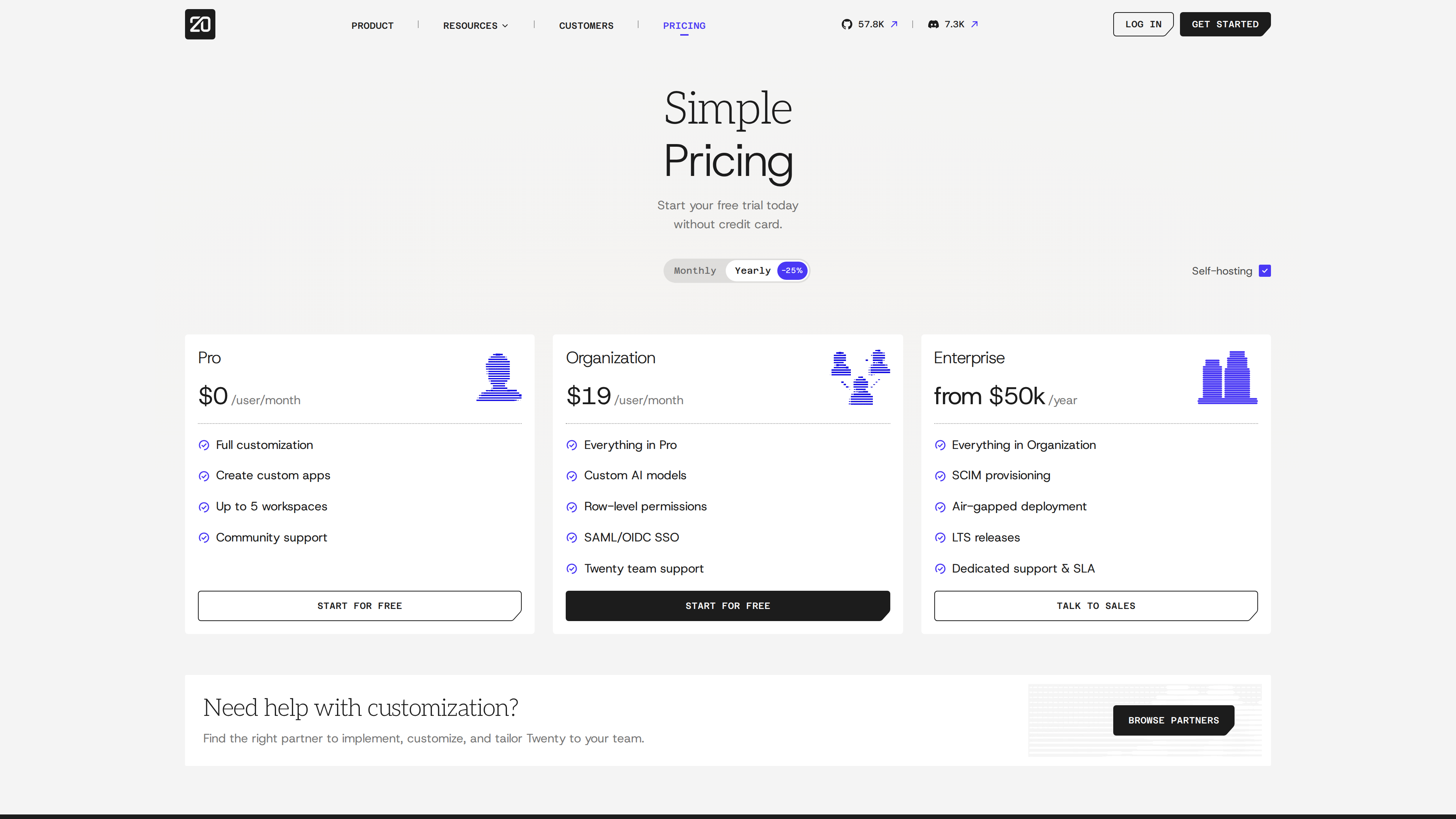
Toggling "Self-hosting" on the pricing page reveals the self-hosted lineup (as of 2026-10-01): Pro at $0 (full customization, custom apps, up to 5 workspaces, community support), Organization at $19/user/month (adding custom AI models, row-level permissions, SAML/OIDC SSO, and support from the Twenty team), and Enterprise from $50,000/year (SCIM, air-gapped deployment, LTS releases, dedicated support & SLA).
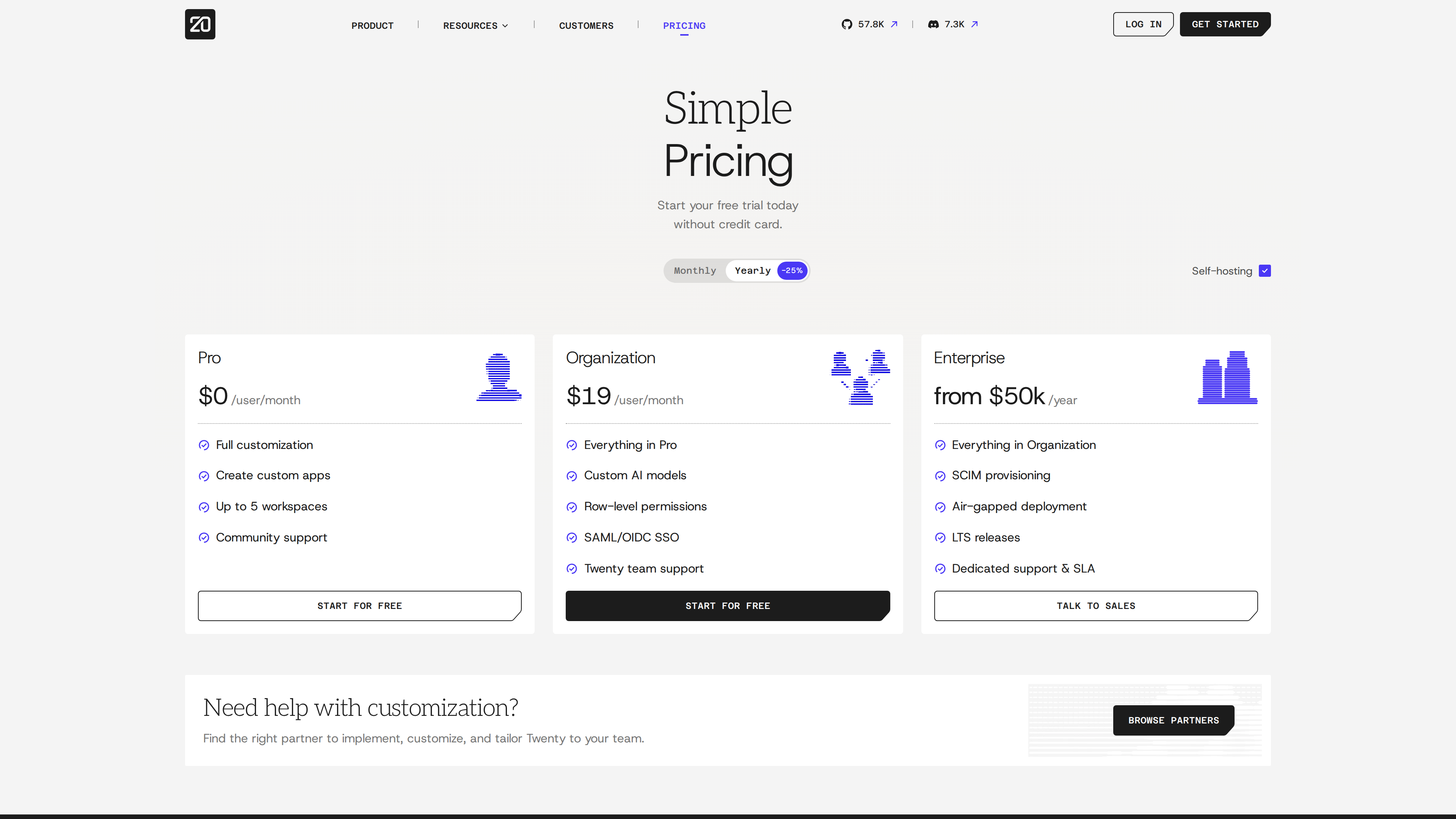
The screenshot above shows the pricing page with Self-hosting enabled: self-hosted Pro is listed at $0/user/month. The self-hosted tiers differ slightly from their cloud counterparts — for example, self-hosted Organization includes custom AI models, whereas the cloud Organization tier highlights a custom domain and priority support.
For deployment, Twenty provides a one-line Docker Compose install script or manual setup: the twentycrm/twenty image runs as server and worker processes alongside PostgreSQL 16 and Redis, with a 2GB RAM minimum and port 3000 by default. Operators must generate an ENCRYPTION_KEY (losing it means losing every secret stored in the database, such as OAuth tokens), set a Postgres password and SERVER_URL, and are advised to put the app behind a reverse proxy with SSL. Backups use pg_dump, upgrades follow an official guide, and certified hosting partners are available for those who prefer managed self-hosting (Docker Compose docs, checked 2026-10-01).
Data Policy Highlights
- The privacy policy, effective 2025-10-13, commits to GDPR and CCPA compliance. On the cloud, the customer organization is the data controller and Twenty the processor; for self-hosted instances, Twenty says it does not access customer data, collecting only workspace/user emails for license verification plus optional telemetry. Twenty states it does not sell personal information. Primary subprocessors are AWS, Cloudflare, Stripe, and Sentry, with a full list in its Trust Center (Privacy Policy, checked 2026-10-01).
- The Terms of Service promise that users own their data and can export it anytime; after a subscription ends, data is kept for at least 14 days with an email warning before deletion; Twenty does not train AI models on customer data — AI features send data to the model provider chosen for the workspace under that provider's terms. Material changes to the terms come with 30 days' notice, and the document's history is public on GitHub (Terms of Service, effective 2026-08-07).
Good Fits
- Teams that want Salesforce/HubSpot-class capabilities without the license cost or vendor lock-in — especially technical teams with TypeScript skills who prefer to maintain their CRM as code.
- Organizations with data-sovereignty, compliance, or privacy requirements that need the CRM inside their own infrastructure, including air-gapped environments.
- Teams that want AI clients like Claude or ChatGPT reading and writing CRM data directly, or AI agents maintaining customer data within a permission model (built-in MCP server and agents).
- Salesforce implementation partners and web development agencies — both are explicitly named as target users in the docs, with the pitch that CRM projects can be delivered without learning Apex or earning proprietary certifications.
Limitations
- Young ecosystem: the official docs concede the pre-built integration catalog is not yet as broad as Salesforce's or HubSpot's, asking companies that need hundreds of ready-made integrations today to "give us another year" (Why Twenty, checked 2026-10-01).
- Not a set-and-forget CRM: the same document says teams wanting "a CRM they never have to think about" will be better served by Pipedrive or HubSpot; Twenty's value proposition favors teams willing to keep shaping their tools.
- No free cloud tier: free use is limited to self-hosted Pro (community support, up to 5 workspaces); the cloud offers time-limited trials only.
- Governance features sit in higher tiers: row-level permissions, SSO, audit logs, and encryption-key rotation require Organization; SCIM and single-tenant isolation require Enterprise (from $50,000/year).
- Self-hosting means operating it yourself: upgrades, backups, SSL, and key management are the operator's responsibility, and some commercial features require a per-seat license key.
- Limited view types: only table, kanban, and calendar views at present (pricing feature table, as of 2026-10-01).
- Mobile apps unconfirmed: neither the website nor the documentation (including the pricing feature table) mentions iOS/Android clients; no official mobile information was found as of 2026-10-01.
Comparable Products
- The pricing page links official cost comparisons against HubSpot, Salesforce, SAP Sales Cloud, Pipedrive, and Microsoft Dynamics (self-described as including sources; vendor-produced) (pricing, checked 2026-10-01).
- This profile records only the vendor's own positioning; independent third-party comparisons were outside the scope of this review.