ToS;DR — short for "Terms of Service; Didn't Read", at tosdr.org — is a non-profit community project built around what it calls "the biggest lie on the web": almost nobody actually reads the terms they agree to. Volunteers read the terms of service and privacy policies of major websites, distill them into short "points" flagged as good, bad, blocker, or neutral, and once enough points have been reviewed, the site computes an overall grade from A (best) to E (worst). Its verifiable distinctions among similar efforts: it has been running since 2012, everything is released as free software and open data, its grades are consumed by DuckDuckGo's privacy apps and extensions, and it exposes a public API.
At a Glance
- URL: https://tosdr.org/
- Type: Community-maintained database of terms-of-service and privacy-policy summaries and grades (plus browser extension and mobile apps)
- Cost: Free, no ads; a donation- and sponsor-funded non-profit FOSS project
- Registration: Browsing and search need no account; contributing reviews or adding services requires an account on the edit platform (edit.tosdr.org)
- Interface languages: English first, with volunteer translations into German, Spanish, French, Japanese, Dutch, Polish, Russian, Chinese, and more (the summaries of the terms themselves remain primarily in English; verified 2026-09-02)
- Launched: June 2012 (official About page)
Background
According to the official About page, the idea behind ToS;DR took shape at the 2011 Chaos Communication Camp near Berlin, among people from the Unhosted movement, which campaigned for user control over personal data. In the summer of 2012, Hugo Roy — then a law student — began the legal analysis and brought the project to life, together with programmer Michiel de Jong and designer Jan-Christoph Borchardt. The name riffs on the internet acronym "TL;DR" (Too Long; Didn't Read). Launch coverage that August included Wired, The Verge, and Time.
Roy led the project from 2012 to 2015, and it was revived with a larger volunteer team in 2020 (Wikipedia). The current team — developers, community managers, and other volunteer roles — is listed publicly on the About page. Funding comes from non-profit grants and individual donations; the thanks page names sponsors including Atlassian, Fastly, BetterStack, StartMail, GitLab, and OpenCollective donors, alongside a sponsorship-independence disclosure stating that ratings are not influenced by sponsors.
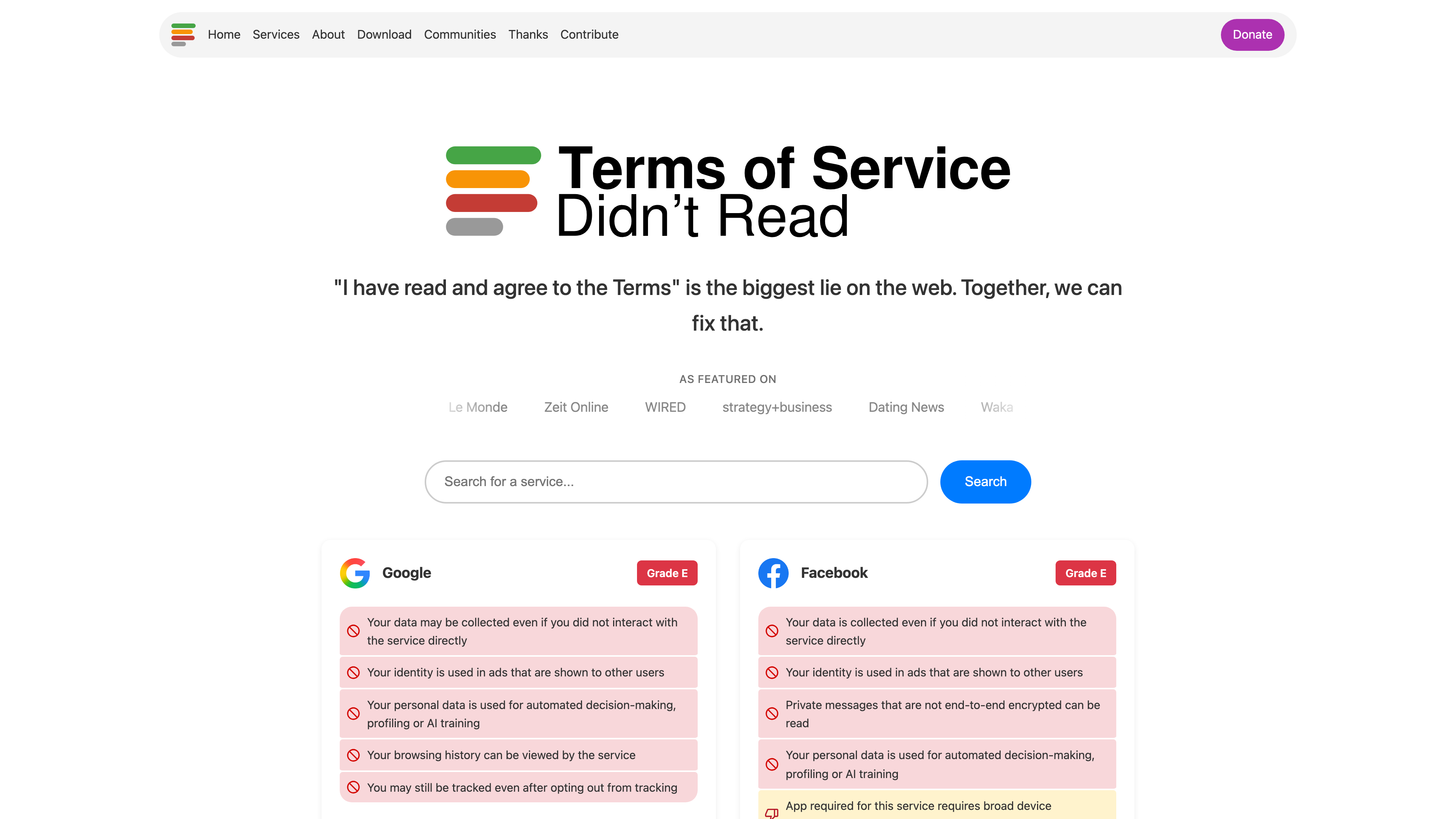
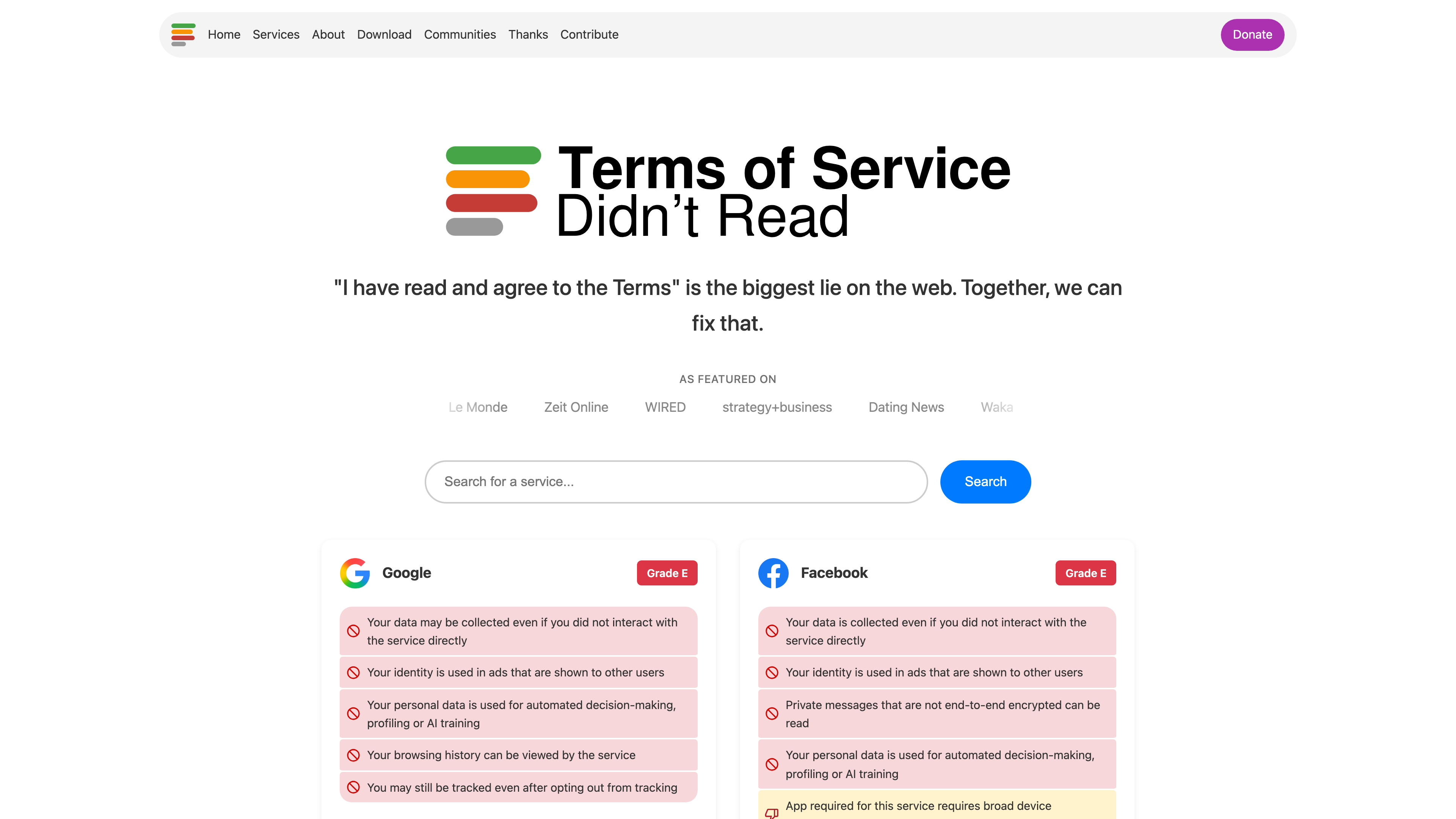
The homepage (captured 2026-09-02) condenses the pitch: below the search box, grade cards for well-known services like Google and Facebook appear with their most serious "blocker" points in red. The footer shows when the crawler last fetched the underlying policy documents (2026-09-01 in this capture), so readers can tell which version of a document a summary is based on.
How the Grading Works
Contributors work in the edit.tosdr.org platform (codenamed Phoenix): they read the original documents, extract noteworthy clauses into "points", and attach each point to a standardized case with a weight — good, bad, blocker, or neutral. When a service has accumulated enough approved points, the system automatically assigns a class based on the average score (explained on the homepage):
- A: the terms treat you fairly, respect your rights, and will not abuse your data (best);
- B: fair to users overall, but with room for improvement;
- C: acceptable, but with issues worth your consideration;
- D: seriously imbalanced terms, or important issues to watch;
- E: raises very serious concerns;
- No grade yet: not enough information — the site itself notes many services remain ungraded because review coverage is limited.
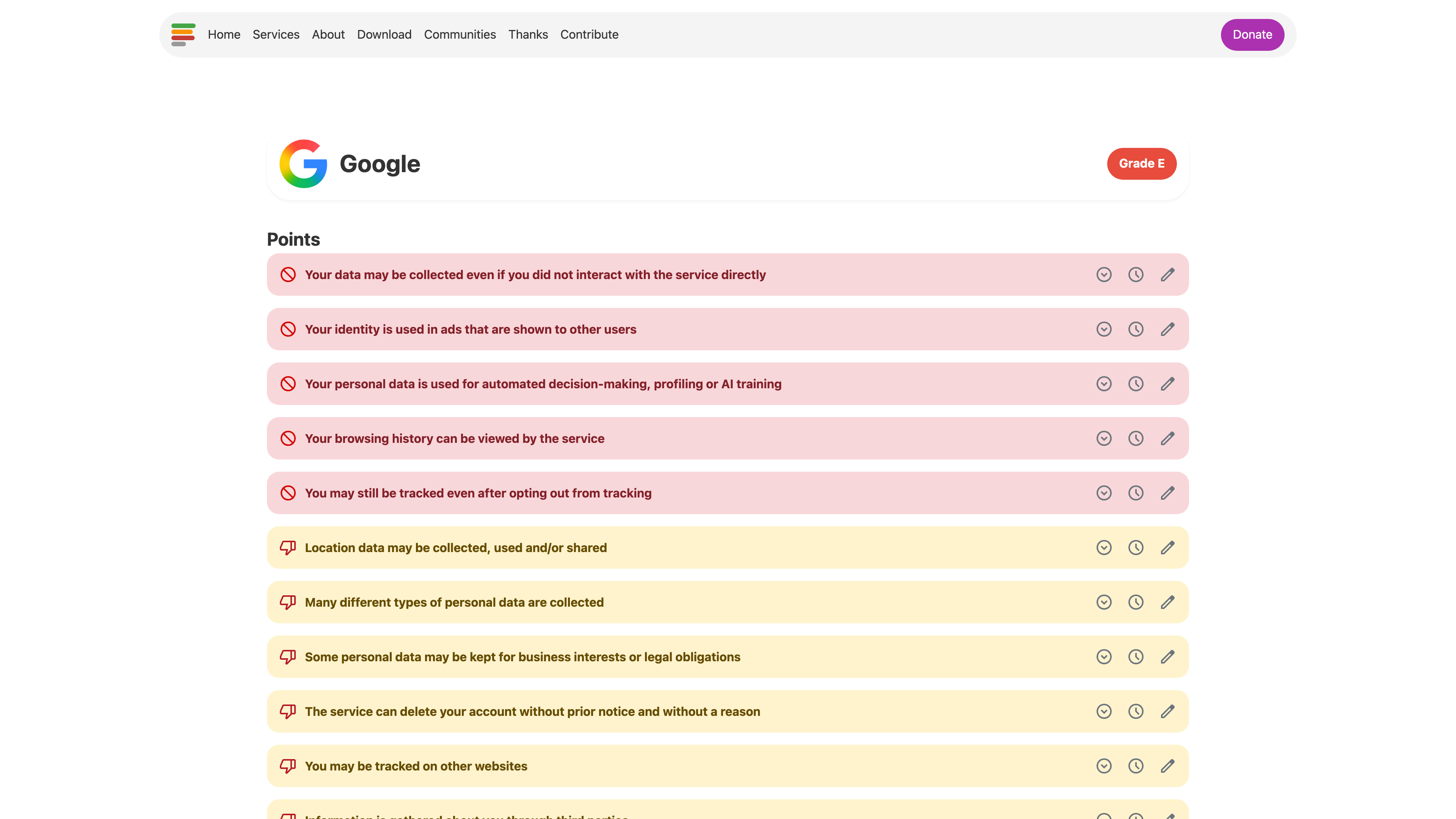
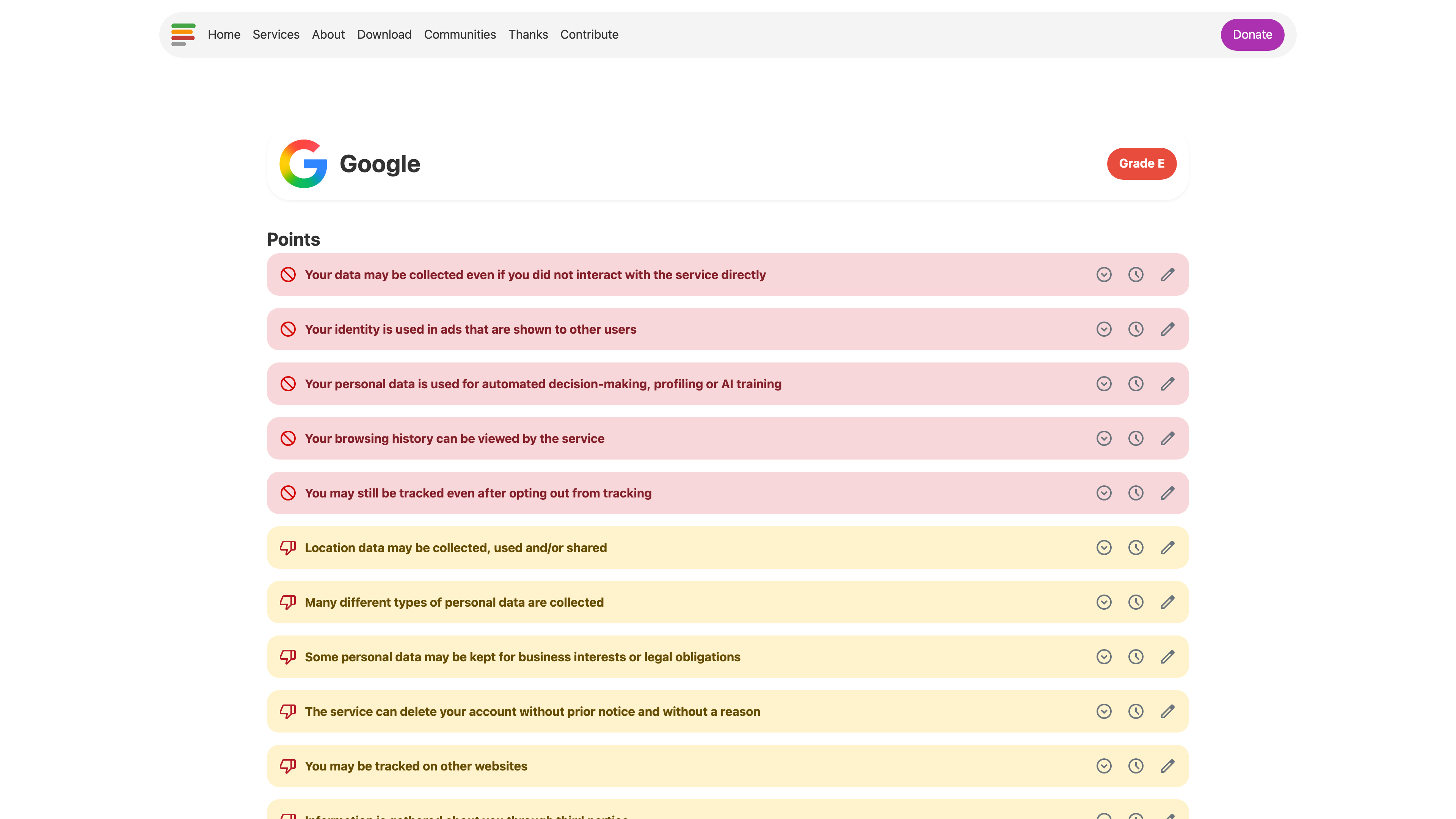
Google's service page, for example, shows Grade E followed by a point-by-point list: "your data may be collected even if you did not interact with the service directly", "your identity is used in ads that are shown to other users", and so on. Each point expands to the source clause and its discussion history, and the page lists the exact documents analyzed (privacy policy, terms of service, and others):
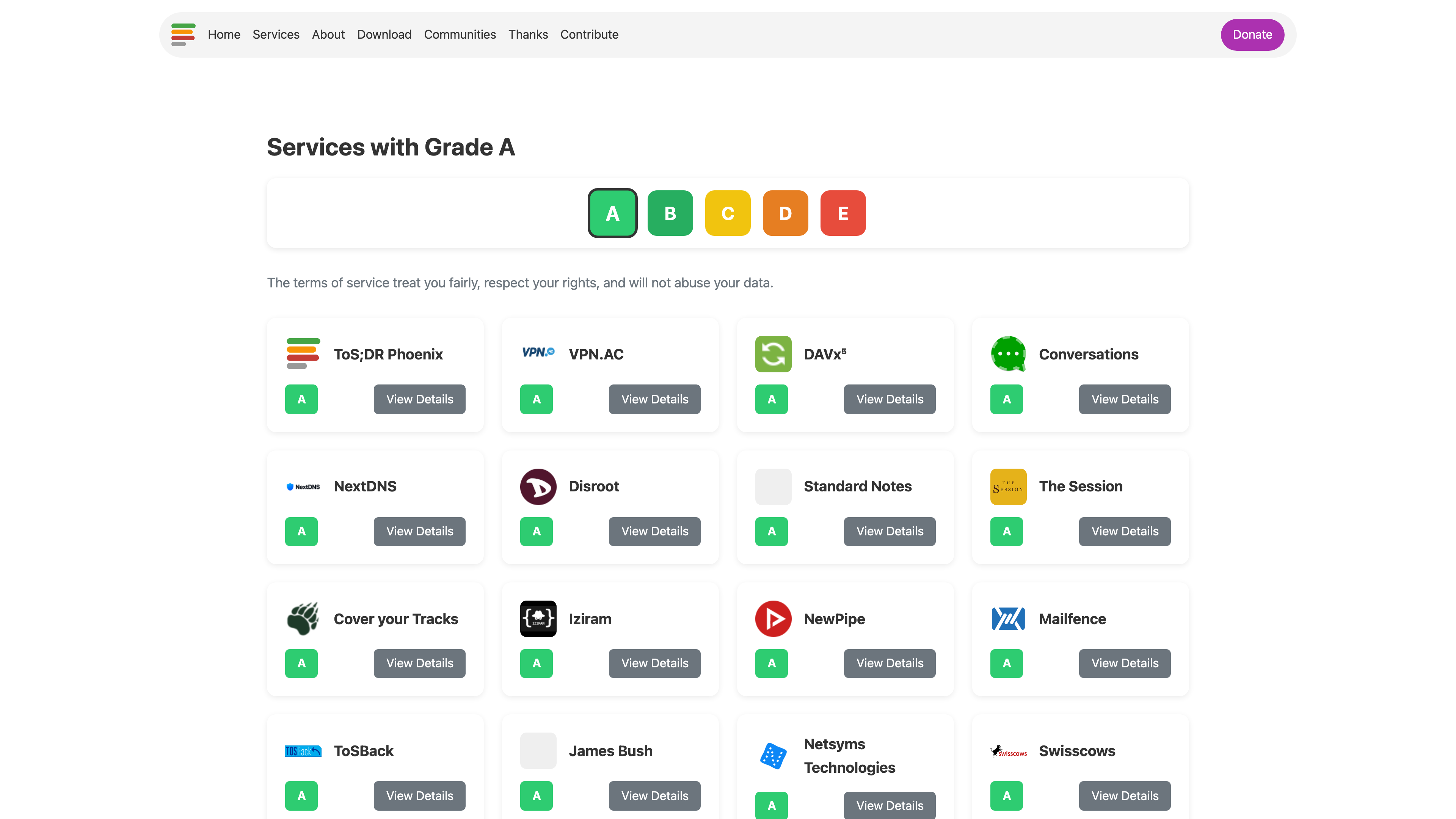
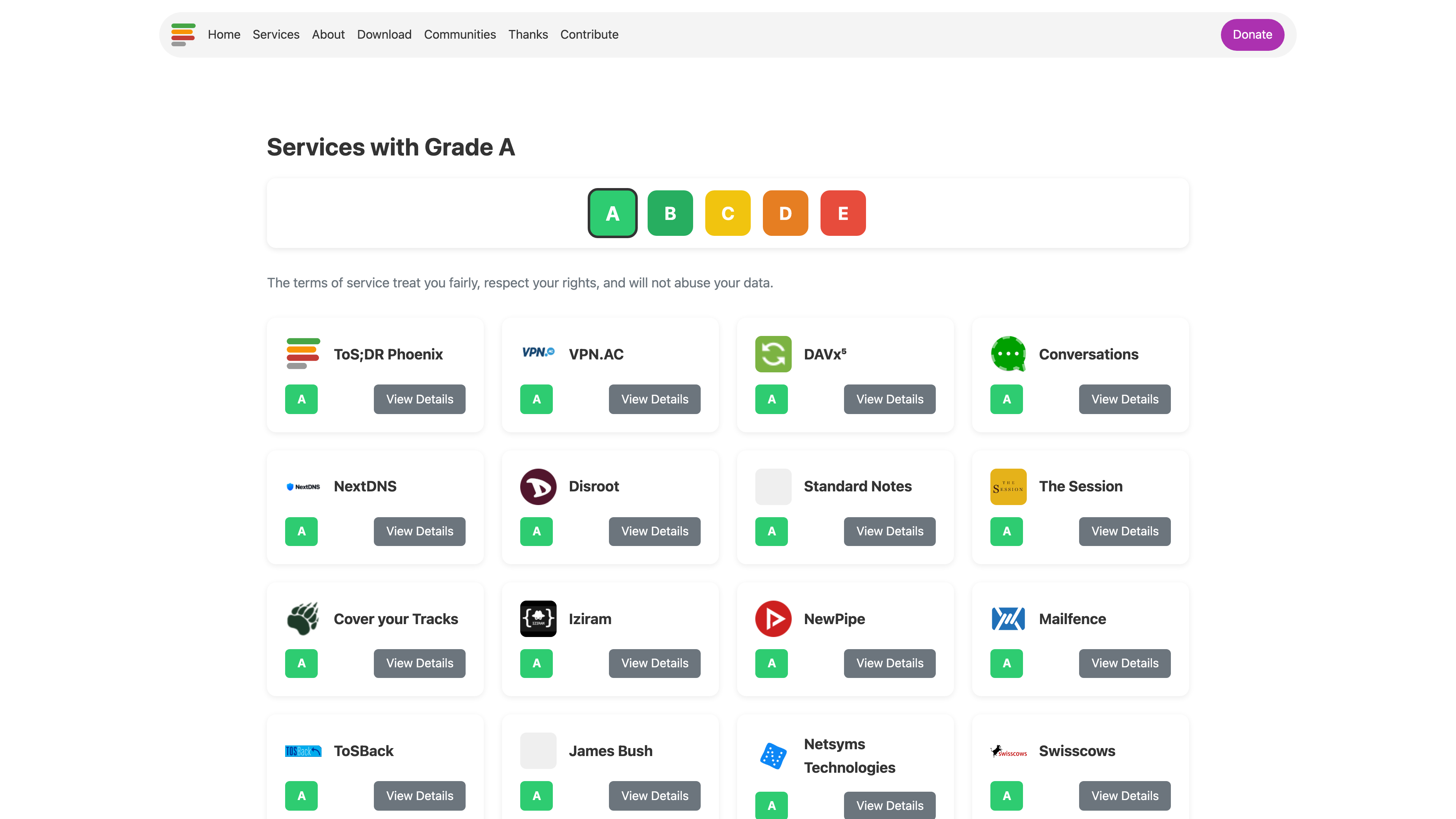
A directory lets you browse services by grade. As of 2026-09-02, the Grade A list runs about two pages and skews toward privacy-oriented, smaller services: VPN.AC, DAVx⁵, Conversations, NextDNS, Disroot, Standard Notes, NewPipe, Briar, and similar:
Browser Extension, Apps, and Open Data
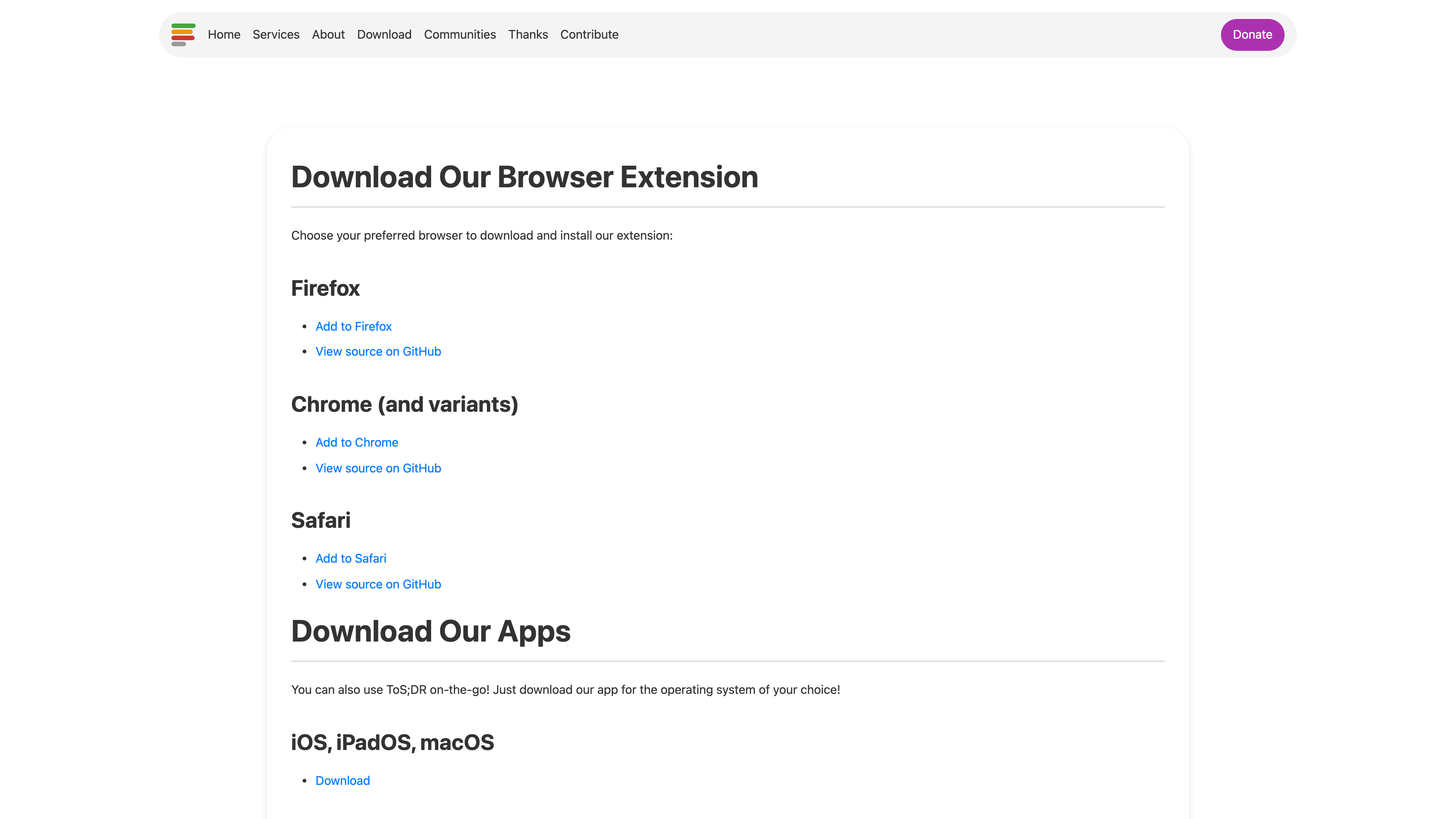
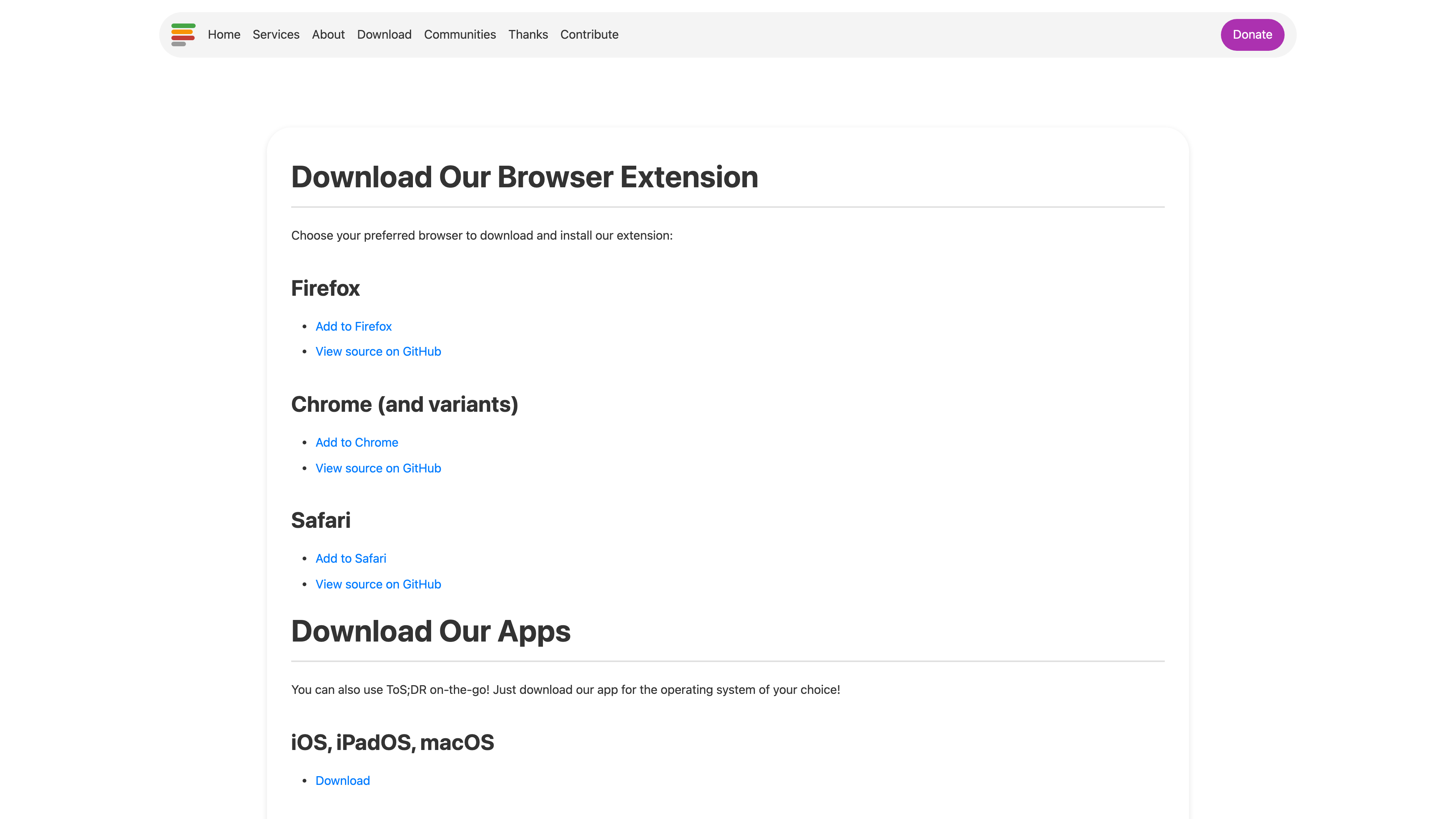
The official browser extension shows the current site's grade as an address-bar icon, opens the point summary on click, and warns you the first time you visit a poorly graded site. The download page offers builds for Firefox, Chrome (and Chromium variants), and Safari, and the extension is open source (GitHub, ~500 stars as of 2026-09-02). Its Chrome Web Store listing reports roughly 40,000 users and a 4.6/5 rating from 133 reviews as of 2026-09-02 (store page). Mobile and desktop apps exist for iOS/iPadOS/macOS and Android:
Open data is the other half of the project. All work is "released as free software and open data" (About): grades and points are available through a public API (documentation at docs.tosdr.org/developer), so anyone can build the ratings into their own product. The best-known integration is DuckDuckGo: since January 2018, DuckDuckGo's revamped extension and mobile app have incorporated ToS;DR's scores into the Privacy Grade they show for websites (DuckDuckGo's announcement).
Copyright and Content Policy
ToS;DR's summaries and grades are written by community contributors. Under its Terms of Contribution, submissions are published under CC BY-SA 3.0 (or a later version approved by contributor vote), with an exception allowing distribution within a larger program under the GNU AGPL-3.0 — which is precisely what makes reuse by products like DuckDuckGo possible.
The project is explicit about its own limits: the legal page states that nothing on the site is legal advice, that it expresses opinions "with no guarantee" and does not endorse any service, and that "reading ToS;DR is in no way a replacement for reading the full terms to which you are bound". Donors and supporters are listed publicly. The underlying policy documents remain the property of the respective services; ToS;DR quotes excerpts and adds its own commentary.
Good Use Cases
- A one-minute check before signing up for a service: does it allow account deletion without notice, waive class-action rights, or use your data for ad profiling?
- Comparing how user-friendly competing services' terms are — for instance, picking privacy-oriented alternatives from the Grade A directory.
- Developers and researchers who need machine-readable terms-of-service ratings (public API plus a CC license).
- Passive protection while browsing, via ToS;DR's own extension or DuckDuckGo's, which embeds the same data.
Limitations
- Grades are community opinion, not legal advice: the site itself stresses it offers no guarantee and endorses no service, and summaries may omit important nuances of the full text.
- Uneven coverage: a large share of services has no grade at all, and coverage concentrates on mainstream US/European services; services in other languages and regions are rarely reviewed.
- Summaries lag behind policy changes: grades reflect the documents as of the crawler's last fetch (stamped on the homepage), so points can go stale when terms are updated.
- A grade is a coarse signal: A–E averages hide real differences between same-graded services — read the individual points before drawing conclusions.
- A small volunteer project: maintenance is steady but modest — the GitHub org saw commits across the editor, extension, and docs repos through mid-2026 (github.com/tosdr), yet the official blog's latest post dates to April 2025, so review throughput and new-service intake should not be overestimated.
Comparable Project
Mozilla's *Privacy Not Included also evaluates consumer privacy, but as staff-written editorial reviews of products (apps, gadgets, AI tools). ToS;DR focuses on the legal documents themselves, annotated point by point by volunteers and released as open data — the two complement each other in coverage and method.
References
- ToS;DR official site, About, legal information, thanks page (checked 2026-09-02)
- Terms of Contribution (CC BY-SA 3.0)
- Developer documentation and public API
- Download page, Chrome Web Store listing, Firefox Add-ons listing
- DuckDuckGo blog: Privacy, Simplified (2018-01)
- Wikipedia: Terms of Service; Didn't Read
- Wired (2012-08), The Verge (2012-08), Time (2012-08)