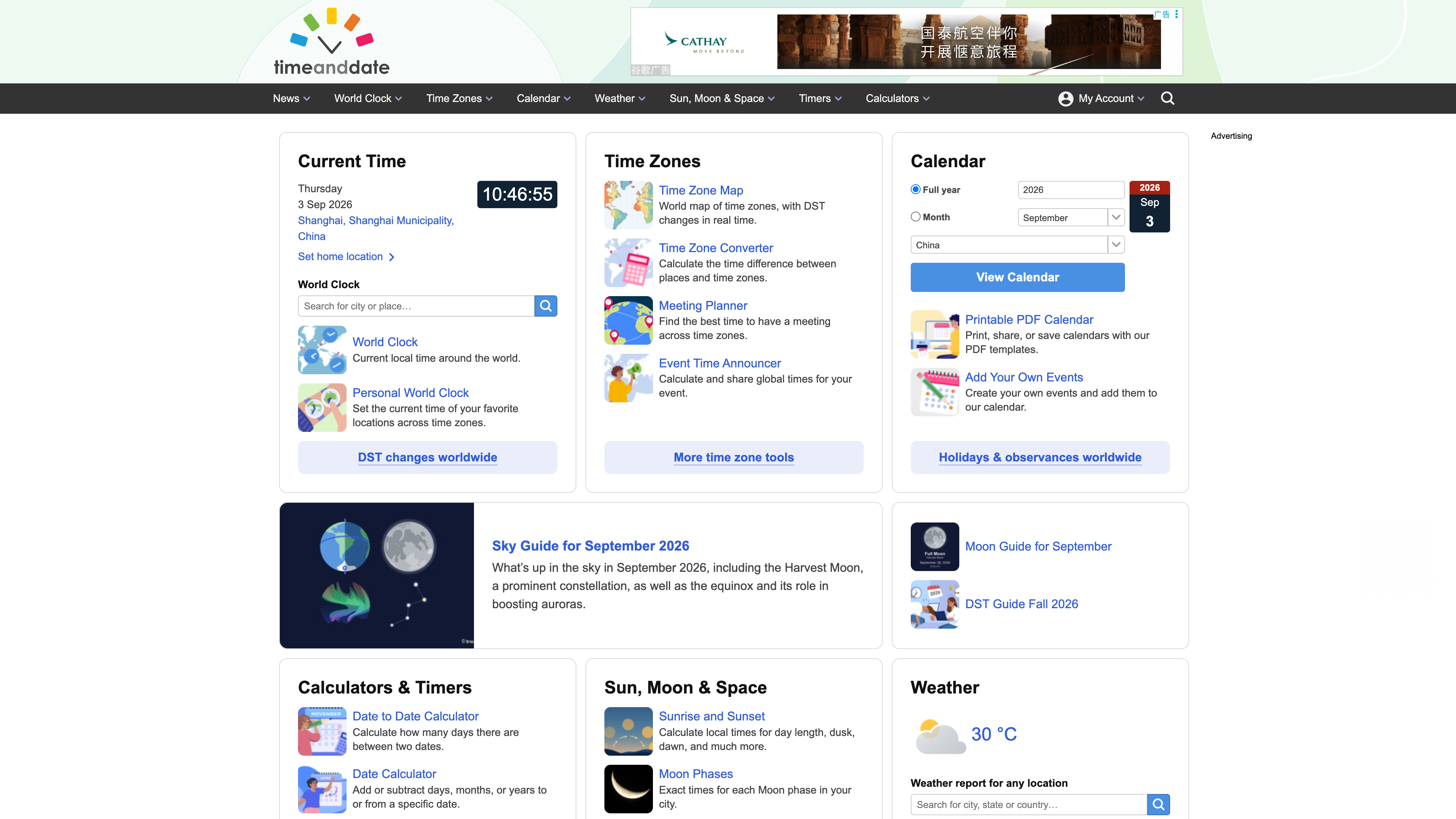
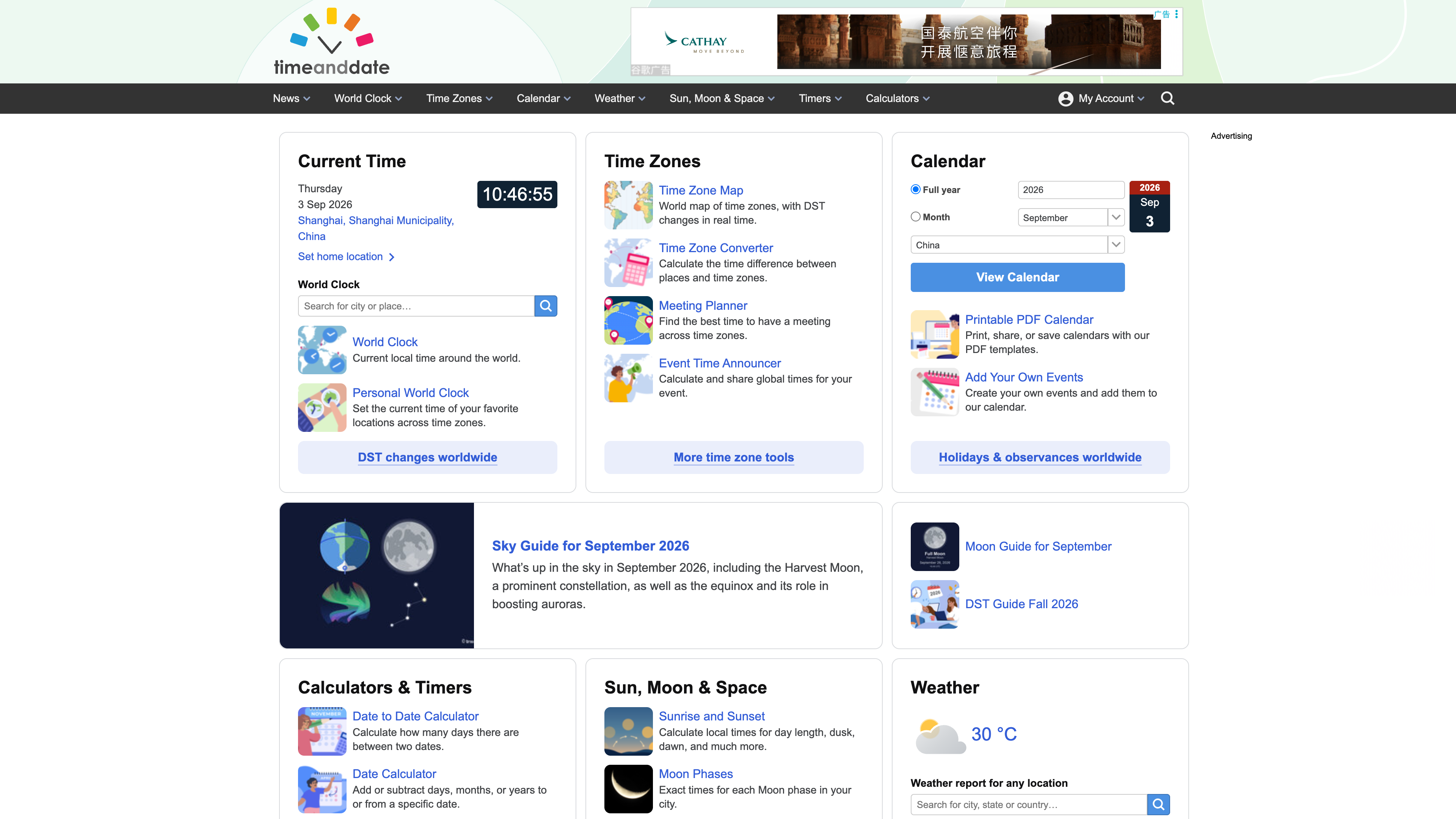
timeanddate.com is a free online toolkit built around time itself: check the current time in any city, convert between time zones, plan meetings across continents, generate calendars with local holidays, look up sunrise, sunset and moon phases, and track solar and lunar eclipses — all in the browser, with no account required. It is operated by the Norwegian company Time and Date AS and launched on May 24, 1998. The company describes itself as the world's top-ranking website for time and time zones, and its company page reports, as of 2026-09-03, around 2 million daily users, more than 5 million app downloads and a database of over 7,800 holidays. What sets it apart from single-purpose alternatives is how the pieces interlock — every city in the world clock links straight to that place's weather, sun times and time zone details — and that since 2016 the team has been hauling its own telescopes around the world to live-stream eclipses.
At a Glance
- URL: https://www.timeanddate.com/
- Type: Online time, date, astronomy and weather toolkit
- Cost: All web tools are free (ad-supported); the Supporter subscription removes ads for US14.99/year (as of 2026-09-03); APIs are paid products with a free three-month trial
- Sign-up: Not required for any tool; a free account saves and syncs personal settings
- Languages: English main site, plus German and Norwegian sister sites
- Mobile: Four iOS apps, one Android app
Background
The site began in November 1995 as a calendar and world clock that founder Steffen Thorsen published on his student account at the Norwegian University of Science and Technology (NTNU). He bought the timeanddate.com domain in 1997, rewrote the services from scratch, and launched on May 24, 1998 to a first-day audience of 24 visitors; by the end of that year the site was serving seven to eight thousand page views a day (official history). The timeline since then reads like a feature changelog: the Sun Calculator in 2001, the Time Zone Converter in 2004, purchased weather data in 2006, the first iOS apps in 2009–2010, the Norwegian site in 2012, the German site in 2015, and a revamped developer API site in 2021.
Time and Date AS was incorporated in June 2005 and is headquartered at Forus, just outside Stavanger, Norway. It remains a privately held company owned by its founder (registered as NO 988 375 713 MVA). The team numbers almost 40 programmers, designers, journalists and researchers — astrophysicists among them. The editorial staff publishes eight guiding principles and a four-stage fact-checking process, and the holiday database is maintained by a dedicated research team working from primary sources such as government announcements and legislation. After streaming the 2016 Mercury transit with its own equipment, the company made eclipse expeditions a tradition — the 2017 Great American Eclipse was its first big show — and says it collaborates with NASA, ESA and observatories worldwide.
World Clock and Time Zone Tools
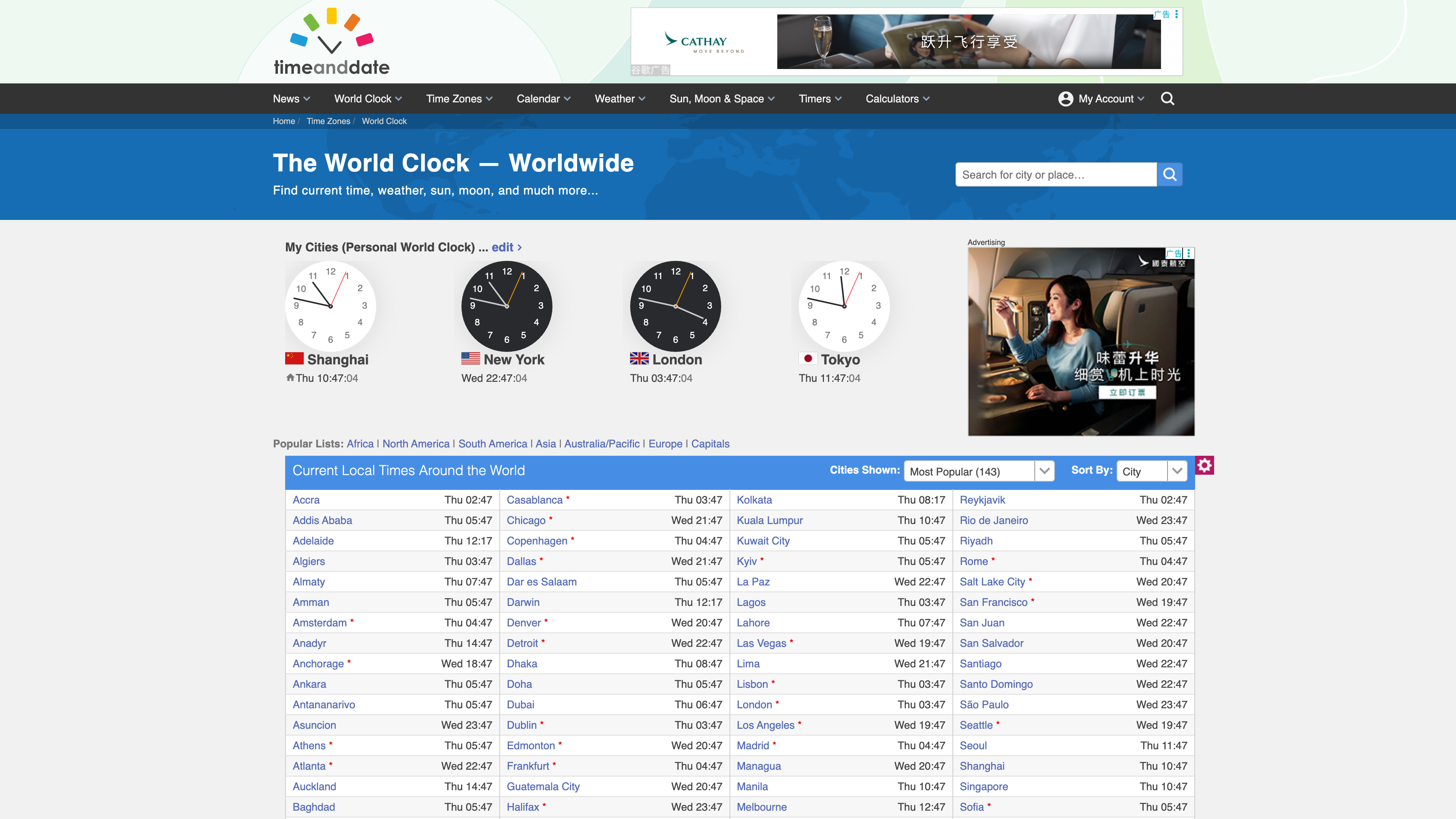
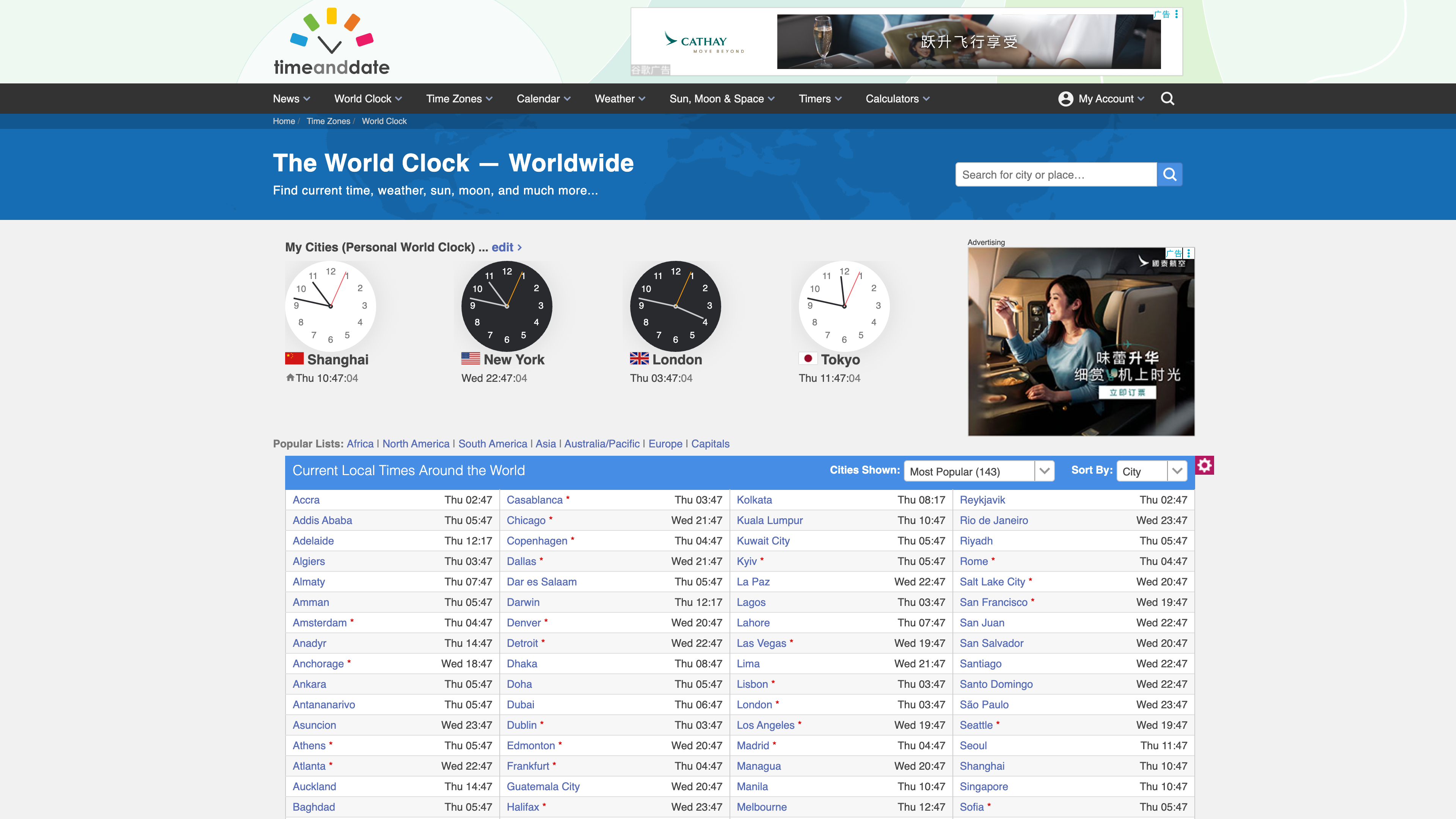
The World Clock lists current local times for cities worldwide, grouped into tiers — Capitals (215), Most Popular (143), Popular (358) and Somewhat Popular (472) — with an asterisk marking places observing daylight saving time (62 places when checked on 2026-09-03) and a UTC conversion note in the footer. Each city links to a detail page with its time zone history, DST change dates, weather and sun times.
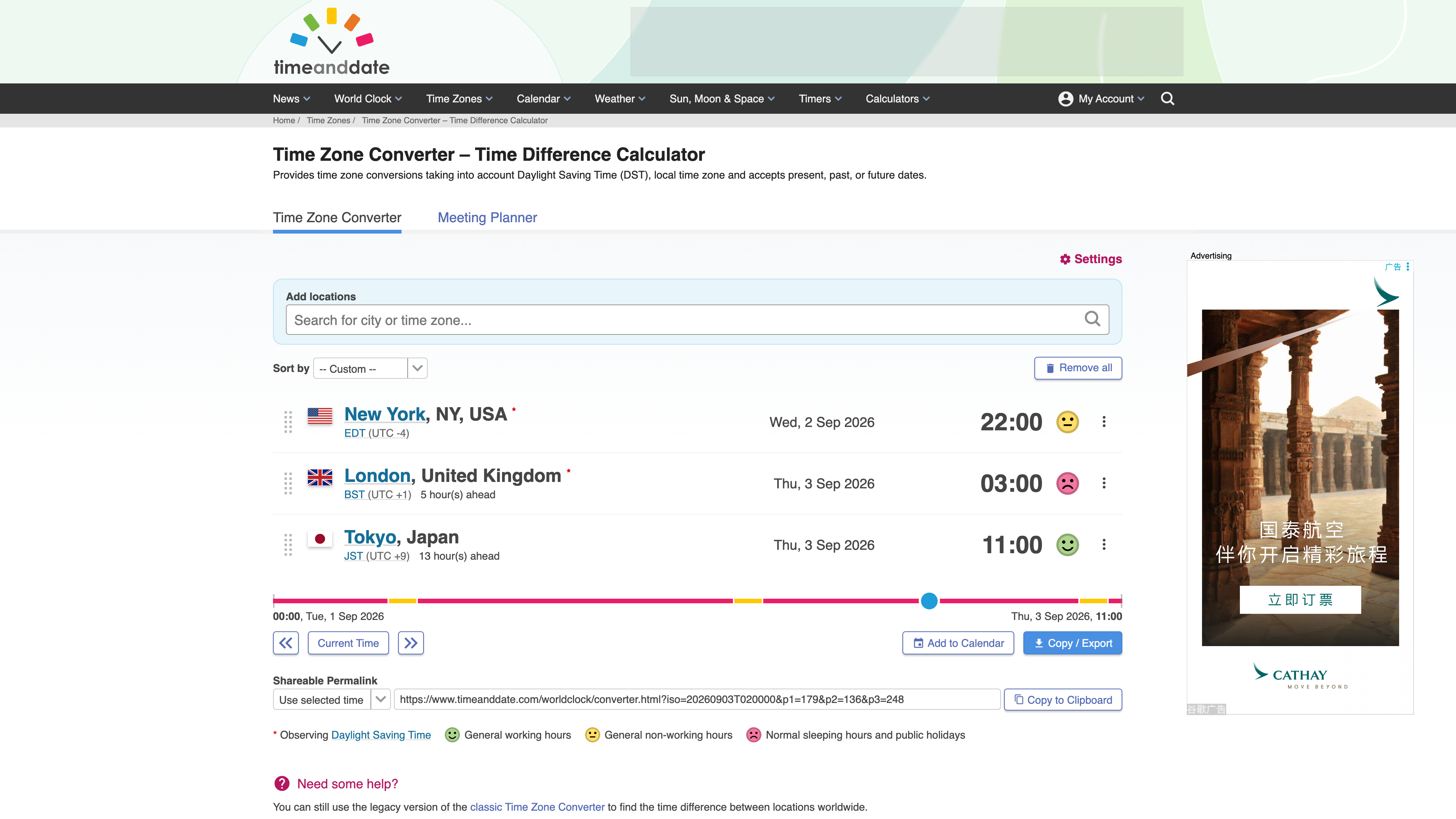
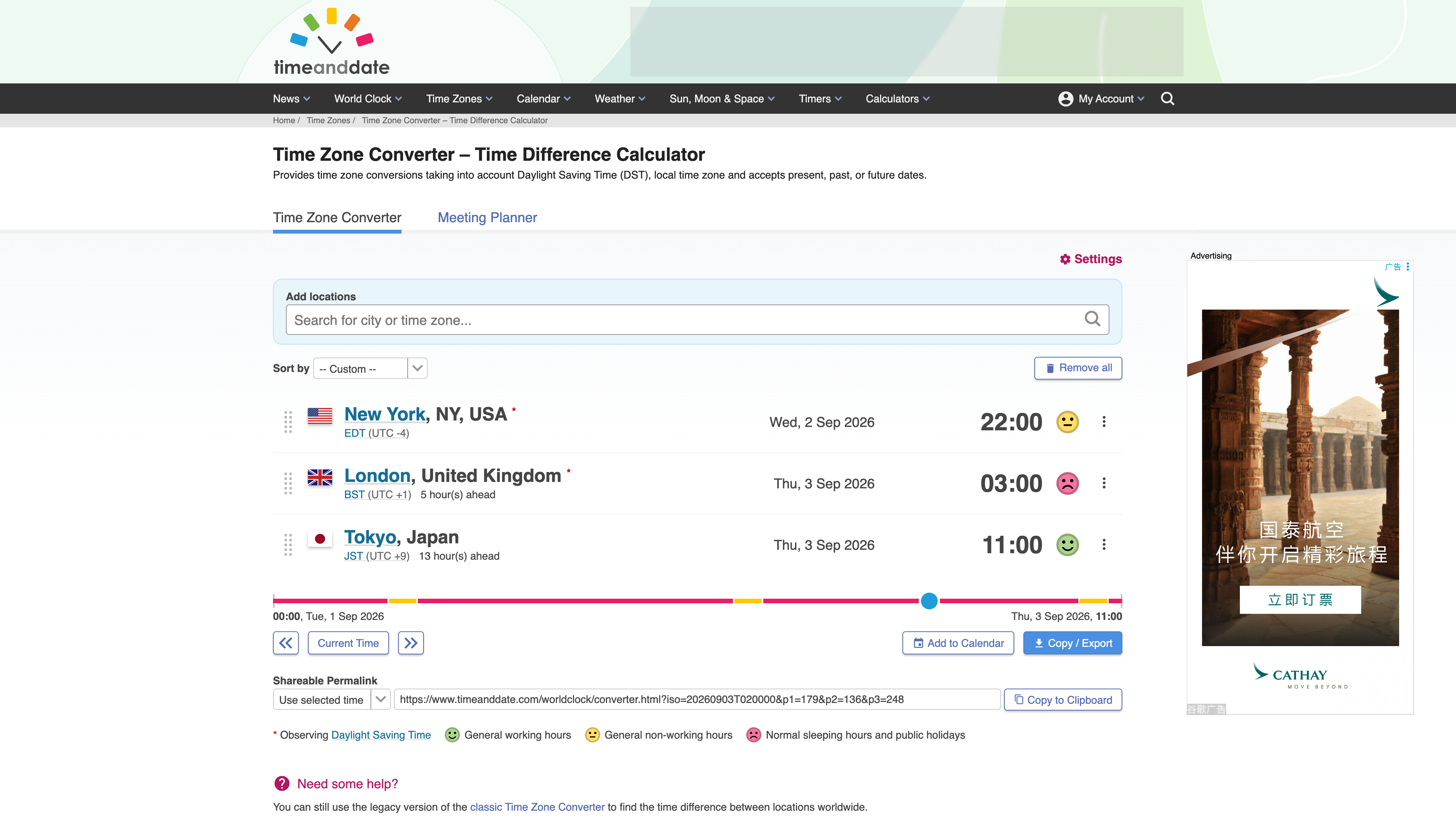
The Time Zone Converter compares up to 12 cities at once, handles DST automatically, and accepts past or future dates — "what was the New York–Shanghai offset last November" and "when should we meet next week" are the same tool. Results are color-coded by general working hours, non-working hours and sleeping hours, and can be shared via a permalink. In the same section, the Meeting Planner finds the best overlap for a call across locations, while the Event Time Announcer converts a single event time into local times worldwide for publication.
Calendars, Holidays and Countdowns
The calendar tool generates full-year or monthly calendars for more than 200 countries and territories, marked with local public holidays and moon phases computed in local time, and exports them as printable PDF templates; signed-in users can add personal events. The holiday database underneath is one of the site's core assets: the company page cites over 7,800 entries, while the developer-facing API page describes 7,000 holidays across 230 countries, researched and continuously updated by a multilingual team.
The timers and calculators section is small but broad: a countdown to any date, an online timer with alarm, a stopwatch, a free countdown widget you can embed on your own site, and calculators for date duration, business days (excluding holidays), date arithmetic, weekdays, week numbers, Roman numerals and more.
Astronomy and the Eclipse Section
The "Sun, Moon & Space" section provides sunrise and sunset times, the three stages of twilight, moonrise and moonset, moon phases, day-and-night world maps, planet positions and brightness, meteor shower calendars and solstice/equinox calculations for any location. The company states that its astronomical calculations use algorithms developed by the US Naval Observatory and NASA's Jet Propulsion Laboratory.
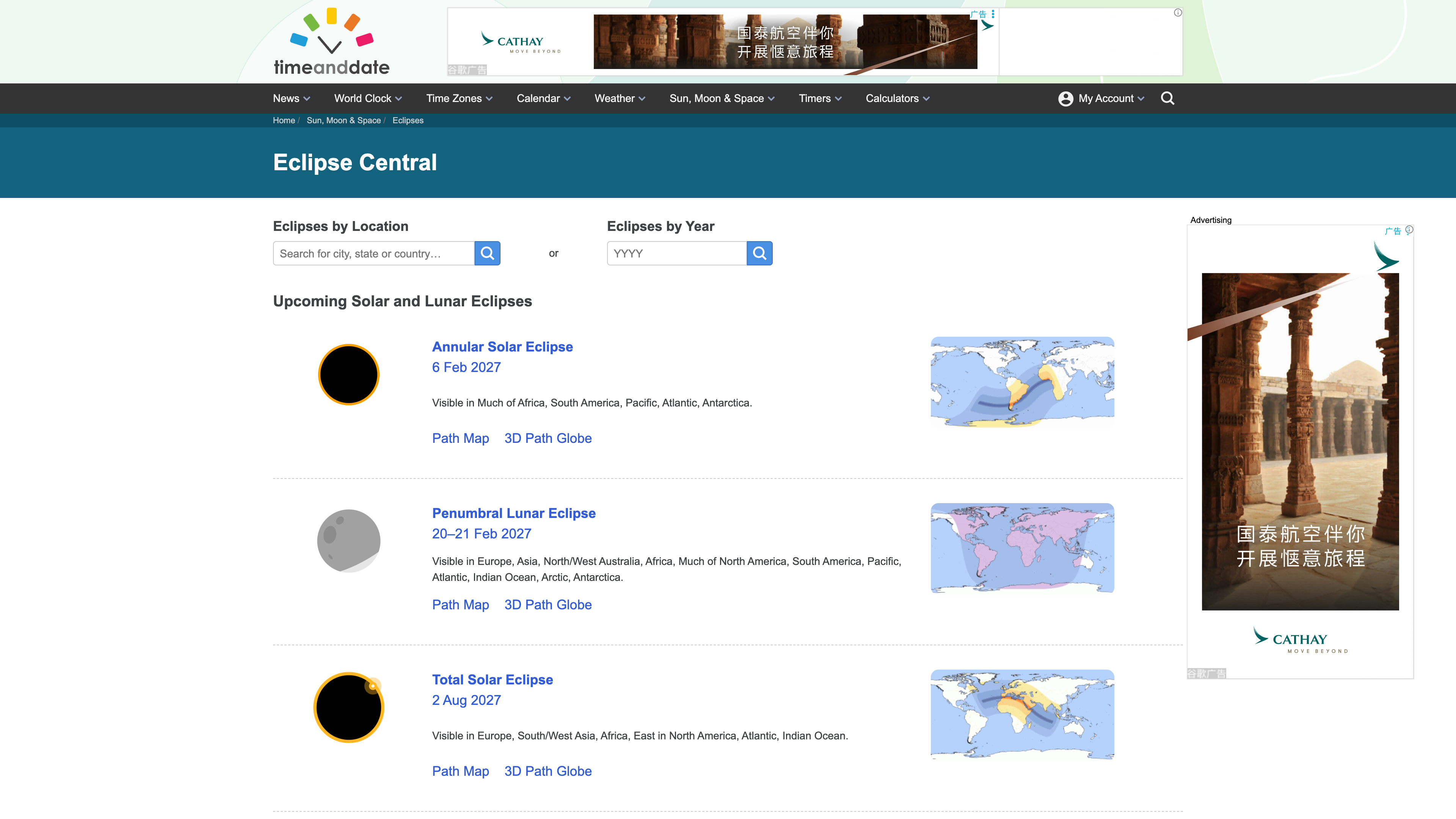
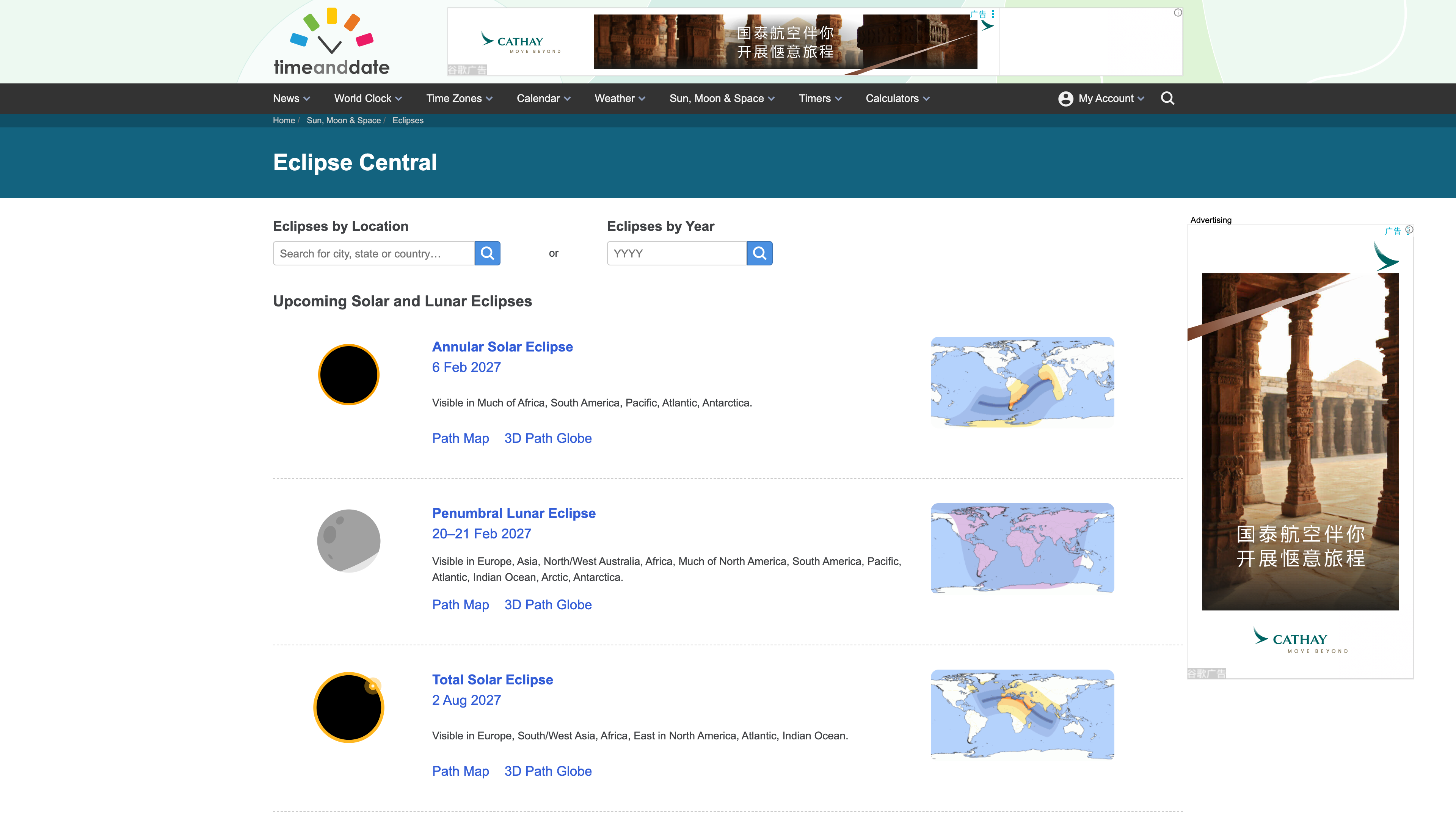
Eclipses are a signature topic. Eclipse Central lets you search solar eclipses, lunar eclipses and planet transits from 1900 to 2199 by location or by year, with visibility summaries, path maps and an interactive 3D path globe for each event, plus live-stream coverage for major ones. As of 2026-09-03, the next events listed are an annular solar eclipse on February 6, 2027, a penumbral lunar eclipse on February 20–21, 2027 and a total solar eclipse on August 2, 2027.
Weather and Climate
The weather section offers current conditions for cities worldwide, a 14-day forecast, hour-by-hour forecasts for the next seven days, the past week's observations and climate averages. Worth knowing: the weather data has been purchased from external providers since 2006 rather than produced in-house, so its strength lies in sitting on the same page as the time and calendar tools rather than replacing a dedicated meteorological service.
Accounts, Pricing and Developer Access
Without an account, personal settings (units, home location, personal world clock) live in browser cookies and disappear when the cookies are cleared. A free account saves settings and syncs them across devices, unlocks the Personal World Clock and lets you add events to calendars (per the Supporter page comparison).
There are two paid tracks:
- Supporter subscription (as of 2026-09-03): US1.99/month) or US1.25/month). Perks include ad-free browsing across the website, sun and moon rise/set times precise to the second, an exclusive Multi-Month PDF calendar template, and the option to remove the timeanddate.com logo from printable calendars. Note that ad removal covers the website only; the apps are upgraded separately. The company frames the subscription as a way to keep funding human-created content as generative AI erodes the advertising model.
- Developer APIs (dev.timeanddate.com): four live APIs — Holidays, Time, Astronomy and Date Calculator — with a Geospatial API marked as coming soon. All can be tried free for three months with no credit card. Paid plans are billed annually: the Holidays API runs 399/49/399. The company states plainly that there are no free plans for students or researchers, and names global retailers, tech companies and airlines as customers.
On mobile, there are four iOS apps (World Clock, Meeting Planner, Time & Date Calculator, Countdown) and one Android app (World Clock), with over 5 million downloads combined according to the company page.
Copyright and Content Policy
All text, images and data on the site belong to timeanddate.com, and the terms of use permit only personal, non-commercial viewing, downloading and printing. Businesses may use subscriptions and services internally but may not resell, sub-license, lease or rent the data — PDF calendars included — to any third party. API services are governed by separate terms, and derivative works made available to third parties require a separate agreement. The terms also provide data "as is" without warranty and explicitly note that "data may be incorrect for politically disputed jurisdictions," where the company aims to stay neutral; Norwegian law governs the service. On privacy, the site publishes GDPR-compliant disclosures, serves ads through third parties such as Google Ad Manager, and offers an opt-out of personalized advertising in its privacy settings (privacy statement).
Good For
- Distributed teams: align meeting times with the Meeting Planner and double-check historical or future offsets with the Time Zone Converter.
- Travel and everyday planning: check a destination's time, weather and daylight hours; print a yearly calendar with local holidays.
- Skywatchers: moon phases, planet visibility, meteor shower calendars, and eclipse paths with live streams.
- Developers and businesses: pull holiday, time zone and astronomy data into their own systems (rostering, calendar products) via the paid APIs.
Limitations
- Noticeable advertising: the free tier carries third-party banner ads on the homepage and tool pages; removing them requires a Supporter subscription and does not extend to the mobile apps.
- No Chinese interface: English, German and Norwegian only.
- Converter cap: the Time Zone Converter handles at most 12 cities at once.
- Astronomy aimed at the general public: you get rise/set times, moon phases, planet visibility and eclipse paths, but not the catalog exports or telescope control of dedicated planetarium software.
- Data scope boundaries: eclipse and transit lookup covers 1900–2199; weather data is third-party; the company itself warns that data for politically disputed jurisdictions may be inaccurate and takes no position there.
- Some enhancements sit behind the paywall: second-precision sun/moon times and advanced PDF calendar templates are Supporter perks, and the APIs have no permanent free tier beyond the three-month trial.
Alternatives
- time.is: a minimal display of exact time and offsets, handy for a quick check; much narrower in scope.
- World Time Buddy: a lightweight grid for comparing meeting times across zones.
- Heavens-Above: satellite passes and star charts for observers; more specialized for deep-sky and artificial-satellite work.
References
- timeanddate.com (homepage) (checked: 2026-09-03)
- Time and Date AS (company page) (checked: 2026-09-03)
- History of timeanddate.com (checked: 2026-09-03)
- Our Editorial Policy and Standards (checked: 2026-09-03)
- Support timeanddate.com (Supporter subscription) (checked: 2026-09-03)
- Terms & Conditions of Use (checked: 2026-09-03)
- Privacy Statement (checked: 2026-09-03)
- The World Clock — Worldwide (checked: 2026-09-03)
- Time Zone Converter – Time Difference Calculator (checked: 2026-09-03)
- Holidays and Observances Around the World (checked: 2026-09-03)
- Solar & Lunar Eclipses Worldwide (Eclipse Central) (checked: 2026-09-03)
- API Services for Developers (checked: 2026-09-03)
- Timeanddate API Services (developer site) (checked: 2026-09-03)
- Holidays API: Pricing (checked: 2026-09-03)
- Time API: Pricing (checked: 2026-09-03)
- Apps, API, plug-ins and tools for your site (checked: 2026-09-03)