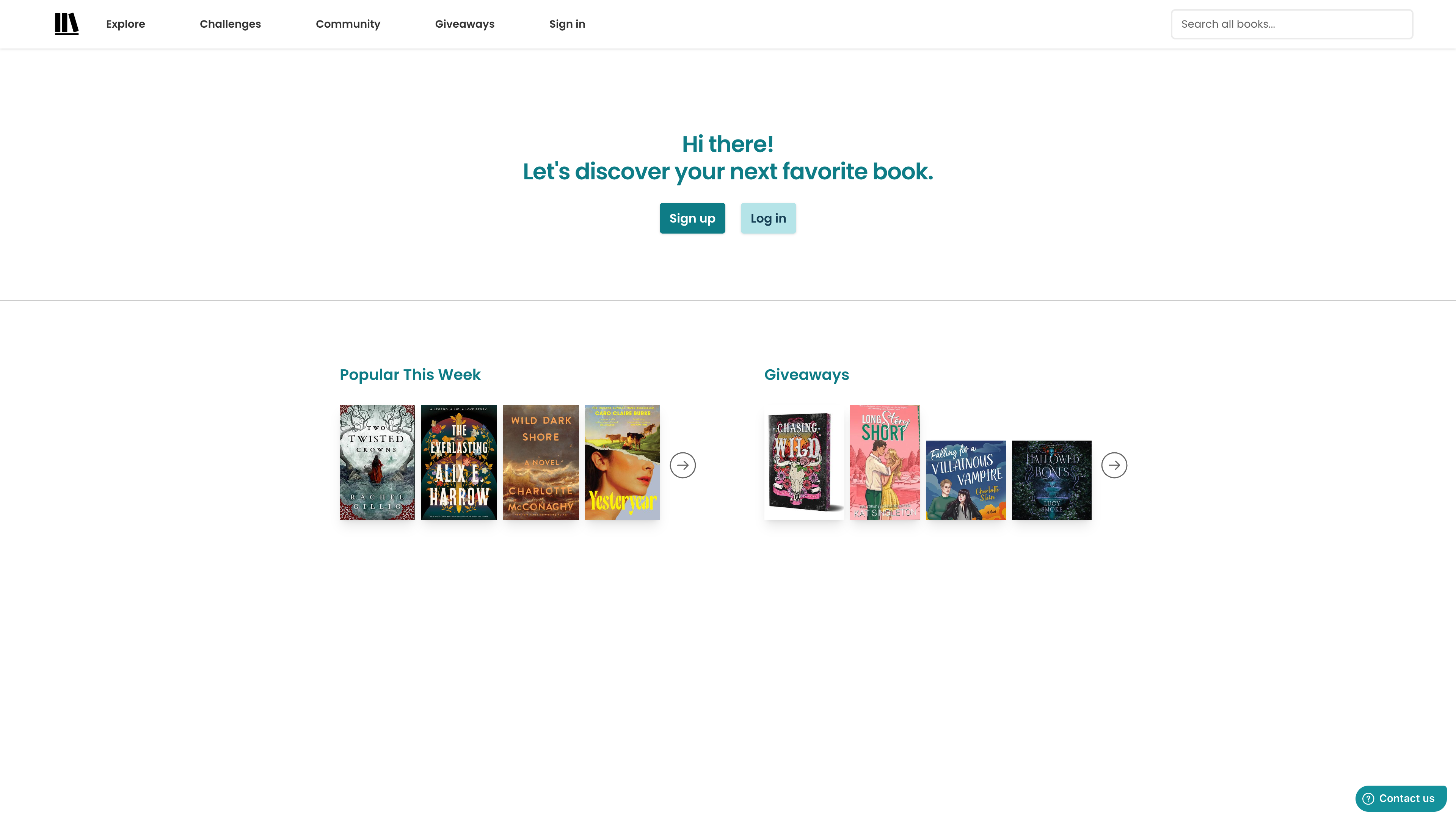
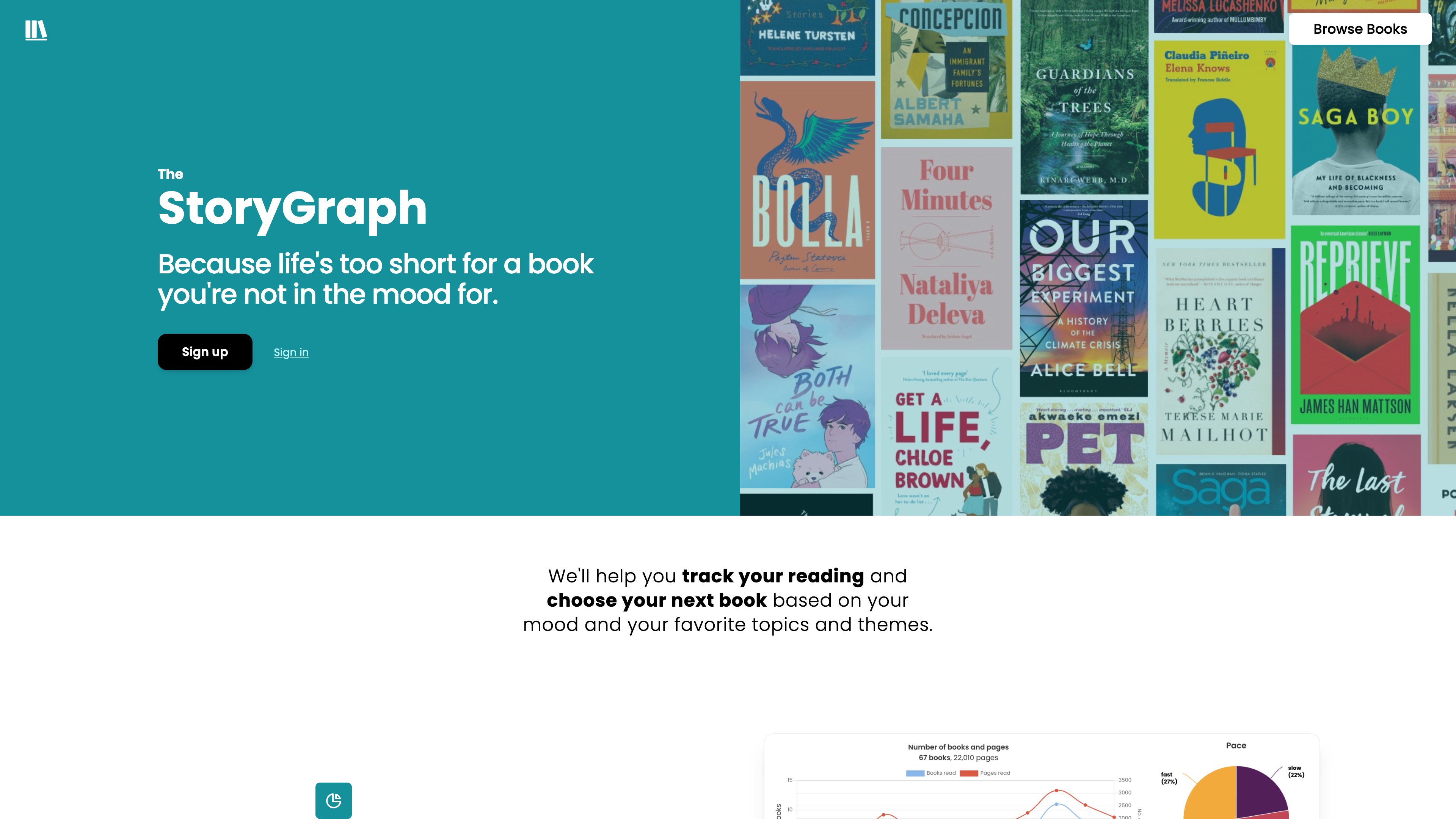
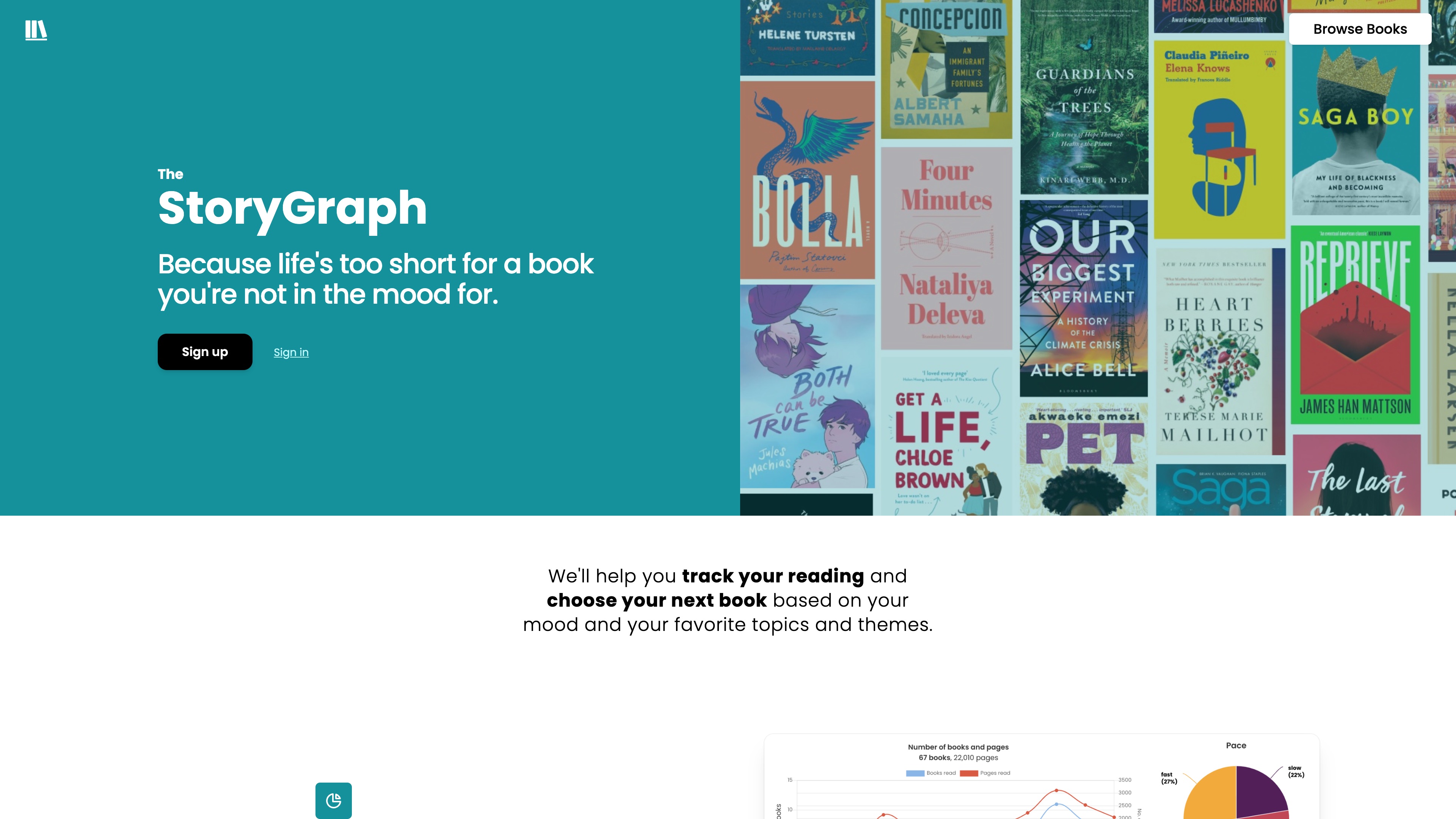
The StoryGraph (marketing site thestorygraph.com, app at app.thestorygraph.com) is a UK-based reading tracker and book recommendation platform. Readers log books as to-read, currently reading, read, or did-not-finish, and the platform suggests what to pick up next using structured community data — moods, pace, and more — together with a machine learning model. It was created in 2019 by software engineer Nadia Odunayo, and its Plus subscription page states the positioning outright: "Invest in a Goodreads alternative not owned by Amazon." Verifiable differences from Amazon-owned Goodreads include: independent operation with no ads; half- and quarter-star ratings; discovery organized around mood and pace tags rather than plain lists; and, since June 2026, native reading-progress sync with Kobo eReaders. Per the Wikipedia article aggregating official figures, the platform passed 5 million user signups in January 2026.
At a Glance
- URL: https://www.thestorygraph.com/ (app: https://app.thestorygraph.com/)
- Type: Reading tracker and book recommendations (social cataloging)
- Cost: Core features free and ad-free; Plus costs 4.17/month billed annually) or $4.99/month, with a 30-day free trial that requires no payment details and ends automatically (as of September 8, 2026)
- Registration: Not required to browse books, reviews, and community stats; an email account is needed for tracking, recommendations, and social features
- Language: English only
- Platforms: Web, iOS, Android (US App Store rating 4.5 from 3,561 ratings as of September 8, 2026)
Background
The StoryGraph was built by British software engineer Nadia Odunayo. In her interview with POCIT, she recounts graduating from Oxford and, in January 2019, choosing a book app over a running app as a side project — initially just to build lists and track her progress on a nice dashboard. Co-founder Robert Frelow leads the machine learning and AI work (per a Libro.fm podcast interview); the in-app AI features are branded SGAI. The company has remained bootstrapped with no venture capital, operated by The StoryGraph Limited, registered in London (the App Store seller name; Wikipedia categorizes it as a City of London company).
Growth milestones (per the Wikipedia article and primary reporting): in mid-2020, viral tweets supporting Black creators brought the platform its first traffic spike; in January 2024 a signup surge briefly crashed its servers for a few hours; after the 2024 US election, anti-Amazon sentiment on BookTok and beyond drove a wave of departures from Goodreads, peaking at nearly 25,000 signups in a single day (CBC, HuffPost). Registered users passed 4 million in April 2025 and 5 million in January 2026 (official Instagram, cited via Wikipedia). In December 2025 the iOS app was named a winner in Apple's 2025 App Store Awards. On May 19, 2026, the platform and Rakuten Kobo announced a partnership: since June 2026, Kobo devices and apps natively sync ebook and audiobook reading progress into StoryGraph (sideloaded titles excluded), making Kobo the first eReader with built-in StoryGraph sync.
Tracking, Stats, and Mood-Based Discovery
Tracking is the free core: shelves cover to-read, currently reading, read, and DNF (Did Not Finish, recording the page where you stopped); progress updates double as a reading journal; there are reading streaks and annual goals for books, pages, or listening hours. Statistics are presented as charts across moods, pace, genres, page counts, and more, with a Reading Wrap-up summary at year-end.
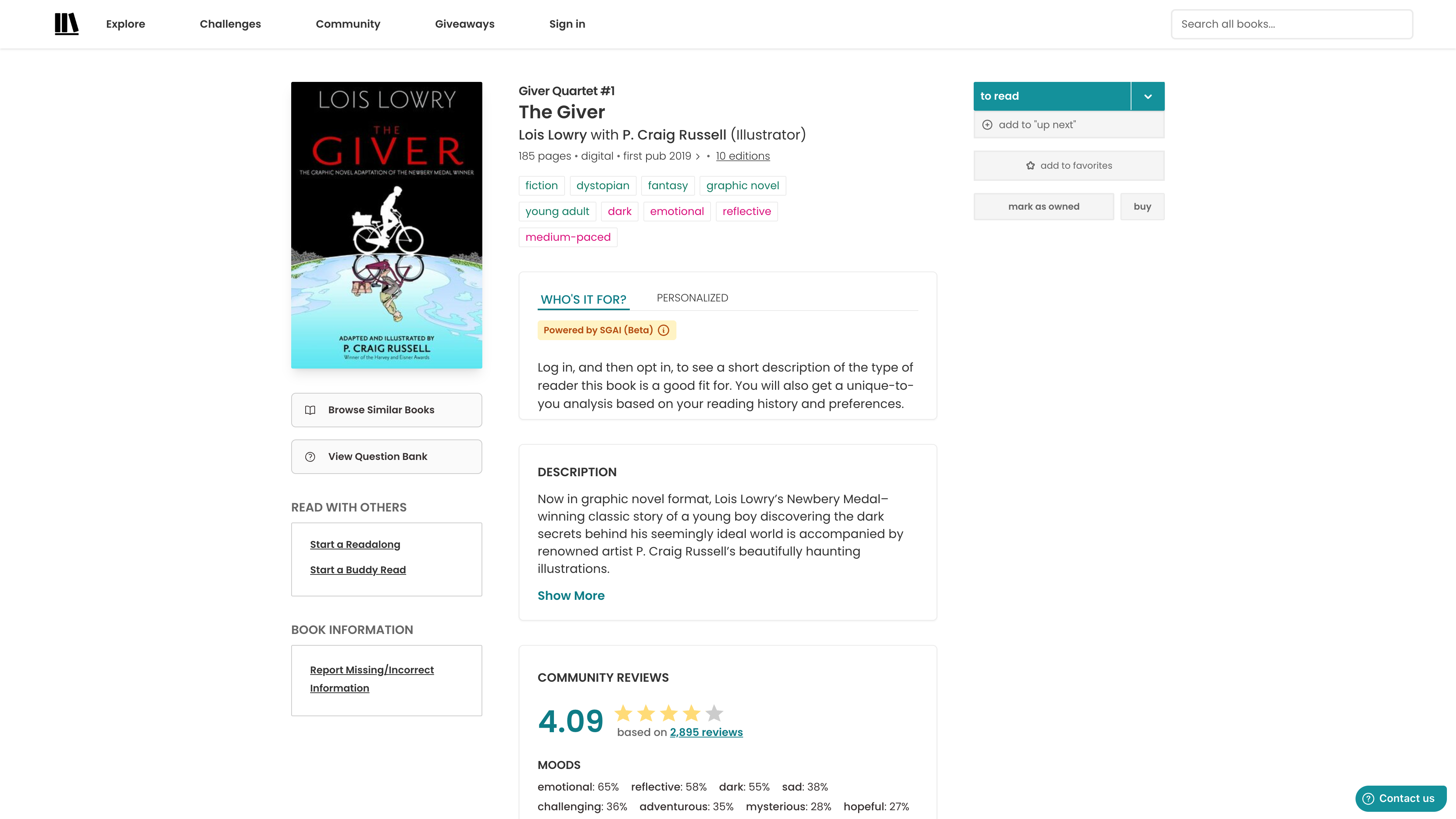
Book pages are public and expose the community data layer that sets the platform apart from plain list-making sites. On The Giver's page, for example (as of September 8, 2026): a 4.09 community rating from 2,895 reviews; mood votes of emotional 65%, reflective 58%, dark 55%; a pace split of fast 50% / medium 44% / slow 5%; plus polls on plot- versus character-driven storytelling, character development, and cast diversity. Discovery filters let you combine mood, pace, and genre, with similar-books and similar-users features to surface the next read.
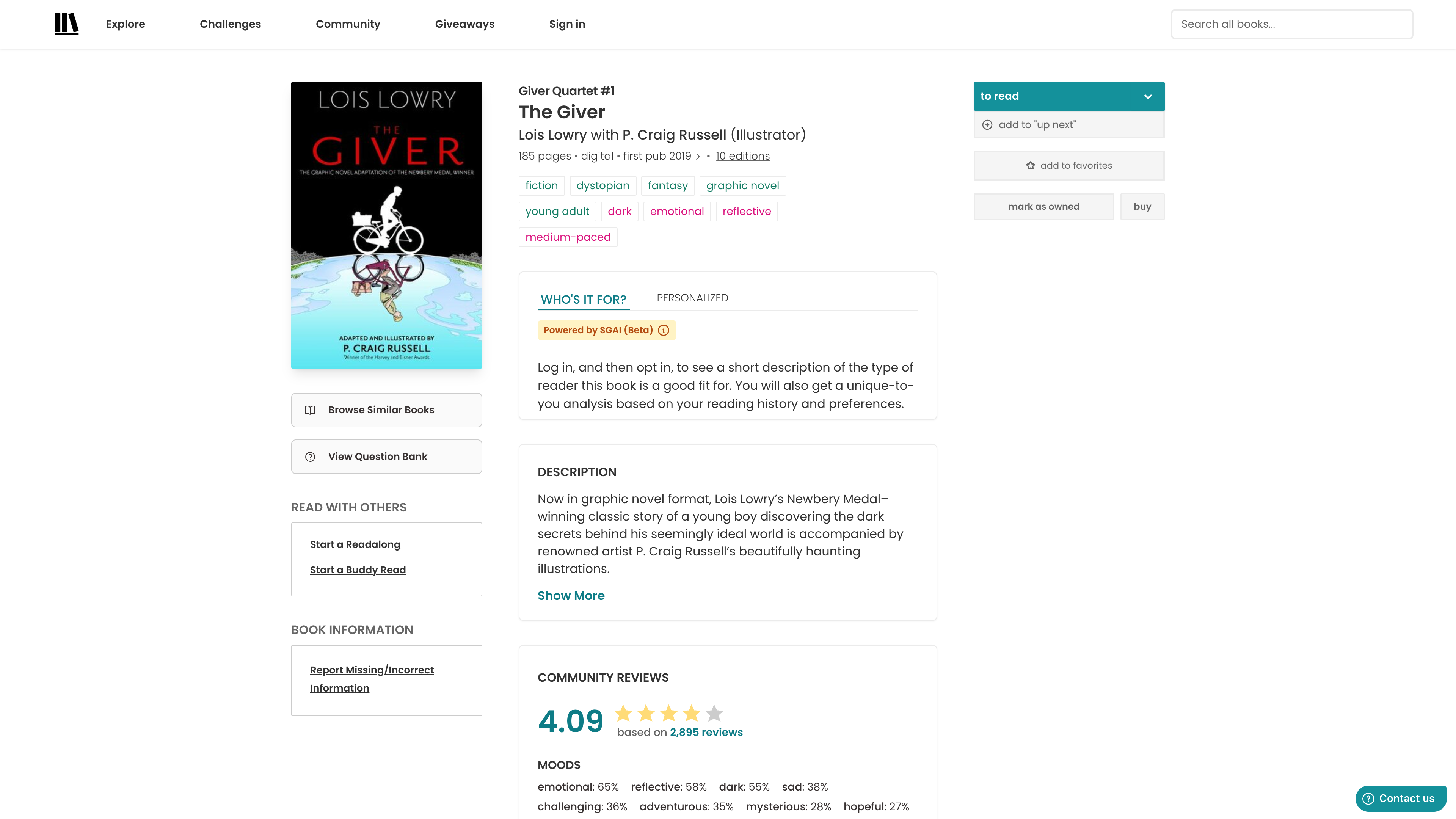
Personalized recommendations are machine-learning driven, and the site says they "understand your reading preferences." A book page's "Who's It For?" module (Powered by SGAI, in beta) requires signing in and opting in, then describes what kind of reader the book suits along with an analysis based on your history. Ratings support half and quarter stars (3.25, 4.75), finer than Goodreads' whole stars. Content warnings are submitted by users alongside their reviews, and authors can provide an author-approved version; a summary is available before you pick up a book.
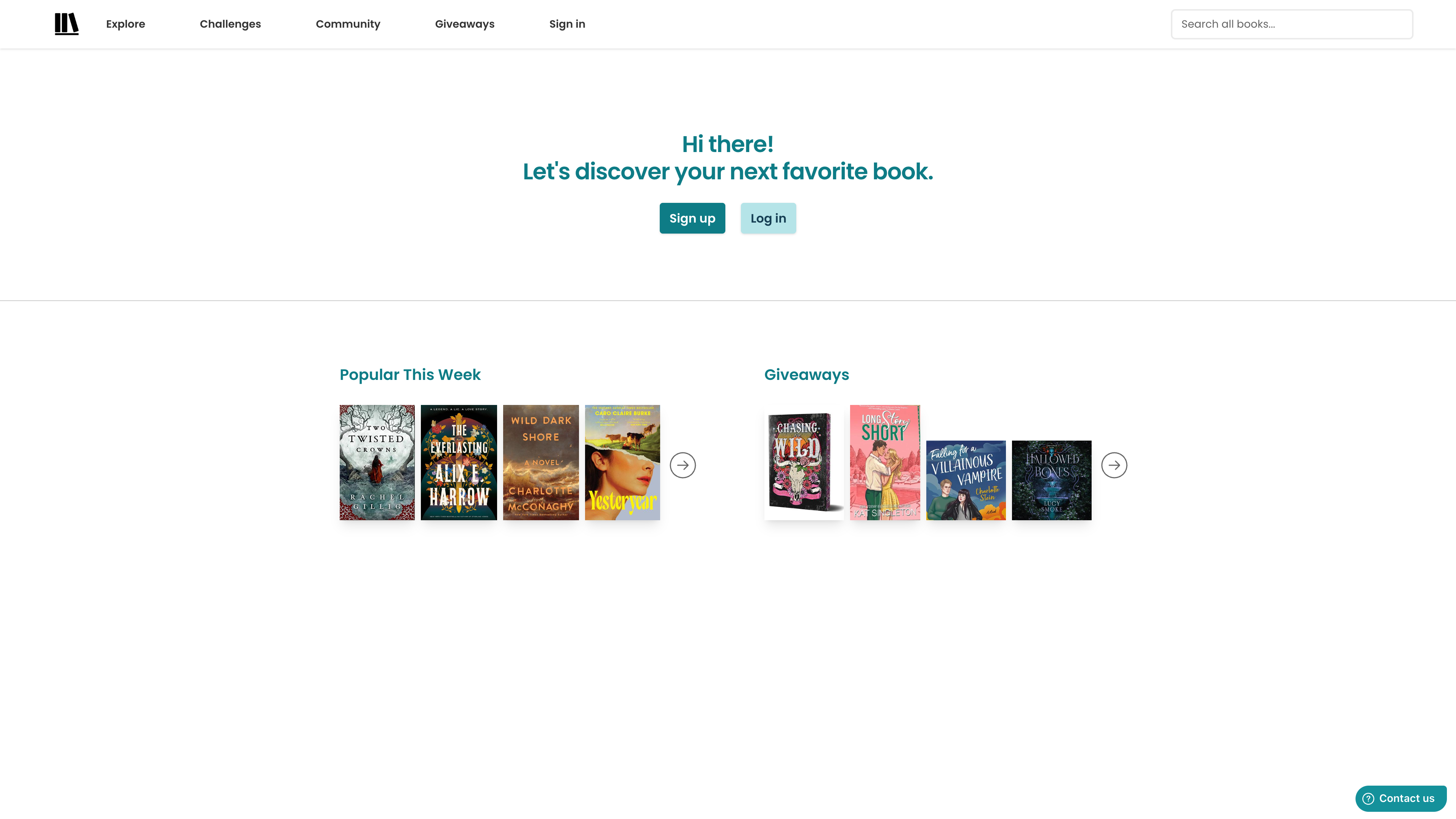
Social and read-together features include Buddy Reads and Readalongs — live reactions to specific passages stay locked for each participant until they reach that point, preventing spoilers by design; Book Clubs; official and user-created reading challenges (e.g., one book from every country); Giveaways, launched in September 2022, where publishers and authors host free-book drawings; plus custom tags, shareable lists, and following friends' activity.
Accounts and Openness
The free tier includes tracking, recommendations, buddy reads, challenges, giveaways, and basic stats, with a stated commitment to staying ad-free. Plus (as of September 8, 2026: 4.99/month, billed in USD, GBP, or EUR) adds Custom Charts, extra stats filters for any time period or tag, shareable Wrap-Up graphics for custom date ranges, comparisons between any two stats segments (including segments from other users), year-on-year comparison charts, voting and request rights on the official roadmap site, and priority support. The 30-day trial needs no payment details and simply ends unless you subscribe manually.
For data portability: the platform imports Goodreads libraries, bringing over currently-reading, read, to-read, and DNF shelves and mapping custom shelves to custom tags; your StoryGraph library can also be exported as CSV from the account page. Beyond the Kobo sync launched in June 2026, there is no public API, so the third-party tooling ecosystem is limited.
Catalog upkeep is a manual process: per the official help center, new books are currently all added by hand, with volunteer librarians completing records; users can set the languages they read in to filter search results; and material not meant for public review, such as fanfiction or academic articles, can be flagged with a "Not a book" checkbox.
Privacy and Terms
The Privacy Policy (effective January 14, 2021) states that it collects standard log data (IP address, browser, pages visited), device data, email, and payment information; data is stored and processed in the United States and United Kingdom, with standard contractual clauses for transfers out of the EEA; users under 16 need a parent or guardian's consent; and personal data can be exported in CSV format or deleted on request. The Terms of Service specify auto-renewing subscriptions that can be canceled anytime, with payments generally non-refundable (reviewed case by case), under UK law. The terms do not spell out a separate license for user-contributed reviews.
Good For
- Readers who want data on their own reading habits — mood, pace, and genre distributions — and want picks based on it.
- Readers who care about rating granularity and want to give 3.25 or 4.75 stars.
- Users leaving Goodreads who want to keep their shelf history and tags.
- Kobo owners who want automatic progress sync; book clubs and buddy-read groups that value the built-in spoiler protection.
- Readers who check community-submitted content warnings before starting a book.
Limitations
- English-only interface; coverage of non-English, niche, and newly published titles depends on manual additions and volunteer librarians, so books or editions may be missing (the official help article confirms the manual workflow).
- Weaker social layer than Goodreads: per Wikipedia and the official roadmap archive, liking reviews only arrived in February 2026 and commenting on reviews is still not possible; there is no Facebook/X friend import, so finding like-minded readers relies on the similar-users algorithm.
- No public API, limiting third-party clients and automation; the web app sits behind a Cloudflare human-verification layer that blocks automated access (observed during this research).
- Advanced stats are paid: custom charts, arbitrary date filters, year-on-year comparisons, and cross-user comparisons are Plus-only, and there is no lifetime purchase option.
- Personalization needs history: the ML recommendations and "Who's It For?" build on your reading record, so new accounts rely mainly on community stats and filters until enough data accumulates.
- Mind the metric: 5 million is cumulative signups; the company does not publish active-user figures.
Alternatives
- Goodreads: Amazon-owned, with the largest user base and review corpus and more active groups; ad-supported, whole-star ratings only, and no structured mood/pace data.
- LibraryThing: a long-running independent cataloging platform focused on collection management and metadata depth, with a more traditional take on social and recommendations.
- Open Library: the Internet Archive's open catalog — free, with a public API and borrowable digital copies, but no personalized recommendations or reading stats.
References
- The StoryGraph marketing homepage (checked September 8, 2026)
- The StoryGraph Plus (checked September 8, 2026)
- The Giver by Lois Lowry - The StoryGraph (checked September 8, 2026)
- How to Add a New Book or New Edition to StoryGraph - official help center (checked September 8, 2026)
- Privacy Policy - The StoryGraph (checked September 8, 2026)
- Terms of Service - The StoryGraph (checked September 8, 2026)
- Giveaways!! - The StoryGraph Roadmap (checked September 8, 2026)
- The StoryGraph - Wikipedia (checked September 8, 2026)
- Interview: How Nadia Odunayo Built The StoryGraph - POCIT (checked September 8, 2026)
- Libro.fm Podcast – Episode 18: Interview with Nadia Odunayo (checked September 8, 2026)
- Deeper reading insights unlocked: Rakuten Kobo and StoryGraph announce integration (checked September 8, 2026)
- StoryGraph: Reading Tracker - App Store (checked September 8, 2026)