TED is a video platform built around short, stage-delivered talks. It grew out of a 1984 California conference about technology, entertainment, and design, began posting conference talks online for free in 2006, and is today owned by the nonprofit TED Foundation under the motto "Ideas change everything" (adopted in April 2024, replacing "Ideas worth spreading"). As of 2026-09-02, the TED talks library indexes 7,641 talks, all free to watch, with subtitles and interactive transcripts in 115 languages produced by a volunteer community. Unlike ad-free subscription services, TED charges nothing for viewing: it is funded by expensive conference passes, sponsorships and on-site ads, content licensing, and donations (source: How TED works).
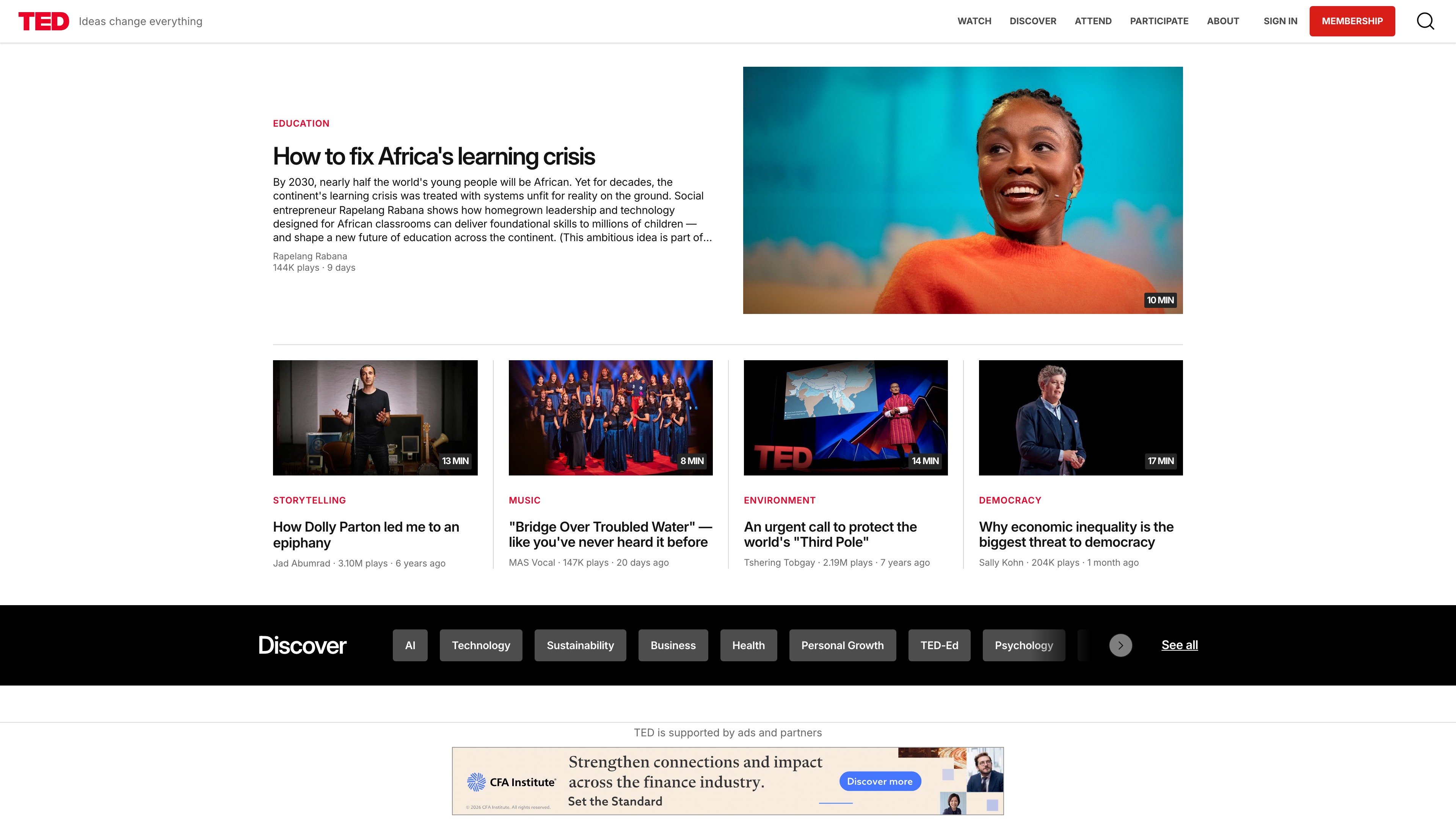
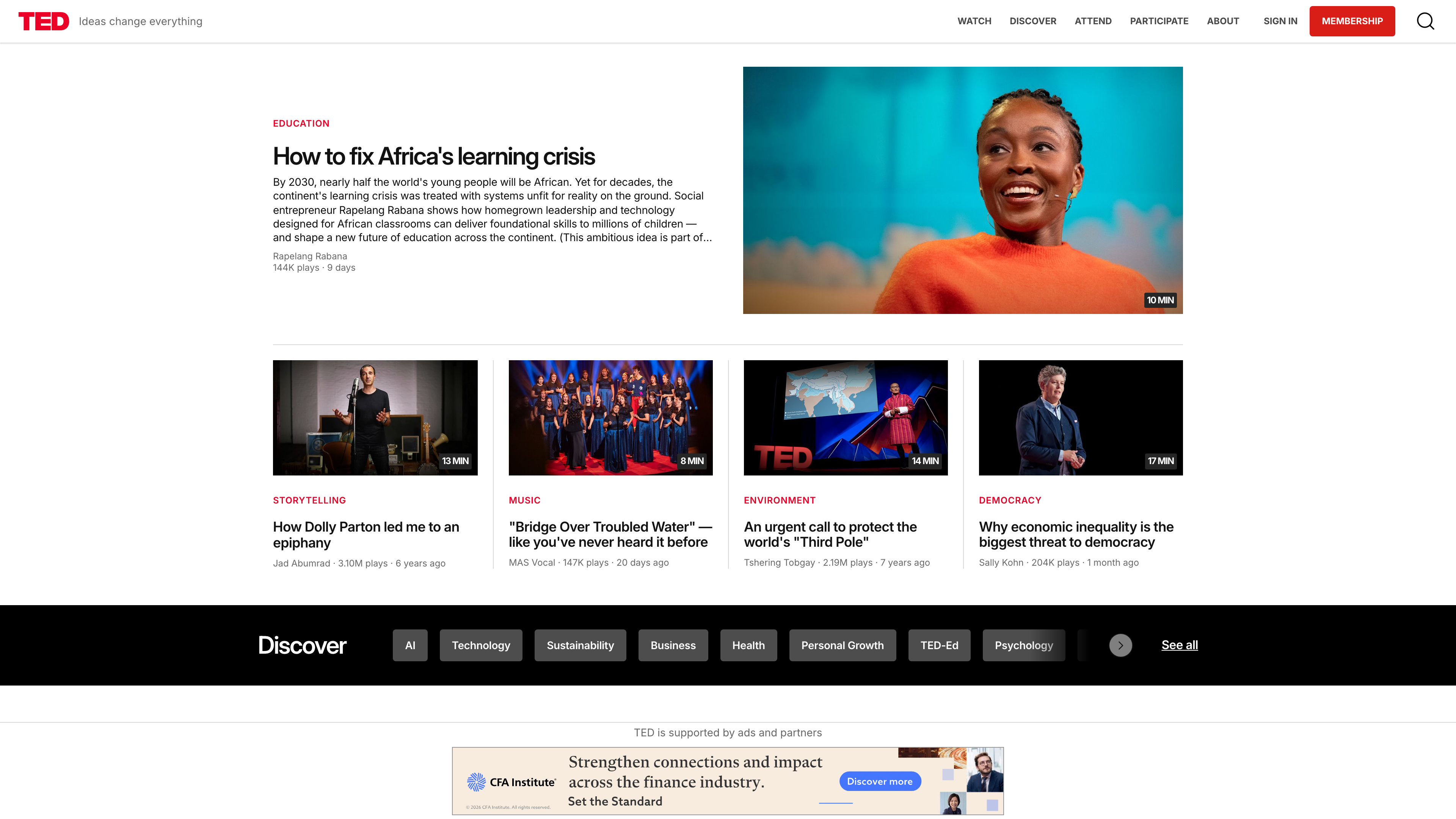
The screenshot above shows the TED.com homepage on 2026-09-02: a featured talk with its play count, topic shortcuts (AI, Technology, Business, Health, and more), and — at the bottom — a sponsor banner next to the explicit notice "TED is supported by ads and partners," which is how the free model works in practice.
At a glance
- URL: https://www.ted.com/
- Type: Talks video platform (conference-derived nonprofit media)
- Cost: Free to watch and listen (with pre-roll and display ads); optional TED Membership is a donation (suggested 500/year, checked 2026-09-02); the flagship conference requires an application — TED2026 passes ran 25,000
- Account: Not required for viewing; a free account adds saving talks and commenting
- Languages: English interface; subtitles and transcripts in 115 languages
- Launched: Conference founded February 1984; talks first posted online June 2006
- Operator: TED Foundation, a US 501(c)(3) nonprofit, headquartered in New York and Vancouver
Background
TED was created by Richard Saul Wurman and Harry Marks; the first conference took place in Monterey, California in February 1984 and featured demos of the compact disc and an early Apple Macintosh. It lost money, and a second event only followed in 1990 — after which it became annual.
In November 2001, publishing entrepreneur Chris Anderson acquired TED through the Sapling Foundation, a nonprofit he had founded in 1996, and he has curated it since 2002. In June 2006 TED posted its first six talks online under a Creative Commons license; the experiment worked, a rebuilt TED.com followed in April 2007, and the organization shifted from a closed conference to a "conference plus free video" media outlet. (Source: TED (conference))
The corporate structure changed once more later: on July 1, 2019, ownership of TED Conferences LLC moved from the Sapling Foundation to the newly created TED Foundation, a 501(c)(3), "to align with our brand and make it easier for our donors to connect TED donations to TED Conferences, LLC." So TED is no longer owned by the Sapling Foundation, as many older profiles still state.
Other milestones: the TEDx free-licensing program and the volunteer translation program both launched in 2009; the education initiative TED-Ed launched in 2012; the flagship conference moved to Vancouver in 2014; the podcast arm TED Audio Collective formed in February 2021; and the flagship will relocate to San Diego in 2027 (source: TED2027).
The talks library and viewing experience
As of 2026-09-02, the TED.com talks index covers 7,641 talks (including TEDx talks hosted on ted.com, per the site's own talks-page index), filterable by topic, duration, and subtitle language. Talks are generally capped at about 18 minutes and follow a "one speaker, one idea" stage format.
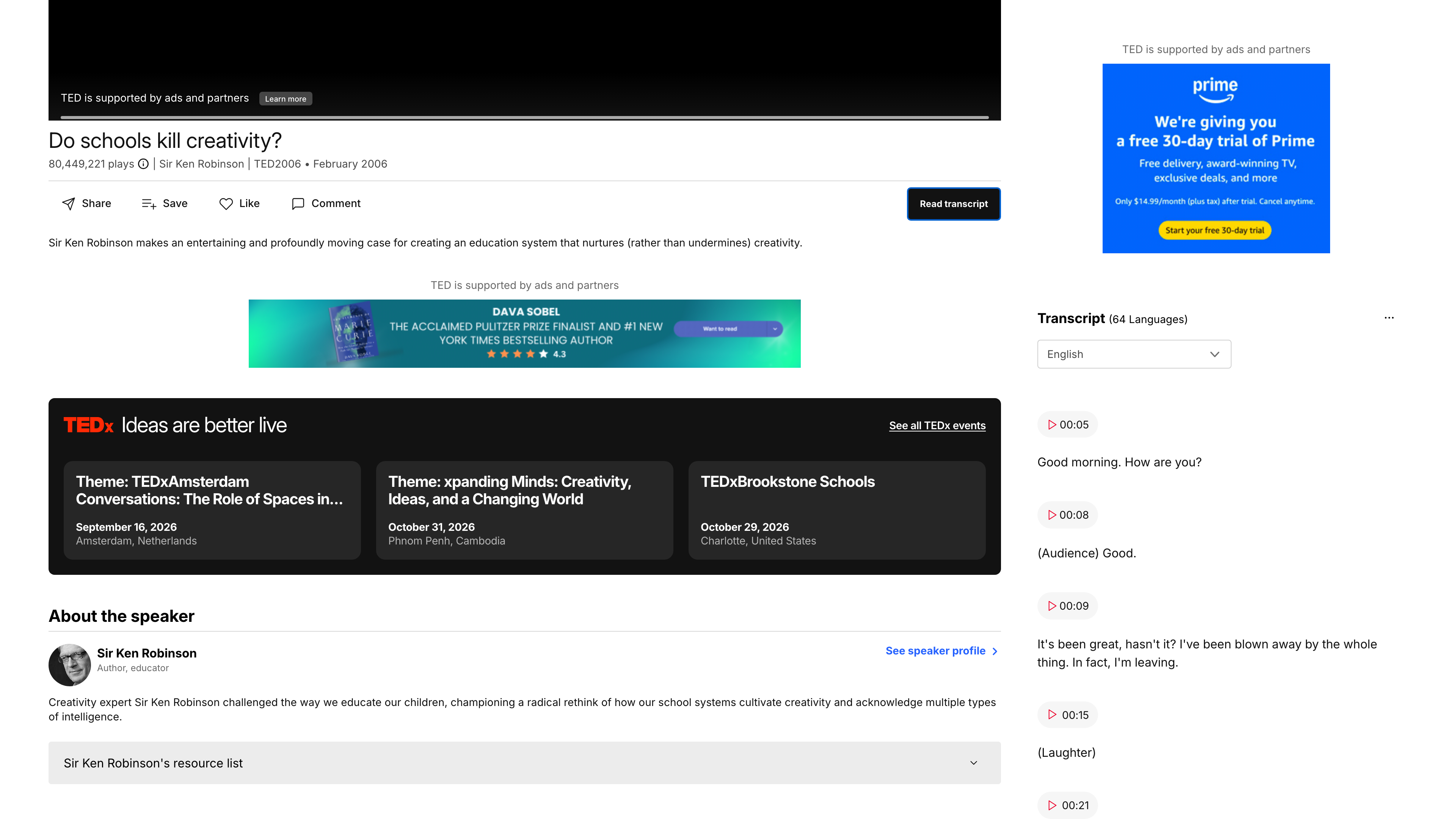
Above is the page for Sir Ken Robinson's 2006 talk "Do schools kill creativity?": 80,449,221 plays as of 2026-09-02, with an interactive, sentence-by-sentence transcript available in 64 languages on the right. The page also shows that sign-in is optional (a banner invites you to create a free account to save and comment) and that display ads appear alongside and inside the content area.
More than talks: TEDx, TED-Ed, and podcasts
TEDx, launched in 2009, lets any community run a local, independent event under a free license, following TED's format; TED does not control the content. TED says more than 4,000 TEDx events are now held annually.
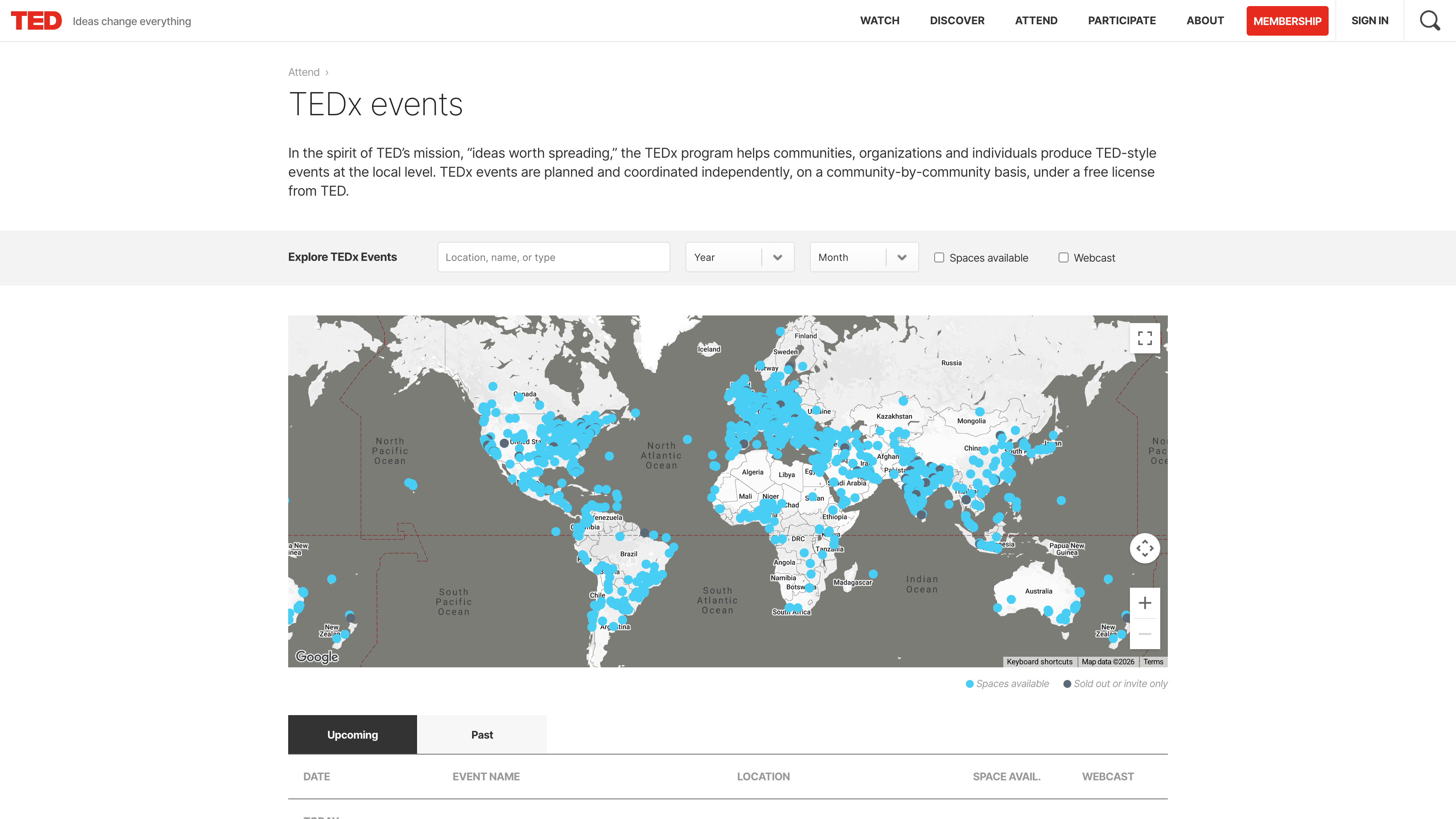
The TEDx events page above plots upcoming events across a world map, searchable by place and date, with filters for events that still have seats.
TED-Ed (launched 2012, ed.ted.com) produces short original animated lessons — roughly five-minute videos made by teams of experts, writers, and animators — paired with quiz questions and further reading. Teachers can also build their own interactive lessons around the animations. TED-Ed describes a global network of over 650,000 teachers, while TED's own About page claims more than 1 million educators use TED-Ed in classrooms.
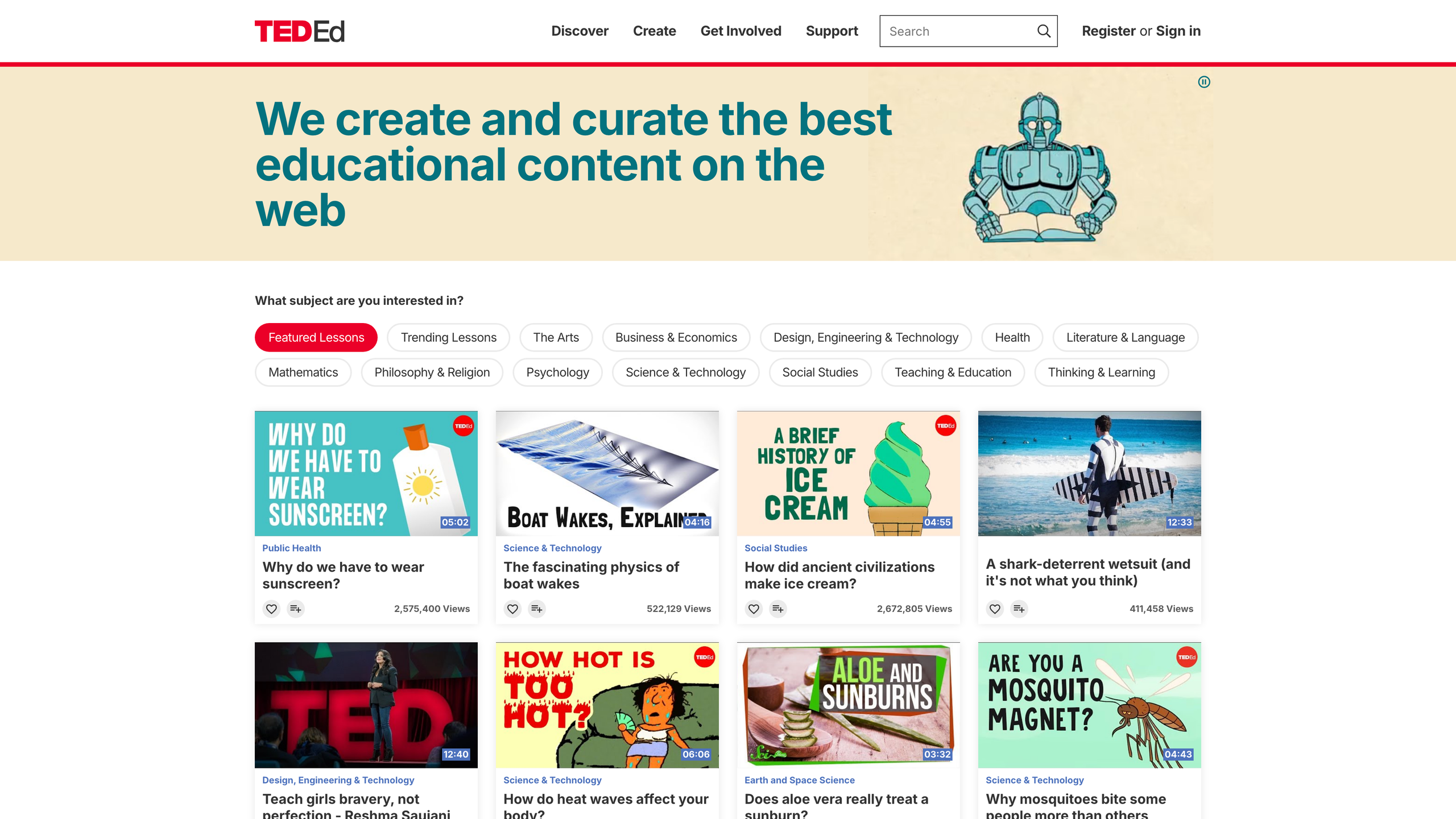
The TED-Ed homepage above organizes lessons by subject (arts, business and economics, science, philosophy, and more), each card showing duration and view counts — clearly aimed at students and classroom use.
Podcasts are grouped under the TED Audio Collective, formed on February 22, 2021, which now lists more than 25 shows, including the weekday TED Talks Daily, the NPR co-production TED Radio Hour, and non-English feeds such as TED in Chinese, TED en Español, and TED en Français (source: TED Podcasts).
The subtitle translation program
TED's multilingual reach is largely volunteer work. According to the TED Translators page, the translation program launched in 2009 with 200 volunteers and 300 translations in 40 languages; as of 2026-09-02 it counts 53,182 volunteer translators and 238,660 published translations across 115 languages, later expanded from TED Talks to TEDx and TED-Ed content. Note that TED does not allow translating, dubbing, or re-uploading its content outside this official community (source: TED Talks Usage Policy).
How TED sustains itself
Per TED's own explanation, revenue comes from conference passes, sponsorships and on-site ads, foundation support, licensing fees, and book sales — and is spent "as soon as we get it" on video production, web operations, community programs like TEDx, and staff salaries:
- The flagship conference is the financial engine. For TED2026 in Vancouver, passes were priced at 12,500 (Standard), and $25,000 (Donor), by application (source: TED2026 Attend).
- Ads and sponsorships: pre-roll and display ads carry the notice "TED is supported by ads and partners."
- Voluntary donations: TED Membership suggests 500 per year and includes member-only virtual events with speakers (checked 2026-09-02, TED Membership).
- Official impact figures (TED About): 2.5 billion global views in 2023, with content shared 400 million times; 180 million monthly followers; over $7.6 billion catalyzed for 49 projects through The Audacious Project.
Licensing and content policy
TED Talks are released under Creative Commons Attribution-NonCommercial-NoDerivs 4.0 (CC BY-NC-ND 4.0). In practice:
- You may share complete talks in non-commercial contexts, with attribution to TED and a link back to TED.com;
- No modifications of any kind: no editing, remixing, clipping, dubbing, or unofficial translations; embedding must use TED's official player, and scraping the video files is prohibited;
- Transcripts and subtitles fall under the same license;
- Commercial use — corporate training, learning management systems, courses, film and TV, podcasts — requires a paid license, handled through the TED@Work program;
- One exception: TED-Ed videos on YouTube are not under Creative Commons; they follow YouTube's standard terms.
Good for
- Catching up on research, ideas, and personal stories from many fields in short sittings
- English listening and public-speaking practice, using multilingual subtitles and sentence-level transcripts
- Classroom material via TED-Ed animations and its lesson-building tools
- Finding a local TEDx event — or applying to organize one, or joining the translator community
- Free podcast listening on the go
Limitations
- English-only interface: subtitles cover 115 languages, but the site UI, search, and TED-Ed's lesson tools are in English.
- Advertising: pre-roll and display ads are part of the free model and cannot be switched off.
- Uneven TEDx quality: TEDx events are independently organized and not content-controlled by TED. Wired and the Harvard Business Review have criticized TEDx talks for occasionally promoting pseudoscience and diluting the brand, and TED itself has moved controversial TEDx talks off the main channel with cautionary framing (source: TED (conference)).
- No derivative works: the ND clause forbids edits, dubs, and fan translations — re-uploading TED videos to third-party platforms is infringement.
- Limited depth: an 18-minute talk is a starting point, not a substitute for courses or primary sources.
Alternatives
- Big Think: a US site similarly built around expert interviews and idea-driven short videos, with paid corporate offerings on the side.
- Yixi (一席): a Chinese-language talks platform whose stage format closely parallels TED, with mostly Chinese-speaking presenters.
Sources
- TED About (impact figures, checked 2026-09-02)
- How TED works (TED Foundation ownership, revenue model, checked 2026-09-02)
- TED (conference) - Wikipedia (1984 founding, 2001 acquisition, 2006 online launch, controversies, checked 2026-09-02)
- TED Talks (library of 7,641 talks, checked 2026-09-02)
- TEDx Program (4,000+ events annually, checked 2026-09-02)
- About TED-Ed (launched 2012, 650,000-teacher network, checked 2026-09-02)
- TED Translators (115 languages, 53,182 translators, 238,660 translations, checked 2026-09-02)
- TED launches TED Audio Collective for podcasts - TED Blog (February 22, 2021)
- TED Podcasts (25+ shows including TED in Chinese, checked 2026-09-02)
- TED Talks Usage Policy (CC BY-NC-ND 4.0 and commercial licensing, checked 2026-09-02)
- TED2026 Attend (passes 25,000, checked 2026-09-02)
- TED2027 (move to San Diego in 2027, checked 2026-09-02)
- TED Membership (suggested donations 500/year, checked 2026-09-02)