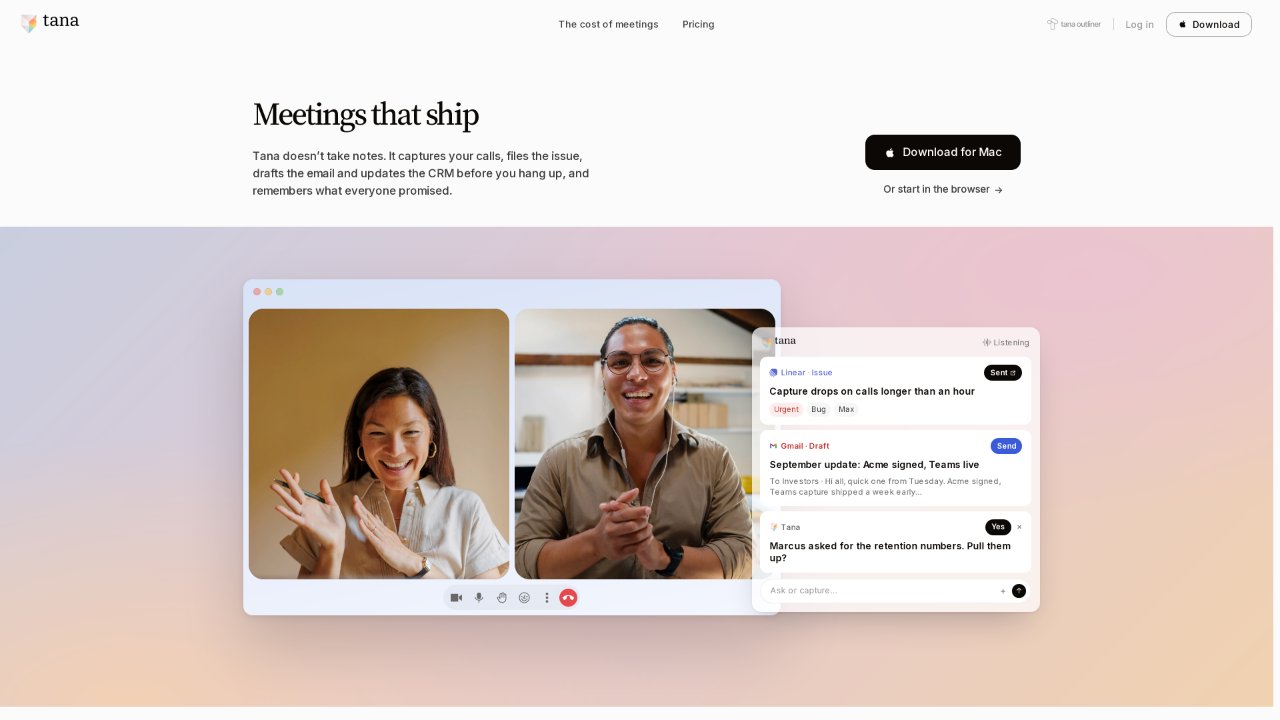
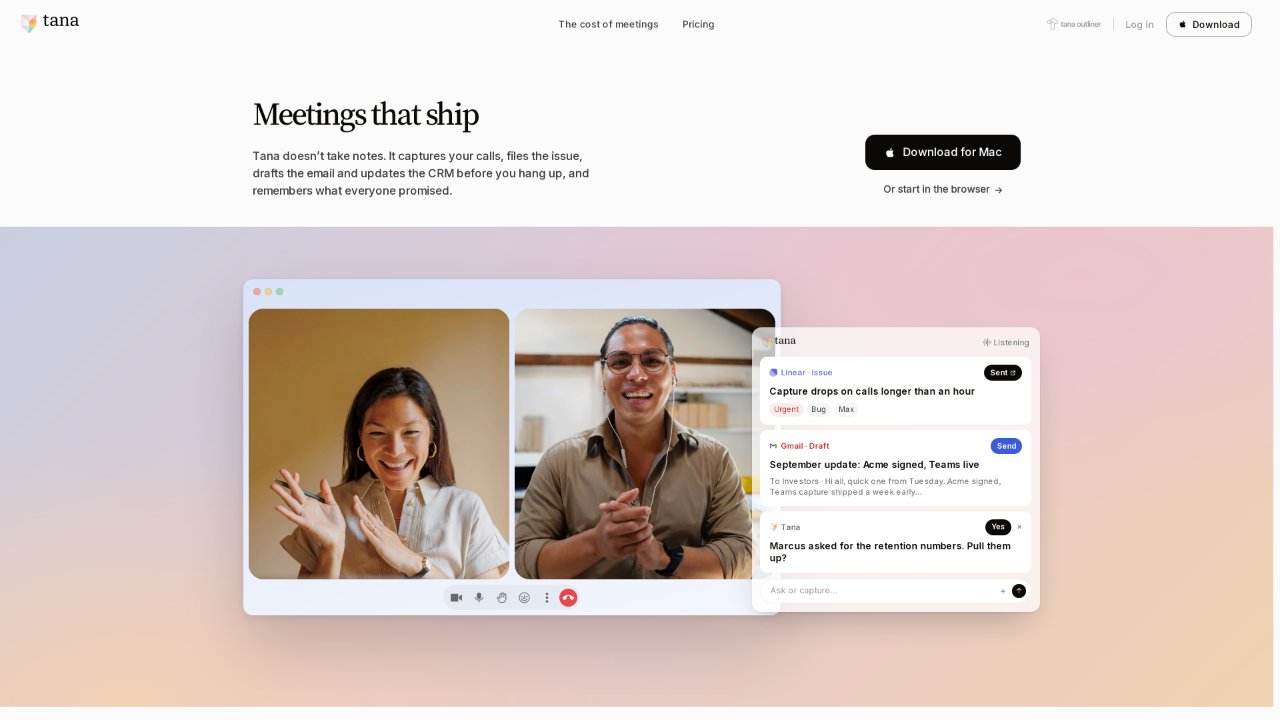
Tana is an "agentic meeting platform" from Tana Labs: during native video calls, AI agents do real work in real time — capturing decisions, filing issues, drafting emails, updating the CRM — before you hang up, and compound the results into a shared context graph. It targets the problem that meetings are where work gets lost: decisions forgotten, action items dropped, context gone when the call ends. Unlike AI notetakers such as Fireflies, Otter or Granola, which summarize after the call, Tana executes during it; unlike "video conferencing + AI add-on" setups (Zoom+Copilot, Meet+Gemini), its agents hold the same tool permissions as human participants (official positioning). In March 2026 the original outliner product was renamed Tana Outliner and spun off, and the Tana brand moved to meetings under the homepage slogan "Meetings that ship."
At a Glance
| Item | Details (as of 2026-09-30) |
|---|---|
| URL | tana.inc (sister product: Tana Outliner) |
| Type | Agentic AI meeting platform / team collaboration; Outliner is an outliner-based knowledge-management tool |
| Cost | Free tier 20/user/month (default Yearly view on the pricing page) |
| Sign-up | Account required; open registration, no invite. Meeting guests join via link without an account |
| Interface language | English only (per the App Store listing); meeting transcription in 33 languages, Outliner transcription in 60+ languages |
| Platforms | Full-featured web (incl. mobile browsers, installable PWA); Mac/Windows/Linux desktop; native iOS/Android apps marked "coming" |
Background
- Company and team: the official team page lists three founders — Tarjei M. Vassbotn, Olav S. Kriken and Grim H. Iversen. Investors include Tola Capital, Lightspeed and Northzone, with angels such as Google Maps founder Lars Rasmussen and Datadog CEO Olivier Pomel (Company page). The legal entity is Tana Labs, Inc., registered at a Nordic Innovation House mailing address in Palo Alto, CA (Terms); the team page shows a largely Norway-based staff, and job posts require a "CET ± 3 hours" time zone (Careers). The Wikidata entry referenced by the official site records inception in 2021 and headquarters in Oslo, Norway.
- Funding: a $14M Series A was announced on 2025-02-03, led by Tola Capital with Lightspeed, Northzone and others participating, bringing total funding to $25M. The same announcement disclosed a stealth-phase waitlist of over 160,000 people, including employees at more than 80% of Fortune 500 companies, and a "Tanarians" community of over 24,000.
- Release timeline: invite-only early access opened on 2022-09-30 (official retrospective); the desktop app (Windows/Mac/Linux) shipped on 2023-10-10; a public launch followed within 2025, and the product won Product Hunt Product of the Year (official thanks). On 2026-03-31 the company split the product line: the original product became Tana Outliner and a new team product was introduced, officially because the original was "powerful but hard to learn and hard to roll out across a team" (split announcement). On 2026-05-27 the new Tana opened to the community — explicitly a "community launch," not a public launch, with the product "still changing fast, with rough edges" (Tana Current May 2026).
Pricing (as of 2026-09-30)
The two products are billed separately.
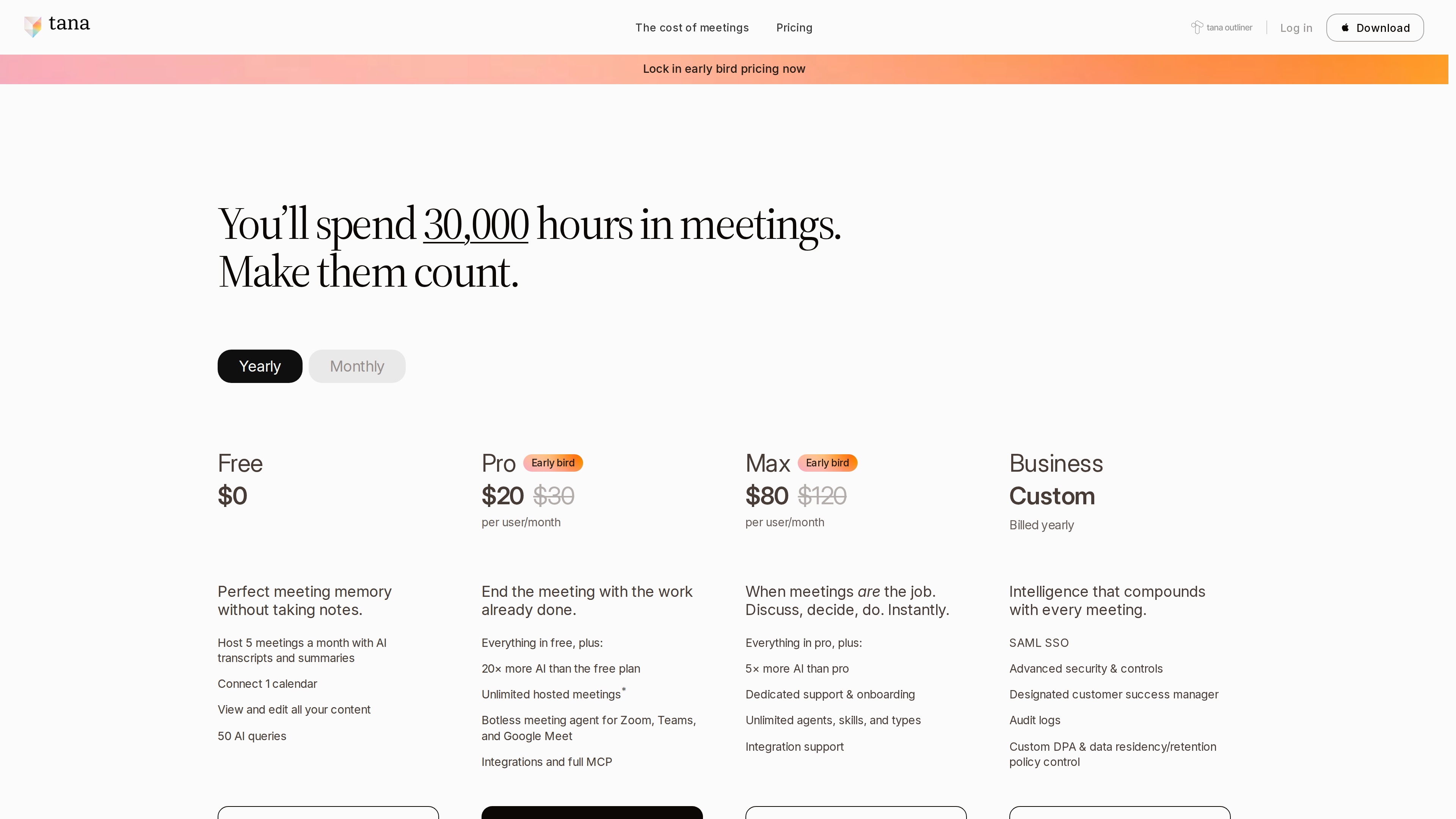
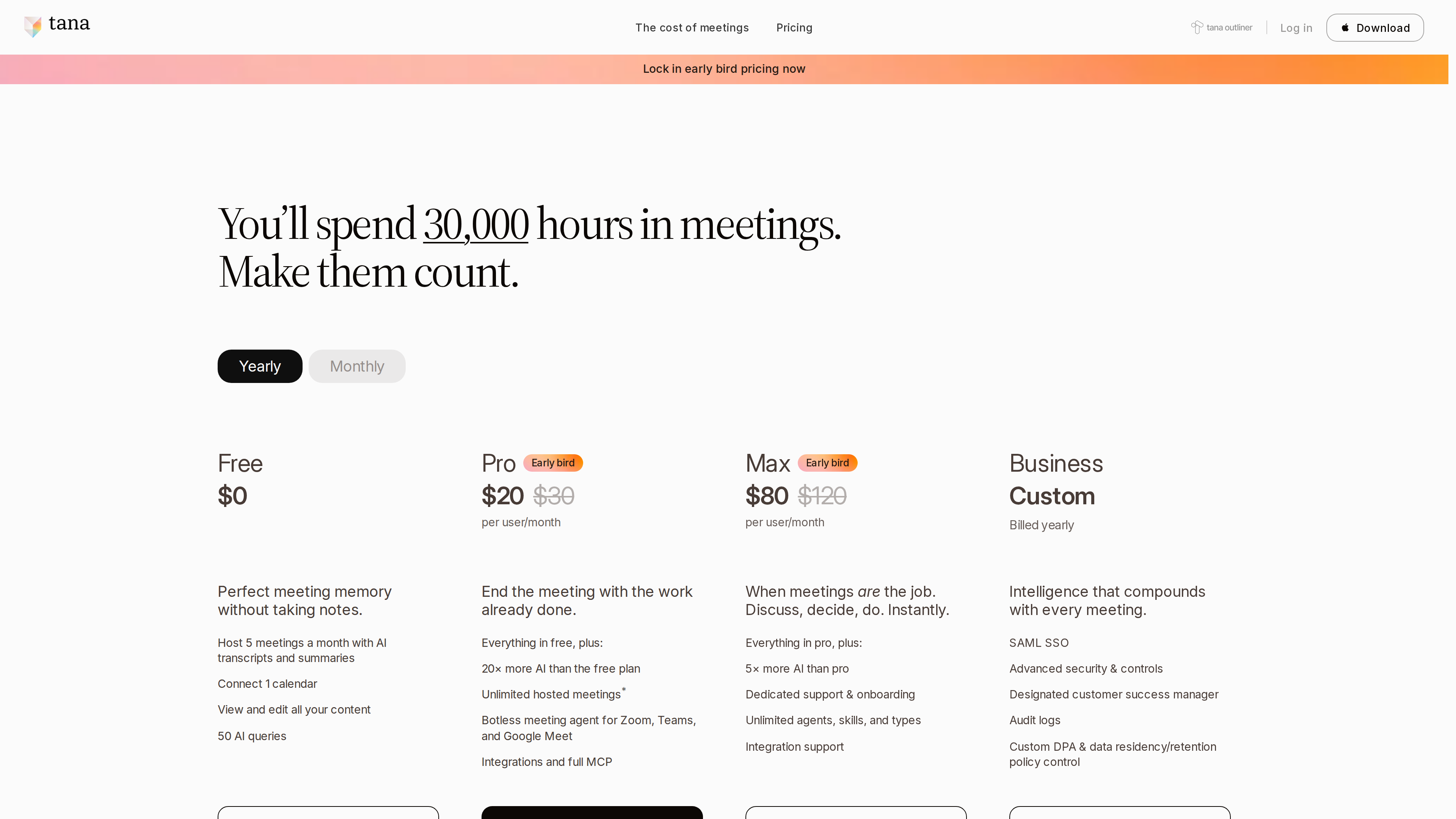
Tana meeting platform (pricing page, default Yearly view):
- Free $0: host 5 meetings per month with AI transcripts and summaries, connect 1 calendar, 50 AI queries.
- Pro, early-bird $20/user/month (list price $30 struck through): 20× the Free plan's AI allowance, unlimited hosted meetings, botless capture of Zoom/Teams/Google Meet, integrations and full MCP.
- Max, early-bird $80/user/month (list price $120): 5× Pro's AI allowance, dedicated support and onboarding, unlimited agents/skills/types.
- Business, custom pricing (billed yearly): SAML SSO, audit logs, custom DPA and data residency/retention controls.
- 30-day free trial with no credit card required; annual plans carry a 60-day refund window. Note: the Monthly view's prices could not be confirmed from the page's static content.
Tana Outliner (pricing page):
- Free $0: 500 AI credits/month (about 100 minutes of meeting transcription), up to 3 workspaces, 0.5 GB upload storage, 5 MB per-file limit, Markdown/JSON export; credits cannot be topped up.
- Plus $8/month: 2,000 AI credits/month, Google Calendar sync and meeting notifications, model choice, custom AI chat agents, unlimited workspaces, password-protected share pages.
- Pro $14/month: 5,000 AI credits/month, Readwise integration, Input API, template publishing.
- 50% student/academic/NGO discount: Plus 48/year, Pro 84/year; 14-day trial of paid tiers (the help docs state a credit card is required to start a trial). Note: the page advertises "Save 22% yearly," so the 14 figures appear to be annual-billing equivalents; pure monthly pricing could not be confirmed on the page.
Core Capabilities
AI agents that work during the meeting
The new Tana's flagship scenario (per the official machine-readable docs and the Meetings doc):
- Native video calls — officially good for up to about 50 people, not built for large webinars; real-time transcription in 33 languages; screen sharing and recording.
- In-meeting AI agents hold the same tool permissions as human participants — sharing screens, editing documents, creating canvases; they can be voice-activated with "Hey Tana" (wake words in 9 languages).
- After the call it auto-generates summaries, action items and artifacts (storyboards, customer journeys, slide decks); every AI change goes through a "proposals" approval flow.
- Meeting output compounds into a context graph built on Types/Attributes (the renamed Supertags concept), with merge proposals to prevent information pile-up.
- The editor is a block editor (not an outliner), with real-time collaborative canvases, granular access control and semantic version history; the AI's default content language is configurable, so non-English organizations can have all AI output in a chosen language.
External-meeting capture and context handoff
- The desktop app detects and records external Zoom/Teams/Google Meet calls without a bot.
- Meeting context can be handed off directly to Claude Code, Cursor, Codex, Lovable and v0.
- Guests join via link — no account, no desktop app required.
Tana Outliner: Supertags and structured notes
The original note-taking product (called Tana from roughly 2020 to 2024) now operates independently, positioned as "a knowledge-management outliner built on Supertags and nodes," with the tagline "Your notes, with superpowers":
- Supertags turn nodes into typed objects with field templates; all nodes sharing a supertag form a searchable, filterable, table-viewable collection. The company says the idea was inspired by object-oriented programming.
- An infinite outliner where "everything is a node": @ mirror references (edit once, update everywhere), live search, outline/table/card/calendar/list views, daily notes (Learn index).
- Tana AI: AI chat with your notes as context, AI command nodes, GPT-like AI agents, and AI autofill for fields; models selectable from OpenAI, Anthropic and Google (Tana AI).
- Voice and meetings: the desktop AI Meeting Notetaker records system audio without a bot in the call, transcribing 60+ languages in real time with auto-summaries; mobile voice memos can run custom AI pipelines per supertag, auto-filling fields and linking to people/projects (desktop, mobile).
Accounts and Open Capabilities
- Sign-up: both products require an account; as of 2026-09-30 registration is open with no invite. Historically, access was waitlist-only from September 2022 until the public launch. SAML SSO is available on the Business tier.
- Integrations (new Tana): GitHub, Slack, Linear, Jira, HubSpot, Google Calendar and Outlook connect via OAuth; custom remote MCP servers can be attached, and Tana exposes its own read/write MCP server; the graph interoperates with Tana Outliner via a hosted MCP (beta); Google Workspace and Microsoft 365 are marked "coming soon" (llms.txt).
- Outliner API: the Input API is a write-only JSON HTTP interface (POST only, 1 request/second per token, max 100 nodes per call, 5,000-character payload; a read API is on the roadmap). The desktop app bundles a free Local API/MCP server (localhost:8262, letting Claude Code/Cursor read and write the workspace); a hosted Remote MCP is in paid beta.
- Import/export (Outliner): built-in importers for Notion, Roam, Logseq and Workflowy (Notion export packs up to 1,500 Markdown files per run); a whole workspace exports to Markdown or JSON, and a May 2025 blog post explicitly promises "exportable, no lock-in."
- Developer resources: the official GitHub org github.com/tanainc hosts import/export tools, Input API samples and Tana Paste examples.
- Data and compliance: the privacy policy states user data belongs to users, is never sold or used for advertising, and private content is not read without consent (Privacy Policy, updated 2024-02-14); the security page explicitly promises not to train AI models on your data (security commitments). The new Tana has completed a SOC 2 Type 2 attestation (Prescient Assurance LLC, covering 2026-03-30 to 06-30; Tana Outliner is outside that report's scope), with HIPAA compliance in progress and an exportable context graph (llms.txt security section).
Who It Suits
- Meeting-heavy teams that want calls to produce tickets, emails and CRM updates directly — the new Tana's core positioning.
- Engineering teams that want to hand meeting context to coding agents such as Claude Code or Cursor.
- Organizations that need botless recording of external Zoom/Teams/Google Meet calls (Pro tier and up).
- Personal knowledge management, outlining and voice capture — sister product Tana Outliner, which starts free.
- Compliance-sensitive enterprises: the Business tier offers SAML SSO, audit logs, custom DPAs and data residency.
Limitations
- Maturity: the company describes the May 2026 release as a "community launch, not a public launch," warning that "you will hit rough edges… some parts are being rebuilt."
- Meeting scale: video calls are not suited to meetings over 50 people or webinars, and meeting-room hardware is unsupported (llms.txt).
- Mobile gaps: the new Tana has no native iOS/Android app yet (marked "coming" as of 2026-09-30); Outliner's mobile apps only capture new content offline — reading/editing existing content requires connectivity — and mobile/tablet browsers are officially unsupported.
- Offline: the new Tana only tolerates brief disconnections, with full offline support unscheduled; Outliner is fully offline only on desktop (since November 2025).
- Outliner API gaps: the Input API is write-only, and workspaces over 750,000 nodes do not sync.
- Free-tier ceilings: the new Tana's Free plan caps at 5 hosted meetings and 50 AI queries per month; Outliner Free has a hard, non-toppable AI credit cap, 0.5 GB storage, a 5 MB file limit and 3 workspaces, with calendar sync, the Input API and Readwise locked behind paid tiers.
- Learning curve: the company itself calls Outliner "hard to learn, hard to roll out across a team," and early users reported that "Tana makes me feel dumb" — the stated reason for building the new product.
- English-only interface (per the App Store listing).
Comparisons
The following reflects the company's own positioning (llms.txt, "What Tana Is Not"), offered for reference:
- Vs. AI notetakers (Fireflies, Otter, Granola named): they summarize after the meeting; Tana works during it.
- Vs. knowledge bases (Notion, Confluence named): those must be filled manually; Tana's context graph accumulates automatically from meetings.
- Vs. general AI assistants (ChatGPT, Claude named) and "video conferencing + AI add-on" setups (Zoom+Copilot, Meet+Gemini named): Tana embeds AI natively as a participant with tool permissions.
- Outliner vs. Notion: the official help docs frame Notion as pages plus databases, and Outliner as a living knowledge graph plus outline; its built-in importers cover Notion, Roam Research, Logseq and Workflowy — the migration sources the company itself recognizes.
- The new Tana's pricing-page FAQ claims it can replace "meeting platforms, company wikis, docs and project management, AI notetakers and most AI assistants" (pricing page).
References
- Tana official site and the official machine-readable llms.txt
- Tana pricing, Tana Outliner pricing
- Official blog: The next chapter for Tana (March 2026 split announcement)
- Official blog: Tana Current May 2026 (community launch notes)
- Official blog: Tana raises $14M Series A
- Privacy Policy and security commitments