Sure (sure.am) is an open-source, self-hostable personal finance app: it brings bank accounts, investments, crypto, property, vehicles and debts into one place to track your net worth, manage transactions and run budgets, with an AI assistant and an API on top. It started life as Maybe — the much-discussed startup Josh Pigford founded in 2021, spent nearly $1M building, and open-sourced in January 2024. In July 2025 the company announced a pivot to B2B forecasting and archived the repository; the community forked the code as Sure and continues development today. The original site, maybe.co, is no longer reachable (checked 2026-10-02).
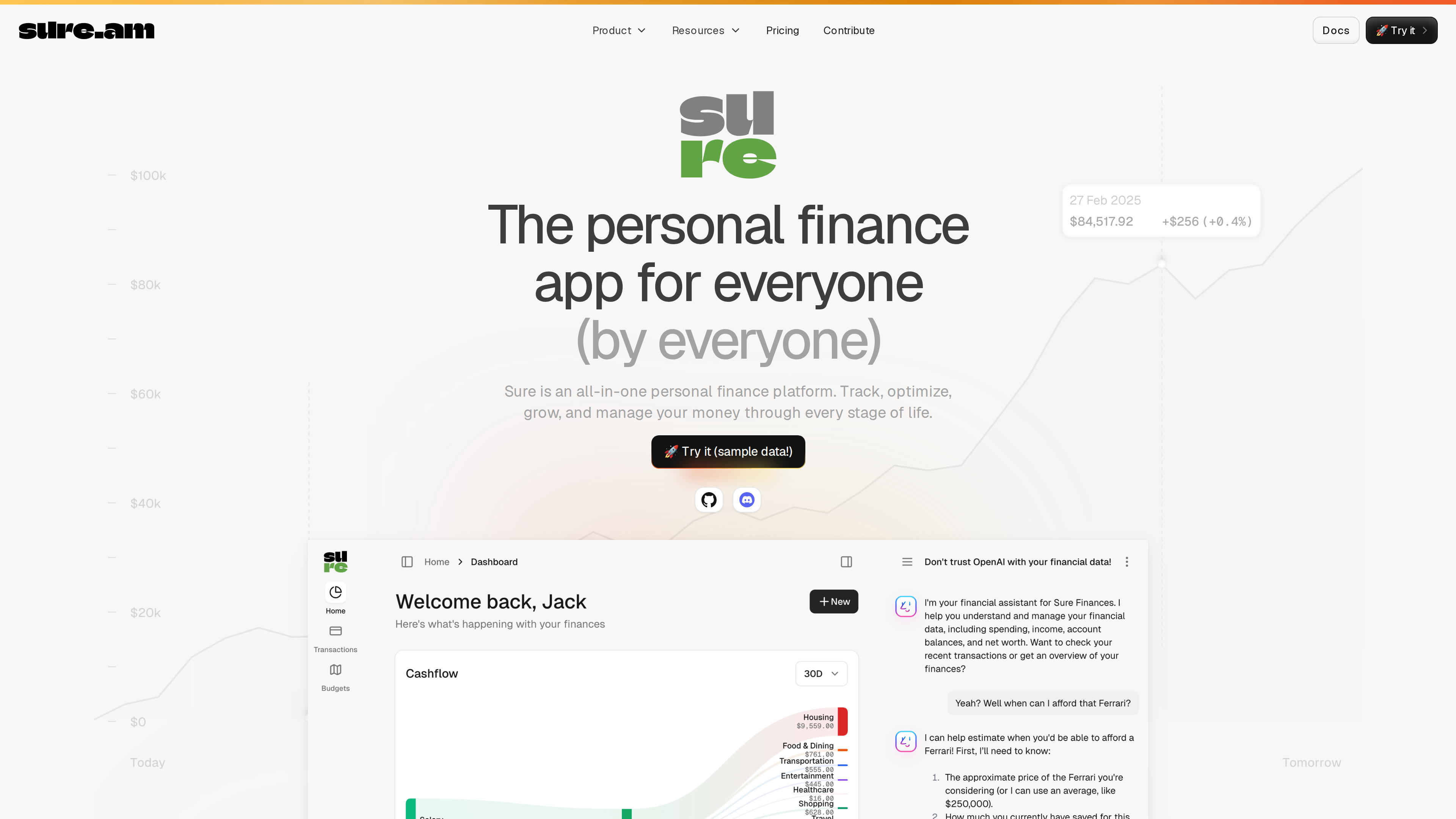
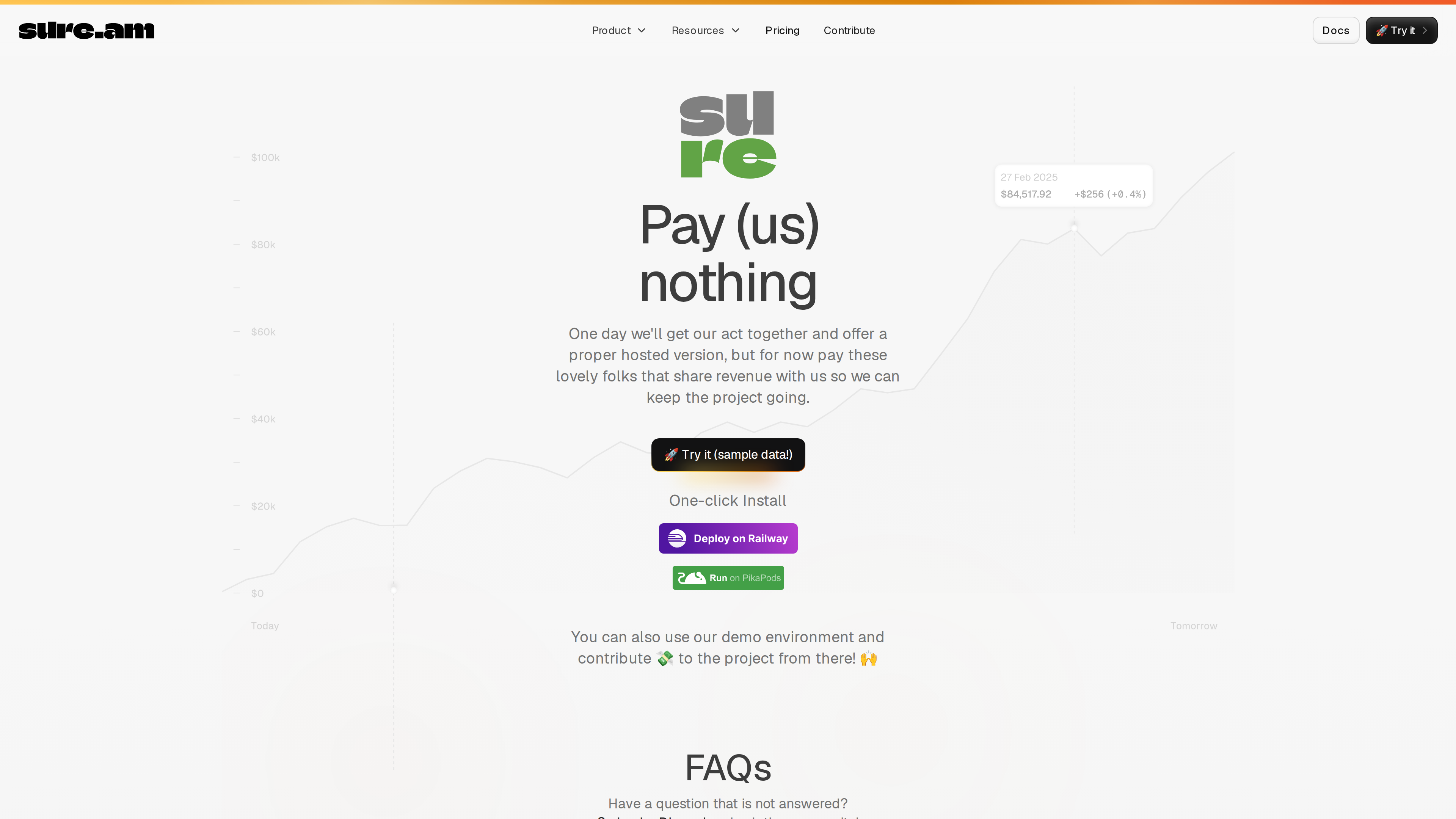
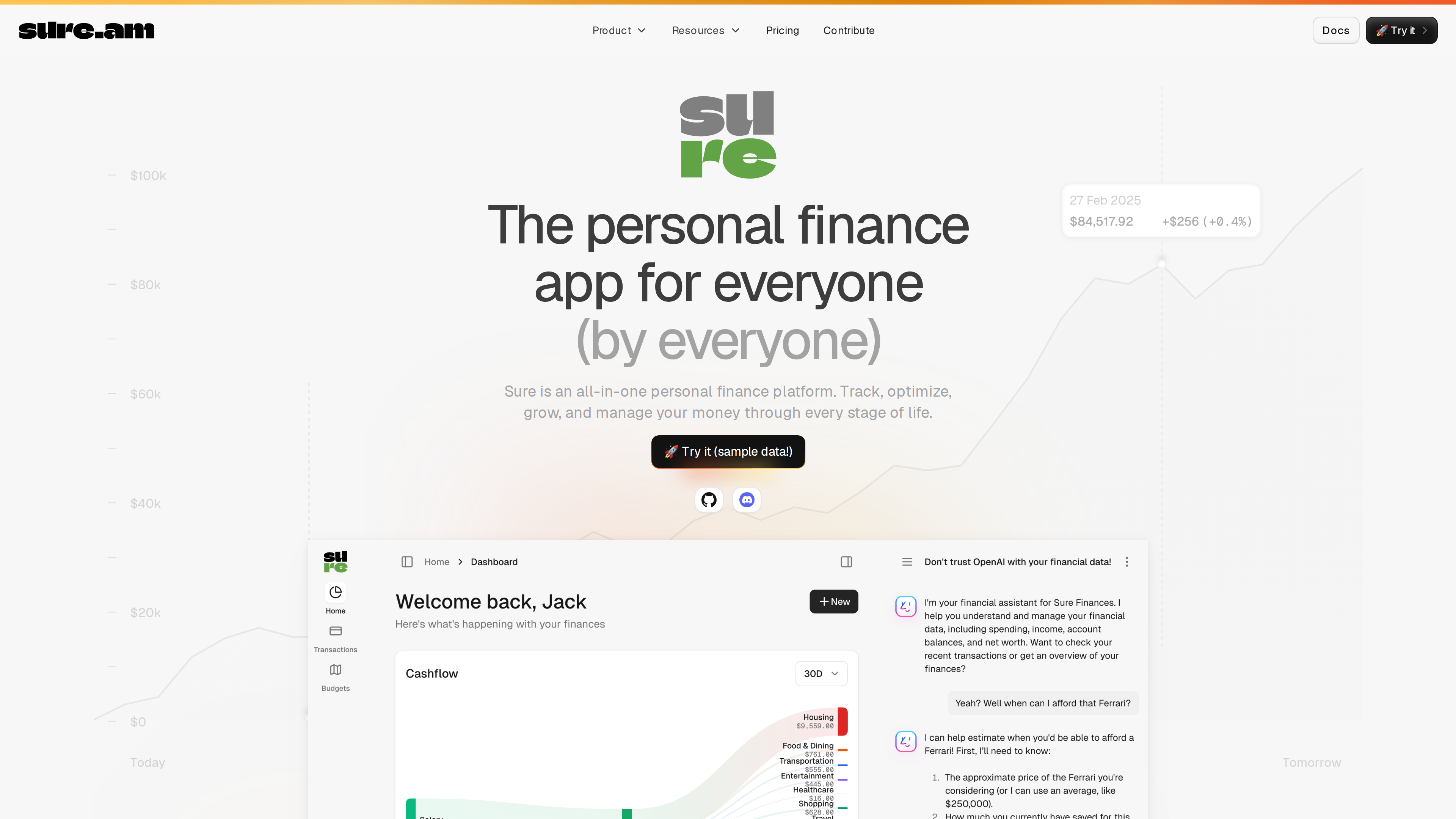
The Sure homepage (2026-10-02). The tagline "The personal finance app for everyone (by everyone)" signals the community takeover, and the "Try it (sample data!)" button leads straight into an official demo environment preloaded with sample data.
At a glance
| Item | Details |
|---|---|
| URL | https://sure.am/ (original maybe.co is offline) |
| Type | Open-source personal finance / net-worth tracker (web-first, self-hostable) |
| Cost | Free software (AGPL-3.0); no official hosted plan as of 2026-10-02 |
| Source code | we-promise/sure (active); maybe-finance/maybe (archived) |
| Deployment | Docker Compose, or one-click Railway / PikaPods / Render / Helm installs |
| Sign-up | Accounts are created on your own instance; the official demo needs no registration (pre-filled sample credentials) |
| Interface languages | English-first, with community translations in 19 locale files including Simplified and Traditional Chinese (coverage varies by release) |
From Maybe to Sure
- 2021–2023: a commercial attempt that didn't work. Josh Pigford (founder of Baremetrics) started Maybe Finance in 2021. The team spent over two years building a full-featured personal finance app — including an "Ask an Advisor" feature that connected subscribers with real CFP/CFA professionals — but the business never worked out, and development stopped in mid-2023. Per the backstory in the Sure README, nearly $1M went into development.
- January 2024: the open-source relaunch. The team released the entire codebase under the AGPL-3.0 license (the repository was created on January 1, 2024), pitching it as "the OS for your personal finances" that anyone could self-host for free; an archived copy of the May 2024 homepage already shows 26.9k GitHub stars.
- 2024–2025: official iterations and a brief hosted run. Development continued in the open: v0.1.0 (October 2024) launched an invite-only hosted version, v0.2.0 (December 2024) added Plaid bank syncing on the hosted app plus multi-currency investment portfolios, v0.3.0 (January 2025) shipped budgeting, and v0.5.0 (April 2025) added dark mode and an optional AI chat (release notes).
- July 2025: farewell, Maybe. In v0.6.0, "Farewell... Maybe", the company announced a pivot to B2B financial forecasting and scenario planning and stopped maintaining the app; the repository was archived read-only on July 27, 2025, with a final count of 54,255 stars (GitHub API, 2026-10-02). On Josh Pigford's own project list, Maybe is marked "Shut it down."
- July 2025–present: the community fork, Sure. Because "Maybe" remains a trademark of the original company and forks may not use it, the community regrouped as we-promise/sure. Through 2026 it has shipped an Insights feed, Passkey sign-in, a unified /plan area for budgets and goals, and a dedicated Bills area. As of 2026-10-02 it has 10,366 stars and 421 contributors, with the latest release (v0.7.5-hotfix.1) dated 2026-10-01 — actively maintained by any measure.
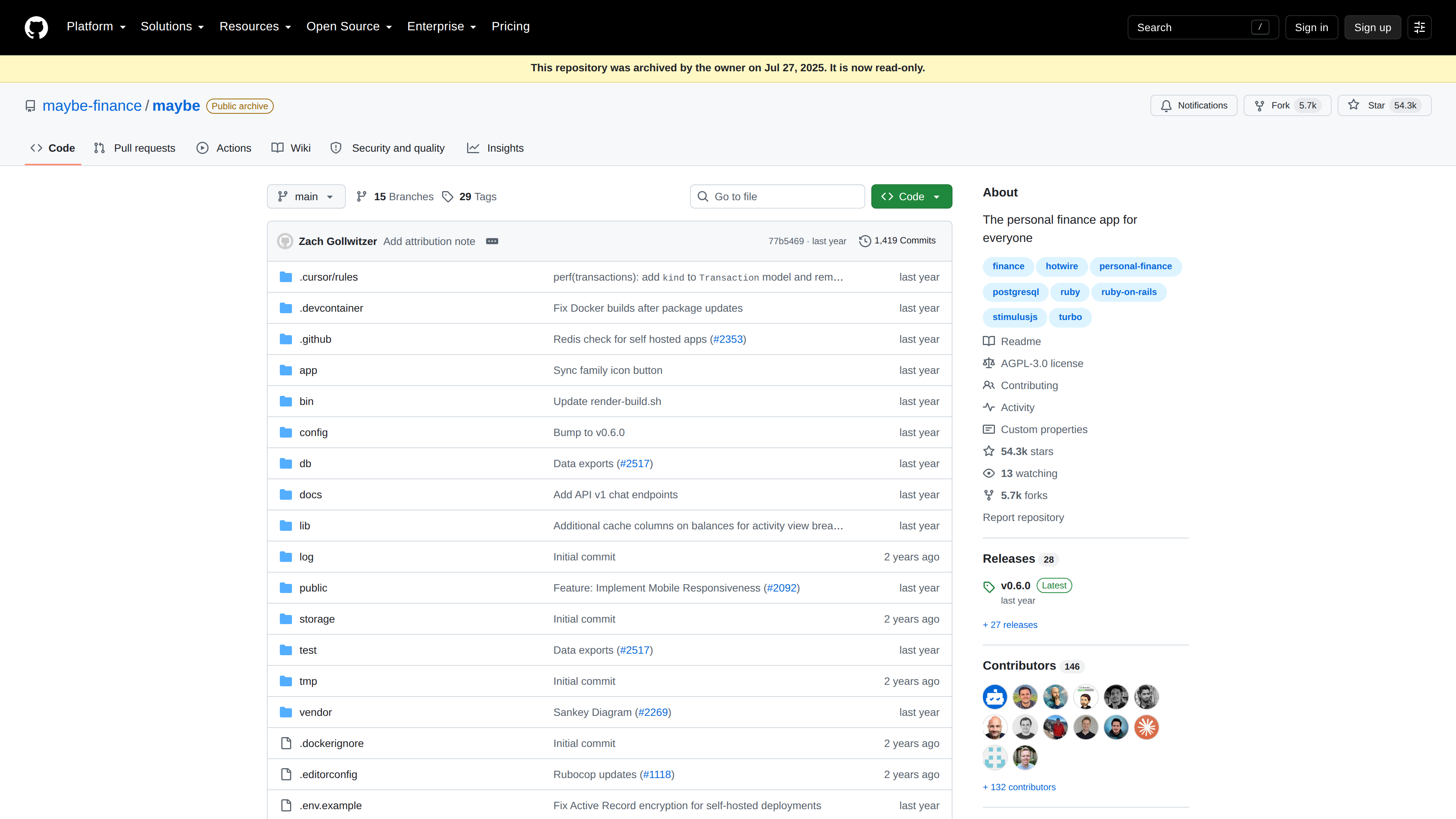
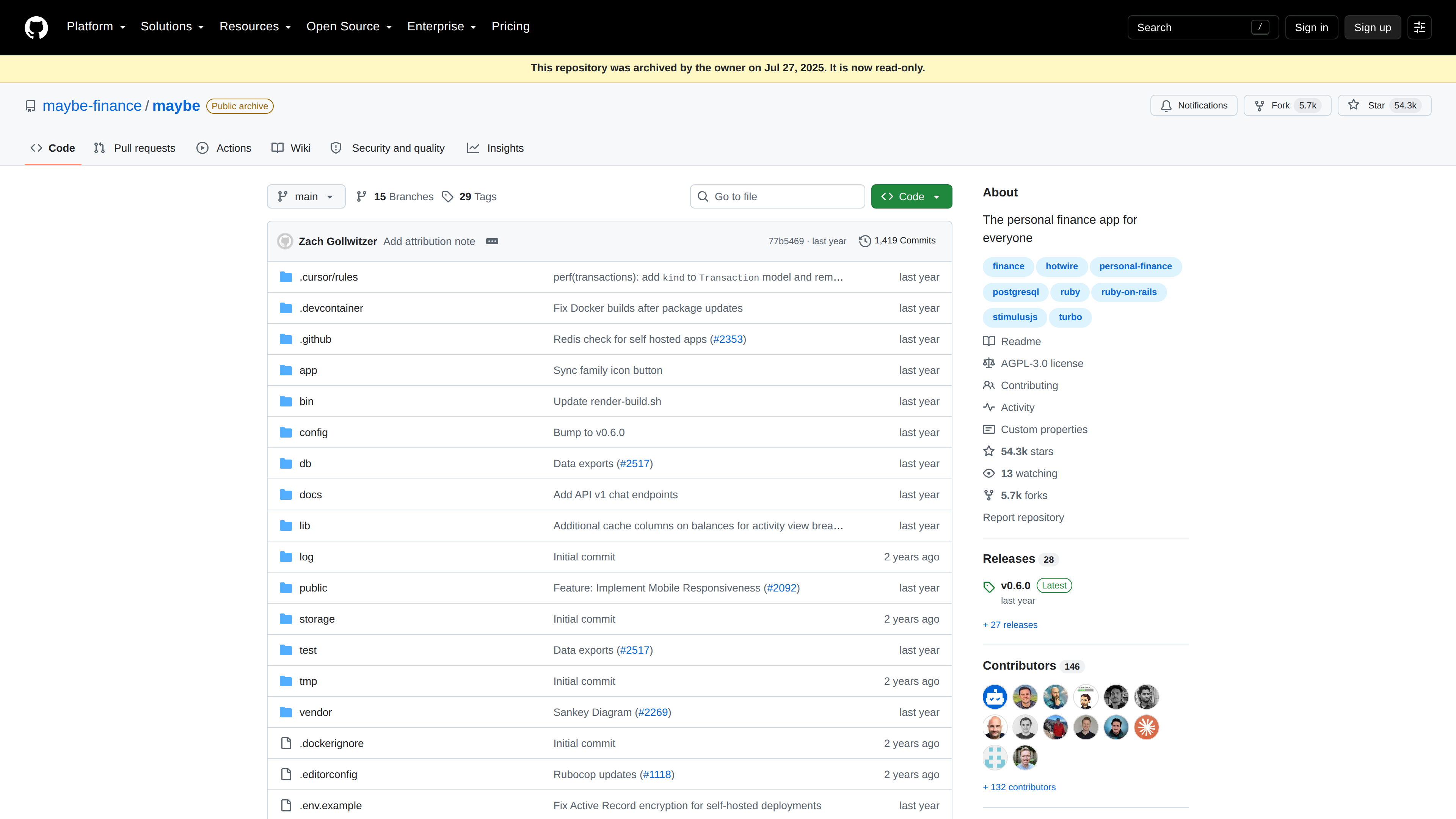
The original Maybe repository today (2026-10-02): the archive banner says it all; 54.3k stars testify to the attention it once drew.
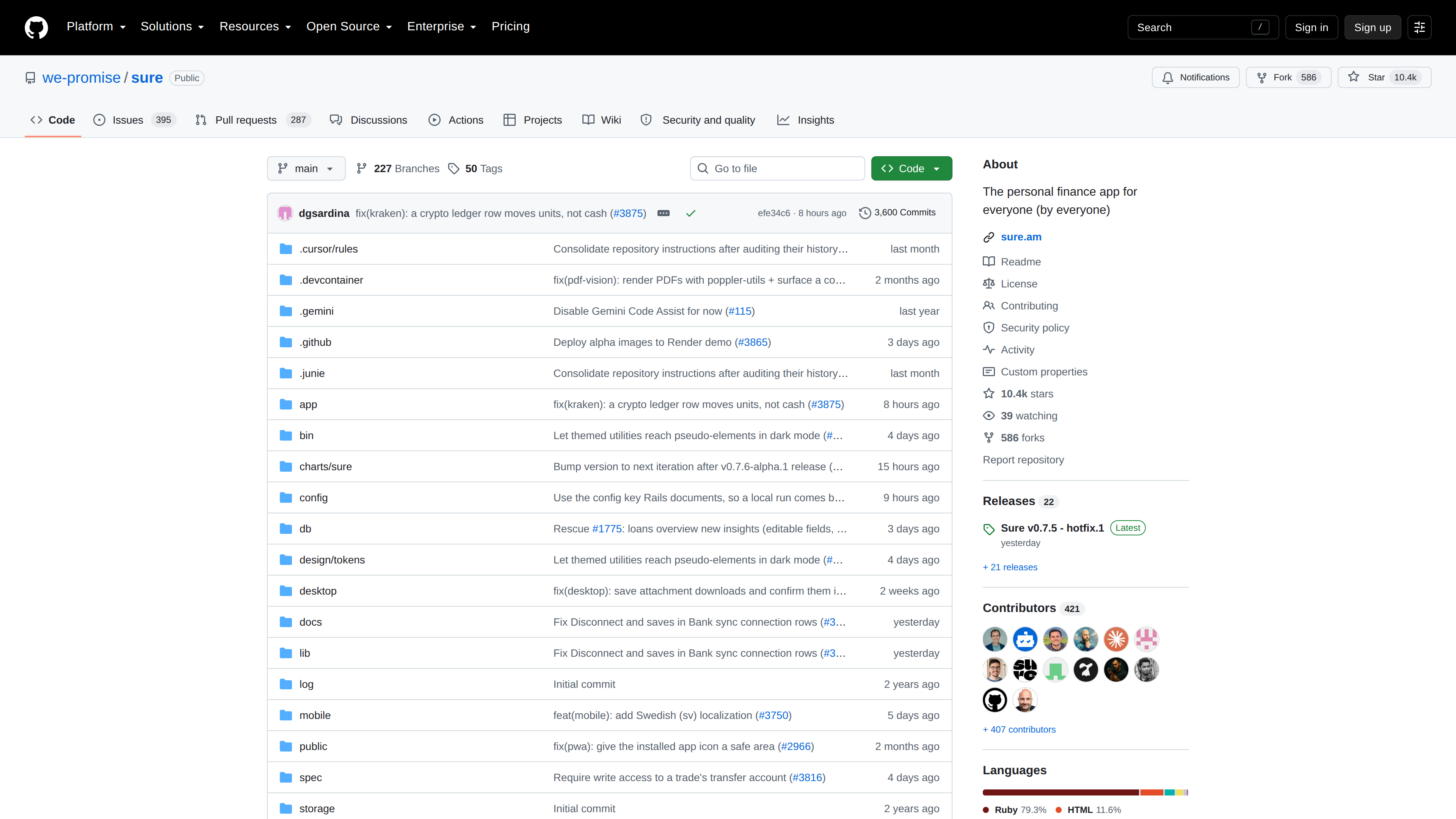
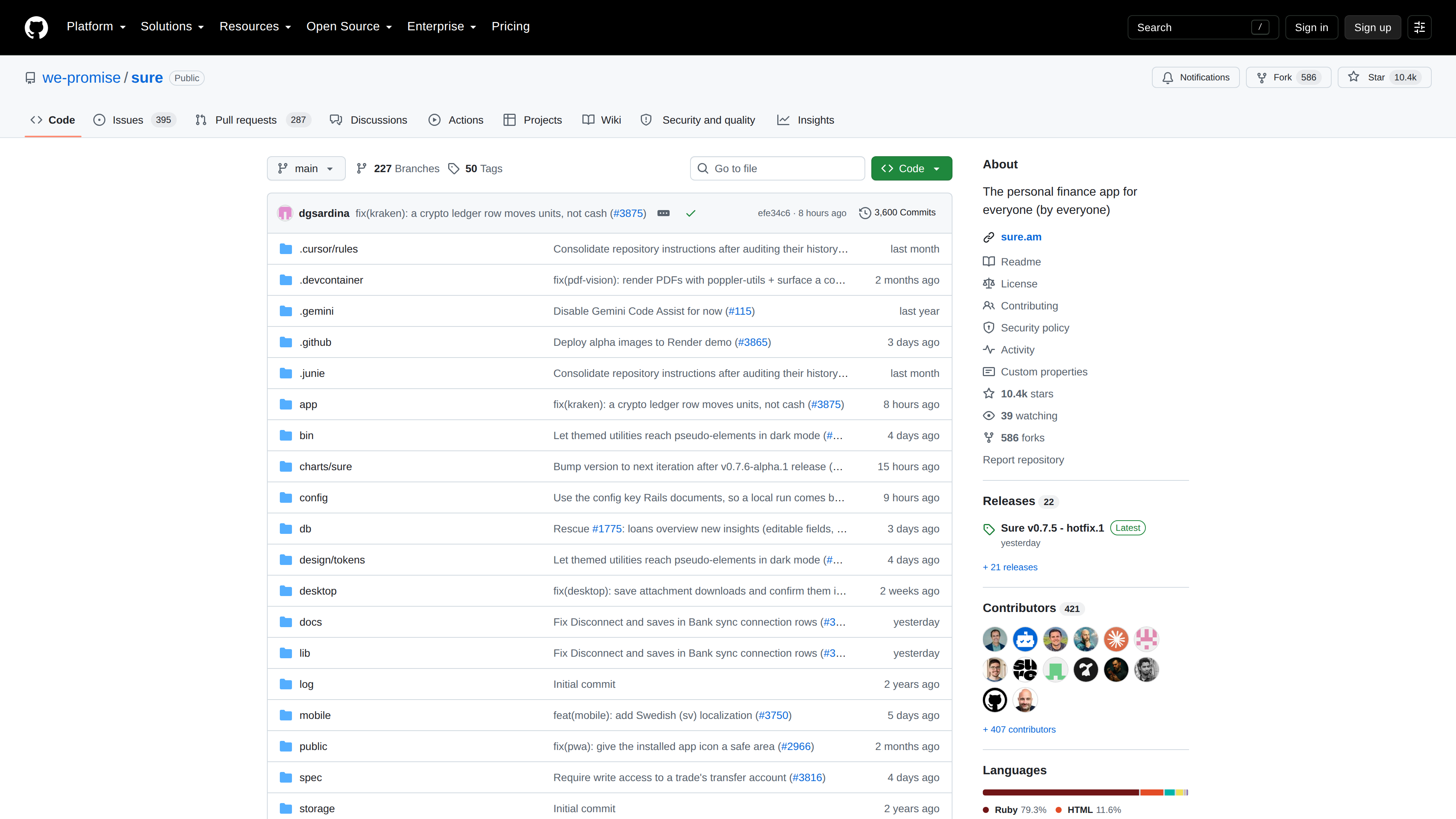
The Sure fork's repository (2026-10-02): commits land by the hour, and the README states plainly that this is "a community fork of the now-abandoned Maybe Finance project."
Core capabilities
- Net-worth dashboard: net-worth trend, balance sheet and cash-flow views; account types span cash, investments, crypto, property, vehicles and other assets, plus credit cards, loans and other liabilities (onboarding guide).
- Multi-currency: the team claims support for any currency, and the demo shows USD, EUR, GBP and NOK accounts aggregated side by side.
- Transactions: nested categories, tags, merchants, filters and bulk editing; a rules engine auto-categorizes transactions and detects merchants; transfers are first-class citizens, auto-detected and matched so they never pollute budget totals; one-off expenses can be excluded from averages; CSV import/export included.
- Budgeting and planning: monthly category budgets, plus envelope-style goals (YNAB-inspired), recurring Bills and income plans added across 2026 releases — some still behind preview toggles (v0.7.4, v0.7.5).
- AI assistant: a chat assistant that answers questions about your own finances, plus background auto-categorization; self-hosters configure an OpenAI-compatible API key (off by default), and the whole conversation can optionally be delegated to an external AI agent (AI configuration guide).
- Extensibility: an HTTP API with an OpenAPI spec, an MCP endpoint for LLM agents, an experimental macOS desktop app (Tauri shell) and a Flutter mobile companion app (clients overview).
- Security and sharing: 2FA, Passkeys/WebAuthn, OIDC single sign-on, and household member invites.
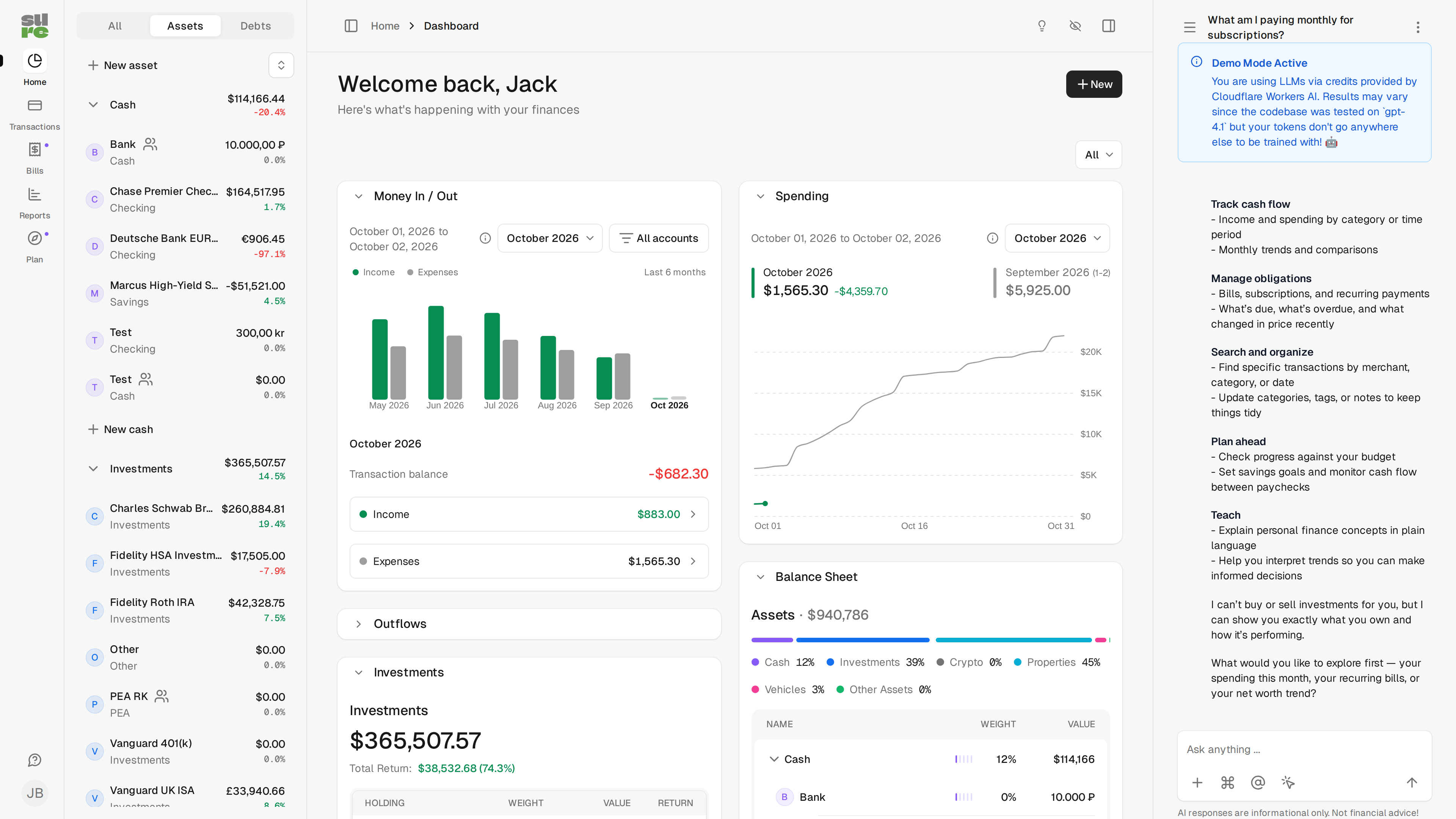
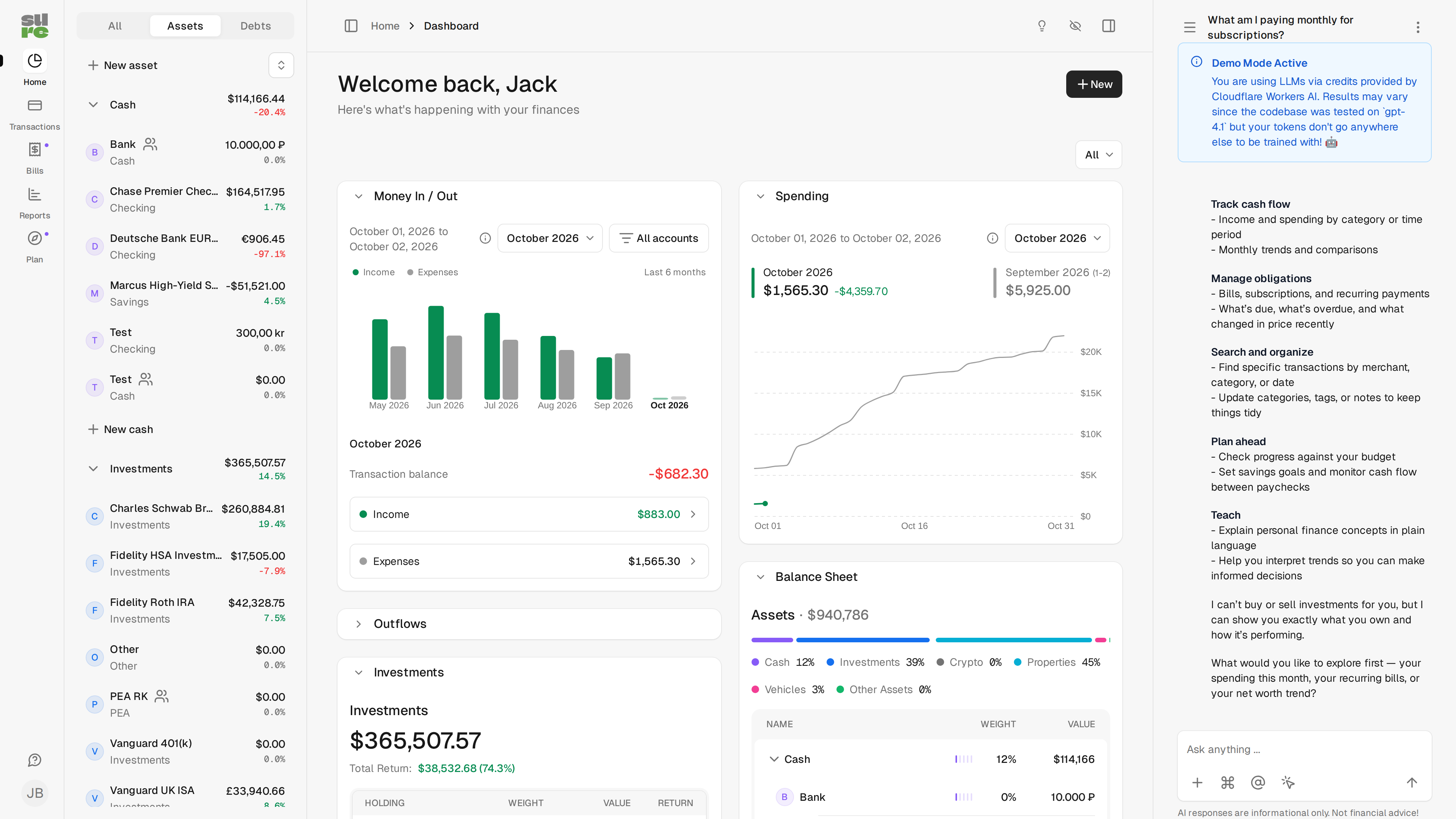
The official demo environment (app.sure.am, sample data, 2026-10-02): the sidebar lists USD, EUR and GBP cash accounts alongside investment accounts (sample Charles Schwab, Fidelity and Vanguard holdings); the center shows monthly income vs. expenses and spending trends; the lower-right panel breaks down the balance sheet; the AI assistant sits on the right. The demo's sign-in page pre-fills sample credentials and explicitly asks you not to enter real information.
Bank syncing and data feeds
Automatic bank syncing is spread across regional aggregators, configured by an admin under Settings > Bank sync: Plaid (US/Europe), SimpleFIN, Lunch Flow, Enable Banking (beta, Europe), Monobank (Ukraine), Fio banka (Czech Republic), Redbark (Australia's CDR open banking), Up (Australia), Akahu (New Zealand) and CoinStats (beta, crypto) — over 10,000 institutions in total, per the project's own claims (setup guide, homepage).
Practical caveats: the Plaid documentation warns that production access is not available to European users; self-hosters must apply for and pay for their own aggregator API access, and OAuth approval at some banks takes months (the docs cite roughly 3–4 months for Chase and about two months for Schwab). Market data (exchange rates and stock prices) can use a Twelve Data API key, falling back to Yahoo Finance. If that sounds like too much, manual entry and CSV import work fine on their own.
Pricing and hosting status (as of 2026-10-02)
The software is free and open source (AGPL-3.0); self-hosting costs only your server. The official pricing page is titled "Pay (us) nothing": the team openly says it hasn't launched a proper hosted version yet, funding the project through revenue shares from one-click platforms like Railway and PikaPods plus voluntary Stripe contributions in the demo environment. In other words, using Sure today means deploying it yourself or renting a one-click install from a third-party platform.
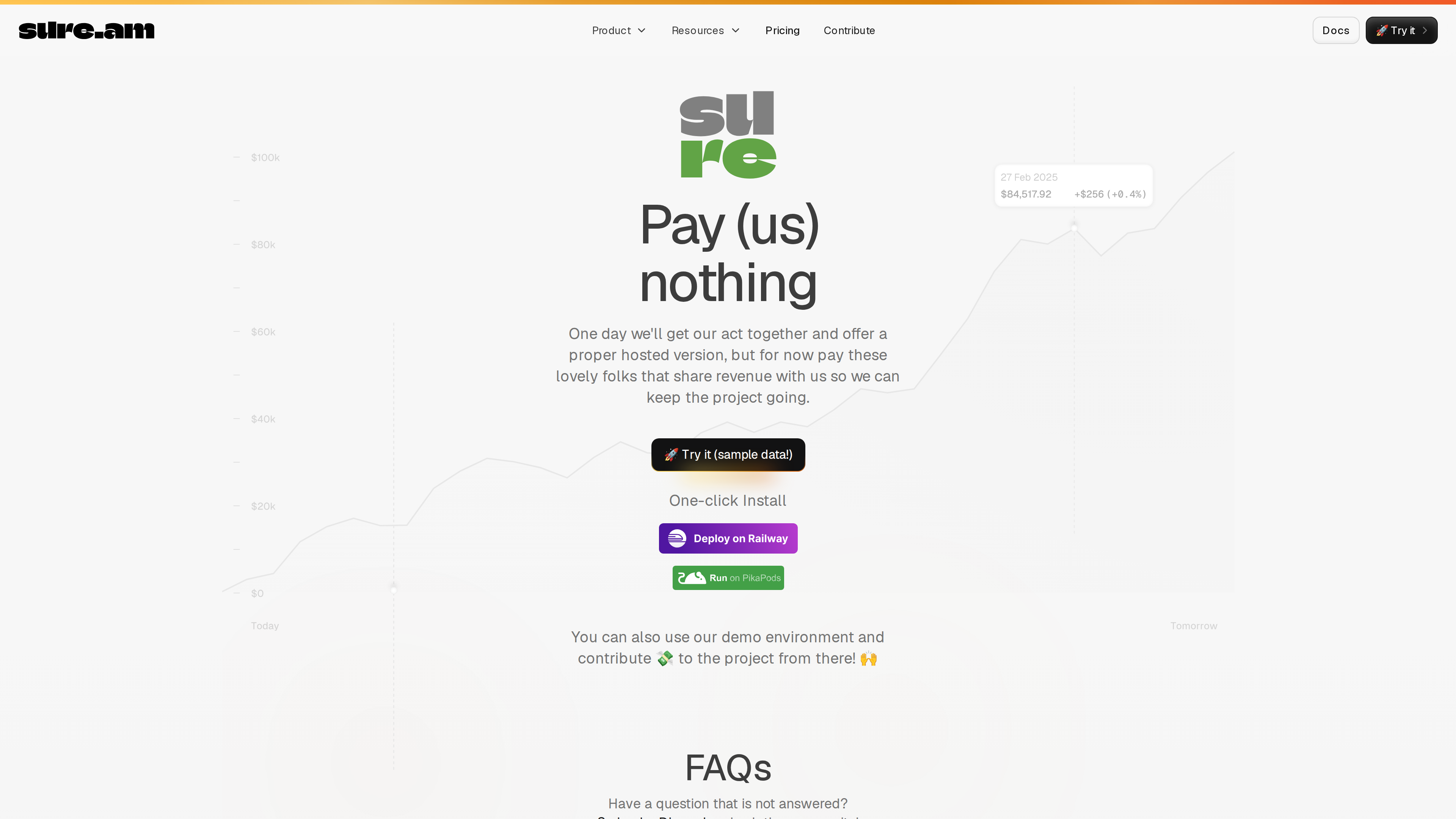
Sure's pricing page (2026-10-02): no price table — just one-click deploy buttons and a note on supporting the project.
Who it's for
- Technical users who want a Monarch Money / Copilot Money-style net-worth experience with full data ownership and auditable code.
- People already self-hosting Actual Budget or Firefly III who want a more modern UI, bank syncing and AI features.
- Developers looking to build on a Rails stack, or to wire personal finance data into their own automations and AI workflows via the API and MCP.
- The curious: try the official demo first, then decide whether to deploy.
Limitations
- Self-hosting bar: Docker Compose with PostgreSQL and Redis is real ops work; bank syncing additionally requires applying for aggregator APIs, paying their fees and waiting out bank approvals — effectively out of reach for non-technical users.
- No official hosted version (as of 2026-10-02): "sign up and go" doesn't exist yet; third-party platforms like Railway and PikaPods fill the gap on their own terms.
- Bank coverage is fragmented by region: no single aggregator covers the globe; Plaid production isn't open to European users, and other regions rely on Enable Banking (beta), Redbark, Akahu and similar regional options.
- Early-stage project shape: rapid releases, several features behind preview toggles, a docs site that labels itself a draft, and incomplete translations; read the release notes when upgrading.
- AI features need your own keys: disabled by default when self-hosting, requiring an OpenAI-compatible endpoint and your own token budget.
- Historical baggage: the original Maybe repository is archived with no further security updates, and with maybe.co offline its old blog posts survive only in web archives. Everything in this profile describes the community fork, Sure, as it stands today.
Alternatives
- Actual Budget: open-source, local-first envelope budgeting; syncs via files rather than full bank aggregation.
- Ghostfolio: open-source portfolio and net-worth tracking focused on investment analysis, with weaker budgeting and bookkeeping than Sure.
- Firefly III: the veteran self-hosted finance manager (PHP) — comprehensive, but more traditional in UI and integrations.
References
- Sure website, pricing page, documentation (checked 2026-10-02)
- we-promise/sure repository, its README backstory and releases
- maybe-finance/maybe repository (archived) and the v0.6.0 farewell release
- Josh Pigford's project list
- Wayback Machine: maybe.co, May 2024
- Stars, license and activity data: GitHub API (checked 2026-10-02)