Substack (substack.com) is a subscription publishing platform operated by Substack Inc., founded in 2017. Its core proposition is letting writers and creators earn money directly from readers instead of relying on advertising: publishing long-form posts, podcasts, video and livestreams is free, and once a publication turns on paid subscriptions, Substack takes 10% of each transaction and the creator keeps the rest. Three verifiable traits set it apart from comparable services: publishing costs nothing, with no tiers or contracts; creators own their content, mailing list and subscriber revenue, and can export everything and leave at any time (the company's own phrasing is "free to start and free to leave"); and a built-in distribution network of Notes and publication-to-publication recommendations drives audience growth — Substack says more than half of new subscribers arrive through its own network. In March 2025 the company announced the platform had passed 5 million paid subscriptions.
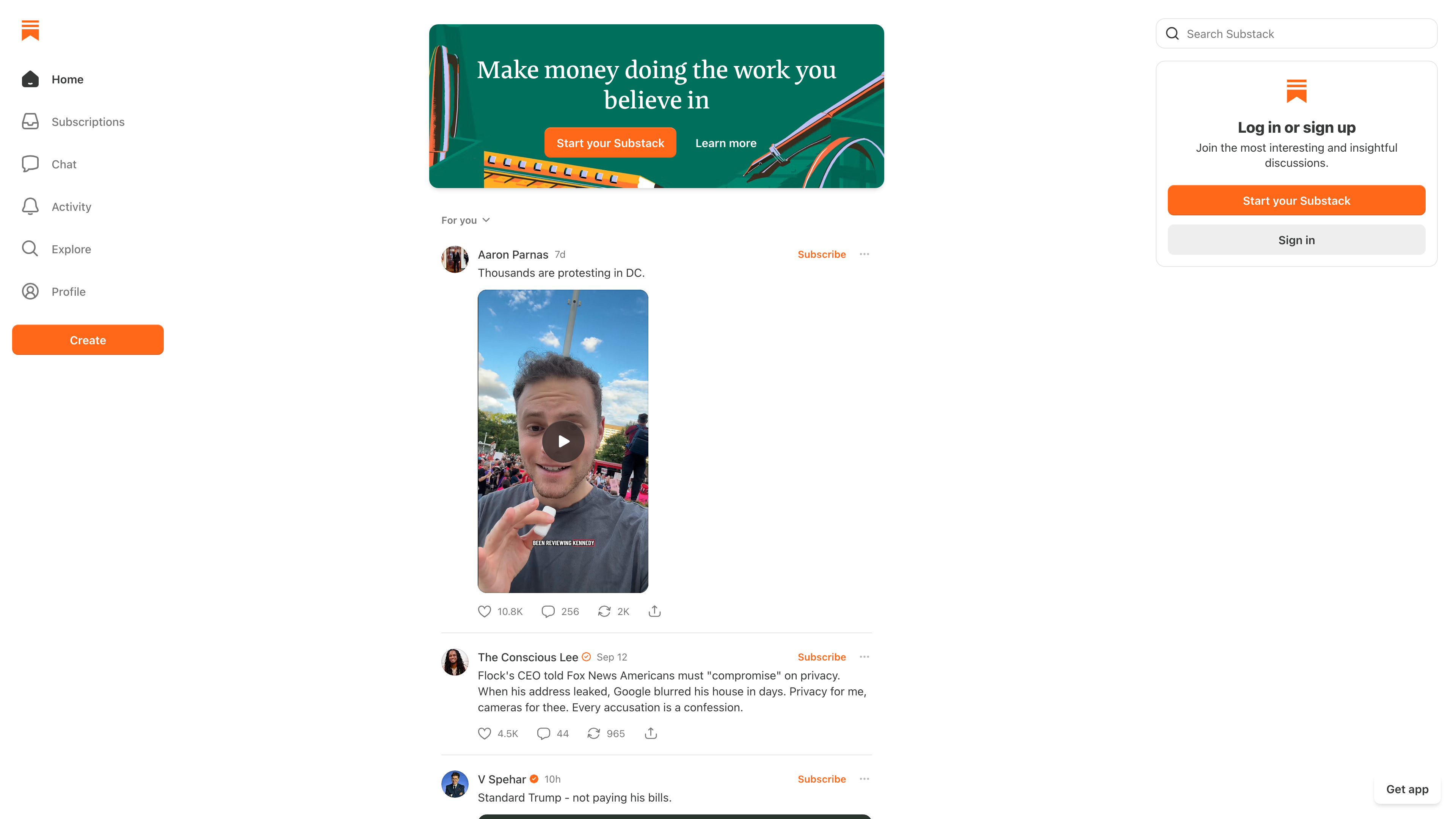
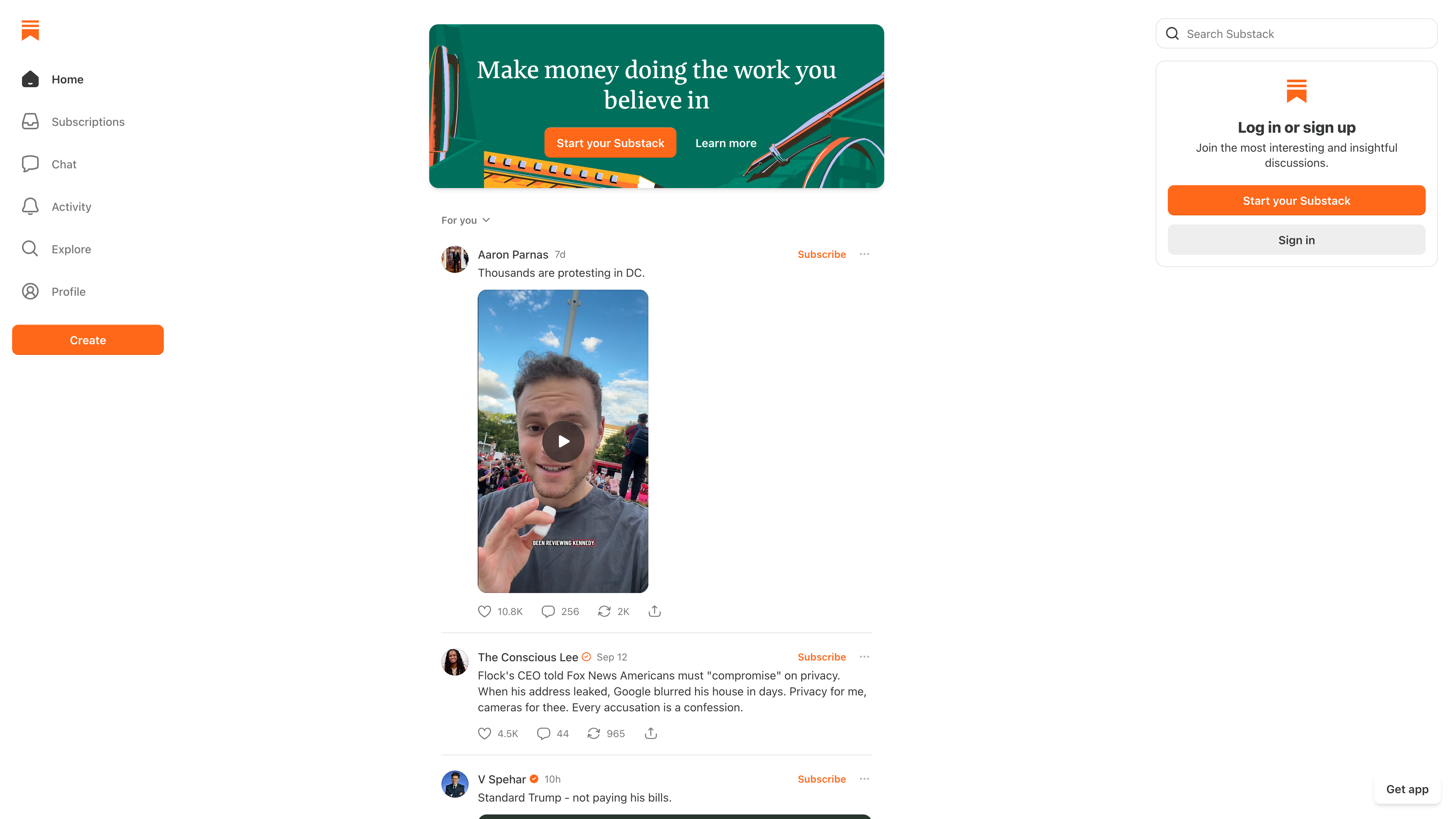
The screenshot above shows Substack's logged-out homepage: a creator recruitment banner on top, a "For you" feed of posts and short videos in the middle, and sign-in controls on the right. Public content is readable without an account.
At a glance
- URL: https://substack.com
- Type: Subscription publishing platform (newsletters + podcasts + video + community)
- Pricing: Browsing public posts and subscribing to free publications is free for readers; paid subscription prices are set by each creator (US-dollar accounts: minimum 30/year); publishing is free for creators, with a 10% Substack fee per paid transaction plus Stripe processing fees (per the official help article, as of 2026-09-25); using a custom domain costs a one-time $50
- Sign-up requirements: No account needed to read public content; subscribing or commenting requires an account (16+); creators must connect a Stripe account to get paid
- Interface language: The account interface and system emails are English; individual publications can localize reader-facing surfaces into about 16 languages (Japanese included; no Chinese)
- Platforms: Web, iOS, Android; a beta app for Apple TV and Google TV launched in January 2026
- Launched: Founded 2017; Y Combinator Winter 2018 batch
Background
Substack was founded in San Francisco by Chris Best (CEO, co-founder and former CTO of the messaging app Kik), Jairaj Sethi (formerly Kik's head of platform) and Hamish McKenzie (COO, a former PandoDaily tech reporter), and went through Y Combinator's Winter 2018 batch. The founders have said Ben Thompson's paid tech newsletter Stratechery was a major inspiration (Wikipedia). At its first birthday in October 2018, the platform had roughly 25,000 paying subscribers (TechCrunch at the time).
Funding history (first-hand reporting or official announcements):
- 2018: $2M seed round, with investors including The Chernin Group and Zhen Fund.
- July 2019: $15.3M Series A led by Andreessen Horowitz (a16z).
- March 2021: 650M (TechCrunch).
- March 2023: A community round opened to the platform's own users via Wefunder.
- July 17, 2025: 1.1B (official announcement, TechCrunch).
Reported paid-subscription milestones: over 1 million in November 2021, 2 million in 2023, 4 million in November 2024, and 5 million announced on March 11, 2025. As of 2026-09-25 the website still states "5 million paid subscriptions and counting," along with "tens of millions" of people reading, watching and listening every week. An October 2025 report (TheWrap, cited in Wikipedia) put the number of creators earning money on Substack at 50,000, at least 50 of whom make over $1M a year.
Core product: writing tools plus a built-in network
For creators, Substack bundles a CMS into one product: a long-form editor, podcast hosting with a Recording Studio, video and livestreaming, subscriber group chats, and per-post free/paid gating; podcasts can be auto-distributed to Apple, Spotify and YouTube. Paid subscriptions support monthly and annual plans plus a Founding Member tier at any higher price, all set at the creator's discretion.
What distinguishes Substack from a plain newsletter tool is its in-product network. Notes, launched in April 2023, is a short-form surface (posting, restacking, quoting — widely compared to Twitter) that, together with publication recommendations, leaderboards and trending topics, acts as a free acquisition channel. The company says over 1 million posts are surfaced to potential subscribers in the app every day, and that 30%+ of paid subscriptions originate inside Substack's network.
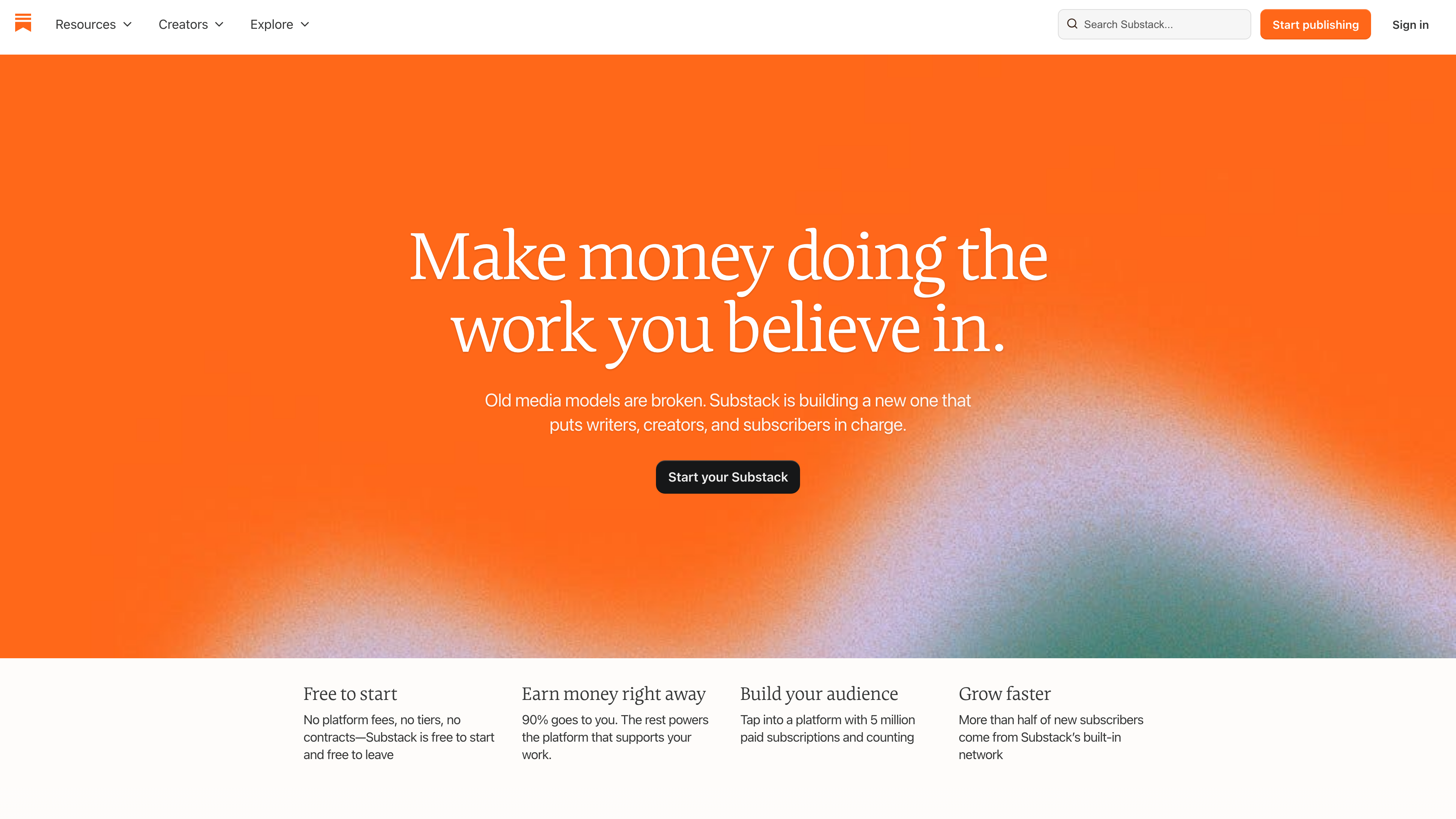
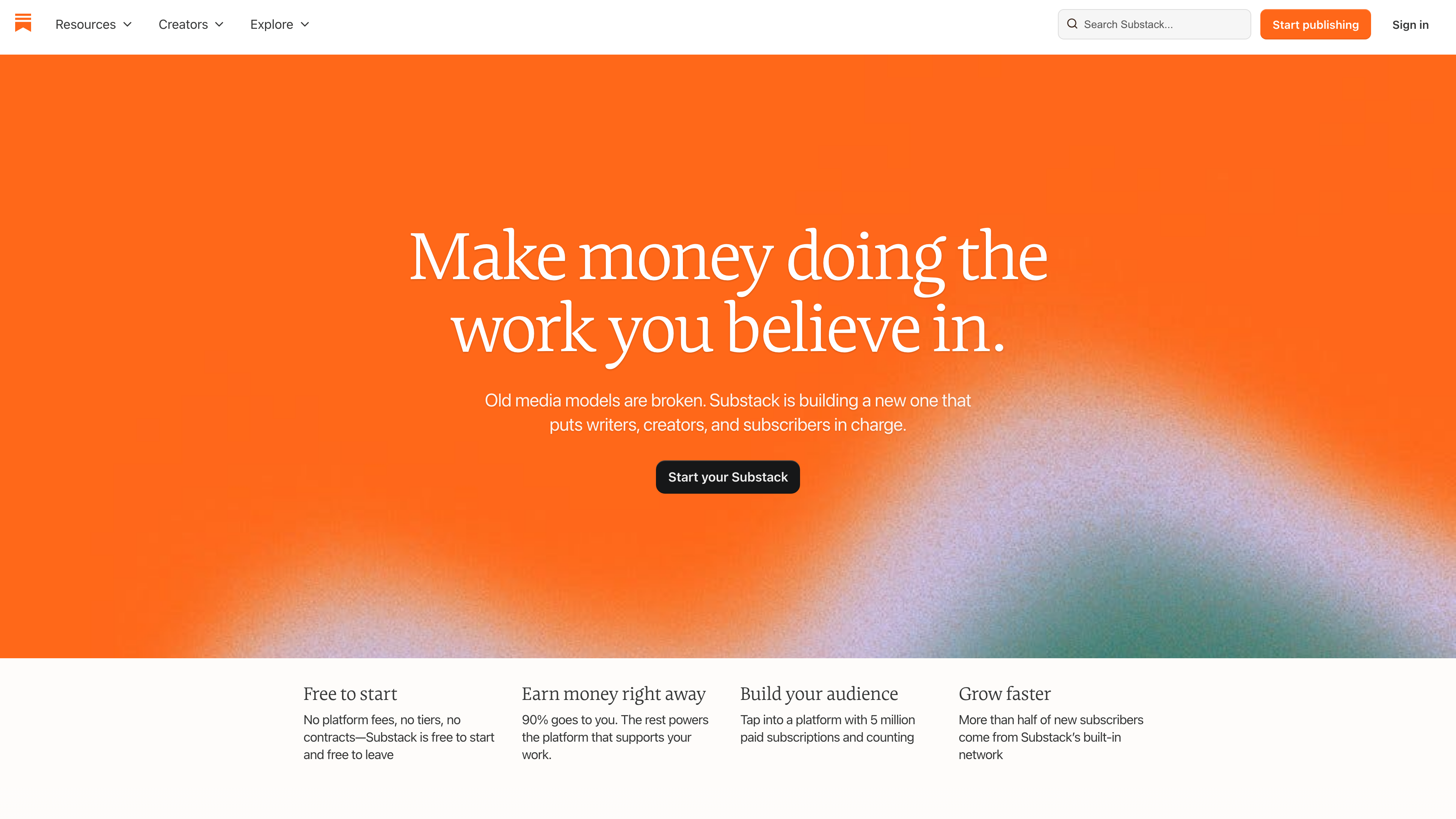
The About page above states the business model's key numbers directly: free to start (no platform fees, no contracts), creators keep 90% of revenue (minus credit card fees), and the platform has passed 5 million paid subscriptions.
Accounts and openness
One Substack account serves as both reader and creator identity. Reading public posts requires no account; subscribing or commenting does. Creators publish under the same account and connect Stripe to receive payouts. Free publications can be started from anywhere, but paid subscriptions depend on Stripe's supported countries, with exceptions such as India and Brazil (Substack's 10% fee is temporarily not charged there, which the company says will change).
Portability is an explicit promise: creators can export all posts, the subscriber list (CSV) and statistics from the dashboard (export instructions), and official guides cover migrating in from Mailchimp, Ghost and beehiiv. There is no public write API and no self-hosting option; in 2026 Substack launched an official MCP server that lets Bestseller-tier publications give AI assistants like Claude and ChatGPT read-only access to subscriber counts, post performance and revenue data.
Copyright and content policy
For a UGC platform, Substack's ownership terms are comparatively clear. The Terms of Use state that "you own what you create," including publications and subscriber lists; creators grant the platform only the license needed to operate and promote the service. The Publisher Agreement (July 20, 2026 version) adds that Substack may not use creator content to train third-party AI models, and third-party tools used for content-safety analysis are contractually barred from retaining it. Copyright disputes follow the standard DMCA notice-and-takedown process, with a repeat infringer policy that can terminate accounts. Since 2020, the Substack Defender program has offered creators legal support including pre-publication review and legal fees, committing up to $1M per accepted case.
The Content Guidelines (July 20, 2026 version) prohibit credible threats of physical harm, incitement to violence based on protected classes, doxxing, plagiarism, impersonation, spam and publications whose primary purpose is marketing; pornography is banned while artistic or journalistic nudity and erotic literature are allowed. The rules also cover comments and Notes, with each publication's community moderated by its own author. It is worth noting neutrally that Substack is known for a "minimal censorship" stance that has drawn repeated controversy: in late 2023 multiple outlets documented extremist content on the platform, more than a hundred creators signed an open letter demanding action, the company publicly declined to remove content based on its views, and prominent publications such as Platformer (Casey Newton) left the platform as a result (Wikipedia summary).
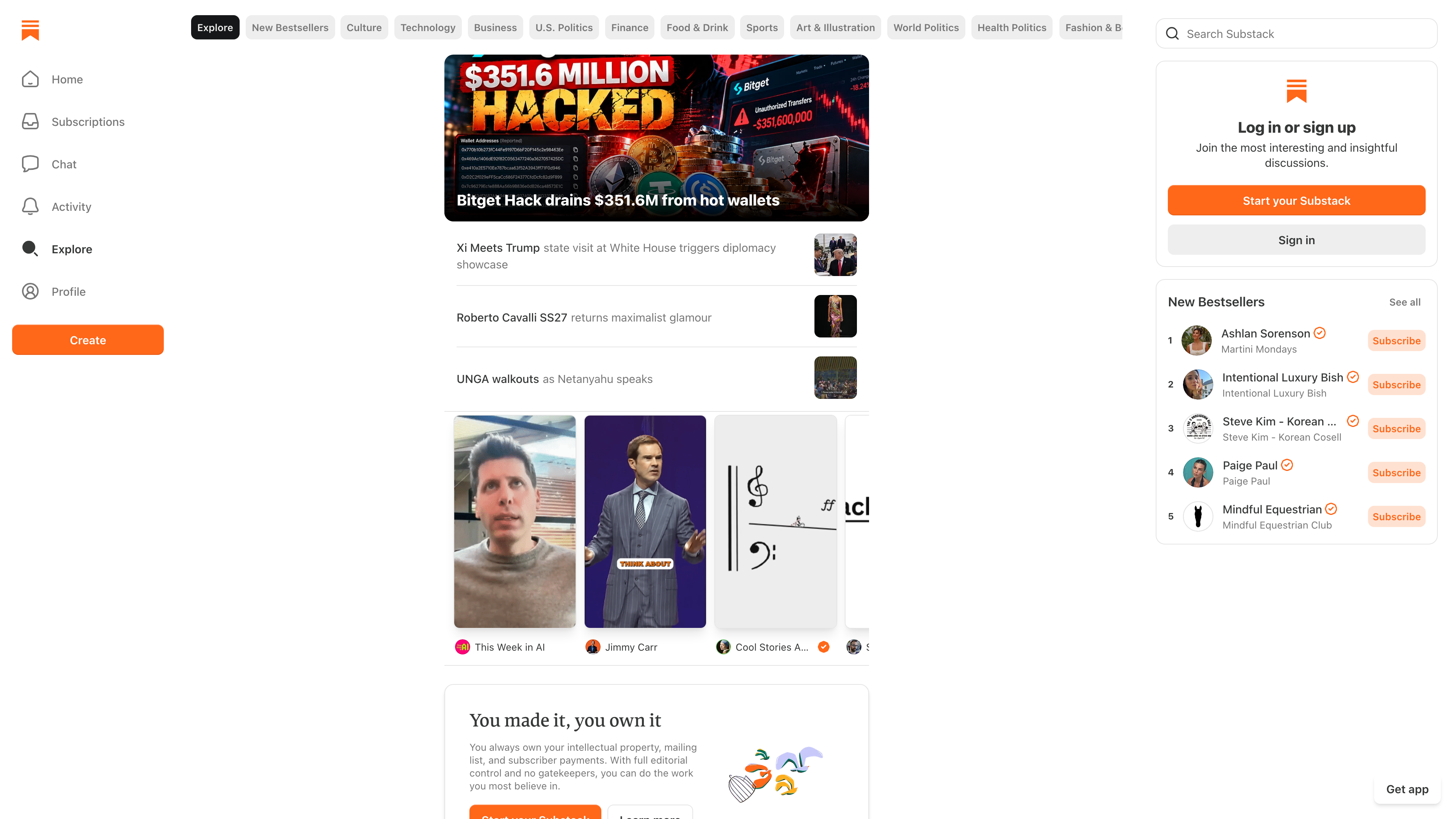
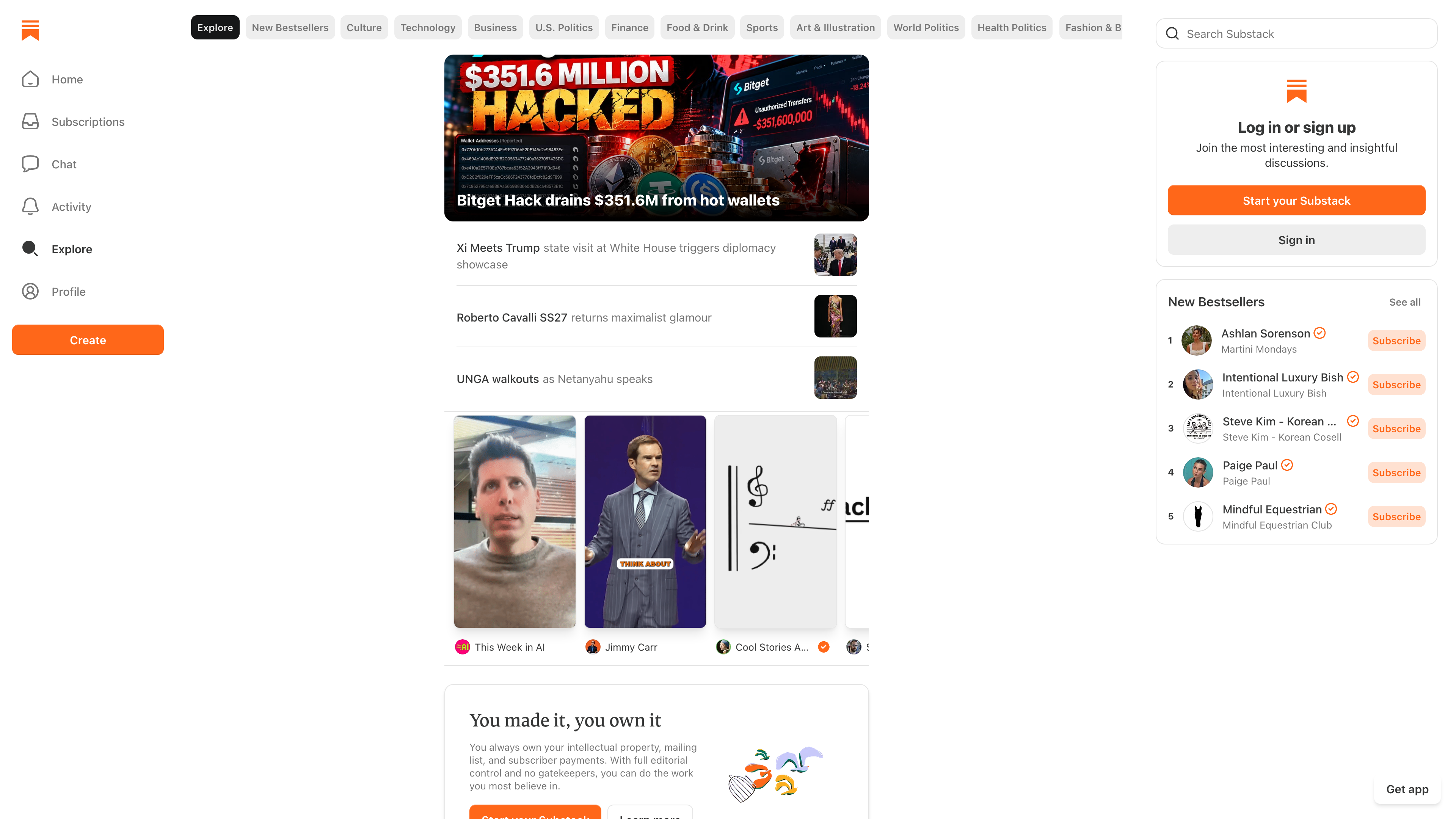
The Explore page above is the reader-side discovery entry point: browse trending publications and posts by category, with a bestseller leaderboard that can be subscribed to directly.
Who it's for
- Writers, journalists, analysts and researchers who want to monetize through subscriptions rather than ads — especially individuals with an existing audience going independent.
- Small media teams that want newsletters, podcasts, video and community in one product without building their own stack.
- Creators who prioritize ownership and portability of their mailing list (content and list are exportable at any time).
- Readers who want every subscribed writer in one app and like discovering new voices through Notes.
Limitations
- No Chinese interface: the account UI and system emails are English-only, and the publication localization list does not include Chinese; Chinese-speaking users must rely on browser translation.
- The revenue share gets expensive at scale: 10% exceeds the fixed monthly pricing of alternatives like Ghost once revenue grows, and Stripe processing fees apply on top (about 2.9% + $0.30 per card transaction, plus a 0.7% Billing fee on recurring payments).
- Payouts depend on Stripe: paid subscriptions require a Stripe account, so creators in unsupported countries and regions (including mainland China) cannot charge readers directly.
- Closed, hosted-only product: no self-hosting and no public write API; even a custom domain costs a one-time $50.
- Reputation risk from its moderation stance: the platform's hands-off policy remains controversial and has driven some high-profile authors away.
- A stained security record: a breach that occurred in October 2025 (disclosed in February 2026) exposed user emails, phone numbers and internal metadata; the company says passwords and payment details were not affected (The Verge).
- Self-reported scale figures: numbers like 5 million paid subscriptions come from the company itself, and the website's figure had not been updated as of 2026-09-25.
Alternatives
- Ghost: an open-source publishing platform that can be self-hosted and charges fixed monthly fees instead of a revenue share — better for high-revenue publications or those wanting full control.
- beehiiv: another newsletter platform, focused on growth tooling and an ad network; its free tier caps subscriber counts.
- Patreon: a membership sponsorship platform with tiered creator fees — closer to patronage than to a subscription content product.
- Medium: a writing community that pays out of a platform membership pool; authors do not directly own subscriber relationships or mailing lists.
References
- Substack homepage (checked: 2026-09-25)
- About Substack (checked: 2026-09-25)
- How much does Substack cost? - Substack Help Center (checked: 2026-09-25)
- How do I set up a paid publication? - Substack Help Center (checked: 2026-09-25)
- Are there any countries or geographies you don't support? - Substack Help Center (checked: 2026-09-25)
- How do I export my posts? - Substack Help Center (checked: 2026-09-25)
- How do I set up my custom domain on Substack? - Substack Help Center (checked: 2026-09-25)
- Can readers see my Substack publication in a different language? - Substack Help Center (checked: 2026-09-25)
- How to connect Substack to your AI Assistant - Substack Help Center (checked: 2026-09-25)
- Substack Terms of Use (effective 2025-04-21; checked: 2026-09-25)
- Substack Publisher Agreement (updated 2026-07-20; checked: 2026-09-25)
- Substack Content Guidelines (updated 2026-07-20; checked: 2026-09-25)
- Substack Copyright Dispute Policy (updated 2025-02-19; checked: 2026-09-25)
- Substack Privacy Policy (updated 2026-05-14; checked: 2026-09-25)
- Substack - Y Combinator (checked: 2026-09-25)
- 5 million - The Substack Post (2025-03-11; checked: 2026-09-25)
- A media future to believe in - The Substack Post (2025-07-17; checked: 2026-09-25)
- Introducing the Substack TV app, now in beta - On Substack (2026-01-22; checked: 2026-09-25)
- Is Substack really worth $650M? - TechCrunch (2021-03-30; checked: 2026-09-25)
- Substack raises $100M from Chernin Group, Andreessen Horowitz, Skims CEO, and more - TechCrunch (2025-07-17; checked: 2026-09-25)
- Substack data breach exposed users' emails and phone numbers - The Verge (2026-02-05; checked: 2026-09-25)
- Substack - Wikipedia (cross-check; checked: 2026-09-25)