Strava (strava.com) is an American workout-tracking service with social-network features: athletes record runs, rides, swims, and other activities with a phone or GPS watch, and the platform turns the data into route maps, pace, elevation, and heart-rate analysis, while letting users follow each other, give "kudos," and comment. Two verifiable traits set it apart from plain activity loggers. First, the Segment system: users mark out stretches of road or trail, and Strava automatically matches every GPS trace that crosses them into leaderboards — cycling's KOM/QOM and running's CR — creating a persistent, community-driven competition. Second, its explicit positioning as "the social network for those who strive." According to an official press release from June 2026, the service claims 195 million athletes; reporting collected on Wikipedia shows one billion activities uploaded by 2017 and more than three billion by 2020.
At a glance
- URL: https://www.strava.com
- Type: GPS workout tracking, training analysis, and athlete social network
- Cost: Free tier plus subscription; in the US, an individual plan costs 11.99/month), a family plan $139.99/year for up to four accounts, verified students 50% off, with a 30-day free trial (as of 2026-09-09; pricing varies by country)
- Registration: Public pages like the homepage need no account; recording, community features, and nearly everything else require a free account; creating an API app additionally requires a subscription
- Interface languages: 24 languages per the App Store listing, including Simplified and Traditional Chinese (via Wikipedia)
- Platforms: iOS, Android, web, watchOS, Wear OS
Background
Strava takes its name from the Swedish "sträva," meaning "to strive." Founders Mark Gainey and Michael Horvath met in the 1980s on Harvard's rowing crew, began building an athlete-focused social platform in 2007, and launched it in 2009 with co-founders Davis Kitchel, Chris Donahue, Mark Shaw, and Pelle Sommansson (per Wikipedia, drawing on the company's open letter and press coverage). The company is headquartered in San Francisco and moved into the 181 Fremont tower in March 2025.
Leadership has rotated several times: after Gainey and Horvath alternated as CEO, James Quarles took over in 2017; Horvath returned in November 2019 and resigned again in February 2023; in December 2023 the company appointed former YouTube executive Michael Martin as CEO. Strava raised a 2.2 billion valuation. In early 2023 the company also laid off about 14% of staff and raised subscription prices in many markets.
The product has kept widening its scope: in 2026 Strava added sport types such as basketball, volleyball, cricket, padel, dance, and physical therapy, shipped offline navigation for hiking, overhauled strength training, and introduced race and club-event discovery (per Strava's Stories and press pages).
Core capabilities
Recording and device sync
There are three ways to get activities in: record directly with the Strava mobile app, sync from third-party devices and apps (the privacy policy names Garmin, Peloton, and Apple Health; Wikipedia also lists Coros, Suunto, and Wahoo), or enter workouts manually on the web or in the app. Per the official support article, the platform supports more than fifty sport types — foot sports (run, trail run, hike, walk, wheelchair), cycling (including gravel, mountain, and e-bike), water sports (swim, kayak, SUP, rowing, sailing, and more), winter sports, and gym or court sports — but some features remain available only for the three core types: riding, running, and swimming. In July 2026 Strava also announced a Samsung partnership, with pre-installs on new Galaxy Watches and Routes integrated into Samsung Health.
Segments, leaderboards, and community competition
Segments are Strava's signature mechanism. Any user can define a stretch with a start and finish — a climb, a sprint — and Strava matches every activity whose GPS trace crosses it, ranking efforts by sport type and gender. The fastest cyclists hold the KOM/QOM (King/Queen of the Mountain), runners the CR (Course Record), and a Local Legend title rewards frequency. To keep leaderboards fair, the official Segment Leaderboard Guidelines require e-bike rides to use the E-Bike sport type, ban motorcycle data, ask that motor-paced rides be marked private, and prohibit manipulated GPS files. Every activity also passes through a machine-learning check, and community members can flag suspicious efforts. Leaderboards have long faced cheating complaints — from doping-linked athletes to motorbikes on cycling segments — which led Strava to ship reporting and detection tools (per reporting collected on Wikipedia).
Routes and maps
Route features include recommended routes, drawing your own, and saving them offline. Underneath sits the Global Heatmap, which Strava describes as showing "which roads and trails athletes have used most over the last 12 months." Community data also powers layers like popular start points and points of interest. In June 2026, Strava refreshed route planning, offline navigation, and trail sharing for hikers, with part of the toolkit available to all members.
Training analysis
Subscriber-oriented analytics include a consolidated training history, deeper workout insights (power, heart rate), custom goal tracking, Relative Effort across activities, a Fitness Score over time, Fitness & Freshness trends, and finish-time predictions. A May 2026 strength update added a workout log and muscle maps.
Social and safety
Community features cover following, a feed, kudos, comments, photos and videos, clubs, challenges, group activities, and Flyby (replaying who else was active at the same time and place). Race and club-event discovery arrived in July 2026. On the safety side, Beacon lets athletes share their live location with chosen contacts.
Free vs. subscription
Strava runs on a freemium model. The turning point came in May 2020, when the company announced it would "put subscription at the centre of Strava," moving segment leaderboards and other previously free features behind the paywall while promising to "always offer a version of Strava for free" (per Cyclingnews).
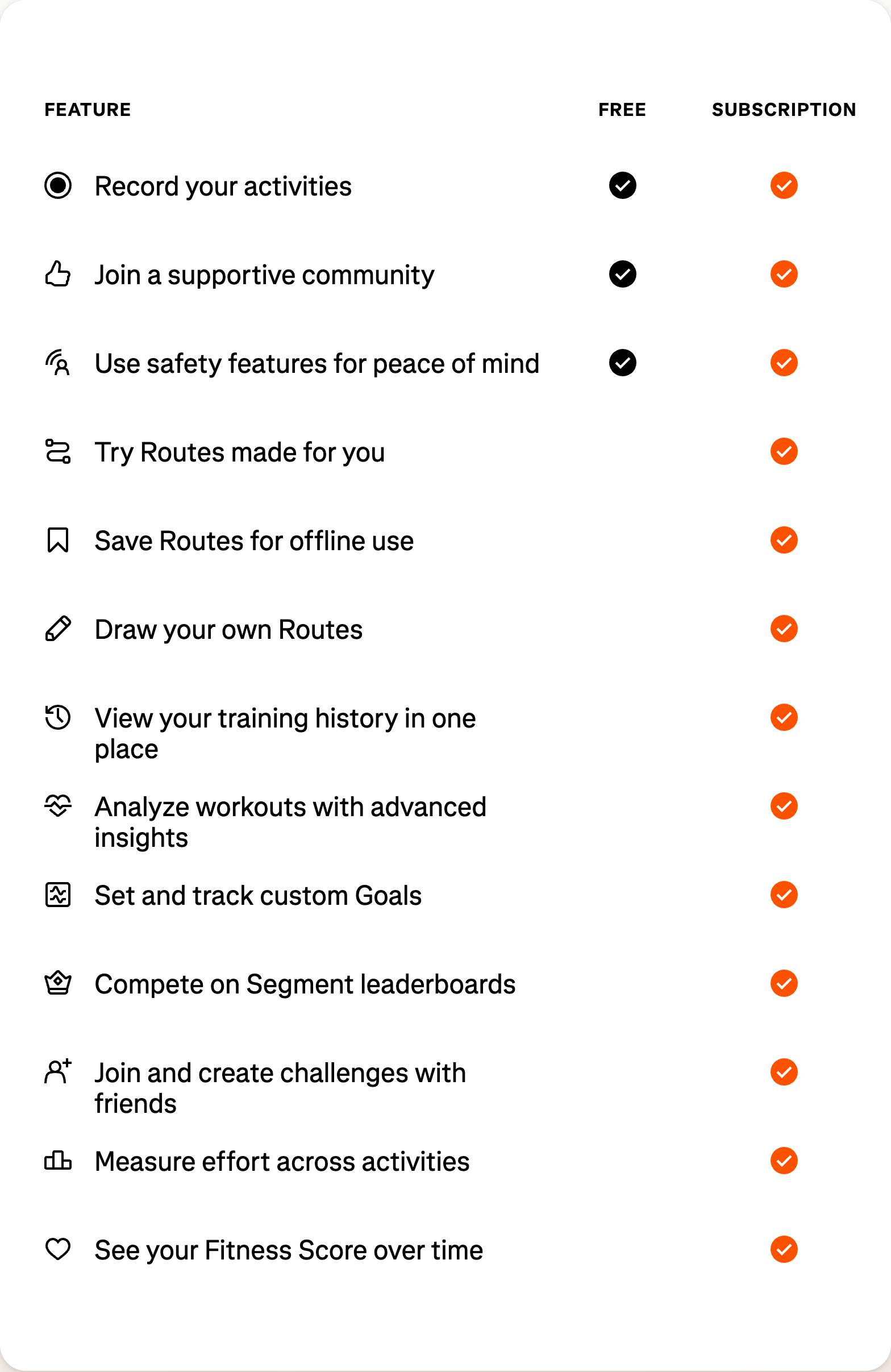
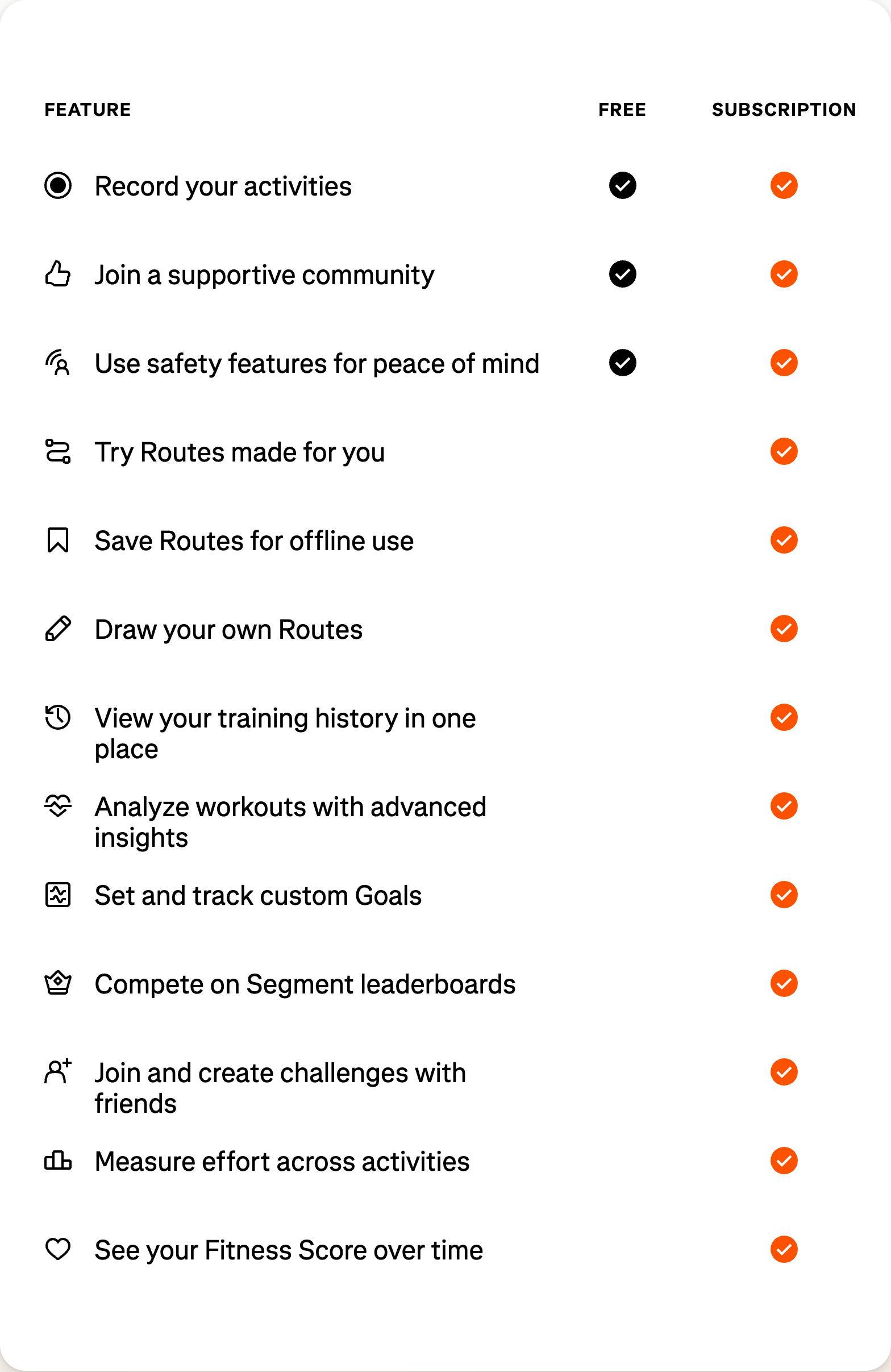
As of 2026-09-09, the comparison table on the official subscription page splits thirteen capabilities as follows: the free tier includes only recording activities, joining the community, and safety features; route recommendations and offline saving, drawing routes, training history, advanced insights, custom goals, segment leaderboards, creating and joining challenges, effort measurement, and the Fitness Score are all subscription-only.
US pricing (checked on the live page, 2026-09-09): 11.99/month), 39.99/year), and 25% off individual plans for teachers, military members, and medical professionals. New users get a 30-day free trial with a reminder two days before it ends. A bundle with Runna, the coaching app Strava acquired, costs $149.99/year and is advertised at up to 60% off. The privacy policy notes that Strava uses location "to determine your country pricing," so prices differ by market — visiting from another region shows local-currency amounts.
Accounts and privacy
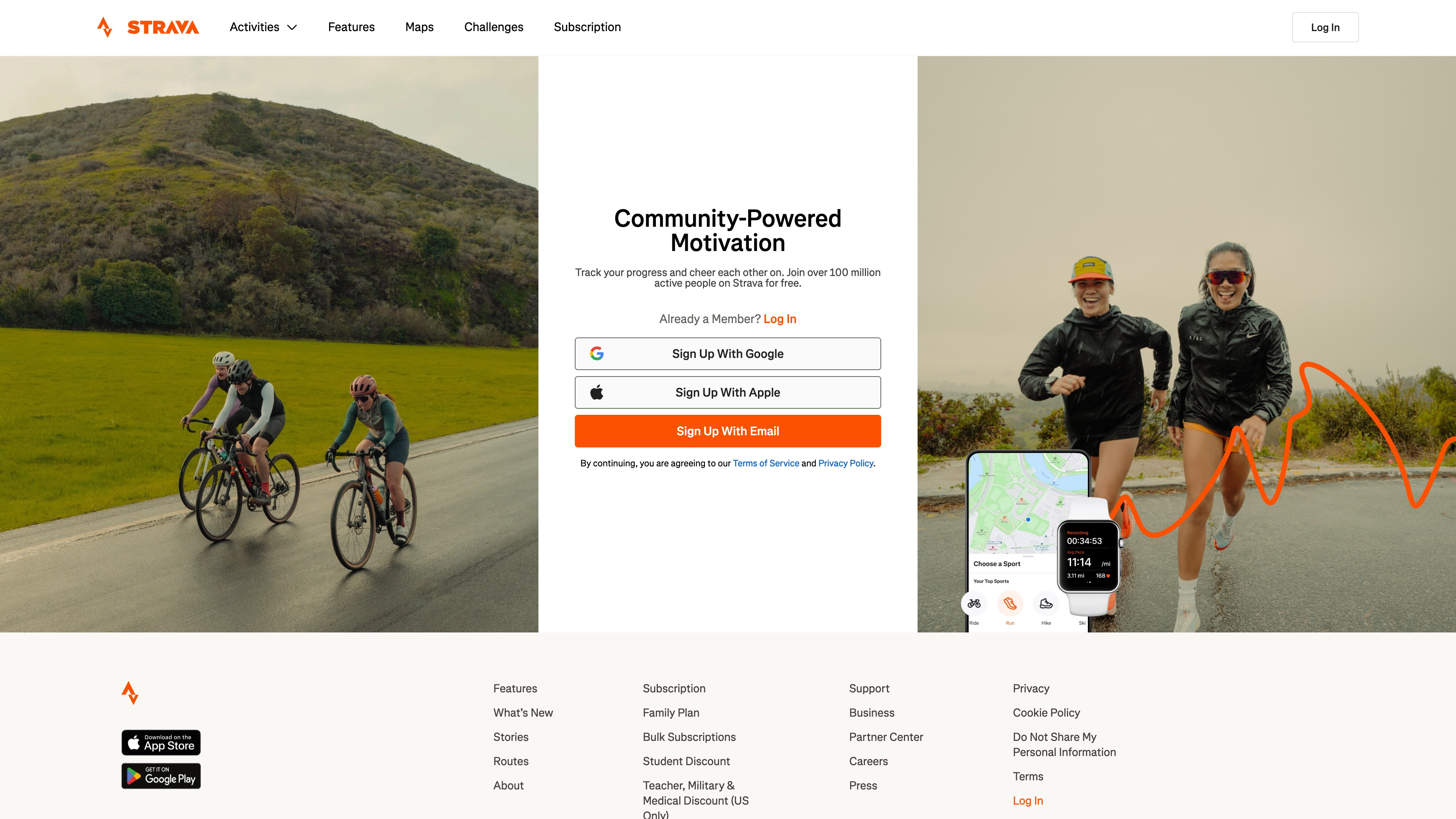
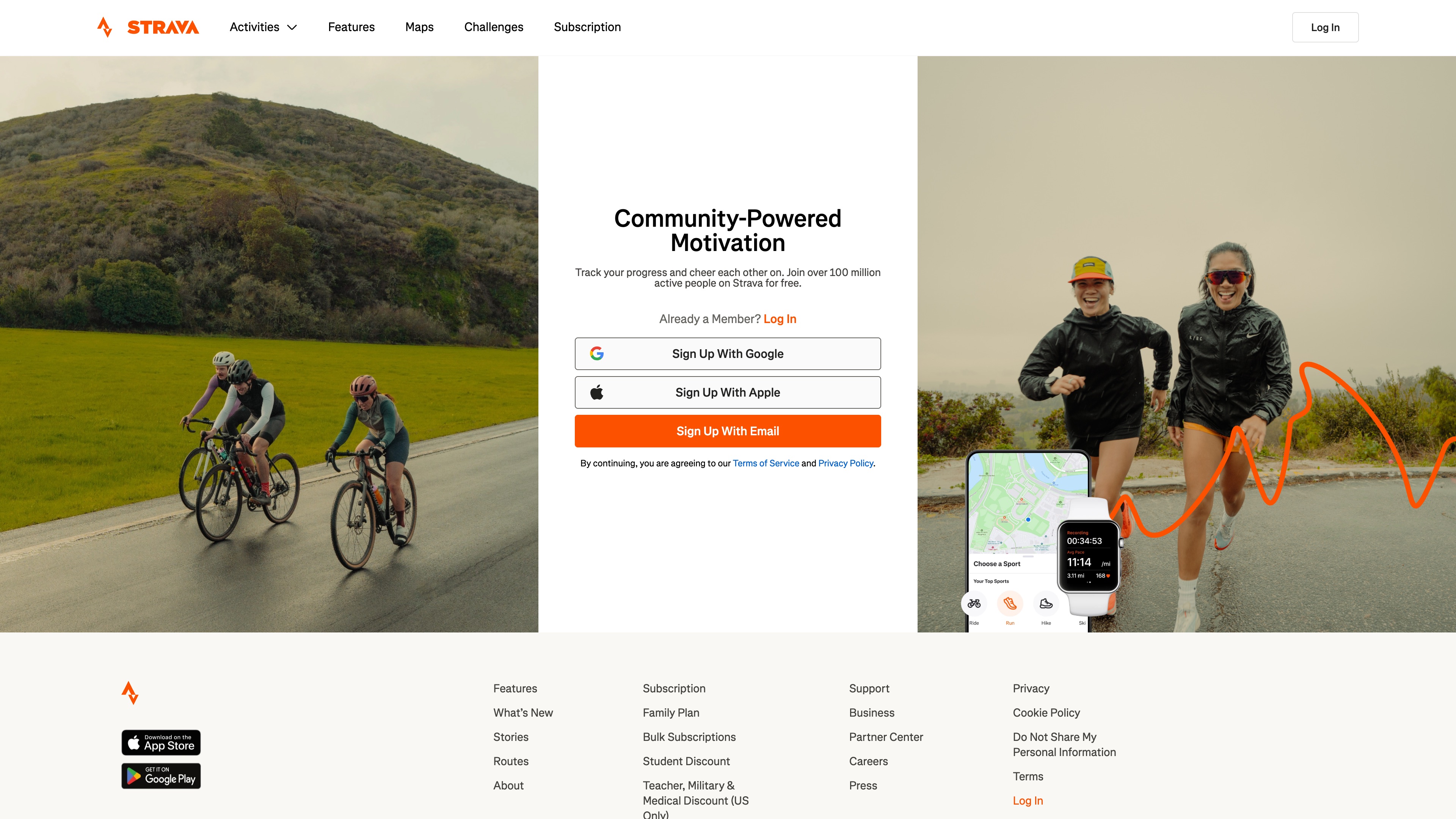
Sign-up works via Google, Apple, or email. Key points from the privacy policy:
- Public by default: for users 18 and older, profiles and activities default to "Everyone" — which includes unregistered visitors and search-engine results. Privacy controls exist, and new users would do well to review them first. Children under 13 may not use the service, and minors under 18 get stricter default protections.
- Data collected: precise geolocation (GPS tracking is a prerequisite for core features), health data such as heart rate (with consent), contacts (optional), plus device and usage logs.
- How data is used: activity data feeds personal heatmaps, the Global Heatmap, and community layers like popular start points. Aggregated, de-identified data is shared through Strava Metro, free of charge for urban and trail planners — the first Metro Commute Report (April 2026) counted 550 million miles of bike commutes logged worldwide in 2025. The policy also says personal information may be used to develop AI features, using aggregated, de-identified data where possible.
- Deletion: account deletion is irreversible, system logs may take up to 45 days to purge, and public segments and routes remain available afterwards.
Location sensitivity has played out publicly on Strava. In January 2018, an Australian National University student showed that the 2017 Global Heatmap outlined military installations, including US bases in Syria and Afghanistan and the UK's nuclear-submarine base HMNB Clyde (reported by the BBC and The Guardian, collected on Wikipedia). Strava pledged to work with military and government officials, simplified its privacy settings, and let users opt out of heatmap aggregation. Similar findings continued: in 2022, FakeReporter showed Israeli base personnel could be tracked via the segments feature; in October 2024, Le Monde traced the movements of security teams protecting world leaders; and in January 2025, Le Monde reported that French ballistic-missile submarine patrol timings could be inferred from crew members' public activities. The shared lesson: on platforms like this, public-by-default workout traces can expose home addresses, workplaces, and movement patterns.
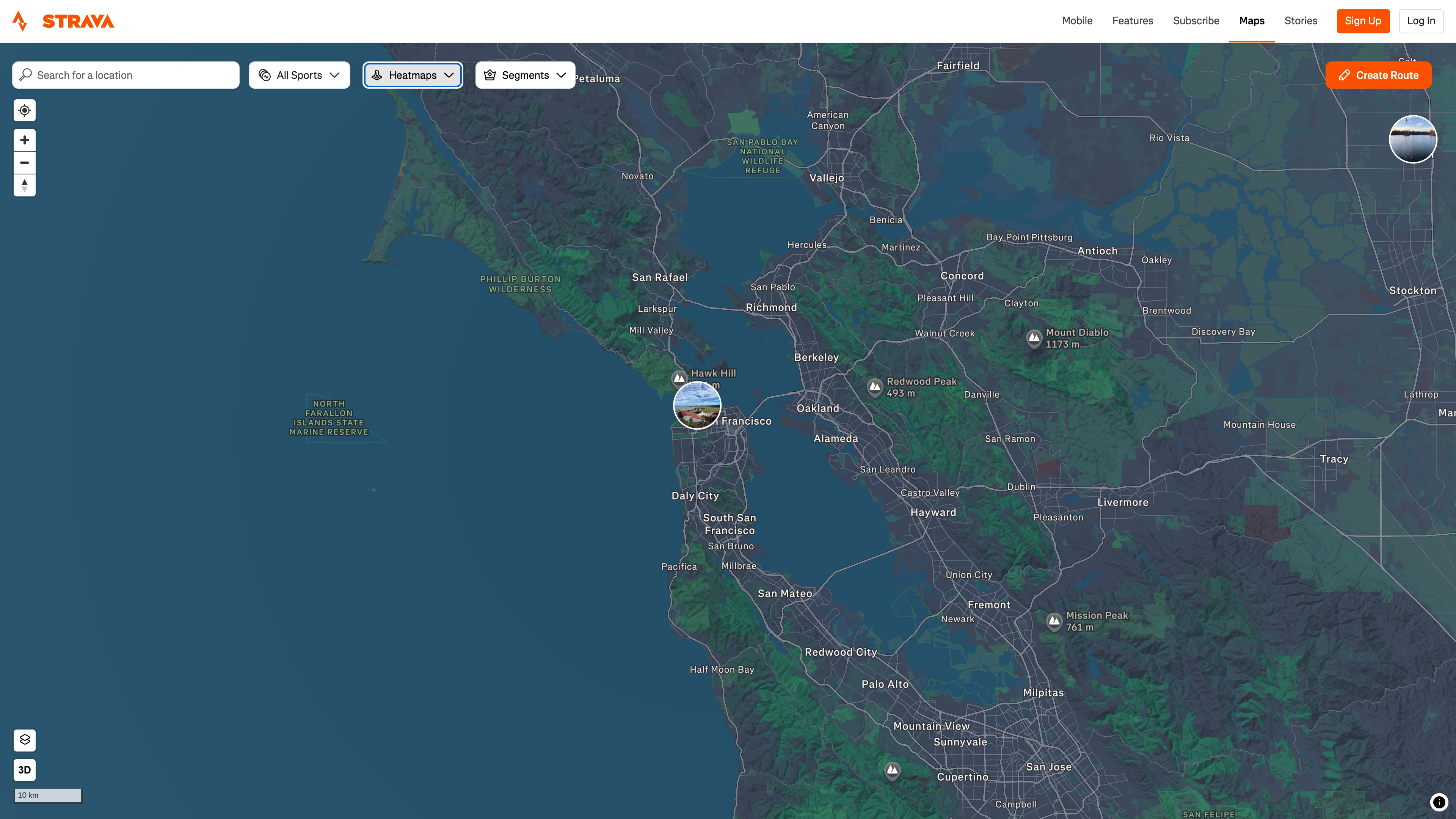
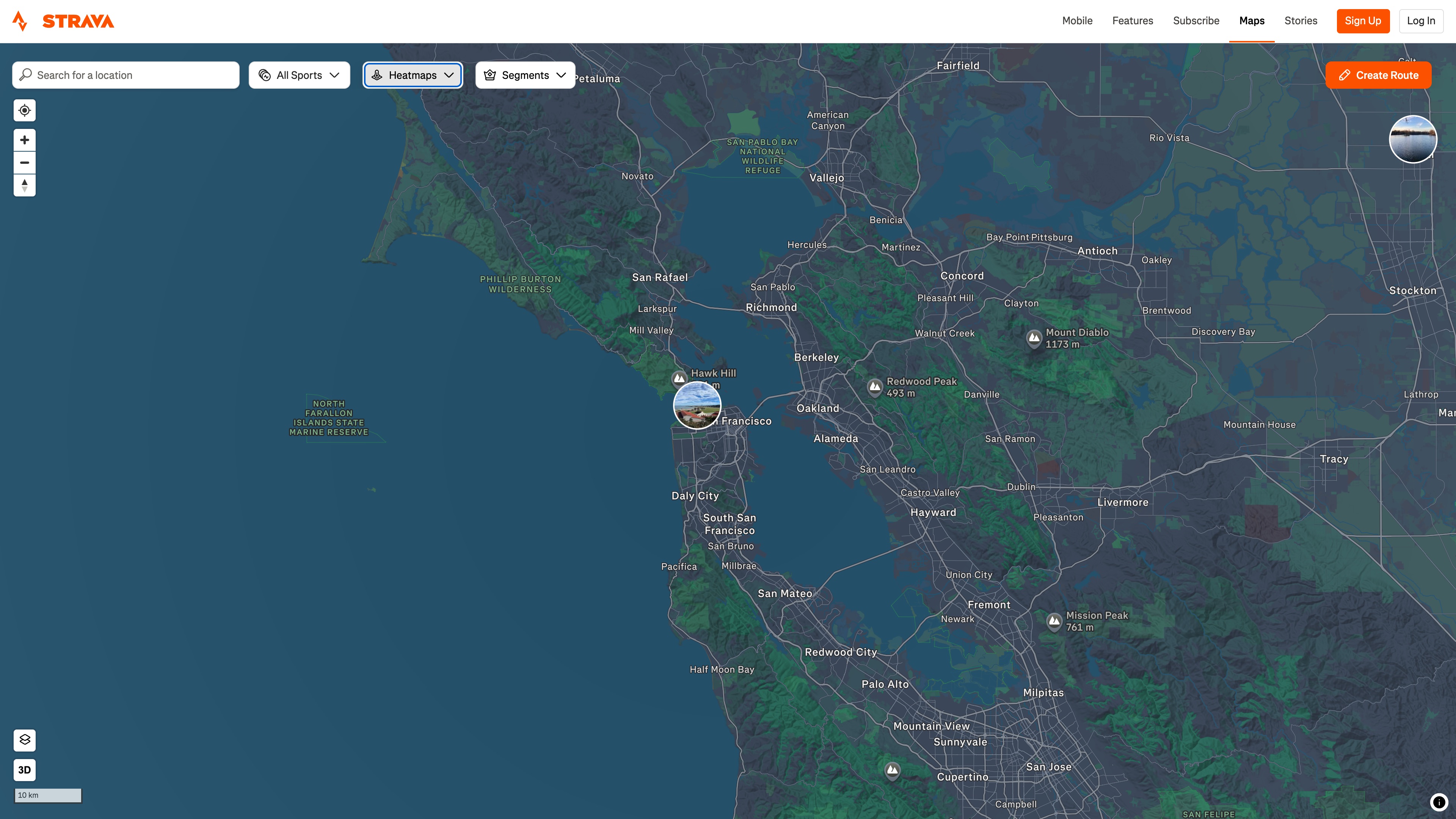
As of 2026-09-09, visiting the Global Heatmap page logged out shows the heat layer switched off by default — only the base map renders — behind a sign-up prompt, and the layers panel marks Global Heatmap with a "Subscriber feature" lock badge. Public access to Strava's aggregate data has visibly tightened.
Open platform
The Strava API is a public V3 REST interface — the same one the official mobile apps use — with OAuth 2.0 authorization. Per the developer documentation: the default rate limit is 200 requests per 15 minutes and 2,000 per day; new apps start in "single-player mode," where only the developer's own account can connect; a Strava subscription is required to create an app; and the API Agreement bars uses that replicate Strava's products or enable virtual races. Developers must also implement webhooks to learn when athletes deauthorize their app. An official directory lists thousands of third-party apps. In June 2026, Strava launched an MCP connector that lets subscribers query their own training history in natural language through Claude.
Good fits
- Runners and cyclists keeping a long-term training log across devices (watch, bike computer, phone).
- Athletes who want to compare times on shared segments and track personal progress on leaderboards.
- Visitors to unfamiliar areas planning runs or rides from community popularity and route suggestions.
- People who stay motivated through online challenges, clubs, and social accountability.
- Urban-planning and transportation researchers accessing cycling and walking volumes via Strava Metro.
Limitations
- Core features are paywalled: segment leaderboards, training analysis, and route planning — the most differentiating capabilities — all require a subscription. The free tier is closer to "recording plus social," and the paywall is steep for occasional lookups.
- Public-by-default privacy exposure: adult profiles and activities are visible to everyone unless changed, and home addresses or commute patterns can be inferred from traces. The security incidents since 2018 show the risk goes beyond individuals. Review privacy controls right after signing up.
- Leaderboard integrity depends on community policing: motorized vehicles, mislabeled e-bikes, and GPS manipulation persist; Strava itself relies on ML screening plus user flags to keep leaderboards fair.
- Nearly unusable logged out: most of the site requires an account, and as of 2026-09-09 even the Global Heatmap page does not show its data layer to visitors.
- Regional pricing gaps: subscriptions are priced per country, differences between markets are significant, and 2023 brought steep increases in many of them.
- Highly sensitive data: the platform combines precise location and health data and says it may use personal information to develop AI features; public segments and routes survive account deletion.
- Core-sport bias: sport types beyond riding, running, and swimming get limited analytical depth.
Alternatives
- Garmin Connect: Garmin's companion platform; recording and analysis are free, but its social and segment-competition culture is far weaker than Strava's.
- Komoot: stronger on outdoor route planning and navigation, monetized by unlocking map regions, with lighter social features.
- Nike Run Club: a fully free run tracker with training plans; running only, with no segment-leaderboard system.
References
- Strava homepage (checked 2026-09-09)
- Strava subscription page (feature comparison and pricing) (checked 2026-09-09)
- Strava Privacy Policy (checked 2026-09-09)
- Strava Global Heatmap (checked 2026-09-09, logged out)
- Strava press releases (checked 2026-09-09)
- Strava Stories (checked 2026-09-09)
- Supported Sport Types on Strava - official support (checked 2026-09-09)
- Segment Leaderboard Guidelines - official support (checked 2026-09-09)
- The Strava API - developer portal (checked 2026-09-09)
- Getting Started with the Strava API (checked 2026-09-09)
- Strava Metro (checked 2026-09-09)
- Strava - Wikipedia (checked 2026-09-09)
- Strava's latest update makes leaderboards a paid-for feature - Cyclingnews (checked 2026-09-09)