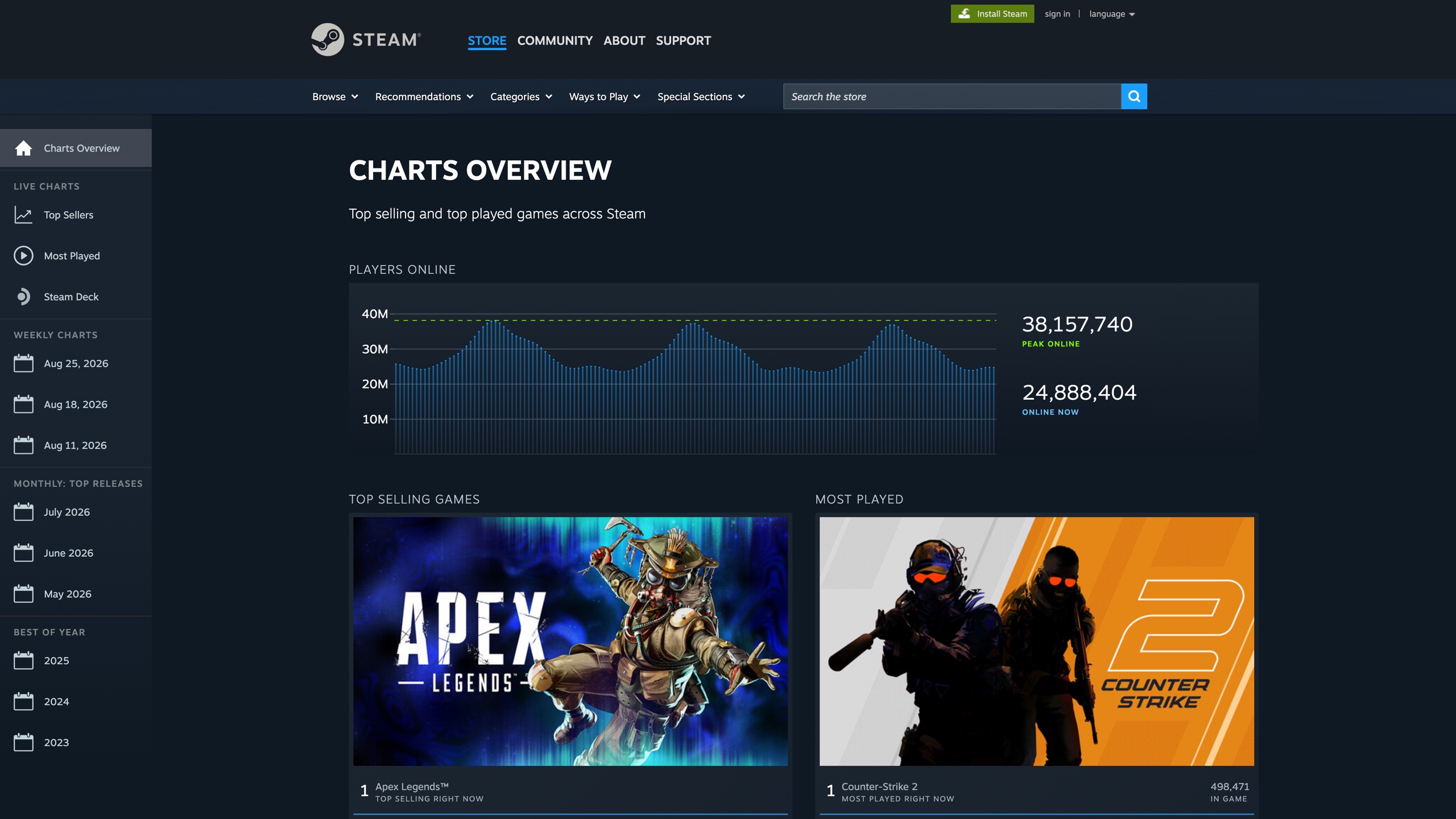
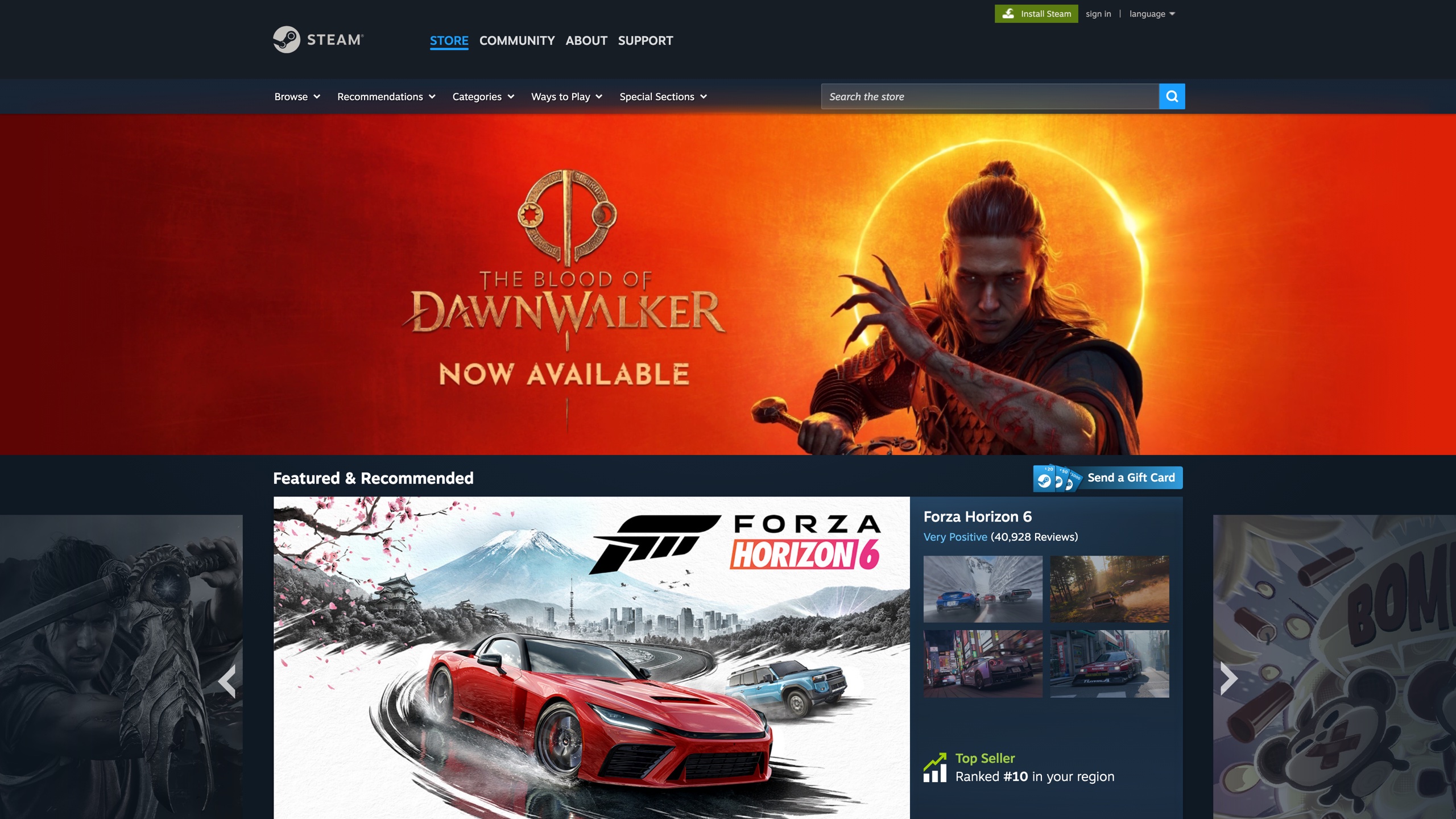
Steam (store.steampowered.com) is the PC game digital distribution platform launched by US game company Valve in 2003. It consists of a web store, a desktop client (Windows/macOS/Linux) and mobile apps: you can browse the store, read reviews and view community content without signing in, and purchases can be completed on the web or in the client, but downloading and running games requires the Steam client. It is the largest PC game distribution channel — Valve's official charts page showed roughly 25 million players online simultaneously at the time of checking (as of 2026-09-03). Beyond buying games, its reference value lies in the information available before a purchase: the user review system and its rating labels, the Steam Workshop, and a written refund policy are the standard toolkit for judging whether a game is worth your money.
At a Glance
- URL: https://store.steampowered.com/
- Type: PC game digital distribution platform (store + client + community)
- Cost: Free to browse and register; games are paid per title (with a large free-to-play catalog); no subscription tier
- Registration: No account needed to browse; purchasing, reviewing, Workshop and Market require an account (must be 13 or older); playing games requires the Steam client
- Languages: Client and web store support 28 languages, including Simplified and Traditional Chinese
Background
Valve says it created Steam in 2003 as a digital content distribution channel, "before app stores existed"; the exact launch date was September 12, 2003 (PCWorld's coverage of Steam's 20th anniversary, secondary source). Steam initially distributed updates for Valve's own games, opened to third-party publishers in 2005, and gradually added community features, the Workshop and the Market. In June 2017 Valve shut down Steam Greenlight — where community votes decided which games could launch — and replaced it with Steam Direct (secondary source): developers now pay a US$100 fee per product they distribute. The fee is non-refundable but recoupable once a product reaches US$1,000 in adjusted gross revenue.
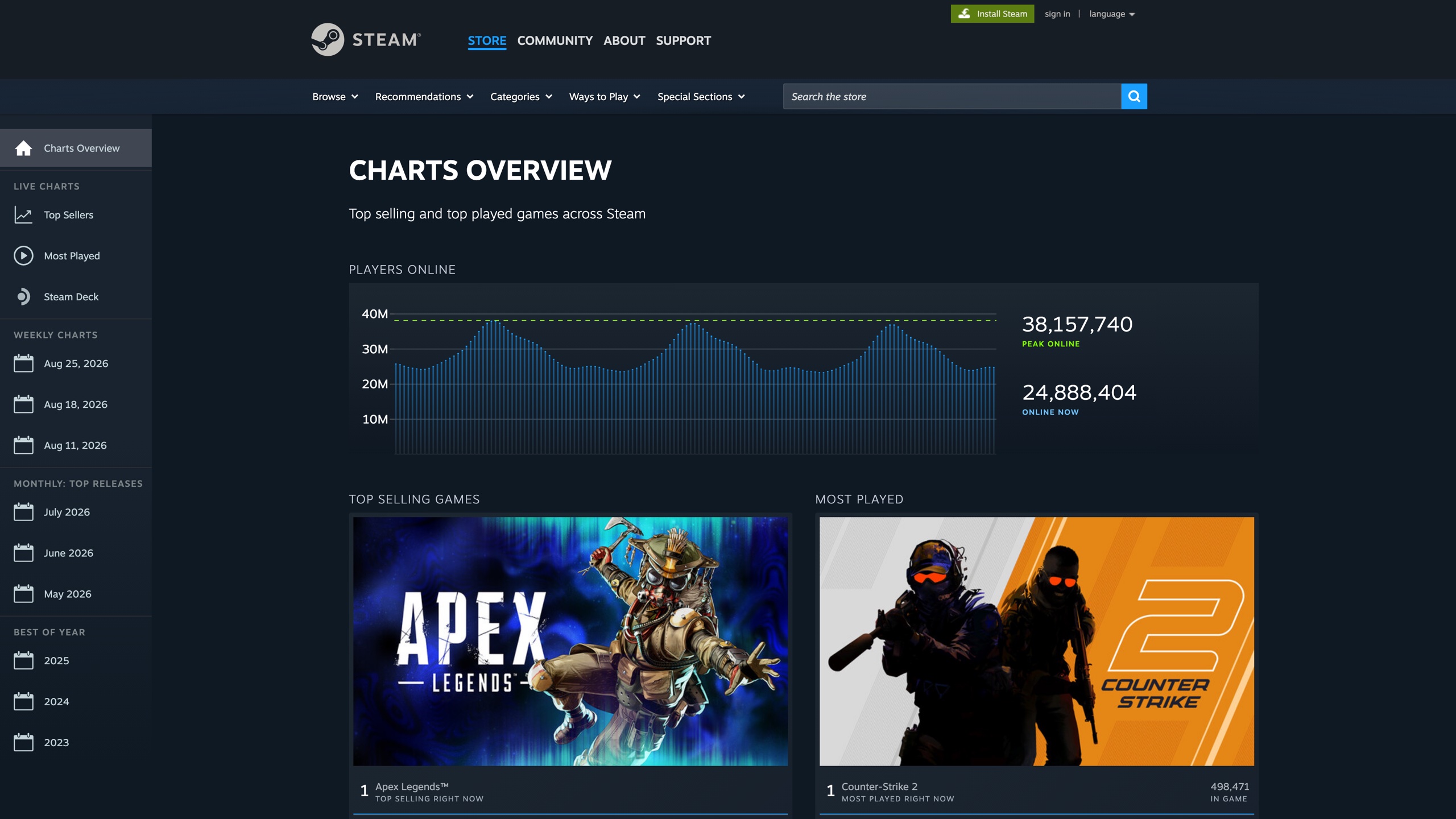
On scale, the official About page cites "nearly 30,000 games," "over 100 million potential friends" in the community, and 100+ payment methods — though the games figure has not been updated in years and the real catalog is clearly larger. More current figures come from the official charts page: as of 2026-09-03, its "PLAYERS ONLINE" panel showed about 25 million players online, with a recent window peak around 38 million.
Pricing, Sales and Purchasing
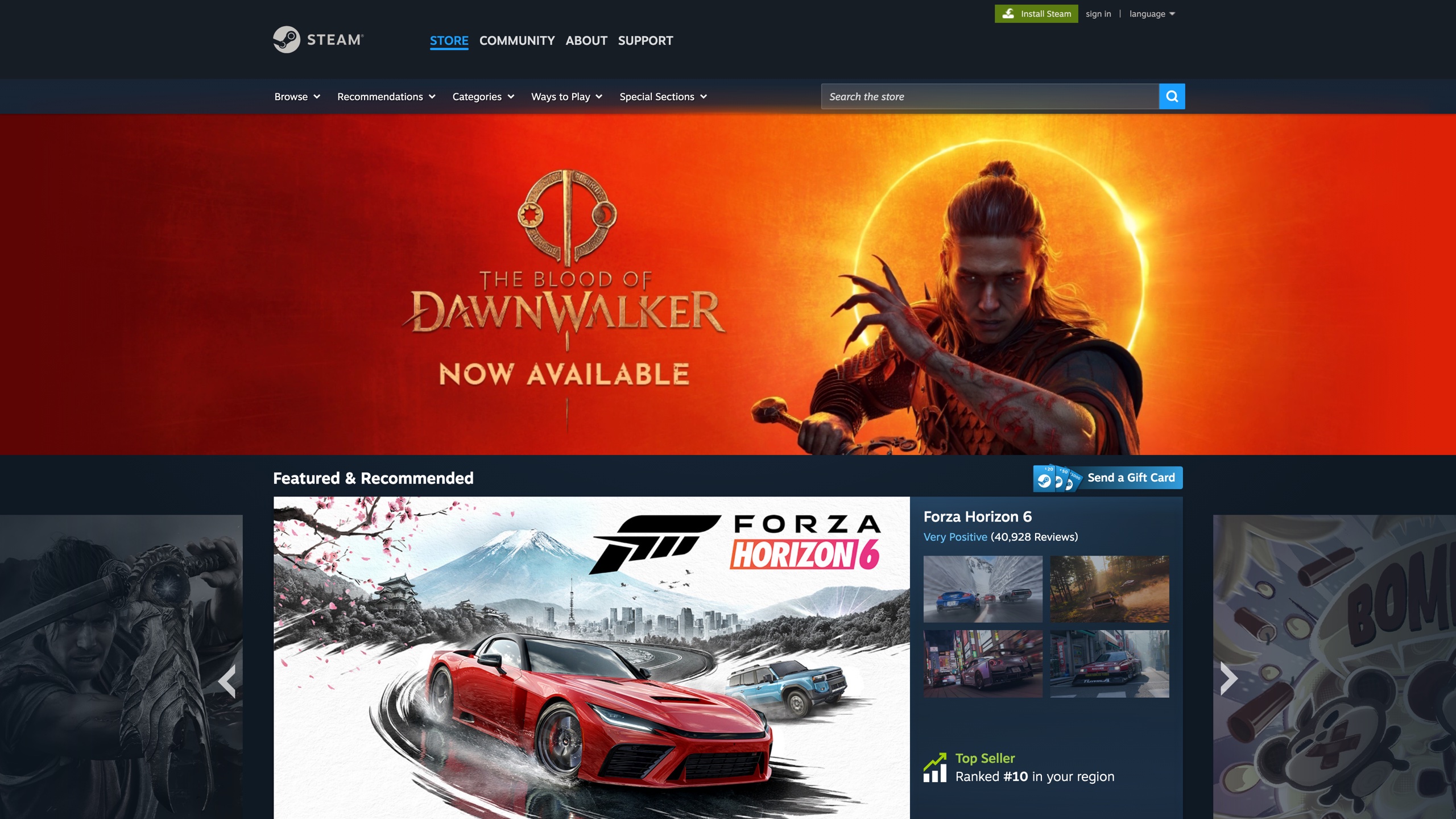
Store browsing works fully without an account; in our test, anonymous visitors see prices in their region's local currency. Prices are set by publishers: Valve's pricing documentation states that Steam supports 37 currencies across 4 region groups, with exchange-rate and purchasing-power conversion tools available — but final pricing decisions rest with publishers, so the same game can be priced differently across regions. Note that the Steam Subscriber Agreement explicitly forbids using proxies to disguise your location to obtain another region's pricing; violations can lead to account termination.
Discounts follow a highly regular rhythm: Valve's events schedule shows four platform-wide seasonal sales per year — as of 2026-09-03, the next two announced are the Autumn Sale (October 1–8, 2026) and the Winter Sale (December 17, 2026 – January 4, 2027) — plus year-round themed "Fests" and the triannual Steam Next Fest demo event (next: October 19–26, 2026). Games cannot be discounted within 30 days of release, and a price increase triggers a 30-day discount cooldown. For buyers, wishlisting games (login required) and waiting for a seasonal sale is the standard playbook.
The User Review System
Steam's user reviews are the most-used reference before buying. Key mechanics, per the official documentation:
- Any account with recorded playtime can leave a "Recommended" or "Not Recommended" review. The store page aggregates these into two scores — last 30 days and lifetime — each with a positive-percentage and a label.
- What counts: only reviews from accounts that purchased the game directly on Steam count toward the score. Reviews written after activating a third-party key, playing a free weekend, or using Family Sharing are visible but excluded.
- Reviews written during Early Access are flagged as such; pre-release reviews carry a "Pre-Release Review" mark; players who received the game for free can disclose it.
- For "review bombing" (sudden floods of one-sided reviews), Steam identifies anomalous periods and buckets them; reviews judged off-topic are excluded from the score.
- There are nine summary labels from "Overwhelmingly Negative" to "Overwhelmingly Positive" (e.g. "Very Positive," "Mostly Positive," "Mixed"). Valve does not publish the exact thresholds; third-party reconstructions put "Overwhelmingly Positive" at ≥95% positive with 500+ reviews, "Very Positive" at ≥80% with 50+, and "Mixed" at 40–69% — treat these figures as unofficial approximations.
- The documentation also notes that a score of "Mixed" (40%) or above does not affect algorithmic store visibility, while dipping below 40% reduces featuring. Developers may not solicit positive reviews, offer rewards for reviews, or delete negative ones; they can only flag reviews or post public responses.
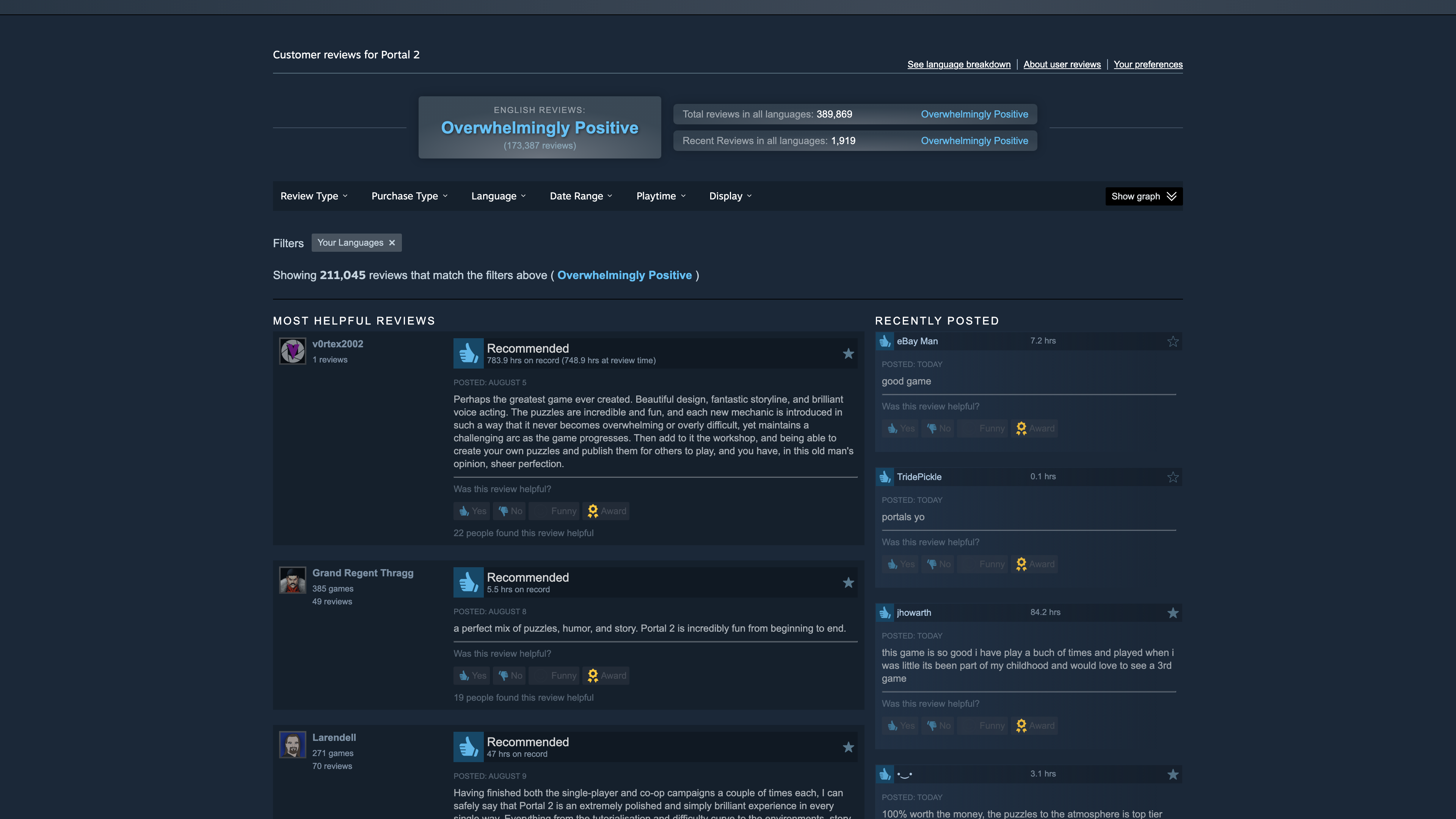
Observed example: the store page for Valve's own Portal 2 (as of 2026-09-03) shows 389,869 reviews across all languages and 1,919 in the last 30 days, both rated "Overwhelmingly Positive."
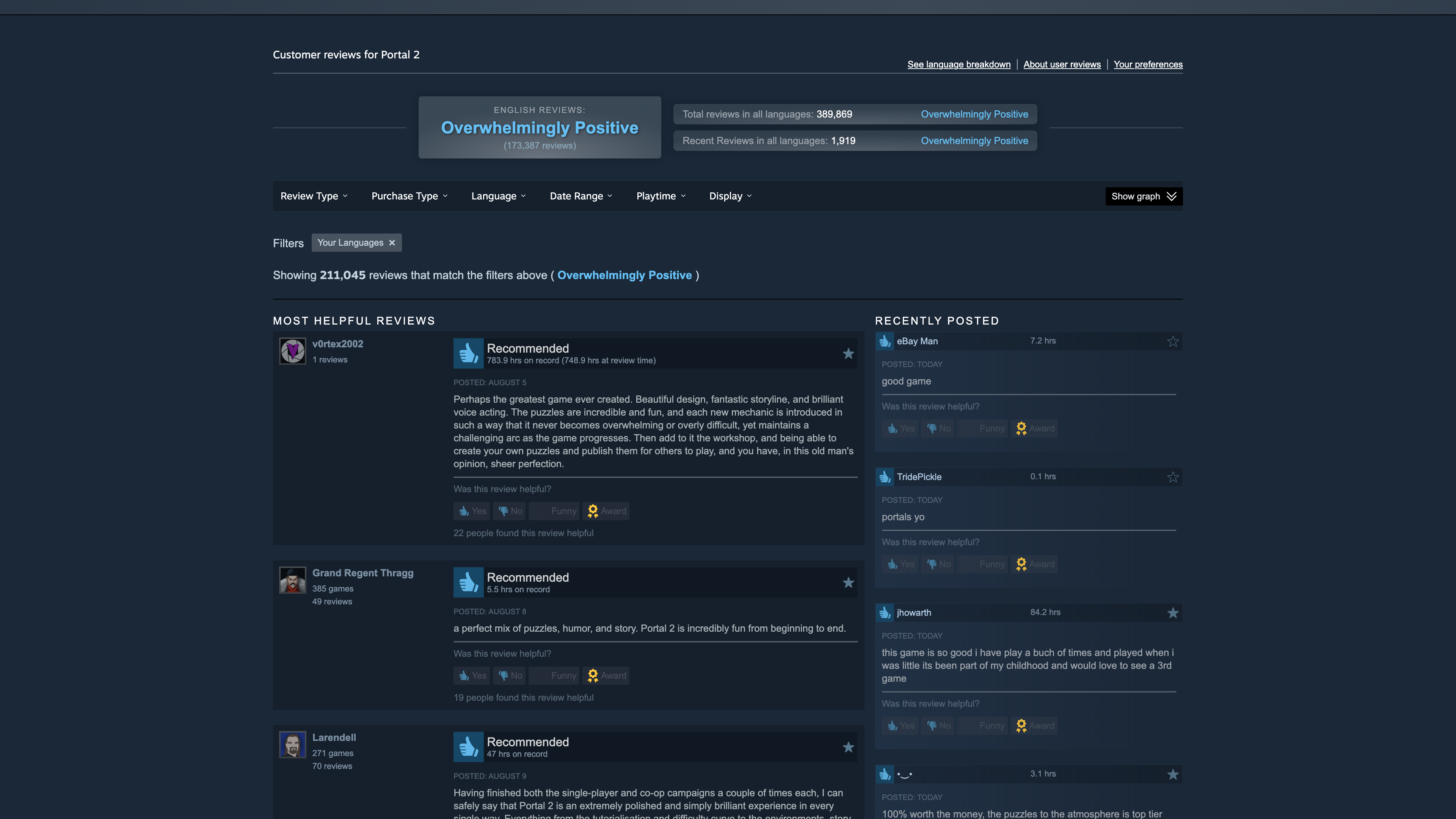
The review section can be filtered by language, purchase type, playtime and date range, with an optional histogram showing review volume over time — useful for spotting whether an older game's recent reception has soured.
Workshop, Community and Market
Steam Workshop is the platform's official channel for player-created content. Per the About page, nearly 1,000 games support it; the developer documentation describes two models — "ready-to-use" (players upload, others subscribe in one click, and the client downloads and keeps items updated) and "curated" (developers select items into the game) — with sales, revenue sharing and tax handling managed by the platform for paid items. For players, the Workshop is why many older games stay alive: mods, maps and cosmetics install with one click.
The Steam Community Market lets players trade items such as trading cards and in-game cosmetics with each other. The official Market FAQ states a 5% Steam transaction fee (minimum US$0.01, paid by the buyer) plus a game-specific fee set by the publisher (10% for Valve's own games). Under the Subscriber Agreement, market items are license rights rather than personal property, and Steam Wallet funds cannot be withdrawn or transferred.
The surrounding community features — groups, discussion hubs, guides, screenshots and live broadcasts (Steam Broadcast) — are all visible on the web, and the official charts page publishes live top sellers, most-played games, monthly top releases and annual roundups, a useful public window into what the platform is actually playing.
Refund Policy
Steam has a written refund policy (page last updated April 23, 2024; checked 2026-09-03):
- Games and software: refundable for any reason within 14 days of purchase and under 2 hours of playtime; requests outside these bounds can still be submitted and are reviewed case by case.
- DLC: refundable within 14 days, provided the base game has been played under 2 hours since the DLC purchase and the DLC has not been consumed, modified or transferred.
- In-game purchases: refundable within 48 hours for Valve-developed games (item unconsumed); third-party developers may opt in, and the store tells you at purchase time.
- Pre-orders and Early Access: pre-orders that are not yet playable can be refunded any time before release; Early Access playtime counts toward the 2-hour limit, and the 14-day window starts on the release date.
- Exceptions: games on which you are VAC-banned are not refundable; video content is not refundable; CD keys bought outside Steam are not covered.
- Approved refunds arrive within a week via the original payment method or Steam Wallet. The policy warns that abuse can forfeit refund eligibility — while explicitly noting that refunding a game bought just before a sale and rebuying it at the discount price is not considered abuse.
Accounts and Open Capabilities
Registration is free; purchases, cloud saves, Workshop subscriptions and the Market are all tied to the account. The legal nature of purchases deserves attention: the Subscriber Agreement states plainly that "Content and Services are licensed, not sold" — you buy a personal, non-commercial license, and the agreement notes you may be required to run the Steam client and maintain an internet connection. This is the contractual basis of Steam's role as a DRM layer, and some publishers stack their own account or launcher requirements on top.
For Linux players, Valve open-sourced Proton, a Wine-based compatibility layer that runs Windows games on Linux; its Steam Deck handheld runs the Linux-based SteamOS and ships with the Deck Verified program, which labels every tested game as Verified, Playable, Unsupported or Unknown right on store and library pages. Developers get an HTTP-based Steamworks Web API for news, player data, reviews and more.
Copyright and Content Policy
Games in the store remain the property of their publishers; Steam is the distribution channel. For user-generated content (reviews, screenshots, Workshop items), Section 6 of the Subscriber Agreement grants Valve a worldwide, non-exclusive license to use uploads for operating and promoting Steam. Workshop authors may take their items down at any time, but copies already obtained by other users or accepted into a game are unaffected. The agreement also states that Valve does not pre-screen third-party content, and a separate set of review guidelines bans personal attacks, commercial promotion and score manipulation, with violating reviews subject to removal. Reporting and moderation exist, but at this scale community content still requires your own judgment.
Good For
- PC players buying, downloading and managing a game library, with cloud saves, family sharing and achievements.
- Pre-purchase research: positive percentages, recent-review trends and "most helpful" reviews reveal a game's current state — especially for live-service titles.
- Deal hunting via the wishlist plus four seasonal sales a year, with the refund policy lowering the cost of trying something new.
- Mod players subscribing to Workshop content; item traders using the Community Market.
- Linux and Steam Deck users checking compatibility through Proton and Deck Verified labels.
- Developers publishing PC games via Steam Direct (US$100 per title, recoupable).
Limitations
- The client is mandatory for play: the web side only covers browsing, purchasing and community — there is no playing in the browser, and some titles require an online check-in.
- Licenses, not ownership: the agreement is explicit; access can be affected if an account is banned or content is removed.
- A tight refund window: two hours of playtime is often too short for slow-burn games, and third-party in-game purchases are non-refundable by default.
- Regional price differences: the same game may cost more in your region, and using a VPN to buy from a cheaper region violates the agreement and risks the account.
- Review-score scope: scores only count direct Steam purchases, so sentiment from third-party key buyers is invisible; the rating-label thresholds have no official documentation, and third-party figures are approximations.
- UGC risks: the Market and Workshop are not pre-screened; scam links and policy-violating content exist, so trade carefully.
- Stale official figures: the About page's "nearly 30,000 games" has not been updated in years — check the date before quoting.
- A separate China edition: the Valve–Perfect World partnership operates a distinct domestic platform, Steam China (蒸汽平台) (IGN China report, secondary source), with a far smaller catalog than the international version.
Alternatives
- GOG: CD Projekt's store, differentiated by DRM-free releases (offline installers that don't depend on a client) — a fit for players who care about license restrictions.
- Epic Games Store: Epic's store, built around exclusives and recurring free-game giveaways.
- itch.io: an open storefront for independent developers, with many small games playable directly in the browser and no upfront publishing fee.
References
- Steam store homepage (checked 2026-09-03)
- Steam - The Ultimate Online Game Platform (About) (checked 2026-09-03)
- About Valve (checked 2026-09-03)
- Steam Charts (official) (checked 2026-09-03)
- Steam Refunds (official policy) (checked 2026-09-03)
- Steam Subscriber Agreement (checked 2026-09-03)
- Steam Direct Fee (Steamworks docs) (checked 2026-09-03)
- User Reviews (Steamworks docs) (checked 2026-09-03)
- Steam Workshop (Steamworks docs) (checked 2026-09-03)
- Pricing (Steamworks docs) (checked 2026-09-03)
- Upcoming Events (sale schedule) (checked 2026-09-03)
- Community Market FAQ (checked 2026-09-03)
- Steam Deck / Deck Verified (checked 2026-09-03)
- ValveSoftware/Proton (GitHub) (checked 2026-09-03)
- PCWorld: Steam turns 20 (checked 2026-09-03)
- Polygon: Steam Direct replaces Greenlight (checked 2026-09-03)