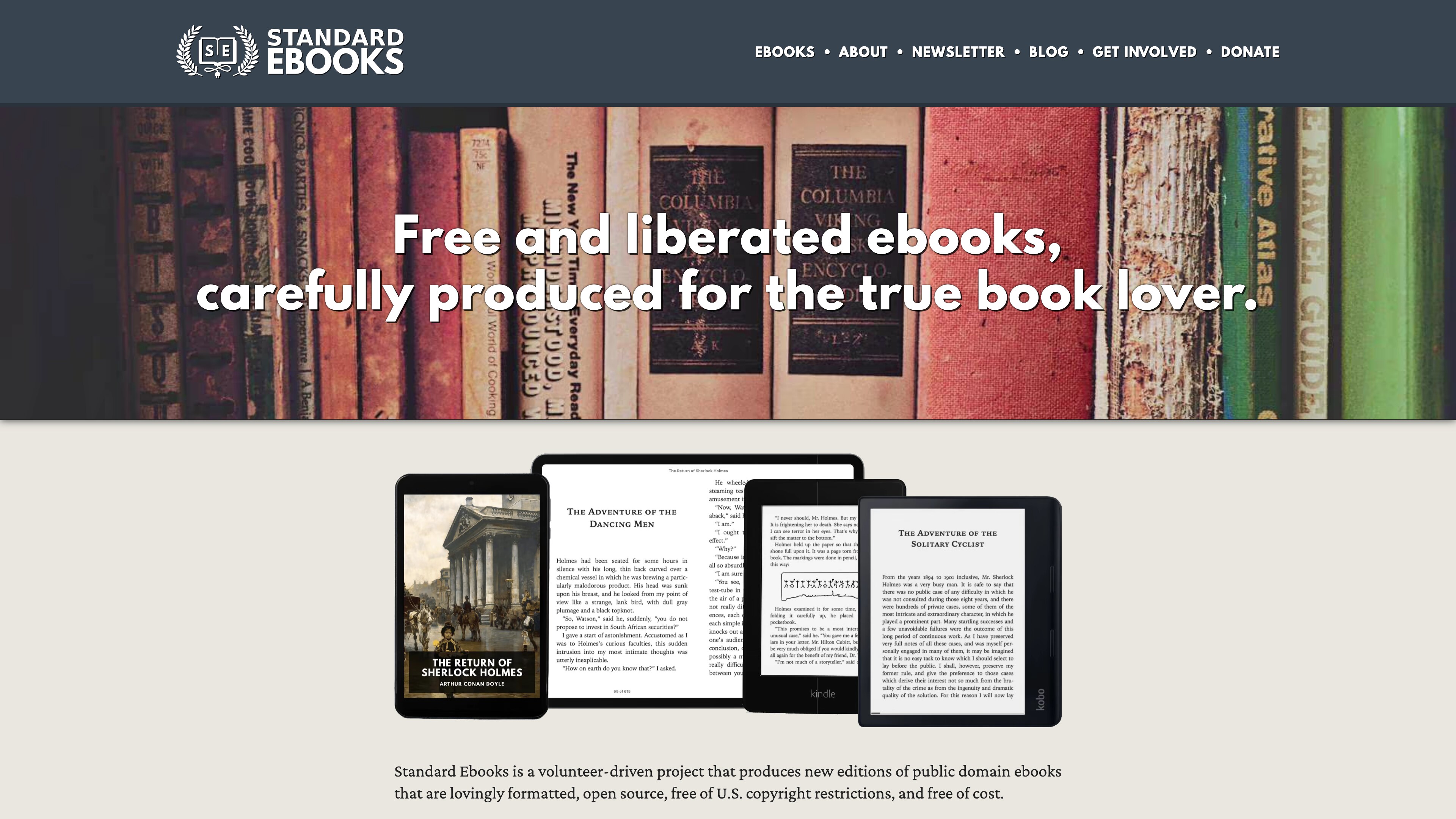
Standard Ebooks is a volunteer-driven project that produces new editions of public domain ebooks. It takes transcriptions from sources like Project Gutenberg, the Internet Archive, and Wikisource, retypesets them against a rigorous, publicly documented style manual, proofreads the full text against scans of the original pages, and adds covers designed from public domain fine art. The result is a catalog of classic literature whose quality is meant to match or exceed commercially produced ebooks, downloadable for free in epub, azw3, and kepub formats. What sets it apart from transcription projects is how far the openness goes: the volunteers' own typesetting, markup, and cover design are given up as well, so each complete ebook file is released into the public domain, and every book's production history lives in a public Git repository. The site launched in 2015, and as of 2026-09-02 the catalog holds more than 1,500 titles.
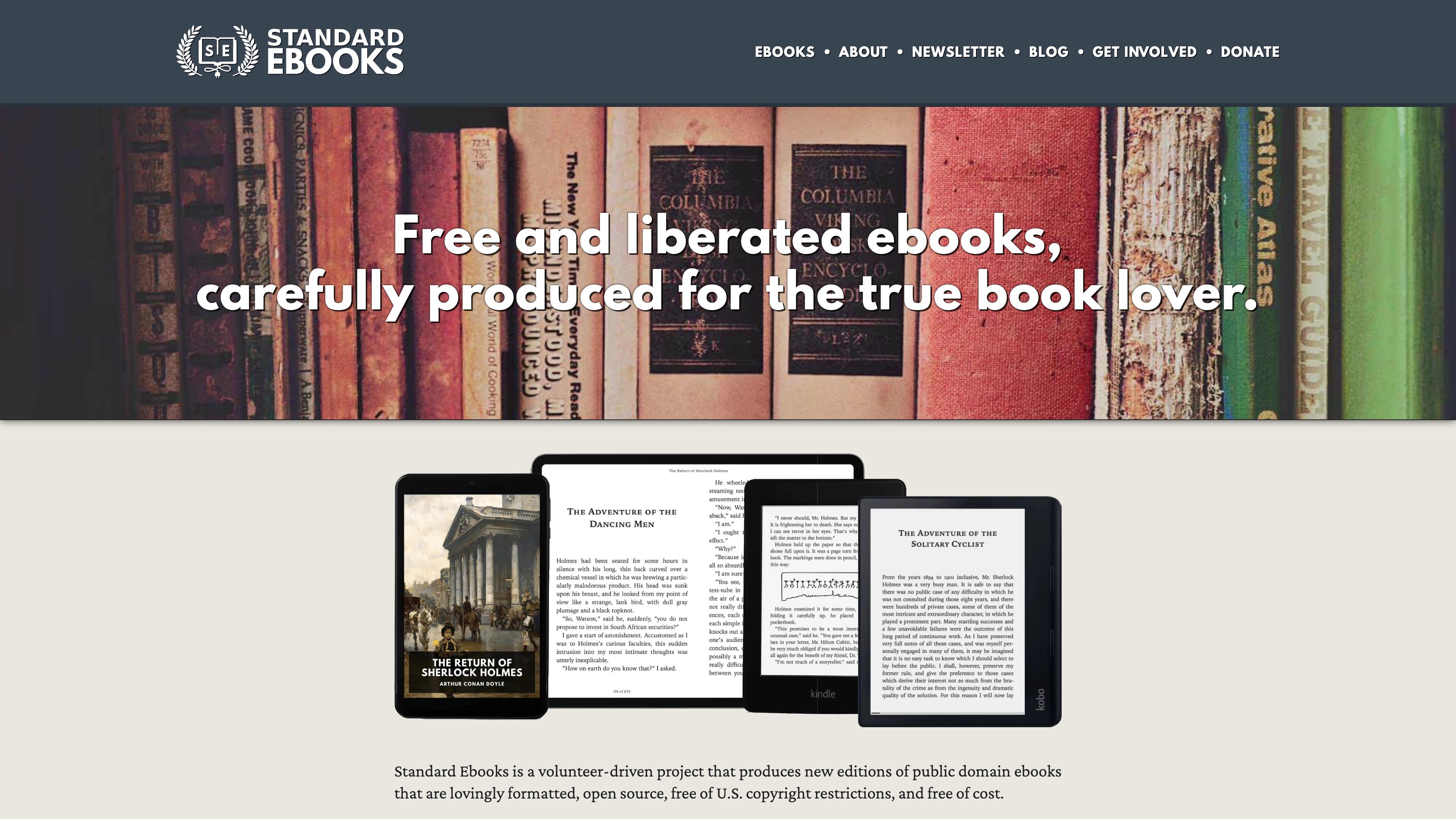
The homepage (above) carries the tagline "Free and liberated ebooks, carefully produced for the true book lover," with mockups showing the same carefully produced edition on phones, tablets, Kindles, and Kobos. "Free and liberated" points to the two things the project promises at once: no cost, and no copyright restrictions on its own work.
At a glance
- URL: https://standardebooks.org/
- Type: Public domain ebook catalog, produced collaboratively by volunteers
- Cost: Free, no DRM; reader donations are the project's only source of income
- Registration: None required for browsing, downloading, or reading online
- Catalog language: English (original English works and translations into English)
- Launched: 2015
- Operator: Standard Ebooks L3C, a U.S. "low-profit limited liability company" that combines a charitable mission with an LLC structure
Background
Standard Ebooks was founded by Alex Cabal. According to its Wikipedia entry, Cabal grew frustrated with the poor formatting of available English-language ebooks while living in Germany, first experimented with a pay-what-you-want edition of Alice's Adventures in Wonderland, and then launched the Standard Ebooks website in 2015. Early attention came from posts on Hacker News and Reddit.
The project is organized as an L3C (low-profit LLC) and states that donations from readers are its only income. Cabal serves as Editor-in-Chief, and "Editor" is an honorary title granted to volunteers with an exceptional track record of producing and reviewing ebooks. In May 2024, the project published its 1,000th title: James Joyce's Ulysses.
How the books are made
Projects like Project Gutenberg transcribe public domain books and aim for the widest possible device compatibility; Standard Ebooks builds on those transcriptions and does the finishing work:
- A unified style manual: Every ebook follows the public Standard Ebooks Manual of Style—curly quotes, correct en- and em-dashes, modernized archaic spellings—plus modern ereader features like hyphenation, popup footnotes, scalable vector graphics, and ereader-friendly tables of contents. (Source: project homepage)
- Full proofreading: Before release, each ebook gets a complete readthrough checked against scans of the original pages. Submitting corrections to the upstream transcription sources is often difficult, so their typos tend to persist—this step exists to fix them.
- A Git workflow: Each book has its own GitHub repository with a fully public change history, and anyone can submit corrections. Every book page ends with "A brief history of this ebook," a changelog of its revisions. As of 2026-09-02, the project's tools repository has 1,661 stars, with its most recent commit on 2026-08-31.
- Fine-art covers: Covers are individually selected and designed from public domain paintings, rather than left for the ereader to generate.
- Rich metadata and accessibility: Ebooks carry original blurbs, encyclopedia links, and Schema.org accessibility feature declarations; the project states that its ebooks and website conform to WCAG 2.2 level AA and EPUB Accessibility 1.1. (Source: Accessibility)
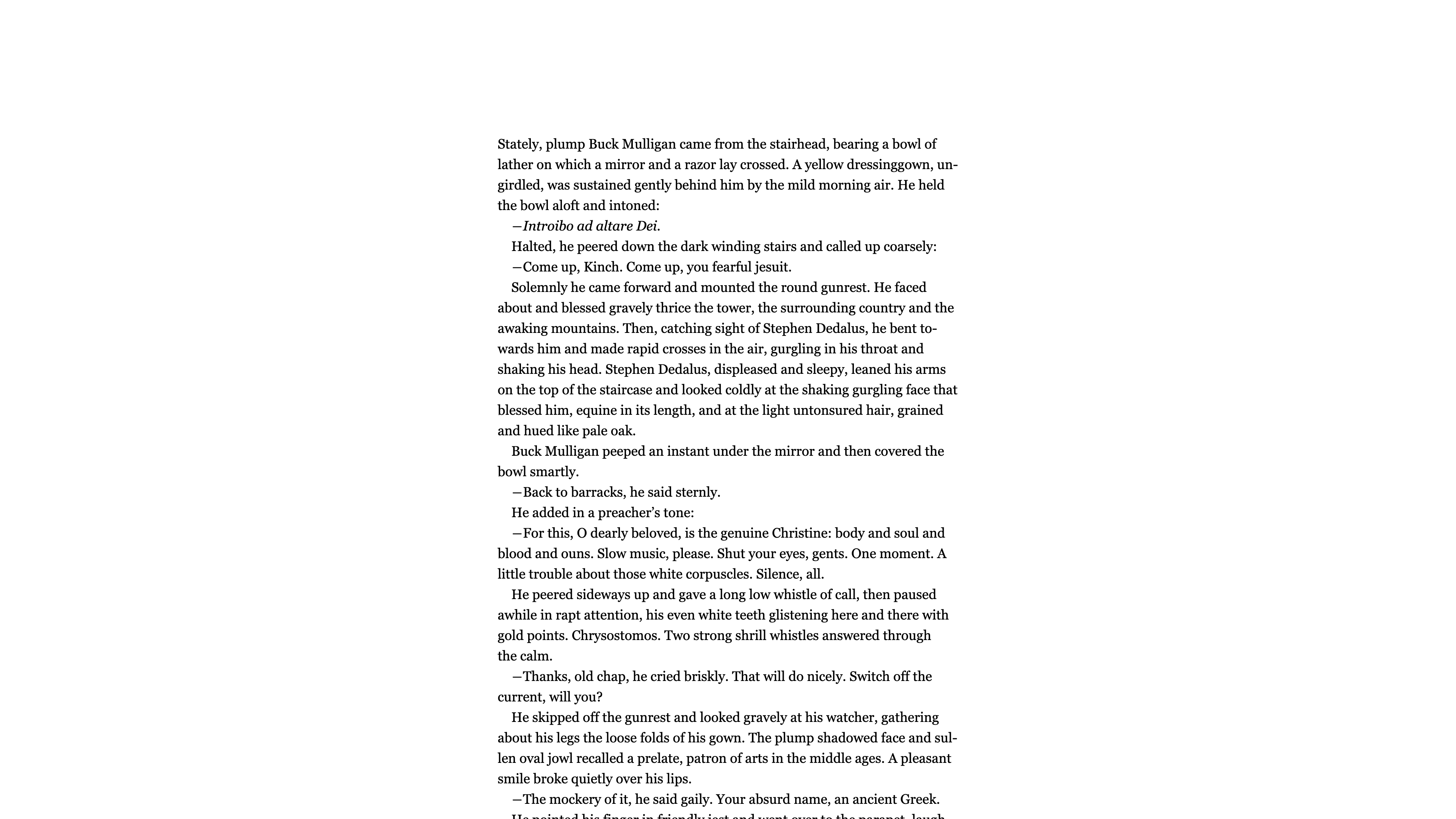
The screenshot above shows chapter one of Ulysses in the site's online reader, where the typesetting is easy to judge directly: a centered measure, serif body text, and properly styled italics and dialogue dashes. Every book can be read online starting from its table of contents or as a single-page edition, with no download required.
Catalog size and browsing
As of 2026-09-02, the catalog contains more than 1,500 titles: Wikipedia recorded 1,502 books on 2026-08-19, and the GitHub organization held 1,513 book source repositories as of 2026-09-02 (including a small number of in-progress productions).
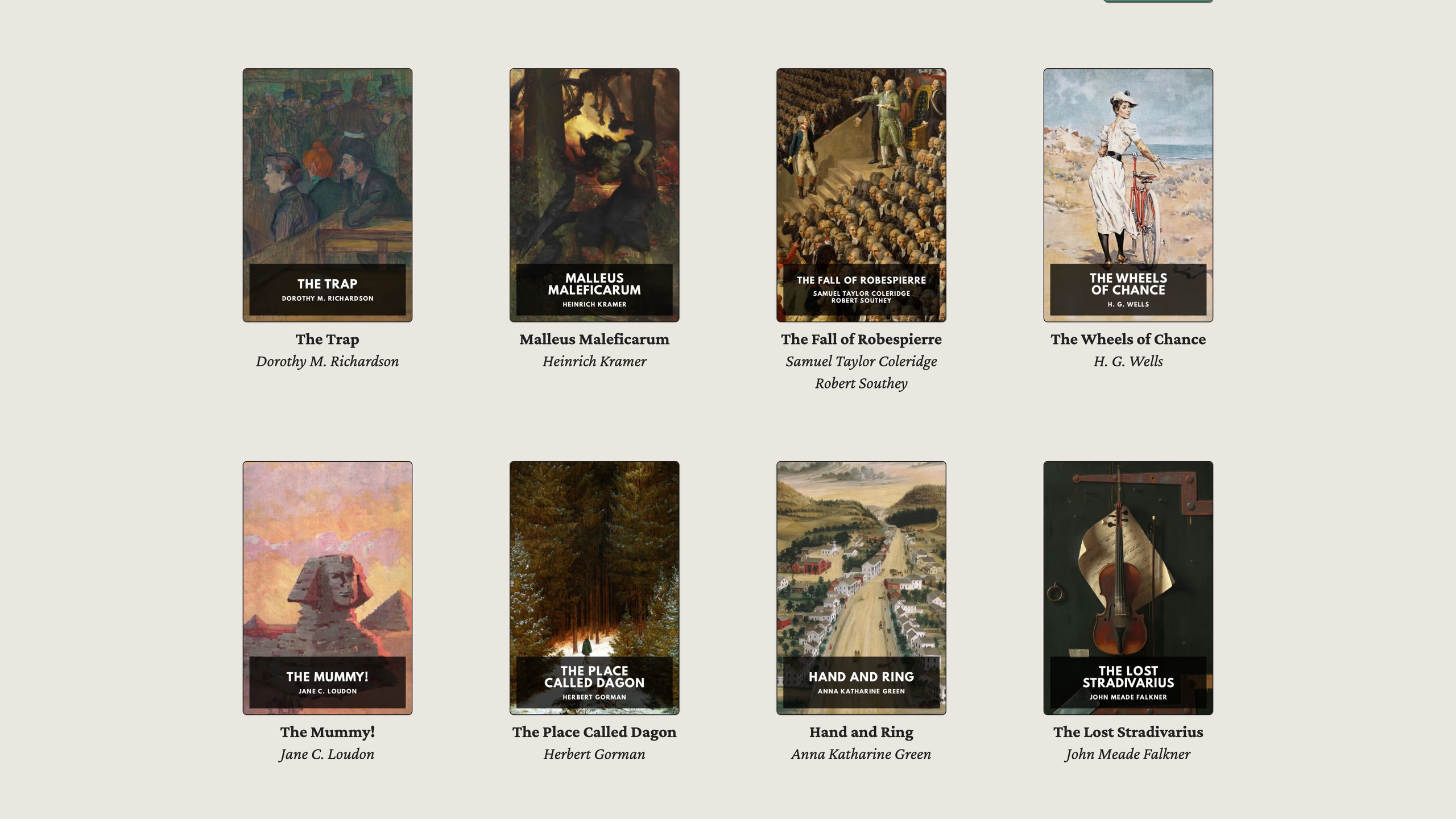
The browse page (above) filters by subject (Adventure, Biography, Drama, and so on), supports keyword search, and sorts by release date. Each book appears as its fine-art cover with title and author. The project also maintains collections—sets like the Modern Library's 100 Best Novels or the Guardian's best-novels lists—and book pages note where a title ranks in each set.
Formats and open feeds
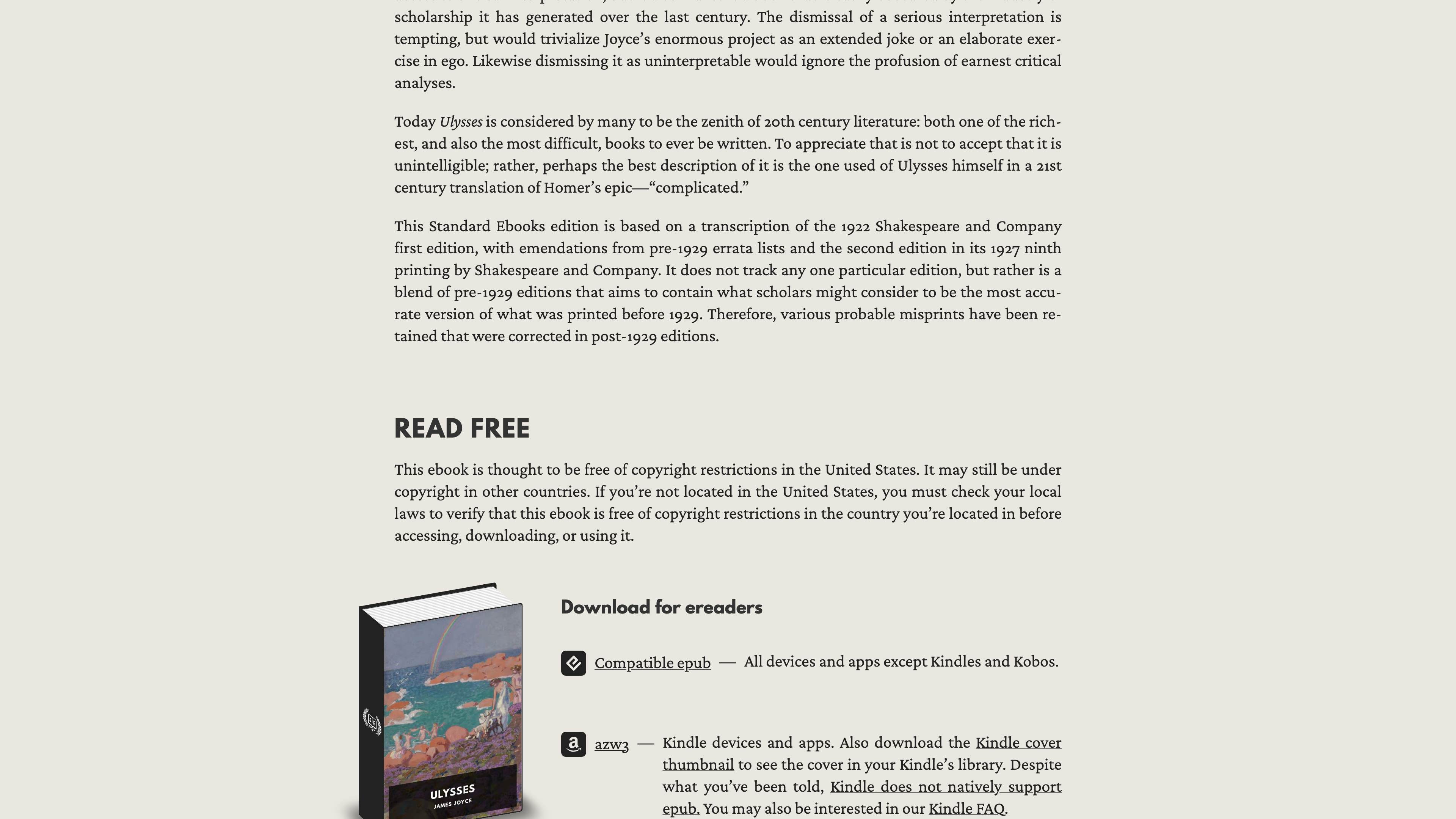
Each book page offers four formats (shown above):
- Compatible epub — all devices and apps except Kindles and Kobos;
- azw3 — Kindle devices and apps, with a separate Kindle cover thumbnail;
- kepub — Kobo devices and apps;
- Advanced epub — a format using newer technology not yet fully supported by most ereaders.
Beyond the website, the catalog is also distributed through Google Play Books and Apple Books (source: Wikipedia). For developers and heavy readers, Standard Ebooks provides an OPDS catalog feed at https://standardebooks.org/feeds/opds (send an Accept: application/opds+json header for OPDS 2.0), which many reading apps can use to search and download directly. The new-releases RSS/Atom feeds are open to everyone, while access to the full catalog feeds is a benefit of the Patrons Circle donor program—volunteers who have produced an ebook for the project receive lifetime feed access.
Copyright and collections policy
Standard Ebooks only produces works that have entered the U.S. public domain, which generally means published before January 1, 1931, with some exceptions. Cover art likewise comes from art believed to be in the U.S. public domain. The project keeps no rights in its own contributions: its policy statement dedicates each ebook file in its entirety—markup, cover design, and everything in between—to the public domain (corresponding to CC0 1.0). The production toolset is released under GPLv3 (with templates under CC0), and the website code under CC0.
U.S. public domain status does not automatically extend elsewhere: every download page warns readers outside the United States to verify the work's copyright status in their own country first. The project also maintains a detailed collections policy: English-language books only (translations into English are welcome); a single "best" edition per work; no illustration-dependent books, modern religious texts, modern self-published public domain releases, or "complete works" omnibuses; and decorative illustrations that are not essential to the work are removed during production.
Good for
- Reading classic literature on a Kindle, Kobo, or other ereader without putting up with sloppy formatting
- Finding clean, semantic ebook source files as a base for your own productions
- Plugging a public domain catalog directly into a reading app via OPDS
- Contributing proofreading, typesetting, or cover-art cataloging to a digital preservation effort
Limitations
- English-only catalog: The collections policy excludes non-English originals, so the catalog serves English readers only.
- U.S. public domain scope: The vast majority of titles were published before 1931; nothing modern is included, and non-U.S. readers must check local copyright status themselves.
- No reader accounts: There are no bookshelves, reading-progress sync, or personalization features, and the full OPDS catalog feed requires a donation or a completed ebook production.
- Decorative illustrations are removed: Readers who value a book's original illustrated form may prefer the page scans on the Internet Archive.
Alternatives
- Project Gutenberg: Standard Ebooks' main transcription source, broader in volume and formats, with plainer formatting.
- Internet Archive / Open Library: Page scans of original editions and controlled digital lending, useful for checking editions and illustrations.
- Wikisource: A wiki-based proofreading platform for public domain texts in many languages, and another of Standard Ebooks' transcription sources.
Sources
- Standard Ebooks homepage (project mission and features, checked 2026-09-02)
- About (L3C structure, donation model, editorial team, checked 2026-09-02)
- Standard Ebooks and the public domain (public domain dedication, checked 2026-09-02)
- Accessibility (WCAG 2.2 AA and EPUB Accessibility 1.1, checked 2026-09-02)
- Ebook feeds (OPDS and RSS/Atom feeds, Patrons Circle benefits, checked 2026-09-02)
- Collections policy (scope and exclusions, checked 2026-09-02)
- Ulysses book page (four download formats, copyright notice, changelog, checked 2026-09-02)
- Wikipedia: Standard Ebooks (founding story, 2015 launch, 1,000th title Ulysses, catalog of 1,502 books as of 2026-08-19, Google Play Books and Apple Books distribution, checked 2026-09-02)
- GitHub: standardebooks (1,518 public repositories, tools repo with 1,661 stars under GPLv3, checked 2026-09-02)