Stack Overflow is a professional question-and-answer site for programmers: developers post concrete programming questions, the community votes the best answers to the top, and the asker marks one as "accepted." It is not a forum — there is no chit-chat, only a searchable archive of questions and answers. As of 2026-09-02, the site holds 24.14 million questions and 36 million answers and serves as the flagship of the Stack Exchange Q&A network; all user content is licensed under CC BY-SA for free reuse.
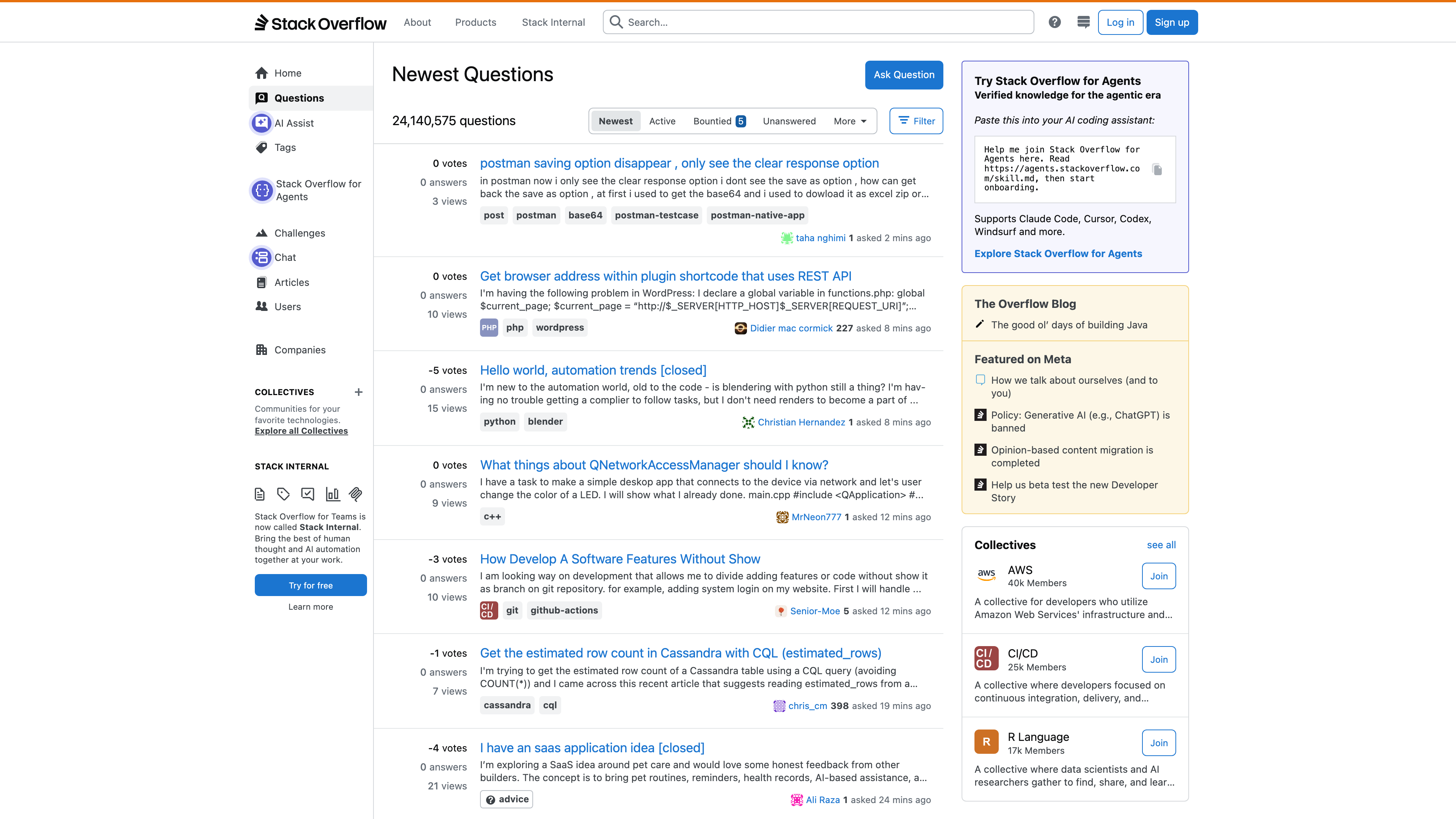
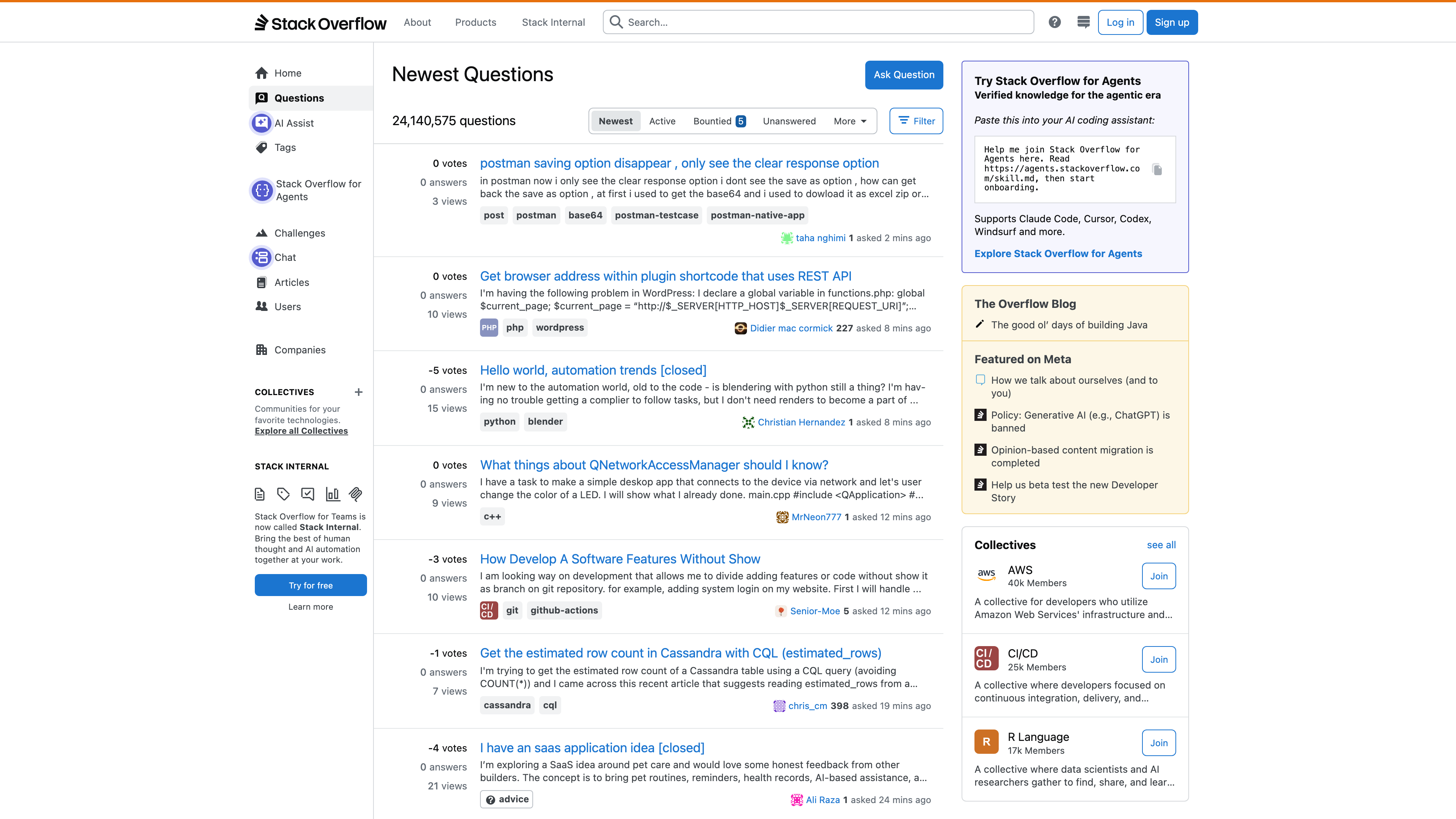
The logged-out homepage is the newest-questions feed: navigation on the left (Questions, Tags, AI Assist, and more), a list showing each question's votes, answer count, and tags in the middle, and the total question count at the top (24,140,575 at capture time). Reading the entire archive requires no registration.
At a glance
- URL: https://stackoverflow.com/
- Type: Programming Q&A community (UGC)
- Cost: Free (with paid enterprise products such as Stack Internal)
- Registration: Not required for reading; a free account is needed to ask, answer, or vote
- Interface language: English; separate sites exist in Portuguese, Spanish, Russian, and Japanese
- Launched: September 15, 2008
- Operated by: Stack Exchange Inc., a Prosus company since 2021
Background
Stack Overflow was created in 2008 by two well-known technology bloggers — Jeff Atwood of Coding Horror and Joel Spolsky of Joel on Software. The name was picked by a reader vote, a private beta began on July 31, 2008, and the site opened to the public on September 15, 2008. Its founding motivation was to build a more open alternative to Experts-Exchange, which at the time charged for access and restricted answers. (Source: the Stack Overflow Wikipedia article)
On June 2, 2021, Stack Overflow's official blog announced its acquisition by Prosus, a Netherlands-based technology investment group, for $1.8 billion; the company continues to operate independently.
How the Q&A mechanics work
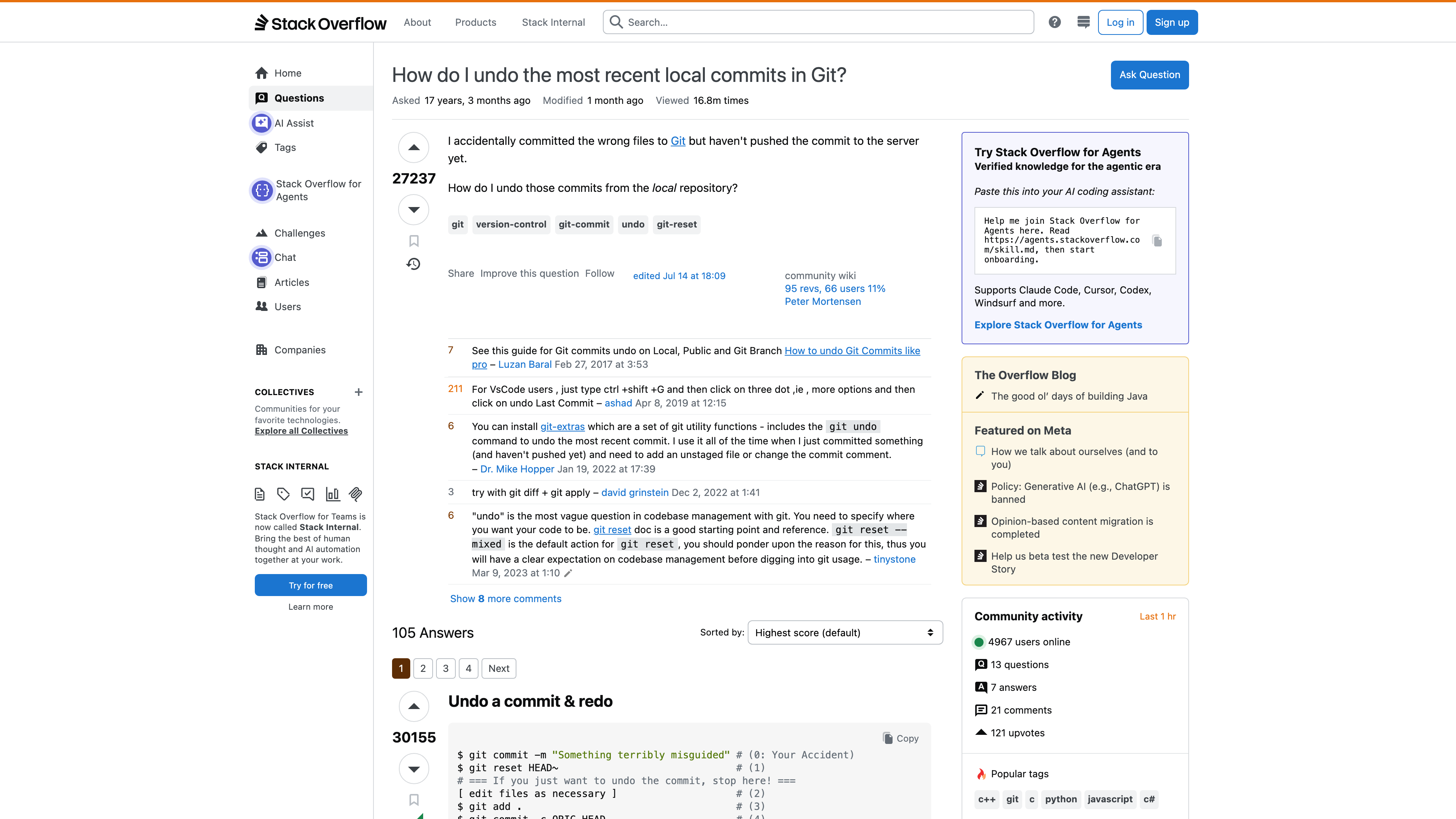
The image above shows one of the site's highest-voted questions, "How do I undo the most recent local commits in Git?": the cumulative vote count sits to the left of the question (27,237 at capture time), 105 answers follow ranked by score, and the asker has marked an "accepted" answer. This vote-ranked, accepted-answer structure keeps the best answers on top and is the core design that sets the site apart from forums (official Tour).
- Reputation and badges: an upvote on a question or answer earns 10 reputation points; reputation progressively unlocks community-moderation privileges such as editing, reviewing, and closing questions, while badges reward specific contributions. This gamification is the main lever behind content quality.
- Community editing: questions and answers can be improved wiki-style by other users, with a public edit history.
- Tags: every question is categorized with tags, and the tag directory ranks technologies by question volume.
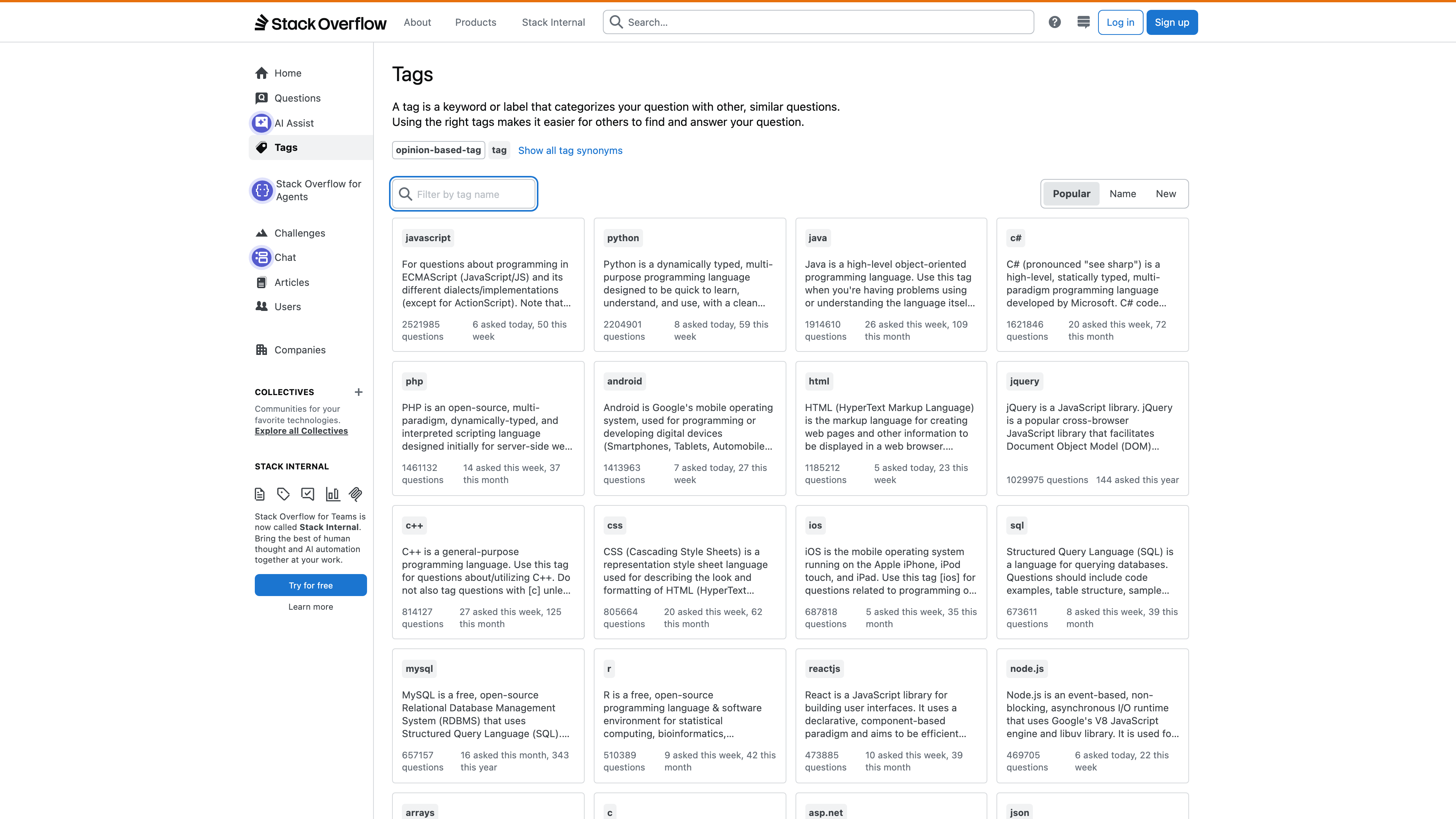
The tags page shows the scale of each topic — as of 2026-09-02, javascript has about 2.52 million questions and python about 2.2 million; browsing by tag is an effective way to find a field's classic Q&As.
Scale and the Stack Exchange network
As of 2026-09-02, Stack Overflow has 24.14 million questions, 36 million answers, and 32 million registered users, with about 70% of questions having received an answer (Stack Exchange site directory). The same network hosts 183 topic-specific Q&A sites covering areas beyond programming — mathematics, system administration (Server Fault), the English language, science fiction, and more. One account works across all sites, while reputation is tracked per site.
Changes in the AI era
New-question volume on Stack Overflow peaked at about 200,000 per month in 2014 and has declined ever since; between December 2024 and December 2025 the number of new questions fell by 78%, a drop attributed to competition from generative AI tools and a moderation culture some perceive as hostile (the Stack Overflow Wikipedia article).
The company's responses include AI Assist and Stack Overflow for Agents for AI coding assistants, a Stack Data Licensing business that packages the archive as AI training data, and the renaming of its enterprise knowledge product from Stack Overflow for Teams to Stack Internal. For readers, the archived questions remain a searchable programming knowledge base, even though new-question activity sits well below its peak.
Copyright and content policy
All user contributions are licensed by submission date under CC BY-SA 2.5 (before 2011-04-08), CC BY-SA 3.0 (until 2018-05-02), and CC BY-SA 4.0 (after). Anyone may therefore copy and reuse the site's questions and answers — including for AI training — as long as they give attribution and share under the same terms. The company also offers a public API and periodic data exports.
Good for
- Looking up concrete programming problems such as error messages and API usage (search engines usually surface the site's answers directly)
- Reading a technology's classic Q&As ranked by tag and score to learn its common pitfalls
- Building a public technical track record by answering questions (reputation and badges are visible to employers)
- Asking non-programming questions on the other Stack Exchange network sites
Limitations
- The main site is English-only in interface and content; Chinese-language questions need other communities.
- New-question activity has fallen sharply, and some older answers target outdated framework versions — check timestamps and edit histories.
- Strict community rules: duplicate, overly broad, or opinion-based questions get closed, and the first-time asking experience is often criticized.
- A high vote count is not an authority certification; answers can still be wrong or outdated, so cross-check them.
Alternatives
- Stack Exchange site directory: the other topic-specific Q&A sites in the same network (including Super User and Server Fault).
- SegmentFault: a Chinese-language developer Q&A community.
- Quora: a general-purpose Q&A community with different mechanics and focus.
References
- Stack Overflow Tour (official mechanics explainer, checked 2026-09-02)
- Stack Exchange site directory (question/answer/user counts and the 183 sites)
- Stack Overflow Help: What is the license for the content I post? (CC BY-SA versions)
- Stack Overflow Blog: Prosus's acquisition announcement (June 2, 2021, $1.8B)
- Joel on Software: Stack Overflow Launches (public launch, September 15, 2008)
- Stack Overflow (Wikipedia article) (founding, reputation mechanics, AI-era traffic changes)
- devclass: Dramatic drop in Stack Overflow questions as devs look elsewhere for help (78% decline in new questions from Dec 2024 to Dec 2025)