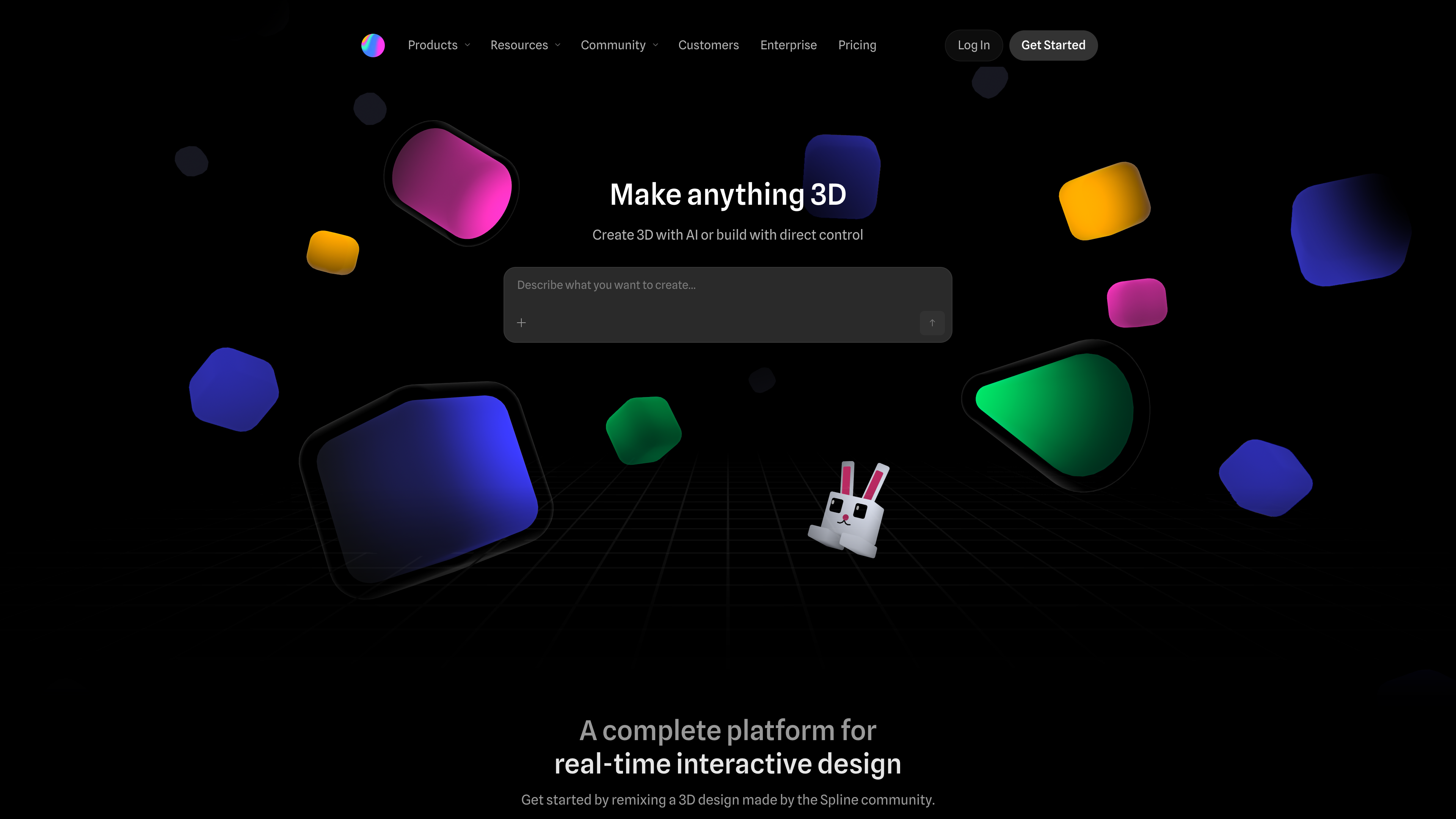
Spline (spline.design) is a 3D design platform run by US-based Spline, Inc. Its core is a collaborative 3D editor that runs entirely in the browser: modeling, materials, lighting, animation, and interactivity all happen live on the web, files live in the cloud, and several people can edit the same scene at once. The problem it targets is a specific one — traditional 3D software such as Blender or Cinema 4D is built for offline rendering and film/game assets, with a steep learning curve, while interactive 3D for websites and apps used to require a game engine or hand-written Three.js. Spline's verifiable difference is that its output is the interactive product itself, not a render: a scene can be published as a public URL, a web embed, a React component, or a native iOS/Android embed. The August 2026 "Spline v2" release rebuilt the editor on WebGPU and added an AI agent that works inside the scene. Per an official press release from March 2026, the company says more than 3 million designers use the platform.
At a glance
- URL: https://spline.design/
- Type: Browser-based collaborative 3D/2D design tool with a publishing pipeline (plus the AI product Omma and the experimental model Spell)
- Cost: Free tier available; paid plans Hobby/Pro/Max from $12/25/60 per seat per month (billed annually), Enterprise custom — official pricing as of 2026-09-12
- Sign-up: Website, docs, and community pages are public; the editor requires an account (the free tier allows a limited number of personal files). Users must be 18+, or 13–17 with a parent or guardian's consent and supervision (Terms)
- Interface language: English only (no official language options observed on the site, docs, or editor as of 2026-09-12)
- Launched: Founded 2020; public beta March 2022
Background
Spline was founded in 2020 by Alejandro León, a lifelong 3D designer who remains CEO; co-founder Caroline Mack is COO (March 2026 press release). The company went through Y Combinator's Winter 2021 batch and opened its public beta in March 2022. The legal entity is Spline, Inc., a Delaware corporation (Terms); current company communications describe it as based in San Francisco.
Funding and scale milestones:
- July 2023: a $15M seed round led by Google's Gradient Ventures, with First Round Capital, Y Combinator, and the CEOs of Vercel and Webflow among participants, bringing total funding to $16M; TechCrunch reported over 1 million creators at the time.
- August 2024: a $10M Series A led by Third Point Ventures, whose partner Dan Moskowitz joined the board; the same announcement brought Android support and stated the community had designed more than 7 million scenes.
- March 2026: the company reports more than 3 million designers, with teams at Google, Datadog, Robinhood, and UPS among its users.
The product cadence shows the shifting direction: Spline AI (alpha) in March 2023, Apple ecosystem support in December 2023, Android in August 2024, the experimental 3D world model Spell in January 2025, the 2D interactive canvas Hana in April 2025, the standalone AI product Omma in March 2026, and the WebGPU-rebuilt Spline v2 in August 2026 (company blog).
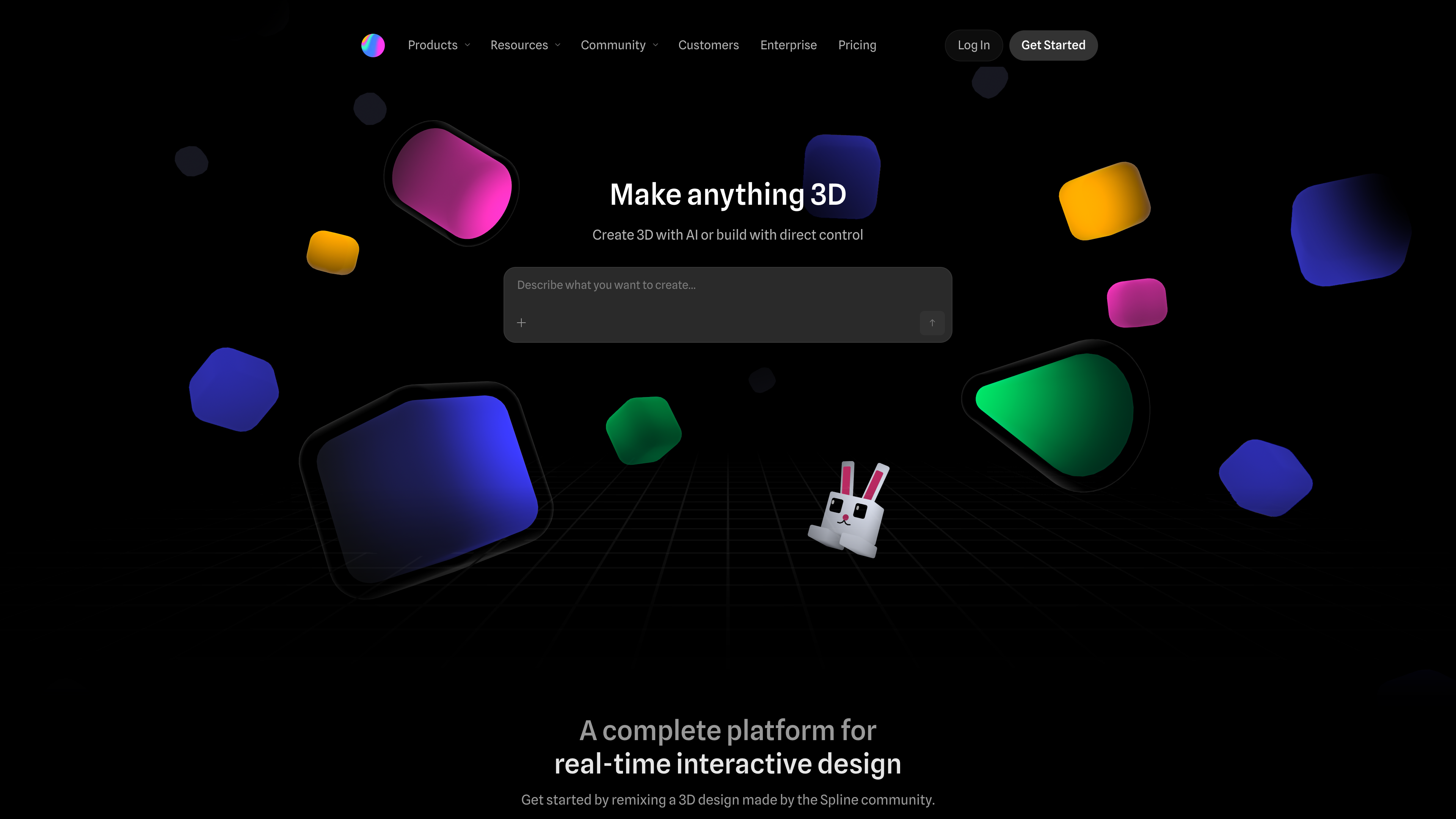
The homepage above sums up the current pitch. The navigation leads with Products, Community, Pricing, and Enterprise; the hero is a live-rendered 3D scene, and the prompt field under "Create 3D with AI or build with direct control" frames the two entry points the product now sells — generate with AI, or keep full manual control.
Core capabilities: an interactive 3D editor in the browser
The 3D editor covers the full path from modeling to publishing (official docs):
- Modeling and materials: parametric primitives, booleans, sculpting, and — new in the 2026 v2 — a hair system and a bevel/chamfer tool. Materials are built as a vertical stack of layers (color, gradients, noise, glass, reflection), which Spline describes as closer to a graphic design tool than a traditional shader graph. v2 added full PBR, an HDR pipeline, and physical skies.
- Real-time rendering: scenes render live with no offline render step; since August 2026 the renderer runs on WebGPU by default with automatic WebGL fallback.
- Interactivity and motion: interactions are assembled from states, events, and actions — mouse, keyboard, scroll, collision, drag-and-drop, and game controls can all act as triggers — alongside timeline animation, physics, and particles.
- Data and code: variables bind a scene to real data, and API requests, webhooks, and a real-time API let scenes react to external sources. A file can also carry its own HTML/CSS/JS (the Code tab) with an injected spline API for game logic and custom UI.
- Collaboration: real-time multi-user editing, comments, and version history; Spline describes itself as "multiplayer from the ground up," much as Figma rethought 2D design.
- Hana, the 2D canvas: a second editor (launched April 2025) for interactive interfaces and motion design — infinite canvas, vector networks, auto layout, glass and 3D projection effects — sharing the same interactivity model and publishing pipeline as the 3D editor.
Publishing and exports: built for the web and mobile
Exports are where Spline's divergence from traditional 3D software is most concrete (export docs):
- Web: a hosted public URL, an embeddable Spline Viewer snippet, or code export (Vanilla JS, Three.js, React, Next.js, react-three-fiber). Note that animations and events only work in the Vanilla JS and React exports. Scenes embed directly into Framer, Webflow, Notion, and similar tools.
- Apple platforms: native 3D embeds for SwiftUI (iOS/iPadOS/macOS/visionOS), generated pre-built Xcode projects, and Vision Pro preview via Spline Mirror.
- Android: native Kotlin embeds plus direct APK/AAB builds — which the company described in 2024 as the first way to design interactive 3D for Android without a game engine.
- Files: glTF/GLB, USDZ, STL (3D printing), PNG/JPG, WebM/MP4, and image sequences. Imports cover OBJ, FBX (with animation and rigs), GLTF/GLB, STL, SVG (partial), MP4, MP3/WAV, and 3D Gaussian splats.
Beyond the browser, a rebuilt desktop app (macOS/Windows, 2026) adds real tabs and built-in MCP support. Plan gating matters here: Apple/Android exports, multiple scenes per file, and video export require Pro or above, while self-hosted exports and code-export downloads are Enterprise features.
Where the AI features stand
As of 2026-09-12, Spline's AI comes in four layers, all designed so results remain fully editable by hand:
- The in-editor AI agent (introduced in the August 2026 v2): a sidebar agent that takes natural-language instructions and drives the editor's own tools — objects, materials, lights, animation, and event-based interactivity — where every step is a normal, undoable edit you can take over. An MCP server lets external clients such as Claude Code, Cursor, and ChatGPT drive the editor the same way.
- AI 3D Generation: text or image to 3D model. A prompt first produces a set of preview images, then builds the mesh from the one you pick; generation engines include Hunyuan3D (default), Hunyuan 3.1 Pro, Trellis 2, and Meshy (docs). Spline itself cautions that generated meshes are heavier than hand-built ones and can slow a scene down.
- AI Textures and Hana's image tools: text-prompt texture generation (up to 2048×2048), plus image generation, background removal, and upscaling in Hana.
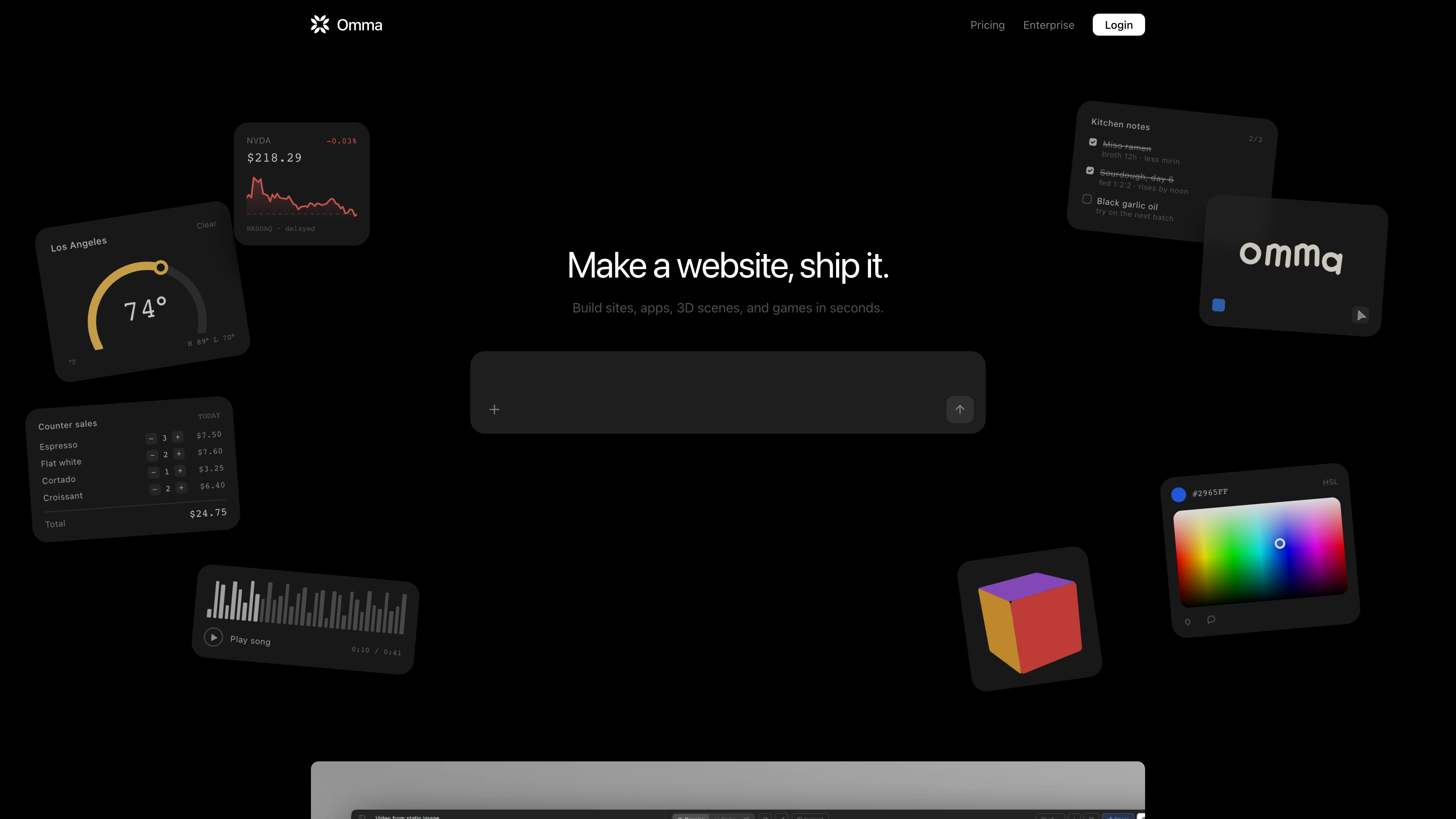
- Standalone products: Spell, an experimental "3D world model" that turns a single image into an explorable 3D world (explicitly labeled highly experimental, priced separately from the editor), and Omma, an AI canvas launched March 2026 that generates shippable interactive sites and 3D experiences from a prompt (separate site at omma.build, from $29/month for the Professional plan).
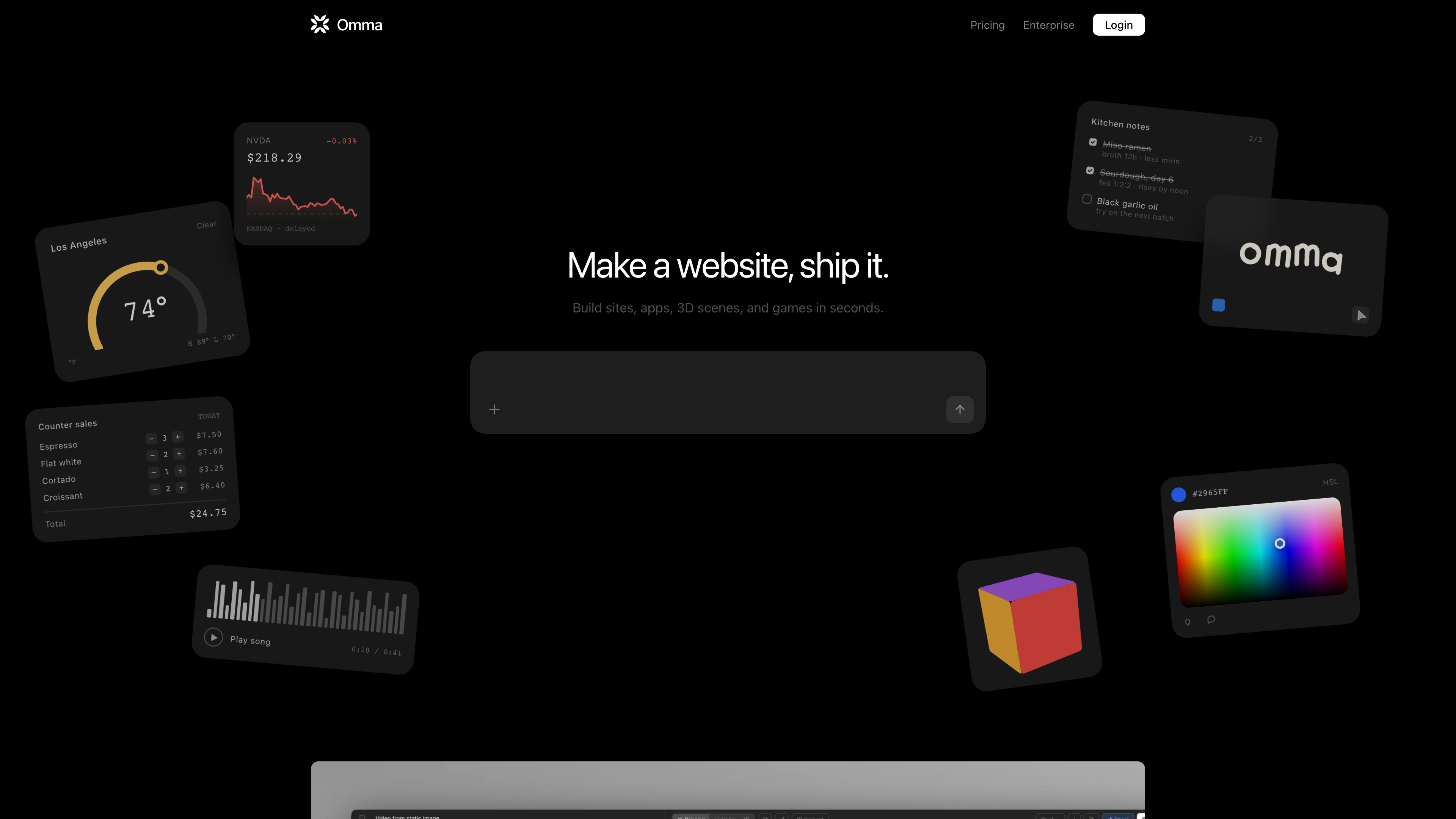
The Omma site above is built entirely around one prompt field — a more radical pitch than the editor: no design tool to open at all, just describe a site or 3D experience in natural language and publish the result.
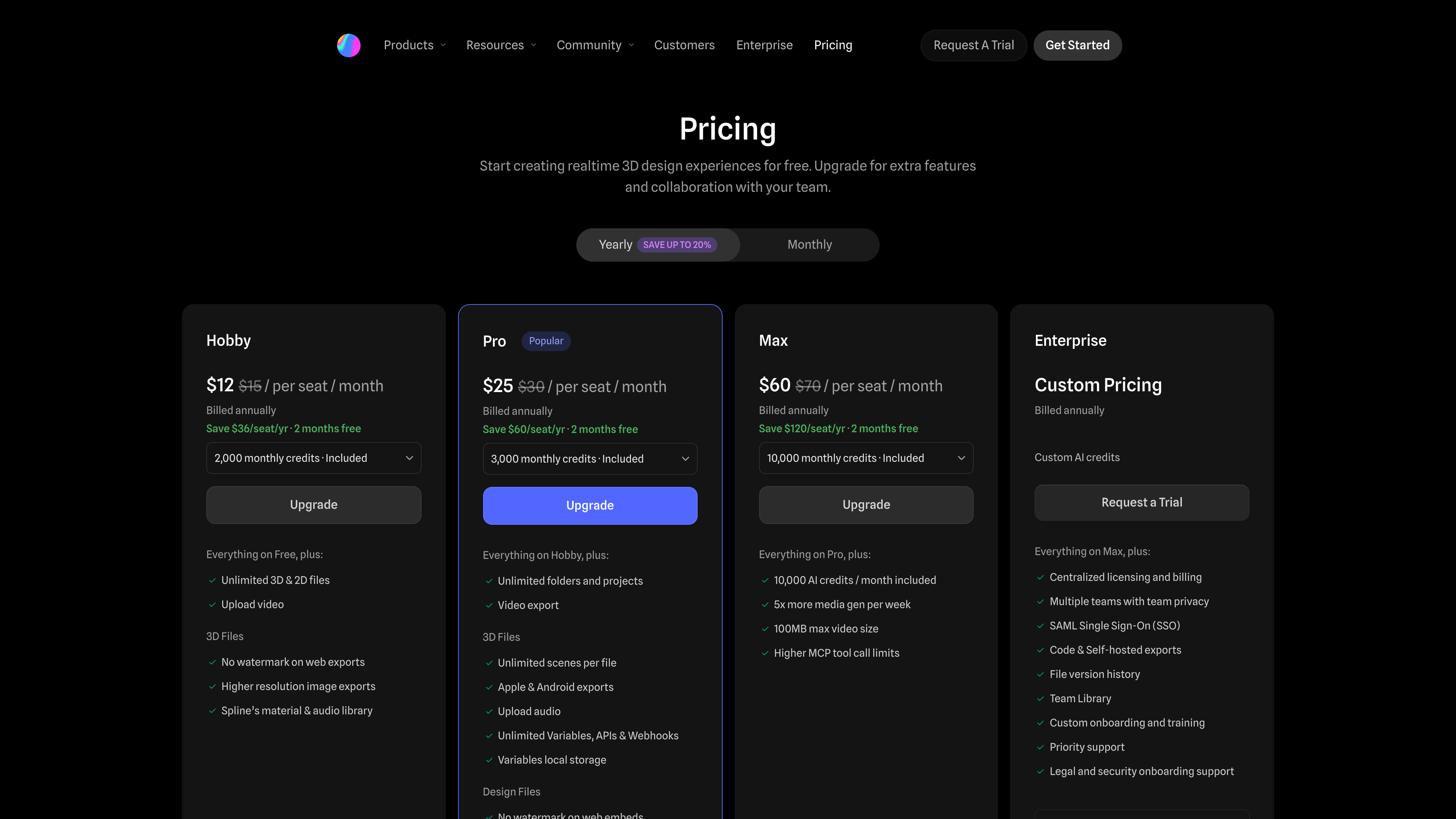
Billing is unified: every AI feature in the editor draws from one monthly AI-credit pool that only comes with paid plans — 2,000/month on Hobby, 3,000 on Pro, 10,000 on Max, with top-ups in 1,000-credit steps; the free tier includes no monthly credits (pricing docs). On data use, the Terms state that Spline does not train its models on customer data, using feedback data only when users explicitly submit and permit it.
Plans and pricing
As of 2026-09-12, pricing is per-seat subscription:
| Plan | Price (per seat/month) | Key inclusions |
|---|---|---|
| Free | $0 | Limited personal files (no specific number published); unlimited file viewers; watermarked web exports; access to the Spline Library |
| Hobby | 15 monthly) | Unlimited 3D & 2D files; no watermark on web exports; higher-resolution image exports; material & audio library; 2,000 AI credits/month |
| Pro | 30 monthly) | Unlimited folders and projects; unlimited scenes per file; video export; Apple & Android exports; unlimited variables, APIs & webhooks; 3,000 AI credits/month |
| Max | 70 monthly) | 10,000 AI credits/month; 5x more media generation per week; 100MB max video size; higher MCP tool-call limits |
| Enterprise | Custom | SAML SSO, multi-team orgs with centralized billing, self-hosted & code exports, file version history, Team Library, onboarding and priority support |
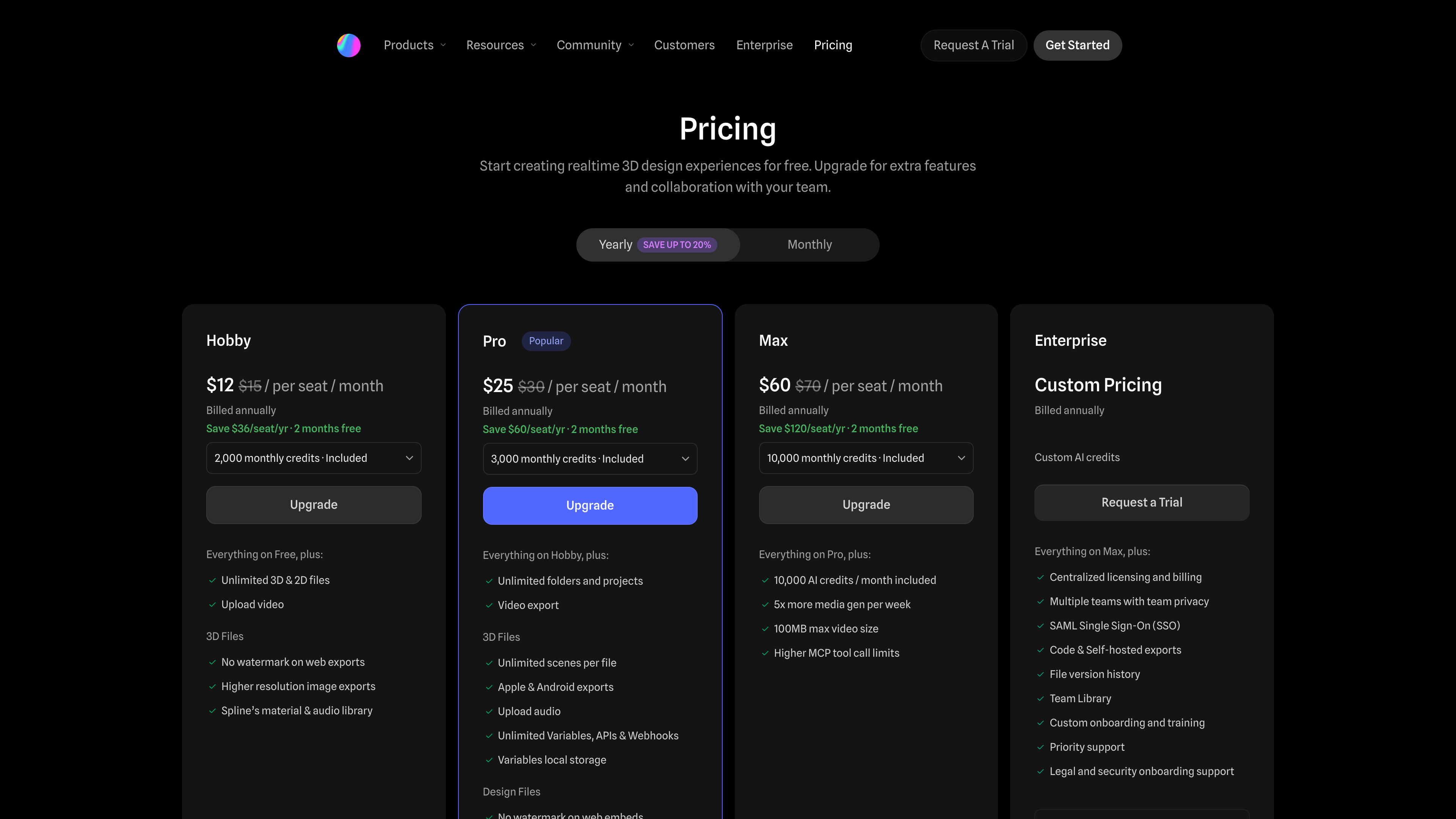
The pricing page above shows the paid tiers at annual rates (toggling to Monthly changes Hobby/Pro/Max to 30/29/month), as is Spell. Legacy Starter/Professional/Team subscriptions remain active, and the docs note that legacy Professional and Team map to today's Pro-level feature gates.
Community and content policy
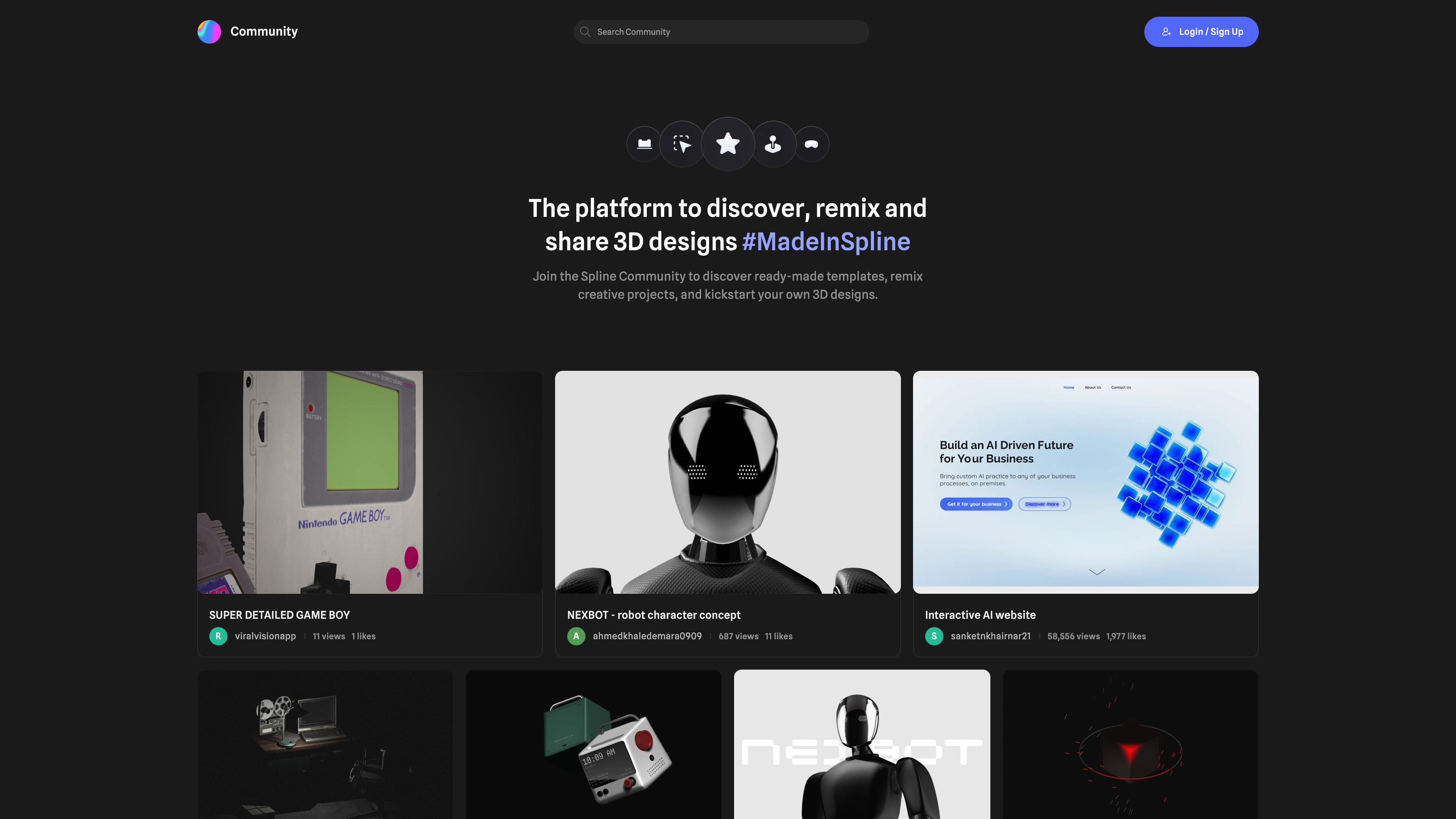
The Spline Community (app.spline.design/community) is browsable without an account and is built around discovering, remixing, and showcasing work. Models and scenes in the official library are cleared for commercial use, and everything users publish to the community defaults to a Standard Commercial License: anyone may remix and reuse it, personally or commercially. That makes remixing the intended on-ramp — the homepage itself suggests starting from a community design — but it also means publishing to the community grants reuse rights by default.
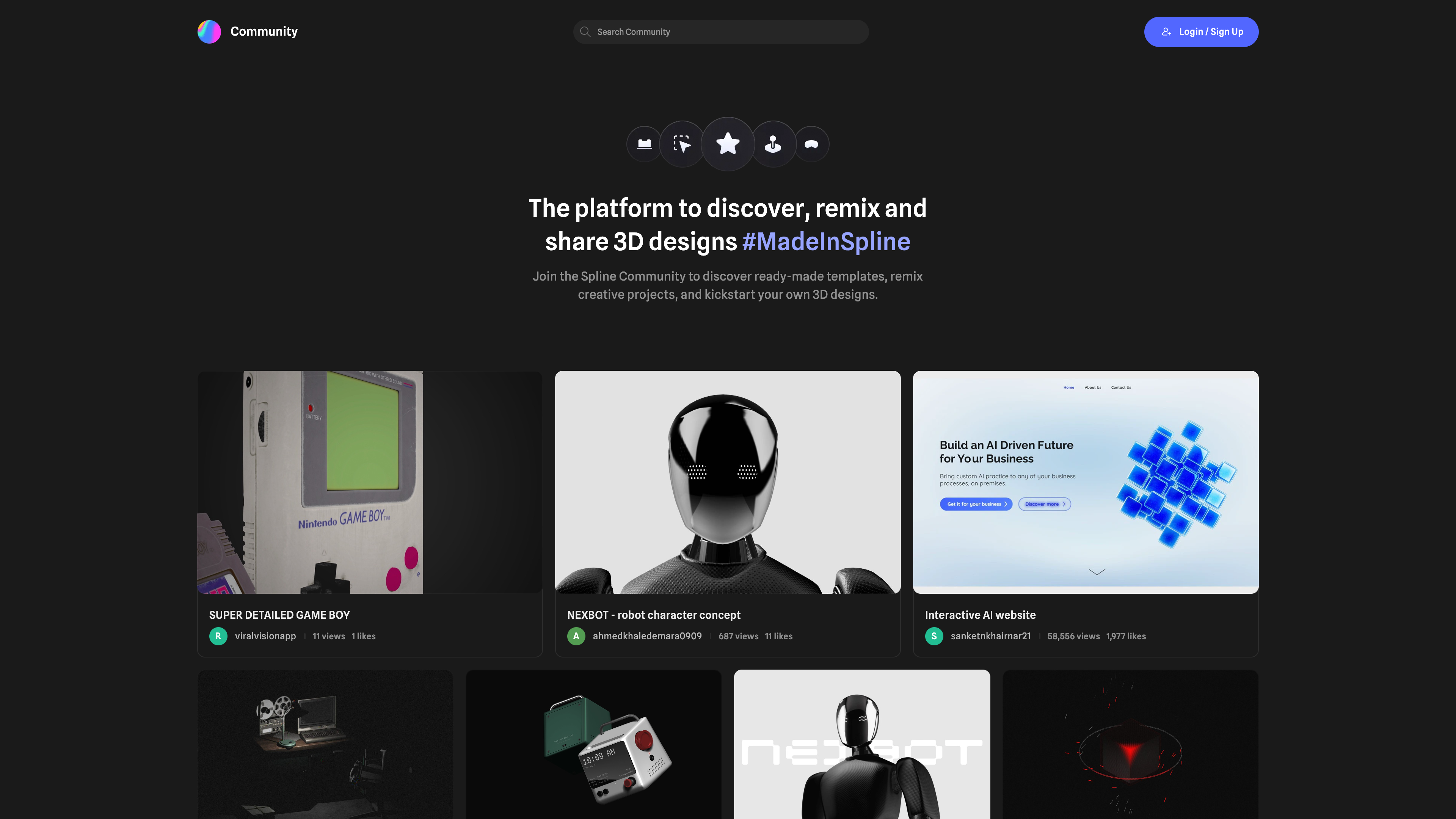
The public community page above shows project cards with author names, view counts, and likes, all visible without signing in. Other policy points: the Terms include a DMCA-style copyright complaint process (agent address in Delaware); the service is not for children under 13; the Privacy Policy (January 10, 2026 version) states data is stored on US servers, lists Amplitude, Vercel, and Stripe as third parties, provides GDPR rights with appointed EU and UK representatives; liability is capped at $100, with disputes governed by Delaware law.
Who it's for
- Interactive 3D for the web: hero sections, product showcases, and interactive brand visuals that ship straight into Framer/Webflow or as React components.
- 3D in mobile apps: native SwiftUI/Kotlin embeds for iOS and Android when pulling in a game engine would be overkill.
- Team-based design workflows: several people editing one 3D file at once, with review, comments, and versioning in a single link.
- 2D designers moving into 3D: layer-based materials and a design-tool interface lower the barrier from Figma-like tools, and community remixes provide ready-made starting points.
- Rapid prototyping: let the AI agent or AI 3D generation draft an interactive scene, then refine and publish it manually.
Limitations
- Not a Blender/C4D replacement: the modeling, sculpting, and UV toolset targets web/product scenes; there is no offline renderer or film-grade pipeline, and complex character animation or high-fidelity assets still call for desktop software. The relationship is more complementary than competitive — Spline's own workflow includes importing FBX and similar formats from such tools.
- Performance depends on the browser and GPU: the official FAQ notes 3D needs more CPU/GPU than traditional 2D design tools, and several heavy AI-generated meshes in one scene will slow it down; published scenes need the same optimization care.
- Real free-tier limits: a capped number of personal files, watermarked web exports, no included AI credits, and Apple/Android exports gated to Pro and up.
- Tiered code exports: animation and interactivity survive only in the Vanilla JS/React exports, and downloading code exports or self-hosting them is Enterprise-only — deep customization has a paywall.
- English only: the editor, docs, and community have no official Chinese (or other language) interface, and learning resources (Discord, YouTube tutorials) are primarily in English.
- Ecosystem lock-in: scenes use the proprietary .spline format; geometry exports to glTF and friends, but the interaction layer (events, variables, states) does not transfer to other 3D tools, so migration costs concentrate exactly where the product adds the most value.
- Community publishing is open by default: posting to the community grants remix and commercial reuse rights by default — creators who want tighter control should mind what they publish.
Alternatives worth comparing
- Blender: the free, open-source desktop 3D suite covering modeling, rigging, animation, and rendering for film, games, and art. Its output goals differ from Spline's (real-time interactive content), and it often serves as the upstream asset tool in a Spline workflow.
- Vectary: another browser-based collaborative 3D design and web-embedding tool — the closest in positioning to Spline and the most direct comparison for editor and publishing capabilities.
Sources
- Spline homepage (checked 2026-09-12)
- Spline pricing (checked 2026-09-12)
- What is Spline? - Spline Documentation (checked 2026-09-12)
- FAQ - Spline Documentation (import/export formats) (checked 2026-09-12)
- Exporting as Code - Spline Documentation (checked 2026-09-12)
- AI 3D Generation - Spline Documentation (checked 2026-09-12)
- AI Textures - Spline Documentation (checked 2026-09-12)
- Pricing & AI credits - Spline Documentation (checked 2026-09-12)
- Spell AI 3D Worlds - Spline Documentation (checked 2026-09-12)
- Spline Community (checked 2026-09-12)
- Spline Terms & Conditions (January 10, 2026 version) (checked 2026-09-12)
- Spline Privacy Policy (January 10, 2026 version) (checked 2026-09-12)
- Introducing Spline v2 - Spline Blog (checked 2026-09-12)
- Spline, a no-code design tool for creating 3D assets, raises $15M - TechCrunch (checked 2026-09-12)
- Spline Becomes First 3D Design Platform to Enable Designers to Ship Interactive Experiences Cross-platform - Business Wire (checked 2026-09-12)
- Omma by Spline Unlocks Production-Ready Motion Design in Minutes - Business Wire (checked 2026-09-12)
- Spline (W21) - Y Combinator Work at a Startup (checked 2026-09-12)
- Spline launches - Product Hunt (checked 2026-09-12)