Softr is a no-code platform for building business applications: without writing code, you connect existing data sources like Airtable, Google Sheets, Notion, or HubSpot (or Softr's own native database) to pre-built "blocks" and assemble web apps with sign-up/login, role-based permissions, and workflow automation. The typical outputs are client portals, vendor portals, internal tools, CRMs, and knowledge bases rather than marketing websites. Since March 2026, the platform also includes an AI Co-Builder that generates the database, interface, permissions, and business logic from a plain-language description, after which you can keep iterating with prompts or switch to the visual editor (source: VentureBeat). It is operated by Softr Platforms GmbH in Berlin, Germany, and claims over one million teams as users (source: softr.io).
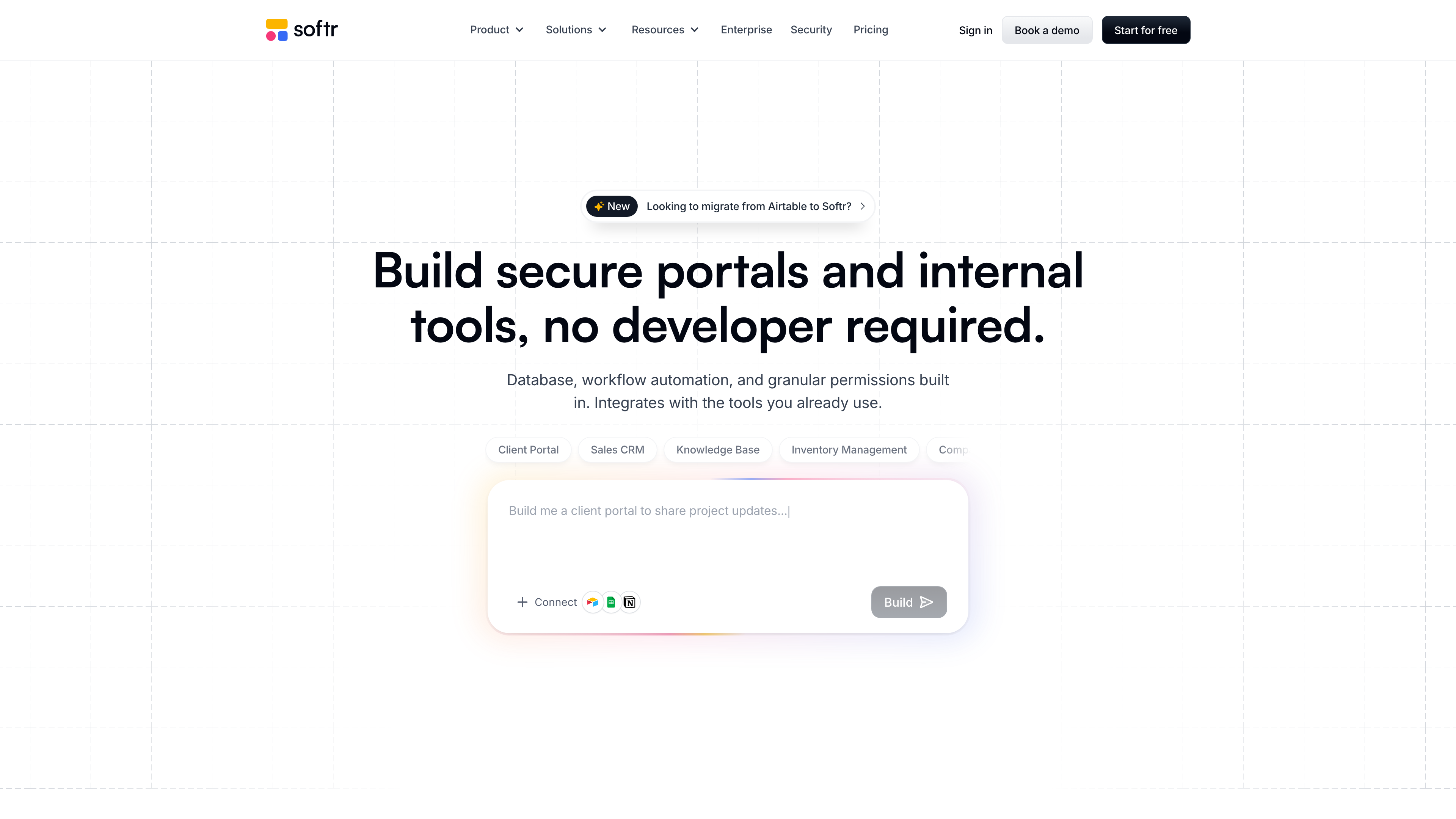
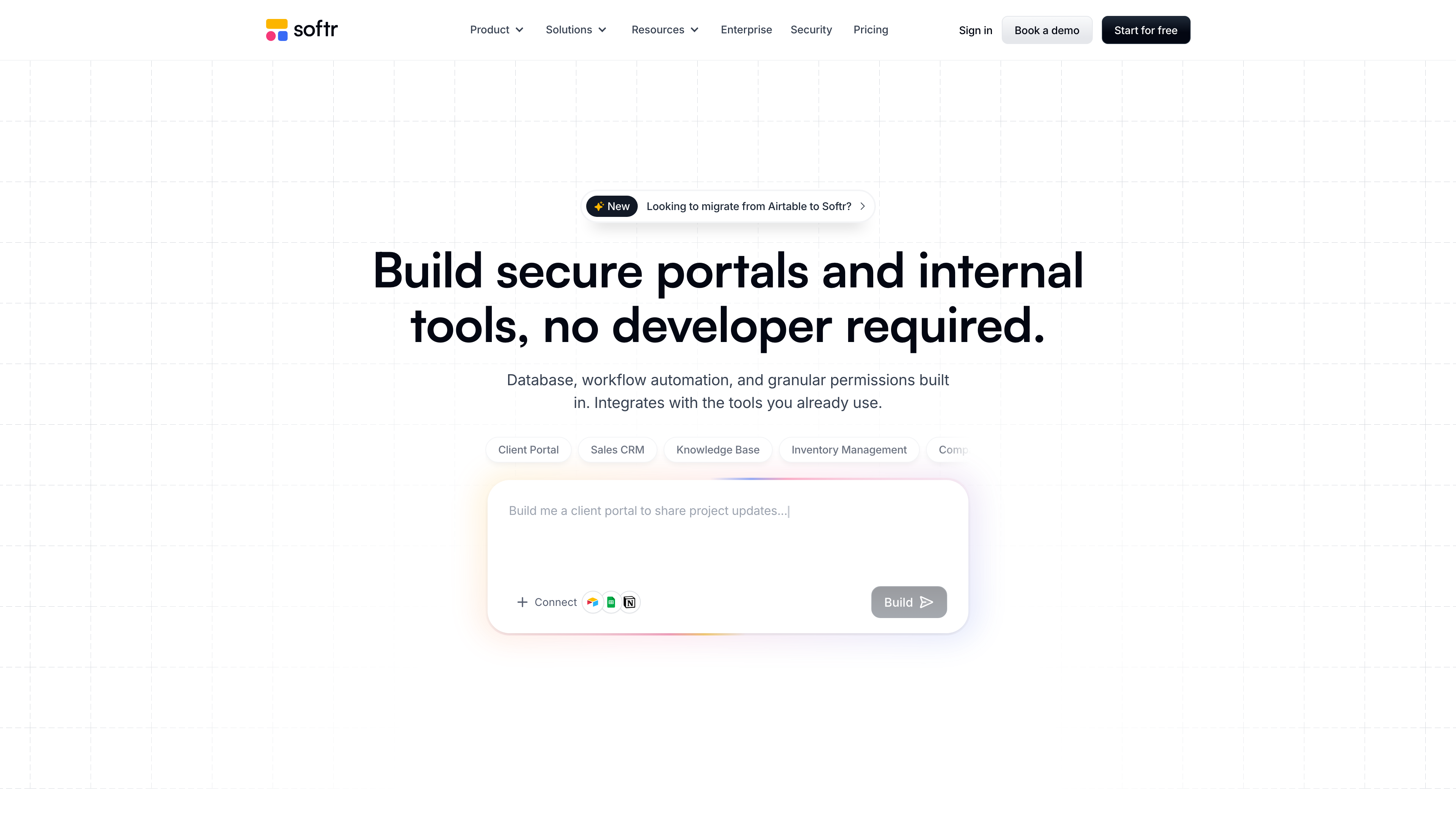
The screenshot above shows Softr's homepage (captured 2026-09-29). The hero headline reads "Build secure portals and internal tools, no developer required." Below it sits the AI Co-Builder prompt box (placeholder: "Build me a client portal to share project updates…") with direct options to connect Airtable, Google Sheets, and Notion; the row of chips above it (Client Portal, Sales CRM, Knowledge Base, …) represents common app types.
At a Glance
- URL: https://www.softr.io
- Type: No-code business app builder (portals, internal tools, database apps; plus native databases, workflows, and forms)
- Cost: Free plan at 19 / 329 per month billed annually, plus custom Enterprise pricing (as of 2026-09-29, source: pricing)
- Sign-up: An account is required to build apps. The terms of service define the platform as a B2B product aimed at businesses rather than consumers, and the registration form asks for a company/professional email address (source: Terms)
- Interface language: English only (no other language versions of the site or docs found, checked 2026-09-29)
- Operator: Softr Platforms GmbH, Berlin, Germany (source: Imprint)
Background
Softr was founded by Armenian entrepreneurs Mariam Hakobyan (CEO) and Artur Mkrtchyan (CTO). TechCrunch reported in 2021 that the company "started in 2019," while the company's About page and VentureBeat date the launch to 2020. The original product was a no-code interface layer on top of Airtable — turning Airtable bases into publishable websites and apps (sources: TechCrunch, About, VentureBeat).
The company raised a 13.5M Series A led by FirstMark Capital in January 2022, with no further public funding since. In a March 2026 interview, Hakobyan said Softr had been profitable for about a year, reached eight-figure revenue, and grown purely through product-led growth without a sales team (source: VentureBeat). The About page lists a remote-first team of roughly 60 people across 22 nationalities (as of 2026-09-29, source: About).
Two product milestones matter for understanding the current platform: in February 2025, Softr moved beyond its Airtable dependency by launching a native database (Softr Databases) and expanding data sources and workflow capabilities (source: TechCrunch); on March 31, 2026, it launched an "AI-native" platform centered on the AI Co-Builder, repositioning itself from pure no-code to a hybrid of AI generation and visual editing (source: VentureBeat).
How Building Works: Blocks and the AI Co-Builder
Softr's building units are pre-built, tested blocks — lists, tables, Kanban boards, charts, forms, calendars, authentication — documented in 47 block-level help articles (source: Softr Help Docs). Compared with blank-canvas tools like Bubble, blocks trade pixel-level design freedom for a much lower learning curve and built-in infrastructure such as authentication and permissions.
The AI Co-Builder launched in March 2026 works on top of these blocks: you describe the app you want in plain language, the AI asks follow-up questions about login methods, roles, and permissions, then generates the database schema, interface, and business logic. According to VentureBeat, the AI does not produce raw code but assembles constrained, pre-built blocks, generating custom components only for requirements outside the standard range. The result can be iterated with further prompts or edited directly in the visual editor — Softr calls this "hybrid AI app building," and manual editing keeps working even after you run out of AI credits (sources: VentureBeat, pricing FAQ).
For a head start, the template gallery offers 90 templates as of 2026-09-29, filterable by use case (portals, business operations, knowledge management, dashboards & reporting, CRM, directories, forms, project management) and 19 industries; representative templates include Client Portal, AI CRM, Vendor Management, and Investor Portal (source: Templates).
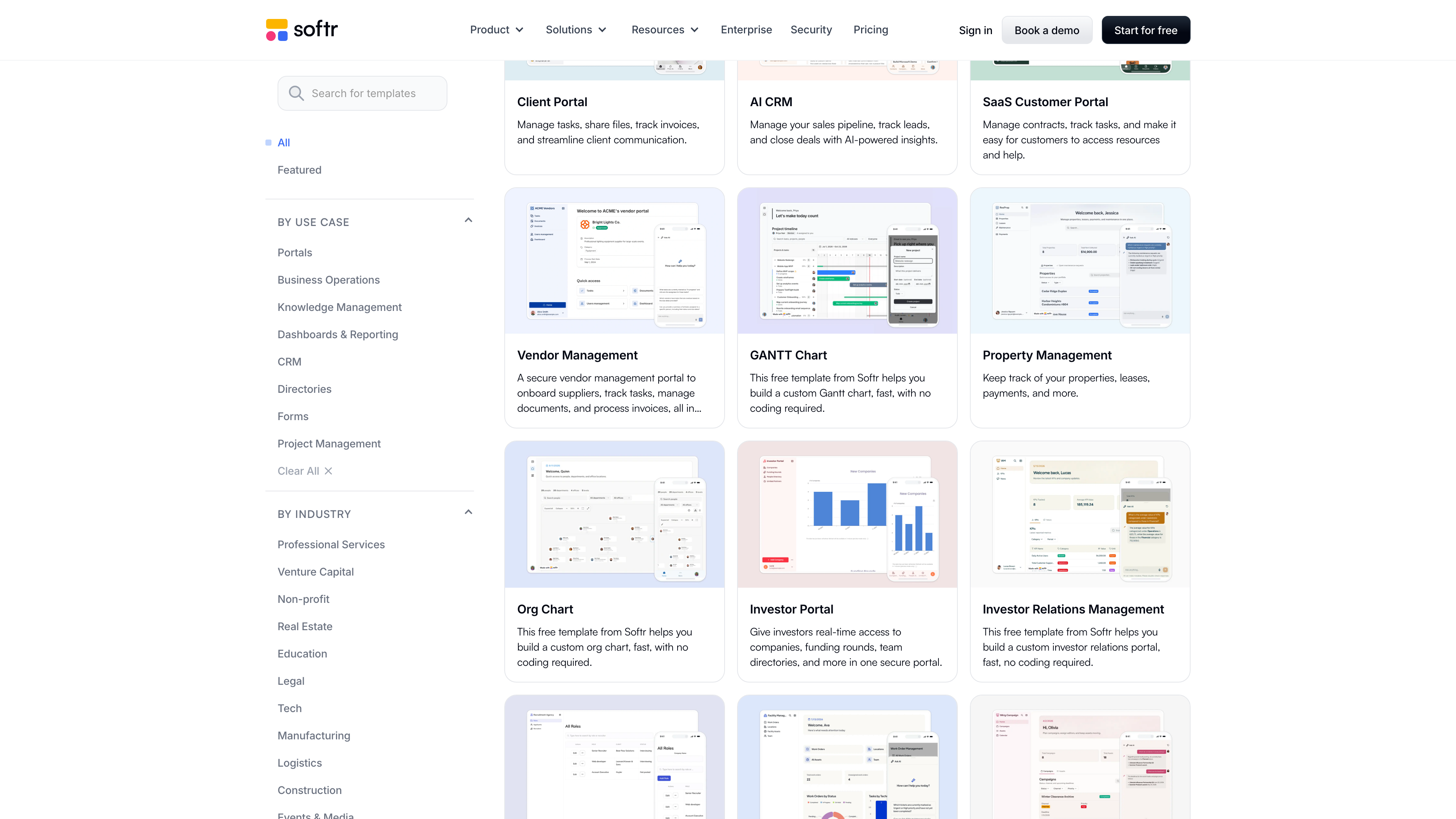
The screenshot above shows the template gallery (captured 2026-09-29), with use-case and industry filters on the left and template cards on the right, each labeled with its intended scenario. Templates can be copied into a workspace and customized further.
Data and Integrations
There are three options for the data layer (source: Data Sources docs):
- Native Softr Databases: a built-in spreadsheet-style database hosted with your apps;
- External data sources: 14 kinds — Airtable, Google Sheets, Notion, HubSpot, Salesforce, monday.com, SmartSuite, ClickUp, Coda, Xano, Supabase, BigQuery, and SQL databases (PostgreSQL, MySQL, SQL Server, MariaDB) — queried live by your apps;
- REST API connector: for virtually any third-party API.
According to the security page, queries against external sources run on Softr's servers, so database credentials and query statements never reach end users' browsers (source: Security). Beyond data sources, plans include 36–53 integrations (payments, automation, analytics, and more, source: pricing), plus built-in visual workflows, forms, an end-user-facing Ask AI assistant, and database AI agents.
Publishing, Permissions, and Security
Apps are built in Softr Studio and remain private until published. The free plan publishes to a *.softr.io subdomain (the subdomain name is customizable); connecting a custom domain requires the Basic plan or above (sources: Publishing docs, pricing). Before publishing, you can preview the app as a specific user to verify what each role will actually see. From the Business plan up, apps can be packaged as installable PWAs with push notifications.
The permission system is what sets Softr apart from ordinary website builders: user groups control the visibility of pages, blocks, and buttons; "global data restrictions" filter data at the record level so users only load rows they are allowed to see; and action permissions govern who can use each button. The Business plan adds domain-restricted sign-up and two-factor authentication (2FA), while Enterprise offers SAML 2.0 / OpenID SSO and SCIM provisioning (sources: Security, pricing).
For compliance, Softr holds a SOC 2 Type II attestation and states GDPR compliance. Data can be hosted in the EU (Germany) or the US, with 256-bit TLS in transit and encryption at rest, running on redundant AWS infrastructure with 24/7 monitoring (source: Security). Note that the security page's "99.9% uptime" marketing claim differs from the contractual "99% average annual availability" in the terms of service — teams with hard availability requirements should rely on the latter (source: Terms).
Pricing
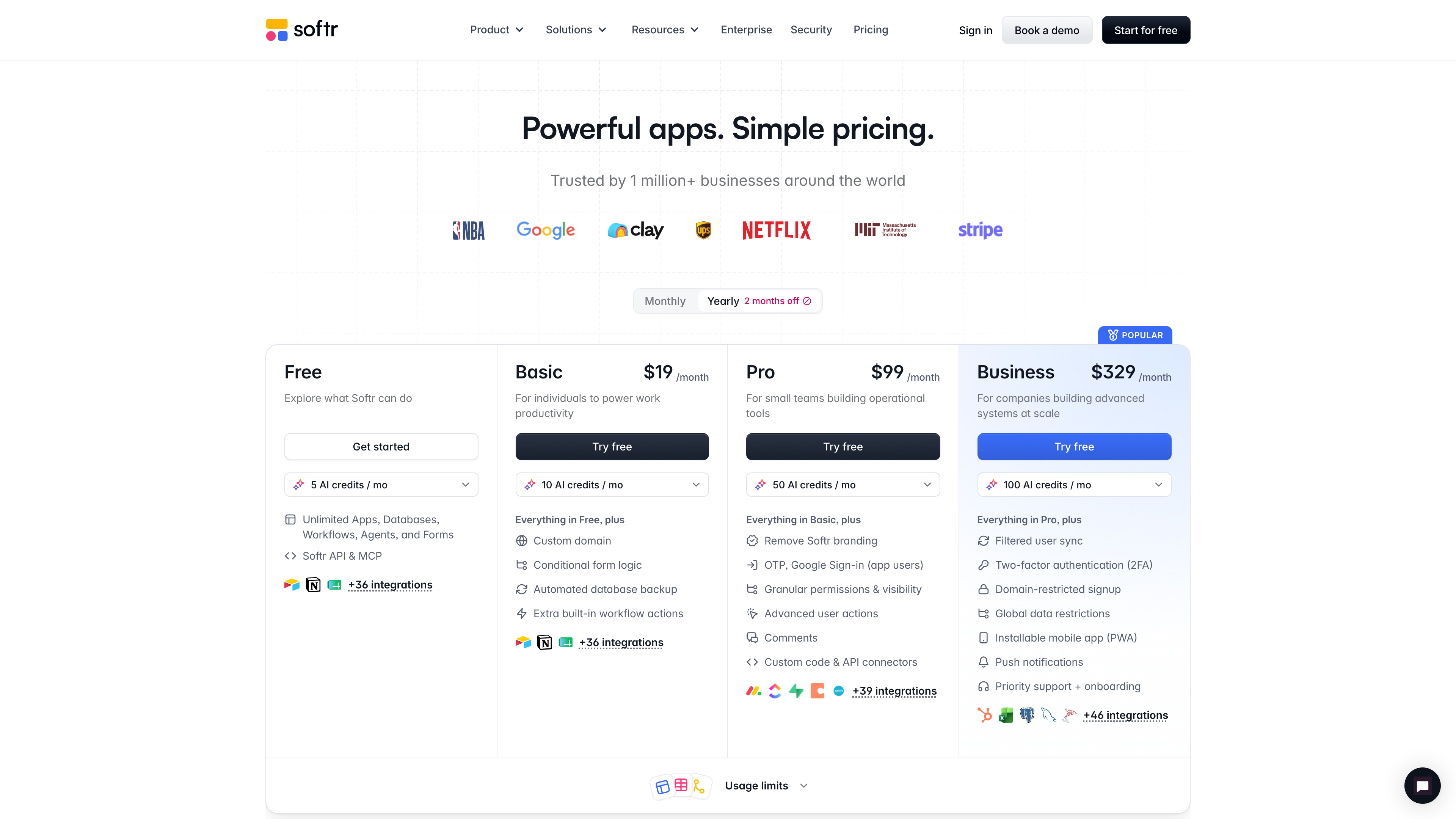
As of 2026-09-29, Softr offers five plans (source: pricing):
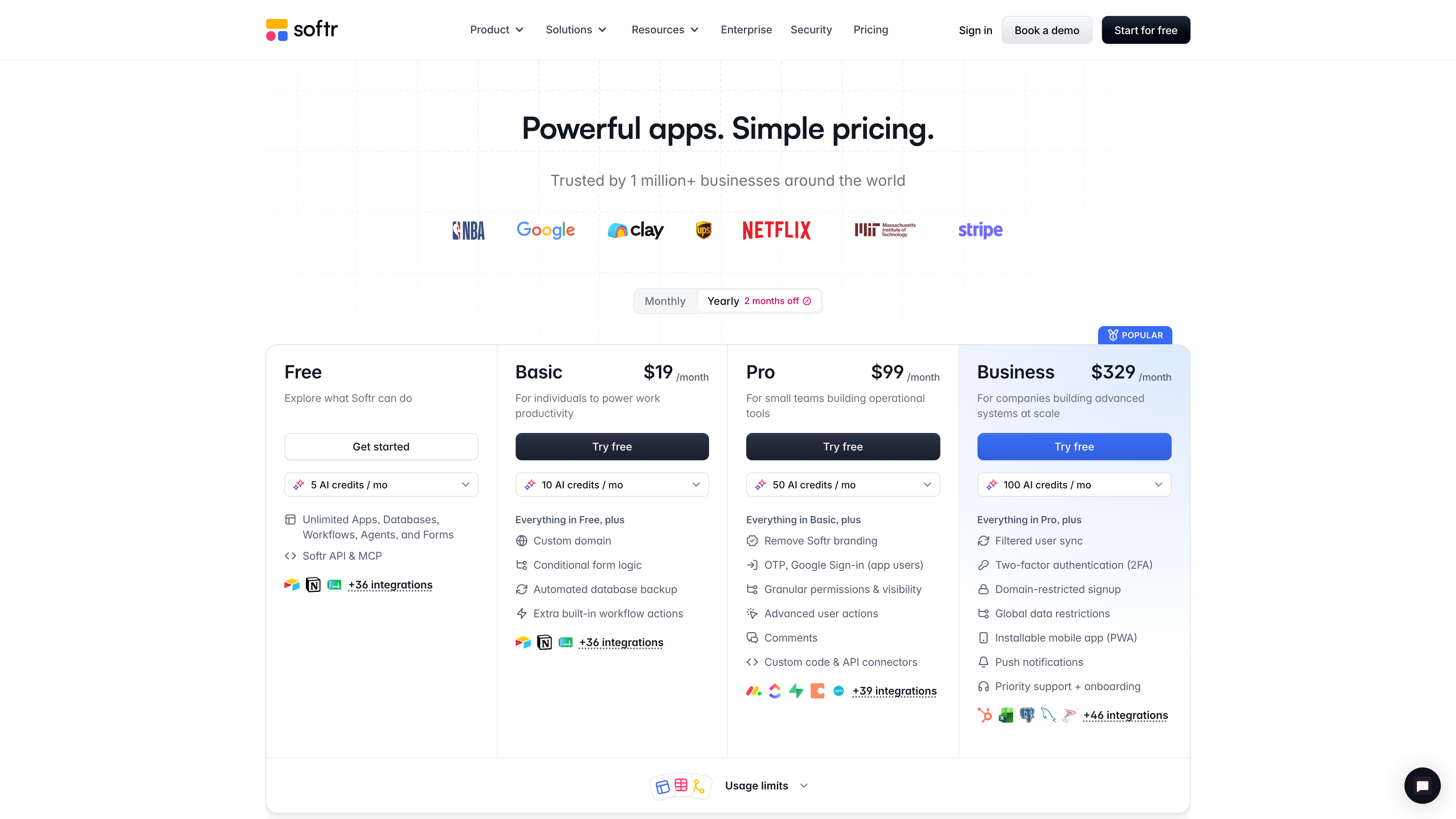
- Free ($0): unlimited apps, databases, workflows, and forms, including Softr API and MCP access; 5 AI credits per month, up to 3 builders and 5 app users; apps carry Softr branding.
- Basic (25 monthly): custom domain, conditional form logic, automated database backups; 10 AI credits per month, 1 builder included, 5 team + 5 client app users.
- Pro (119 monthly): removes Softr branding; one-time passcodes and Google sign-in for app users; granular permissions, comments, custom code and API connectors; 50 AI credits per month, 10 team + 50 client app users.
- Business ($329/month billed annually): 2FA, domain-restricted sign-up, record-level global data restrictions, installable PWA and push notifications, priority support; 100 AI credits per month, 30 team + 100 client app users.
- Enterprise (custom): SSO (SAML, OpenID), SCIM, audit logs, custom agreements and SLAs.
Extra builders, app users, and custom domains can be purchased on top (e.g., additional domains at $15/month). Database records and monthly workflow executions scale with the plan (Free: 5K records and 500 workflow runs per month; Business: 1M records and 25K runs per month). Non-profits and educational institutions get a 50% discount; refunds are available within 14 days of a first monthly payment or 30 days of a first yearly payment (source: pricing FAQ).
Accounts and Open Capabilities
Softr distinguishes two account types: builders, who can access Softr Studio to create apps, databases, and workflows, and app users, who can only log in to published apps. They are billed separately, and app users are deduplicated by unique email across all your apps (source: pricing).
Open capabilities include the Softr API (REST access to databases and apps) and MCP support (connecting apps and databases to AI tools like Claude, with permissions tied to the caller's identity) on all plans; custom code and API connectors from the Pro plan; and a Vibe Coding block that generates a single UI component with AI — the generated code is parsed by the platform and folded into the existing permission system (sources: Security, pricing).
Copyright and Content Policy
Under the terms of service effective December 13, 2025 (source: Terms):
- Customers are responsible for the content they upload (Customer Content) and grant Softr the license needed to operate the service; the platform itself and its documentation remain Softr's property, and customers have no right to access the platform's source code.
- Input to AI tools belongs to the customer, and output belongs to the customer to the extent permitted by law. AI tools only process data when the customer chooses to use them; customers must verify AI output themselves and must not present it as solely human-generated.
- The content policy prohibits hateful, discriminatory, or fraudulent content, infringement of third-party intellectual property, malware distribution, and content related to gambling, narcotics, pornography, human trafficking, or child exploitation. Violations can lead to blocked access or deleted apps and content.
- Softr may reference customer names and logos in its marketing materials; customers can revoke this consent at any time by email.
- Softr performs daily backups retained for seven days but explicitly does not warrant their correctness or completeness — customers are expected to keep their own backups.
Good Fits
- Teams already managing data in Airtable, Google Sheets, Notion, or HubSpot that want to add login, permissions, and a presentable interface — client portals, vendor portals, and member directories are the flagship use cases;
- Business teams building their own internal tools (inventory management, CRM, project tracking, approval flows) to replace spreadsheet-and-email workflows;
- Non-technical users who want AI-generated, production-ready app prototypes they can keep maintaining in a visual editor, without ever touching AI-generated code;
- European teams with data-residency requirements (hosting in Germany, GDPR, SOC 2 Type II).
Limitations
- The interface and documentation are English-only, with no localized versions.
- The terms define the platform as a strictly B2B product aimed at businesses; hobbyist side projects are not the target audience, and registration asks for a company/professional email address.
- Blocks make Softr fast to learn but offer less design freedom than canvas-style tools like Bubble, and apps can look similar to one another; complex interactions and front-end customization require the Pro plan's custom code.
- Apps run on Softr's infrastructure and cannot be exported as code, so deep adoption creates migration costs; record counts and workflow executions are capped per plan and require upgrades or add-ons beyond the limits.
- The "builder + app user" pricing model grows noticeably with external user counts in portal scenarios — budget-sensitive teams should run the calculator on the pricing page first.
- Free and Basic plan apps display Softr branding; removing it requires the Pro plan.
Alternatives
Other platforms built around the same "data source + no-code interface" idea include Glide, Noloco, and Stacker; Bubble offers deeper customization at the cost of a steeper learning curve; Retool targets developers building internal tools; and "vibe coding" tools like Lovable take the AI-generates-code route. Softr maintains its own comparison pages (vs. Glide / Airtable / Retool / Noloco / Bubble / Lovable) — a reasonable starting point for evaluation, keeping in mind they are written from Softr's perspective.