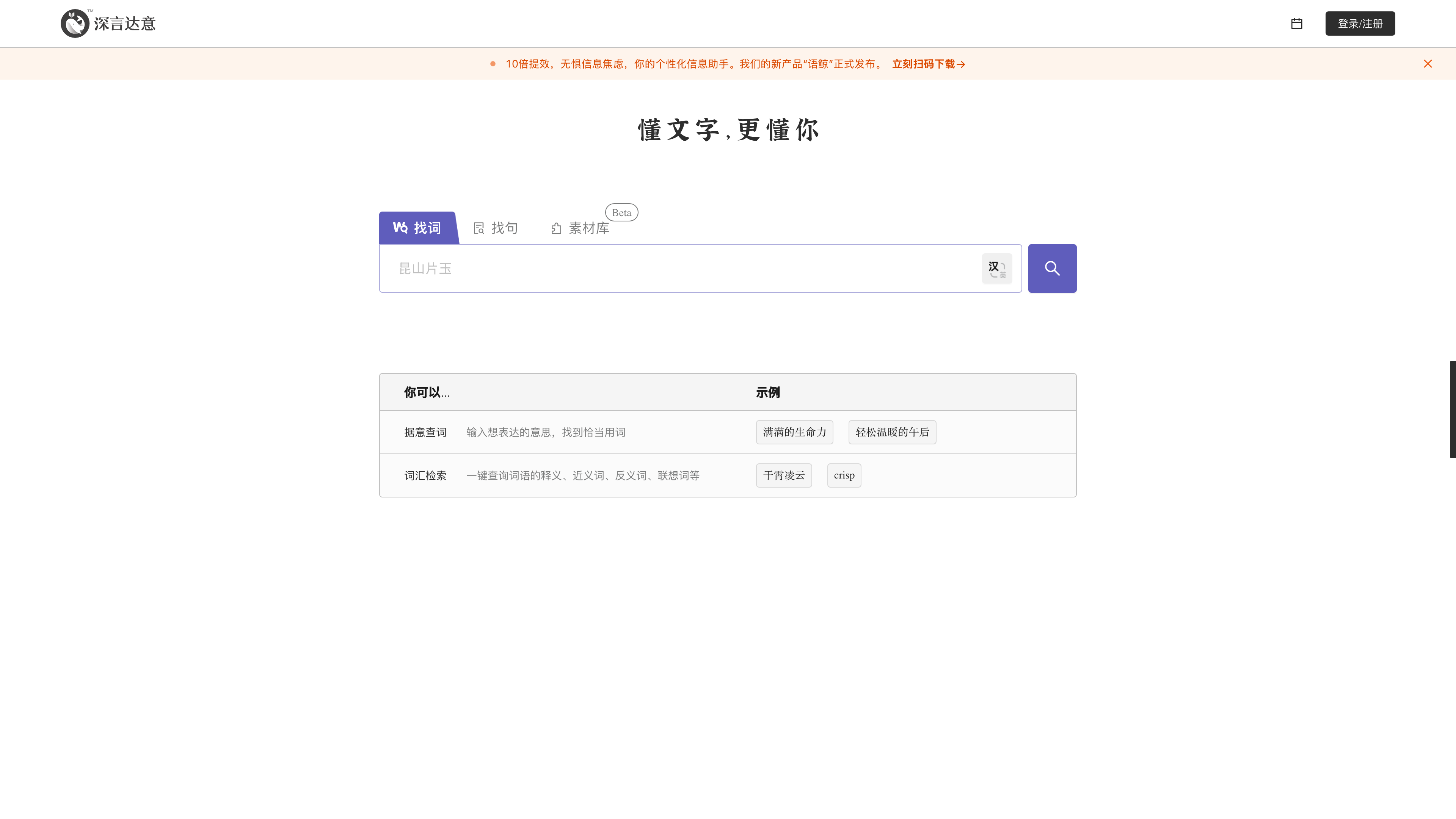
Shenyan Dayi (深言达意, shenyandayi.com) is a free online writing assistant run by Beijing DeepLang Technology (DeepLang AI). Rather than generating prose for you, it targets one specific step of writing: the moment you know what you want to say but cannot recall the right wording. Type a rough description and it returns matching Chinese words, idioms, famous quotes, or authoritative example sentences. The product is a 2023 merger and upgrade of two earlier tools from Tsinghua University's NLP lab (THUNLP): the WantWords reverse dictionary and the WantQuotes quote finder. Among Chinese semantic-lookup writing tools, it is one of the few maintained long-term by a company with an academic NLP research background.
At a glance
- URL: https://www.shenyandayi.com/
- Type: AI writing aid (semantic word lookup, quote search, example-sentence retrieval)
- Cost: Free; no membership or paid tier found anywhere on the site (as of 2026-08-31)
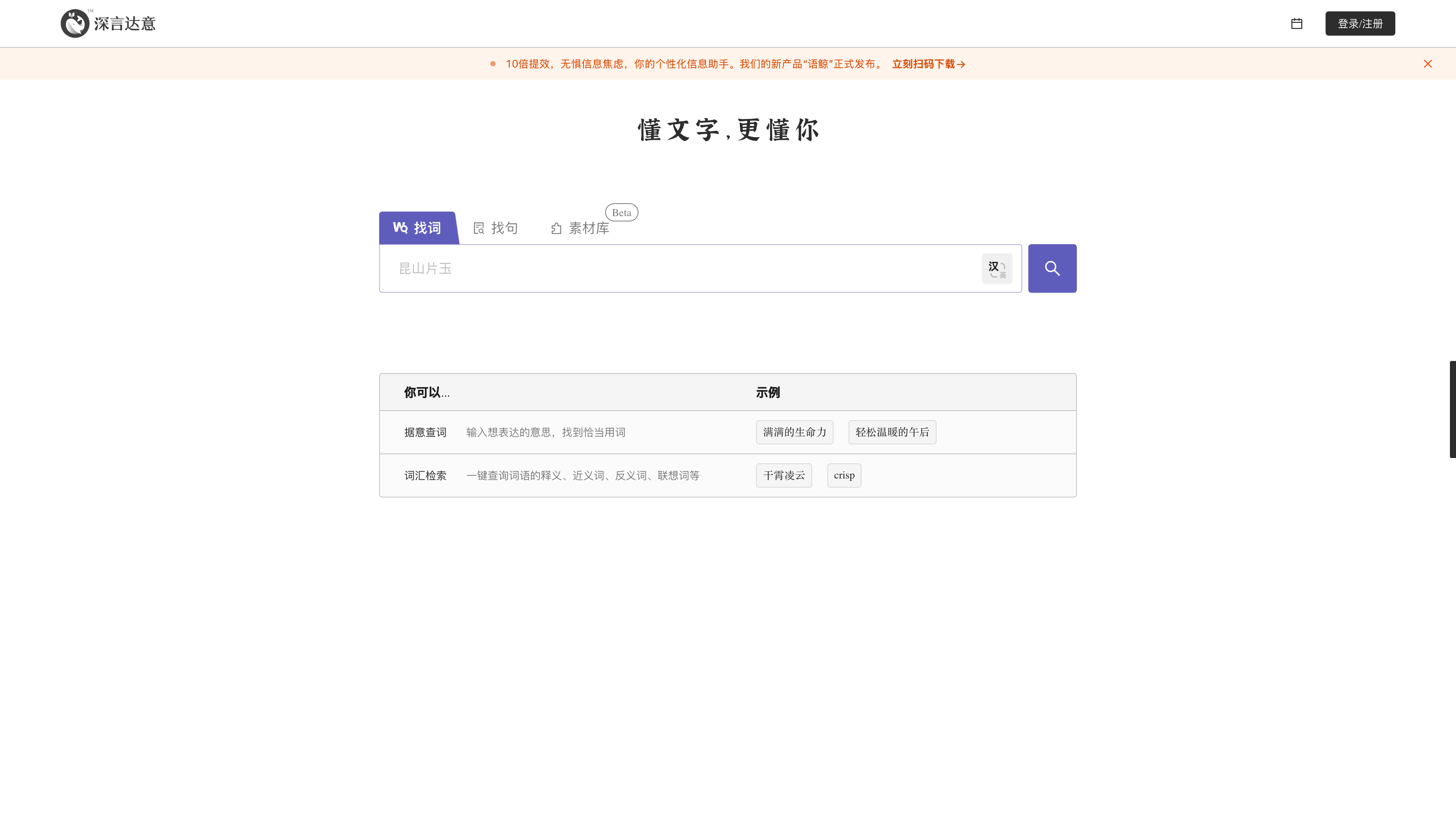
- Sign-up: Core features work without an account — searching words, sentences and the material library, browsing entries and paging through results. Login (SMS code to a mainland China phone number, password, or third-party quick login) unlocks what the site calls "full functionality"; unregistered numbers are signed up automatically on first login.
- Interface language: Simplified Chinese only
- Query languages: Chinese and English, including cross-lingual lookup
- Platforms: Web app, plus a WeChat mini program
Background
The technology traces back to THUNLP's reverse dictionary research. A reverse dictionary does the opposite of a normal one: you describe a meaning, and it returns words that match. In 2020, Fanchao Qi and colleagues presented WantWords at EMNLP 2020, describing it as the first online reverse dictionary supporting Chinese and Chinese-English cross-lingual queries; the code and data were released openly on GitHub (thunlp/WantWords), which has about 7,100 stars as of 2026-08-31, though the repository has not been updated since February 2022 and no longer matches the live product. WantWords went viral in Chinese internet communities in November 2021, and the same team launched the WantQuotes quote finder in 2022 (never open-sourced). Both legacy sites, wantwords.net and wantquotes.net, are still reachable today, and Shenyan Dayi's footer links back to them.
In March 2022, Qi — a THUNLP PhD — founded DeepLang AI. The company's site describes it as incubated by THUNLP and the Beijing Academy of Artificial Intelligence (BAAI); press coverage reports investment from Sequoia China, Tencent and others. In 2023 the company merged WantWords and WantQuotes into Shenyan Dayi — third-party write-ups show it was live by July-August 2023 — and later added modules such as the material library. In a 2025 interview carried by BAAI's community site, Qi said the product line had passed 10 million cumulative users, and that its scope is deliberately narrow: it assists with wording and phrasing only, not full content generation.
Finding words: lookup by meaning, plus a regular dictionary
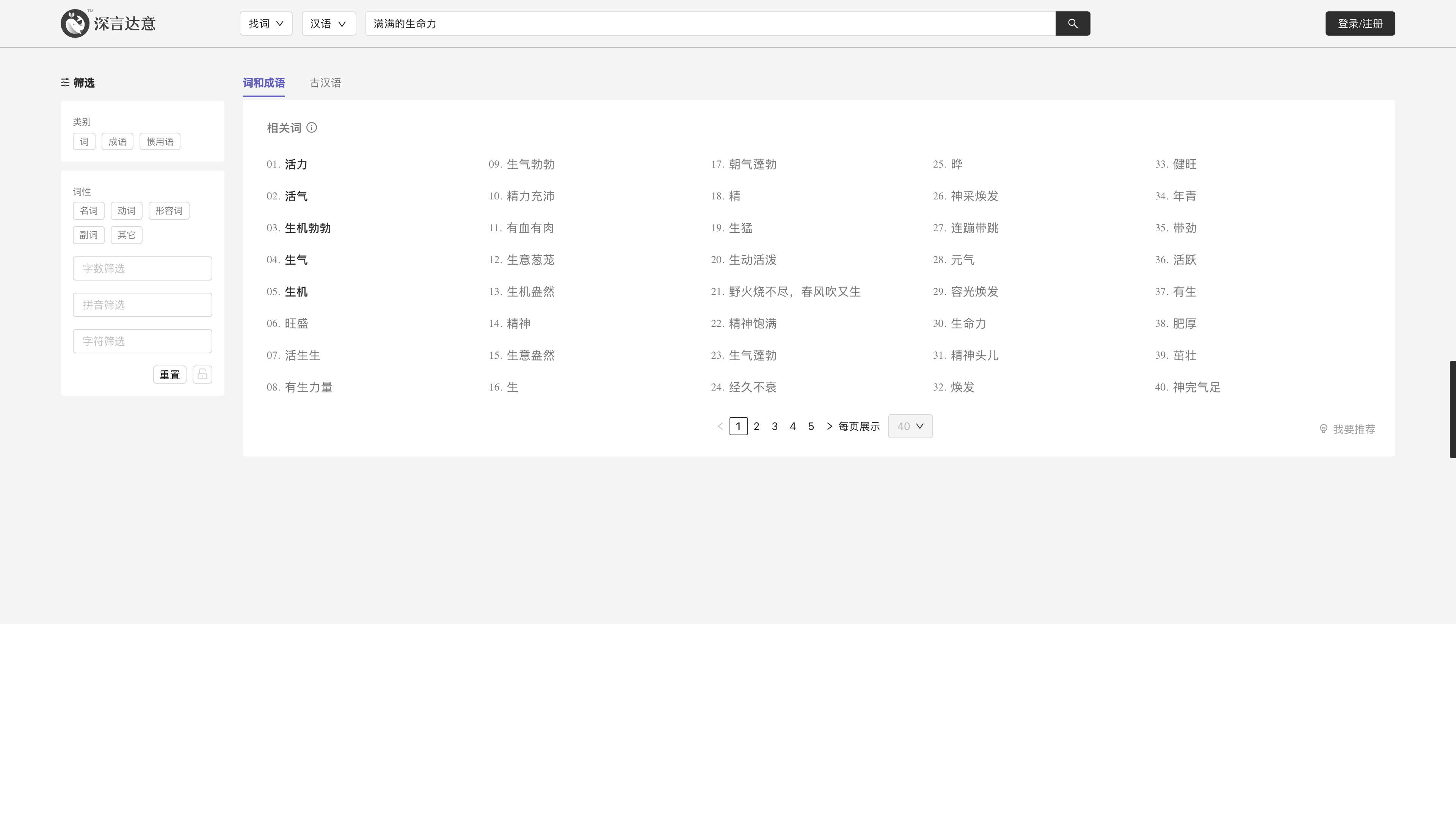
The core feature: enter what you mean, get semantically related words. Searching "满满的生命力" (brimming with vitality) returned candidates such as 活力 (vitality), 生机勃勃 and 朝气蓬勃 (full of life), paginated at 40 per page. Filters on the left narrow results by category (word / chengyu idiom / colloquialism), part of speech, character count, pinyin, or specific characters, and results can be toggled between modern usage and classical Chinese.
It also works as a conventional dictionary. Clicking an entry such as 干霄凌云 or 快乐 shows pinyin, the traditional form, literary origin (for idioms), definitions with example sentences, synonyms, antonyms, related words and associative words; some entries offer English glosses. A "我要推荐" (suggest a word) entry at the bottom of result pages lets users propose additions to the lexicon.
Finding sentences: famous quotes by meaning or by keyword
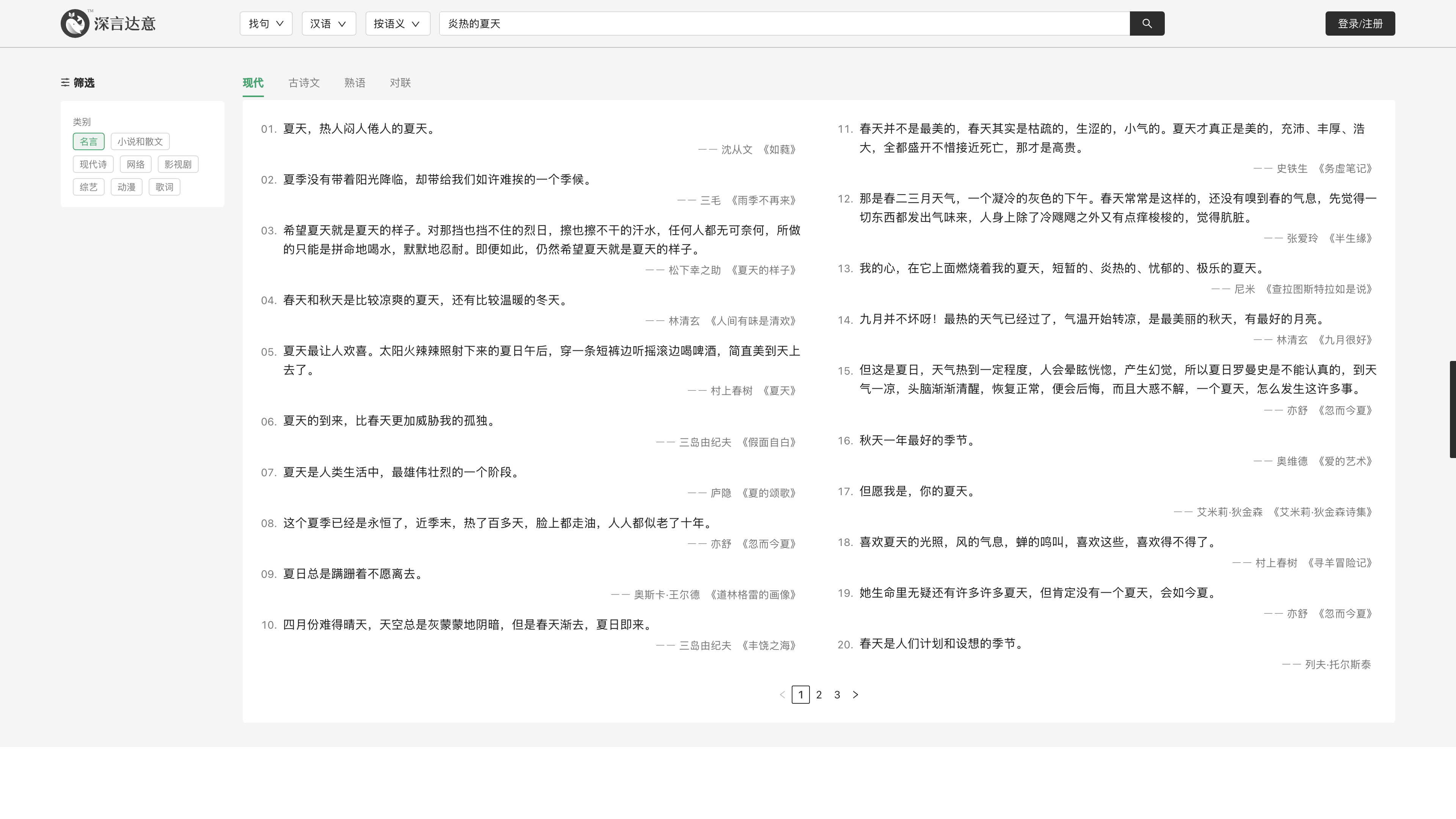
Sentence search has two modes: semantic (sentences close in meaning) and literal (sentences containing the exact characters). Results can be filtered by category — modern (celebrity quotes, fiction and essays, modern poetry, internet, film and TV lines, variety shows, anime, lyrics), classical poetry, set phrases, or couplets — and each quote carries an author and source attribution. A query for "scorching summer" returned lines from modern Chinese and translated literature, e.g. Shen Congwen's Ru Rui and Haruki Murakami's Summer (tested 2026-08-31).
Material library: official-document and academic example sentences
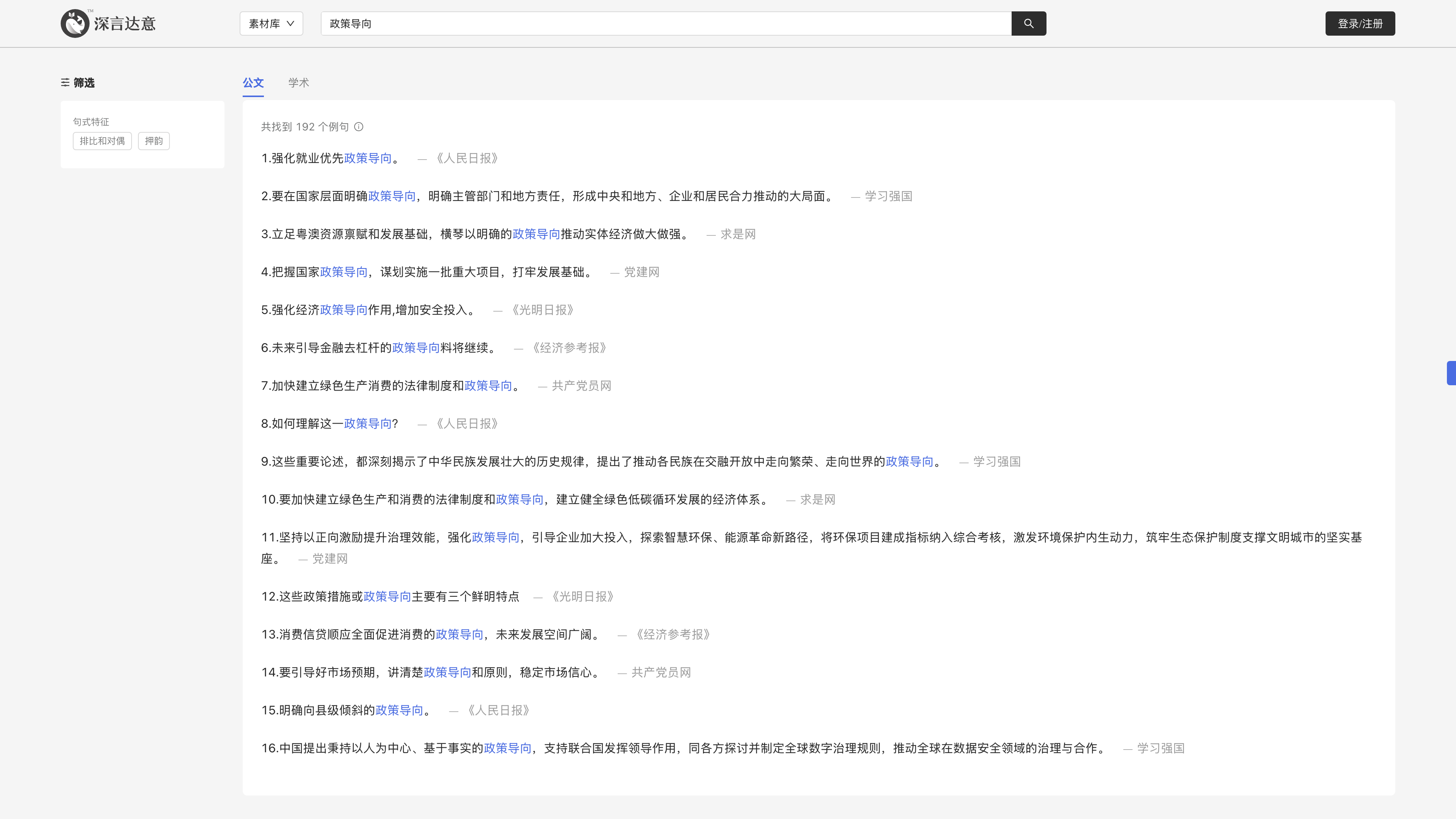
The material library (labeled Beta) serves applied writing: enter a word or phrase to see how authoritative sources use it in context, with optional manual word segmentation via spaces. It currently has two categories — official documents (公文) and academic (学术) — and can filter by rhetorical pattern (parallelism, rhyme). A search for 政策导向 returned 192 example sentences sourced from People's Daily, Xuexi Qiangguo, Qiushi and similar outlets. It is useful for checking standard usage in official or report writing, though coverage remains narrow compared with a general writing corpus; the homepage says vertical-domain sentences are being added continuously.
Cross-lingual Chinese-English lookup
On the word-results page, a toggle switches between Chinese and English. In testing, the Chinese query "满满的生命力" switched to English mode returned vibrant, vivid, vital and similar words; querying in English directly (e.g. "warm afternoon") returns English candidates. This cross-lingual capability inherits from the WantWords paper's design and is handy when writing in English but thinking in Chinese. Note, however, that the site interface itself is Chinese-only.
Account and content policy
No login is needed to search, read entries, or page through results. The WeChat mini program, per official descriptions, supports combined word-and-sentence search, favorites and sharing.
The site's copyright disclaimer (effective 2024-01-19) states that the site may include third-party content and user-generated content whose rights belong to the respective holders, and lists a phone number and an email address (dayi@deeplang.ai) for copyright complaints. Quotes in results carry author and source attributions, but reusing them — especially commercially — still requires your own judgment on rights.
Limitations
- Chinese-only interface: no English or other UI language, which raises the bar for non-Chinese readers despite the English query support.
- Relevance is uneven: semantic matching is not always precise. In testing, some candidates were only loosely related to the query (e.g. "brimming with vitality" returned 肥厚, "thick/fertile"; "scorching summer" returned "autumn is the best season of the year"), so results need manual sifting.
- Phone-number login: registration centers on mainland China mobile numbers with SMS codes; there is no email sign-up, which is inconvenient for overseas users.
- Material library still in Beta: example sentences are limited to official-document and academic verticals; everyday writing coverage is thin.
- No public API, and the open-source release lags behind: no developer API was found; the open-source WantWords repository has been frozen since early 2022 while the live product has moved well ahead, so self-hosting means settling for the old version.
- Mobile steers you to the mini program: mobile browsers get a pop-up promoting the WeChat mini program, and the web app has no dedicated mobile optimization (tested 2026-08-31).
Alternatives
- OneLook: an English meta-dictionary searching across 800+ English dictionaries, with describe-a-meaning word lookup — the closest counterpart for English, but with no Chinese coverage.
- General-purpose AI chatbots can also suggest words and quotes from a description, but they offer no structured filters (part of speech, length, category) and no source attribution; Shenyan Dayi's distinction is precisely its retrieval-style interface and traceable sources.
References
- Shenyan Dayi official site and DeepLang AI company page
- WantWords: An Open-source Online Reverse Dictionary System (EMNLP 2020) and GitHub thunlp/WantWords
- Interview with DeepLang's founder (BAAI Hub, 2025-08)
- The Paper: Tencent's large-model investment and Tsinghua-affiliated AI startups (2023-06)
- Appinn: Shenyan Dayi launch write-up (2023-08)
- Shenyan Dayi copyright disclaimer