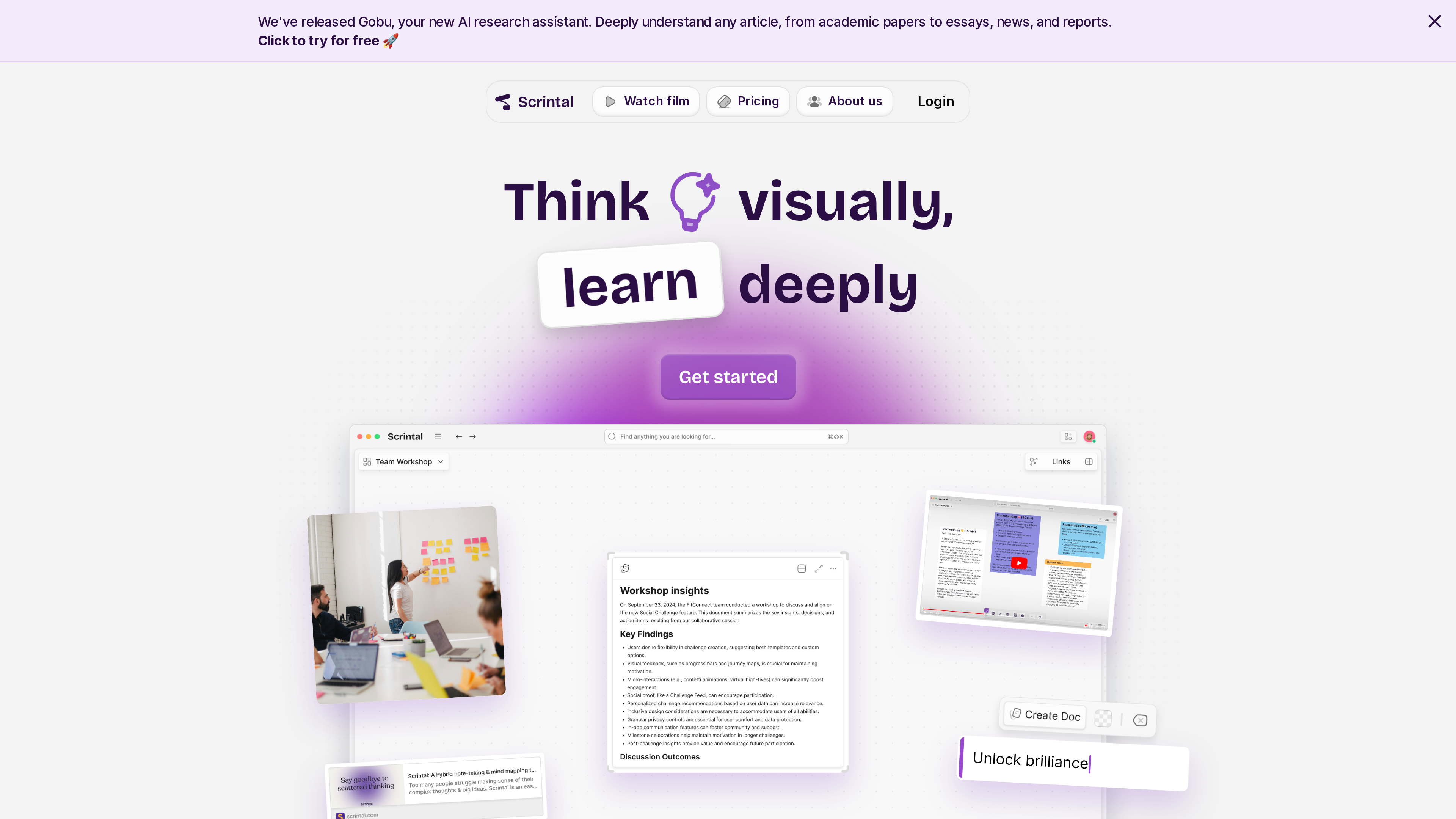
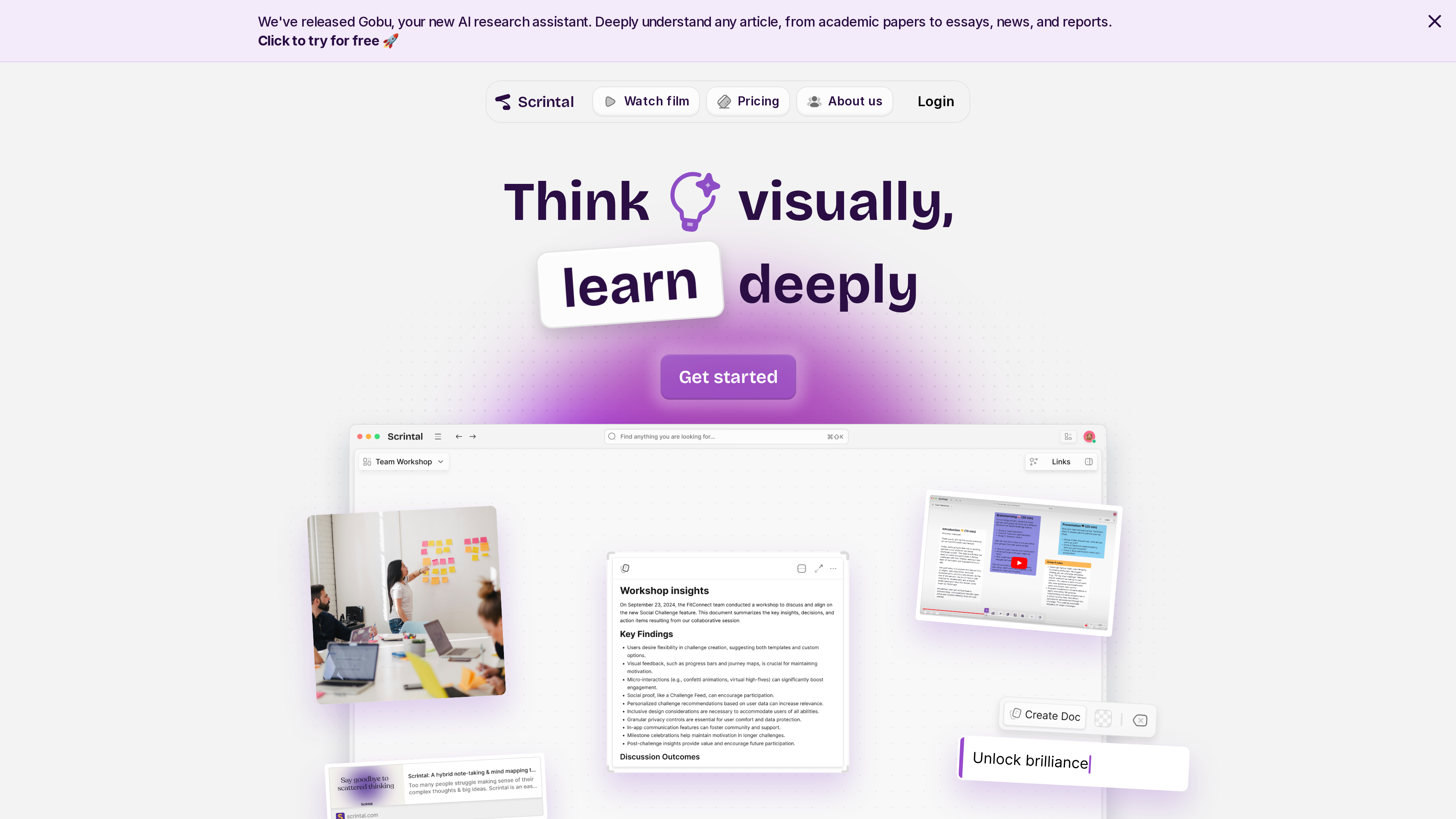
Scrintal (scrintal.com) is a visual note-taking and research tool whose homepage bills it as "Visual Note-Taking & Research Made Easy" under the tagline "Think visually, learn deeply." It aims to gather scattered PDFs, notes, images, videos, and ideas onto a single free-form canvas and turn them into a long-term, extensible knowledge base. Its verifiable differences from generic online whiteboards: canvas elements are reusable blocks, links between docs are bi-directional and work library-wide, and everything lives in a single library (per Scrintal's own comparison page). The company says it serves researchers, advanced students, executives, entrepreneurs, consultants, authors, and software developers tackling complex topics (official guide), and the homepage claims 10,000+ learners and researchers have joined as of 2026-09-30.
At a Glance
| Item | Details |
|---|---|
| URL | scrintal.com; app at app.scrintal.com |
| Type | Visual note-taking / research tool (Web + macOS + Windows desktop) |
| Cost | Single paid tier, Scrintal Pro, billed annually; no permanent free tier; 14-day invite-only trial; 30% student discount (as of 2026-09-30) |
| Sign-up | Valid email + password (Terms of Use 5.3) |
| Interface language | English (site, app, and support docs are all in English; no language switcher found) |
Background
- The official About page states "We founded Scrintal in Stockholm, Sweden," with a mission to build "a powerful canvas where insights are built one block at a time"; it does not state a founding year.
- The listed core team: Ece Kural (Co-Founder & CEO, holds a PhD), Furkan Bayraktar (Co-Founder & CTO), Filip Hedberg (Sr. Fullstack Software Engineer), Bengisu Bayraktar (Growth & Data Analysis), and Mathias Björk (Head of Product, who describes himself as Epidemic Sound's first developer and former CTO).
- The operating entity is Scrintal Labs AB, a Swedish registered company, registration number 559258-1614, Sankt Eriksgatan 63A, Stockholm (Privacy Policy); the site footer reads "© 2025 Scrintal Labs AB."
- A third-party aggregator of Swedish company registry data lists the company as registered on 2020-06-03 with 7 employees (allabolag.se; non-official source, for reference only).
- The team has launched a related new product, Gobu (an AI research assistant, gobu.ai), announced in a banner on the homepage; official docs say Gobu shares the same engine as Scrintal and the libraries interoperate, but Gobu has no bi-directional links between docs and targets linear research workflows.
Canvas-Based Visual Thinking (Core Capabilities)
A three-layer model: Blocks, Docs, and Boards
Per the official concepts doc: Blocks are the basic elements—text, images, lists, or embedded media such as videos, files, docs, and boards; Docs are rich-text documents composed of blocks; Boards are infinite canvases where blocks, docs, and even other boards can be freely arranged.
Bi-directional links vs. canvas connectors
The docs clearly distinguish two kinds of connections: Links are bi-directional connections between items that work globally across the whole library, while Connectors are hand-drawn visual lines/arrows that exist only on their board. Typing "+" inside a doc creates or searches links.
Multimedia collection and nesting
The homepage claims you can collect PDFs, images, notes, and docs in one place with nesting, and supports embedding PDFs, images, and videos.
Real-time collaboration and AI assistant
A Share button in the upper-left corner of a board enables real-time collaboration with other Scrintal users. The homepage lists an AI Assistant feature; the Privacy Policy confirms it is powered by OpenAI and processes only the documents a user actively selects for AI help.
Personal desk, global search, and templates
"My Desk" is a private canvas; Spotlight global search uses Cmd/Ctrl+Shift+K; the template library includes Kanban, Cornell notes, priority matrix, and monthly/weekly planners.
Pricing and Subscription (as of 2026-09-30)
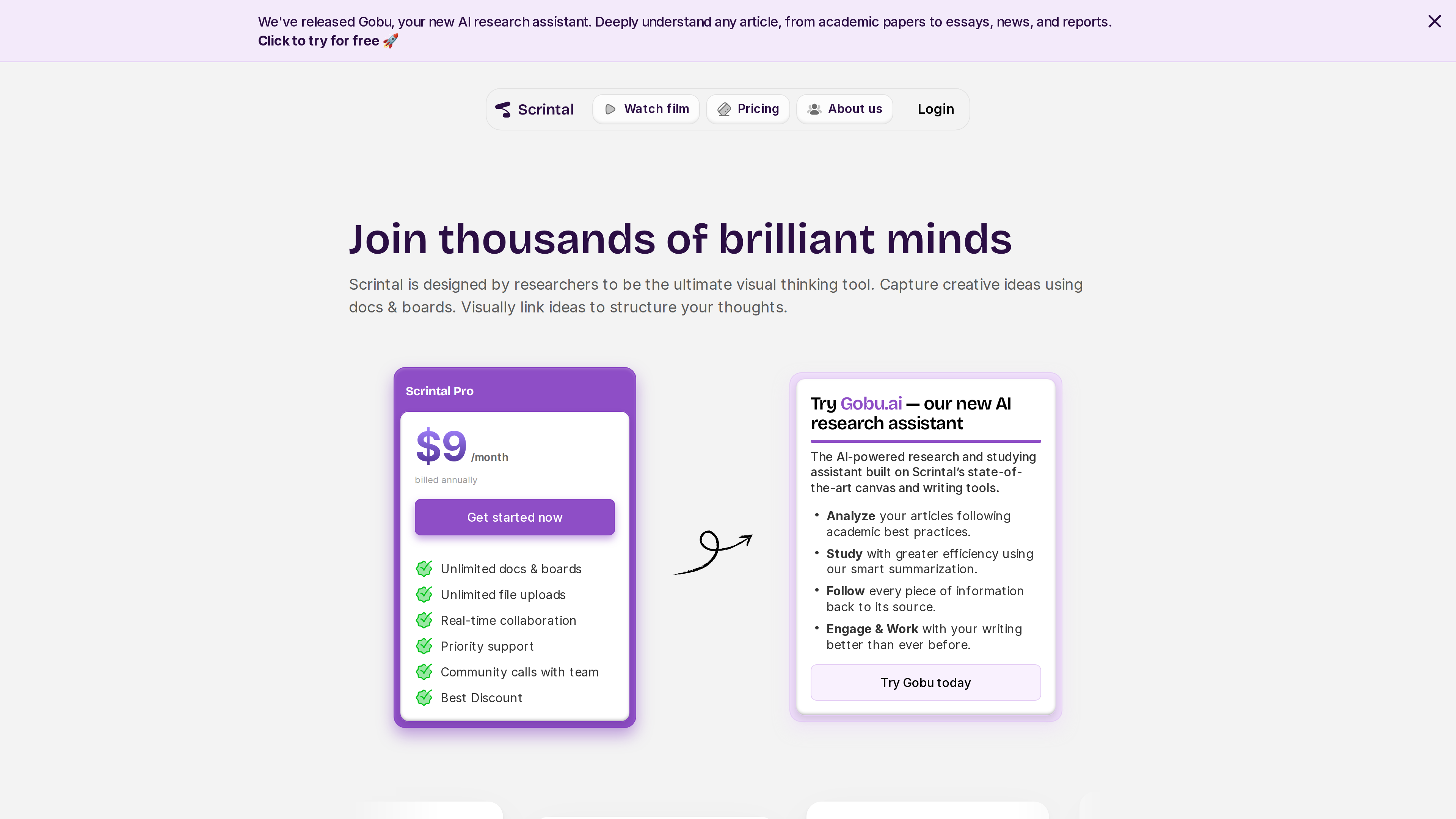
- The pricing page shows a single paid tier, Scrintal Pro, laid out as "__/month, billed annually"; the price figure is rendered by front-end JavaScript and absent from the static HTML, while the page's JSON-LD structured data marks **4.83/month (roughly $58/year)**. A month-to-month price does not appear in the static page content.
- Pro includes: unlimited docs & boards, unlimited file uploads, real-time collaboration, priority support, and community calls with the team.
- No permanent free tier and no public direct trial: the official FAQ states "we do not offer a direct trial program"; a 14-day free trial is only available via an existing user's invite (invite links circulate on X under #scrintalinvite).
- 30% student discount, applied automatically when subscribing with a university email (e.g., .edu, .ac.uk).
- Payments are handled by Stripe, supporting major credit/debit cards and Stripe's local payment methods; installments and bank transfers are not supported.
- Refund policy: new subscriptions are refundable within 7 days, renewals within 3 days; subscriptions that used a trial are non-refundable; one refund per person; refunds are issued via Stripe within 1–2 business days.
- Related perk: Scrintal users are automatically activated on the Gobu Learner plan (40 credits/month), with 1 credit consumed per PDF analysis; top-ups and upgrades are available.
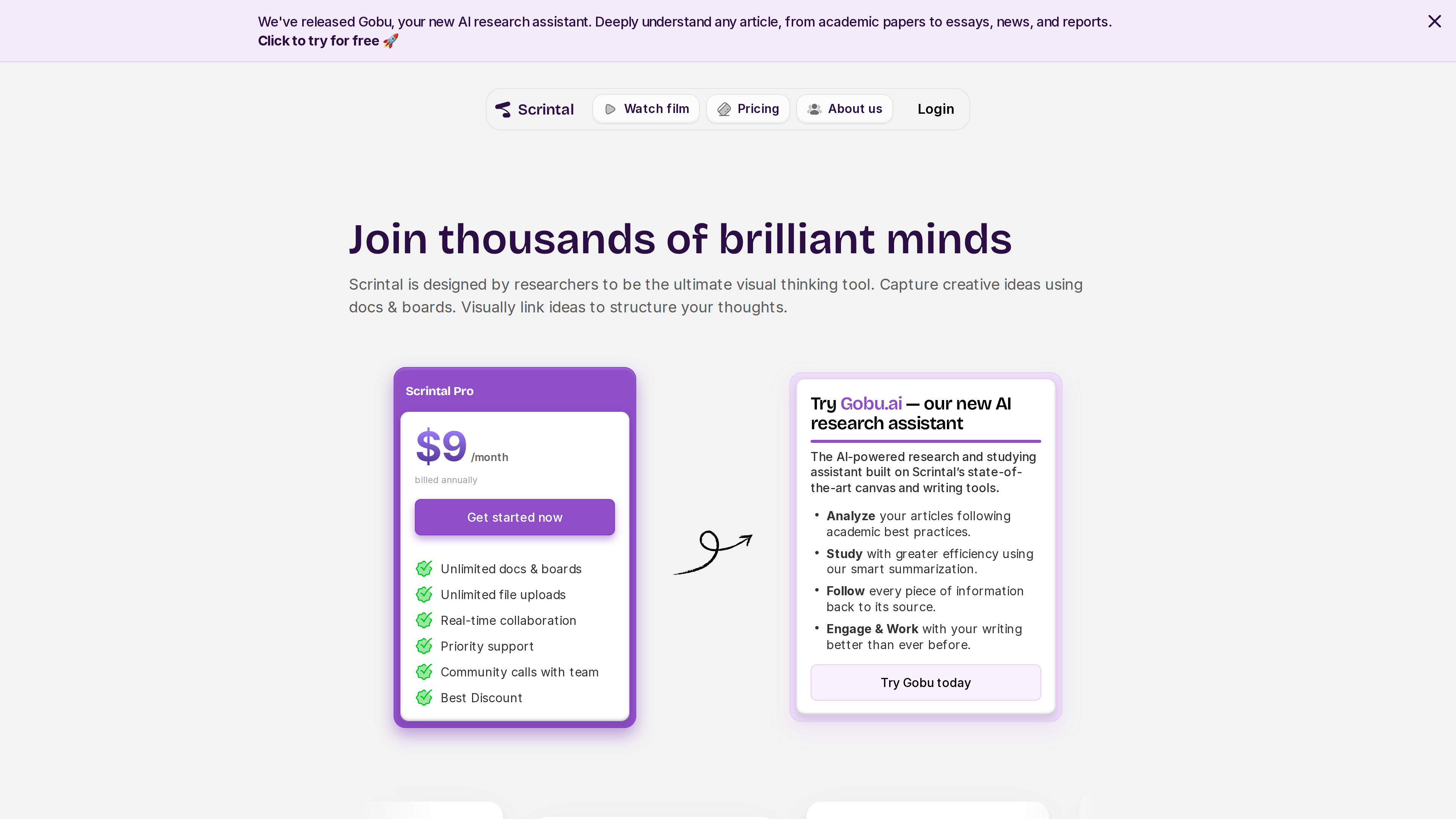
The banner at the top of the screenshot is Scrintal's genuine announcement for its new product Gobu. As actually rendered in a browser, the Pro card in the screenshot shows 4.83/month); we present both as-is—check the live page for the current price.
Accounts and Openness
- Sign-up: Terms of Use 5.3 requires an account tied to a valid email with a password; account sharing is not allowed. Submitting the homepage sign-up form means agreeing to the Terms and Privacy Policy and joining the mailing list; the app entry loads Google reCAPTCHA.
- Platforms: Web (app.scrintal.com) plus macOS (Apple Silicon / Intel) and Windows desktop apps; the installers offered on the site are all version 0.2.13 (as of 2026-09-30). No official iOS/Android app was found.
- Import: Markdown archive import only—you must select a folder containing .md files (single files are not accepted); tags and bi-directional links are preserved, but embedded files and images are not imported; imported docs carry an #imported tag.
- Export: a single doc can be downloaded as .md or saved as PDF; the whole library can be exported in one click as a Markdown zip (boards are converted to link-preserving md files). The FAQ promises "your data always belongs to you," with full Markdown export possible even if the company shuts down.
- API and integrations: the support docs' site-wide index contains no API/developer entries and no third-party integration directory—no public API was found.
Data and Privacy
- Personal data is processed under the GDPR, with Scrintal Labs AB as data controller (Privacy Policy).
- User content data is stored within the European Economic Area (EEA), with the user as controller and Scrintal as processor; other personal data (analytics, billing, etc.) may be transferred outside the EEA (including the US), involving third parties such as Google Analytics, MixPanel, Stripe, Typeform, Brevo, and PromoteKit.
- The AI assistant shares data with OpenAI only for the documents you select.
- You can permanently delete your account self-service under Settings → Account (confirmed via an email verification code); deletion is irreversible.
- Security measures are described only in general terms; no written details on encryption (e.g., end-to-end encryption) were found.
Who It's For
The following is inferred from the official positioning and the verifiable features above, for your own assessment:
- Researchers and students who need to structure PDFs, notes, and multimedia material on one canvas (the official target audience, with a 30% student discount);
- Individual users who want a knowledge base that accumulates long-term, links docs bi-directionally, and can be fully exported to Markdown;
- Authors and consultants who prefer canvas-style brainstorming but also need rich-text writing;
- Small-scale real-time collaboration on boards (per-person subscription, no seat billing).
Limitations
- No permanent free tier and no public direct trial—the 14-day trial requires an existing user's invite, a higher barrier than most peers.
- No official mobile apps (Web + macOS + Windows only), and no Linux client.
- Import supports Markdown folders only; embedded images/files do not migrate.
- No public API and no third-party integration ecosystem; Scrintal's own Miro comparison page lists Miro's "integration with many tools" as a strength, which indirectly confirms Scrintal's weakness here.
- Collaboration centers on board sharing and real-time editing; no written evidence of team spaces, seat billing, or other enterprise features—pricing is a single Pro tier.
- The company is small (7 employees per third-party registry data); the 4.5/5 rating in the pricing page's JSON-LD (ratingCount 1200) is self-declared structured data, not an independent review.
Alternatives (as of 2026-09-30)
| Site | Pricing | Objective differences vs. Scrintal |
|---|---|---|
| Heptabase | Pro 17.99/mo, Premium+ $53.99/mo (annual billing prices; 25% off annually, includes AI credits) | Covers Mac, Windows, Linux, iOS, Android (Scrintal has no mobile or Linux apps) |
| Milanote | Permanent free tier (100 notes/images/links, 10 file uploads, unlimited shared boards); Personal 12.50/mo (monthly); Team $49/mo (annual, up to 10 people) | Scrintal's lack of a free tier is a clear difference |
| Miro | Free tier with 3 editable boards; Starter 20/member/mo (annual) | Seat-based and team-oriented, with guest roles and AI credits; Scrintal is a single individual subscription |
Note: Scrintal's official comparison page (the vendor's own view, for reference) argues that Miro is a team-collaboration whiteboard "not designed to build a long-term, extendable knowledge base," while Scrintal's differentiation lies in blocks + global bi-directional links + a single reusable library. The site also hosts comparison pages vs. Notion / Obsidian / Evernote / Roam / Milanote / Mural / Logseq, but none vs. Heptabase.
References
- Homepage: https://www.scrintal.com/
- Pricing: https://scrintal.com/pricing
- About: https://scrintal.com/about
- Support docs (GitBook): https://scrintal.gitbook.io/scrintal-support-docs/
- Terms of Use: https://scrintal.com/terms-of-use ; Privacy Policy: https://scrintal.com/privacy-policy
- Third-party registry info (non-official): https://www.allabolag.se/5592581614/scrintal-labs-ab