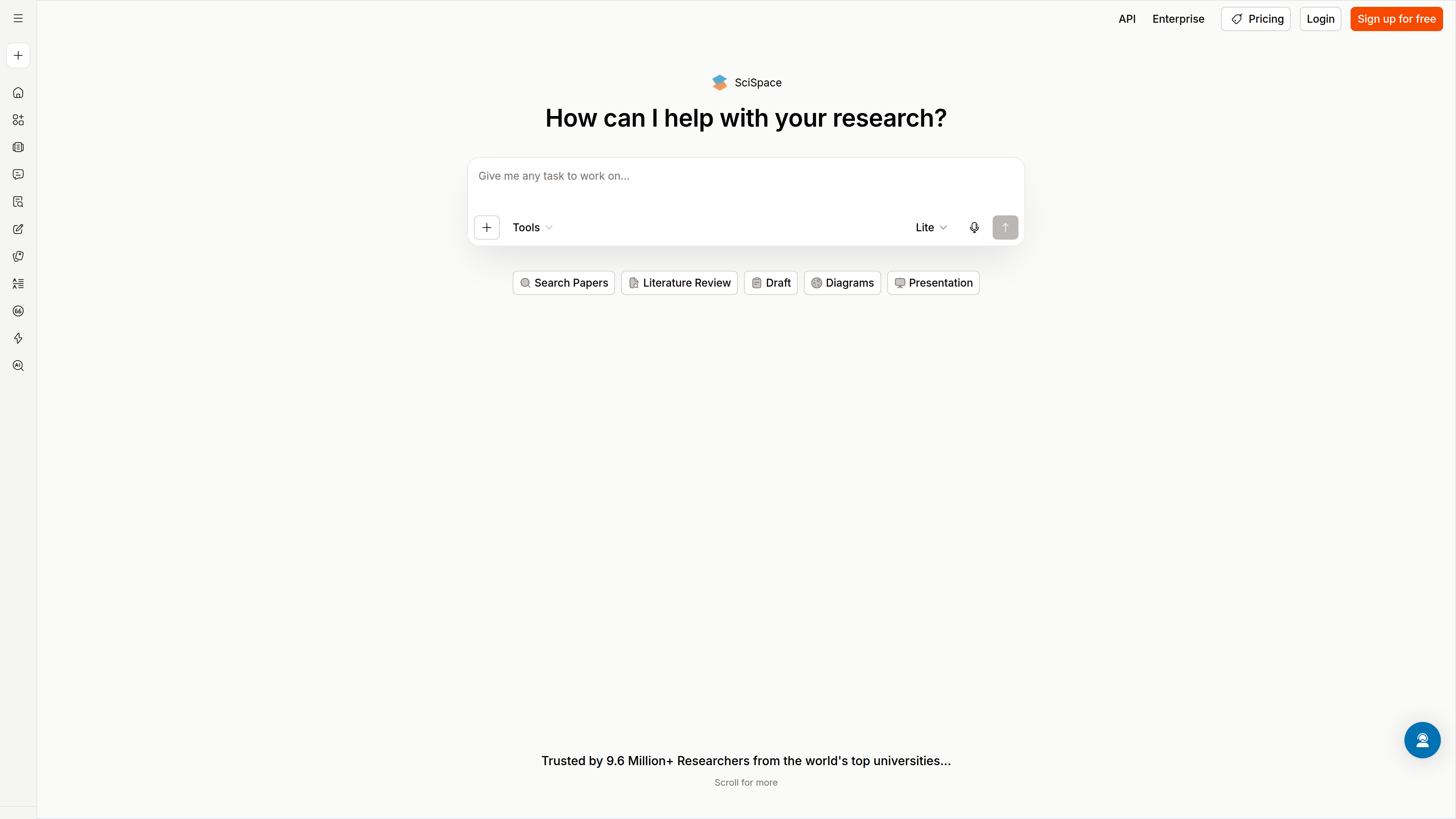
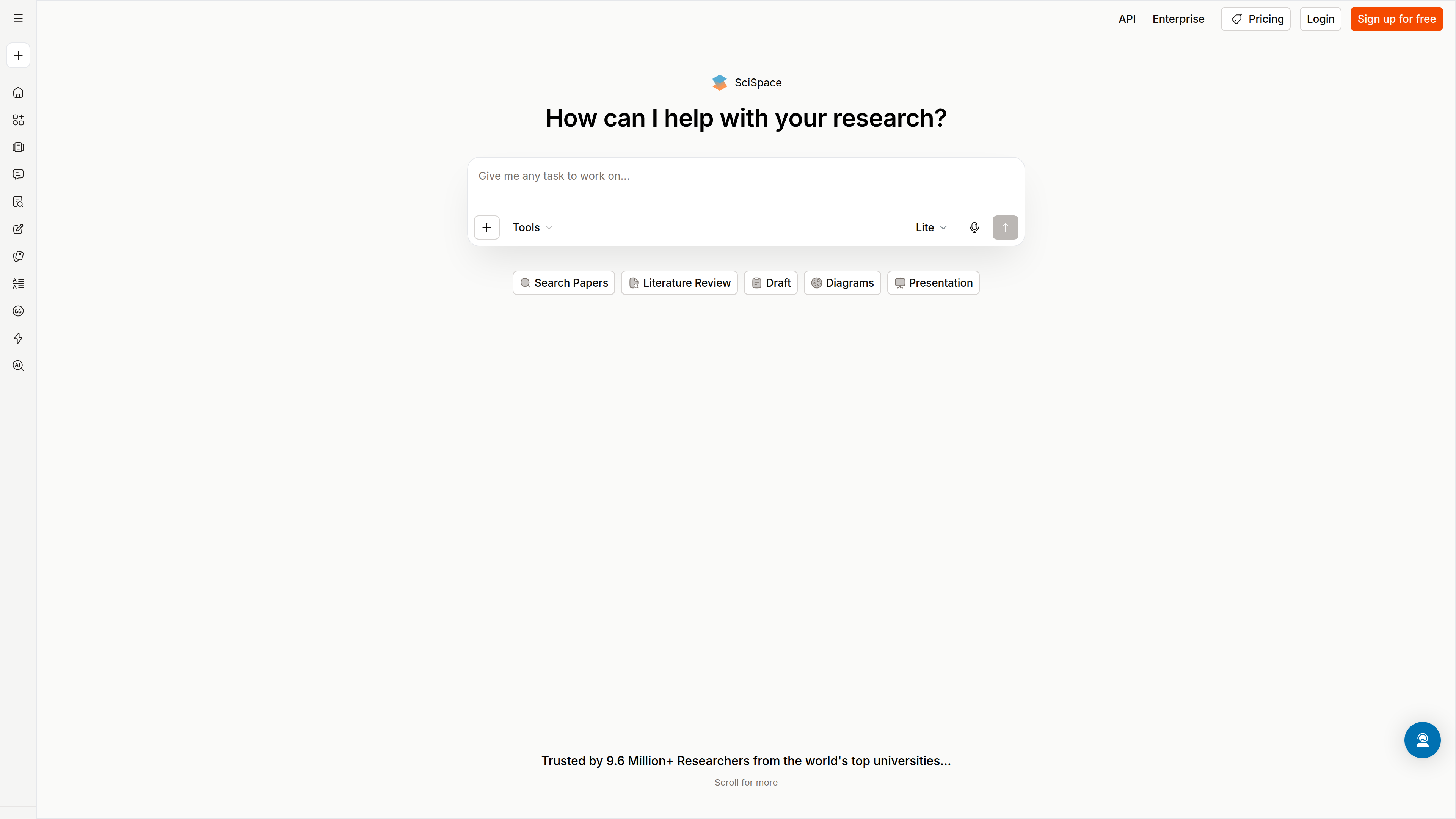
SciSpace (scispace.com) is an AI research assistant built for students, academics and R&D teams. It wraps a paper database—280 million+ papers by the company's own count as of 2026-10-02 (homepage)—in a single workspace that covers discovery, reading and writing: literature search and review, Chat with PDF, an AI writer with citations, a citation generator and data extraction tools. The company began as Typeset, a journal-formatting platform founded in the mid-2010s, rebranded to SciSpace around 2023, and now redirects typeset.io to scispace.com.
At a glance
- URL: https://scispace.com/
- Type: AI research assistant / academic search and writing platform
- Cost: Free tier + subscriptions (Premium from $12/mo billed annually; see Pricing)
- Sign-up: Required for core features (Sign up for free on the homepage); product pages are publicly readable
- Languages: 19 localized site versions including Simplified Chinese (per page hreflang declarations, as of 2026-10-02); the company says Chat with PDF handles documents in 75+ languages
- Operator: PubGenius Inc., Milpitas, California, USA (site footer, 2026-10-02)
Background
SciSpace was co-founded by Saikiran Chandha (CEO) and Shanu Kumar. According to an Inc42 report from July 2023, the two Indian engineers (VIT and IIT Kharagpur alumni) met through the Stanford Ignite program; the report cited the company website at the time as saying it was founded in 2016 and based in Bengaluru, India. Its original product, Typeset, helped researchers format manuscripts to journal templates. Riding the generative AI wave, the company renamed itself SciSpace and launched its flagship Copilot reading assistant around April 2023. The current site footer lists the operating entity as PubGenius Inc. in Milpitas, California.
On funding, verifiable first-hand information is limited: the same Inc42 report notes undisclosed investment from Inventus Capital and Silicon Valley Quad; no later rounds have been officially announced.
Scale figures have grown over time: in July 2023 the company claimed 250 million open-access papers and 400,000 active researchers (Inc42); the Chrome extension page said 270 million+ papers in January 2026; since August 2026 the homepage states 280 million+ papers and "Trusted by 9.6 Million+ Researchers" (as of 2026-10-02). Other pages carry different marketing figures ("1 million+", "10 MILLION+ USERS"), so dates and sources matter when citing them.
Core capabilities
Literature search and review
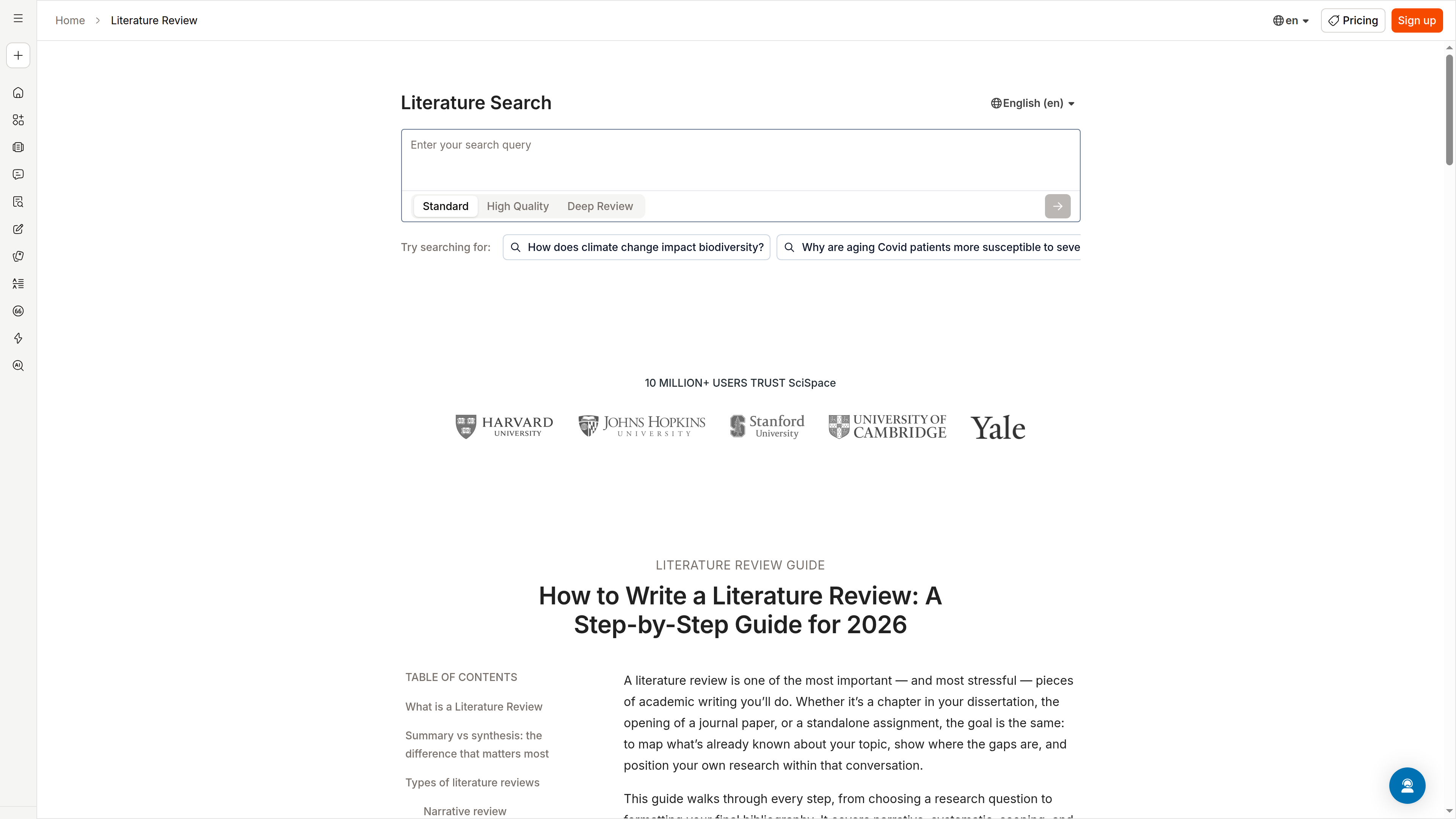
The Literature Review tool offers Standard, High Quality and Deep Review modes: ask a question in natural language and it retrieves papers and drafts a review. The site cites the company's own whitepaper claiming that, across 200 complex research queries, Deep Review returned 26.3 highly relevant papers per query on average versus Elicit's 13.0—a self-reported figure that has not been independently verified.
Chat with PDF (Copilot)
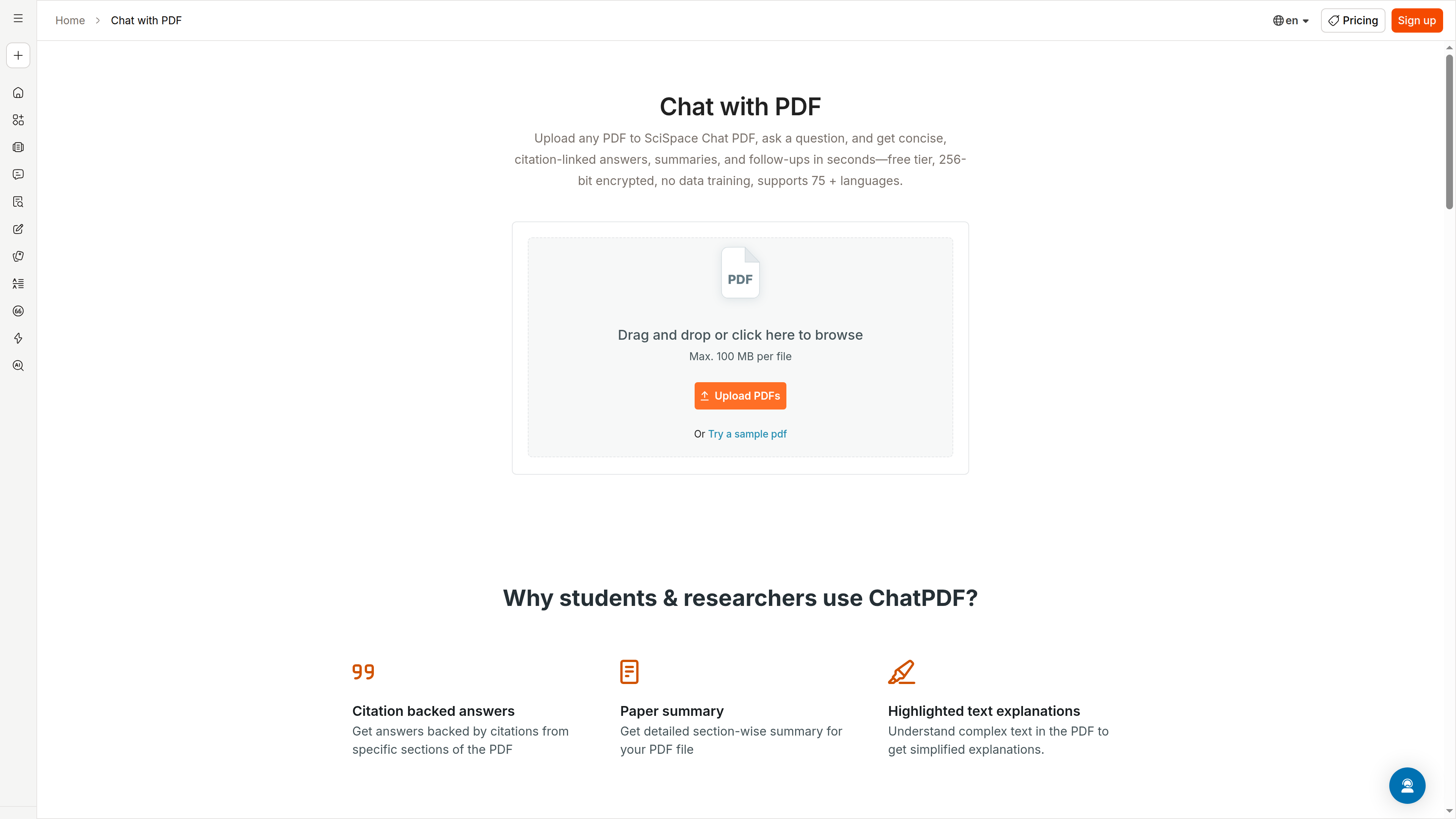
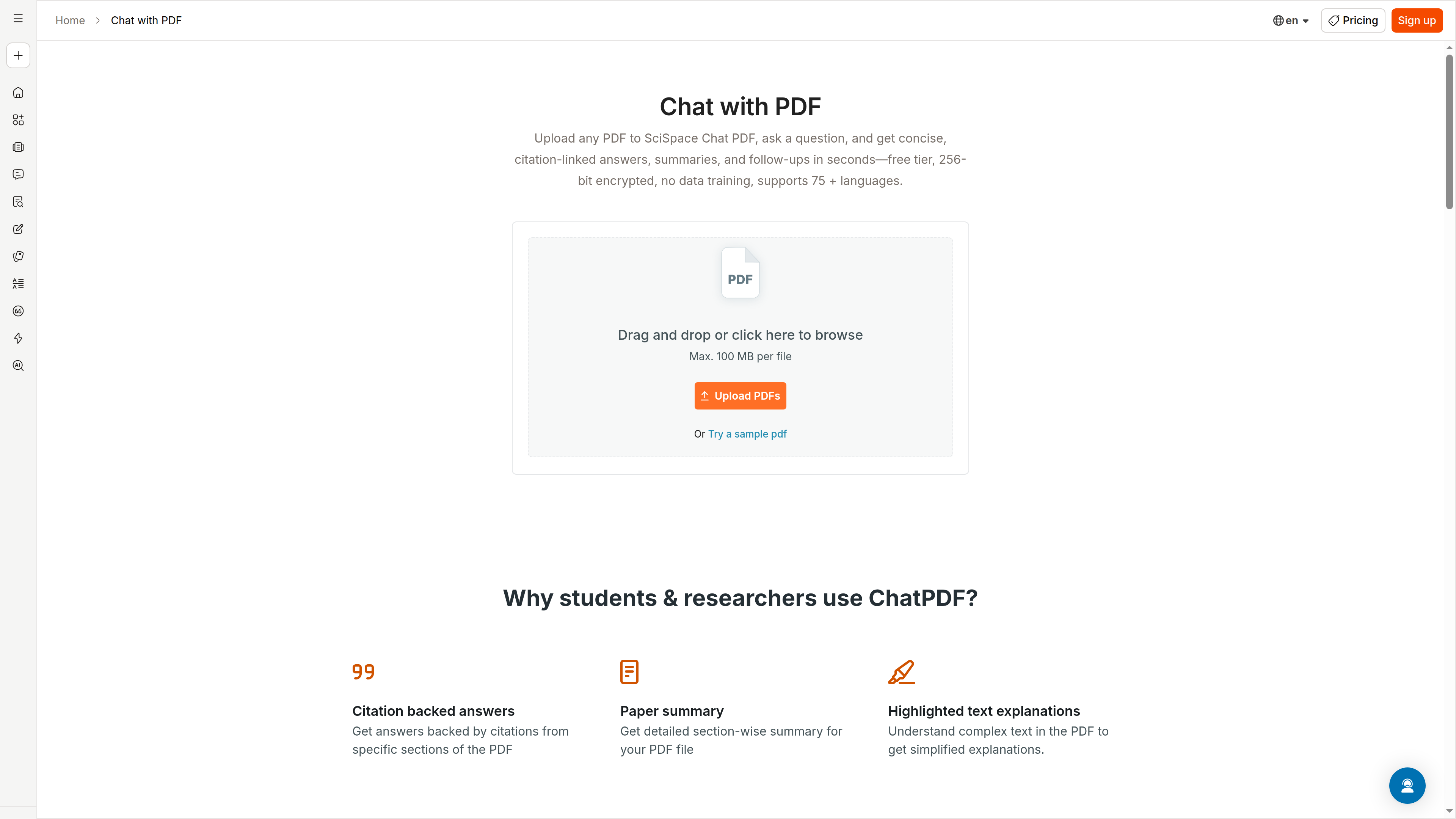
Chat with PDF lets you upload a PDF (up to 100 MB) and ask questions, returning citation-linked answers and section-wise summaries. Highlighting passages, equations or tables yields simplified explanations, and the tool suggests related papers and supports notes. The page promises a free tier, 256-bit encryption, no training on user data, and 75+ language support.
AI Writer and writing aids
AI Writer autocompletes academic text, suggests edits and inserts citations from the 280M+ paper database while you write, with export options. Companion tools include a Paraphraser, an AI Detector, and Find Topics, which groups papers and insights by discovered topics.
Citations and data extraction
The Citation Generator is free and, per the company, produces references in 2,300+ styles including APA, MLA, Chicago and Harvard. Extract Data identifies tables, statistics and citations in research PDFs, compares up to 50 parameters across papers, and exports to CSV, Excel, RIS, BIB or XML.
Agents and integrations
The Agent Gallery provides prebuilt AI agents for PRISMA systematic reviews, patents, clinical trials, grant applications and more, alongside a domain-specific Biomedical Agent. The Chrome extension explains highlighted text, answers follow-ups and saves articles on publisher and repository sites (Nature, Springer, Elsevier, Wiley, Google Scholar, arXiv, among others); the Chrome Web Store lists 200,000 users and a 4.4 rating from 144 ratings as of 2026-10-02. An iOS app is available on the App Store. The 40,000+ journal templates from the Typeset era remain available under Templates.
Pricing
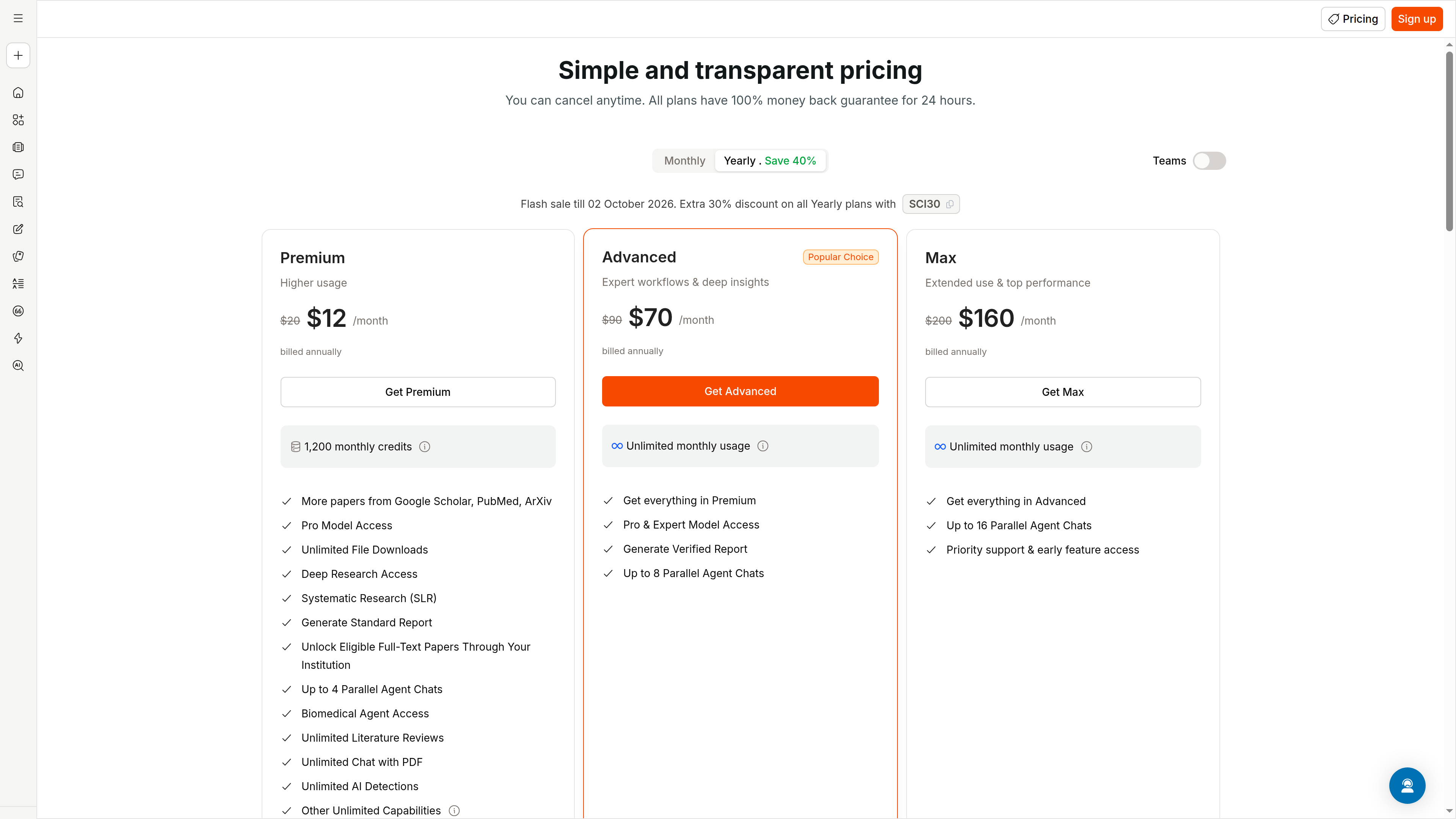
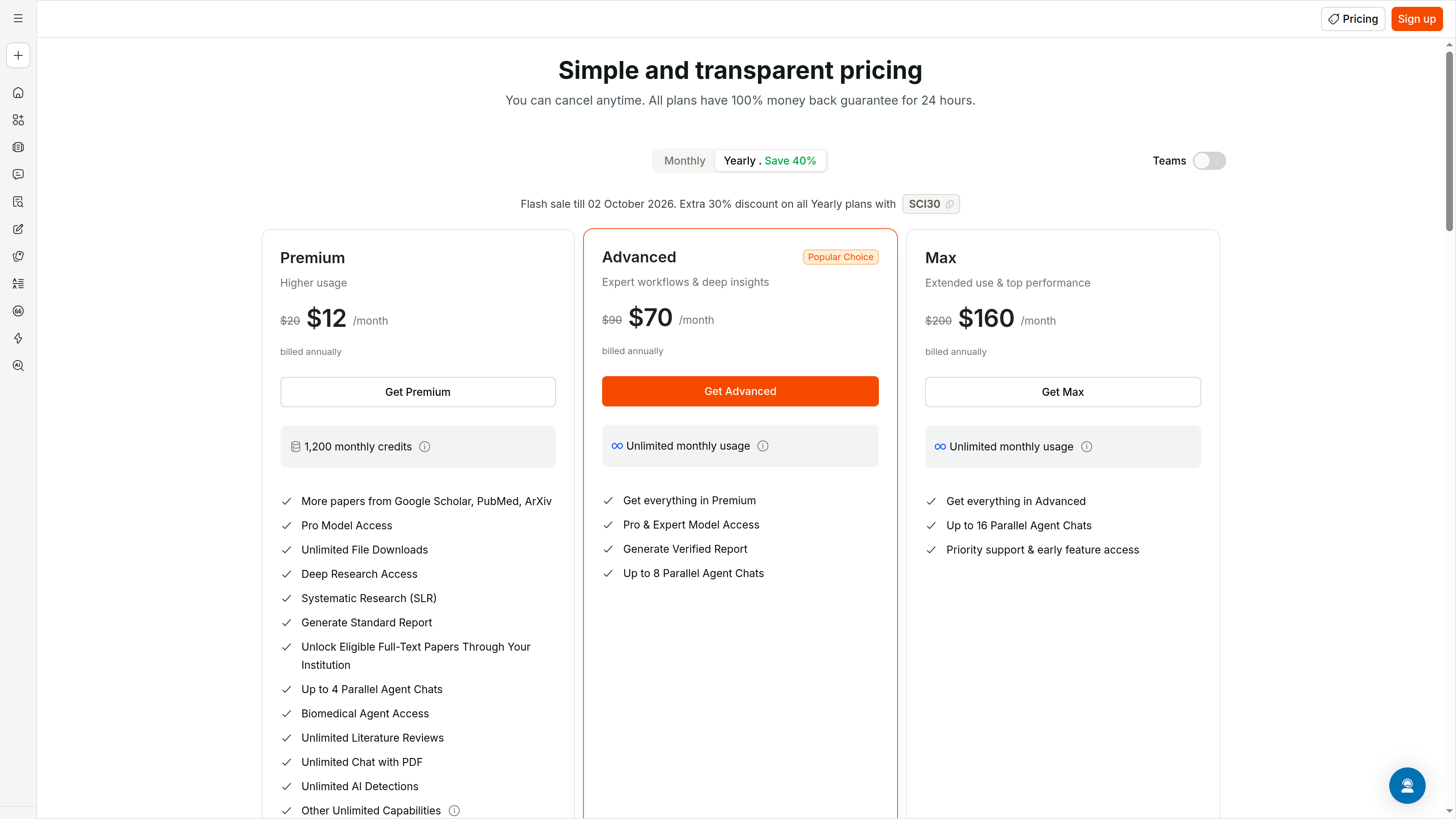
SciSpace is freemium. A free account covers basic usage (the Chat with PDF page explicitly mentions a free tier), but the public pages do not state exact free-tier quotas. Paid plans (as of 2026-10-02, pricing page, USD):
| Plan | Monthly | Billed annually | Highlights |
|---|---|---|---|
| Premium | $20/mo | 144/yr) | 1,200 monthly credits; Pro models; unlimited literature reviews, Chat with PDF and AI detections; up to 4 parallel agent chats |
| Advanced | $90/mo | 840/yr) | Unlimited monthly usage; Pro & Expert models; Verified Reports; up to 8 parallel chats |
| Max | $200/mo | $160/mo | Up to 16 parallel chats; priority support and early feature access |
| Enterprise | Custom | Custom | Everything in Advanced plus SSO/SCIM, shared credit pools, consolidated billing and custom integrations |
Team plans are per seat (2–300 seats): Teams Premium 75/seat/mo and Teams Max $175/seat/mo when billed annually (pricing page data from 2026-09-30). Plans can be cancelled anytime, and the company advertises a 100% money-back guarantee for 24 hours. Time-limited discounts run regularly (for example, an annual-plan promo code valid through 2026-10-02). Credits fuel heavy operations such as agent tasks; unused monthly credits do not roll over.
Who it suits
- Students and cross-disciplinary readers who need to get through English-language papers quickly: highlighted-text explanations, equation and table decoding, and section summaries lower the barrier.
- Researchers running literature or systematic reviews: natural-language search, Deep Review and data extraction cover the path from search to synthesis matrix.
- Writers who need citations and formatting help: the Citation Generator is free, and AI Writer cites as you type.
- Anyone who reads directly on publisher sites: the Chrome extension explains content in place.
Limitations
- Opaque free tier: public pages confirm a free plan exists but do not publish its quotas; heavier features (Deep Review, agent tasks, more parallel chats) sit behind paid tiers.
- AI output needs verification: summaries, explanations and reviews are AI-generated and can misread or omit; the company's own AI Detector underscores that AI content warrants scrutiny. Check sources before citing conclusions.
- Self-reported database figures: the composition of the 280M+ paper count (open-access full text versus metadata records) is not fully disclosed on public pages, and the Deep Review benchmark comes from the company's own whitepaper.
- English-first content: despite 19 localized versions, blogs and guides are maintained primarily in English.
- Dynamically rendered legal pages: the privacy policy renders client-side, which makes offline reading and archiving inconvenient.
Alternatives worth knowing
- Consensus: also answers questions with citations from the literature (220M+ papers per its help center, as of 2026-09-30) but focuses on Q&A and consensus metering; SciSpace covers a wider workflow from PDF reading to writing and extraction.
- Semantic Scholar: a free academic search engine from the nonprofit Allen Institute for AI, indexing 214 million papers (About/API pages, as of 2026-10-02); SciSpace is a commercial product that layers AI reading and writing on top of literature data.
References
- SciSpace homepage, Pricing, Chat with PDF, Literature Review, AI Writer, Citation Generator, Extract Data, Agent Gallery, Mobile app page (checked 2026-10-02)
- How SciSpace Has Become The ChatGPT For Researchers & Academicians — Inc42 (2023-07-21)
- SciSpace Chrome extension — Chrome Web Store (checked 2026-10-02)
- Semantic Scholar About (checked 2026-10-02)