SaaS Landing Page is a design inspiration gallery focused exclusively on SaaS landing pages: real SaaS websites are captured as full-page screenshots and organized by page section, so designers, marketers, and indie makers working on their own landing pages can study how established products handle a specific block — a Pricing section, an FAQ, a Features grid — instead of starting from a blank canvas. The homepage claims 880 landing page examples (as of 2026-09-21; the site's own figure), and every entry is annotated with the fonts, color palette, and tech stack it uses. The footer credits the site as "A project by Davide Pacilio," a personal project of an Italian product designer.
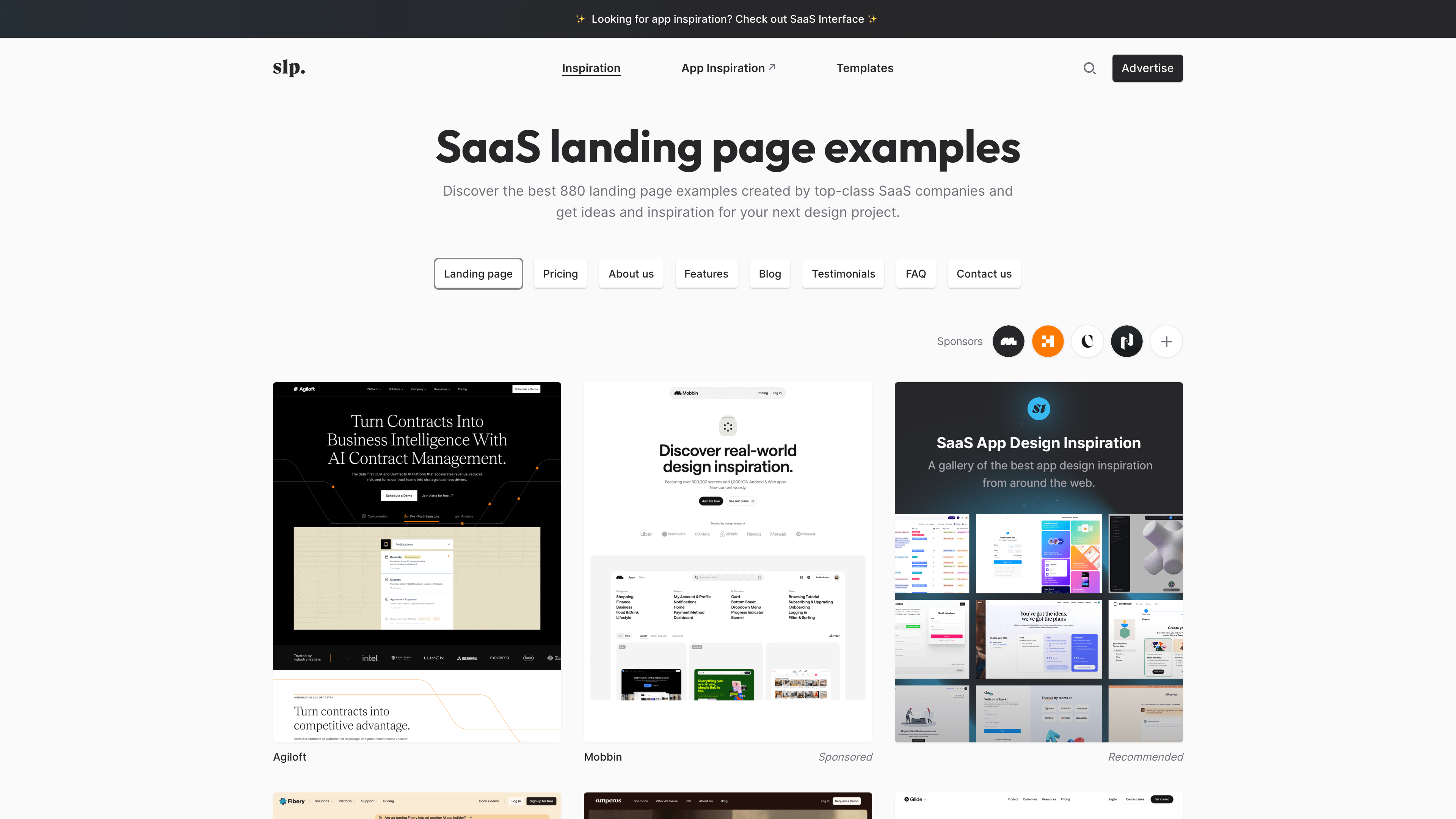
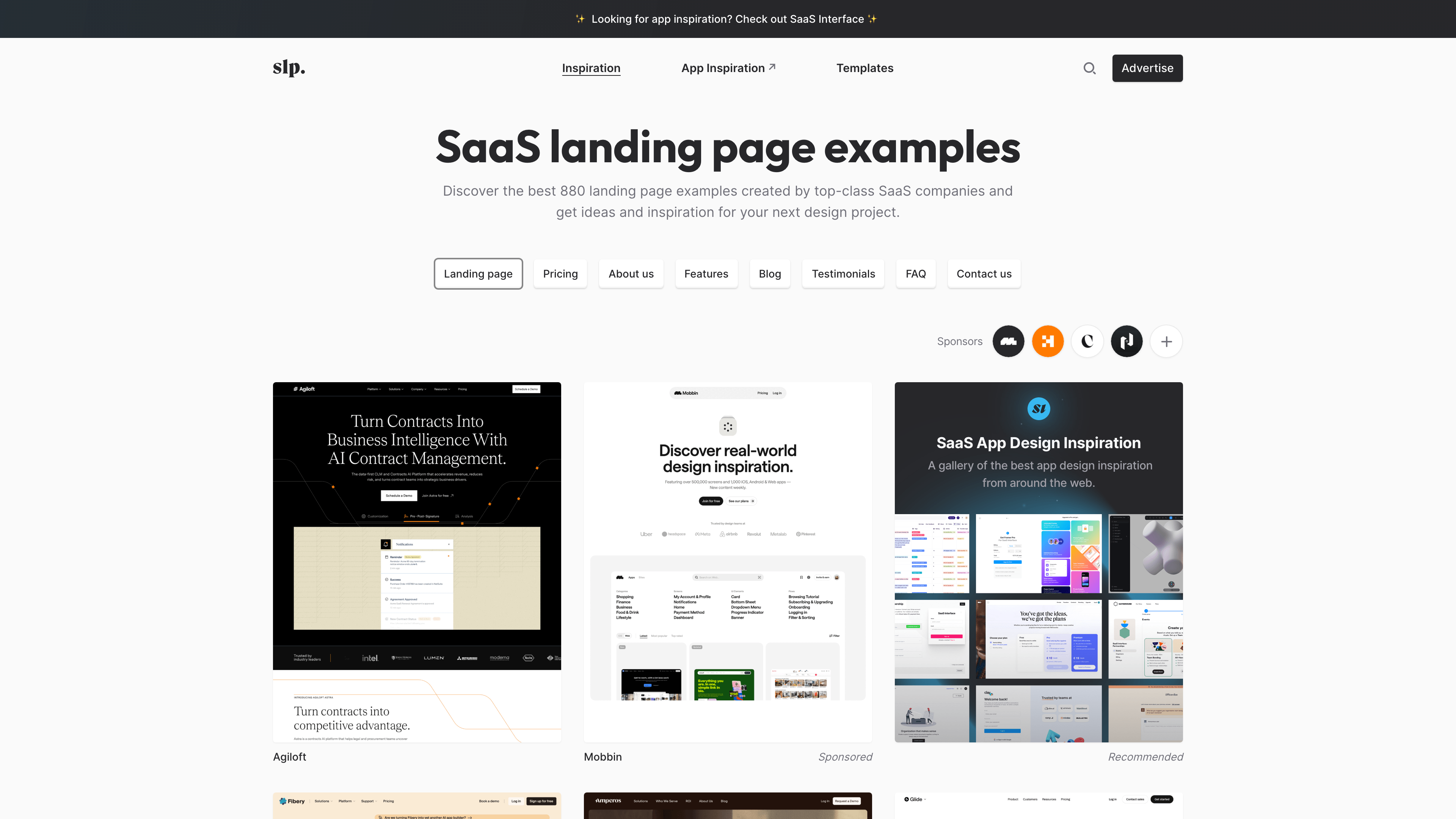
The screenshot above shows the homepage (captured 2026-09-21). The hero states the gallery size and offers eight section filters (Landing page, Pricing, About us, Features, Blog, Testimonials, FAQ, Contact us). Below is a card stream where each card is a full-page screenshot thumbnail labeled with the company name; sponsored entries carry a "Sponsored" badge (Mobbin in the image), the SaaS Interface cross-promotion is marked "Recommended," and a row of current sponsor logos sits above the grid.
At a glance
- URL: https://saaslandingpage.com/
- Type: SaaS landing page design gallery (plus a template directory and blog articles)
- Cost: Browsing the gallery is free; ad placements and the sister site SaaS Interface are paid (details below)
- Account: None required; there is no account system
- Interface language: English only (checked 2026-09-21)
- Operator: Personal project of Davide Pacilio (Italy)
Background
SaaS Landing Page is run by Italian product designer Davide Pacilio, credited in the site footer with a link to his X account. The makers page on Product Hunt lists two makers: Davide Pacilio and front-end developer Pasquale Vitiello, who are also co-founders of the landing page template shop Cruip (source: BetaList profile).
The exact launch date is not officially documented: the advertising page claims the site has served "designers and founders who've trusted us since 2018," while the third-party directory BetaList featured it on February 26, 2020 (listing Italy as its location), and Product Hunt labels it "Launched in 2020." What can be confirmed is that the site has existed since at least early 2020 and remains actively maintained — entry dates show updates as recent as August 2026 (see the Calendly entry below).
The same team also runs SaaS Interface, a paid gallery of SaaS application UI, and the Cruip template shop; all three cross-promote each other on-site.
The gallery and its filters
The gallery's core value is browsing by page section rather than by whole site. Each of the eight sections has its own page with a self-reported count (all figures as of 2026-09-21): 880 full homepages (Landing page), 62 Pricing pages, 50 About us pages, 40 Blog pages, 24 FAQ pages, and 18 Contact us pages, with Features and Testimonials categories available as well. If you want to study how others structure a pricing page, you can simply open the Pricing category and scroll through screenshots — far faster than visiting dozens of live sites one by one.
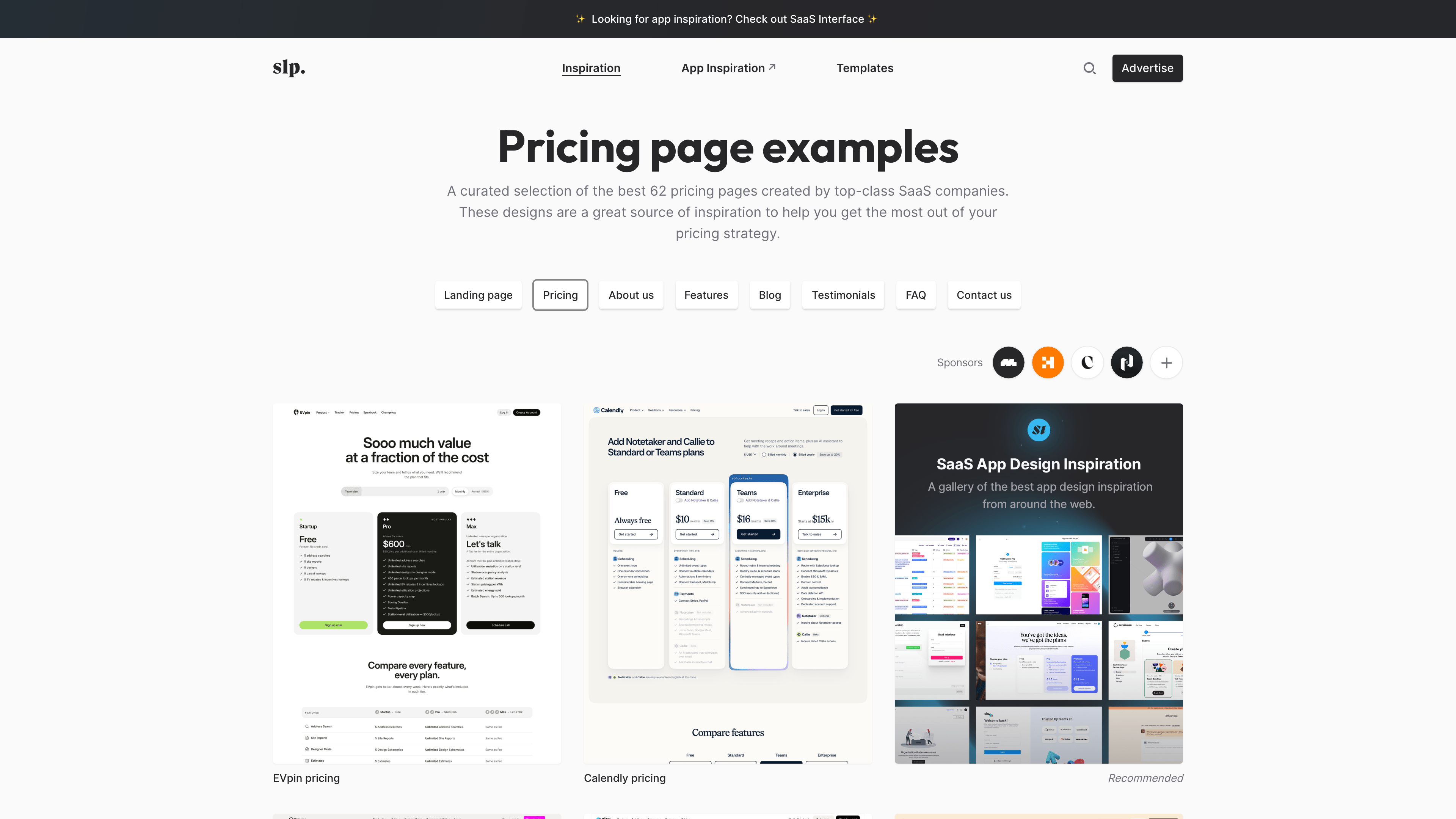
The screenshot above shows the Pricing category page (captured 2026-09-21), which describes itself as "a curated selection of the best 62 pricing pages," with cards showing full-page captures of SaaS pricing pages.
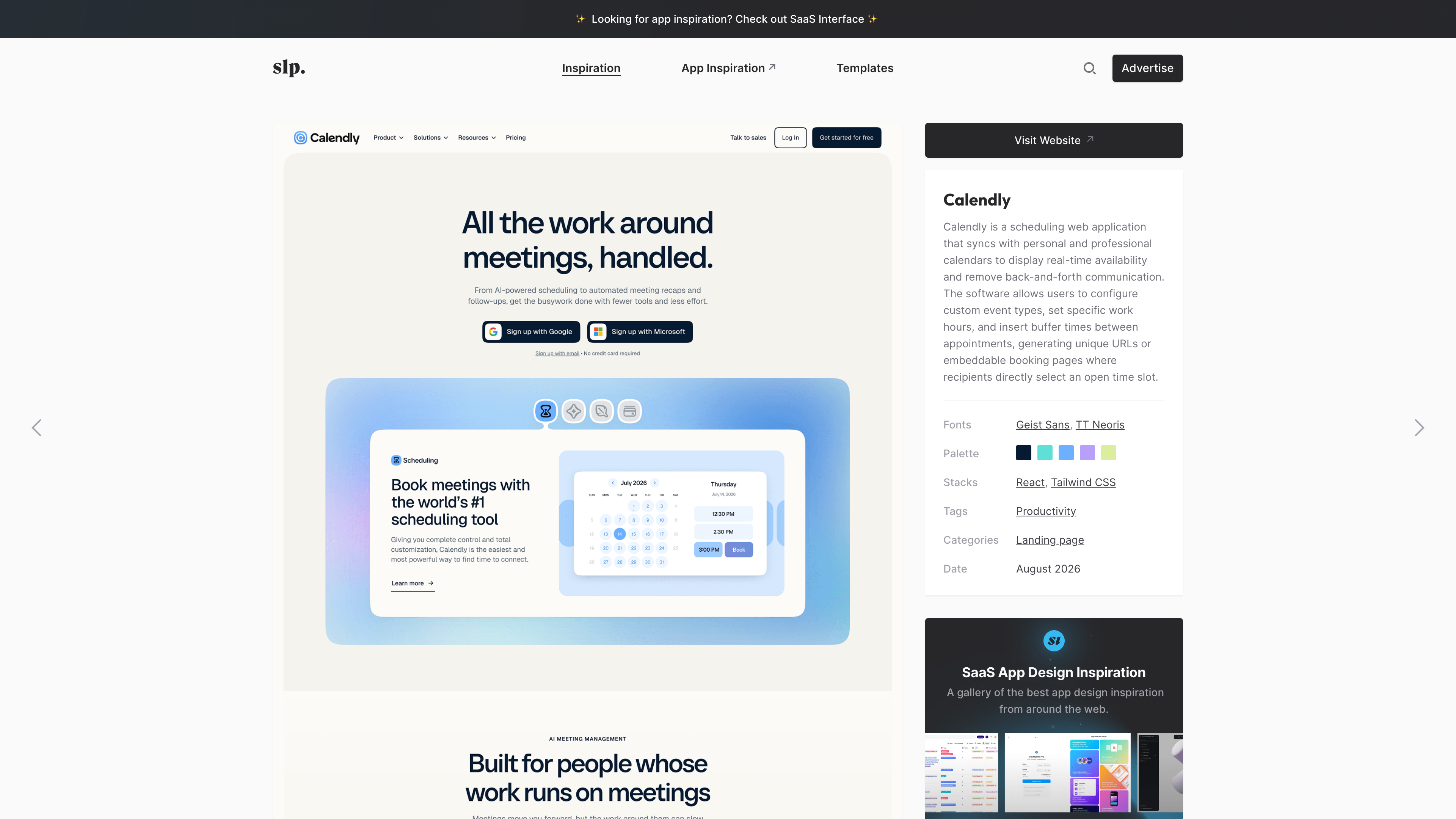
Opening an individual entry reveals the site's signature feature: design metadata annotations. Take the Calendly entry:
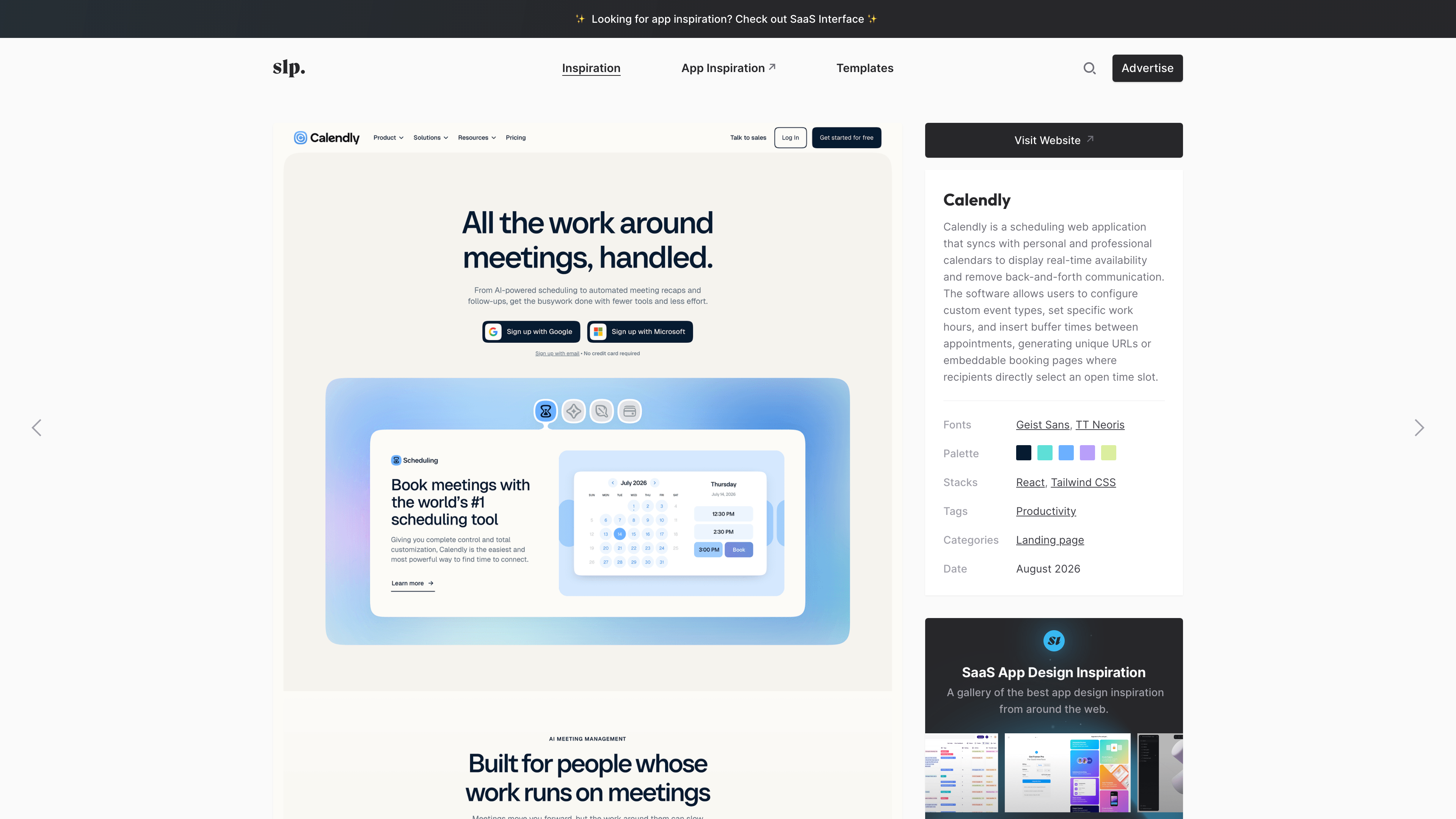
The screenshot above shows the Calendly entry (captured 2026-09-21). On the left is a full-page capture of calendly.com; on the right are its Fonts (Geist Sans, TT Neoris), Palette (five theme color hex values), Stacks (React, Tailwind CSS), Tags (the Productivity industry tag), Categories (Landing page), and Date (August 2026 — the month the entry was added or refreshed), along with a "Visit Website" link to the live site. Entry pages support arrow-key navigation to flip quickly to the previous or next example. The font, palette, and stack dimensions also have their own aggregate pages — browse by the Inter font or by Tailwind CSS, for instance — so you can reverse-lookup what real landing pages built with a particular font or framework look like. Note that the site does not disclose whether this metadata is auto-detected or manually annotated, so its accuracy carries no public guarantee.
The site runs on WordPress, offers a light/dark theme toggle, and paginates the gallery with a "Load more" button.
Template directory and the SaaS Interface sister site
Beyond the free gallery, the site has two adjacent businesses.
The first is the template directory, which claims 84 SaaS landing page templates (as of 2026-09-21), filterable by Framer, Webflow, React, HTML, Next.js, Tailwind CSS, and Vue, with some entries marked "Free." The directory hosts no templates itself — clicking through leads to third-party platforms including the official Framer Marketplace, Cruip, Nucleo, and Crafted. The Framer links are affiliate referrals, and Cruip is the owner's own template shop.
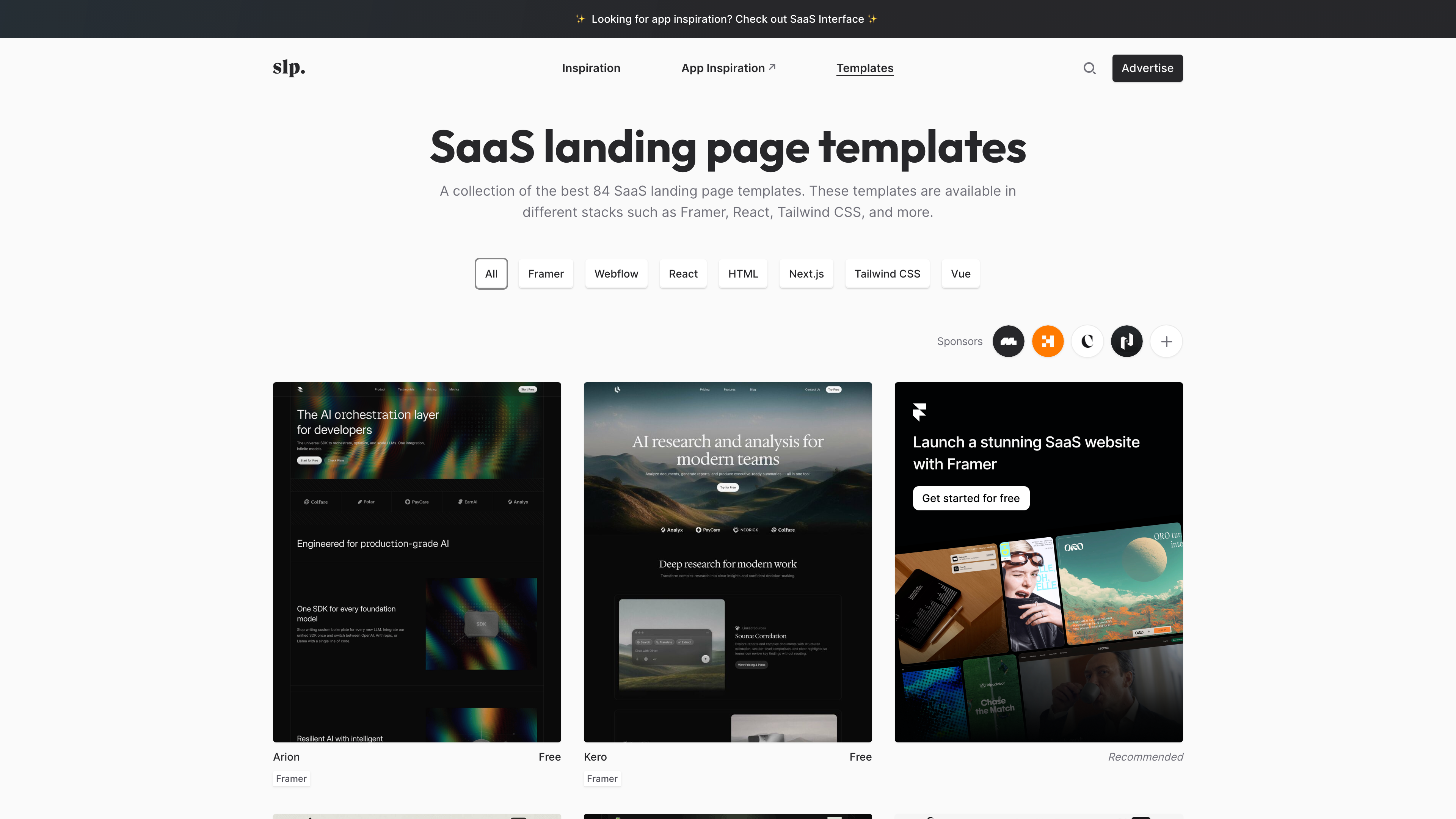
The screenshot above shows the template directory (captured 2026-09-21), filterable by stack, with template previews and pricing labels.
The second is the sister site SaaS Interface, a gallery of screenshots from inside SaaS applications (dashboards, settings pages, and other real product UI), self-described as the "world's largest gallery of SaaS app UI and UX design examples." Unlike this free site, SaaS Interface is a paid product sold as a one-time purchase: 199 for a team license (its pricing page showed a 20%-off promotion as of 2026-09-21, reducing them to 159), with monthly updates promised, a 48-hour refund window, and a 25% discount for students and teachers. SaaS Landing Page promotes it through a top banner and placements on entry pages.
Monetization
Browsing the site itself is entirely free. Revenue comes from three channels: template referrals (including affiliate links), SaaS Interface sales, and advertising. The advertising page (as of 2026-09-21) publishes rate cards: a homepage sponsorship at 550 one-time, and a blog feature at $500 per article. The site's self-reported traffic — over 60,000 monthly unique visitors with 90–95% organic and direct traffic — cannot be independently verified and should be read as an order-of-magnitude claim. Sponsored entries appear in the gallery with a "Sponsored" badge; regular entries are unaffected.
Copyright and content policy
The gallery consists of third-party website screenshots curated by the owner; every entry credits its source and links to the original site. No public licensing, reprint, or takedown policy could be found on the site. The privacy policy (last updated September 18, 2024) contains only a general third-party content disclaimer stating that the owner assumes no responsibility for such content. If your website is listed and you want it removed, the only public channel is the email contact in the footer (the "Advertise on SLP" footer link is in fact a mailto link to the owner's address), and there is no way to verify how responsive this channel is. The privacy policy itself follows the GDPR framework, disclosing the use of Google Analytics with anonymized IPs and a MailChimp mailing list; browsing the gallery requires no personal data.
When it is useful
- When designing or revamping a SaaS landing page, benchmark real products' layout and copy structure section by section (pricing, FAQ, testimonials, and so on).
- Reverse-lookup real examples by font, color palette, or tech stack to see how a particular choice works in production landing pages.
- Use the template directory as a cross-stack aggregator when shopping for a SaaS landing page template across Framer, Webflow, React, and more.
Limitations
- English-only interface, and the curated sites are predominantly English-language SaaS products, limiting its usefulness as a reference for non-English markets.
- Gallery size and traffic figures are self-reported with no third-party verification, and the curation criteria (what qualifies as "top-class") are not documented.
- The provenance of the font, palette, and stack annotations is opaque — likely auto-detected — and there is no channel to report errors.
- Screenshots age: entries are labeled with the month they were added or refreshed, and outdated captures remain in the gallery after a site redesigns (an advantage if you are researching design history).
- Sponsored entries are mixed into the gallery stream — badged, but not filterable.
- No public submission or takedown process; everything goes through the owner's personal email.