
Runway (runway.com) is an AI video generation and creation platform operated by Runway AI, Inc. of New York. In the browser (and in its mobile apps) you can generate short video clips from text or image prompts, edit and transform existing footage, transfer a recorded human performance onto a digital character, and access the same family of models through a developer API. The problem it tackles is compressing work that once required a shoot, a VFX stage and a post-production team into cloud generation tasks billed by the second. Its verifiable difference from single-model destinations like OpenAI's Sora or Google's Veo is scope: alongside its own Gen-series models, Runway bundles a full editing, upscaling, workflow and collaboration suite around the shot, and aggregates third-party models such as Kling, Seedance and Veo in the same workspace. Since December 2025 the company has also been shifting its center of gravity from video generation toward interactive "world models" (GWM-1) and robotics simulation. As of 2026-09-12, the homepage claims the creative platform is used by more than 60 million creatives worldwide.
At a glance
- URL: https://runway.com/ (the legacy runwayml.com domain redirects here)
- Type: AI video generation and editing platform + developer API + world-model/robotics research
- Cost: Free plan at 15/mo, Pro 95/mo (28/$76 per month billed annually); Team and Enterprise plans quoted separately — see the official pricing page (as of 2026-09-12)
- Registration: Public pages are browsable without an account; generation requires sign-up. Users under 18 need a parent or guardian's permission, and the service is not intended for children under 13 (Terms of Use, Privacy Policy)
- Interface language: English (no other language options found); web-first, with iOS and Android apps that expose a subset of features
- Launched: Company founded in New York in 2018; first public video model Gen-1 released in February 2023
Background
Runway was founded in 2018 in New York by Cristóbal Valenzuela (CEO, from Chile), Alejandro Matamala (CDO, from Chile) and Anastasis Germanidis (CTO, from Greece), who met at NYU's Tisch School of the Arts ITP program (Wikipedia entry, corroborated by TechCrunch reporting). The company started as a tooling platform that made machine-learning models easier for creatives to use; in August 2022 it co-released the open-source text-to-image model Stable Diffusion with the CompVis group at LMU Munich (with compute from Stability AI), an episode often traced as its entry into generative AI.
The funding cadence tracks how hot the video-generation race has become (amounts and dates cross-checked against official announcements and multiple outlets):
- 2018–2022: 8.5M Series A (December 2020); 50M Series C (December 2022, at a reported $500M valuation per Forbes).
- June 2023: 1.5B valuation; named to TIME's 100 Most Influential Companies the same year.
- April 3, 2025: 3B (General Atlantic announcement).
- February 10, 2026: 5.3B valuation (official announcement, Crunchbase News). In March 2026 the company also launched a $10M Runway Fund to back AI and world-simulation startups (Global Venturing).

The homepage shown above (captured 2026-09-12) illustrates the repositioning: the tagline has moved on from creative tooling to "Building Real-World Intelligence," and logos for Adobe, Lionsgate, Amazon and NVIDIA appear directly below the hero.
Core capabilities: the Gen models and the browser studio
Runway's model lineage is the backbone of the product story:
- Gen-1 (February 2023): the first publicly available video generation model, doing video-to-video style transfer; Gen-2 (announced March 2023, public June 2023): the first commercially available text-to-video model.
- Gen-3 Alpha (June 2024): a jointly trained diffusion transformer that sharply improved fidelity and control; the Act-One character-performance feature followed in October 2024.
- Gen-4 (March 31, 2025): focused on cross-shot consistency — characters, locations and objects hold their identity across scenes without fine-tuning (official announcement, TechCrunch's launch-day coverage).
- Act-Two (July 2025): transfers the motion, expression and voice from a recorded driving performance onto any character image or video, up to 30 seconds (official help article).
- Aleph (July 25, 2025): an "in-context video model" that performs multi-task edits on an input video — adding or removing objects, generating new camera angles, restyling and relighting (official announcement).
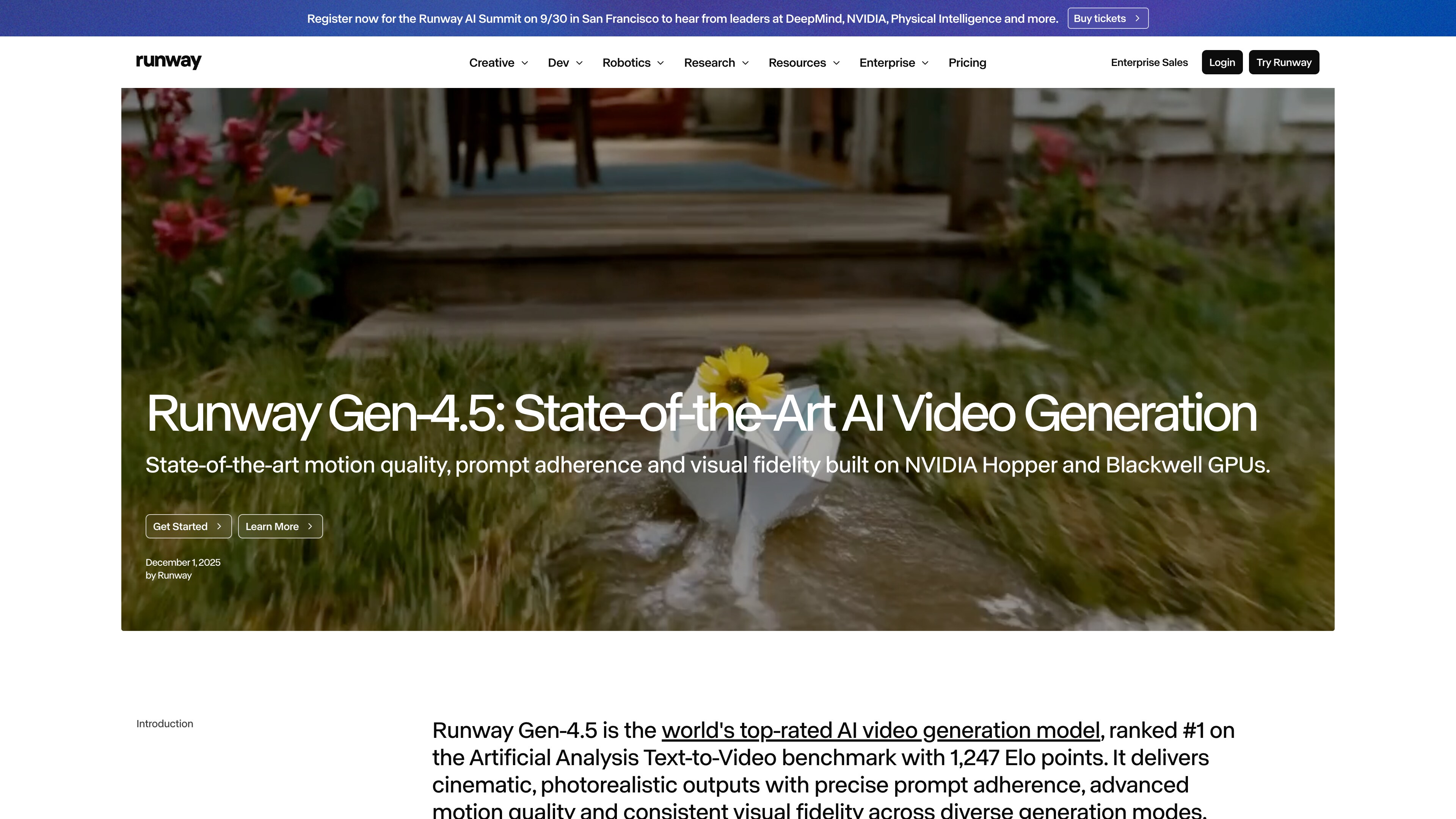
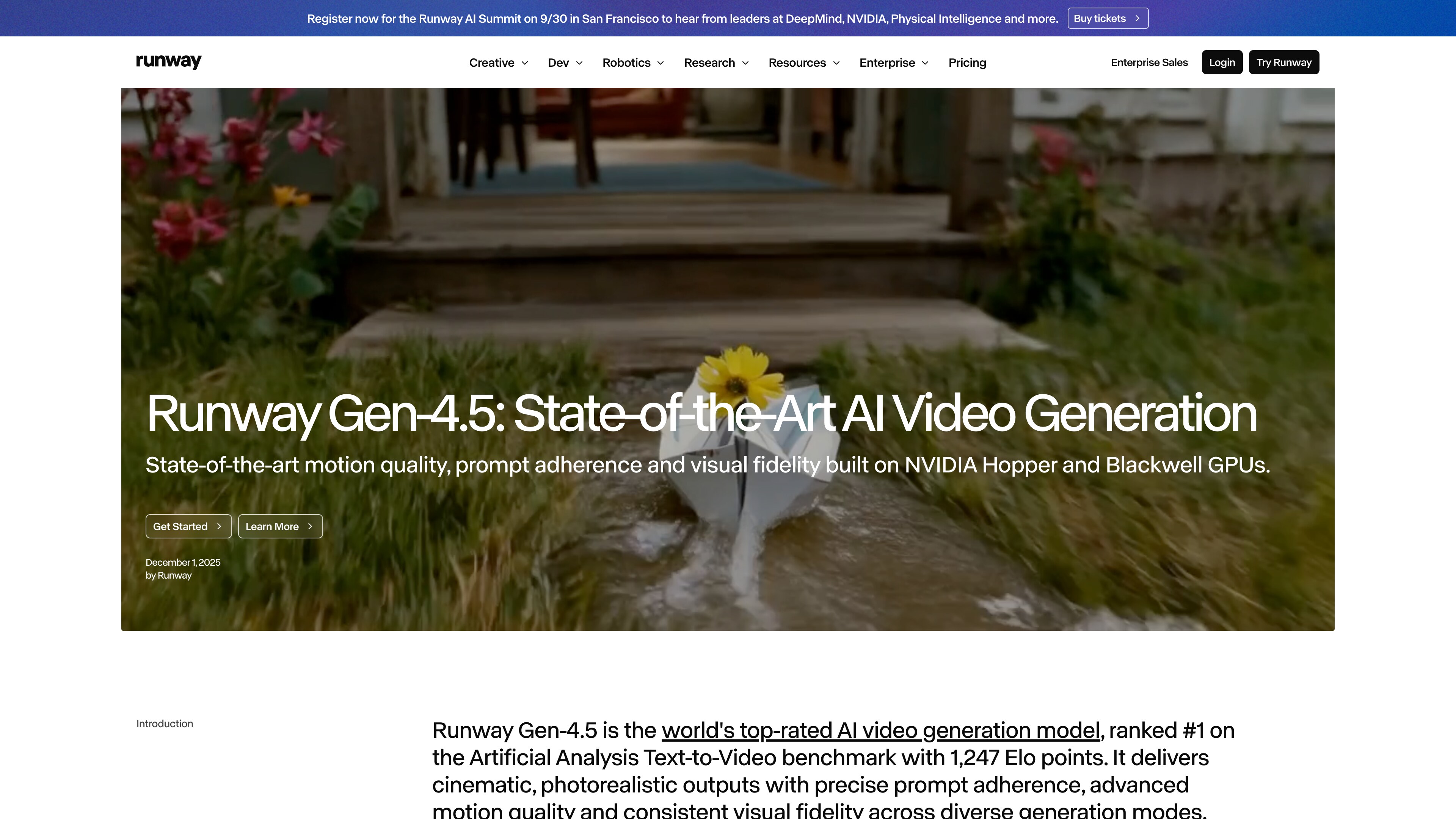
- Gen-4.5 (December 1, 2025): the current flagship. Runway says it debuted at #1 on the Artificial Analysis Text-to-Video benchmark with 1,247 Elo points, ahead of Veo 3, Kling 2.5 and Sora 2 Pro, and was trained and is served entirely on NVIDIA Hopper and Blackwell GPUs (official announcement). A December 11 update added native audio and long-form multi-shot generation — roughly one-minute videos with consistent characters and dialogue (TechCrunch).
Around the models sits a browser-based creative suite: text/image-to-video (Gen-4.5 clips run 5 or 10 seconds at 24fps, up to 1080p, in six aspect ratios from 16:9 to 21:9), Gen-4 image generation, music/voice/sound-effect generation, a conversational Runway Agent that drives generation and editing in natural language, 4K upscaling, and ProRes/HDR/image-sequence export for professional pipelines (Max plan and API). The same workspace also invokes third-party models — Kling 3.0, Nano Banana Pro, Seedance 2.5 — whose badges the pricing page lists next to Runway's own. Node-based Workflows and use-case Apps (product ads, virtual try-on and the like) target team-scale production.
Beyond video: world models, robotics and the developer platform
On December 11, 2025, Runway used its Research Demo Day to introduce GWM-1, its first general world model, in three variants — Worlds (explorable environments), Avatars (conversational characters) and Robotics (robotic manipulation) — aimed at "simulating reality in real time" (TechCrunch). The business is now organized into three platforms:
- Runway Creative: the suite described above, for individuals and teams.
- Runway Dev: the developer API. Credits cost $0.01 each; Gen-4.5 runs 12 credits/second, Gen-4 Turbo 5, Aleph 2.0 28, with third-party models such as Veo 3.1, Seedance and GPT Image plus a Model Router that picks a model automatically (API pricing docs, as of 2026-09-12). Note that API credits are completely separate from web subscription credits.
- Runway Robotics: a GWM-1-powered simulation toolchain for robot policy inference, evaluation and synthetic data generation, delivered via SDK; Runway says it is working with several robotics companies.
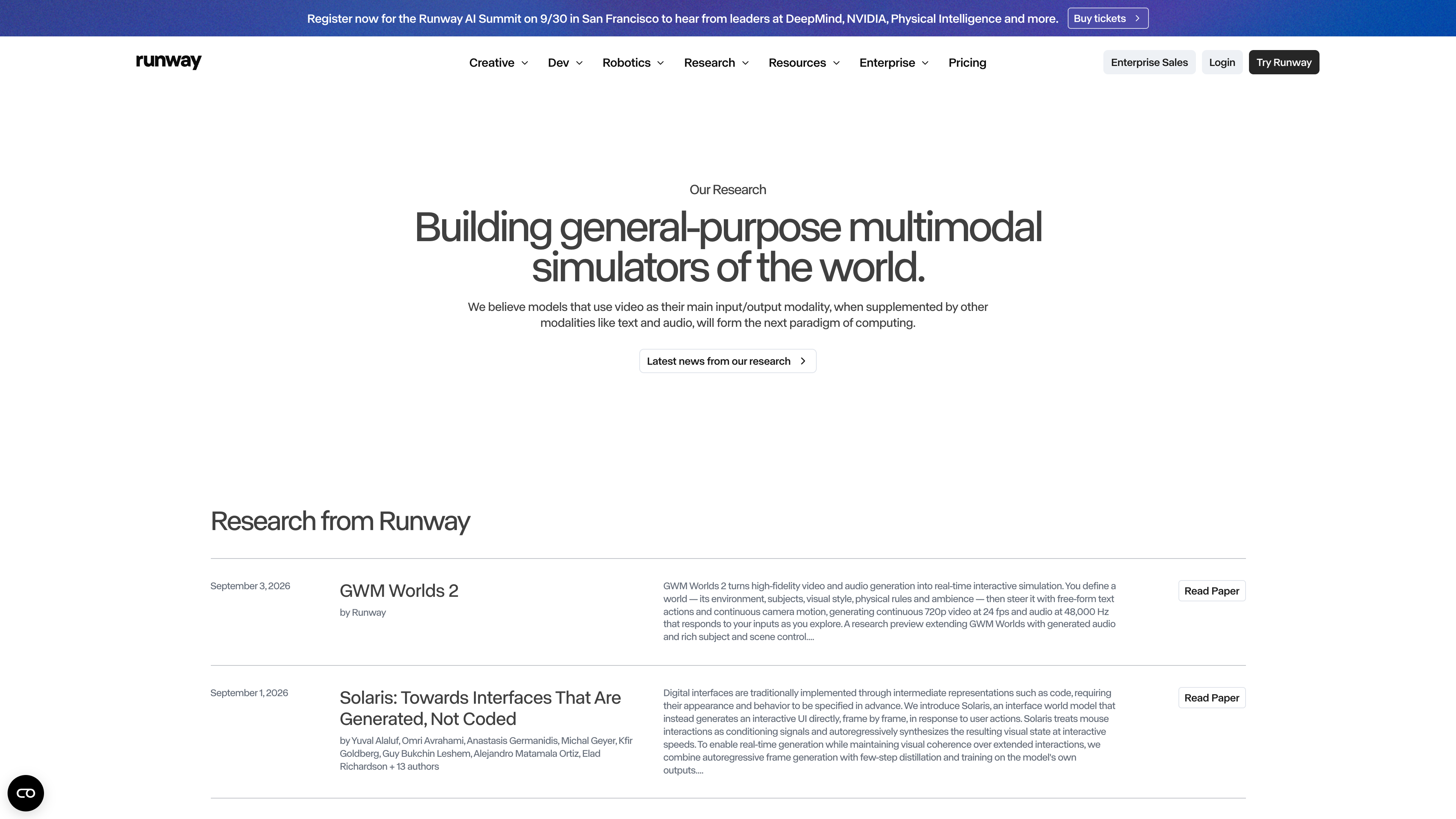
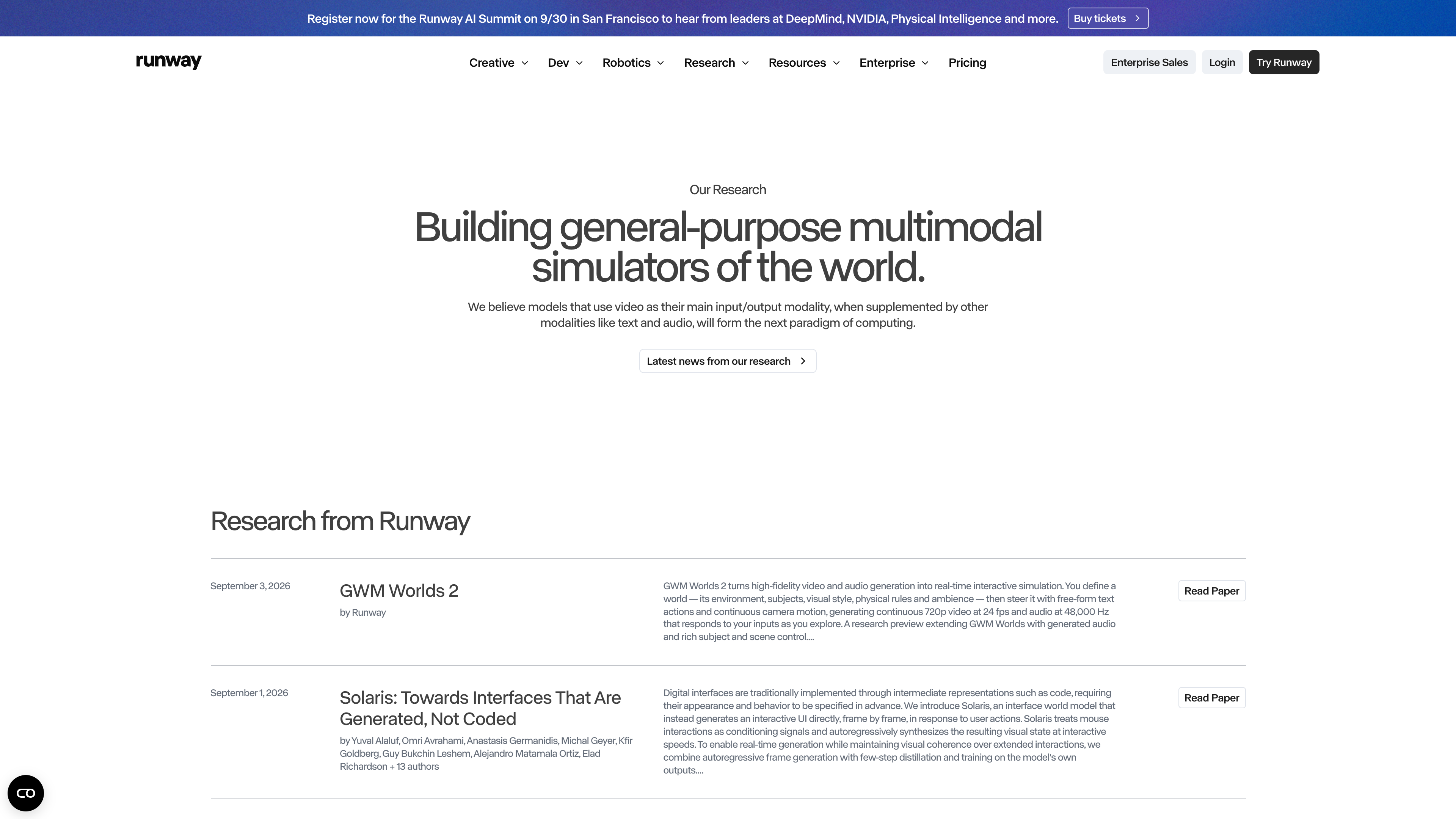
The research index (captured 2026-09-12) shows where this is heading: the GWM Worlds 2 research preview generates real-time interactive worlds at 720p/24fps with 48kHz audio; Solaris explores generating interfaces frame by frame instead of coding them; Runway Characters turns a single image into a real-time conversational avatar.
Accounts and pricing
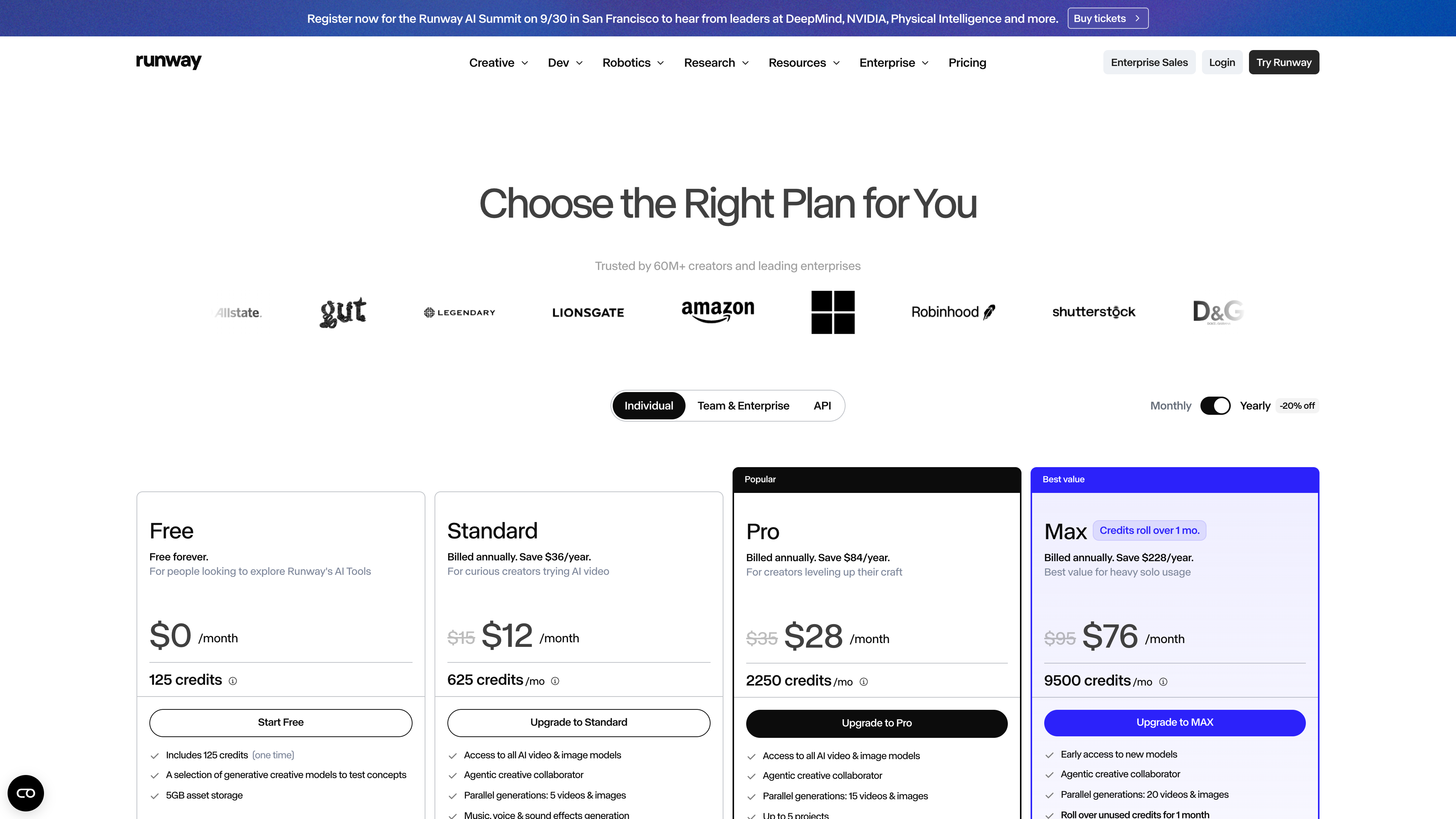
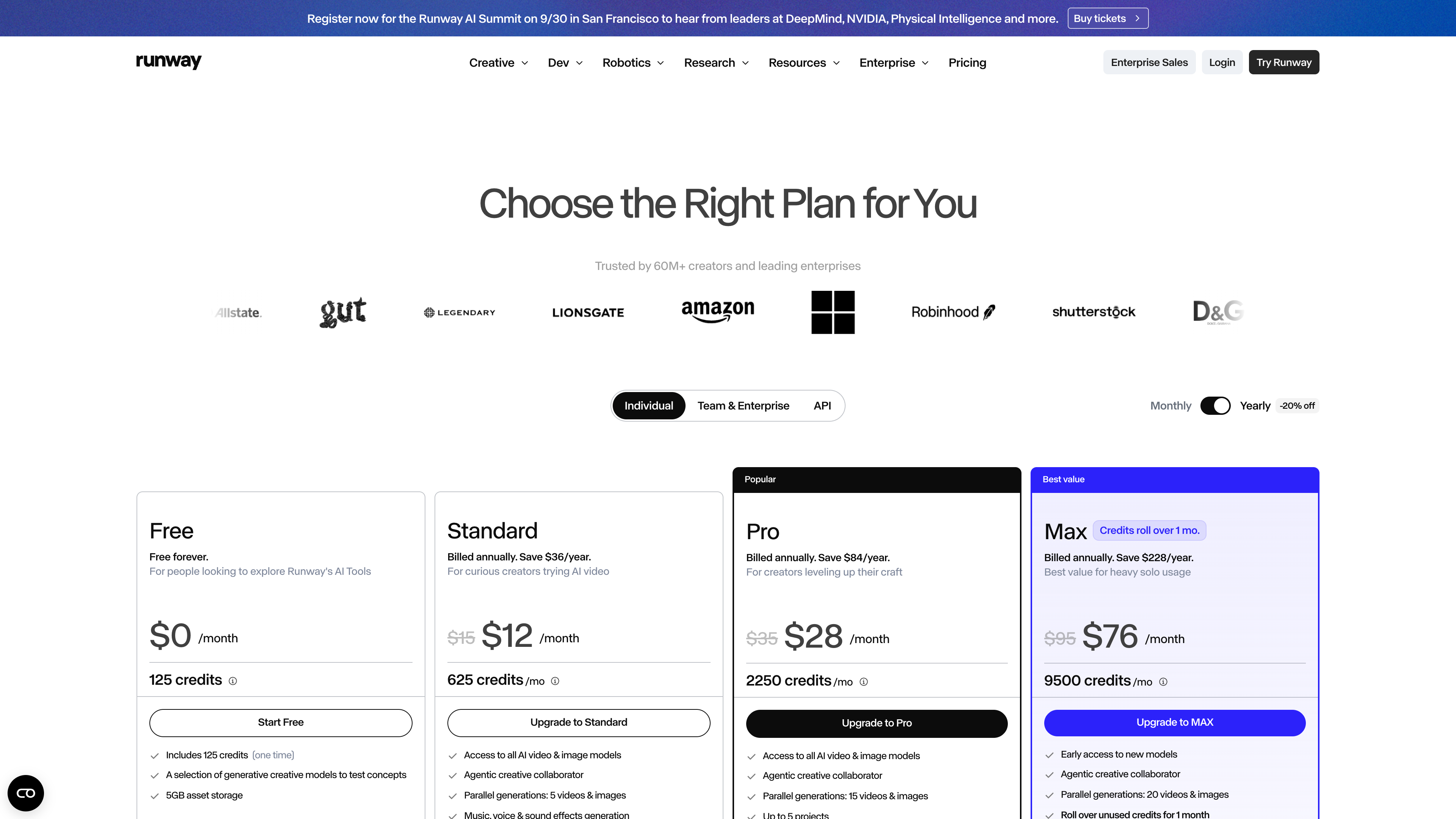
As of 2026-09-12, the official pricing page lists four individual tiers (Team and Enterprise are quoted separately; Enterprise includes SSO, SOC 2 Type 2 compliance and a "we don't train on your data" commitment):
| Plan | Monthly | Annual (per month) | Credits | Key differences |
|---|---|---|---|---|
| Free | $0 | — | 125 one-time credits (never expire) | Selected models only; watermarked exports; 5GB storage |
| Standard | $15 | $12 | 625 credits/mo (≈52s of Gen-4.5) | All in-house and third-party models; no watermarks; 4K upscaling; 3 projects |
| Pro | $35 | $28 | 2,250 credits/mo (≈187s of Gen-4.5) | 15 parallel generations; brand kit and voice clone; top up anytime |
| Max | $95 | $76 | 9,500 credits/mo, unused credits roll over one month | Early access to new models; ProRes/HDR/image-sequence export; 500GB storage |
Credits are the single meter across the platform: Gen-4.5 and Gen-4 cost 12 credits/second (5 or 10 seconds per clip), while Gen-4 Turbo and Act-Two cost 5 credits/second. Monthly allotments on Standard/Pro expire on the billing date; separately purchased credits never expire (official credits FAQ). In practical terms, the free plan's 125 credits cover about ten seconds of Gen-4.5 — it is a trial, not a workable free tier.
Ties to the film industry
Runway is the AI video company most deeply embedded in Hollywood, a verifiable distinction from purely consumer-facing rivals:
- Lionsgate: on September 18, 2024 the two announced the first partnership between a major studio and an AI company — Runway trained a custom model on Lionsgate's catalog of more than 20,000 film and TV titles for use by the studio's affiliated filmmakers. On June 11, 2026 the deal expanded: Lionsgate took an equity stake in Runway and the pair launched a joint development program to mine the catalog for new IP (Variety).
- AMC Networks: a June 2025 partnership to generate marketing imagery and pre-visualize shows before production (The Hollywood Reporter, cross-checked via Wikipedia).
- Production usage: Vulture and The Ankler have reported that Runway's tools were used for visual effects in Everything Everywhere All at Once and in the editing workflow of The Late Show with Stephen Colbert.
- AI Film Festival: the company has run the festival annually since 2023 (about 300 submissions in 2023, over 6,000 in 2025). The 2026 fourth edition expanded into the Runway AI Festival spanning film, design, new media, fashion, advertising and gaming, screening ten finalists in New York (June 11) and Los Angeles (June 18) with more than $135,000 in prizes (official screening room).
Copyright and content policy
Runway is a textbook AI-generated-content platform. The key points of its Terms of Use (May 11, 2026 version) and Privacy Policy (effective May 11, 2026):
- Output ownership and commercial use: the company claims no ownership of your inputs or outputs and does not restrict commercial use of outputs, subject to compliance with the terms (§4.2, §4.4). The Enterprise page likewise promises "full ownership of your outputs."
- A training-license gap: the consumer terms (§4.4) state that inputs and outputs may be used to train and improve Runway's models — you grant an irrevocable, perpetual license for that purpose — while the Enterprise tier publicly promises "we don't train on your data." Individual creators who mind their material being used for training should note the difference.
- Content prohibitions: no nudity, sexually explicit, violent, dangerous, hateful, harassing, fraudulent, misleading or illegal content; do not submit photos of other people without permission; outputs may not be used to build competing products.
- Disputes and litigation: in July 2024, 404 Media reported, based on a leaked internal spreadsheet, that Runway had scraped thousands of YouTube videos to train Gen-3 (404 Media, with follow-ups by The Verge and others). On February 23, 2026, YouTube creator David Gardner filed a class action in the U.S. District Court for the Central District of California alleging Runway circumvented YouTube's technological protections to mass-download videos (Gardner v. Runway AI, Inc.; Law360). As of the check date the allegations remain untested in court, and Runway has not disclosed the composition of its training data.
- Miscellaneous: the terms include binding arbitration and a class-action waiver (with an opt-out window); subscriptions auto-renew and fees are generally non-refundable; copyright complaints go through a DMCA agent (copyright@runwayml.com). The privacy policy discloses Stripe for payments and AWS for infrastructure; features such as voice cloning and facial performance involve biometric data (voiceprints, face scans), which Runway says it uses only to provide the requested service and retains no longer than the purpose requires or three years after your last interaction.
Good fits
- Advertising and social video: cinematic 5–10 second shots and product mood pieces, produced in volume with brand kits.
- Film pre- and post-production support: storyboards, animatics, previs and concept shots — the Lionsgate and AMC deals show the tools already sit inside studio workflows.
- Character-driven content: Act-Two transfers live performances onto animated characters, with voice replacement for explainers or virtual presenters.
- Repurposing existing footage: Aleph reshoots, relights and restyles live-action clips without a physical reshoot.
- Developers and enterprises: embed video generation in your own product via Runway Dev, or let the Model Router pick among vendors' models.
Limitations
- Short clip length: core generation still works in 5–10 second units (Gen-4.5's newer multi-shot long-form mode is recent and paid-only), so long-form narrative means heavy stitching.
- Iteration burns credits fast: at 12 credits/second, trial-and-error adds up quickly — the Pro plan's 2,250 monthly credits equal roughly three minutes of Gen-4.5 output; Standard/Pro allotments expire monthly and cannot be banked.
- The free plan is a demo: 125 one-time credits, no top-ups, watermarked exports, and flagship models like Gen-4.5 are not included.
- Model flaws acknowledged by Runway itself: the Gen-4.5 announcement lists causal-reasoning errors (a door opening before the handle is pressed), object-permanence failures (objects vanishing after occlusion) and success bias (actions unrealistically succeeding). Physics simulation is still imperfect.
- Non-deterministic output: as with all generative video, results carry randomness, and the terms note that similar outputs may be generated for other users — a real constraint for work that must be reproducible.
- Split balances: subscription credits cannot be spent on the API; developers buy API credits separately at $0.01 each.
- English-only interface and support: no localized UI; the help center and community are English.
- Unresolved training-data controversy: the scraping report and the class action described above remain open; rights-sensitive commercial projects should assess that risk themselves.
Alternatives
- OpenAI Sora: OpenAI's text-to-video model and app; Sora 2 (October 2025) pushed synchronized audio and social distribution. A different bet from Runway's production-suite positioning — more single-model generation and consumer sharing.
- Google Veo: Google DeepMind's video model line, offered through the Gemini app and the Flow filmmaking tool; trades places with Gen-4.5 on third-party benchmarks such as Artificial Analysis and is the most direct flagship rival.
- Luma Dream Machine: the closest independent competitor in positioning (web generation plus API), with a smaller model lineage and ecosystem than Runway.
References
- Runway homepage (checked 2026-09-12)
- Runway pricing (checked 2026-09-12)
- Runway for Enterprise (checked 2026-09-12)
- Introducing Runway Gen-4.5 - Runway Research (checked 2026-09-12)
- Introducing Runway Gen-4 - Runway Research (checked 2026-09-12)
- Introducing Runway Aleph - Runway Research (checked 2026-09-12)
- Runway Research index (checked 2026-09-12)
- New Funding to Scale World Simulation - Runway News (checked 2026-09-12)
- How do credits work? - Runway Help Center (checked 2026-09-12)
- Creating with Gen-4 Video - Runway Help Center (checked 2026-09-12)
- Performance Capture with Act-Two - Runway Help Center (checked 2026-09-12)
- Runway Dev API Pricing (checked 2026-09-12)
- Runway Terms of Use (May 11, 2026) (checked 2026-09-12)
- Runway Privacy Policy (effective May 11, 2026) (checked 2026-09-12)
- Runway (company) - Wikipedia (checked 2026-09-12)
- Runway releases its first world model, adds native audio to latest video model - TechCrunch (checked 2026-09-12)
- Gen AI Video Startup Runway Raises 5.3B Valuation - Crunchbase News (checked 2026-09-12)
- Lionsgate Takes Equity Stake in Runway AI With Plans For AI Show - Variety (checked 2026-09-12)
- AI Video Generator Runway Trained on Thousands of YouTube Videos Without Permission - 404 Media (checked 2026-09-12)
- Runway AI Faces Suit Alleging YouTube Content Scraping - Law360 (checked 2026-09-12)
- Runway AI Festival screening room (checked 2026-09-12)