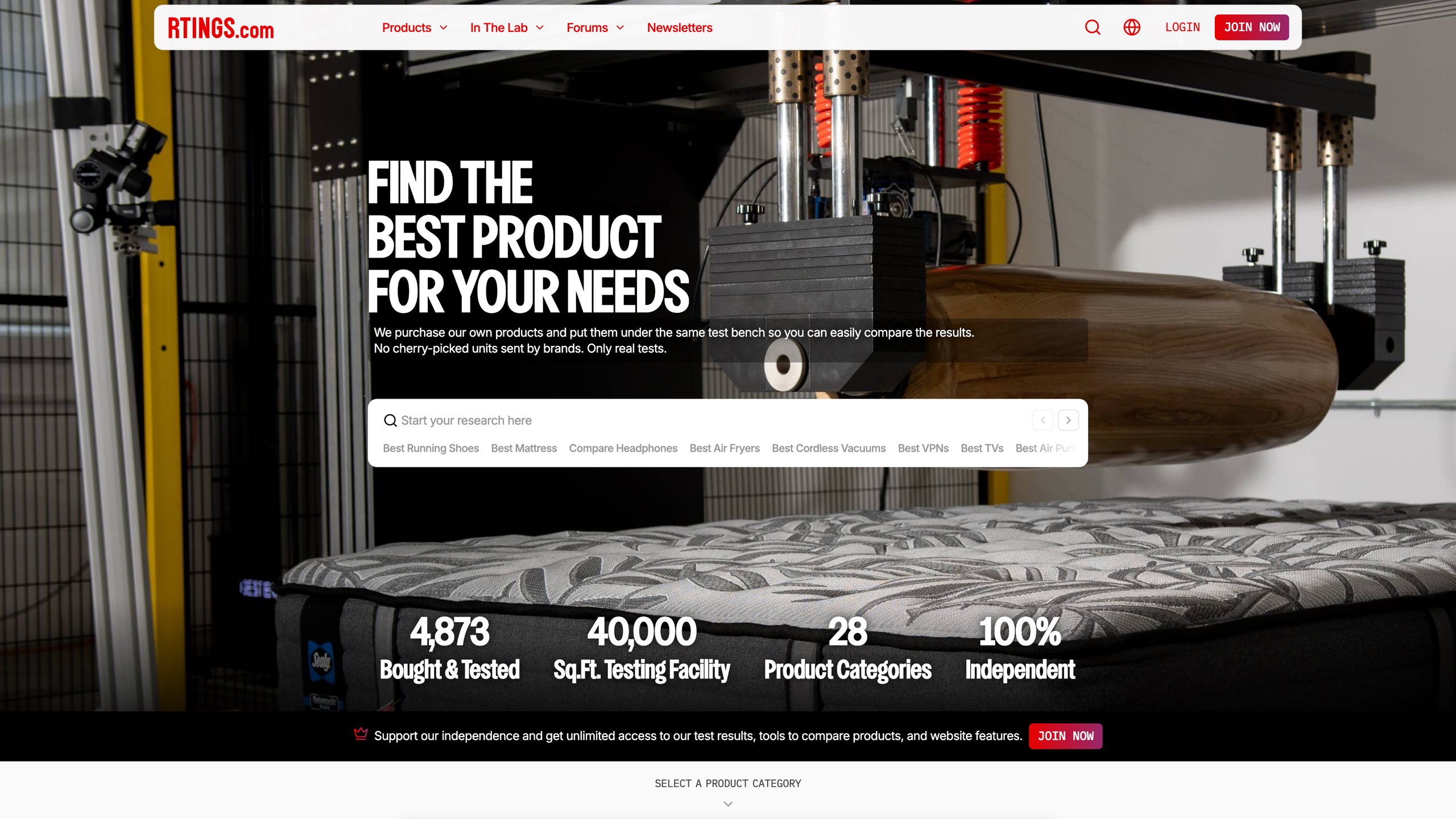
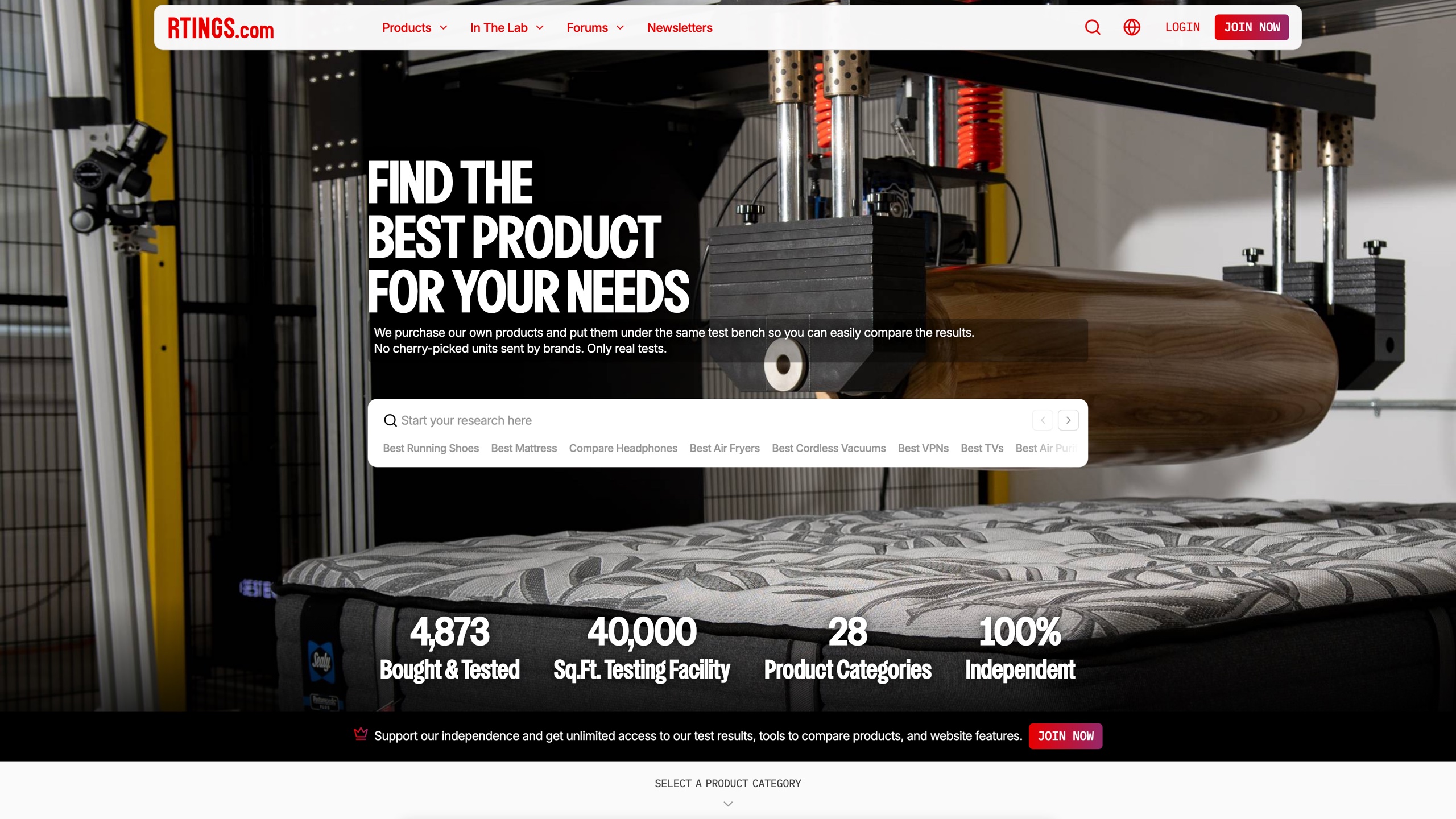
RTINGS (rtings.com, pronounced "ratings") is an independent product-testing organization headquartered in Montreal, Canada. Every product it reviews is purchased at retail, measured in a roughly 40,000 sq. ft. lab using a single public, versioned test methodology, and published as data-driven scores and raw results that consumers can compare directly across brands and models. As of September 3, 2026, the site reports 4,873 products bought and tested across 28 categories. Unlike outlets that rely on manufacturer-supplied review units or subjective editor impressions, RTINGS' verifiable distinction is that it accepts no loaner units and runs no paid reviews: its methods are published in full and every product goes through the same test bench, so results are strictly comparable between models.
At a Glance
- URL: https://www.rtings.com/
- Type: Data-driven consumer product reviews and recommendations (lab testing)
- Cost: Review text and conclusions are free; since March 2026, full scores, measurements, and test photos require a paid membership (31.50 for the first year and $45/year after)
- Registration: None needed to read; an account is required for review voting, comments, and forums
- Language: English only
Background
RTINGS was founded in 2011 by Cédric Demers. It began in his basement as an aggregator that compiled review scores from other websites (a "Rotten Tomatoes for products"), and published its first original review in July 2013 — a Samsung F5300 plasma TV, a page still online today (per the Wikipedia article, summarizing La Presse and Fast Company reporting; the official About page likewise states "Independent company founded in 2011").
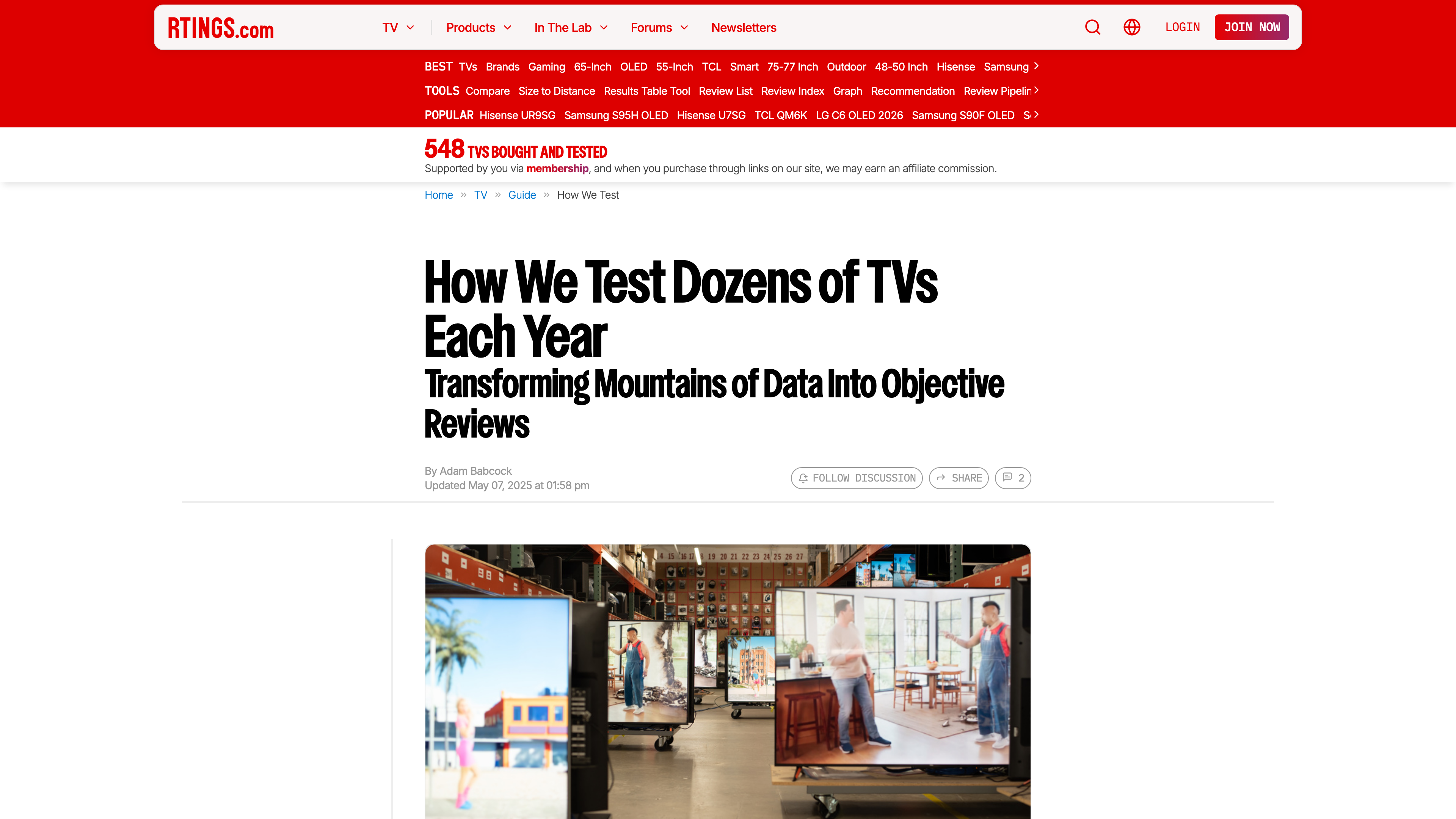
The operating company is 9298-5266 Quebec Inc, based in Montreal. Its corporate site says the team now numbers over 100 employees and remains independent. Coverage grew from TVs to 28 categories: monitors, mice, keyboards, printers, routers, VPNs, keyboard switches, and laptops on the computing side; TVs, soundbars, and projectors in home entertainment; headphones and speakers in audio; vacuums, robot vacuums, dehumidifiers, air conditioners, mattresses, humidifiers, and air purifiers for the home; cameras; six kitchen categories from toasters to refrigerators; and running shoes. TVs remain the deepest category by far, with 548 bought and tested as of September 3, 2026.
The Lab Methodology
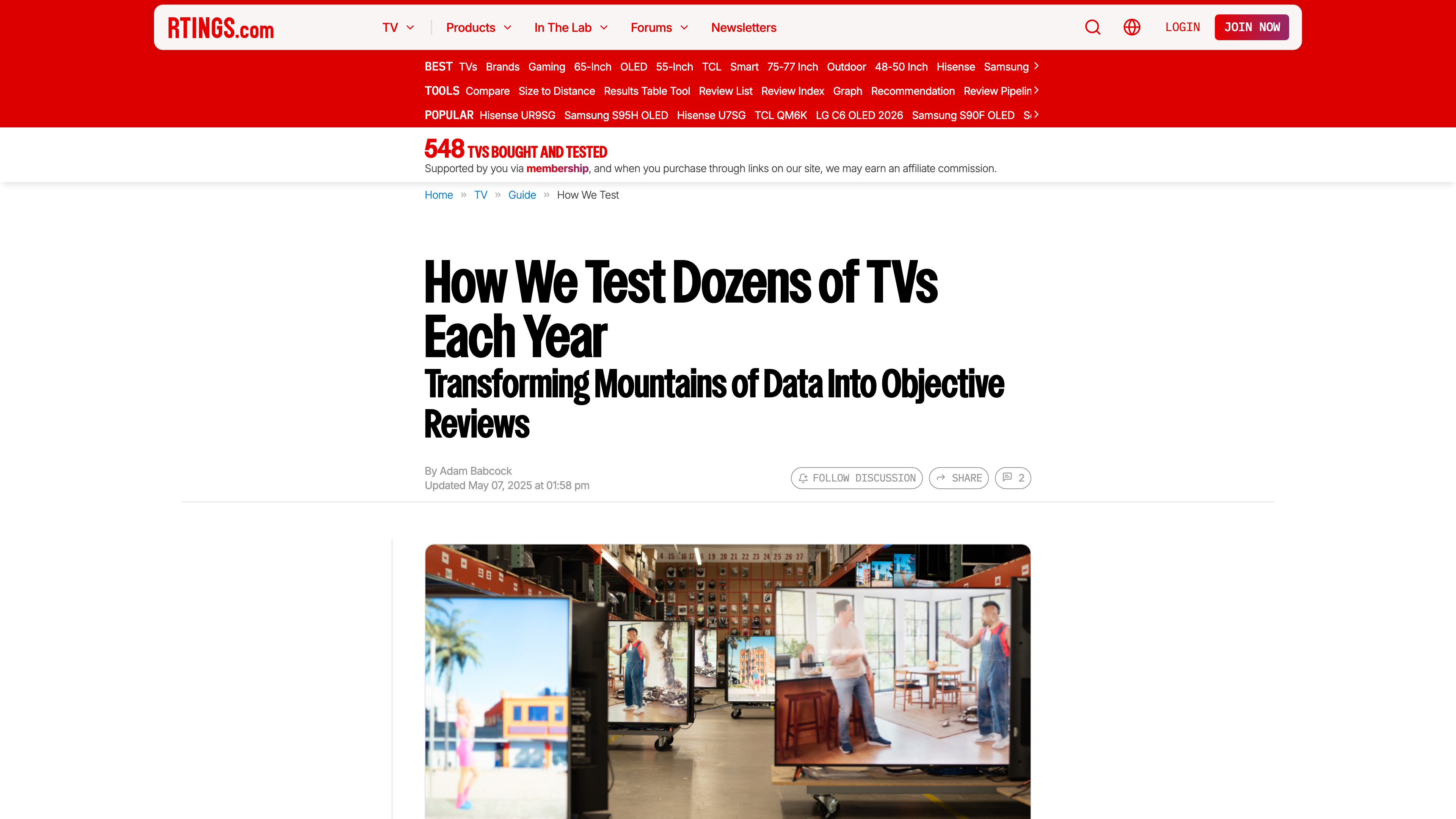
RTINGS' foundation is the standardized testing process it publishes openly. The official How We Test TVs article illustrates the approach:
- Retail purchases: Products are bought like any customer would, from Amazon.com, BestBuy.com, Walmart, and other retailers — mostly in the United States — so manufacturers cannot cherry-pick units. The trade-off: RTINGS usually gets new models later than outlets that receive loaners.
- One bench for everything: A single tester runs each TV through the same 350+ tests and thousands of measurements, taking about six working days; from unboxing to publication takes roughly two weeks and involves about a dozen people across photography, testing, writing, and editing. Instruments include a Colorimetry Research CR-100 colorimeter and a CR-250 spectroradiometer (with a spectral calibration profile built per TV), plus a custom-built tool for input lag and response time.
- Public, versioned methods: Each category's methodology iterates under version numbers (TVs are currently reviewed under Methodology v2.2), with a changelog for every revision; older products can be retested under new versions. Test photos and raw measurements are published alongside reviews so readers can verify results.
- Units kept for retesting: Products are kept until discontinued, allowing retests after firmware updates or methodology changes, then resold used locally in Montreal.
- Defects and disputes: Under the Out-of-Spec Policy, defective units are returned and replaced without being tested. If a manufacturer argues a unit is unrepresentative, RTINGS buys a second unit from a different retailer and retests; the review is updated only if the second unit is significantly better, otherwise the brand loses the right to invoke the policy for a year.
This infrastructure also supports research beyond individual reviews. The best-known project is the accelerated longevity test of 100 TVs, launched in November 2022: TVs ran content at maximum brightness for more than 10,000 hours over three-plus years, with the final update posted in March 2026. Twenty TVs failed completely and another 24 failed partially; the headline finding was that edge-lit LCD TVs fail prematurely because of concentrated heat, while every OLED developed burn-in yet proved more durable overall. Raw data of this kind is rare in media reviews.
Scores, Recommendations, and Tools
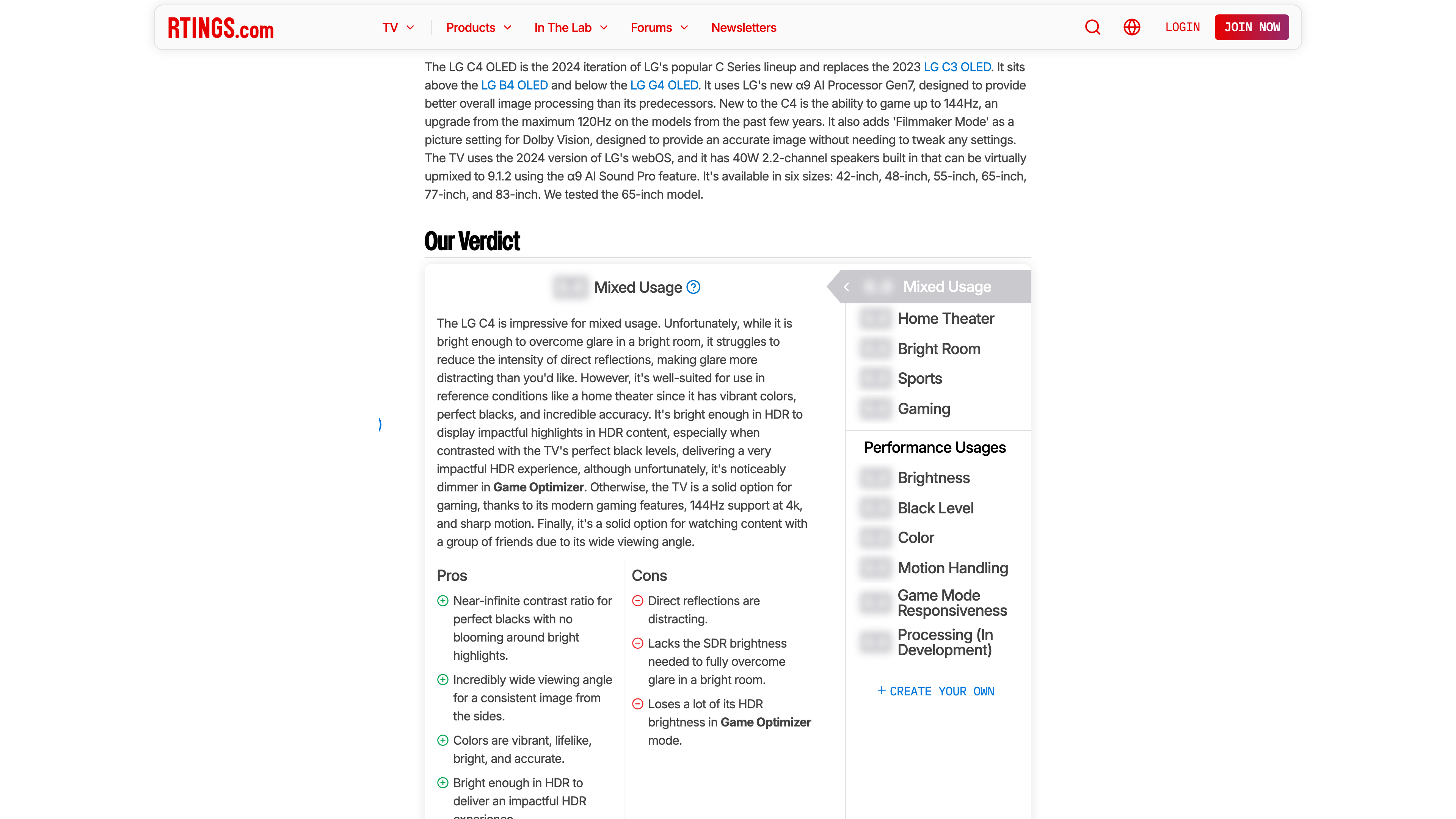
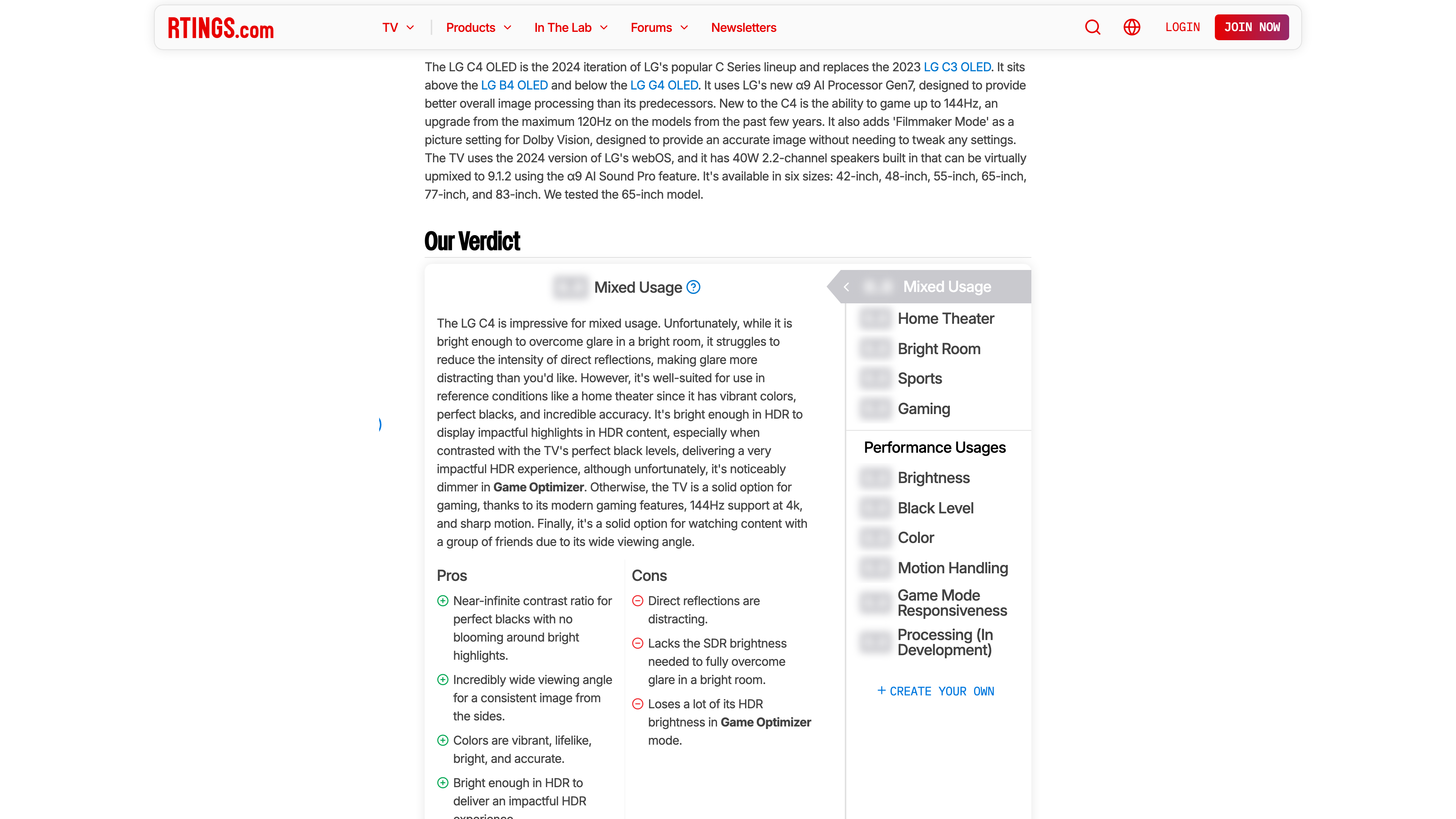
Each review's "Our Verdict" assigns usage-based scores (for TVs: Mixed Usage, Home Theater, Bright Room, Sports, Gaming) and performance groups (Brightness, Black Level, Color, Motion Handling, Game Mode Responsiveness, and more), each with pros, cons, and written analysis. Reviews also document size and variant differences, compare the product against rivals, and provide reference calibration settings. Scores reflect performance only — price is not a factor.
Beyond individual reviews, every category maintains a frequently updated "Best ×××" roundup (e.g., The 7 Best TVs). According to the site, these are curated by the same writers who produce the reviews and factor in pricing and market position, so rankings don't always mirror raw scores. Site tools include side-by-side comparison (Compare), a results table (Table Tool), needs-based Recommendations, and Custom Ratings with adjustable weights. For transparency into what's coming, the Review Pipeline shows each product's progress from purchased to in the lab, testing, early access, and reviewed — and registered users vote on what gets bought next (one TV every 60 days is chosen by votes).
Membership and Business Model
On March 2, 2026, RTINGS announced a revamped membership program: the former Insider Access became RTINGS.com Membership, and full test results and in-depth analysis moved from a metered soft paywall to members-only. The company cites declining Google organic traffic and AI systems that scrape its data without attribution — and frequently misquote it — against the high cost of lab testing; per the official explanation cited in press coverage, the previous year alone it spent $714,000 buying 618 products.
As verified on September 3, 2026, free visitors can still read review text, verdicts, and pros/cons, but all numeric scores are blurred, specific measurements show as "Locked", and test photos prompt visitors to join. Membership benefits include full data access, no ads, and early access to new review measurements and scores 3–5 days before publication, at 31.50 for the first year ($45/year thereafter), cancellable anytime. YouTube video reviews remain free.
Other revenue sources, per the official disclosure, are affiliate commissions from retailer links, display advertising (introduced cautiously in 2025 with a promised cap per page and no pop-ups or autoplay), content licensing managed by third-party Wright's Media, and a merchandise store. The company stresses a strict wall between its editorial and revenue teams, and says manufacturers and advertisers cannot influence scores or recommendations.
Copyright and Content Policy
All site content (text, images, video) is owned by 9298-5266 Quebec Inc. The Terms of Use permit access and printing for personal, non-commercial use only, and explicitly prohibit systematic downloading to build a database, screen scraping, or accessing the site other than through the provided interface — consistent with the company's stance against AI scraping. Material users submit to Q&A and forums is licensed to RTINGS on a worldwide, irrevocable, royalty-free, perpetual basis. The Privacy Policy describes collecting registration details and standard access logs (IP address, browser, pages visited), using cookies, and pledges not to sell, trade, or rent personal information; retailer sites reached via outbound links are not covered.
Good For
- Checking lab-measured, apples-to-apples comparisons before buying a TV, monitor, headphones, or other big-ticket items, rather than trusting marketing specs.
- Narrowing a shortlist of two or three models with the Compare tool's per-test measurements.
- Research-oriented buyers who care about long-term reliability data, such as the TV longevity test and OLED burn-in tracking.
- Using the per-model calibration settings pages as a starting point for tuning your own device.
Limitations
- Hard paywall: Since March 2026, scores, measurements, and test photos are members-only; free readers get written conclusions only, which is a steep ask for checking a single product.
- North American units: Test samples come from US and Canadian retailers; model names and some specs can differ in other regions, so conclusions may not fully transfer to local variants.
- Coverage lag: Throughput is limited — over a hundred TVs launch each year but only 40-odd are tested, prioritized by popularity and votes; buying at retail also means reviews land later than loaner-based outlets.
- Single sample per model: Only one unit is tested; the Out-of-Spec Policy allows manufacturer appeals, but unit-to-unit variance can't be ruled out. RTINGS itself concedes multi-sample testing is "not a financially realistic solution" for an independent company.
- Uneven category depth: TVs, monitors, and headphones have the deepest history; appliances, running shoes, and mattresses are newer; common categories like smartphones are absent.
- Price-blind scores: Scores reflect performance only; value judgments require the recommendation articles and current street prices.
- English only, and non-members see display ads since 2025 (capped, per the site's pledge).
Alternatives
- Consumer Reports: A US nonprofit that likewise buys its own test units behind a membership paywall, with broader category coverage (cars, appliances, financial services) but less public methodology and raw data than RTINGS.
- Wirecutter: The New York Times' recommendation site, built on editorial research and long-term use rather than lab measurements, funded by affiliate commissions, with more free content.
References
- RTINGS.com homepage (checked: 2026-09-03)
- About Us - RTINGS.com (checked: 2026-09-03)
- Product Categories - RTINGS.com (checked: 2026-09-03)
- How We Test Dozens of TVs Each Year - RTINGS.com (checked: 2026-09-03)
- Longevity Burn-In Test Updates And Results From 100 TVs - RTINGS.com (checked: 2026-09-03)
- LG C4 OLED Review - RTINGS.com (checked: 2026-09-03)
- Revamping Our Membership Program - RTINGS.com (checked: 2026-09-03)
- Become a Member - RTINGS.com (checked: 2026-09-03)
- How We Make Money - RTINGS.com (checked: 2026-09-03)
- Out-of-Spec Policy - RTINGS.com (checked: 2026-09-03)
- Review Pipeline - RTINGS.com (checked: 2026-09-03)
- You Might Start Seeing Ads On RTINGS.com (checked: 2026-09-03)
- Terms of Use - RTINGS.com (checked: 2026-09-03)
- Privacy Policy - RTINGS.com (checked: 2026-09-03)
- 9298-5266 Quebec Inc (corporate site) (checked: 2026-09-03)
- RTINGS - Wikipedia (checked: 2026-09-03)
- RTINGS Locks Full Test Results Behind a Paywall to Combat AI Scraping - Back2Gaming (checked: 2026-09-03)