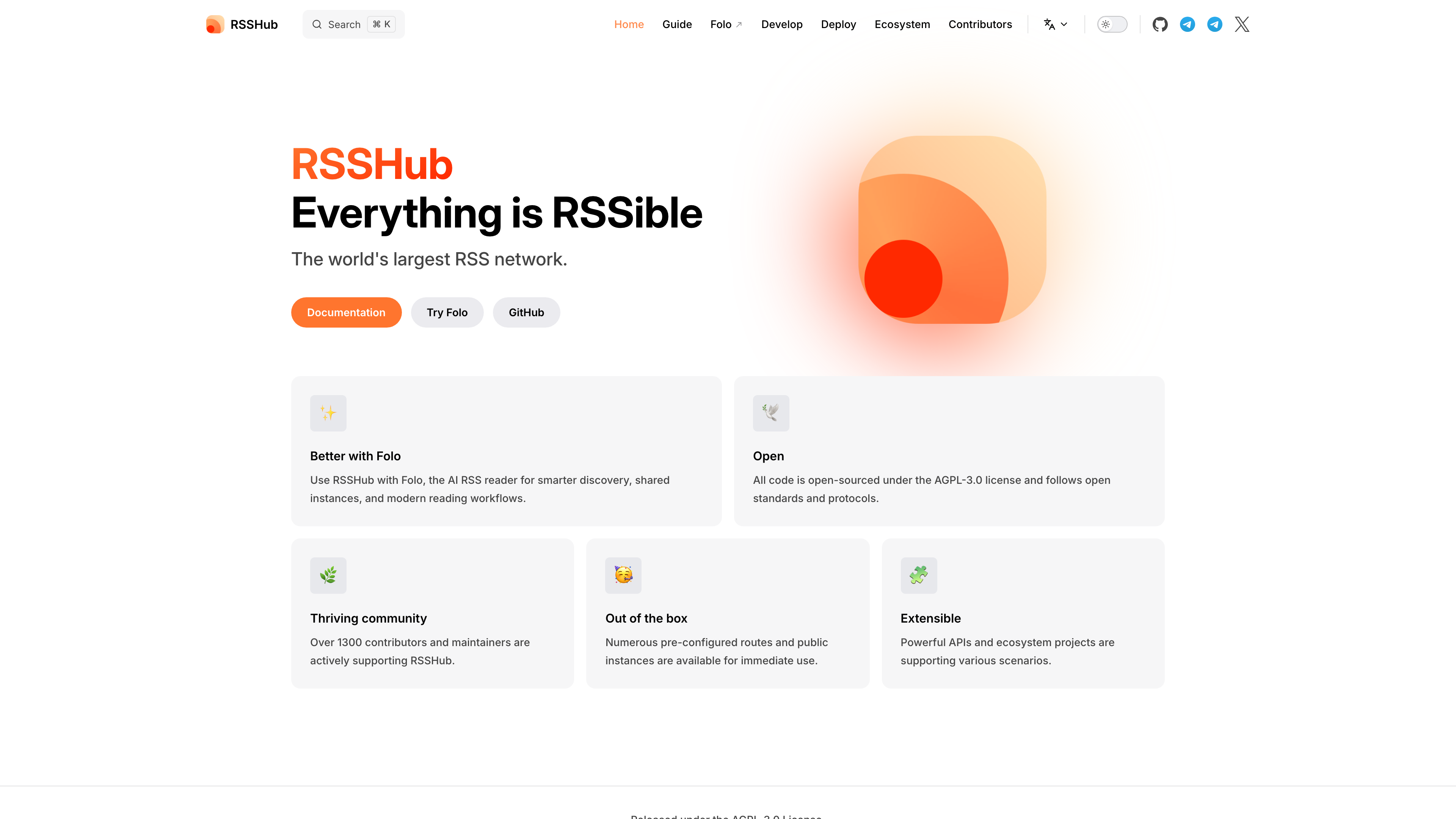
RSSHub is an open-source RSS generator that solves a specific problem: many websites — social media, forums, university notice boards, video platforms — do not offer RSS feeds natively, and RSSHub converts their content into standard RSS/Atom feeds. The usage pattern is "route + instance domain": find the route path for a target site in the documentation, append it to any RSSHub instance domain, and you get a subscription URL ready for any feed reader. The project was created by developer DIYgod in 2018, with all code public on GitHub — about 46,000 stars as of 2026-09-02; its README describes it as "the world's largest RSS network," made up of more than 5,000 instances worldwide.
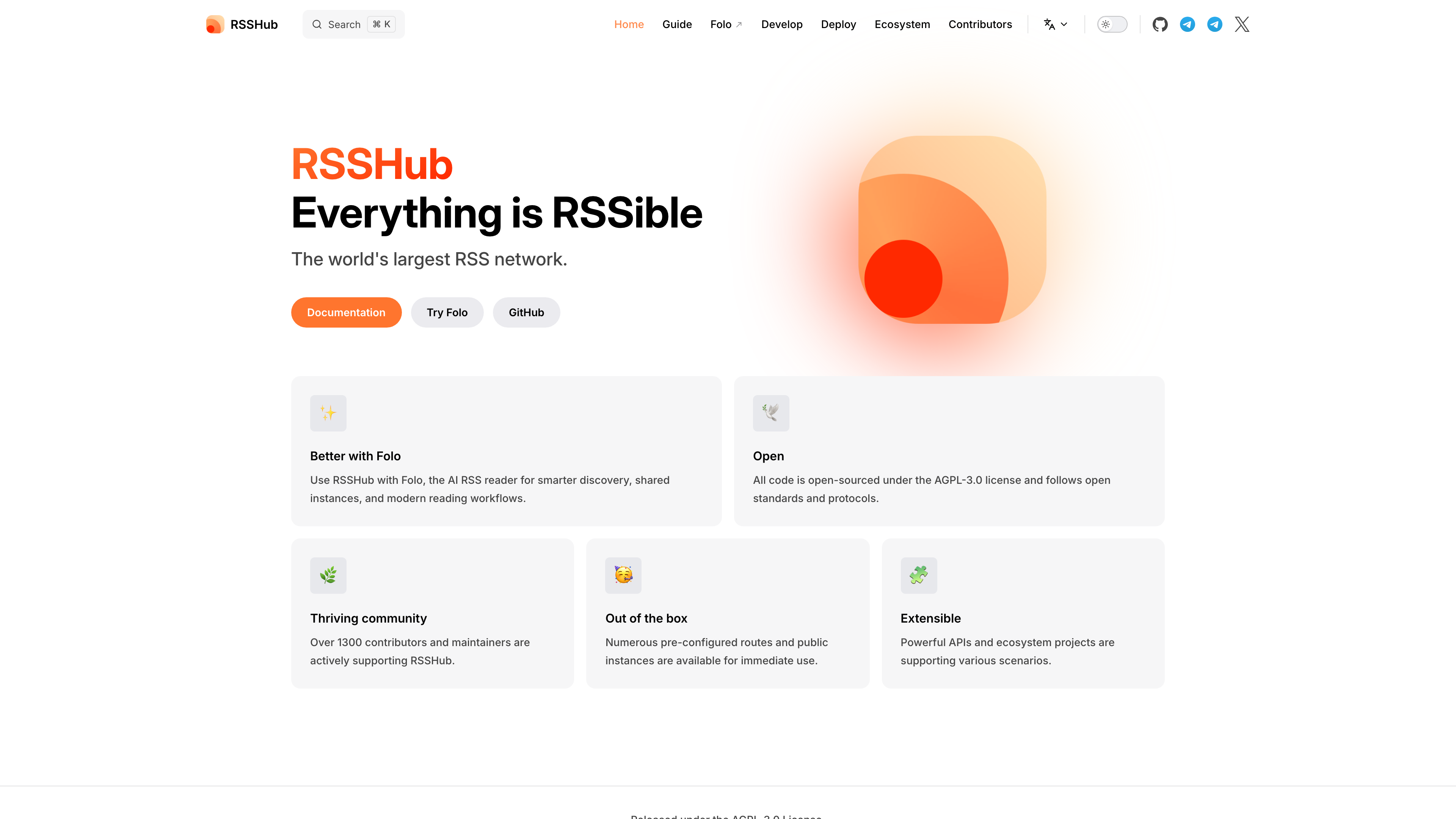
What sets RSSHub apart from other subscription services is that it is not a hosted product run by a company: it is open-source, self-hostable software plus a loose network of instances. The team maintains a single demo instance, rsshub.app, while encouraging users to self-host or use third-party public instances.
At a glance
- URL: demo instance https://rsshub.app/; documentation https://docs.rsshub.app/; source https://github.com/DIYgod/RSSHub
- Type: open-source RSS generator (Node.js service with Docker images and an npm package) plus an instance network
- Cost: free; code released under the AGPL-3.0 license; donations accepted via OpenCollective and other channels
- Registration: none (instances need no account; self-hosted instances are controlled by their operator)
- Interface language: documentation available in English and Simplified Chinese
- Mobile: no official app; companion apps in the ecosystem include RSSBud (iOS) and RSSAid (Android)
Background
The RSSHub GitHub repository was created on April 2, 2018 by DIYgod, who still maintains it; new routes and features come largely from community contributors, whom the documentation site numbers at over 1,300. As of 2026-09-02 the repository has 45,982 stars and 10,185 forks (measured via the GitHub API), and its lib/routes directory holds roughly 1,900 source namespaces.
One easily outdated fact is the license: RSSHub spent years under the MIT license, and many write-ups still say so, but a commit dated December 28, 2025 changed the license to AGPL-3.0, and both the README and the documentation site have been updated. Under the AGPL, if you modify RSSHub and offer it as a network service, your modified code must also be published.
Funding comes from donations and vendor sponsorships: the README's acknowledgements list an OpenCollective donation channel, DIYgod's personal GitHub Sponsors, and product sponsorships from Cloudflare, Netlify, and 1Password.
How routes work
The core concept in RSSHub is the "route": each route is a subscription rule for one source site, with parameters in its path. Using the documentation's own example, the Telegram channel route is /telegram/channel/:username; replace :username with a channel id (e.g. awesomeRSSHub), prepend the instance domain, and you get the feed https://rsshub.app/telegram/channel/awesomeRSSHub, ready for any RSS reader. The instance domain can be swapped for a self-hosted instance or any public one.
Several supporting layers surround the routes (see the official guide):
- Common parameters: every route accepts query parameters for content filtering, full-text output, item limits, and more, without the route itself implementing them.
- Radar rules: a set of "website URL → RSSHub route" mappings, used by the RSSHub Radar browser extension and companion apps to auto-detect subscribable feeds while you browse.
- API and npm package: instances expose an API, and RSSHub can also be embedded as an npm package in Node.js projects to request route data programmatically.
- Route documentation: each route has its own documentation page listing parameters, examples, and anti-scraping warnings.
Instances: official demo, public instances, and self-hosting
RSSHub follows a decentralized instance model, and the public instances page lays out three tiers:
- Official demo instance rsshub.app: runs the latest master-branch build with a 120-minute cache, free to use. The official FAQ warns that routes flagged "strict anti-crawling" (popular sites such as Facebook) can be unreliable on the demo instance because of per-IP request quotas, and recommends self-hosting for better usability. In our own test on 2026-09-02, opening rsshub.app from our test environment was intercepted by a Cloudflare human-verification challenge (HTTP 403), showing the demo entrance sits behind anti-automation measures and actual reachability varies by network; the documentation site docs.rsshub.app loaded normally.
- Third-party public instances: the documentation lists 18 community-run public instances (as of 2026-09-02) in various countries, free to use at your own discretion — availability and data handling are each operator's responsibility.
- Self-hosting: the officially recommended path is Docker Compose deployment, with images on Docker Hub (
diygod/rsshub) and GitHub Container Registry; routes that need to render web pages can use thechromium-bundledtag. npm, Heroku, Fly.io, Zeabur, and Sealos are also supported. Some routes only work once you configure target-site cookies or proxies on your own instance.
Content sourcing and compliance notes
RSSHub produces no content of its own: per the official FAQ, it fetches data from the source site when a request arrives, outputs it in RSS format, and caches results to reduce load on the source. This creates two practical boundaries: some source sites explicitly fight scraping, so the corresponding routes are inherently unstable; and the copyright status of scraped content, along with the source site's terms, is for the user to judge — the RSSHub project grants no content license. A related quirk: source sites often hotlink-protect their images, so RSSHub adds referrerpolicy="no-referrer" to images, but some third-party readers strip that attribute and images break; the FAQ suggests workarounds.
When it is useful
- Subscribing to updates from sites without native RSS: social accounts, forum boards, video and livestreaming platforms, university announcements
- Filtering information with common parameters (keyword-only pushes, full-text output)
- Building automation pipelines that use RSS as an intermediate format feeding IFTTT, Telegram bots, and the like
- Self-hosting a private subscription service if you care about data sovereignty
Limitations
- The official demo instance has anti-scraping and quota limits; popular routes are unstable, so serious use basically requires self-hosting or picking a public instance.
- Routes depend on source-site page structures; a redesign breaks them, and repair speed depends on the community.
- Self-hosting carries an operations burden: a Node.js/Docker environment, Redis caching, and cookies, proxies, or Puppeteer rendering for some routes.
- The project grants no content license; compliance risk from redistributing scraped third-party content rests with the user.
Similar projects
RSS-Bridge is an open-source project with the same goal (a PHP implementation that generates feeds for sites without RSS); Huginn is a more general self-hosted automation agent that can also watch web pages and emit RSS. All three are open source and self-hostable — pick based on your stack and needs.
References
- RSSHub GitHub repository (creation date, stars, license, README scale claims; checked 2026-09-02)
- RSSHub documentation site (guide, public instances, FAQ, deployment; checked 2026-09-02)
- License change commit (MIT → AGPL-3.0, 2025-12-28)