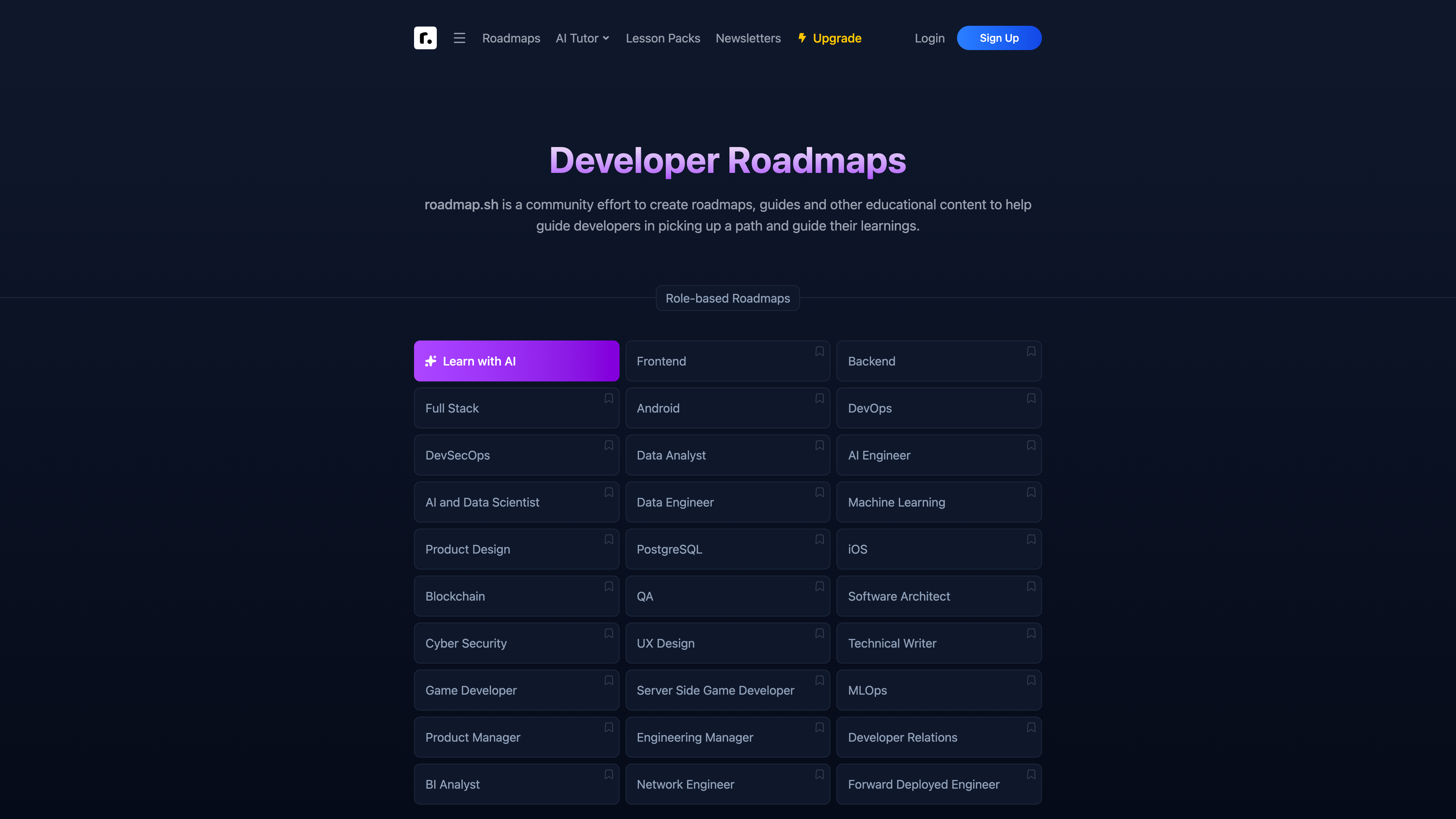
roadmap.sh is a community-maintained website of developer learning roadmaps. It draws more than 80 career and technology directions — frontend, backend, DevOps, AI, data, security and more — as clickable skill trees that answer the question beginners and career switchers ask most: "What should I learn for this path, and in what order?" Its verifiable difference from a plain link list or a course platform is how the content is maintained: every roadmap lives in a public GitHub repository, anyone can propose changes via pull request, and merged edits sync to the site automatically. As of 2026-09-08 the repository has roughly 367k stars and ranks 8th among all GitHub repositories by star count, making it one of the most-starred projects on the platform.
At a Glance
- URL: https://roadmap.sh
- Type: Community-maintained developer roadmaps and learning-resource navigation
- Cost: All roadmaps, best practices, question sets, project ideas and articles are free without registration; AI features come with a one-time free allowance; Pro costs 100/year; the team plan is 59.99 lifetime (all figures as of 2026-09-08)
- Registration: Not required for browsing; needed for progress tracking, custom roadmaps and AI features
- Interface language: English only
Background
The project was started by Kamran Ahmed, a software engineer from Pakistan. The GitHub repository record dates its creation to March 15, 2017, when it was a set of static charts titled "Roadmap to becoming a web developer in 2017"; the original README explained that Ahmed drew the charts for a former professor who wanted something to give students a big-picture view. After the charts spread through the community, the project grew into today's interactive website: nodes expand on click, progress can be tracked, and the catalog grew from the original three charts (frontend, backend, DevOps) to more than 80 roadmaps.
Ahmed is a Google Developer Expert and GitHub Star, author of the open-source booklet Design Patterns for Humans, and he told the project's story on freeCodeCamp Podcast episode 145 (October 2024). His author page states he now works on roadmap.sh full-time. The site's Terms of Use (updated March 2025) name the operating company as Insight Media Group, LLC of San Francisco.
On scale, as of 2026-09-08: the repository shows 366,593 stars, 44,906 forks and about 1,600 contributors, with commits pushed the same day; a GitHub-wide star search places it 8th overall (the site footer still claims "6th" and the About page "7th" — both are stale marketing figures). The official About page cites hundreds of thousands of monthly visitors and a newsletter with over 150,000 subscribers; a Starter Story write-up from January 2026 (secondary source) reports roughly 700k monthly users and a profitable operation.
How the Roadmaps Work
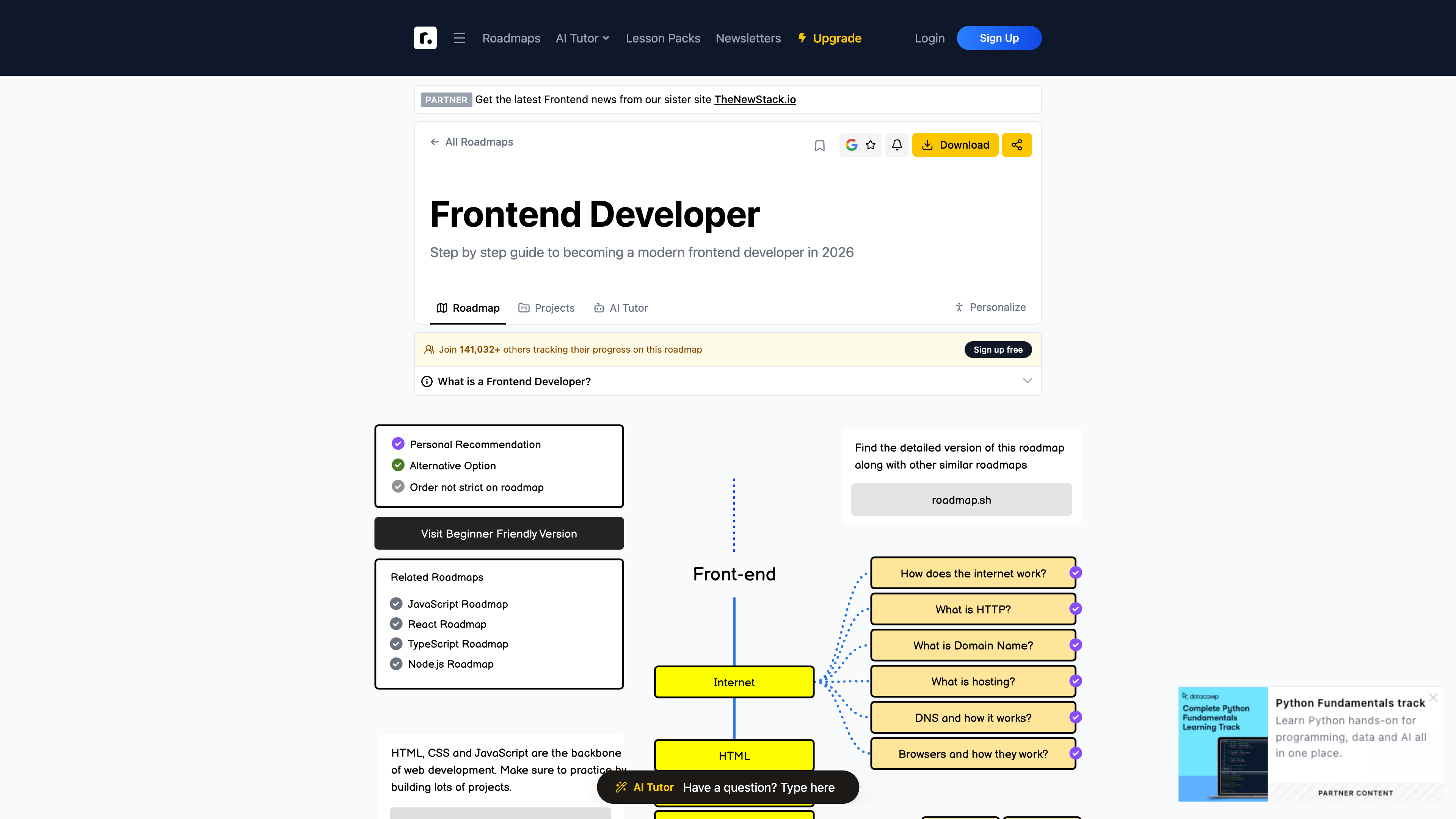
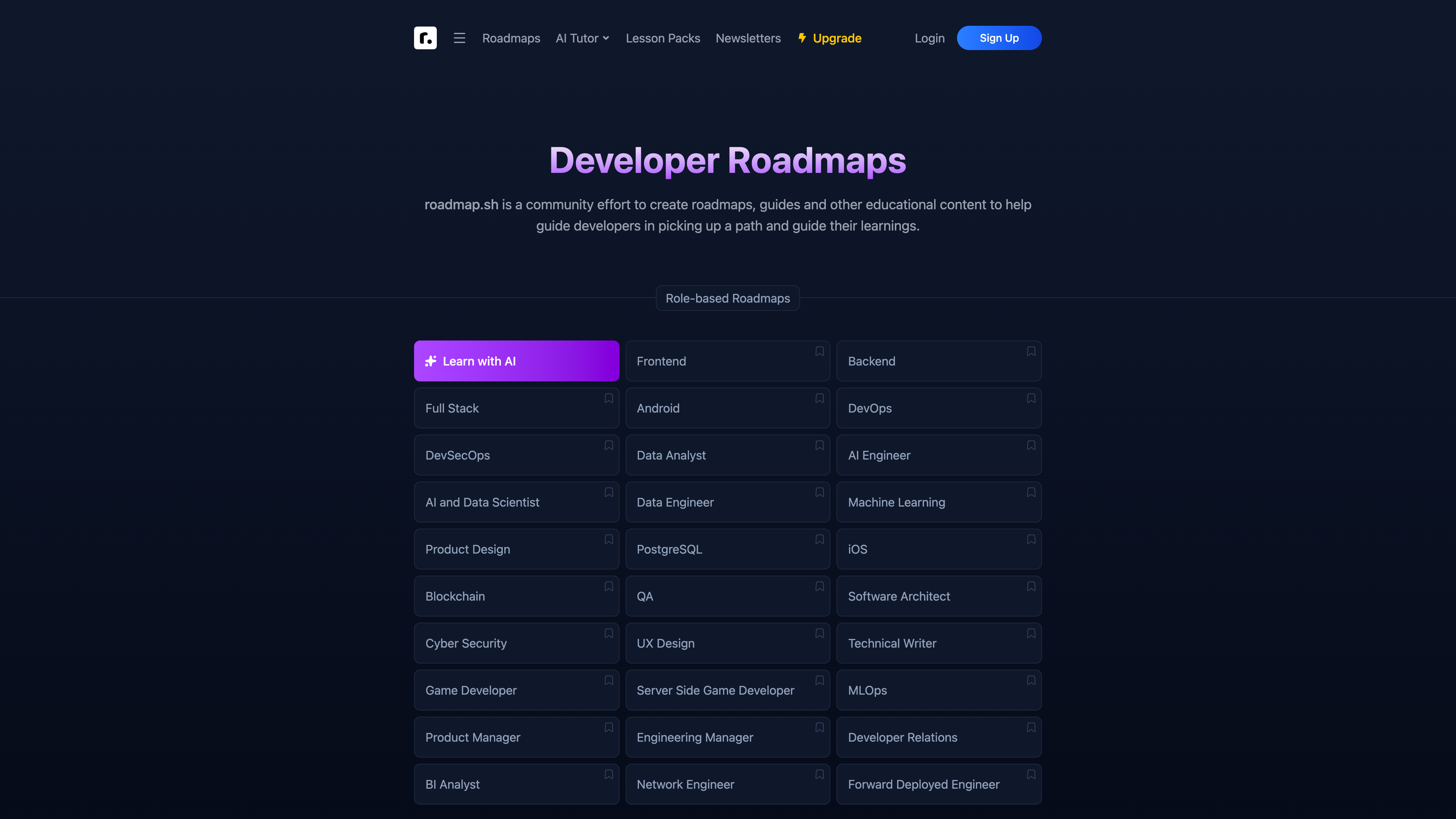
Roadmaps come in two kinds: role-based ones (Frontend, Backend, DevOps, QA, Engineering Manager…) describe what a job requires, while skill-based ones (JavaScript, SQL, Kubernetes, Terraform…) map out a single technology. Nodes are color-coded — purple marks the personally recommended path, green marks alternatives, and grey marks topics where order doesn't strictly matter. Popular directions such as Frontend, Backend and DevOps also ship condensed Beginner versions.
Clicking a node opens a one-paragraph brief plus a short list of curated external links labeled by type (official docs, open source, article, course, podcast, video, book). In other words, roadmap.sh provides the map, not the textbook: the actual learning happens in the resources it points to. Everything is readable without an account; registering lets you mark progress on the map (the frontend roadmap page shows more than 140,000 users tracking their progress), build custom roadmaps and publish a public skill profile.
Beyond the roadmaps, the site bundles several companion formats:
- Best Practices: five interactive checklists covering backend performance, frontend performance, code review, API security and AWS.
- Questions: self-test and interview question sets by technology (JavaScript, React, Node.js, Python, system design and more), with answers and difficulty labels.
- Projects: hands-on project ideas organized per roadmap, with requirement briefs and community-submitted solutions.
- Guides and video: tutorial articles and an official YouTube channel, plus email newsletters such as AI Weekly and DevOps Weekly.
How the Community Builds the Content
The update pipeline is what sets roadmap.sh apart from a static directory. In the repository, each file at roadmaps/<roadmap>/content/<topic>@<node-id>.md backs one node on the map; contributors edit the Markdown, open a pull request, and once a maintainer merges it the change syncs to the site automatically. New roadmaps can be proposed as a textual outline in an issue or drawn with the official draw.roadmap.sh editor. The contribution guide requires English content, at most 8 links per topic and a single-paragraph brief, and states plainly that the goal "is not to have the biggest list of items" but to list the skills most relevant today.
The word "open source" needs a caveat, though. The repository uses a custom license (flagged as NOASSERTION by GitHub) that permits personal use only and forbids republishing or redistributing the content in any form — including blog posts and newsletters — with copyright held by Kamran Ahmed since 2017. The website's own code is not open either; the contribution guide notes the repository "only holds the roadmap content, so there is no app to run." roadmap.sh is therefore best described as a publicly maintained, open-collaboration content project rather than open-source software in the OSI sense.
Paid Features and Business Model
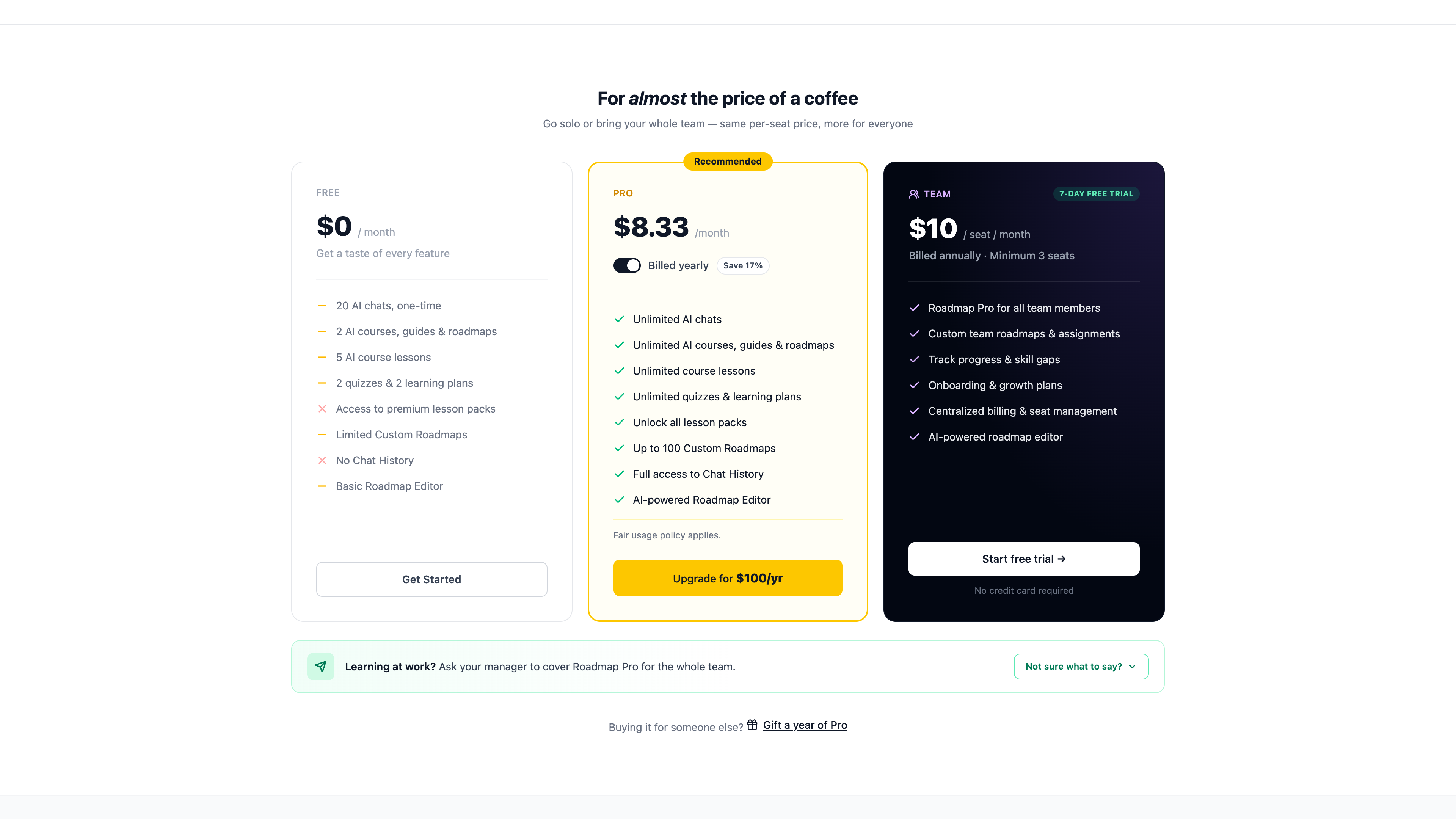
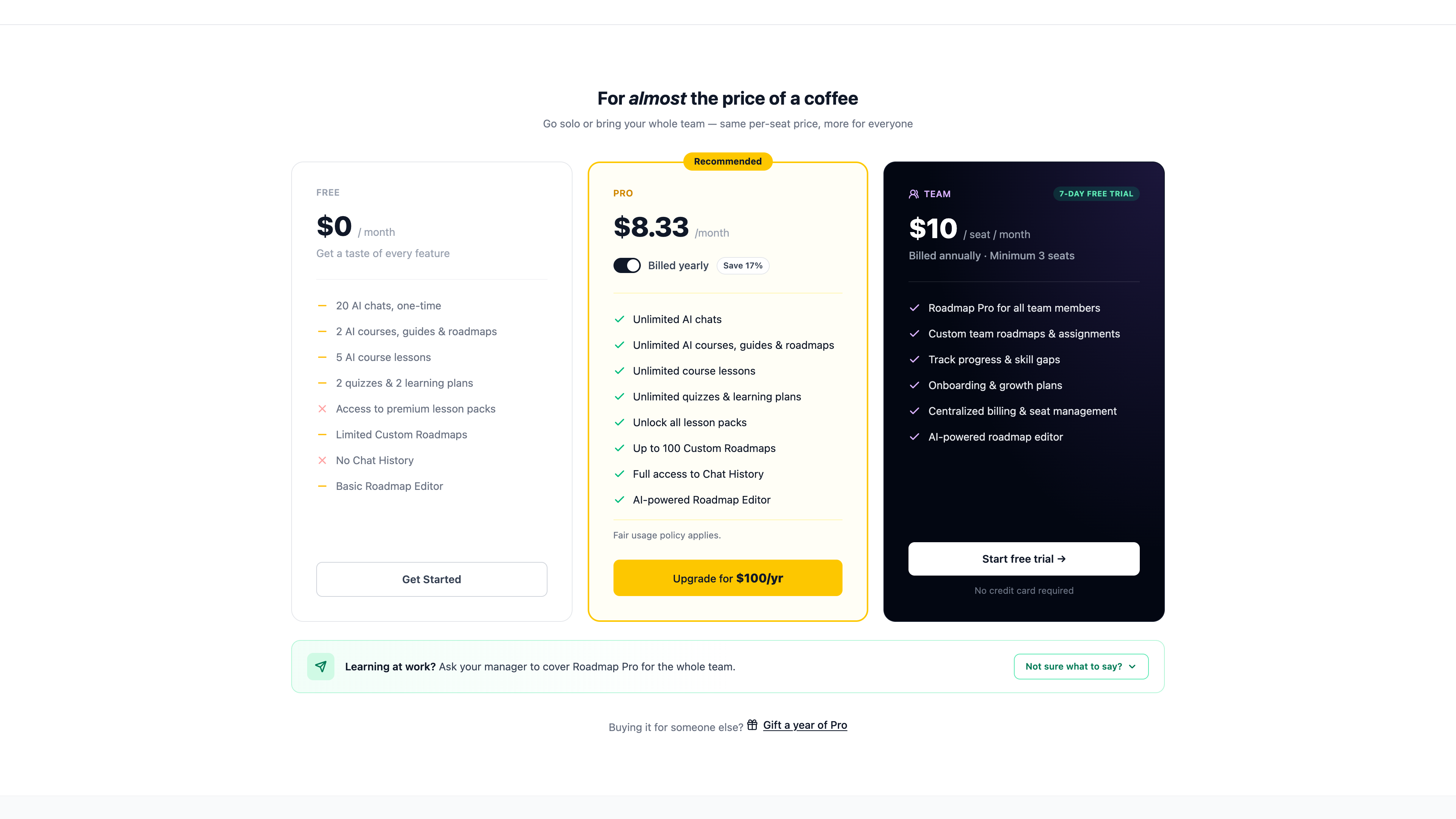
The core content is free; revenue comes mainly from subscriptions and courses. Starting in 2025 the site added AI learning features: an AI Tutor that generates a course on any topic with a map view, quizzes and a chat; an AI learning-plan generator that tailors a path to your background; and AI personalization of existing roadmaps. These features have a free allowance, but per the pricing page it is a one-time, non-renewing quota: 20 AI chats, 2 AI courses (capped at 5 lessons), 2 guides, 2 roadmaps, 2 quizzes and 2 learning plans.
As of 2026-09-08, the paid tiers are:
- Pro: 100/year ($8.33/month equivalent). Unlocks unlimited AI chats and course generation, all Lesson Packs, up to 100 custom roadmaps, chat history and an AI-assisted roadmap editor, subject to a stated fair-usage policy.
- Lesson Packs: illustrated mini-courses written by the team — Internet, HTML, CSS, JavaScript Foundations and Build CLI Apps with Node.js are live (6–21 lessons each), with a few free preview lessons and the rest gated behind Pro; four more packs, including Git in Practice, are in production.
- SQL course: roadmap.sh/courses/sql, the first paid course, launched February 2025 — 9 chapters, about 60 lessons plus coding challenges, sold at $59.99 with lifetime access and a certificate of completion.
- Team plan: 10/seat/month billed annually), 3-seat minimum, with a 7-day free trial; includes Pro for every member, custom team roadmaps, progress tracking, skill-gap analysis and onboarding plans.
The site also carries clearly labeled "PARTNER" placements (for example, sponsor cards at the top and bottom-right of roadmap pages), and its newsletters and YouTube channel serve as additional channels.
Copyright and Content Policy
All site content is licensed for personal use only under the custom license; the Terms of Use further restrict usage to personal, non-commercial purposes and explicitly ban scraping the site's material, including for AI training. User-submitted content is granted to the platform under a perpetual, irrevocable, sublicensable, worldwide royalty-free license. The terms include a binding arbitration clause under New York law, with a 30-day written opt-out window. The Privacy Policy states that registration data and standard server logs (IP, device, cookies) are collected, and that advertising partners may set cookies; the service is limited to users aged 13 and above. An iOS app also exists.
Who It's For
- Beginners or career switchers who want to fix a learning order and scope before committing to a course.
- Working developers auditing themselves against a skill tree to surface blind spots.
- Interview candidates using the Questions sets for self-testing, or the Projects lists for portfolio practice.
- Engineering managers using the team plan for skill inventories and growth plans.
- Developers who want to contribute fixes and content through pull requests.
Limitations
- English only: the roadmaps, briefs and linked resources are all in English, a real barrier for readers not comfortable with the language.
- A map, not a textbook: each node offers only a paragraph plus outbound links; there is no systematic instruction or practice, and learning depth depends on the external resources.
- Restrictive license: the content cannot be republished or redistributed — unlike a true open license — so offline saving or remixing is limited to bookmarking links.
- One-time AI allowance: the free 20 chats and 2 courses never reset; continued AI use requires payment.
- Uneven update cadence: popular roadmaps (frontend, backend, AI-related) have been redrawn several times recently, while niche directions may lag; the changelog tracks redraws and new releases.
- Free tier constraints: custom roadmap count, chat history and similar features are limited or unavailable without Pro.
- Sponsored placements: some pages carry PARTNER-labeled promotions, so editorial picks and paid placements should be distinguished.
Alternatives
- freeCodeCamp: a nonprofit, free learning platform with full interactive courses, projects and certifications — the more direct choice if you want the curriculum itself rather than a map of one; the two frequently reference each other.
- The Odin Project: a free, project-driven full-stack curriculum whose content is also maintained in a public GitHub repository, offering a single path with more structured instruction.
References
- roadmap.sh homepage (checked 2026-09-08)
- About roadmap.sh (checked 2026-09-08)
- developer-roadmap on GitHub (checked 2026-09-08)
- Repository README (checked 2026-09-08)
- Contribution guide (checked 2026-09-08)
- Content license (checked 2026-09-08)
- GitHub REST API repository data (checked 2026-09-08)
- GitHub star-ranking search API (checked 2026-09-08)
- Premium Features (pricing) (checked 2026-09-08)
- Roadmaps for Teams (checked 2026-09-08)
- Lesson Packs (checked 2026-09-08)
- Complete SQL Course (checked 2026-09-08)
- Changelog (checked 2026-09-08)
- Terms of Use (checked 2026-09-08)
- Privacy Policy (checked 2026-09-08)
- Kamran Ahmed author page (checked 2026-09-08)
- freeCodeCamp Podcast #145: Kamran Ahmed (checked 2026-09-08)
- How Kamran Ahmed Built Roadmap.sh to 700K Monthly Users - Starter Story (checked 2026-09-08)