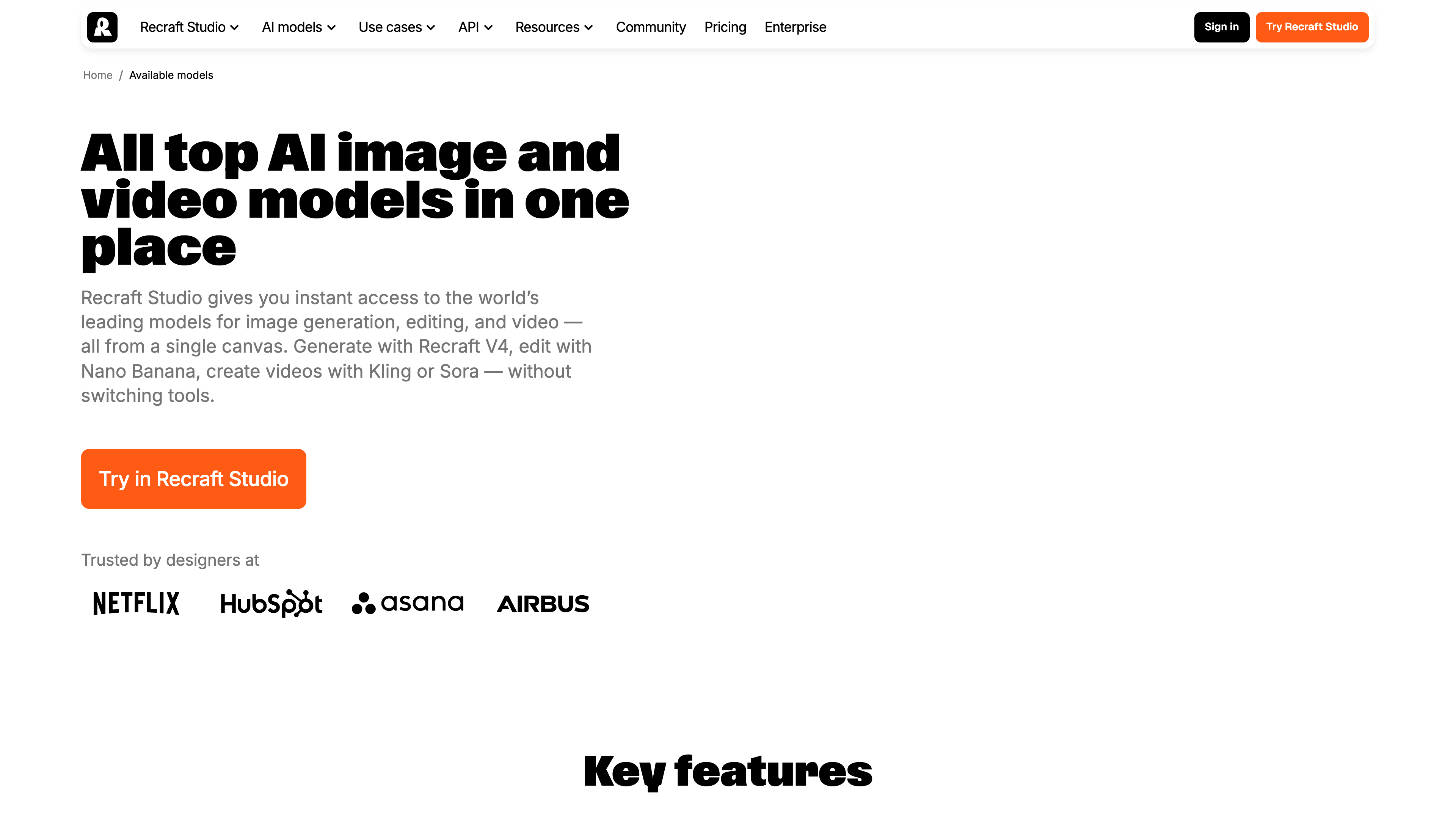
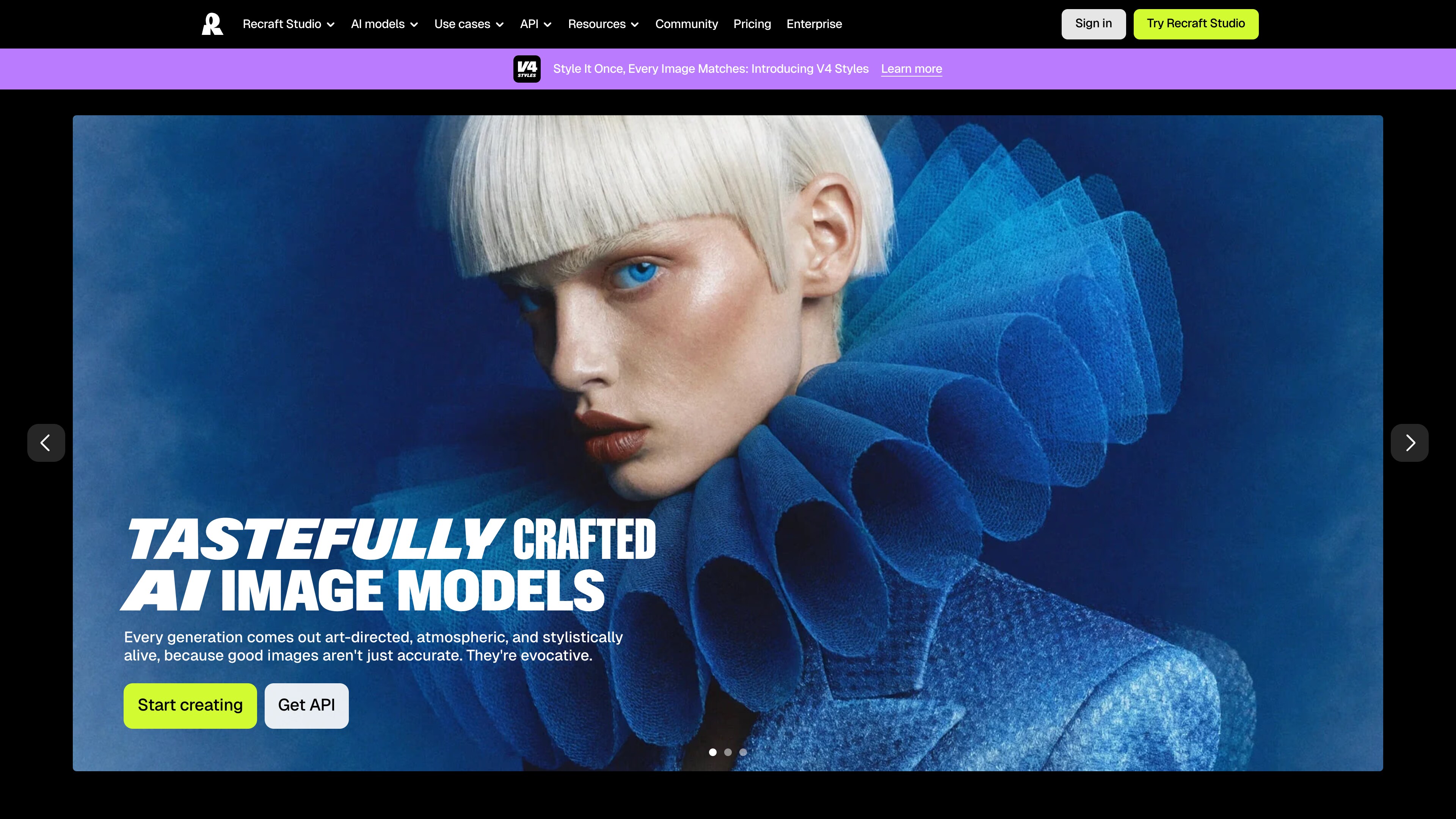
Recraft (recraft.ai) is an AI design platform from Recraft Inc.: you type a prompt on an infinite browser canvas (Recraft Studio) and get back raster images or native SVG vector graphics, with style controls, brand palettes, and mockup tools that fold the output into a real design workflow. The problem it targets is not "make one pretty picture" but producing consistent, deliverable visual assets at scale. Its verifiable differences from pure text-to-image tools like Midjourney: native vector output, precise control over in-image text and brand styles, and model variants built for production work. In October 2024 its V3 model anonymously topped the Artificial Analysis text-to-image leaderboard under the codename Red Panda, which put the company on the map; as of 2026-09-17 the current family is V4.1.
At a glance
- URL: https://www.recraft.ai
- Type: AI image/vector generation and editing platform (Recraft Studio) + developer API
- Cost: Free plan at 12/month (20/month; Teams from $22/seat/month — see the official pricing page (as of 2026-09-17)
- Account required: Browsing the site, docs, and community gallery needs no account; generating requires sign-up (email one-time code, Google, Discord, or Apple — no password). Users must be 18 or older per the Terms of Service
- Interface language: English, German, Spanish, French, Ukrainian, and Russian — six languages, no Chinese; prompts can be written in any language
- Launched: May 31, 2023 (public Product Hunt launch; the company was founded in 2022)
Background
Recraft was founded in the US in 2022 and is headquartered in London (official About page). Founder and CEO Anna Veronika Dorogush is a machine-learning scientist: at Yandex she created the open-source gradient-boosting library CatBoost and led the machine-learning systems team, after earlier roles at Google and Microsoft (TechCrunch, Jan 2024; 36Kr interview, Dec 2024). The company came out of stealth on May 31, 2023 with a Product Hunt launch of its vector graphics generation (Wikipedia).
Key milestones, all from first-hand reporting or official announcements:
- January 2024: $12M Series A led by Khosla Ventures and former GitHub CEO Nat Friedman; at the time it reported 300,000+ users eight months after launch, with a 13-person team (TechCrunch).
- October 2024: the V3 model appeared anonymously on the Artificial Analysis text-to-image arena as "red_panda", about 40 Elo ahead of runner-up Flux1.1 Pro, before being revealed as Recraft V3 (TechCrunch).
- May 2025: $30M Series B led by Accel, with Madrona Ventures and existing investors participating; the company reported more than 4 million registered users (Business Wire announcement).
- February 2026: V4 released, billed as a ground-up rebuild focused on "design taste", in a standard version and a print-ready Pro version (official blog).
- May 2026: V4.1 released. On May 30 the company announced that V4.1 Utility Pro had entered the Artificial Analysis Image Arena at third place overall — the only model in the top five not owned by a Big Tech parent (OpenAI or Google) — and noted its research team numbers fewer than 20 people (official press release).
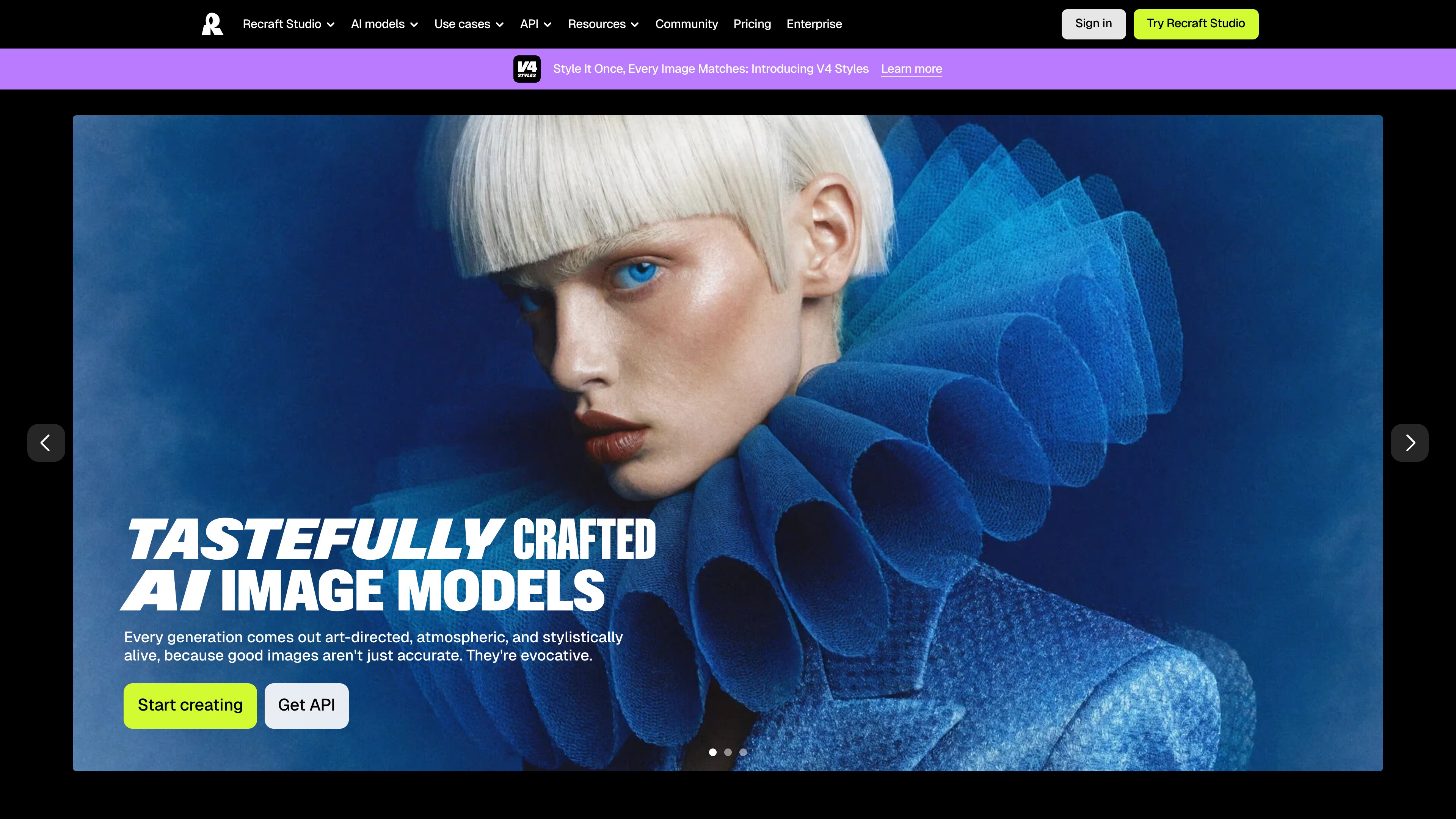
As of 2026-09-17, the homepage banner promotes V4 Styles — "style it once, every image matches" — keeping style consistency at the center of its pitch. The About page claims over 3 million users across 200 countries and more than 350 million images generated; Netflix, HubSpot, Asana, Airbus, and Ogilvy appear in its trusted-by list.
Core capabilities: raster, vectors, and style control
Recraft Studio is a browser-based infinite-canvas workspace (official quick start):
- Four in-house generations side by side: V2 (March 2024, the first model trained from scratch, roughly 20 billion parameters), V3, V4, and V4.1 are all selectable. Each generation ships as a standard raster model, a higher-resolution Pro, and a native-SVG Vector variant; V4.1 adds a Utility variant — flat lighting, front-facing composition — built for mockups and product shots (model docs, Wikipedia).
- Style and brand control: create custom styles from reference images, set brand palettes, and keep multiple generations consistent; V4 Styles turns "one style applied to everything" into its own feature.
- Vector workflow: generate editable SVGs directly or vectorize raster uploads; vectors export as SVG, PDF, or Lottie, rasters as PNG, JPG, PDF, or TIFF.
- Editing tools: natural-language editing, inpainting/outpainting, background removal and replacement, crisp and creative upscaling, image variations, and an Exploration mode; edits produce new versions while originals are kept.
- External models and video: the same canvas can call third-party image models such as Nano Banana, GPT Image, Imagen, Flux, and Seedream, plus video models including Kling, Veo, Sora, and Seedance (video requires Pro or above).
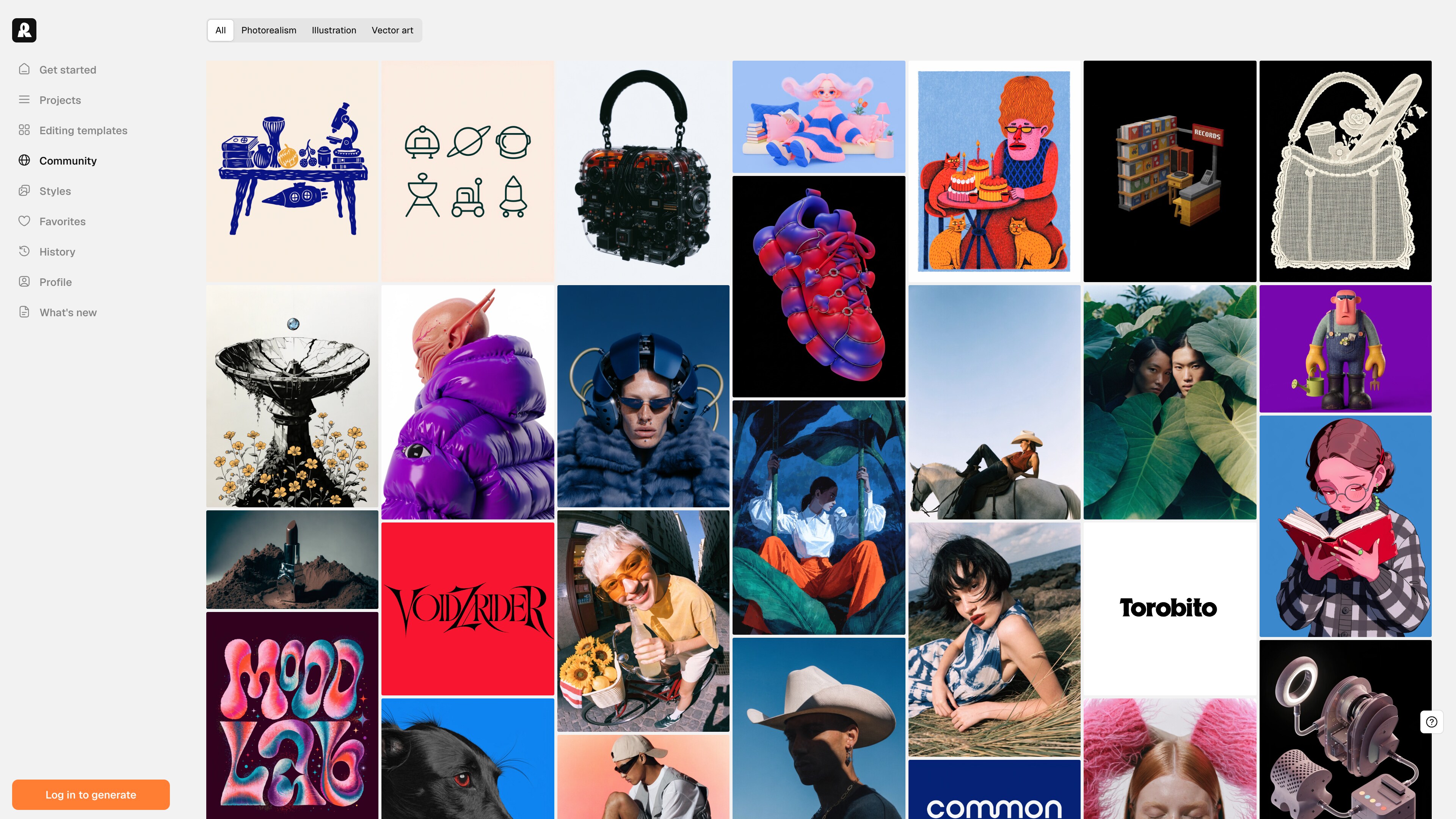
- Other surfaces: mobile apps, a Figma plugin, and a public community gallery.
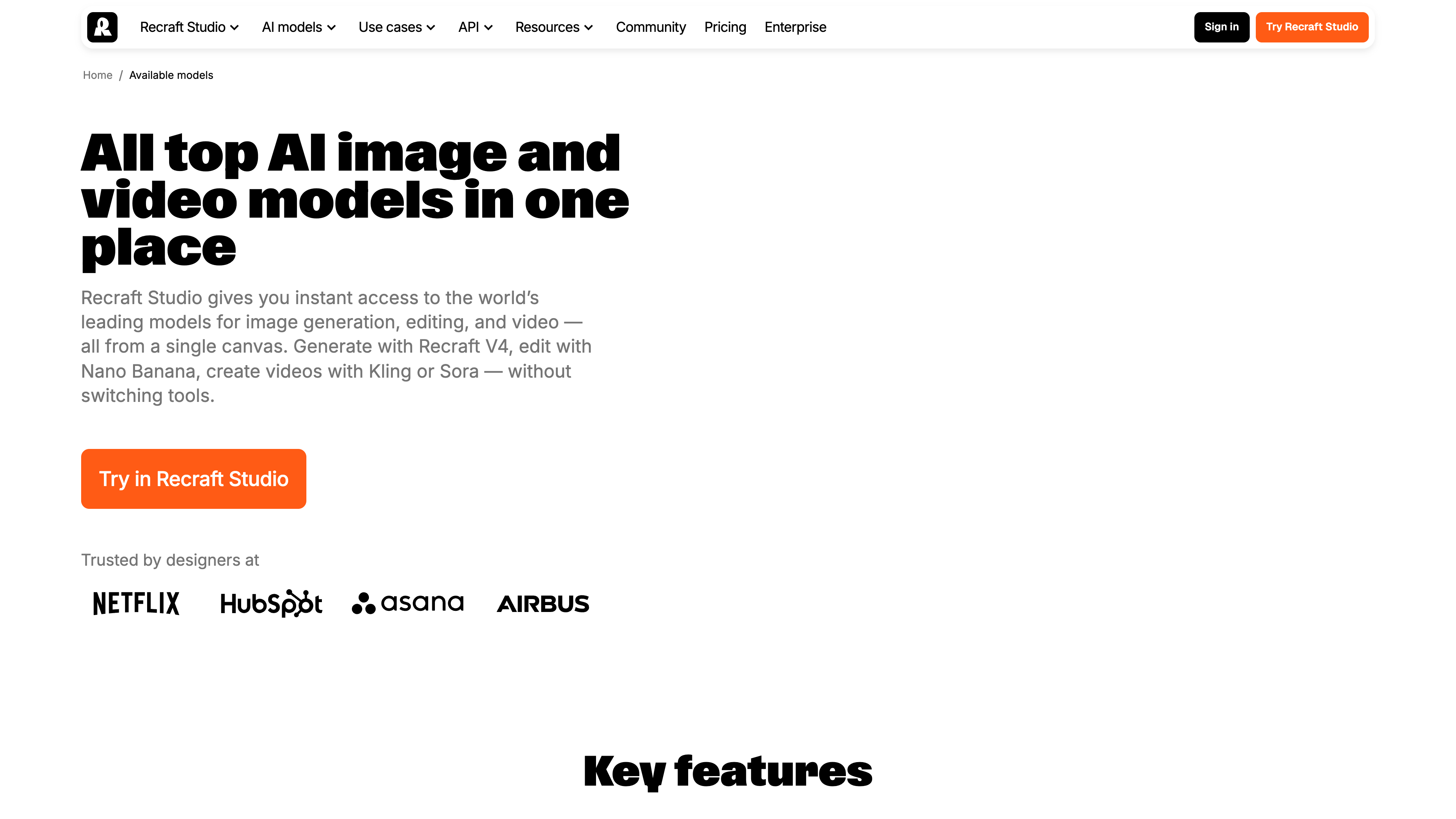
Recraft pitches "all top models in one place": its own V4 family handles generation while external models cover editing and video, so designers don't have to hop between tools.
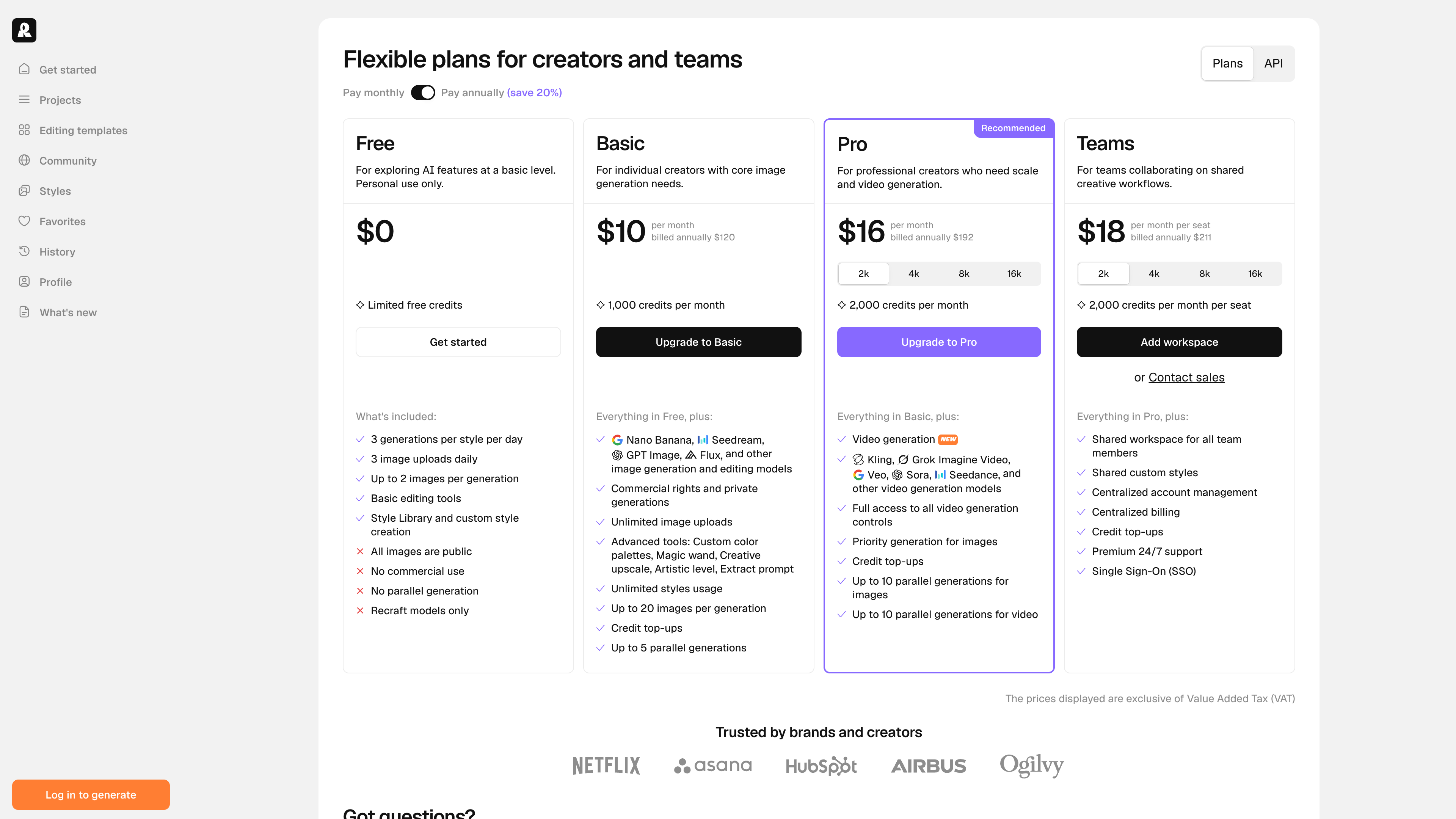
Pricing: metered in credits, and the free tier is non-commercial
All generation and editing is metered in credits (pricing page and credits docs, as of 2026-09-17):
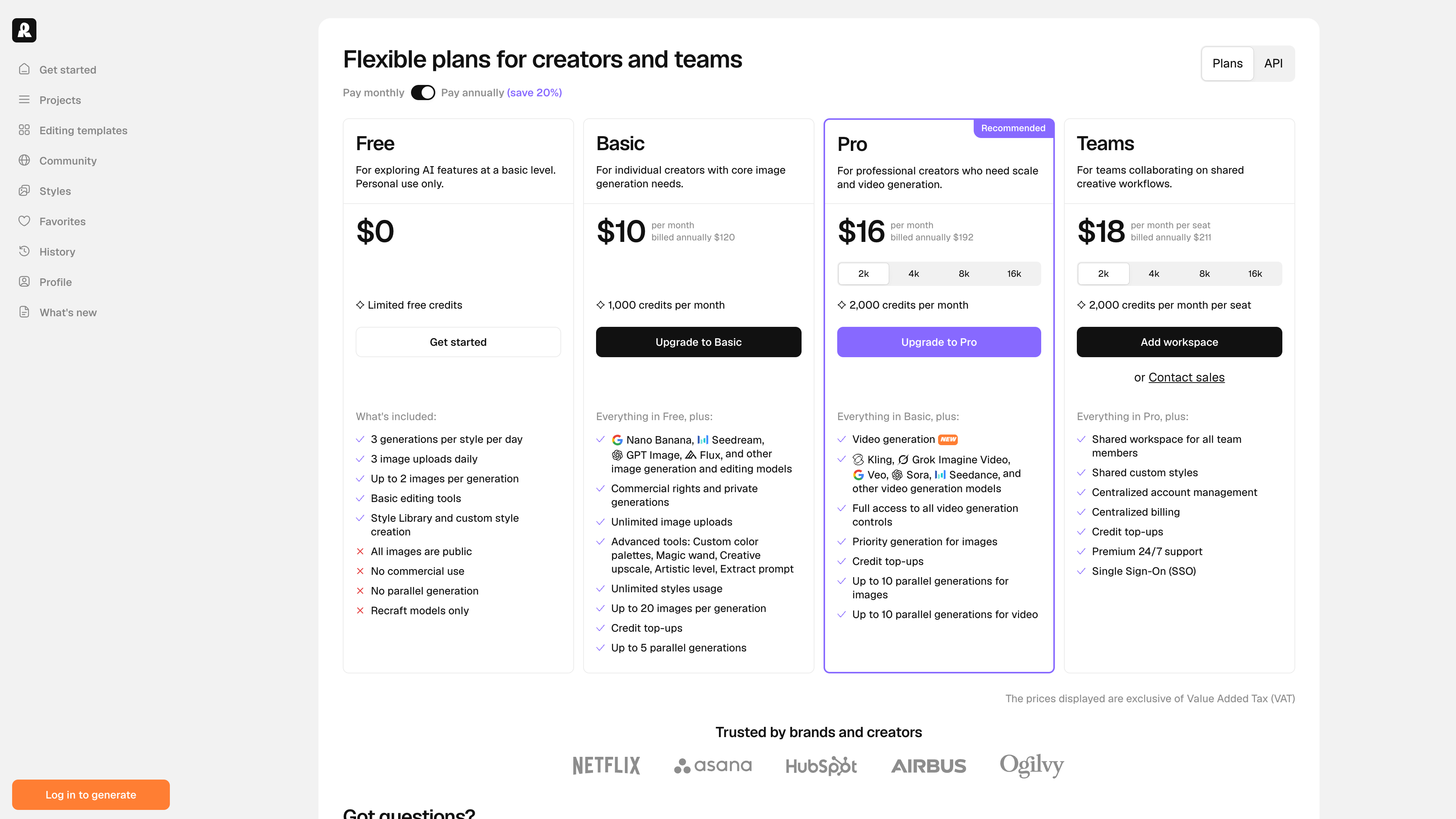
| Plan | Price | Monthly credits | Key differences |
|---|---|---|---|
| Free | $0 | Limited daily allowance | 3 generations per style per day, 3 uploads daily, up to 2 images per generation; outputs public and non-commercial; in-house models only |
| Basic | 10/month annually) | 1,000 | External models, commercial rights and private generations, unlimited uploads, advanced tools, top-ups, 5 parallel generations |
| Pro | from 16/month annually) | 2,000 and up (16,000 max) | Video generation, priority image generation, 10 parallel generations |
| Teams | from 18 annually) | 2,000 per seat and up | Shared workspace and styles, centralized billing, 24/7 premium support, SSO |
Credit consumption depends on the operation and model: raster generation costs the selected model's per-image price (the docs don't list a single figure — check inside Studio); vector generation has explicit rates — 4 credits per image for V4.1 Vector, 12 for V4.1 Pro Vector; a mockup costs 2 credits, background removal and vectorization 1 each. Subscription credits reset each billing cycle and don't roll over; paid plans can buy top-up packs (from $2 for 200 credits) that never expire. Payments run through Stripe, and refunds are discretionary.
Accounts and openness
- Sign-up: email one-time code, Google, Discord, or Apple — no password. The interface is available in six languages, none of them Chinese (interface language docs).
- Recraft API: all models from V2 through V4.1 are available, covering image/vector generation, editing, background removal, and batch and asynchronous jobs. Billing is separate from subscriptions via prepaid API Units (0.035, a V4.1 Pro vector $0.30. Units are non-refundable but never expire (API pricing docs).
- Third-party platforms: Recraft models are also hosted on inference platforms such as fal, Replicate, and Prodia (Wikipedia).
Copyright and content policy
This is the part of Recraft's terms most worth reading (commercial rights & ownership docs, Terms of Service, August 2026 version):
- Free-plan output belongs to the platform: it is displayed publicly in the community gallery and carries no commercial license — it typically can't be listed on stock platforms, which require proof of ownership.
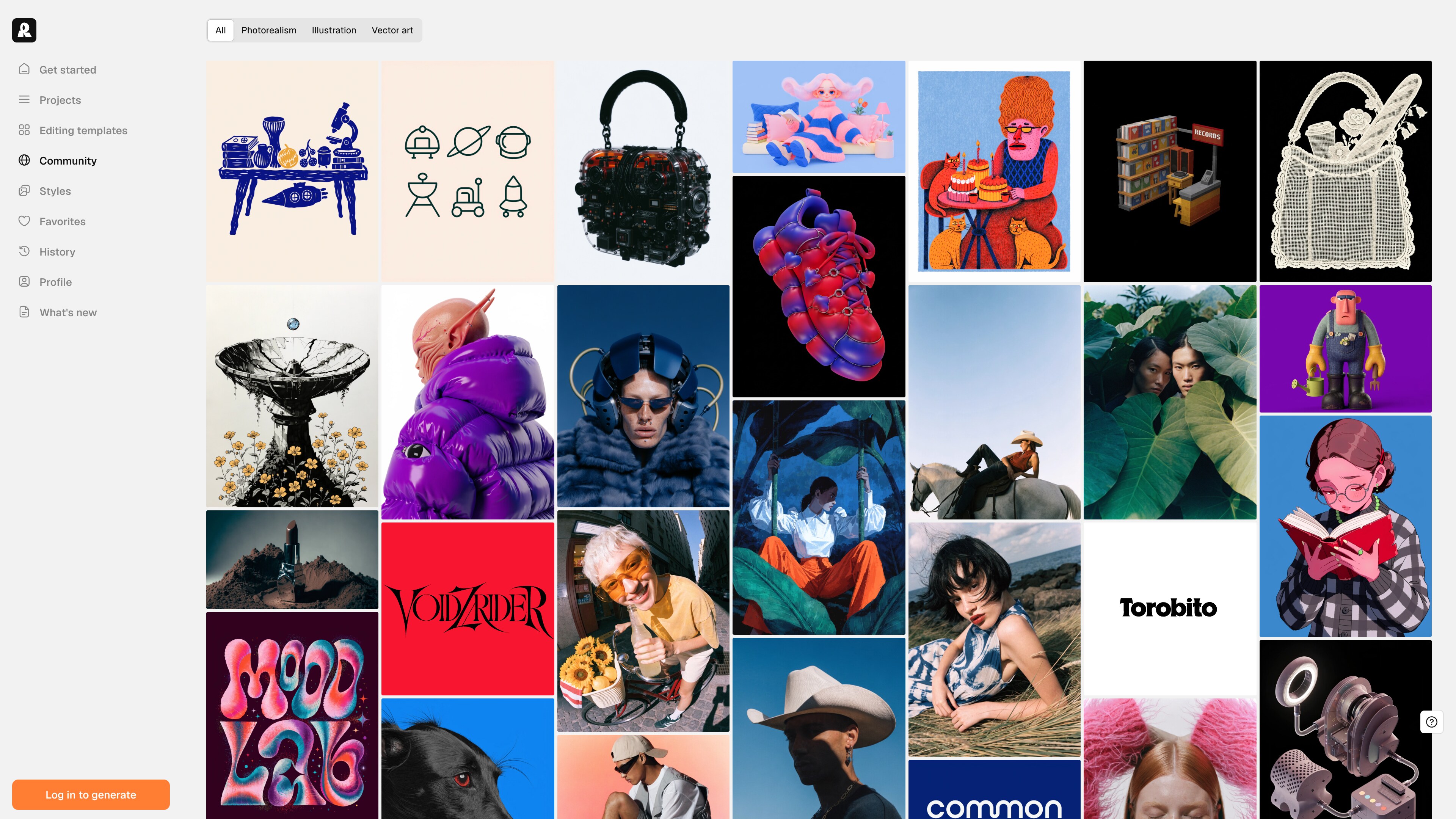
- Paid plans get full ownership and commercial rights: Recraft assigns whatever copyright it may hold in the output to the user; images stay private, and rights survive cancellation.
- On any plan, output may not be used to train AI models; community-gallery content is licensed to other users on a non-exclusive basis and may be used by Recraft for training.
- User inputs and generations are used to improve the models by default, with an opt-out in the account settings.
- Other notable terms: the contracting entity is the US company Recraft Inc.; New York law applies; disputes go to JAMS arbitration in San Francisco with a class-action waiver; liability is capped at $50 or the fees paid in the prior six months; users must be 18 or older.
Good fits
- Brand and marketing teams: generate consistent illustrations, icons, and ad assets at scale with custom styles, replacing some stock-library purchases.
- Graphic and logo design: native SVG output drops straight into Figma or Illustrator for further editing, skipping raster tracing.
- E-commerce and product imagery: the Utility variant's flat, front-facing look plus mockup tools suits quick product-scene visuals.
- Developers: wire image and vector generation into your own toolchain via the API or fal/Replicate.
Limitations
- The free tier is barely more than a trial: limited daily credits and three generations per style per day, and everything you make is public, owned by Recraft, and non-commercial — stricter than most peers' free plans.
- Leaderboard results are crowd-voted: Artificial Analysis ranks models by blind user-preference Elo, which reflects taste rather than objective quality — a caveat TechCrunch also noted in its Red Panda coverage.
- Credits don't roll over: subscription allowances reset each cycle, making costs harder to predict for uneven usage.
- No Chinese interface; support and documentation are primarily in English.
- Closed-source models: online use or API only, no self-hosting; the terms lean toward the platform (mandatory arbitration, liability cap, discretionary refunds).
Alternatives
- Midjourney: the most art-driven of the pure raster generators; no vector output and fewer precise controls.
- Ideogram: another text-to-image product founded in 2022, best known for in-image text rendering; also offers an API.
- Adobe Firefly: Adobe's generative AI, deeply integrated with Creative Cloud and pitched on commercially safe training data.
Sources
- Recraft homepage (checked 2026-09-17)
- Recraft About (checked 2026-09-17)
- Recraft pricing page (checked 2026-09-17)
- Paid plans - Recraft Docs (checked 2026-09-17)
- Credits - Recraft Docs (checked 2026-09-17)
- Commercial rights and ownership - Recraft Docs (checked 2026-09-17)
- Quick start - Recraft Docs (checked 2026-09-17)
- Interface language - Recraft Docs (checked 2026-09-17)
- API pricing - Recraft Docs (checked 2026-09-17)
- Terms of Service - Recraft (updated 2026-08-11) (checked 2026-09-17)
- Introducing Recraft V4 - Recraft Blog (2026-02-17) (checked 2026-09-17)
- Recraft V4.1: More Beautiful by Nature - Recraft Blog (2026-05-14) (checked 2026-09-17)
- Recraft V4.1 Utility Pro becomes the highest-ranked text-to-image model outside Google and OpenAI - Recraft press release (2026-05-30) (checked 2026-09-17)
- Can Recraft's foundational model for graphic design swerve the AI controversy? - TechCrunch (2024-01-17) (checked 2026-09-17)
- A mysterious new image generation model has appeared - TechCrunch (2024-10-28) (checked 2026-09-17)
- Recraft Raises $30M Series B - Business Wire (2025-05-06) (checked 2026-09-17)
- Recraft - Wikipedia (checked 2026-09-17)
- Interview with Recraft's founder - 36Kr (2025-01-08, in Chinese) (checked 2026-09-17)