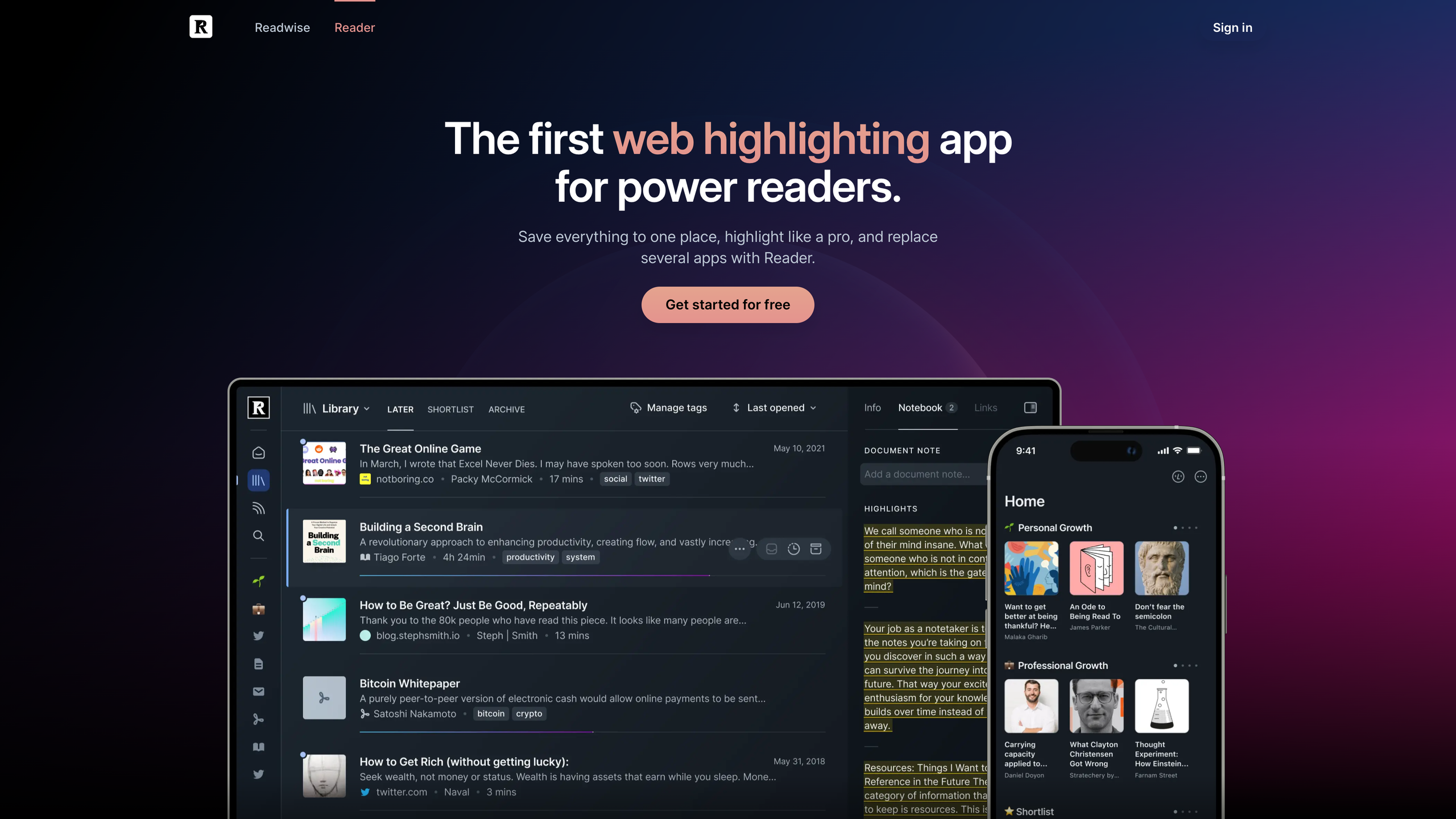
Readwise Reader (readwise.io/read) is an all-in-one reading application from Readwise, Inc. in Raleigh, North Carolina, built to fix the fragmentation of digital reading: articles live in browsers, newsletters in inboxes, feeds in RSS readers, PDFs in folders, ebooks on dedicated devices. Reader consolidates these seven or eight content types into a single reader and treats highlighting as a first-class feature — text, images, tables and rich text can all be highlighted, with annotations syncing instantly into the companion Readwise highlight service and from there out to note-taking apps. Its verifiable differences from classic read-it-later tools (Instapaper, the now-defunct Pocket) are broader content coverage, a local-first architecture with offline full-text search, and a built-in RSS reader, YouTube transcript highlighting and the Ghostreader AI assistant.
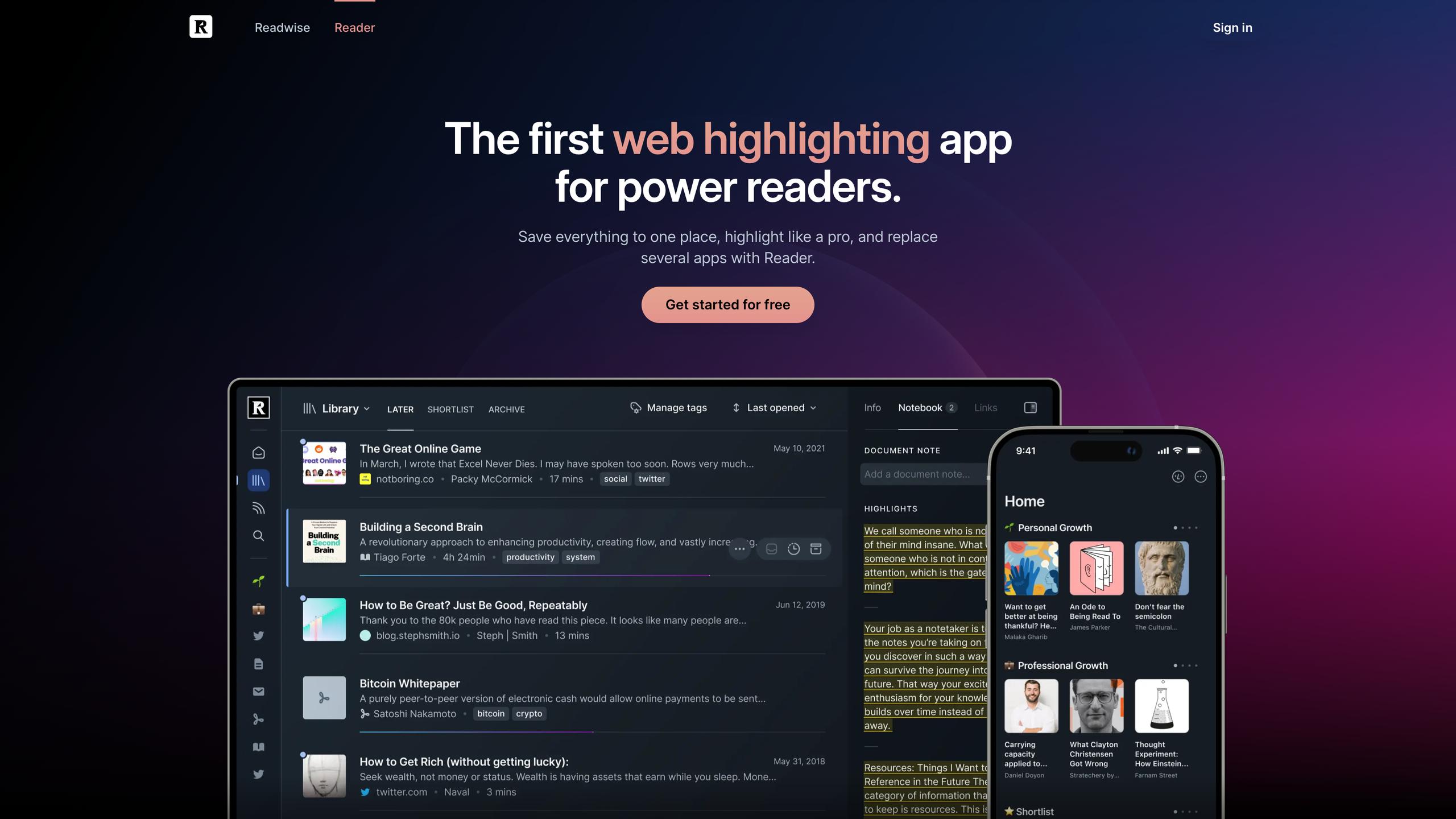
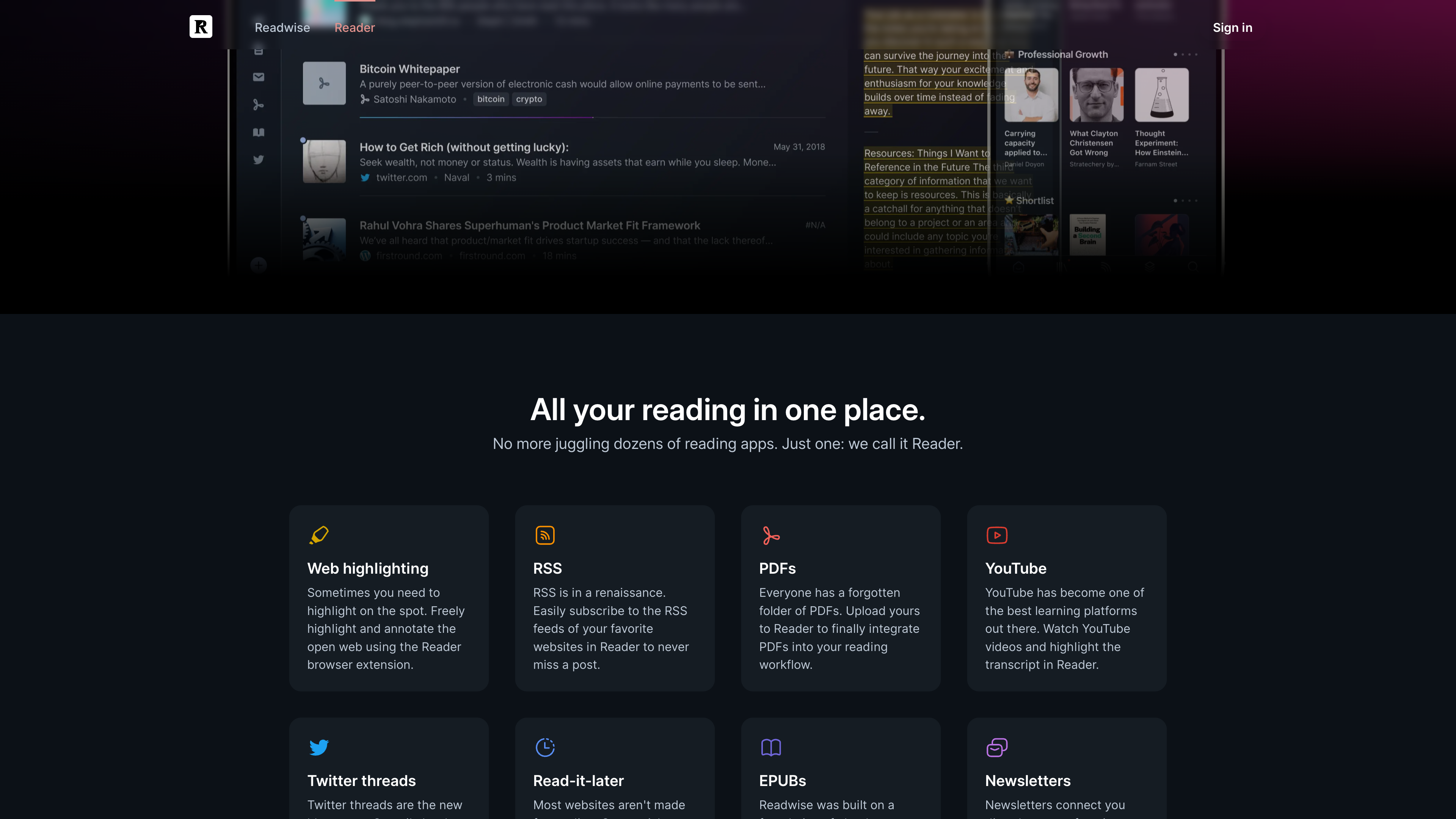
The screenshot above is the homepage hero: “web highlighting” is a rotating word that cycles through content types such as read-it-later, and below it sit mockups of the desktop document library (with tags and reading progress) and the mobile home screen.
At a glance
- URL: https://readwise.io/read
- Type: All-in-one read-it-later + highlighting app (consumer SaaS)
- Cost: No permanent free tier; 30-day free trial, then Readwise Full at 12.99/month billed monthly (per the official pricing page as of 2026-09-25)
- Sign-up: An account (email or Amazon login) is required to use the product; the website, docs and blog are browsable without one
- Interface language: English only — no language switcher on the site, pricing page or docs as of 2026-09-25
- Platforms: Web, iOS, Android, native macOS and Windows apps, and Chrome/Firefox/Safari browser extensions (official docs)
- Launch: Development announced September 2021; public beta opened December 14, 2022
Background
Readwise was founded by Daniel Doyon and Tristan Homsi and is headquartered in Raleigh, NC (the address on its terms of service). In an officially annotated Twitter thread, the founders state that the Readwise MVP launched in May 2017 and reached roughly 3,000, 10,000 and 30,000 registered (not paying) users after its first, second and third years. The original product focused on what happens after you read: it collected highlights from Kindle, Apple Books, Instapaper and others, resurfaced them through a spaced-repetition Daily Review email, and synced them out to note-taking apps.
In July 2018 the company announced on its blog that it would bootstrap on revenue rather than raise venture capital, switching from freemium to a paid-only model after a free trial. On September 8, 2021, the post “The Next Chapter of Readwise: Our Own Reading App” announced an in-house reading app, motivated by user complaints about upstream reading apps — lost highlight context, no image highlighting, slow sync, hard-to-export PDF annotations — that only a first-party reader could fix. On December 14, 2022, Reader entered public beta; that post notes the company was five years old with a team of 13. The official changelog was still shipping weekly updates as of September 2026.
Core capability: every content type in one reader
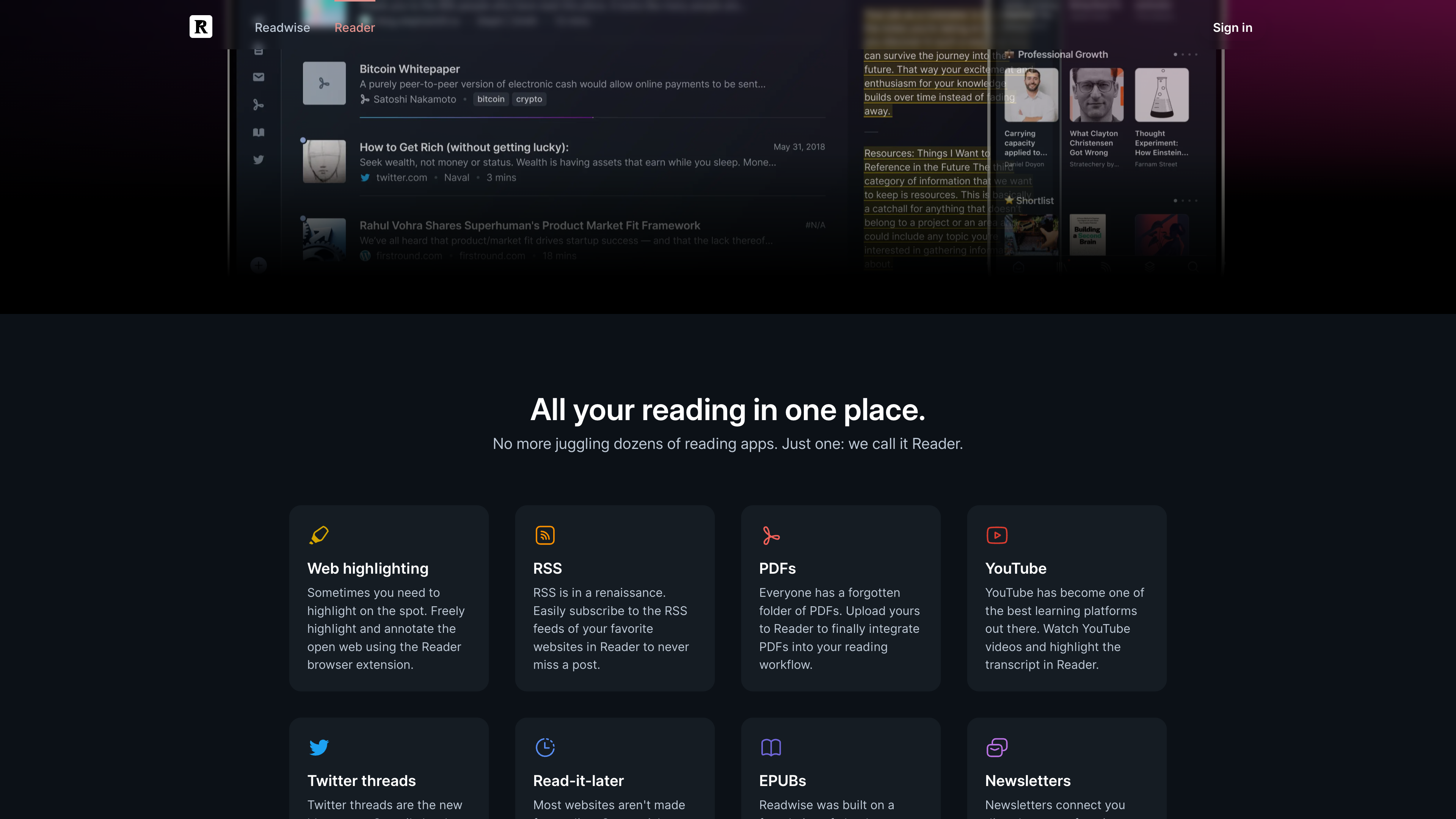
The feature section above maps to the content types Reader handles:
- Web read-it-later and open-web highlighting: the browser extension saves a clean, distraction-free version of a page, and can also highlight directly on the live web; highlights overlay bidirectionally between the original page and the parsed copy in Reader (docs).
- RSS and email newsletters: a built-in feed reader, plus a personal Reader email address that delivers newsletters straight to your library.
- PDFs and EPUBs: uploaded files live alongside everything else and support the same annotation tools.
- YouTube: videos play next to a time-synced transcript you can highlight, with click-to-seek navigation.
- Twitter/X: threads are compiled into long-form articles, and public lists can be subscribed to as twice-daily digests.
Beyond ingestion, Reader separates manually curated material (Library: Inbox/Later/Shortlist/Archive) from automatically pushed content (Feed), and offers filtered views — saved queries that treat the library like a database of document properties. Annotation goes beyond text: images and rich text can be highlighted, notes appear as margin notes in the sidebar, and tags work at both document and highlight level. The Ghostreader AI provides definitions, translation, summarization and custom prompts; the default GPT-5 Mini model is included in the subscription, your own OpenAI API key unlocks higher-tier models and automatic Feed summarization, and the whole feature can be turned off globally (Ghostreader docs). There is also AI text-to-speech (voices by Unreal Speech) and a mobile-only Quick Lookup panel for selected words.
Relationship to Readwise, exports and openness
Reader and Readwise share one account and database: highlights made in Reader sync instantly to Readwise, which then exports them automatically to Notion, Obsidian, Roam Research, Logseq, Evernote and more, with Jinja2-customizable templates. The sync is one-directional — Kindle highlights do not appear in Reader — and deleting a Reader document also deletes its highlights in Readwise (official note). Self-serve exports include per-document Markdown, tag-level batch export, a library-wide CSV, OPML for feeds, and a full ZIP of uploaded files and article contents delivered by email (export docs); documents can also be sent to Kindle.
For developers, Reader exposes a REST API (token auth; create/list/update/delete for documents and highlights, webhooks, 20–50 requests/minute rate limits), plus an official MCP server and npm CLI (browser OAuth login) aimed at AI tools — letting agents like Claude Code search and organize an entire reading library.
Pricing
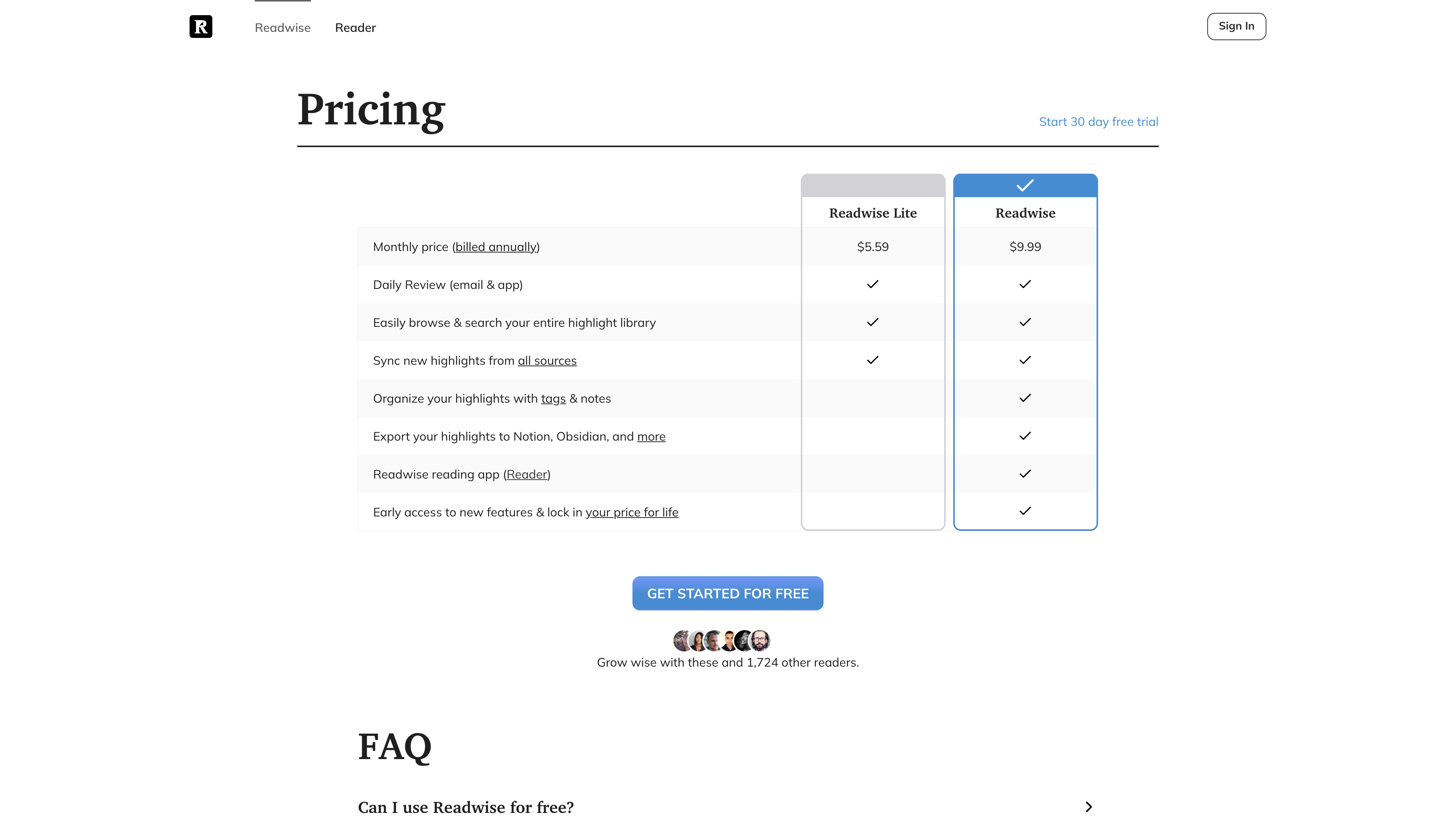
As of 2026-09-25, the official pricing page lists:
| Plan | Price | Notes |
|---|---|---|
| Readwise Lite | $5.59/month (billed annually) | Highlight sync, Daily Review, note-app export; Reader not included |
| Readwise Full | 119.88/year) or $12.99/month billed monthly | Includes Reader, early access to new features and a “lock in your price for life” pledge |
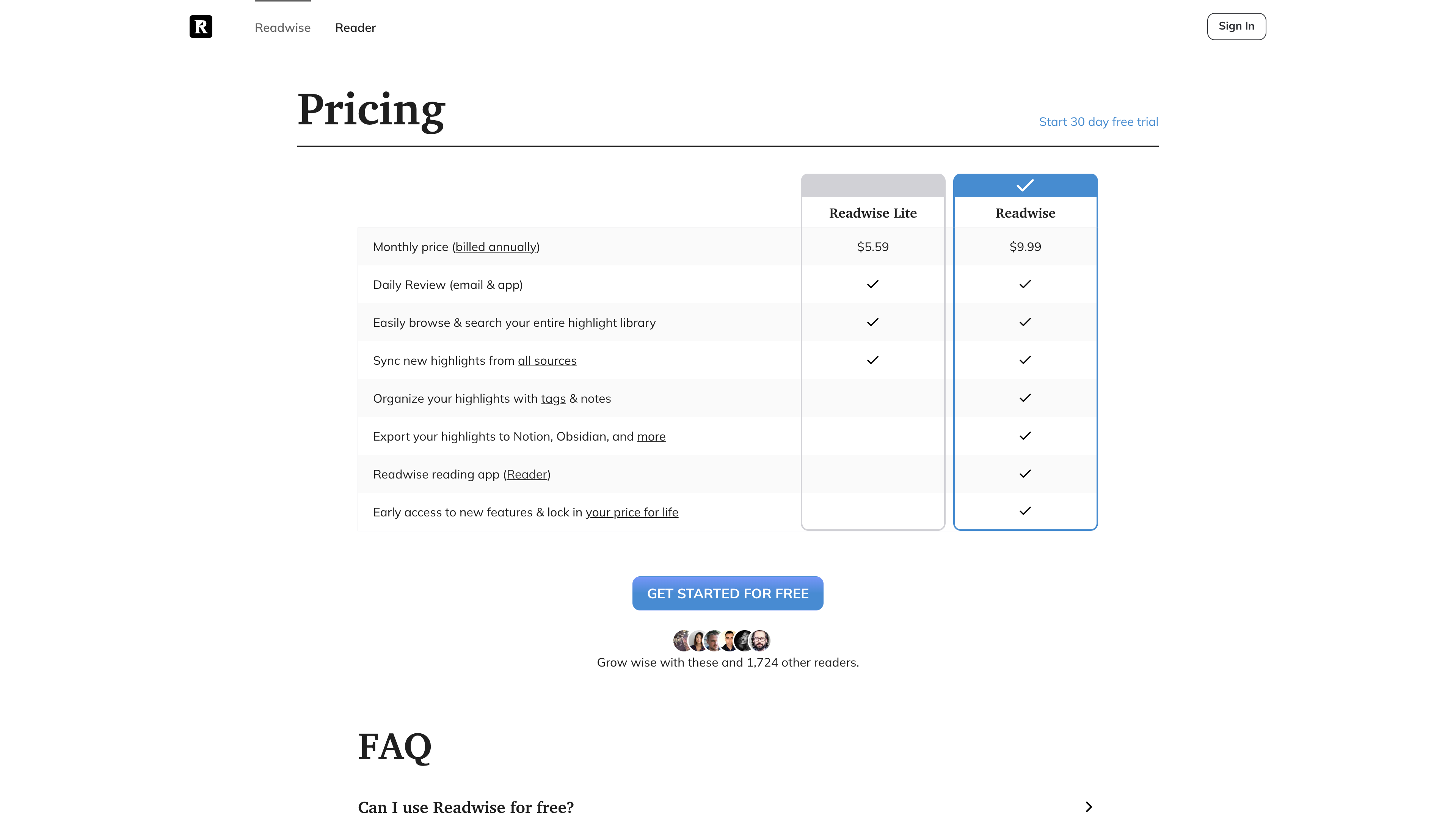
There is no permanent free tier; new users get a 30-day full-feature trial, and students and academics can email for a 50% discount. Subscriptions can be cancelled anytime in account settings, though the terms of service state that payments are final and non-refundable unless Readwise decides otherwise.
Privacy and terms
The privacy policy (revised 2024-12-20) opens with “our business model has never been to sell data and it never will,” collecting only login details, saved content, and ordinary error monitoring and product analytics; data can be exported at any time; payments go through Stripe; the service is not for children under 16; data is stored in the United States, Google Analytics is used, and Do Not Track signals are not honored. For Ghostreader, Readwise says documents reach OpenAI only when you invoke an action, limited to the passage named in the prompt, and that it has opted out of OpenAI training on that data. The terms of service (revised 2023-08-15) limit the service to personal use, prohibit scraping, and include binding arbitration with a class-action waiver.
Who it's for
- Heavy readers whose sources are scattered (articles + newsletters + RSS + PDFs + ebooks + video) and who want one searchable library, including offline.
- Personal-knowledge-management users whose workflow runs “highlight → review → export to notes,” especially Obsidian and Notion users.
- Former Pocket users looking for a replacement: Reader documents migration from Instapaper, Matter and Raindrop.io, plus bulk CSV import.
- Users who want their reading library accessible to AI assistants or their own tooling (API, MCP, CLI).
Limitations
- No free tier: payment is required after the 30-day trial, and Reader is not sold separately from Readwise Full; per the terms, payments are non-refundable in principle.
- English only: the app, website and documentation have no Chinese or other language versions.
- Parsing has limits: the official docs concede that 100% correct parsing of the web is impossible; paywalled articles yield full text only when saved from iOS Safari while logged in — saves from Android or other sources produce only partial parses from the bare URL.
- Closed, hosted service: “local-first” means local caching and offline use, but accounts and sync depend on the vendor's servers; there is no self-hosting, and the terms restrict usage to personal, non-commercial purposes.
- Tight coupling with Readwise: Reader requires the Full plan, its highlight system lives on the shared account, and deleting a document deletes its highlights too.
- Vendor-reported figures: user counts, retention improvements and similar numbers on the site and blog are self-reported and not independently audited.
Alternatives and context
- Pocket: Mozilla's classic read-it-later app — shut down on July 8, 2025 per Mozilla's May 22, 2025 announcement, with data export available until October 8, 2025. It was the category's biggest recent change, and Reader's migration docs cover imports from it.
- Instapaper: the veteran read-it-later app focused on web articles; Reader can import from it automatically.
- Matter: a mobile-first modern read-it-later app that likewise emphasizes highlighting and AI narration.
References
- Readwise Reader homepage (checked 2026-09-25)
- Pricing | Readwise (checked 2026-09-25)
- The Next Chapter of Readwise: Our Own Reading App (2021-09-08) (checked 2026-09-25)
- The Next Chapter of Reader: Public Beta (2022-12-14) (checked 2026-09-25)
- Why We're Bootstrapping Readwise (2018-07-24) (checked 2026-09-25)
- Reader documentation home - Readwise Docs (checked 2026-09-25)
- Saving Content to Reader - Readwise Docs (checked 2026-09-25)
- Exporting - Readwise Docs (checked 2026-09-25)
- Ghostreader - Readwise Docs (checked 2026-09-25)
- Miscellaneous - Readwise Docs (checked 2026-09-25)
- Mobile Apps / Desktop Apps - Readwise Docs (checked 2026-09-25)
- Readwise & Reader Changelog (checked 2026-09-25)
- Reader API / Readwise MCP / Readwise CLI (checked 2026-09-25)
- Terms of Service (2023-08-15) / Privacy Policy (2024-12-20) (checked 2026-09-25)
- Investing in what moves the internet forward - The Mozilla Blog (2025-05-22) (checked 2026-09-25)