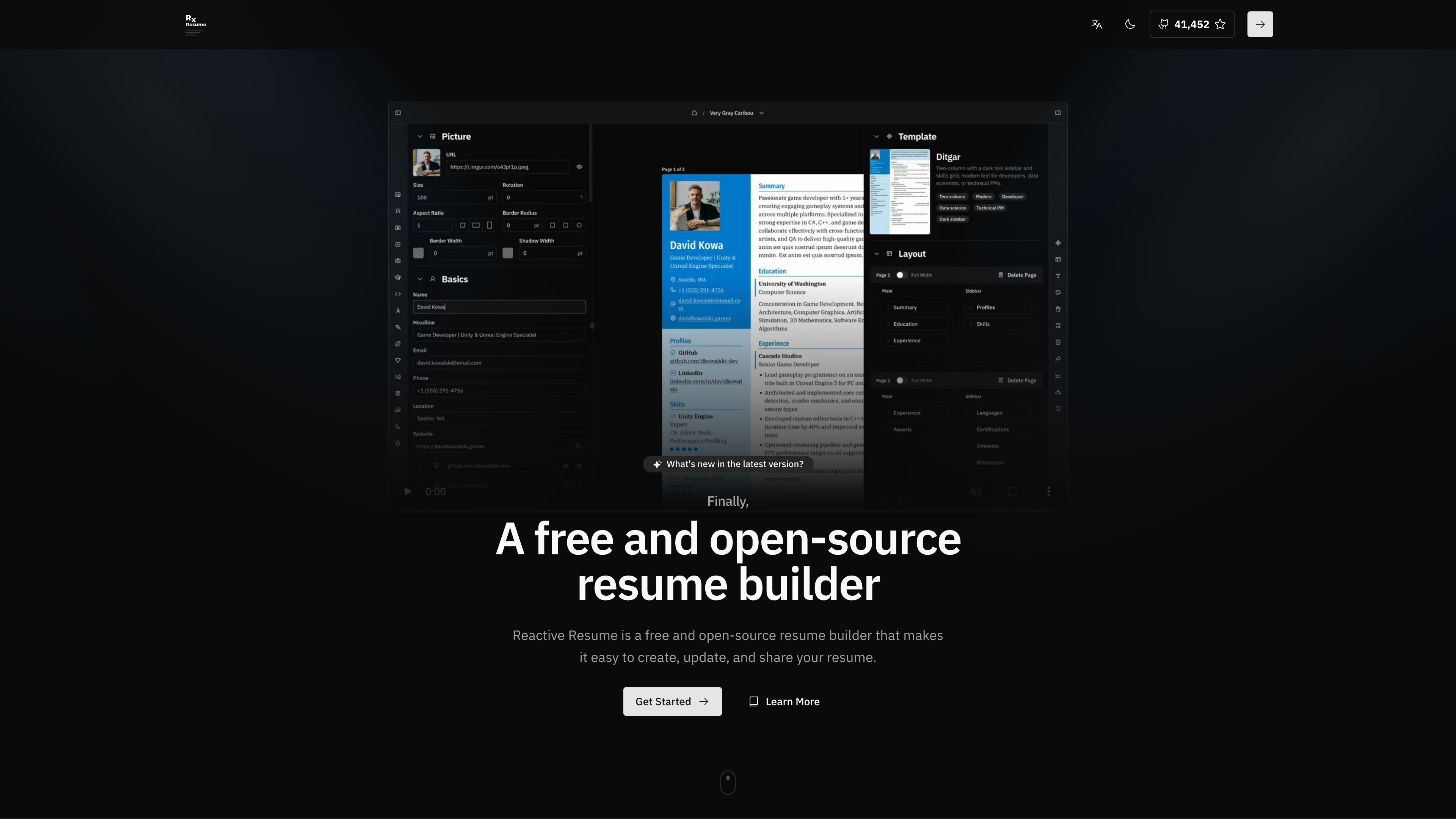
Reactive Resume (rxresu.me) is a free, open-source resume builder: you fill in your details in the browser, watch the layout update live, and export to PDF or share the result via a public link. Unlike commercial builders such as Zety or Resume.io that charge at download time, its verifiable differences are that the code is fully open source under the MIT license, the hosted service pledges to stay free forever with no ads and no tracking, and the entire stack can be deployed on your own server with the official Docker image. As of 2026-09-08, the GitHub repository has 42,333 stars, and the operator-reported counters on the homepage show 1,213,095 registered users and 1,651,866 resumes created.
At a glance
- URL: https://rxresu.me
- Type: Online resume builder and job-search management tool (open-source web app)
- Cost: Completely free, no paid tiers; the project is sustained by sponsorships and donations
- Sign-up: Building and saving resumes requires a free account (email, GitHub, or Google sign-in; email verification is not enforced); public tools like the ATS Checker work without an account
- Interface languages: 55, including Simplified and Traditional Chinese, translated by the community via Crowdin
- License: MIT — free to use, modify, and redistribute
Background
Reactive Resume was started by developer Amruth Pillai and first launched publicly on Product Hunt in March 2020 (the GitHub repository dates to 2020-03-25). According to his personal site, he is a senior frontend engineer based in Berlin (previously at Postman and Twilio) who maintains the project in his spare time.
The project has iterated steadily: v3 shipped in March 2022, v4 in November 2023, and a ground-up rewrite, v5, arrived in January 2026 on a new stack (TanStack Start with React 19, PostgreSQL), adding passkey sign-in, API access, and AI integration. As of 2026-09-08 the latest release is v5.3.0 (published 2026-09-06), which introduced a cover letter library and local PDF resume import. Users of the retired v4 can migrate by exporting JSON and re-importing it, per the official guide.
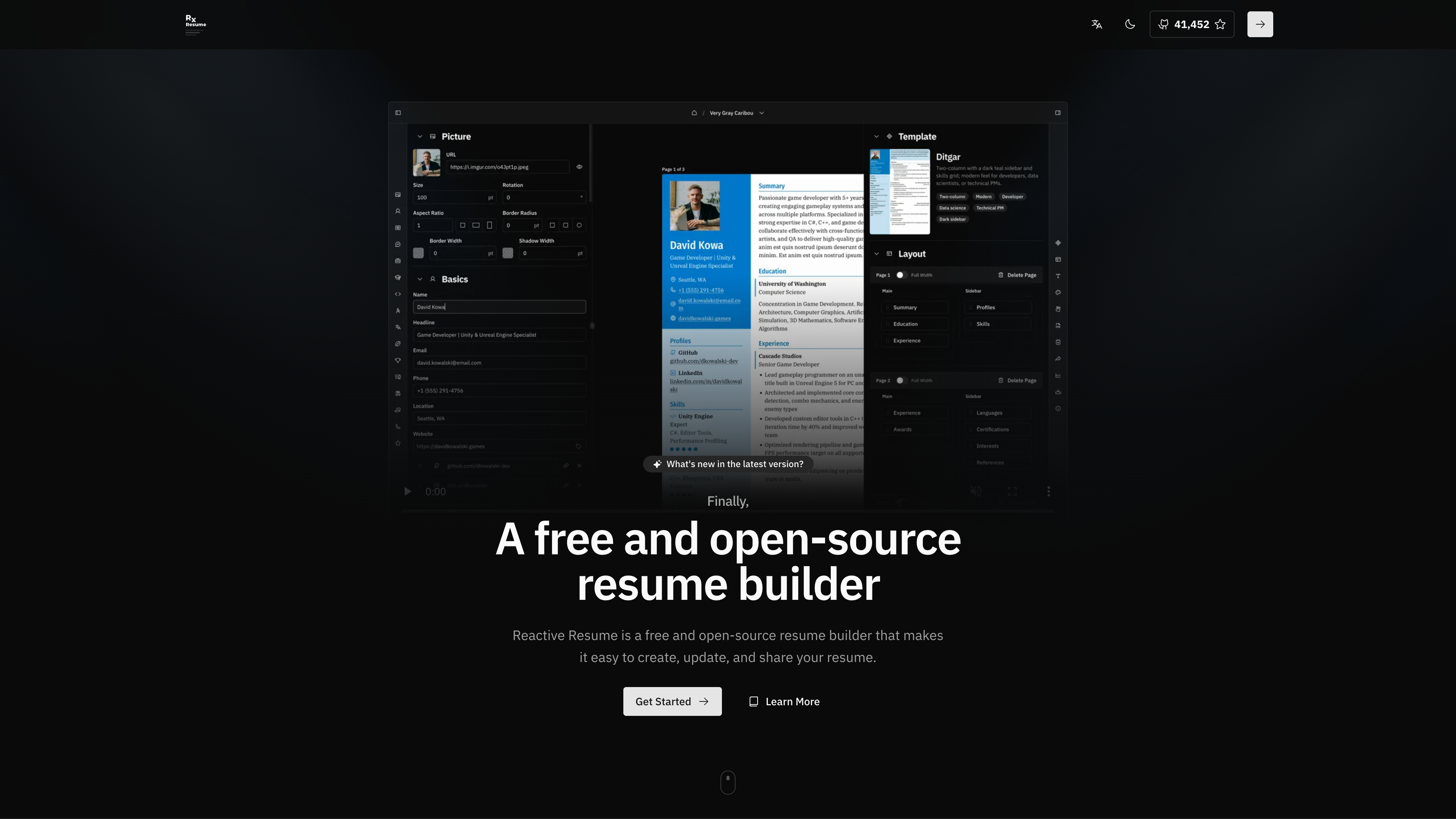
Editor and templates
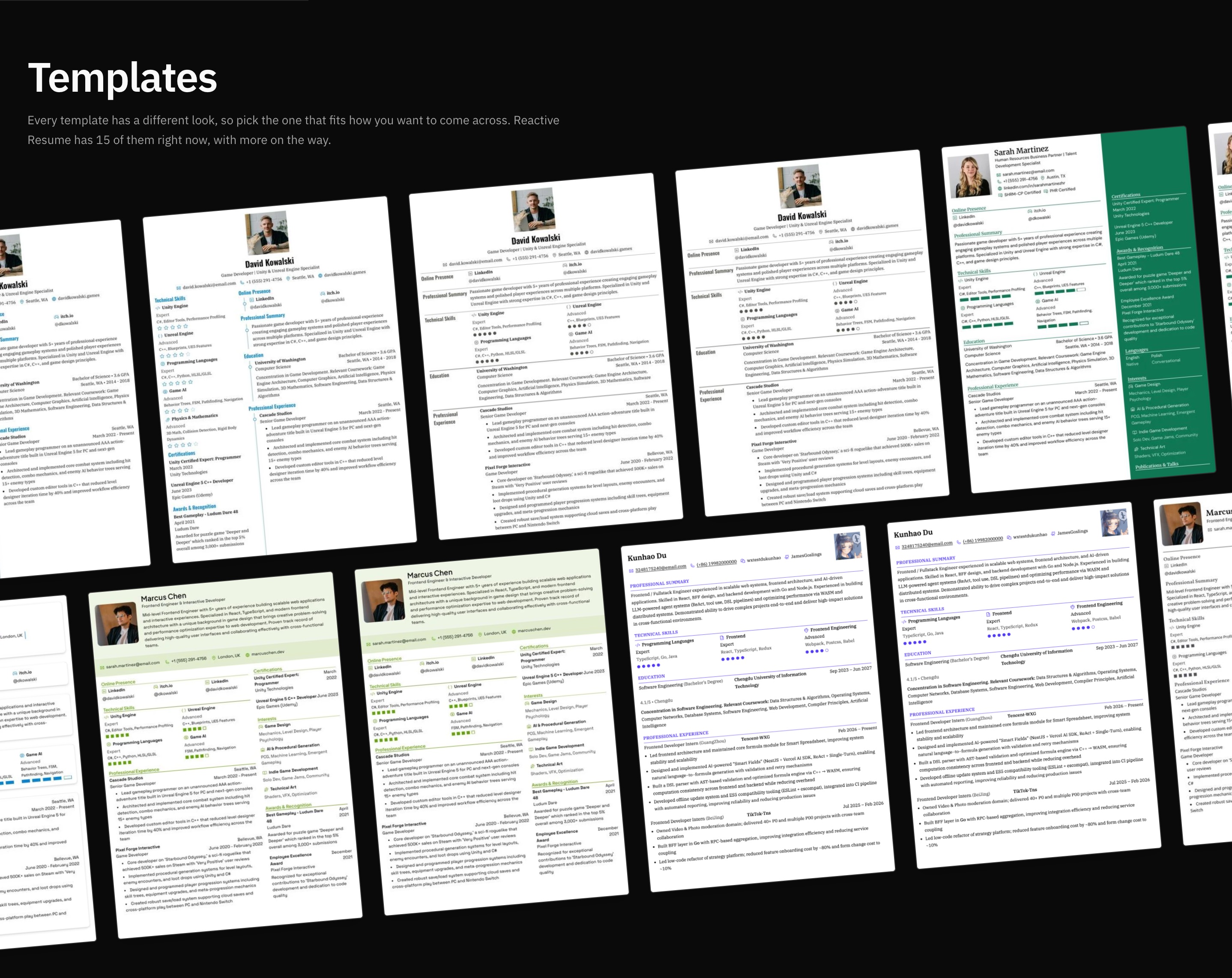
The editor pairs a form panel with a live preview, with drag-and-drop section ordering, custom sections, rich text formatting, and undo history. As of 2026-09-08 it offers 15 templates — Azurill, Bronzor, Chikorita, Ditto, Pikachu, and others, all named after Pokémon — each adjustable in colors, fonts, spacing, and page size (A4/Letter), plus a CSS editor for users who want direct control over styling.
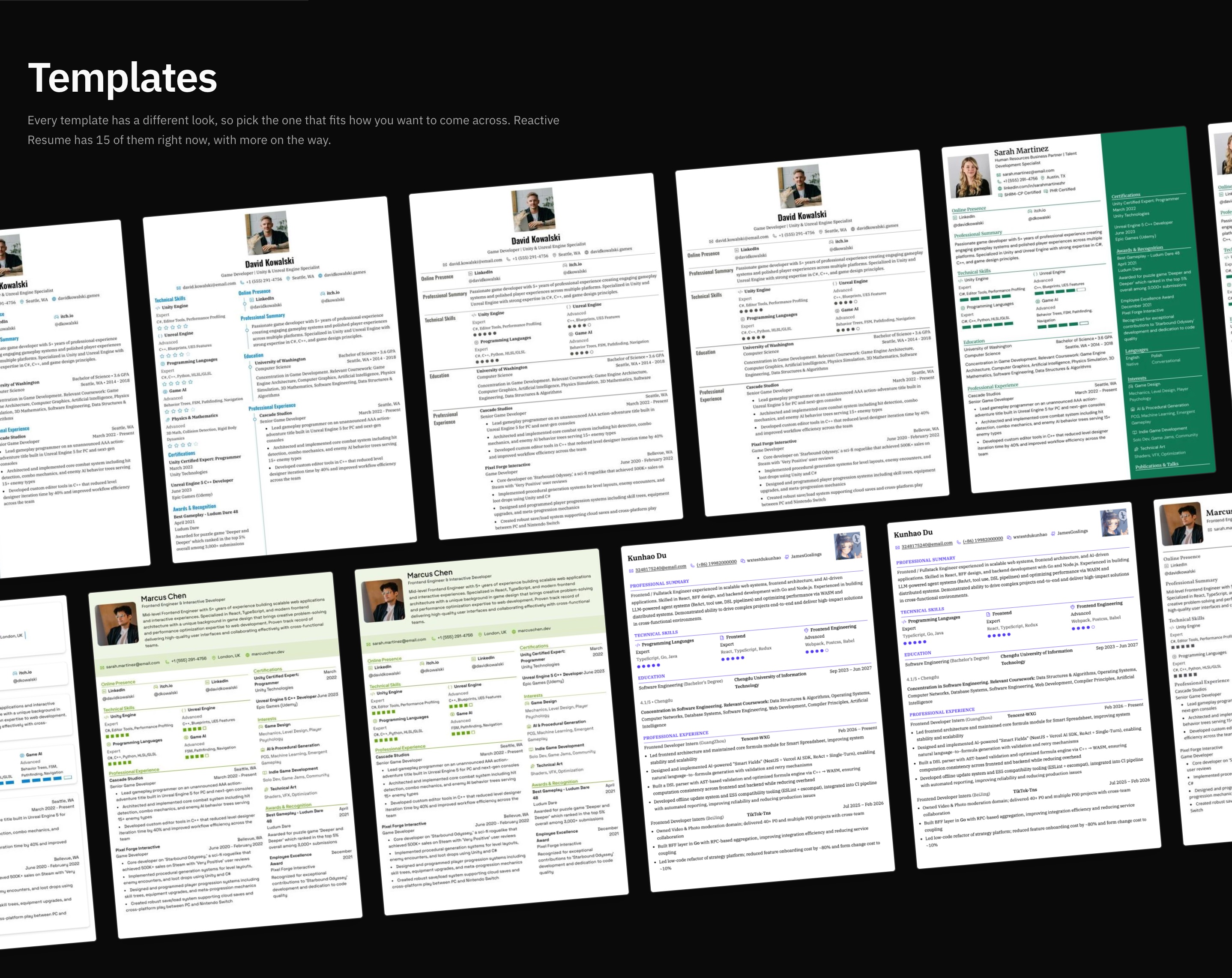
Resumes export to PDF, DOCX, Markdown, and JSON. Since v5.1.0, PDFs are rendered entirely in the browser via @react-pdf/renderer, so resume content never passes through a server-side rendering service — part of the project's privacy design. Imports cover the JSON Resume open format, legacy Reactive Resume JSON, and PDF/DOCX parsing (PDF parsing has run locally in the browser since September 2026, with an AI-assisted path available when a provider is configured). Full account data can be exported or permanently deleted from the settings page.
Sharing, ATS checking, and application tracking
A resume can be published at rxresu.me/{username}/{slug} with optional password protection and view/download counters, and taken private again at any time.
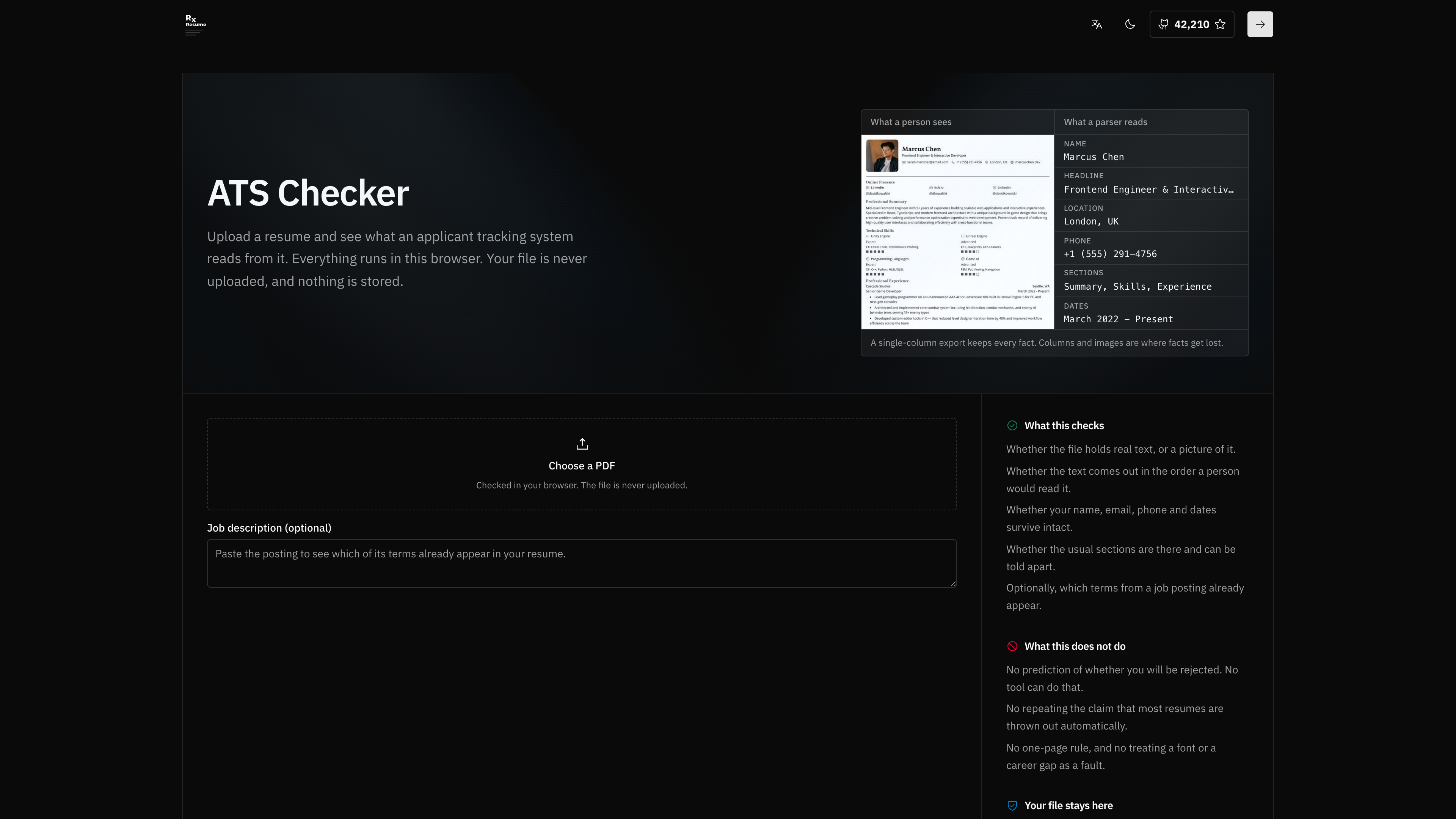
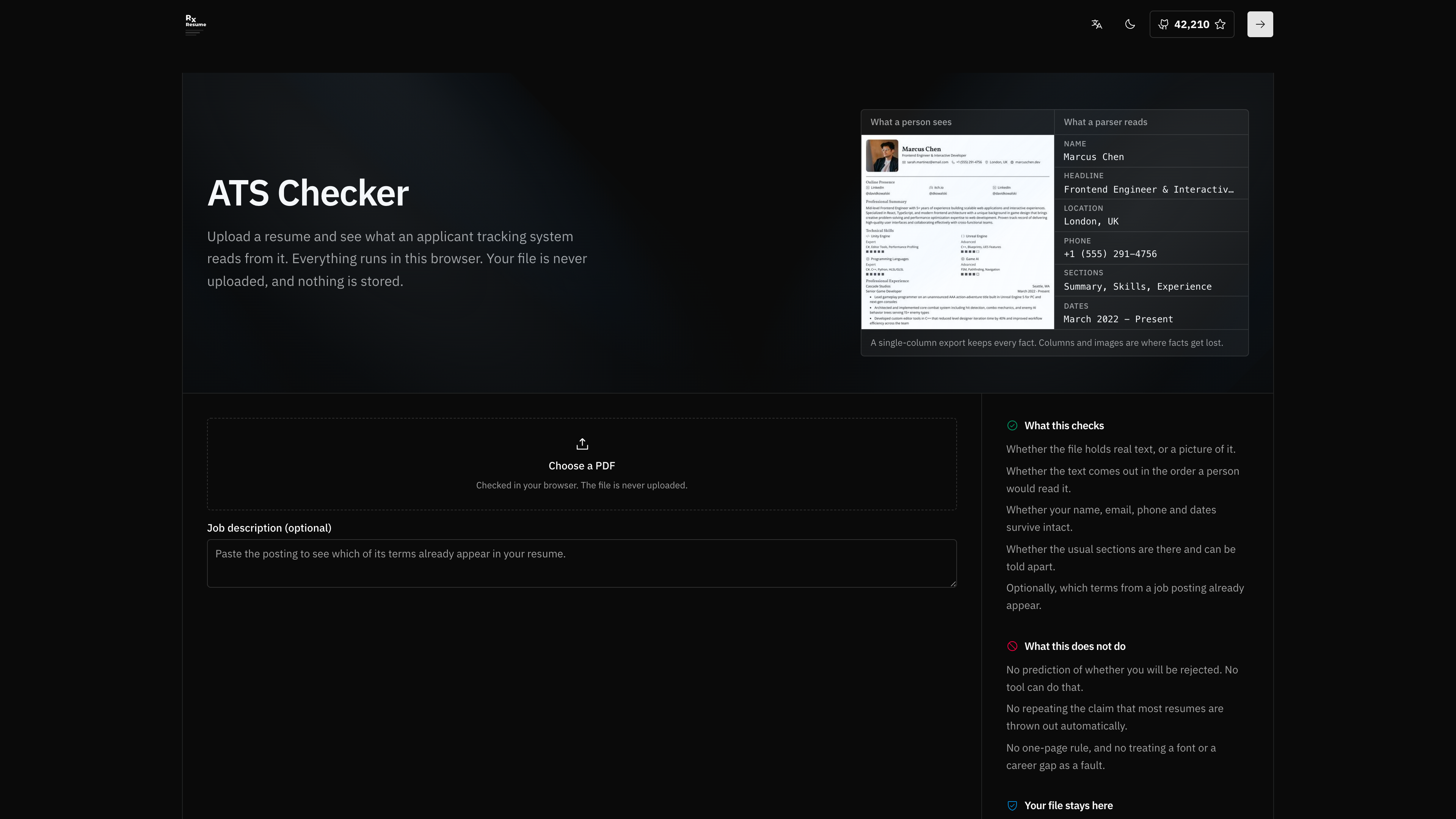
One easily overlooked extra is the standalone ATS Checker. It needs no account: drop in a resume PDF and it is parsed entirely in your browser — the file is never uploaded or stored. The tool scores the file from 0 to 100 across readability, layout, sections, contact details, and dates, pointing out exactly which text a machine parser would lose, and it can compare the resume against a pasted job posting for keyword coverage. Notably, the official documentation states what the tool deliberately does not do: it does not predict whether an application will be rejected, does not repeat the marketing claim that most resumes are auto-discarded, and does not enforce a one-page rule. Section detection currently works only for resumes written in English.
Since the 2026 releases, the tool's scope has grown from building resumes to managing the job hunt: the Application Tracker offers board, table, and insights views across six stages from "Saved" to "Offer", links each application to the resume sent, stores contacts and follow-ups, and exports to CSV. The September 2026 update added a standalone cover letter library.
Accounts and open interfaces
Accounts support email/password and one-click GitHub/Google sign-in (self-hosted instances can add LinkedIn or any OIDC provider), plus two-factor authentication and passkeys. Developers can create API keys (shown once at creation, used via an x-api-key header against the REST API), or connect an AI client through the MCP server to manage resumes and applications, with MCP connections gated by a full OAuth consent flow.
AI features follow a bring-your-own-key model: OpenAI, Anthropic, Google Gemini, OpenRouter, Ollama, and OpenAI-compatible endpoints are supported, with credentials encrypted server-side and never displayed again after saving. AI powers resume rewrite suggestions, an optional writing review in the ATS report, smart PDF/DOCX imports, and Application Copilot (match scoring, tailored resume copies, cover letter and follow-up drafts). Everything else works unchanged with no AI configured.
Privacy and self-hosting
The hosted service's privacy policy states that no behavioral advertising or third-party analytics is built in (the auth layer's telemetry is disabled), resume data is retained until you delete it, and AI requests go only to the provider you configure. Under the terms of service you retain full ownership of your content; the service is operated by Amruth Pillai as an individual, governed by German law, and provided "as is".
Users who want full data control can self-host: official images are published on Docker Hub and GHCR with a Compose example, requiring as little as 1 vCPU and 1 GB of RAM. PostgreSQL is the only hard dependency; SMTP, S3-compatible storage, and Redis (needed only for the AI Agent workspace) are optional, and database migrations run automatically at startup. The documentation states there is no feature difference between the cloud and self-hosted versions.
Who it's for
- Anyone who needs to produce or update a cleanly typeset PDF resume quickly, without paying for exports or signing up for a marketing-driven commercial platform.
- Job seekers checking ATS readability before applying — especially with multi-column layouts or icon-based skill bars that parsers often mangle.
- People maintaining several resume variants for different roles who want to track each application's progress in one place.
- Privacy-conscious individuals or teams who prefer to keep resume data on their own infrastructure (self-hosting).
- Developers who want to wire resume data into their own scripts or AI workflows (REST API, MCP, JSON export).
Limitations
- An account is required to build resumes: free and without enforced email verification, but unlike purely client-side tools, resumes live in a server-side account; only isolated public tools like the ATS Checker work without one.
- Fixed template frames: the 15 templates set the overall structure; customization is limited to colors, fonts, spacing, and CSS overrides. There is no way to design a layout from scratch and no template marketplace.
- AI is not free: every AI feature requires your own API key, and provider costs are yours; the hosted service includes no complimentary AI quota.
- A one-person project: the service is run and maintained by a single developer, with no SLA; support happens via GitHub, Discord, and Reddit. Homepage user counts are operator-reported.
- ATS checks are English-centric: section detection only works on English resumes; some checks are skipped for other languages.
- Translation depth varies: the 55 interface languages are community-translated, so non-English interfaces may contain untranslated strings.
Alternatives
- OpenResume: another open-source resume builder and parser (AGPL-3.0, ~8.9k stars as of 2026-09-08), focused on editing a single resume locally in the browser, with no accounts or application tracking.
- JSON Resume: an open JSON standard for resume data with its own theme ecosystem; Reactive Resume imports the format, so the two toolchains can complement each other.
- The project's documentation site hosts its own comparison pages against commercial tools like Canva, Zety, Novoresume, and resume.io (17 in total) — useful leads, though written from the project's own perspective.
References
- Reactive Resume homepage (checked 2026-09-08)
- Reactive Resume documentation - Getting Started (checked 2026-09-08)
- GitHub repository AmruthPillai/Reactive-Resume (checked 2026-09-08)
- Official changelog (checked 2026-09-08)
- Self-hosting guide (checked 2026-09-08)
- Using the ATS checker (checked 2026-09-08)
- Tracking job applications (checked 2026-09-08)
- Using artificial intelligence (checked 2026-09-08)
- Privacy Policy (checked 2026-09-08)
- Terms of Service (checked 2026-09-08)
- Amruth Pillai's personal site (checked 2026-09-08)
- Reactive Resume - Product Hunt (checked 2026-09-08)