PubMed is a biomedical literature search system developed and maintained by the National Center for Biotechnology Information (NCBI) at the U.S. National Library of Medicine (NLM), part of the National Institutes of Health (NIH). It has been freely available to the public since 1996. PubMed is not a full-text database: as of 2026-09-02 it indexes more than 40 million citations and abstracts, and full text is reached through links to PubMed Central (PMC) or publisher websites. Unlike general-purpose scholarly search engines such as Google Scholar, PubMed's core records are cataloged by NLM and indexed with Medical Subject Headings (MeSH), so searches can be narrowed precisely with structured fields like subject headings, article types, species, and age groups.
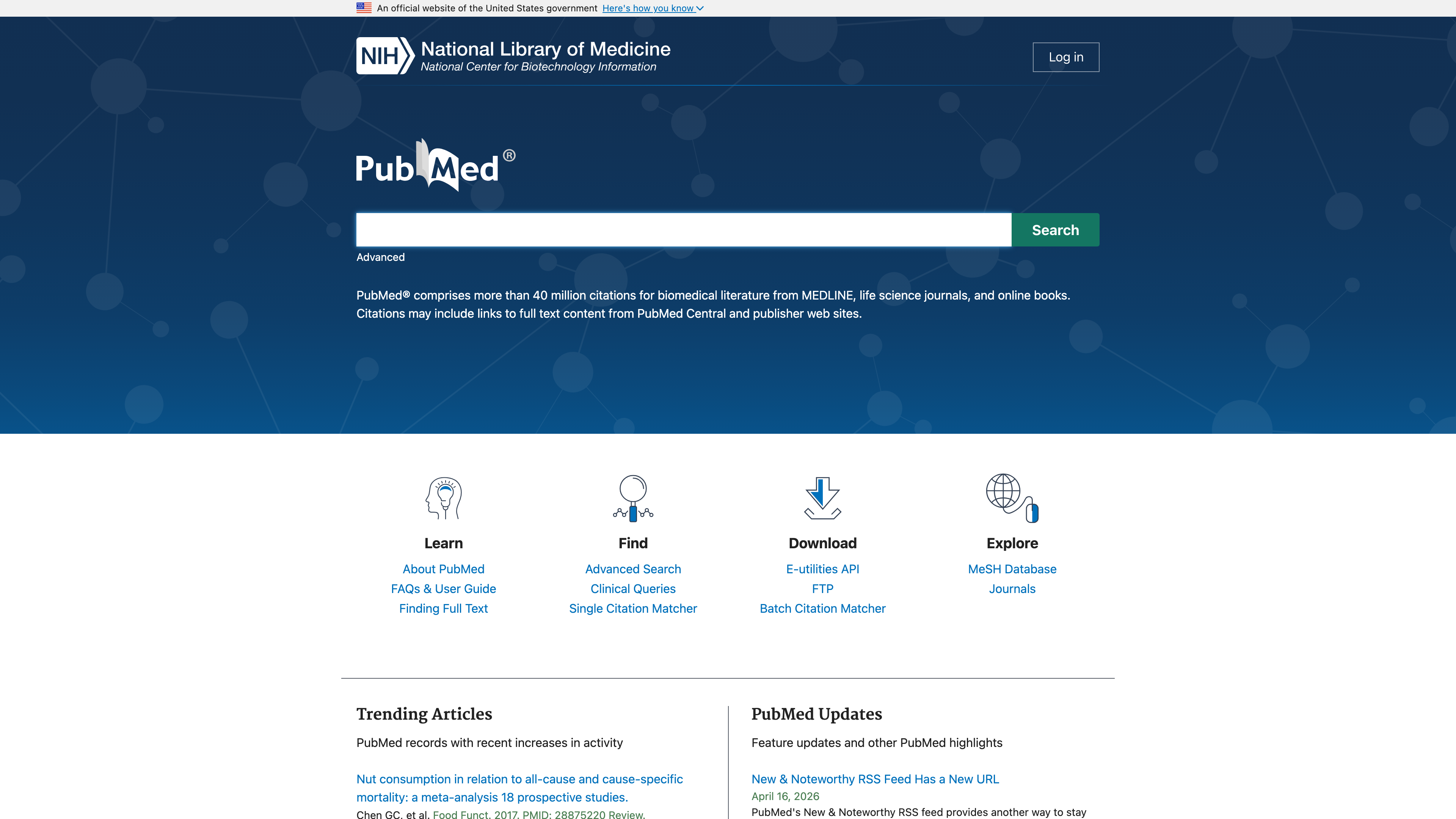
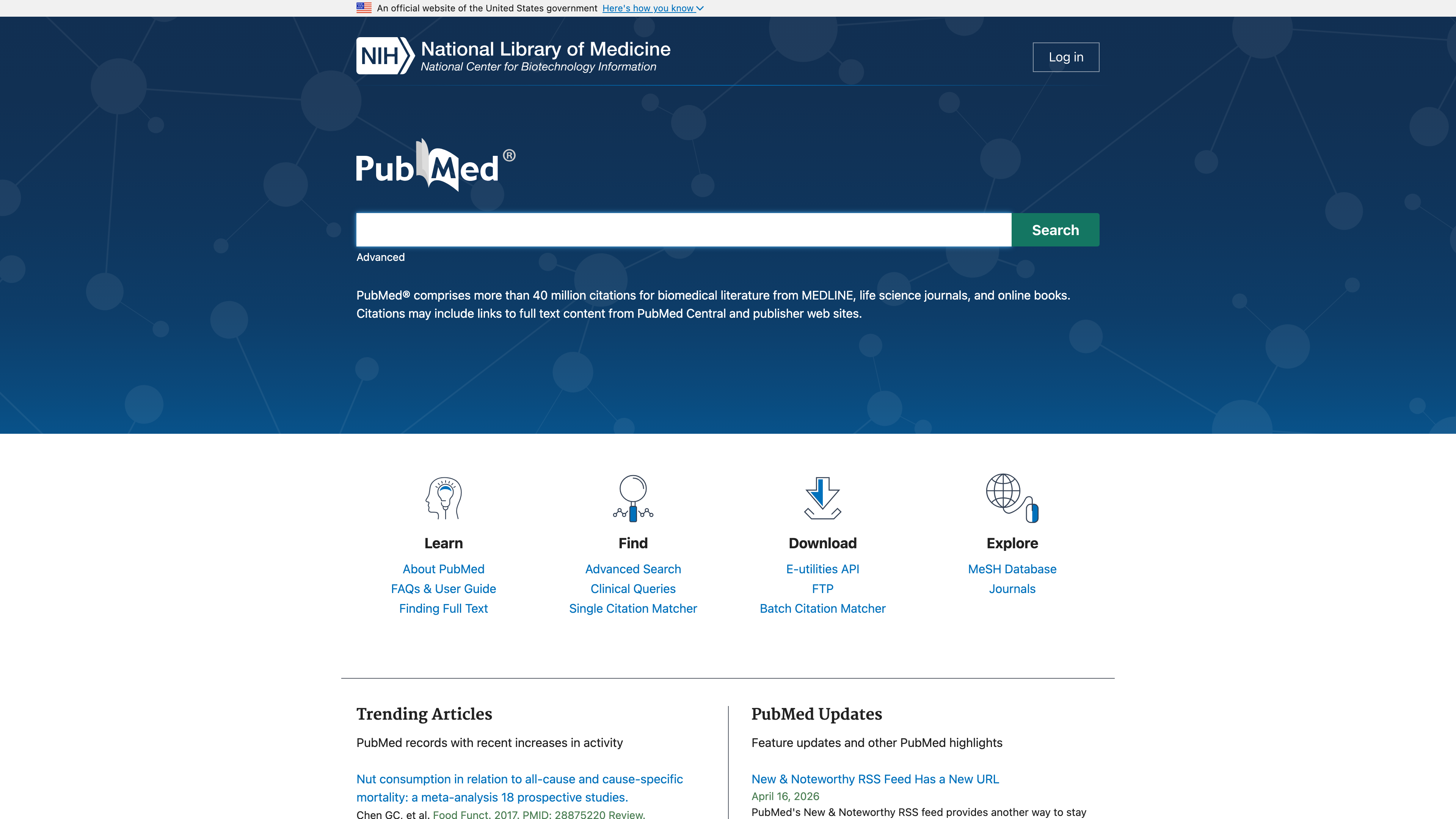
The screenshot above shows the PubMed home page (pubmed.ncbi.nlm.nih.gov). Below the search box, the site states that it comprises "more than 40 million citations for biomedical literature from MEDLINE, life science journals, and online books." The entry points below are grouped into Learn (About, user guide), Find (Advanced Search, Clinical Queries, citation matchers), Download (E-utilities API, FTP), and Explore (MeSH Database, Journals).
At a Glance
- URL: https://pubmed.ncbi.nlm.nih.gov/
- Type: Biomedical citation and abstract database with full-text links
- Cost: Free; searching and reading abstracts require no registration
- Registration: Optional. A free My NCBI account adds saved searches, collections, and email alerts
- Interface language: English
- Launched: January 1996 (experimental); free access officially announced on June 26, 1997
- Operator: National Center for Biotechnology Information (NCBI), at the U.S. National Library of Medicine (NLM) / National Institutes of Health (NIH)
Background
PubMed's data source is MEDLINE, NLM's bibliographic database, which descends from the Medical Literature Analysis and Retrieval System (MEDLARS) created in 1964. In January 1996, NCBI released PubMed as an experimental database under the Entrez retrieval system with full access to MEDLINE. The "experimental" label was dropped in April 1997, and on June 26, 1997, free MEDLINE access via PubMed was officially announced at a Capitol Hill press conference. (Source: NLM Technical Bulletin: PubMed's 10th anniversary)
According to the same bulletin, PubMed handled about two million searches in June 1997; by 2006 usage typically exceeded three million searches per day. The service is maintained by NCBI, and records are added seven days a week (source: MEDLINE overview).
PubMed vs. MEDLINE vs. PubMed Central
The three names are often conflated. Per PubMed's official About page, PubMed is a search interface whose content comes mainly from three sources:
- MEDLINE: the largest component, made up of citations from journals selected for MEDLINE, indexed with MeSH and curated with funding, genetic, chemical, and other metadata. MEDLINE itself covers more than 31 million citations from 1966 to the present (with selected earlier coverage), drawn from over 5,200 journals in about 40 languages (as of 2026-09-02; source: NLM MEDLINE overview).
- PubMed Central (PMC): a full-text archive whose article citations form the second-largest component of PubMed. Launched in 2000, PMC archives full text from journals reviewed and selected by NLM, peer-reviewed author manuscripts, and articles deposited under funder policies. In fiscal year 2025 the archive held 11,327,616 articles (checked 2026-09-02).
- Bookshelf: citations for books, reports, and similar documents whose full text lives in the NCBI Bookshelf.
In short: MEDLINE is a curated, cataloged citation set; PMC is a full-text archive; PubMed is the unified search interface across both. A record found in PubMed does not necessarily have free full text, and some records (such as publisher-supplied citations, or articles archived in PMC but not indexed for MEDLINE) are not part of MEDLINE at all.
Search and Reading Experience
- Best Match ranking: the default sort uses a machine-learning algorithm to surface the most relevant citations first (source: PubMed User Guide); results can also be sorted by date.
- Search assistance: autocomplete suggestions, spell checking, and a citation sensor that recognizes searches with citation-like terms such as author names and journal titles.
- Precision searching: Boolean operators (AND/OR/NOT), field tags (e.g.,
[au]for author,[tiab]for title/abstract,[pt]for publication type), phrase searching, truncation, proximity searching, and a visual Advanced Search Builder with history. - Filters: the results sidebar can restrict by publication date, text availability, article type (e.g., Systematic Review, Randomized Controlled Trial), species, age, and language.
- Specialized tools: Clinical Queries runs pre-set search strategies for clinical study categories (therapy, diagnosis, etiology, prognosis) and medical genetics; the Single and Batch Citation Matchers locate specific articles from known bibliographic details.
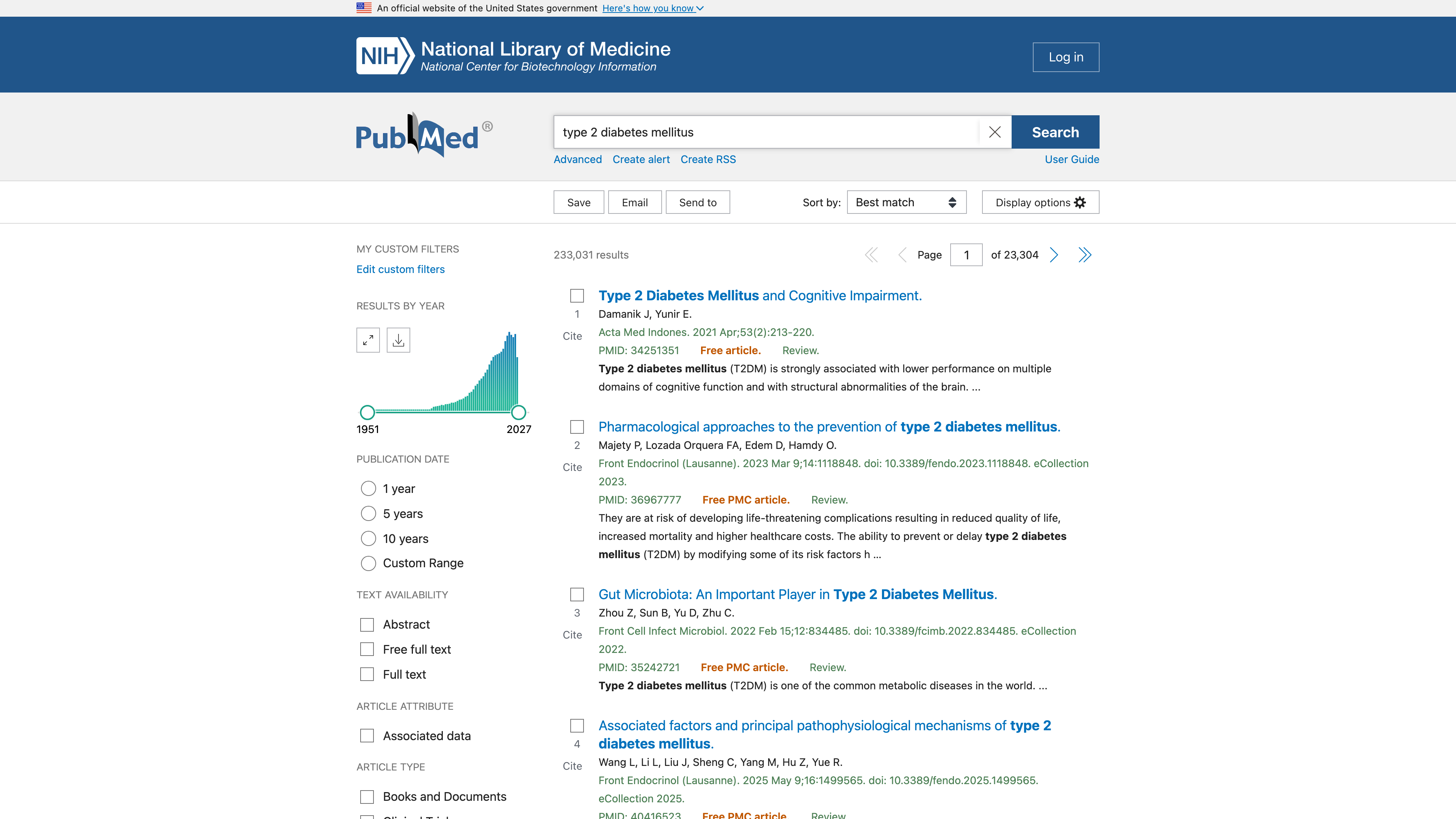
The screenshot above shows results for the query "type 2 diabetes mellitus" (233,031 results on 2026-09-02). The left sidebar offers a results-by-year slider plus filters for publication date, text availability, and article type; each result on the right shows its PMID and publication type, with "Free article" and "Free PMC article" labels marking records whose full text is free to read.
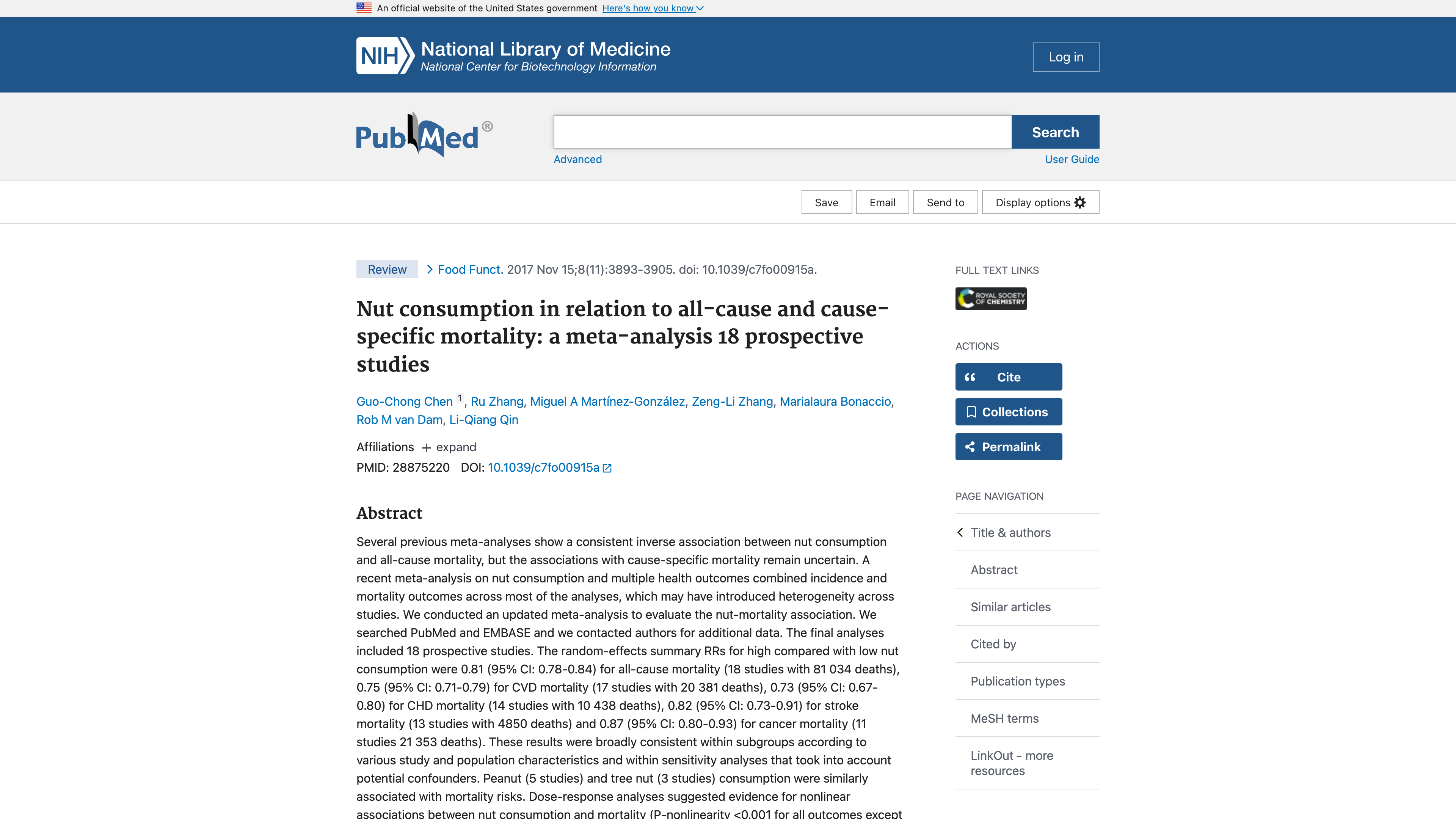
The screenshot above shows a record page (PMID: 28875220). The structured abstract appears in the main column, with publisher full-text links under "Full text links" on the right. The action buttons offer Cite (export in several citation styles), Collections (save to My NCBI), and Permalink; the page navigation jumps to sections such as Similar articles (a pre-computed related set), Cited by, Publication types, and MeSH terms.
Accounts and Open Access
- My NCBI: a free account that saves searches with email alerts, creates RSS feeds for queries, stores unlimited Collections, and customizes filters and display preferences. Since 2021–2022, NCBI has required third-party sign-in only — eRA Commons, NIH, Login.gov, and more than 4,000 InCommon/OpenID partner organizations — with no NCBI-managed username and password (source: My NCBI Help). Searching without signing in works fully, but activities and preferences are not saved after eight hours of inactivity.
- E-utilities API: a free set of nine server-side tools (ESearch, EFetch, ELink, and others) for programmatic search and retrieval of PubMed records. Without an API key, an IP may post no more than three requests per second; a key, created in the NCBI account settings, raises the default to ten per second, and large jobs should run at night or on weekends (source: E-utilities usage guidelines).
- Bulk data: PubMed baseline files are released annually — the 2026 baseline was published on January 30, 2026 (home page announcement) — and together with daily update files can be downloaded from NLM for local text mining and large-scale analysis (source: Access PubMed Data).
Data Use and Copyright
PubMed's interface is produced by a U.S. government agency, but abstracts in PubMed may incorporate copyrighted material; reproducing or redistributing them beyond fair use requires permission from the copyright holder. PMC's full text is "free to read" but not free of copyright (source: PMC About); licenses vary by article, and bulk text mining is limited to designated subsets. On privacy, NLM states that visits do not collect personally identifiable information unless you explicitly provide it, and that it uses Google Analytics for aggregate statistics; My NCBI preferences are stored in a persistent cookie, which can be disabled in the browser without losing access to content.
When It Is Useful
- Literature searches for evidence-based research such as systematic reviews and meta-analyses (MeSH indexing + article-type filters + Clinical Queries)
- Keeping up with new publications in a field (saved searches + email alerts or RSS)
- Verifying a paper's source, DOI, PMID, and whether free full text exists
- Bulk metadata harvesting for bibliometrics or text mining (E-utilities or baseline files)
Limitations
- Not a full-text database: most records are abstracts only; whether full text is free depends on publisher policy or PMC archiving.
- English-only interface: MEDLINE indexes journals in about 40 languages, but the interface and cataloging language are English, and non-English query terms have limited coverage.
- Inclusion is not endorsement: records come from multiple pipelines (MEDLINE, PMC, publisher submissions); appearing in PubMed does not mean a journal passed MEDLINE selection or that NLM vouches for its quality.
- Biomedicine-centered scope: fields such as physics, engineering, and the humanities are essentially out of scope.
- No medical advice: NLM explicitly presents its content as an information resource, not diagnosis or treatment guidance.
Comparable Services
- Europe PMC: a free literature database backed by European life-science funders; it integrates PubMed and PMC content, adds more than 30 preprint servers, and supports full-text search and APIs.
- Google Scholar: broader disciplinary coverage, but without MeSH indexing or structured article-type filters.
References
- PubMed home page (database-size statement; checked 2026-09-02)
- PubMed About (three content components, online since 1996, not a full-text database)
- NLM MEDLINE overview (31M+ citations, 5,200+ journals, ~40 languages, 1966–present)
- PMC About (launched 2000, 11,327,616 articles in FY2025, free access ≠ no copyright)
- NLM Technical Bulletin: PubMed 10th anniversary (January 1996 experimental release, free access announced 1997-06-26)
- PubMed User Guide (Best Match, filters, Clinical Queries, citation export)
- My NCBI Help (third-party sign-in, eight-hour session, Collections)
- E-utilities usage guidelines (3/10 requests per second, API keys, abstract copyright notice)
- NLM Privacy and Security Policy (no PII collection, Google Analytics, cookie policy)