ProjectionLab (projectionlab.com) is a web-based financial planning and retirement simulator. Unlike budgeting or expense-tracking apps, it is not about where your money went — it projects where your money is going. You enter account balances, income and spending plans, and life events (buying a home, going part-time, relocating, and so on), and it builds a year-by-year model of cash flow, taxes and net worth across your whole life. Monte Carlo simulations and historical backtesting then turn that model into a "chance of success" for your plan (homepage, Monte Carlo page, checked 2026-10-02).
Two verifiable traits set it apart. First, it never asks to link your financial accounts: the official help center states that direct account linking is currently not supported at all, and manual entry is the standard path. Second, it is independently owned: founder Kyle Nolan started building it as a solo developer in 2021, and the company took zero outside funding on its way to $1M in annual recurring revenue (About, official blog).
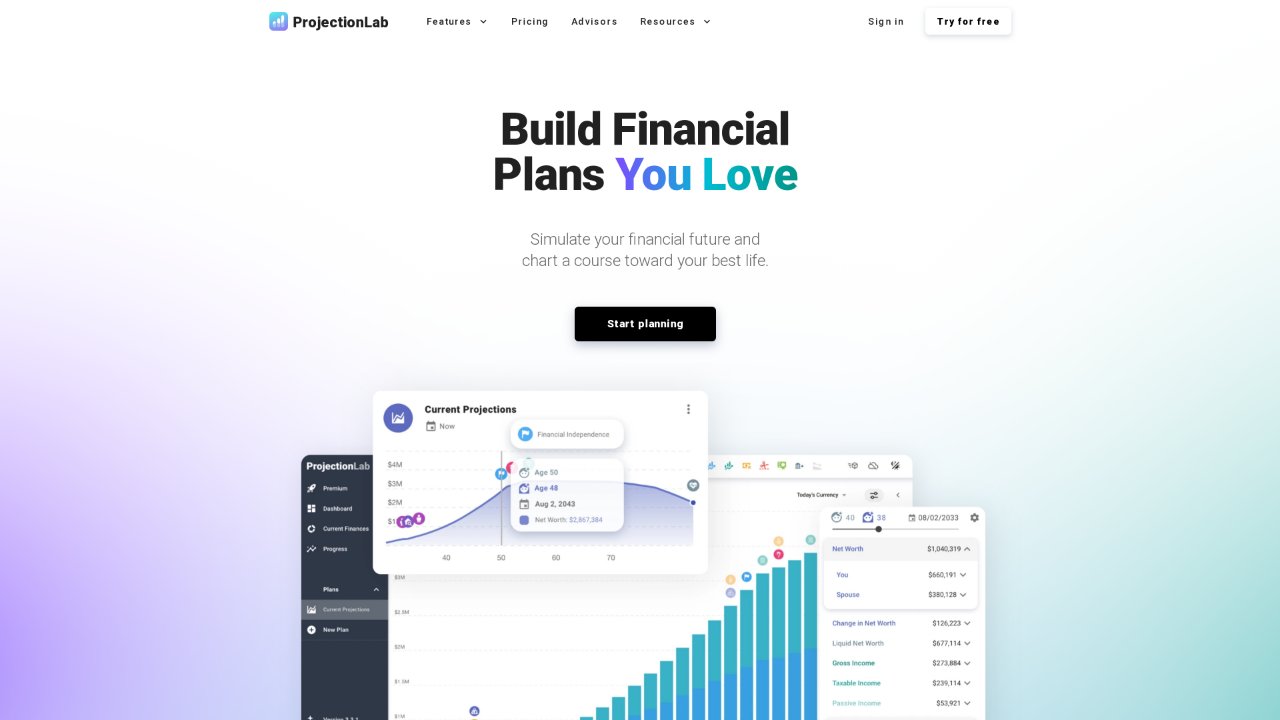
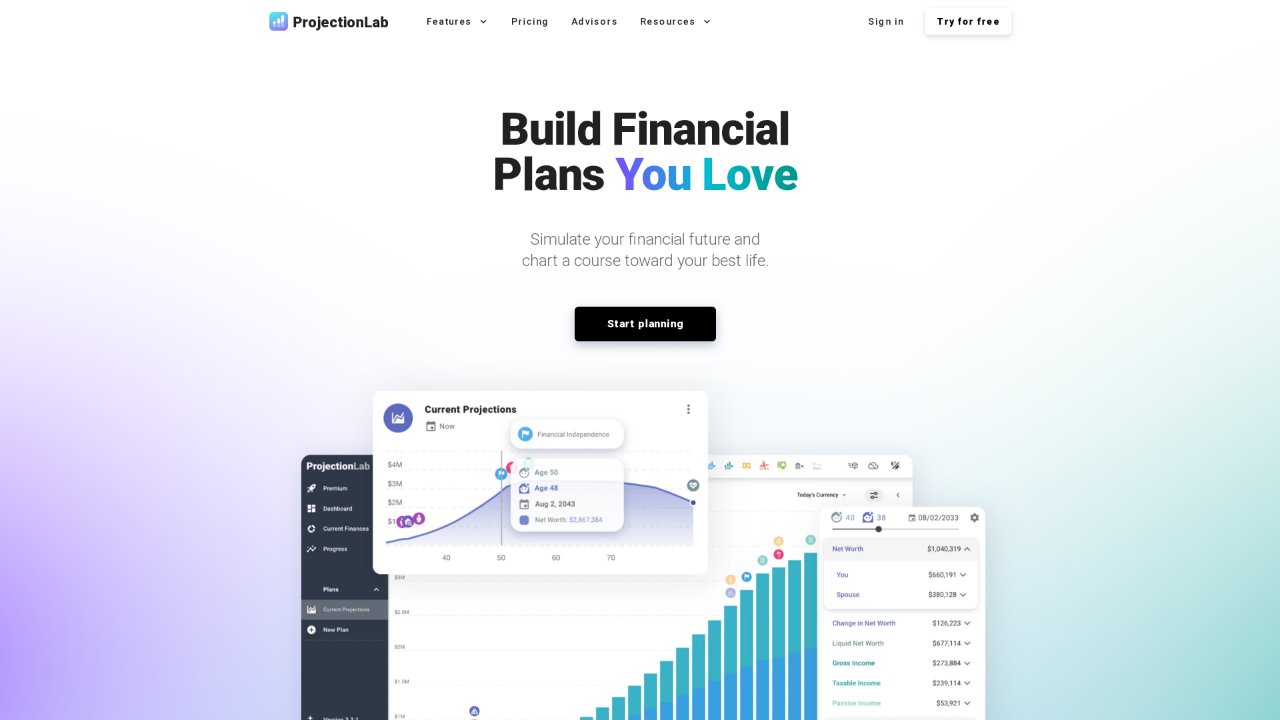
The homepage (2026-10-02) leads with the product's core interface: a net-worth projection curve across ages, draggable life milestones, and year-by-year cash-flow charts.
At a Glance
| Item | Details |
|---|---|
| URL | https://projectionlab.com/ (app at app.projectionlab.com) |
| Type | DIY financial planning and retirement simulator (web app) |
| Pricing | Basic free; Premium 549/year or $74.08/month (pricing, as of 2026-10-02) |
| Sign-up | Google or email account; 7-day free trial on paid plans |
| Platforms | Web only; installable as a PWA on mobile; no native app |
| Interface language | English |
| Launched | 2021 (solo side project) |
Background
- Built for himself first: In 2021, approaching 30 during the pandemic, Kyle Nolan got into the financial independence (FIRE) literature and wanted to visualize his own long-term trajectory. A spreadsheet spiraled out of control, so he started writing a web app. His stated design criteria included no account linking, experimentation that feels fun, a strong visual link between model and results, and the ability to drill into every simulated year (origin post, 2021-08-08).
- Solo project to $1M ARR: The About page says he started building ProjectionLab as a solo developer in 2021. The company's published milestones: first revenue in May 2021 (1M ARR in June 2025 — all bootstrapped, with zero funding. The company says the product has helped over 100,000 households plan, and its Discord community has grown past 8,500 members (We reached $1M ARR with zero funding, 2025-06-30).
- Small team, community-driven: The team now includes Kyle on product and engineering, growth & marketing partner Jon Kuipers, and contractors recruited from the user community. Priorities are shaped by a public roadmap and user feedback, and releases are frequent (changelog — v4.6.0 shipped in April 2026).
- Self-hosted version sunset: ProjectionLab once offered a self-hosted deployment. In March 2025 the company announced that future updates ship to the web app only (99.4% of users were already on the web version); existing self-hosted installs keep running, and JSON export/import remains available for migration and backups (announcement).
- The operating company is ProjectionLab LLC (site footer, checked 2026-10-02).
Core Capabilities
- Lifetime cash-flow modeling: Combine income, expenses, savings rates, accounts (taxable, tax-advantaged, real assets like homes, and debts) and life events (home purchases, rental income, part-time work, sabbaticals, buying a car every Y years) into one model that evolves over decades. Sankey diagrams show where money comes from and where it goes in each simulated year (Cash Flow page).
- Monte Carlo and backtesting: Backtest plans against real historical returns, or build Monte Carlo simulations with custom probability distributions. You can drill into individual trials and adjust how success rates are characterized (Monte Carlo page).
- Tax estimation and analytics: Visualize effective brackets and marginal rates per income type, and model US-specific strategies such as Roth conversions, 72(t) SEPP distributions, backdoor and mega backdoor Roth, ACA subsidies, IRMAA surcharges and Medicare premiums (Tax Analytics page).
- Optimize: Set a target — a federal bracket, an IRMAA cliff, an ACA subsidy limit, or a custom income ceiling — and the optimizer coordinates Roth conversions, capital-gain harvesting and withdrawal shielding, comparing hundreds of strategies on a heatmap for lifetime taxes, net worth and legacy. The winner applies in one click (Optimize page).
- Estate planning: Estimate US federal estate tax and UK inheritance tax, model step-up in basis, qualified charitable distributions (QCDs) and donor-advised funds (DAFs), and see how today's decisions change what heirs receive (Estate Planning page).
- International scenarios: Choose a display currency and use built-in tax presets and account types for Canada (TFSA/RRSP, CPP), the United Kingdom (SIPPs, marriage allowance), Australia, Germany, the Netherlands and more (homepage, Canada page).
- Progress tracking: Periodic balance updates create progress points, letting you overlay actual net worth on the original projections.
- Professional lines: A Pro tier for financial advisors and coaches (client management, advisor dashboard, directory listing), and a financial-wellness offering for employers (Advisors, Employers).
Account Data and Connectivity
A defining stance of ProjectionLab is that it does not link your bank accounts. The help center states plainly that direct linking of financial accounts is currently not supported; the idea is on the public roadmap but still debated within the community, and the team prefers to focus on long-term planning rather than daily balance-chasing (official note, updated 2026-06-23). The founder's 2021 origin post listed "no account linking" as a design criterion from day one — for privacy, and to avoid the friction of syncing accounts protected by 2FA.
In practice there are two ways to keep data current:
- Manual entry: Edit balances directly in Current Finances; each update automatically creates a progress point so you can compare actuals against the plan.
- Optional plugins: A plugin system can pull data from budgeting tools — Lunch Money (an official partner), YNAB and Monarch Money — or you can build custom automations with the open Plugin API. Plugins are built by third-party developers, so review their terms before enabling them (plugin docs).
On security and privacy (security page, marked last updated 2026-08-12): TLS in transit and AES-256 at rest; infrastructure on Google Cloud and Firebase with automated daily backups; TOTP/SMS multi-factor authentication; and a security program described as aligned with core SOC 2 control areas (aligned, not certified). The company says it never sells user data and does not ask for account numbers or even your real name; data can be exported, and the account and its data can be deleted from within the app. Payments are processed by Paddle as merchant of record, so card numbers never touch ProjectionLab's systems.
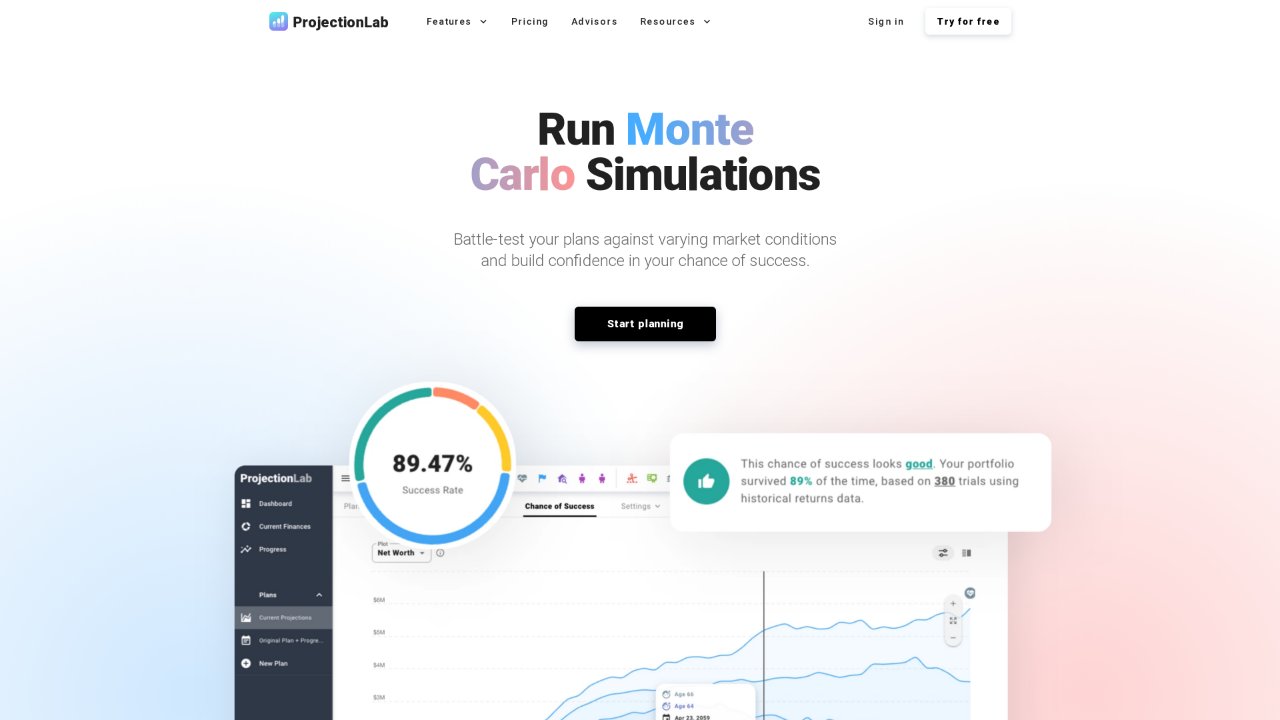
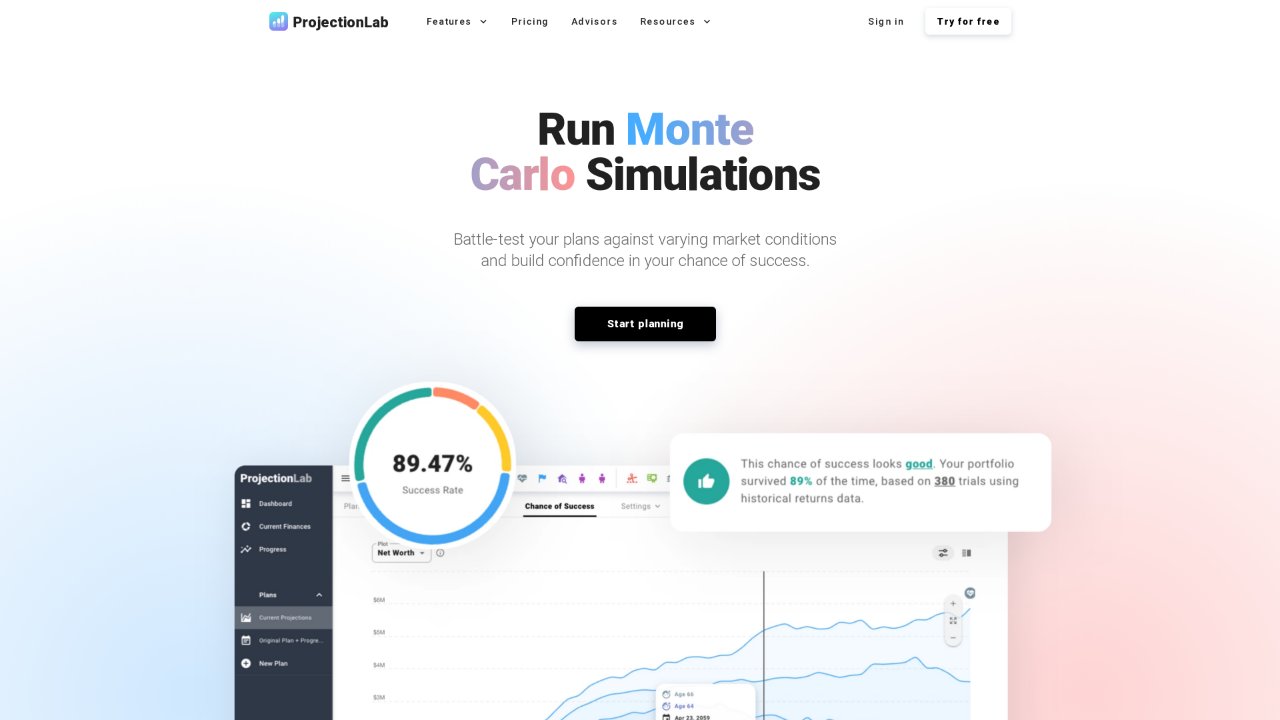
The Monte Carlo feature page (2026-10-02) demonstrates a plan scoring an 89.47% chance of success across 380 trials based on historical returns.
Pricing (as of 2026-10-02)
Prices below are from the pricing page and the billing FAQ, checked on 2026-10-02:
| Plan | Price | What you get |
|---|---|---|
| Basic | Free, no payment method required | Forecasting, financial planning, Monte Carlo simulations, historical backtesting, flexible modeling |
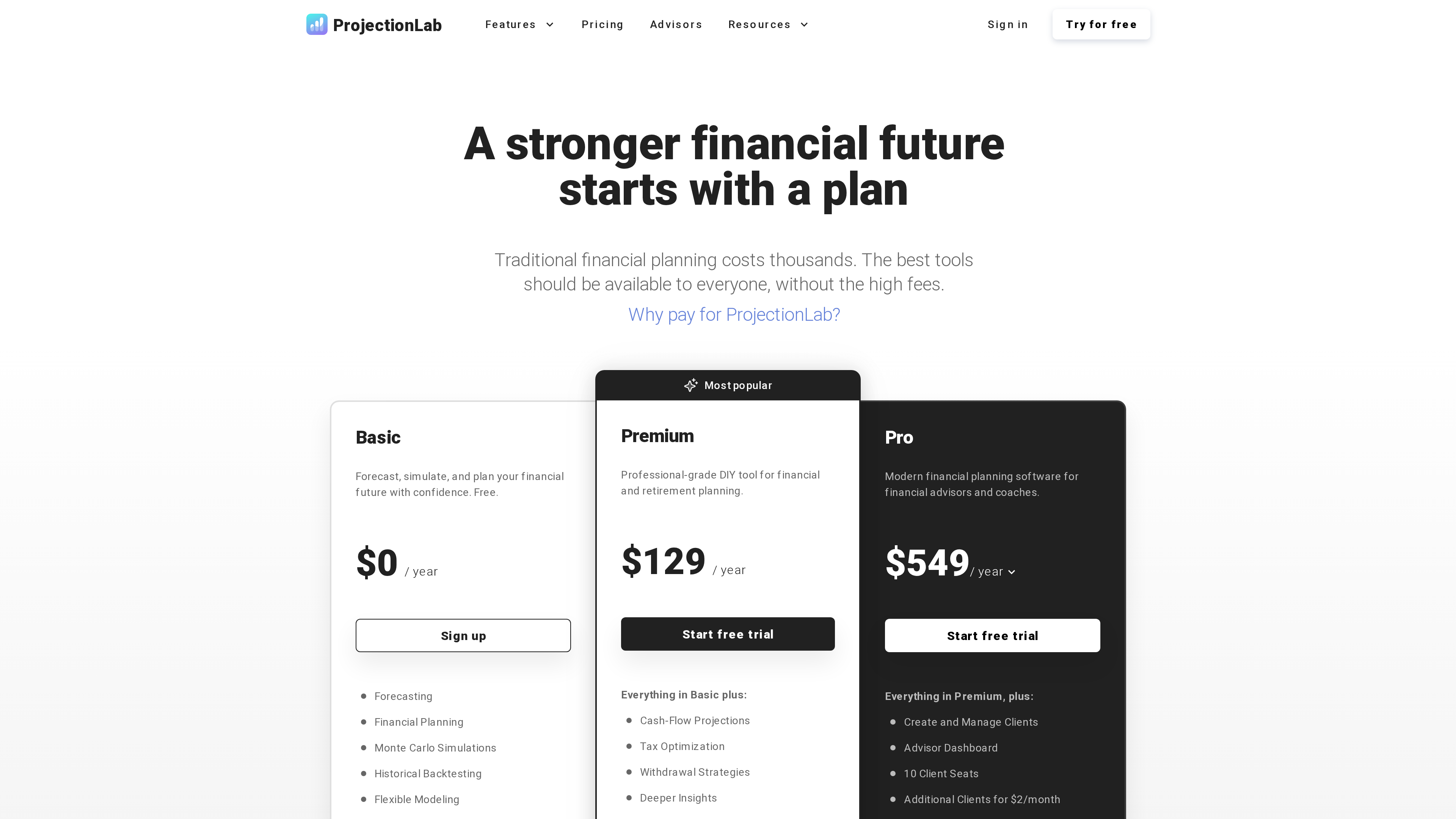
| Premium | $129/year (annual only) | Adds cash-flow projections, tax estimation and optimization, withdrawal strategies, Roth conversions, ACA subsidies, what-if scenarios, compare mode, multiple plans, downloadable reports, estate planning, international planning, advanced analytics and more |
| Pro (advisors & coaches) | 74.08/month billed monthly | Everything in Premium plus client management, an advisor dashboard, 10 client seats (extra seats $2/month each) and a directory listing |
Paid plans include a 7-day free trial that converts on the 7th calendar day (GMT) after sign-up. The homepage feature list still advertises "Monthly, Annual, or Lifetime pricing", but that copy is outdated: the current pricing page offers only the plans above, and no lifetime option is on sale.
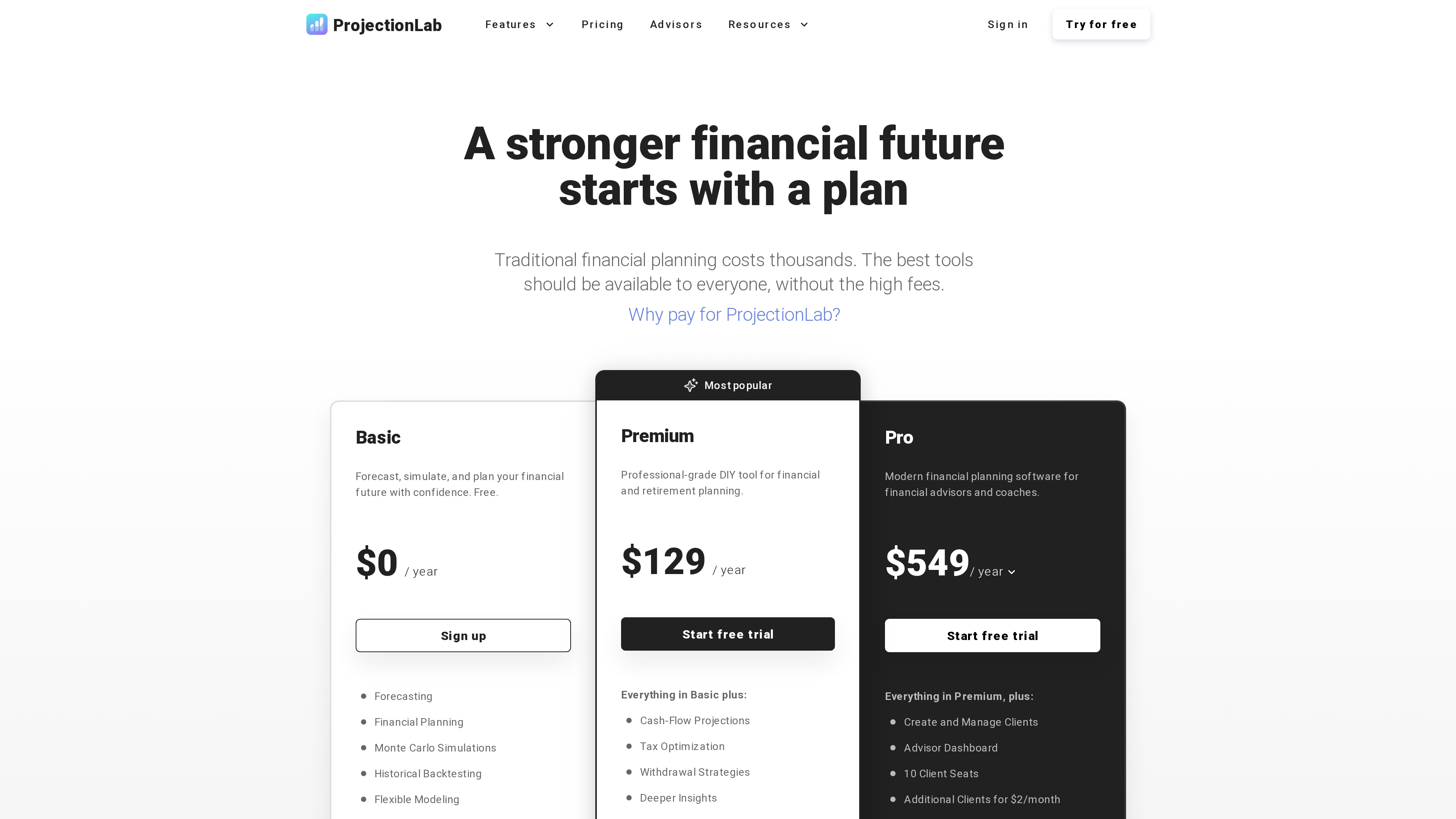
The pricing page (2026-10-02): the free tier already includes Monte Carlo and backtesting, while Premium unlocks the tax and cash-flow toolset.
Who It's For
- People seriously planning for retirement or financial independence (FIRE) who want to know when they can retire and how confident the plan is.
- Hands-on DIY planners willing to enter data and tweak assumptions, especially around taxes and withdrawal strategies.
- Long-term planners in supported tax systems — US users get the deepest modeling (Roth, ACA, IRMAA, Social Security, Medicare).
- Privacy-conscious users who would rather not hand bank credentials to an aggregator.
- Financial advisors and coaches who want to model plans for clients.
Limitations
- Web only: There is no native iOS or Android app; on mobile you install it as a PWA (official note, updated 2026-05-26).
- No automatic bank sync: Balances are maintained manually or via third-party budgeting plugins. If you want "connect once, always current", this will feel like work.
- US-centric tax depth: International presets cover a handful of countries (Canada, UK, Australia, Germany, Netherlands) at varying depth — estate tax, for example, is modeled only for the US federal level and the UK. Other tax systems need manual approximation.
- Learning curve: Tax brackets, drawdown order and Monte Carlo assumptions are dense concepts. Sandbox personas, video walkthroughs, a help center and paid 1-on-1 sessions help, but expect an investment of time.
- Premium is annual-only: There is no monthly billing for Premium, and the free tier excludes core advanced features like tax estimation and cash-flow projections.
- Simulation, not advice: The official disclaimer states the content and tools are for informational and educational purposes only and are not professional financial or investment advice.
- English only.
Related Tools
Most popular personal-finance apps look backward — aggregating transactions and tracking where money went (Monarch Money, Copilot Money, Lunch Money, YNAB). ProjectionLab looks forward: given your current trajectory, what could the future look like? The two categories complement each other, and ProjectionLab's own plugins treat those budgeting tools as data sources for planning. Among forward-looking retirement calculators and FIRE tools, its distinguishing traits are the interactive visual modeling, tax depth and the no-account-linking stance (based on its official feature pages; not a hands-on comparison).
References
- ProjectionLab homepage, About, Pricing, Security (checked 2026-10-02)
- Why I Built Another Financial Planning Tool (2021-08-08), We reached $1M ARR with zero funding (2025-06-30), Important Update on Self-Hosting (2025-03-06)
- Help center: Account linking & plugins, Billing FAQ, Mobile support, Getting started
- Feature pages: Monte Carlo, Cash Flow, Tax Analytics, Optimize, Estate Planning, Changelog