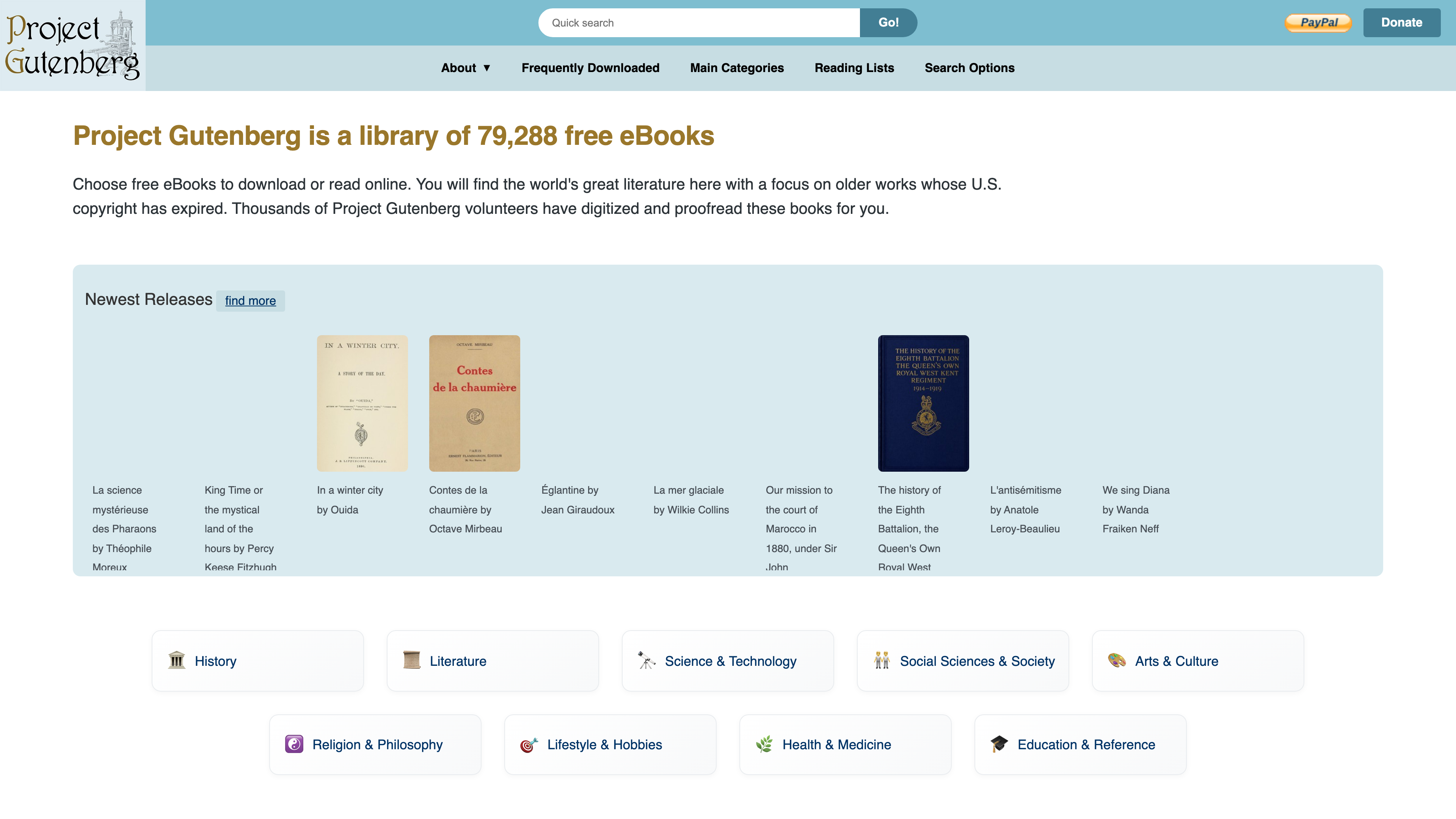
Project Gutenberg is the oldest eBook project on the Internet — its own FAQ calls it "the original, and oldest, eBook project" online. Founded in 1971 by Michael Hart at the University of Illinois, it publishes works that have entered the public domain in the United States (mostly classic literature from the early 20th century and before), digitized and proofread by volunteers and given away to everyone. As of 2026-08-30, the homepage lists 79,288 eBooks. Unlike most eBook platforms, there are no accounts, no paywalls, no required apps, and no visitor tracking: open a browser and read, then copy and redistribute the files as you like.
At a glance
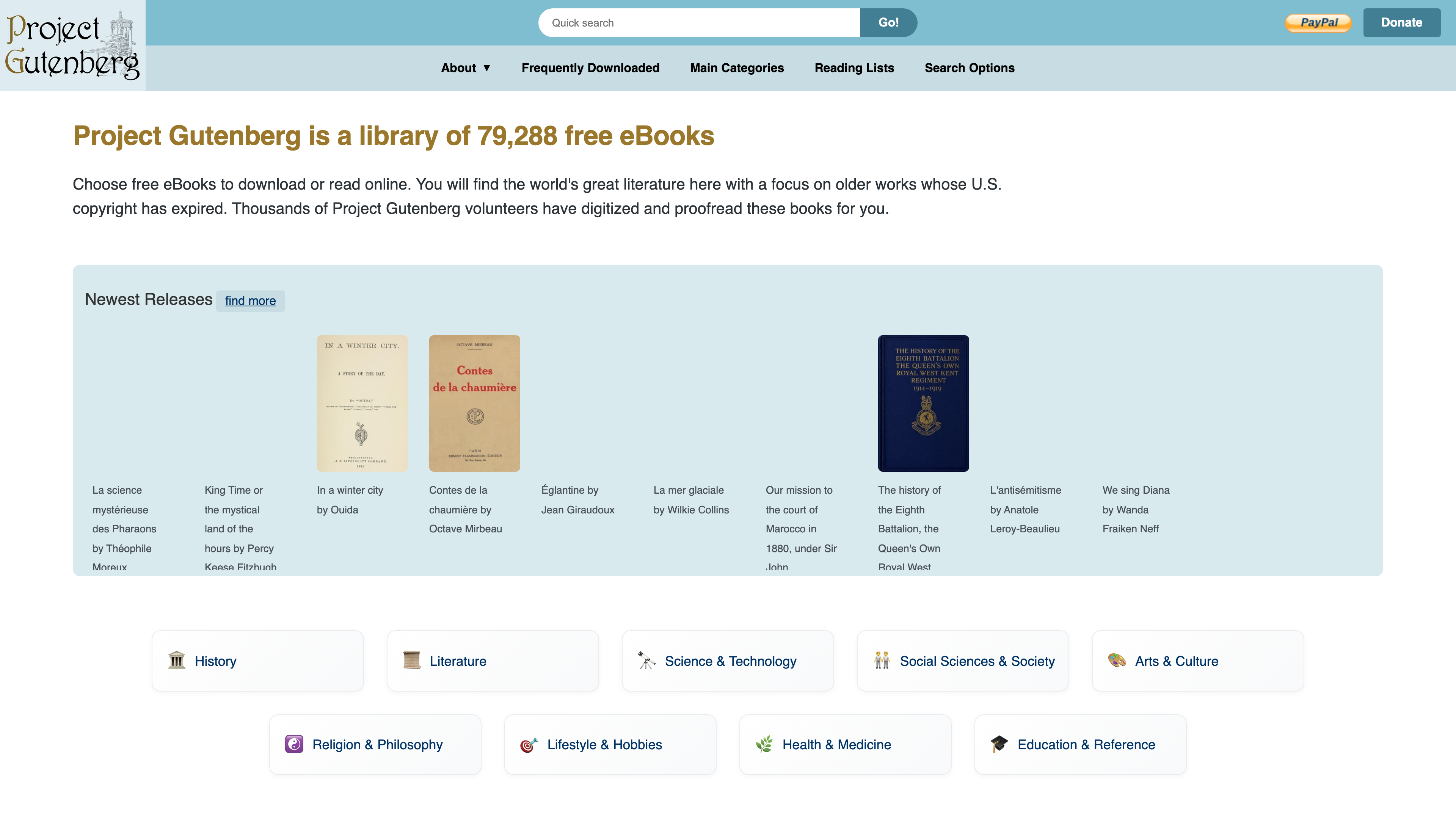
- URL: https://www.gutenberg.org/
- Type: Public domain eBook library
- Cost: Completely free; funded by donations (a U.S. 501(c)(3) nonprofit)
- Registration: None required; the site has no account system at all
- Interface language: English (the collection spans roughly 70 languages — see below)
- Collection size: 79,288 eBooks (homepage counter, as of 2026-08-30)
Background
In 1971, University of Illinois student Michael Hart was given operator time on a Xerox Sigma V mainframe at the school's Materials Research Lab. In his 1992 account, he concluded that the greatest value of computers would be storing and retrieving library content, so he typed in the U.S. Declaration of Independence and posted it to the network — widely regarded as the first eBook, and the birth of Project Gutenberg. Hart (1947–2011) devoted the rest of his life to the project; the official memorial page records his biography.
Today the project is run by the Project Gutenberg Literary Archive Foundation (PGLAF), a 501(c)(3) tax-exempt nonprofit registered in Mississippi, with day-to-day content production self-organized by volunteers. According to the official FAQ, more than 10,000 people have contributed over the years; most new titles come from the Distributed Proofreaders community and are shepherded online by a posting team known as "whitewashers," with hundreds of new eBooks added each month. The FAQ also notes that Eric Hellman became the foundation's Executive Director on January 1, 2026, following the death of longtime volunteer CEO Dr. Gregory B. Newby in October 2025.
Finding books: search, charts, and reading lists
The site offers a combined search by author, title, subject, language, type, and popularity, plus three human-maintained browsing paths:
- Frequently Downloaded: Top 100 eBook and author charts for yesterday, the last 7 days, and the last 30 days. The counting rules are public: repeat downloads from the same address on the same day count once, and addresses downloading more than 100 eBooks in a day are treated as robots and excluded. The page also publishes site-wide traffic: about 1.75 million downloads on 2026-08-29 and 79.46 million over the trailing 30 days (as of 2026-08-30).
- Main Categories: bookstore-style top-level sections such as History, Literature, Science & Technology, and Religion & Philosophy.
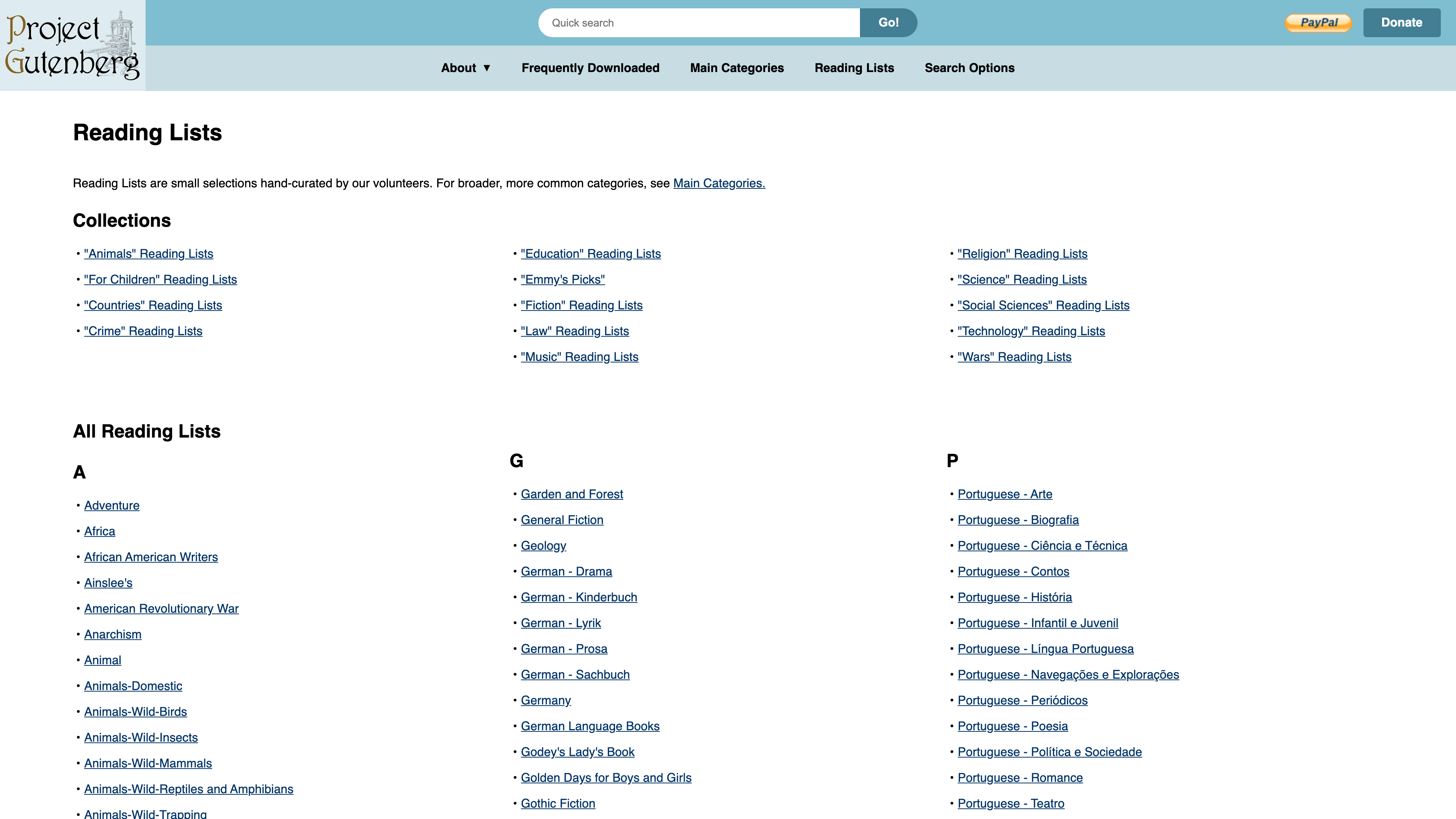
- Reading Lists: small, hand-curated volunteer selections at a finer granularity — from Arthurian legends and banned-book lists to per-language collections for French, German, Italian, and Portuguese.
Reading and downloading: browser-first, mainstream formats
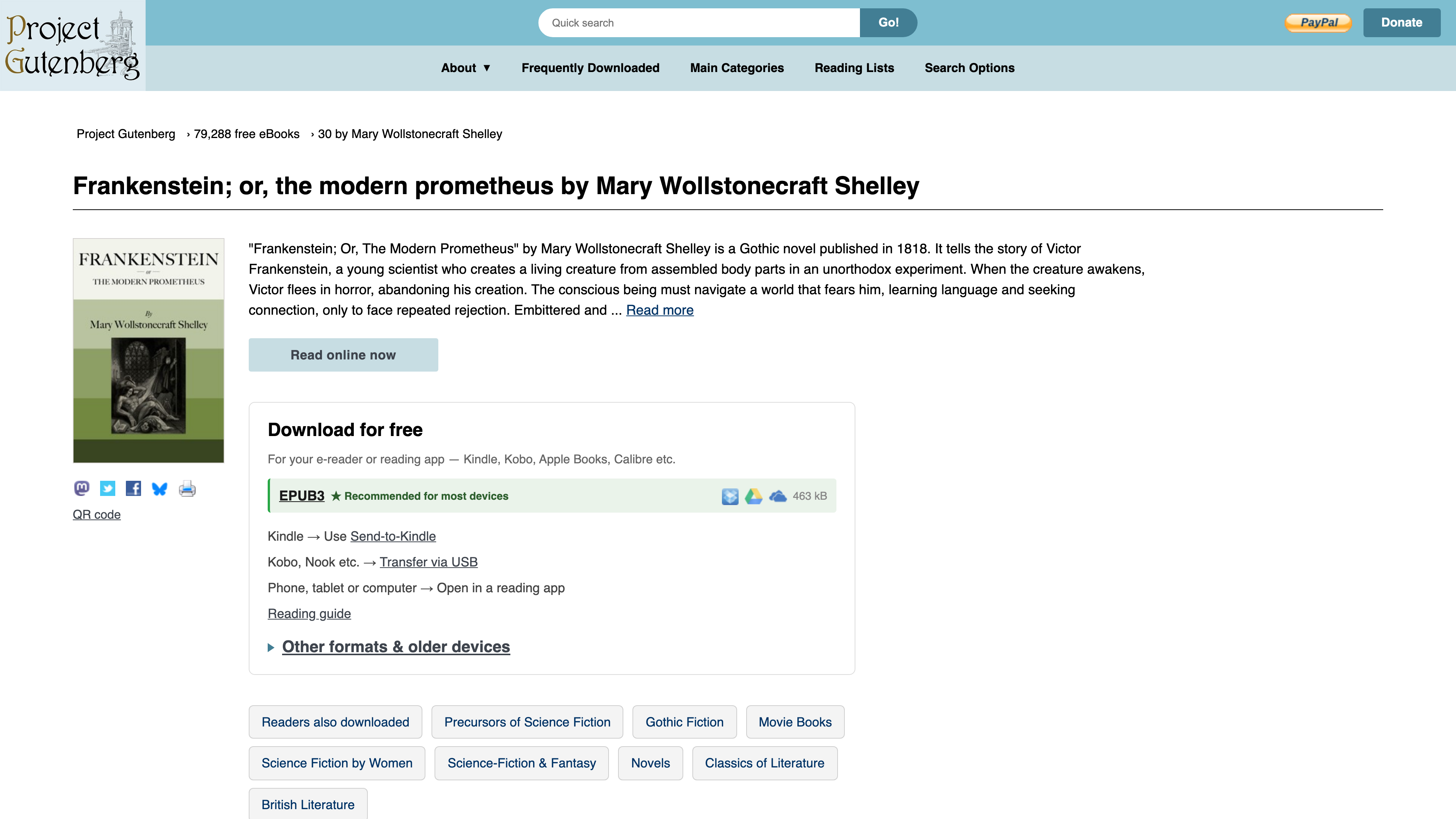
Every title page has a "Read online now" button that opens the full text in the browser — no software to install on any device. For downloads, the official reading guide recommends EPUB3, which works with Kindle, Kobo, Apple Books, Calibre, and most other devices and apps, and it lays out concrete paths per device: Send-to-Kindle or email for newer Kindles, USB-transferred MOBI for pre-2013 Kindles, and plain USB copies of the EPUB for Kobo, Nook, and similar e-readers. Files can also be sent directly to Dropbox, Google Drive, or OneDrive. Every book is additionally available as plain UTF-8 text with no formatting or images — a tradition since 1971, when Hart chose maximally compatible "Plain Vanilla ASCII" so the texts would still be readable decades or centuries later.
Beyond English — including a Chinese collection
The collection is predominantly in English, but the language index spans roughly 70 languages (as of 2026-08-30), with substantial sub-collections in French, Finnish, German, Dutch, Spanish, Italian, and Portuguese. One section worth knowing for Chinese readers is the Chinese-language catalog: over 440 titles as of 2026-08-30, mostly classical works in the public domain — the Records of the Grand Historian (史記), Dream of the Red Chamber (紅樓夢), Journey to the West (西遊記), the Analects (論語), the Tao Te Ching (道德經), The Art of War (孫子兵法) — alongside early-20th-century authors such as Lu Xun.
Open data and bulk access
Project Gutenberg has no accounts or API keys, but it maintains several official channels for developers and power users, all documented on the Offline Catalogs page:
- OPDS catalog feed (https://www.gutenberg.org/ebooks/search.opds/): subscribable from reading apps like Calibre and Thorium to browse and download the catalog over a standard protocol. A JSON-based OPDS2 feed is in testing, and the existing XML OPDS feeds are expected to be sunset in 2027.
- Machine-readable metadata: the full catalog as XML/RDF, updated daily and dedicated to the public domain; a weekly CSV export; and MARC records produced with the Free Ebook Foundation for libraries and third-party tools.
- Bulk and mirrors: the monthly GUTINDEX plain-text accession lists; a list of mirrors (http/ftp/rsync) and a
robot/harvestendpoint for pulling files by format and language; a zipped archive of all plain-text files; and a Kiwix offline package.
Copyright and content policy
This is the part that matters most when using Project Gutenberg, and the core rules are spelled out in the Permissions How-To:
- The vast majority of the collection is in the public domain in the U.S., meaning anyone may use it however they like — including commercial publication, derivative works, and quotation — with no permission or payment needed. Original copyright notices reproduced on title pages or illustrations do not change this.
- A few thousand items are still under copyright (usually distributed with permission); each is clearly marked as copyrighted in the eBook's header, so check before reuse.
- Public domain determinations follow U.S. copyright law only (a 95-years-since-publication rule of thumb). The project explicitly warns that the same work may still be protected elsewhere, and non-U.S. users should check their own country's laws before redistributing.
- "Project Gutenberg" is a registered trademark: non-commercial redistribution is free with or without the name, but commercial use of the name itself requires royalty payments.
- The project claims no "sweat of the brow" rights: it asserts no new copyright over digitization, markup, or spelling modernization.
Privacy and access rules
The privacy policy is remarkably short: no personally identifiable information is collected beyond the IP address in access logs; there are no third-party analytics such as Google Analytics and no web trackers of any kind; and all access logs, including IP addresses, are automatically and permanently deleted after at most 60 days. In return, the Terms of Use state the website is intended for human users only: perceived automated access triggers temporary or permanent IP blocks, and bulk needs must go through mirrors, the harvest endpoint, or OPDS. When linking, point to a book's landing page rather than deep-linking files, which the site technically enforces. The stated target audience is U.S. persons over 13.
Good fits
- General readers who want classic literature for free — especially English-language classics: no sign-up, in-browser reading, and every mainstream format make this the default source for public domain texts.
- Authors, teachers, and researchers who need public domain text for derivative works, publishing, citation, or teaching: commercial use is free under U.S. law, and the site even suggests citation formats.
- Chinese readers looking for original texts of classical works and early modern Chinese authors.
- Developers and libraries building catalogs or reading products on public domain metadata, MARC records, and the OPDS feed.
- Offline use cases: full collection copies via mirrors, Kiwix, or the all-text archive.
Limitations
- Old books only: bound by U.S. public domain rules, the library has no bestsellers, recent releases, or modern computing books — for anything from the last few decades you need another source.
- Uneven coverage by language and subject: English fiction dominates; coverage of history, science, biography, and each non-English language depends entirely on what volunteers choose to work on, which the official FAQ admits frankly.
- No accounts means no sync: no bookmarks, notes, reading progress, or recommendations — it is a book repository, not a reading app.
- Texts are not scholarly authoritative editions: eBooks are modernized in spelling, dehyphenated, and re-typeset, and do not track a specific print edition; for citation-sensitive work, verify against page scans of the original (Internet Archive pairs well here).
- Automated access is blocked: running a scraper against the main site will get your IP banned; use the official bulk channels instead.
- The interface is plain and the discovery experience is that of a library catalog — no modern, recommendation-driven browsing.
Alternatives and companions
- Standard Ebooks: carefully typeset, proofed EPUB editions built on Project Gutenberg texts, with higher production polish.
- LibriVox: volunteer-recorded public domain audiobooks, and Project Gutenberg's officially recommended partner.
- Internet Archive: a much larger general digital archive where you can find page scans of many of the same public domain books — a complement to Project Gutenberg's plain text.
- Wikisource: a wiki-style public domain text library with stronger multilingual cross-referencing and source annotations.
- Note the distinct namesakes: Project Gutenberg of Australia, Projekt Gutenberg-DE, Project Gutenberg of Canada, and others are entirely separate organizations operating under their own national copyright laws, with different collections and policies (per the official FAQ).
References
All sources checked on 2026-08-30:
- Project Gutenberg homepage (collection size, free and no-registration claims)
- About Project Gutenberg (mission statement)
- The History and Philosophy of Project Gutenberg, Michael Hart, 1992 (founding story)
- Michael Stern Hart (1947–2011) memorial page
- Frequently Asked Questions (governance, volunteers, selection and copyright rules of thumb)
- PGLAF overview (501(c)(3) status and structure)
- Reading Options & Kindle (formats and device guide)
- Offline Catalogs and Feeds (OPDS, metadata, mirrors)
- Permissions, Licensing and other Common Requests (copyright and trademark policy)
- Terms of Use and Robot Access (automation rules)
- Privacy Policy
- Top downloads statistics (download counts and methodology)
- Language index and the Chinese catalog