
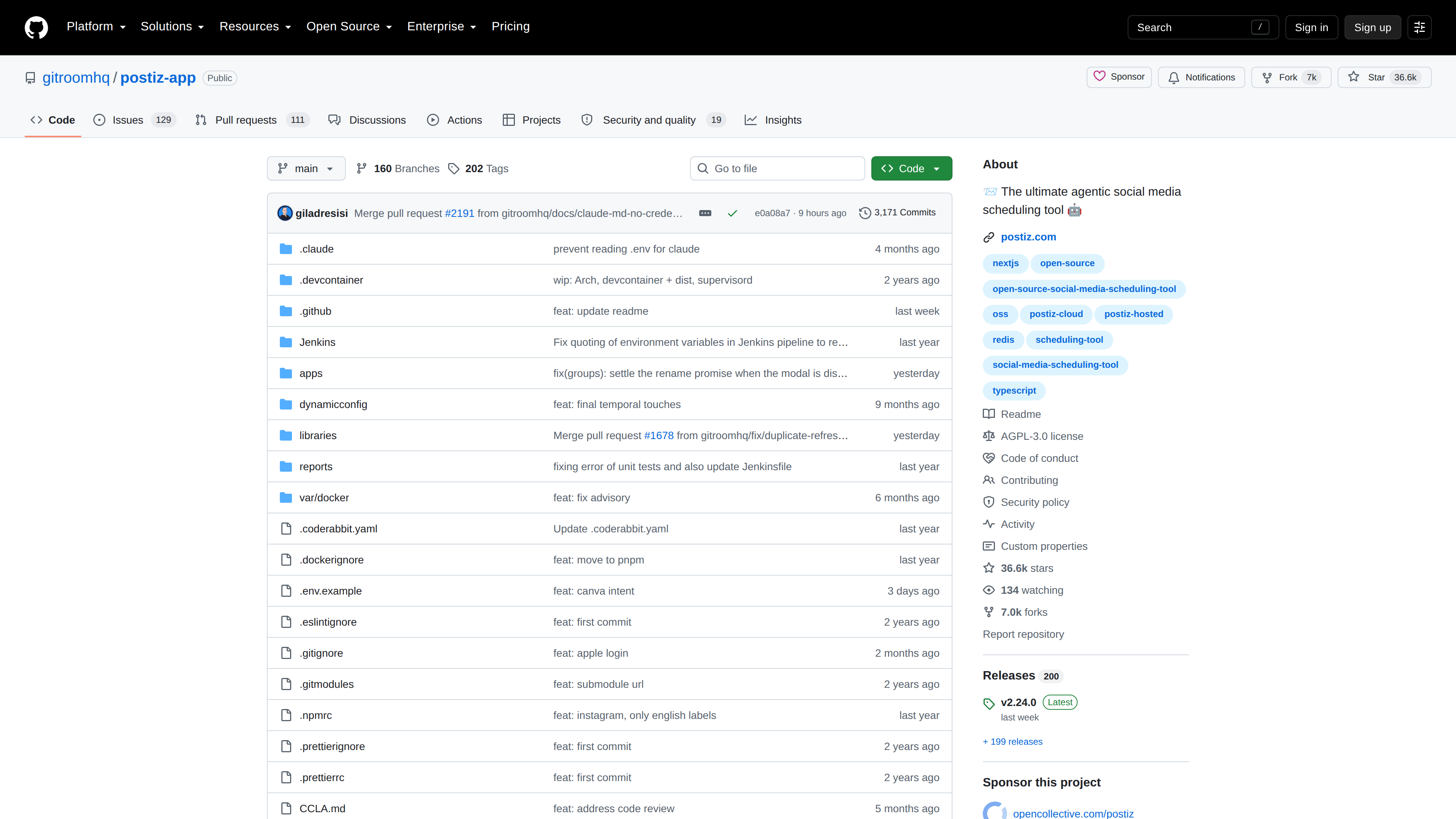
Postiz (postiz.com) is an open-source social media scheduling and management tool. Its code is published on GitHub (gitroomhq/postiz-app) under the AGPL-3.0 license, and it is frequently cited as an open-source alternative to commercial tools like Buffer and Hootsuite. It ships in two forms: an official hosted cloud (platform.postiz.com) and a free self-hosted option. The site currently positions itself as "The Agentic Social Media Scheduling Platform": alongside classic calendar-based scheduling, it offers a hosted MCP server, a CLI, and an installable agent skill so AI agents such as Claude, ChatGPT, and Cursor can plan, generate, and schedule posts, which a human then approves in the calendar (homepage, checked 2026-10-01).

The screenshot above shows the homepage: the hero explains that AI agents schedule posts to 30+ networks while everything is reviewed in one visual calendar; the channel icons include Instagram, YouTube, LinkedIn, TikTok, X, Telegram, and WordPress; a toggle near the bottom switches between "agentic scheduling" and "classic scheduling."
At a Glance
| Item | Details |
|---|---|
| URL | https://postiz.com/ |
| Type | Open-source social media scheduling/management platform (hosted cloud + self-hosted) |
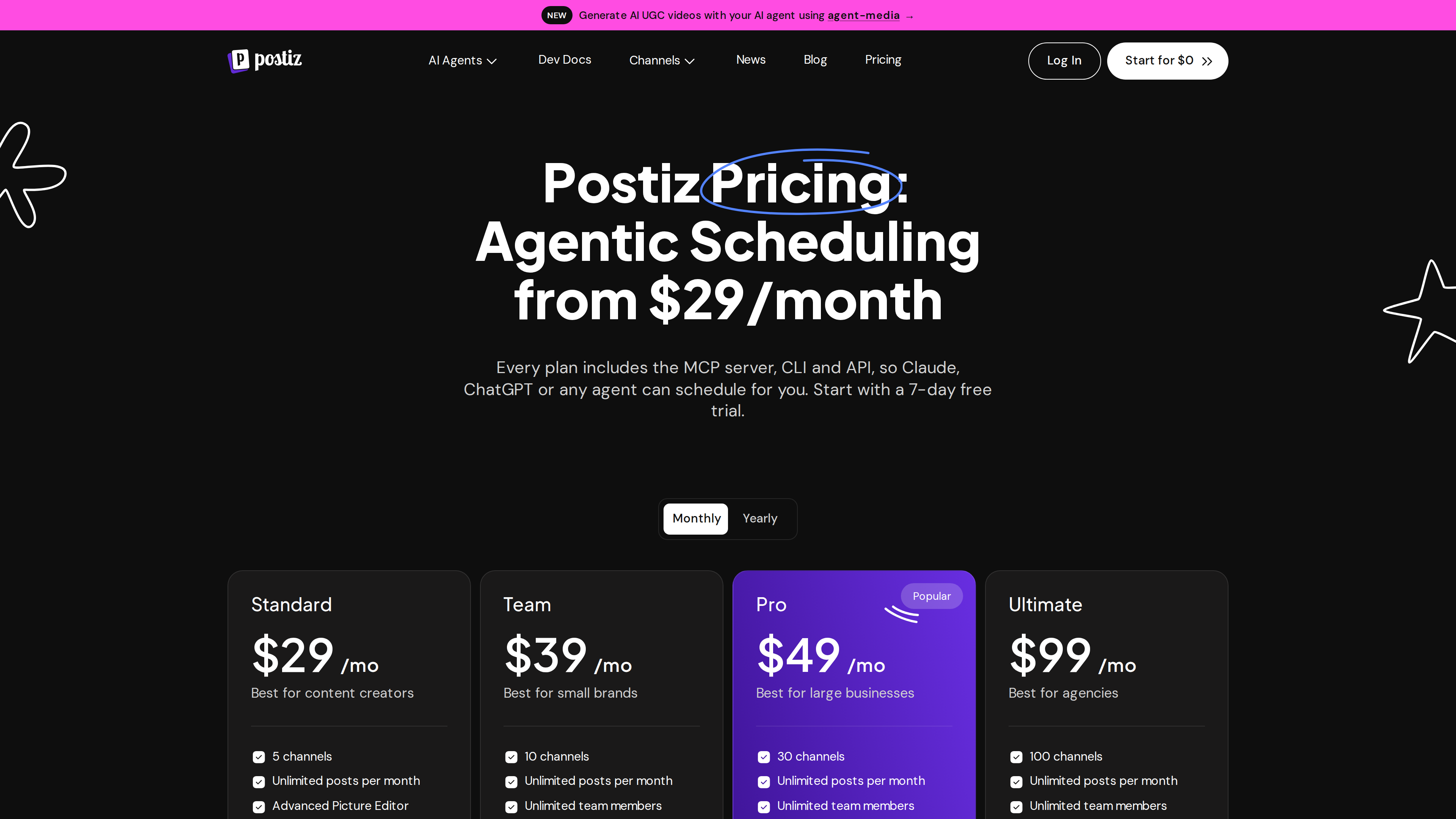
| Pricing | Cloud from $29/month with a 7-day trial, no permanent free tier; self-hosting is free (pricing page, as of 2026-10-01) |
| Sign-up | Cloud: email or Google / Apple / Farcaster / wallet login; choosing a plan is required after registration |
| Interface languages | 14 in-app (including English, Chinese, Japanese, Korean, French, German); the marketing site is English-only |
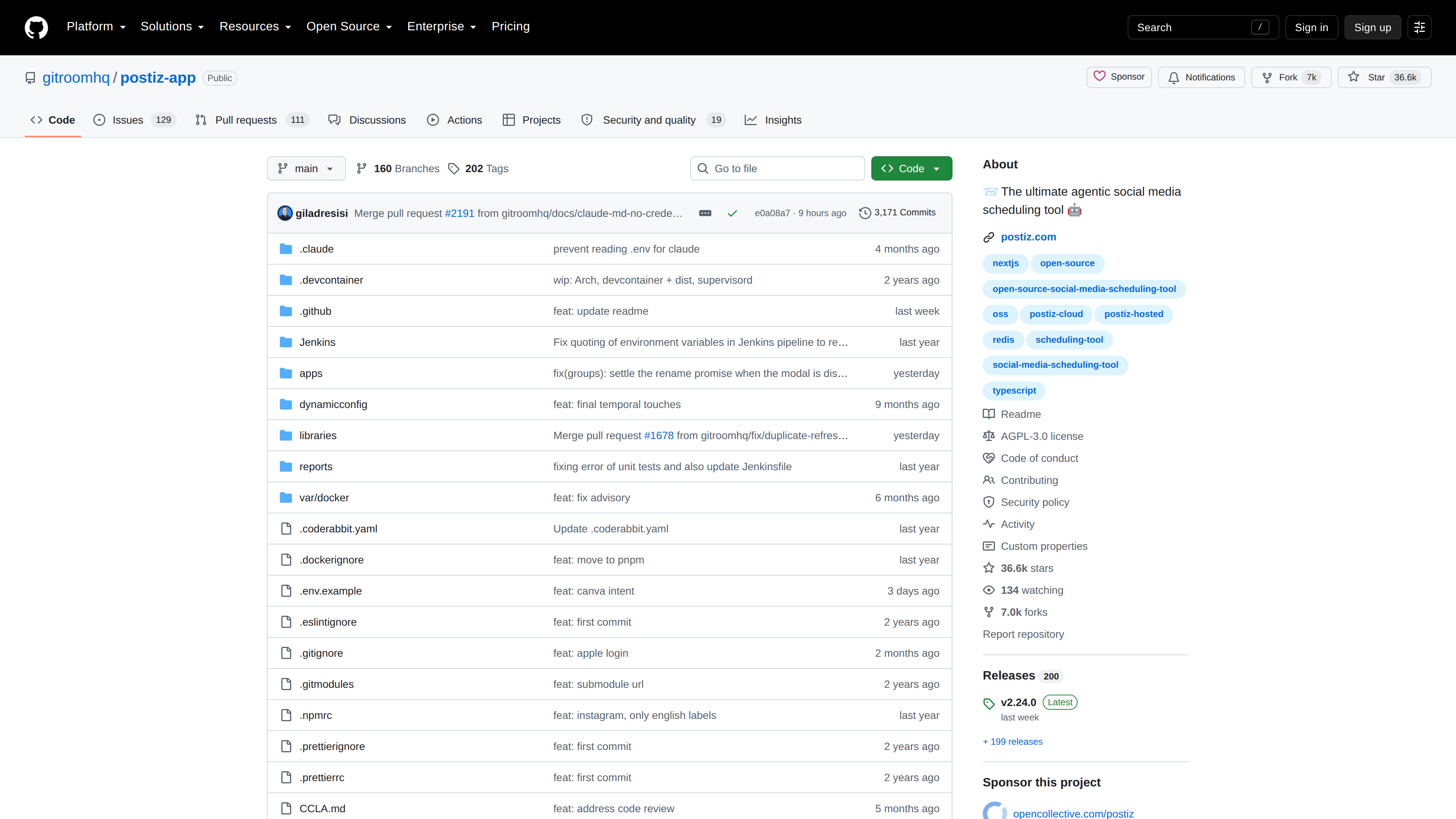
| Repository | gitroomhq/postiz-app, ~36.6k stars (as of 2026-10-01) |
| License | AGPL-3.0 |
Background
Postiz was founded by Nevo David and grew out of Gitroom, a project under the same GitHub organization (gitroomhq): a July 2024 archive of postiz.com still linked to the now-defunct gitroomhq/gitroom repository, while gitroom.com later became the founder's personal site (September 2024 archive). There is no official announcement of the Gitroom-to-Postiz rename; this account relies on observable evidence (the organization name, the old repository link, and the company entities that kept the Gitroom name).
The main repository was created on July 8, 2023. As of 2026-10-01 it has about 36,579 stars and 7,045 forks, with the latest release v2.24.0 (2026-09-22) and ongoing commit activity. It is written mainly in TypeScript as a pnpm monorepo (Next.js frontend, NestJS backend, Prisma/PostgreSQL, Temporal workflows). The About page states that Postiz reached #1 of the day, week, and month on Product Hunt, and the sign-up page claims over 20,000 entrepreneurs have registered (both are the company's own figures).
Two related entities operate the service: Gitroom Limited (Hong Kong, the contracting party for subscriptions) and Gitroom LLC (Dover, Delaware, which holds the developer-app approvals for the integrated social platforms) (About page).
Supported Channels
The marketing pages say "30+ channels"; the official documentation lists 34 platform entries broken down by API (counting LinkedIn personal profiles and pages separately, two Instagram connection types, TikTok and TikTok Business, and so on). The list includes:
- Mainstream social networks: X, LinkedIn, Facebook Pages, Instagram, Threads, TikTok, YouTube, Pinterest, Reddit;
- Decentralized and emerging platforms: Bluesky, Mastodon, Lemmy, Farcaster, Nostr;
- Communities and messaging: Telegram, Discord, Slack, VK, Whop, Skool;
- Publishing platforms: Medium, Dev.to, Hashnode, WordPress, ListMonk (newsletters).
The documentation also records how each channel connects (OAuth, stored credentials, an in-app dialog, or a browser extension) and whether self-hosters must register their own developer app. Each connected social account consumes one "channel" of quota and can be swapped at any time.
Core Capabilities
Scheduling and distribution: write once and cross-post to many channels, with per-channel copy edits and previews; the visual calendar offers day, week, and month views. Advanced features include evergreen reposting, RSS auto-posting (with AI-generated descriptions and images), scheduled comments and threads, staggered posting delays, signatures, Posting Sets (reusable content groups), and customer groups.
Automation: Internal Plugs auto-repost or comment from your other connected accounts; Global Plugs trigger actions at engagement thresholds (for example, auto-reposting once a post reaches 100 likes).
AI and media: a built-in AI copilot for copywriting, AI image generation (DALL·E), AI video generation, and AI video clipping (turning long videos into vertical shorts), plus a Canva-like picture editor.
Teamwork: the Team tier and above allow unlimited members, Admin/Member roles, and approval workflows.
Analytics: the documentation is explicit that only 10 of the 34 platforms report analytics back to Postiz (Facebook Page, Instagram, LinkedIn Page, TikTok, YouTube, Threads, X, and others, over 7/30/90-day ranges); the remaining channels support publishing only.
Open surfaces: a public REST API, webhooks, a NodeJS SDK (@postiz/node), OAuth2 for building apps on top of Postiz, an n8n custom node, Make.com and Zapier integrations, and the hosted MCP server and CLI aimed at AI agents.
Cloud Pricing
As of 2026-10-01, the pricing page lists four tiers (monthly billing shown; annual billing is roughly 20% off):
| Tier | Monthly | Channels | Team | AI quota (per month) |
|---|---|---|---|---|
| Standard | $29 | 5 | Solo | AI copilot; 3 AI videos; 60 min clipping |
| Team | $39 | 10 | Unlimited members | 100 AI images; 10 AI videos; 120 min clipping |
| Pro | $49 | 30 | Unlimited members | 300 AI images; 30 AI videos; 300 min clipping |
| Ultimate | $99 | 100 | Unlimited members | 500 AI images; 60 AI videos; 600 min clipping |
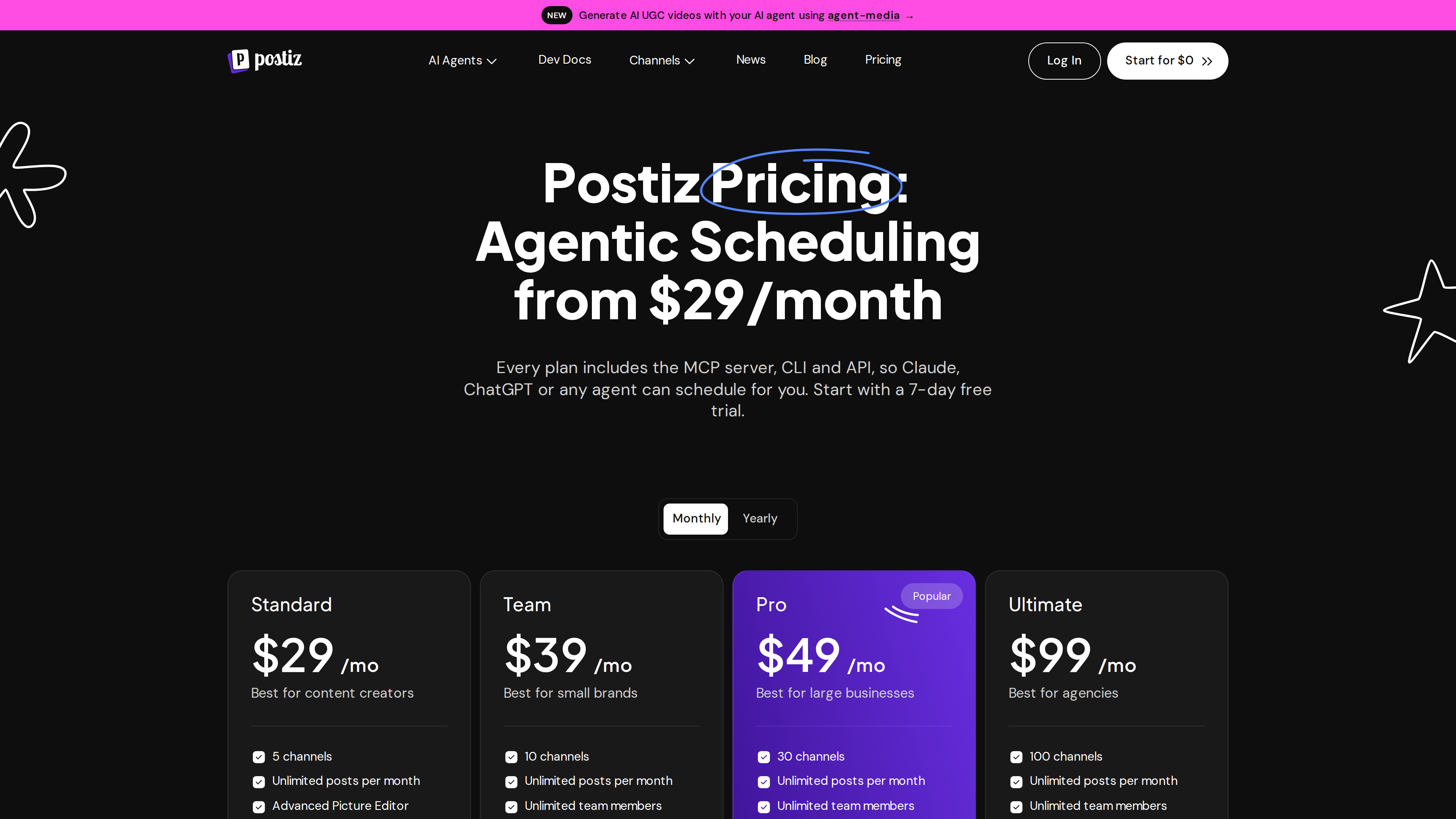
All tiers include unlimited posts per month and MCP/CLI/API access, and start with a 7-day trial at $0; the documentation confirms there is no permanent free tier on the cloud. Refund policy: an unused paid month can be refunded in full via Discord or the contact page; downgrading disables the most recently connected channels beyond the new limit without deleting data.
For context, the July 2024 homepage archive shows an Essential free tier (3 channels, 30 posts/month) existed at the time — the pricing structure has been adjusted several times, so the pricing page is the authoritative source.
Self-Hosting and Licensing
Postiz is released under AGPL-3.0, and the README states the project does not "gate" features or limit the license — self-hosted instances are not bound by the cloud tiers' channel counts or AI quotas. Key self-hosting points (system requirements and Docker docs, checked 2026-10-01):
- Deployment: the official image ghcr.io/gitroomhq/postiz-app; the recommended path is the official Compose repo postiz-docker-compose (pre-wired Postgres + Redis + Temporal), with Helm/Kubernetes and Dev Container alternatives;
- Required services: PostgreSQL 14+, Redis 6+, and Temporal (mandatory since v2.12.0); object storage is optional (local disk or Cloudflare R2);
- Hardware floor: 2 vCPU / 2 GB RAM / 20 GB disk works only for a single light user; 4 vCPU / 8 GB / 50 GB+ is recommended;
- Platform onboarding: most OAuth channels require self-hosters to register and get approval for their own developer apps — the docs warn that Meta, YouTube, and TikTok reviews can take weeks; a paid approval-handling service is offered in the pricing FAQ;
- AI features: require your own provider keys (e.g., OpenAI); cloud quotas do not apply;
- The X channel is special: X splits posting (v2 API, OAuth2) from media upload (v1 API, OAuth1), so self-hosters must configure both flows; a free-tier X developer account can be used. If your X API plan lacks analytics access,
DISABLE_X_ANALYTICS=trueturns off analytics pulls — a concrete example of how a platform's paid API policy shapes what tools like this can offer.
On compliance, the README states that the hosted service uses only officially approved OAuth flows for each platform, does not scrape or automate social media content, and does not collect, store, or proxy users' API keys or access tokens.
Who It's For
- Creators and small teams distributing the same content across many platforms — especially channels that commercial tools rarely cover, such as Bluesky, Mastodon, Telegram, or Discord;
- Teams that want social publishing inside automation pipelines (n8n/Make/Zapier) or run by AI agents, while keeping a human approval step;
- Developers and organizations that value data control, want free self-hosting, and can accept AGPL-3.0 obligations;
- Developers building their own publishing apps on top of Postiz's OAuth2/API.
Limitations
- No permanent free tier on the cloud; the $29/month entry price is higher than some alternatives, and the trial lasts only 7 days.
- Limited analytics coverage: only 10 of 34 channels report analytics, with depth constrained by each platform's public API.
- Non-trivial self-hosting overhead: beyond the app itself you maintain PostgreSQL, Redis, and Temporal, and most platforms require registering your own developer apps and waiting for review.
- AGPL-3.0 copyleft: commercial products built on the code and offered as a service must open their derivative source — evaluate this before adopting.
- Inconsistent channel counts: marketing says "30+" while the documentation's API-level breakdown counts 34; a few channels (e.g., Skool, which relies on a browser extension reading your session) depend on platform-side behavior that may change.
- The "20,000+ entrepreneurs" figure and the Product Hunt #1 claims are self-reported, with no independent verification.
Alternatives
- Buffer / Hootsuite: commercial hosted services; Postiz's own comparison page covers 63 tools;
- Mixpost: another self-hostable social media manager (under a paid license) that is often mentioned alongside Postiz.
References
- Postiz homepage, pricing, About, comparison page (checked 2026-10-01)
- Postiz documentation: platform list, system requirements, Docker installation, X channel setup (checked 2026-10-01)
- GitHub repository gitroomhq/postiz-app and GitHub API data (checked 2026-10-01)
- Wayback Machine: postiz.com, 2024-07-03, gitroom.com, 2024-09-03