Plausible (plausible.io) is a website analytics tool developed by Plausible Insights OÜ, an Estonian company. It answers a specific need: site owners want to know where traffic comes from, which pages get viewed, and how conversions perform, without paying for that insight with their visitors' personal data the way Google Analytics does. Its verifiable differences from typical analytics products: no cookies, no stored raw IP addresses or User-Agent strings, and no persistent visitor identifiers; a tracking script of about 2.5KB gzipped (the vendor says 54 times smaller than the GA script); the full source code published on GitHub under AGPLv3; and, alongside the managed cloud, a free self-hosted Community Edition. As of 2026-09-25, the website claims more than 21,000 paying customers, naming Basecamp, Ghost, Hugging Face, MongoDB, the Python Software Foundation, and Harvard University among them (About page; vendor-reported figures).
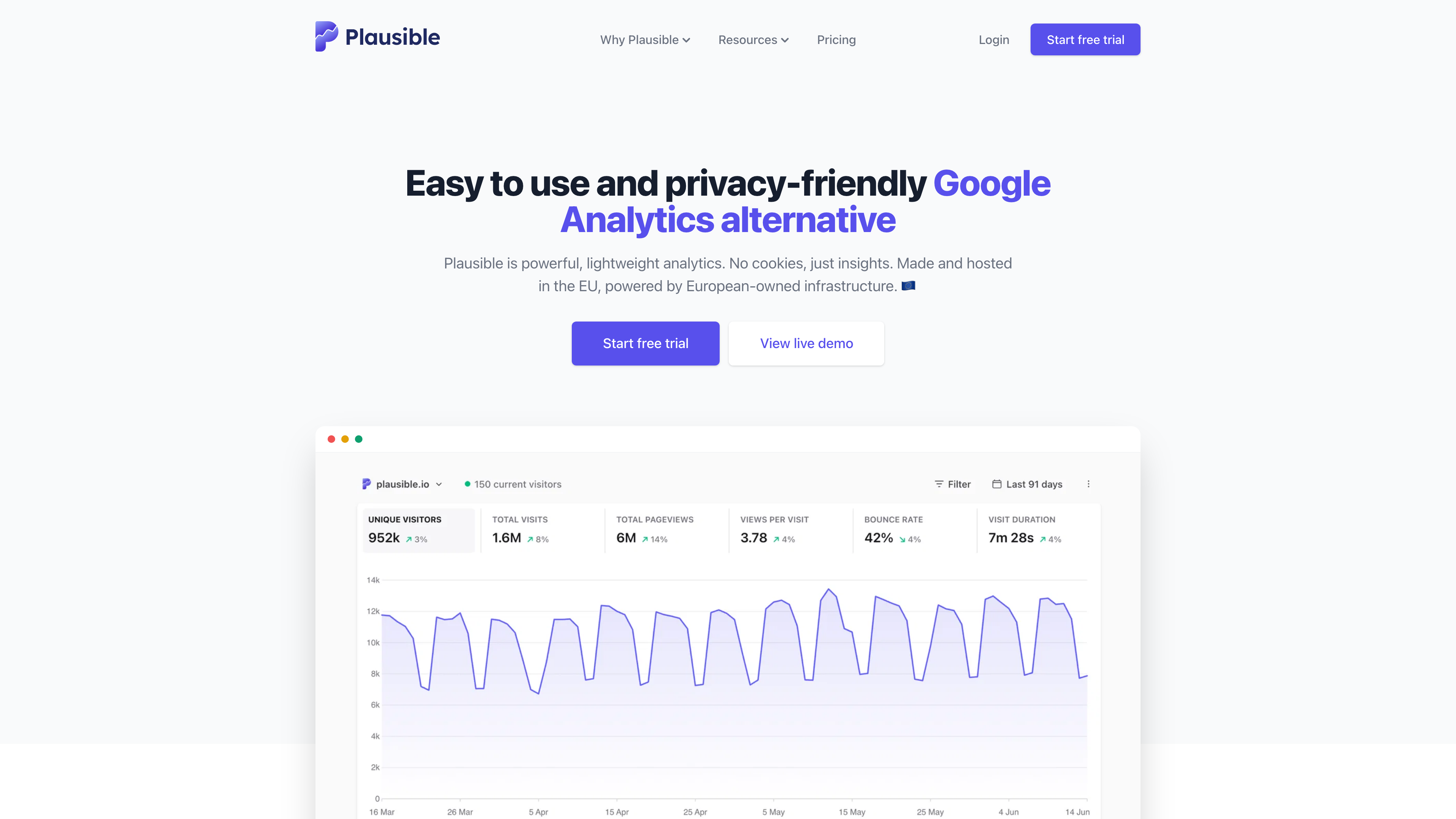
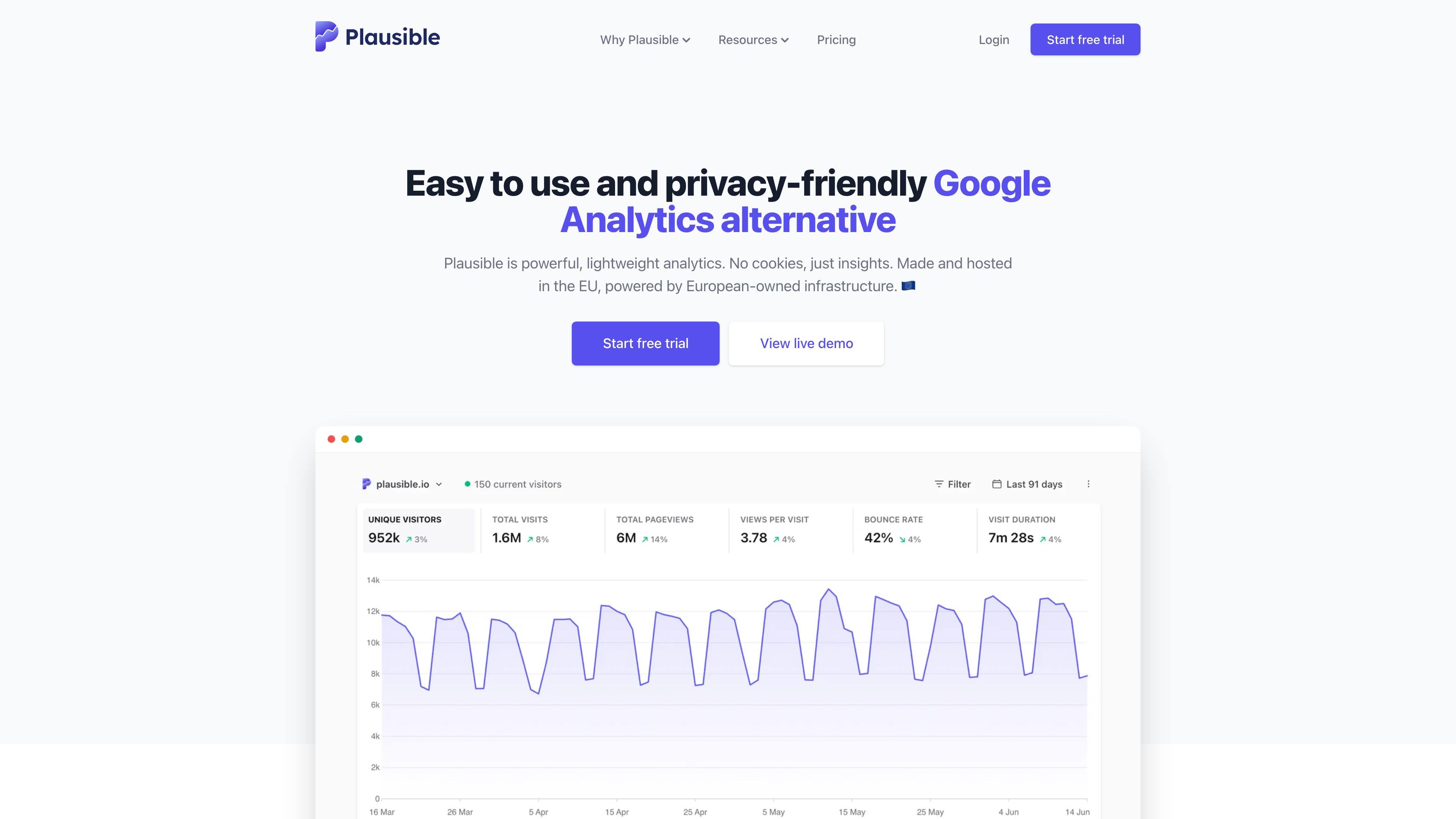
The screenshot above shows the Plausible homepage, which states its positioning up front — an easy-to-use, privacy-friendly Google Analytics alternative — followed by the product's single-page dashboard: metric cards for visitors and visit duration over a traffic trend chart.
At a glance
- URL: https://plausible.io
- Type: web analytics SaaS (managed cloud) plus open-source self-hosted software (Community Edition)
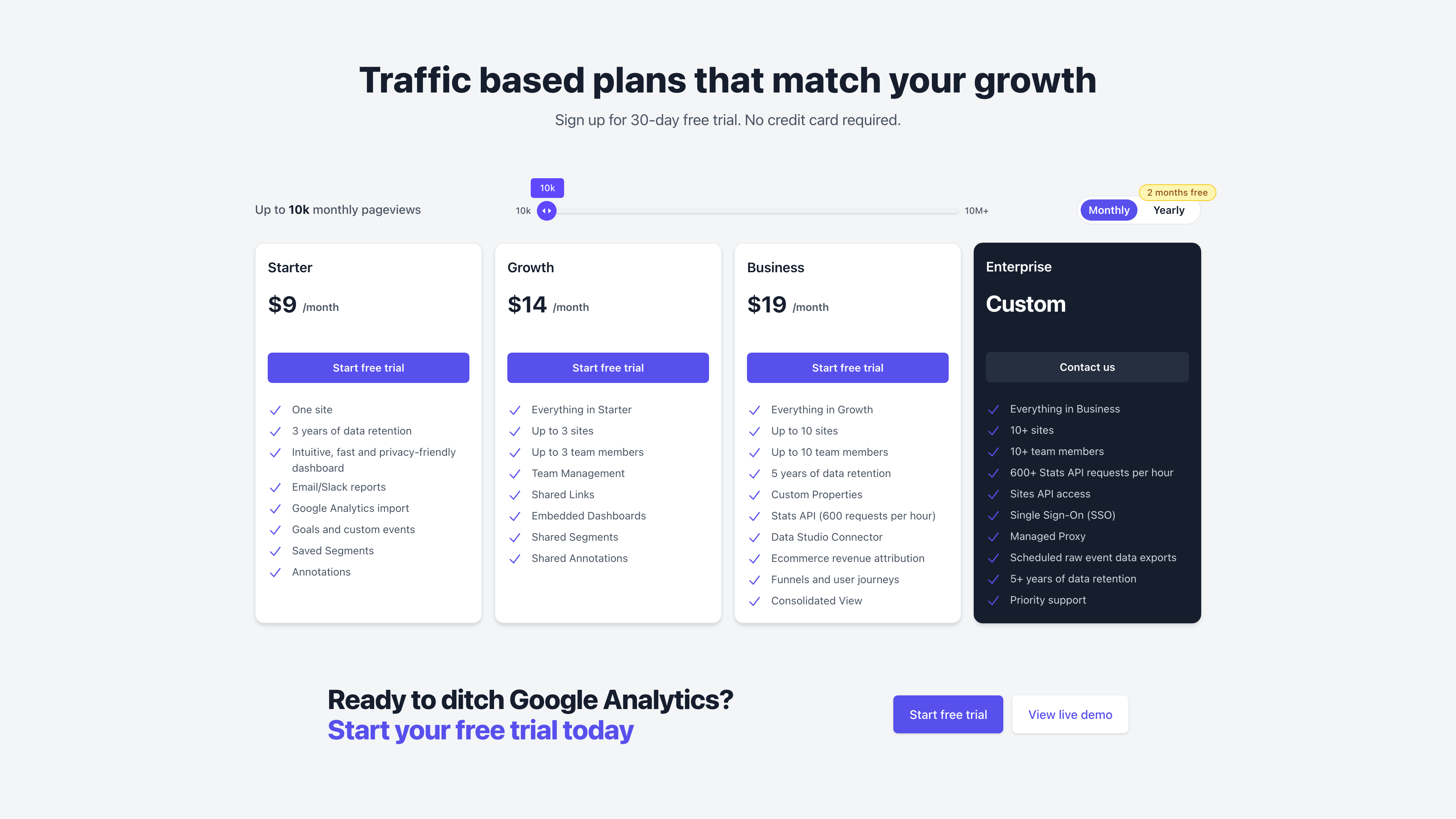
- Cost: the cloud service is subscription-based, tiered by total monthly pageviews and custom events across all sites in an account; monthly billing starts at $9 (10k pageviews, Starter plan). A 30-day free trial requires no credit card (as of 2026-09-25; see the pricing table below)
- Sign-up requirements: browsing the site, docs, and the public demo requires no account; tracking your own site requires an account and embedding the script
- Interface language: English only (no language switcher on the site, docs, or dashboard; a multilingual dashboard remains an open request on the official feedback board)
- License: the main repository is AGPL-3.0; the browser-side tracker is MIT-licensed
- Launch: first line of code in December 2018, public beta in January 2019, paid subscriptions from May 2019
Background
Plausible was started solo by developer Uku Taht in December 2018, sparked by being asked to integrate Google Analytics at work and thinking "can we just use something else?" (the company's own retrospective). It entered public beta on Indie Hackers in January 2019, launched paid subscriptions that May (ending the month at $64 MRR), and in September 2019 open-sourced the entire SaaS codebase under MIT (the 2019 announcement). Marko Saric joined in March 2020 to run marketing and communications — a two-person "build + market" split that held for years — and in October 2020 the license changed from MIT to AGPLv3 to keep corporations from taking the code closed-source.
The company has remained self-funded with no outside investors: it crossed $1M ARR in June 2022 (over 7,000 paying subscribers counting stats for more than 50,000 websites at the time) and today operates as a team of 10. Plausible says it has never spent on advertising, affiliates, or paid endorsements, growing instead through content and word of mouth. EU privacy enforcement proved a major tailwind: when the Austrian and French data protection authorities ruled in early 2022 that using Google Analytics violates the GDPR, Plausible saw a direct spike in sign-ups (all per the company's own account).
What it does: one page of traffic stats
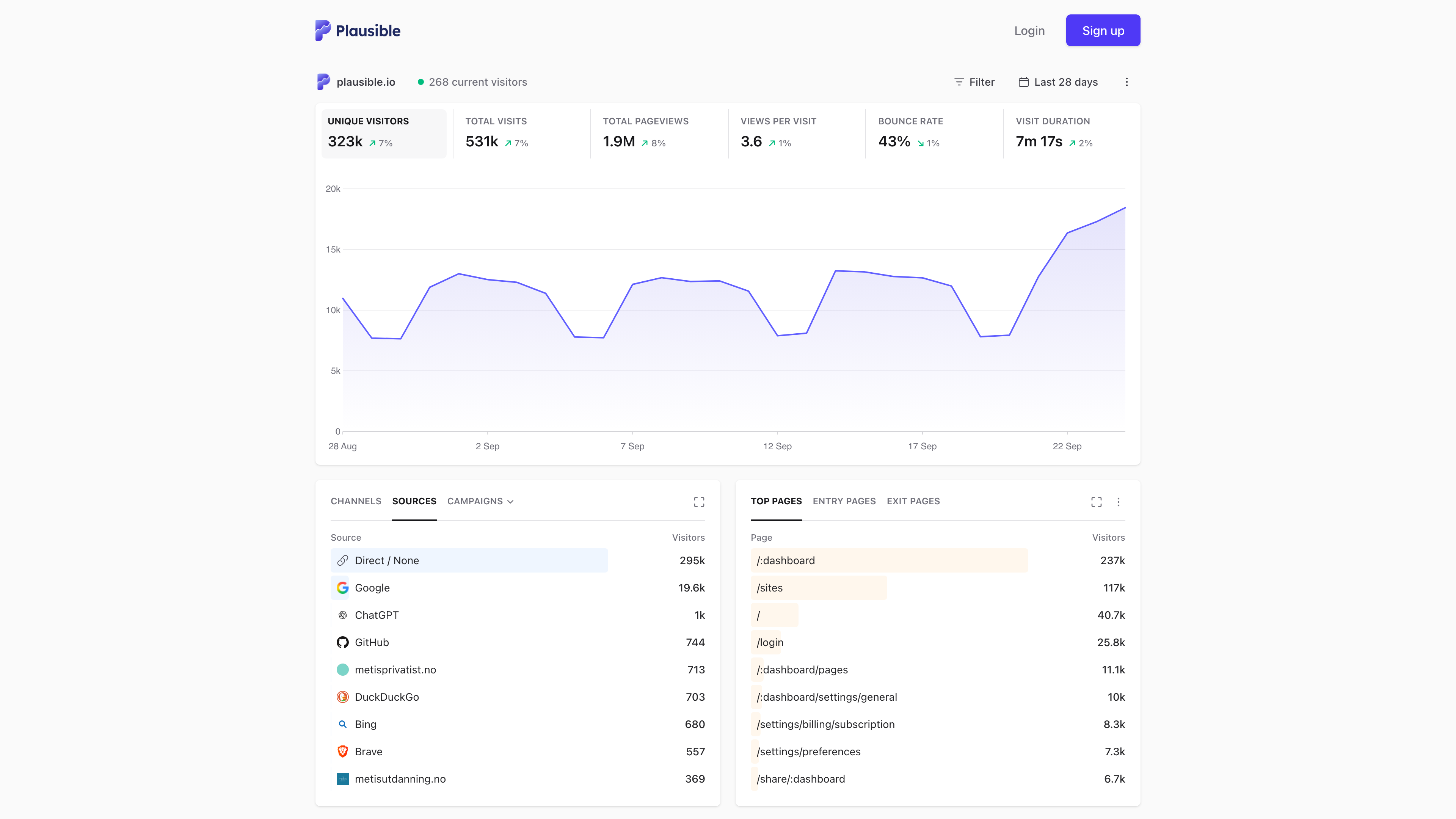
Plausible's product is a single-page dashboard: six headline metrics (unique visitors, total visits, pageviews, views per visit, bounce rate, visit duration), then a traffic trend chart, acquisition channels (with Google Search Console keyword integration), top/entry/exit pages, locations, devices, and browsers. There are deliberately no nested menus or custom report builders; the stated goal is to see everything that matters in one minute.
Paid plans add goal and custom-event tracking (outbound link clicks, file downloads, form submissions, and 404 pages can be enabled without code), funnels and user journeys, ecommerce revenue attribution, segmentation via custom properties, a consolidated cross-site view, email/Slack reports with traffic spike alerts, public shared links and embeddable dashboards, and Google Analytics historical import.
Lightweight is its headline technical claim: per the vendor's numbers, the tracking script is 2.5KB gzipped versus roughly 135KB for the GA4 script — and once Google Tag Manager and a cookie consent banner are added, the GA stack typically exceeds 285KB. Because Plausible uses no cookies and collects no personal data, sites can drop the analytics cookie consent banner entirely.
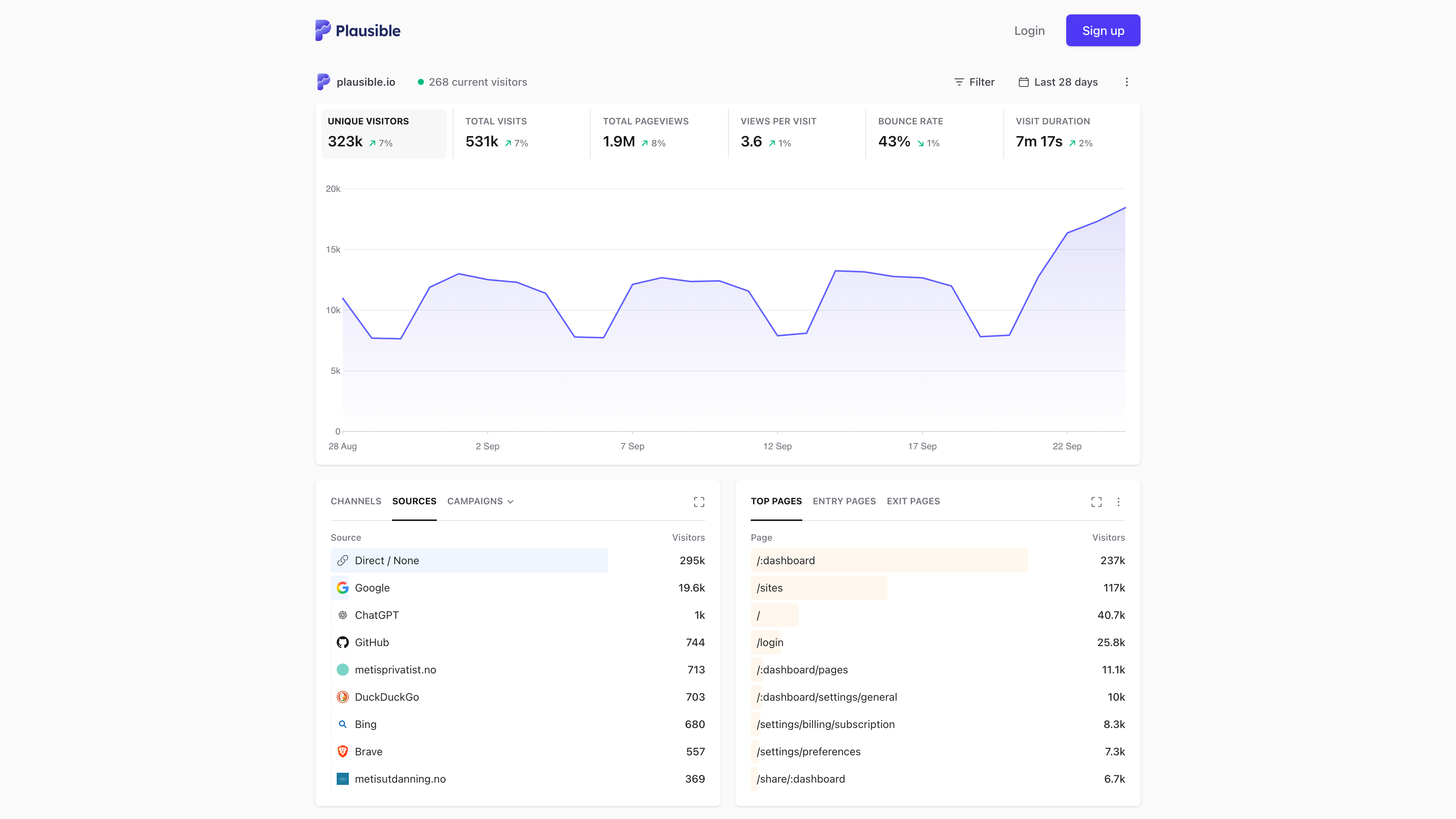
A public demo is open to anyone: the "View live demo" link in the site navigation leads to Plausible's own public dashboard, no account needed — shown below. The top row covers the last 28 days of metrics with a trend chart, and the Sources panel breaks down referral traffic from Google, ChatGPT, GitHub, and others. Publishing its own website stats is itself part of the company's marketing.
Privacy model and compliance
The official data policy (September 2026 edition) is specific about what is recorded: page URLs (query strings discarded except campaign parameters), referral sources, browser/OS/device type derived from the User-Agent, approximate location derived from the IP address, and engagement metrics — while raw IP addresses and User-Agent strings are never stored. Unique visitors are counted via hash(daily salt + website domain + IP + UA), with the salt rotated and deleted every 24 hours, so the same visitor cannot be recognized across days, devices, or websites.
All hosted data is processed within the EU on infrastructure owned by European companies (the vendor says servers are in Germany) and never leaves the EU. The company claims full GDPR, CCPA, and PECR compliance, states that no cookie banner is needed for analytics, and has published a GDPR legal assessment written by a data protection expert. This "measure trends, not individuals" design also defines the product's boundary: no user profiles and no new-vs-returning visitor segment — as the official "When Plausible is not a fit" page puts it, "It is not a limitation to work around. It is the design."
Pricing and self-hosting
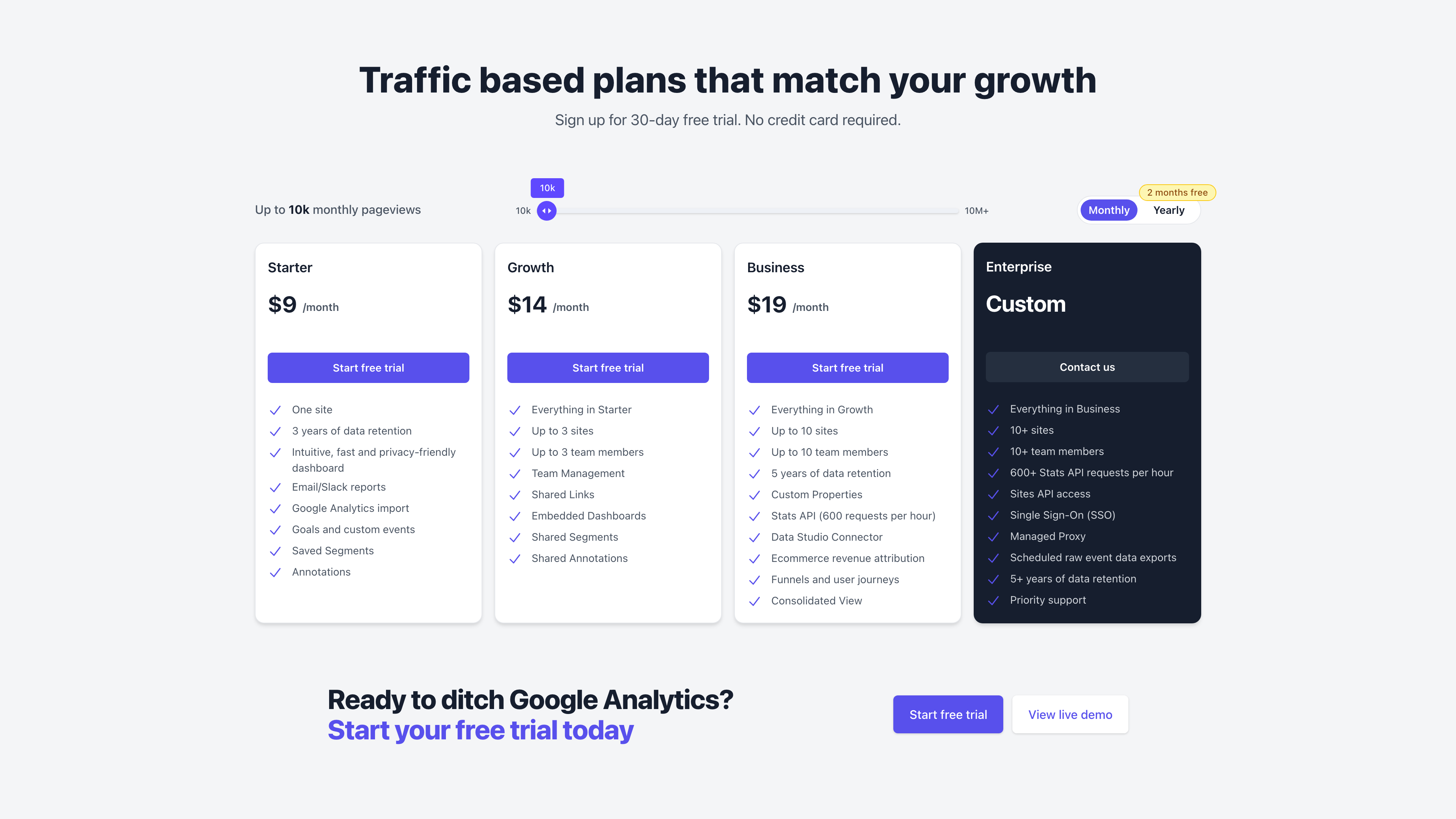
Cloud subscriptions are metered by total monthly pageviews plus custom events across all sites in an account (team members are capped per plan rather than billed per seat). As of 2026-09-25, the pricing section and subscription docs list these monthly-billing tiers (annual billing comes with a "2 months free" discount):
| Monthly pageviews | Starter | Growth | Business |
|---|---|---|---|
| 10k | $9 | $14 | $19 |
| 100k | $19 | $29 | $39 |
| 500k | $49 | $74 | $99 |
| 1M | $69 | $104 | $139 |
| 5M | $129 | $194 | $259 |
| 10M | $169 | $254 | $339 |
Plan differences are mainly site counts and features: Starter covers 1 site with 3-year data retention; Growth allows 3 sites, 3 team members, shared links, and embedded dashboards; Business raises that to 10 sites, 10 members, and 5-year retention, unlocking custom properties, the Stats API (600 requests/hour), the Looker Studio connector, funnels, and ecommerce attribution. Higher volumes (10M+) or requirements like SAML SSO, the Sites API, a managed proxy, or scheduled raw-data exports go through custom-priced Enterprise plans. Nonprofits, educational institutions, and open-source projects get 15% off annual Business plans. The overage policy is comparatively lenient: one month over the limit costs nothing and interrupts nothing; only two consecutive months over triggers an upgrade request, and refusing to upgrade only locks the dashboards temporarily while stats keep being collected.
Those unwilling to pay can self-host Plausible Community Edition (CE): the same AGPLv3 codebase as the cloud service, free to use, but with trade-offs spelled out on the official comparison page — CE excludes funnels, user journeys, ecommerce revenue goals, SSO, and the Sites API; it ships long-term releases only twice a year (the cloud is updated multiple times a week); bot filtering is basic; and there is no official support. In exchange, the data is fully yours: raw records can be read directly from ClickHouse, and the instance can run in any jurisdiction. The stack is Elixir/Phoenix, PostgreSQL, ClickHouse, and React.
Accounts and openness
Cloud accounts start with a 30-day full-featured trial (Business-plan limits), no credit card required; continued access to stats requires payment after the trial. Team members are managed with role-based access, and reports can be shared via public links or embedded dashboards that need no login. For developers there is a Stats API for aggregated queries, an Events API for sending events from servers or any platform, CSV export, a Looker Studio connector, and — on Enterprise — a Sites API for programmatic site management plus scheduled raw event exports to S3-compatible storage. Payments are processed by Paddle; the terms state fees are non-refundable, and after cancellation stats remain accessible until the end of the current billing period.
Limitations
- No individual-level analysis: no session replay, no heatmaps, no user profiles, no cross-day recognition of returning visitors, and no new-vs-returning segment. Teams needing cohorts, retention curves, or per-user journeys should look at product analytics tools (Mixpanel, Amplitude, PostHog).
- No permanently free hosted tier: after 30 days the cloud service requires a subscription. The free path is self-hosted CE, which means owning operations, backups, upgrades, and bot filtering — and security fixes only protect you once you apply each release yourself.
- English only: the dashboard, documentation, and email reports have no Chinese (or other language) versions; localization remains a long-standing open request.
- Aggregate-method trade-offs: metrics like bounce rate and visit duration are inferred from event sessions and do not match GA's definitions exactly, so numbers rarely line up after migration; the vendor's script-size comparisons and customer counts are self-reported.
- Compliance responsibility stays with the site owner: the terms prohibit sending sensitive personal data through URLs, event names, or custom properties, and Plausible offers no HIPAA compliance or BAA. The terms of service are governed by Estonian law.
Alternatives
- Google Analytics: the de facto industry standard — free and the most feature-complete, but heavy, complex to configure, and built on the data-driven advertising model Plausible exists to replace.
- Matomo: the long-established open-source analytics platform, closer to GA in feature breadth and also self-hostable, with a more complex interface and setup than Plausible.
- Umami: another lightweight, cookieless, open-source self-hosted option, MIT-licensed, for teams comfortable running their own infrastructure.
References
- Plausible homepage (checked: 2026-09-25)
- About - Plausible Analytics (checked: 2026-09-25)
- Plausible Data Policy (checked: 2026-09-25)
- Terms of Service - Plausible (checked: 2026-09-25)
- Subscription plans - Plausible docs (checked: 2026-09-25)
- Self-hosted web analytics - Plausible (checked: 2026-09-25)
- Lightweight web analytics - Plausible (checked: 2026-09-25)
- When Plausible is not a fit (checked: 2026-09-25)
- How we built a $1M ARR open source SaaS - Plausible Blog (checked: 2026-09-25)
- Plausible is going open source - Plausible Blog (checked: 2026-09-25)
- plausible/analytics - GitHub (checked: 2026-09-25)
- Plausible public demo dashboard (checked: 2026-09-25)