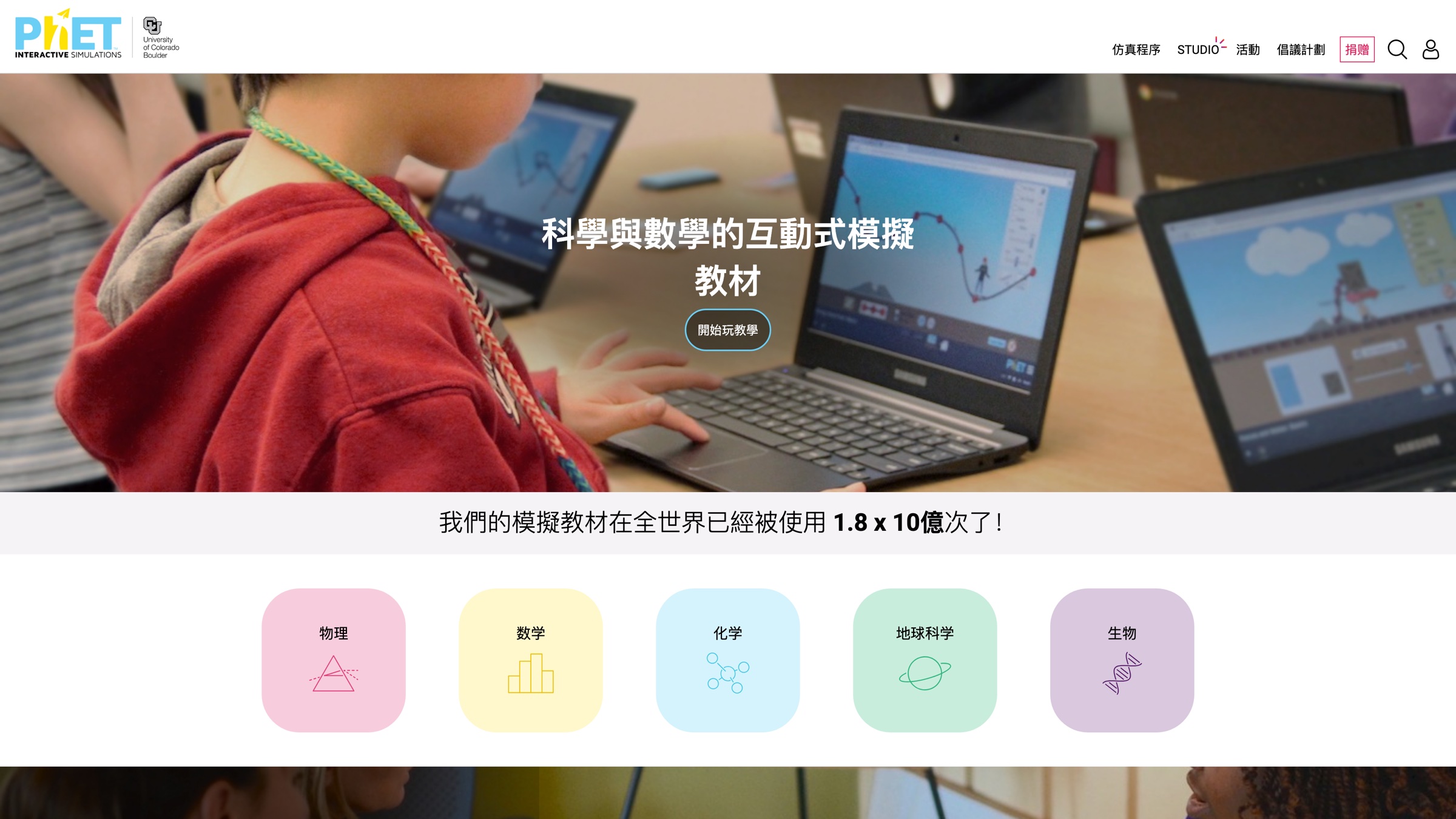
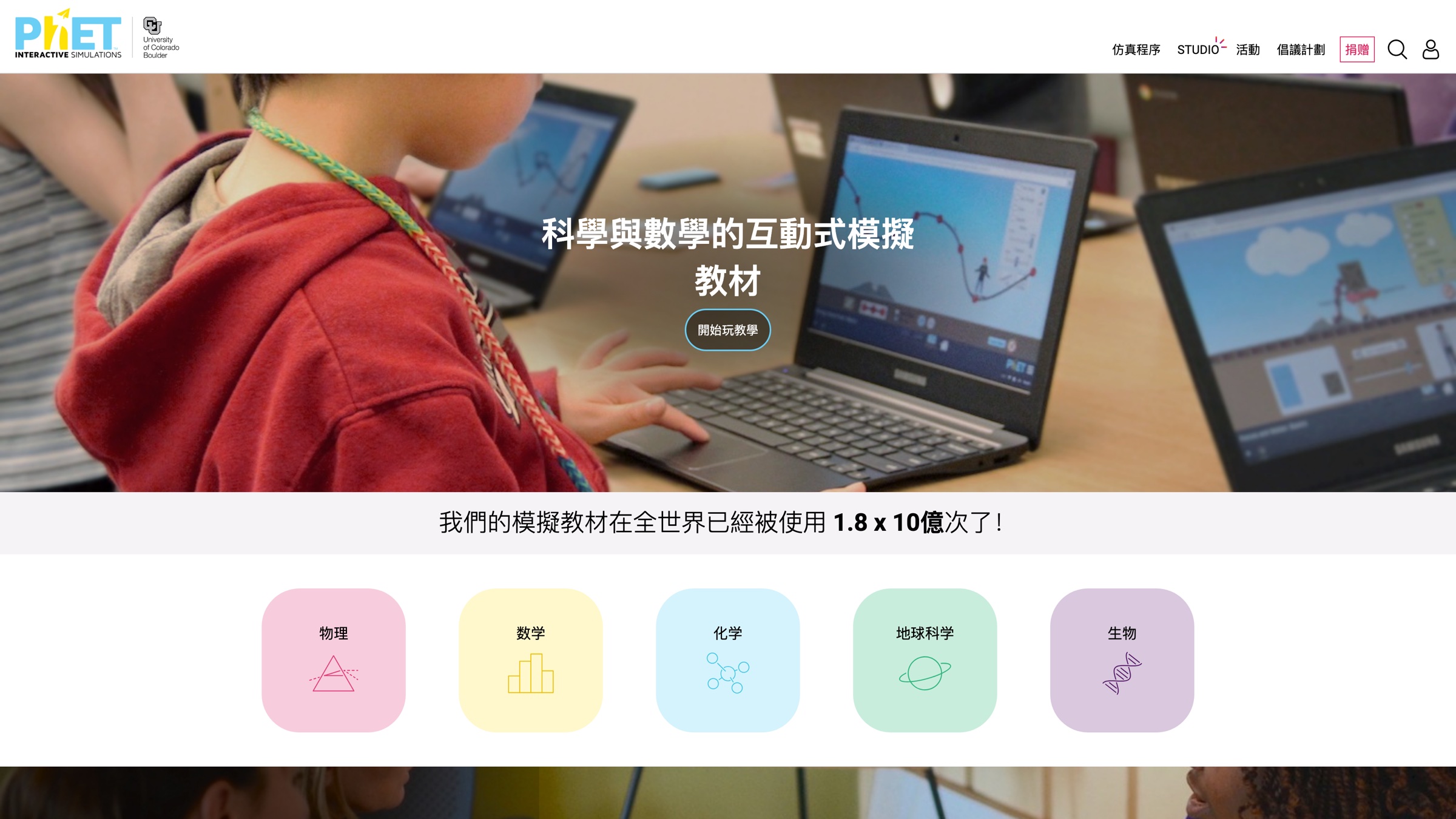
PhET Interactive Simulations (phet.colorado.edu) is a free interactive science and mathematics simulation project run by the University of Colorado Boulder. Its browser-based "virtual experiments" address two familiar problems in science teaching: experiments that are impractical because of equipment, space or safety constraints, and abstract concepts — molecular motion, circuits, energy transformation — that text and static diagrams struggle to convey. What distinguishes it from ordinary teaching animations, and can be verified from the site itself: every simulation follows a research-driven design process with student interviews and classroom observation; the simulations have been translated into more than a hundred languages (Chinese alone has more than 150); and everything runs free of charge without registration, with source code released under a GPL license.
Site Overview
- URL: https://phet.colorado.edu/
- Type: Interactive simulations for science education (physics, chemistry, math and statistics, biology, earth and space)
- Cost: Simulations and teaching resources on the website are free; the project is supported by sponsors and donations. The mobile apps and the Studio customization tool are paid products.
- Registration: Not needed to run simulations; a free account adds bookmarks, activity contributions, and preset and license management.
- Interface languages: The language picker lists 48 interface locales (including Simplified and Traditional Chinese); some documentation pages, such as the accessibility and research pages, are English only.
- Scale: As of 2026-08-31, the homepage reported 173 interactive simulations, translations into 132 languages, 3,690 teacher-contributed lessons, and roughly 1.8 billion simulation uses to date.
Background
The project was founded in 2002 by Nobel laureate Carl Wieman and is operated on a non-profit basis by a team at the University of Colorado Boulder (homepage; Wieman was one of the three recipients of the 2001 Nobel Prize in Physics, see Wikipedia: Carl Wieman).
Each simulation goes through the project's own design and effectiveness evaluation: student interviews — typically four to six individual think-aloud sessions per simulation — plus observation of classroom use, with the interface and content revised accordingly (About, Research). The published design principles include encouraging scientific inquiry, making the invisible visible, combining multiple representations (object motion, graphs, numbers), and using real-world connections and deliberately limited controls as implicit guidance. The project's awards include the 2011 Tech Award, the 2017 WISE Award, the 2018 APS Excellence in Physics Education Award, the 2018 TPG Web Accessibility Challenge Delegates Award, and the 2019 Open Education Award for Excellence in the open simulation category (About).
Catalog and Subjects
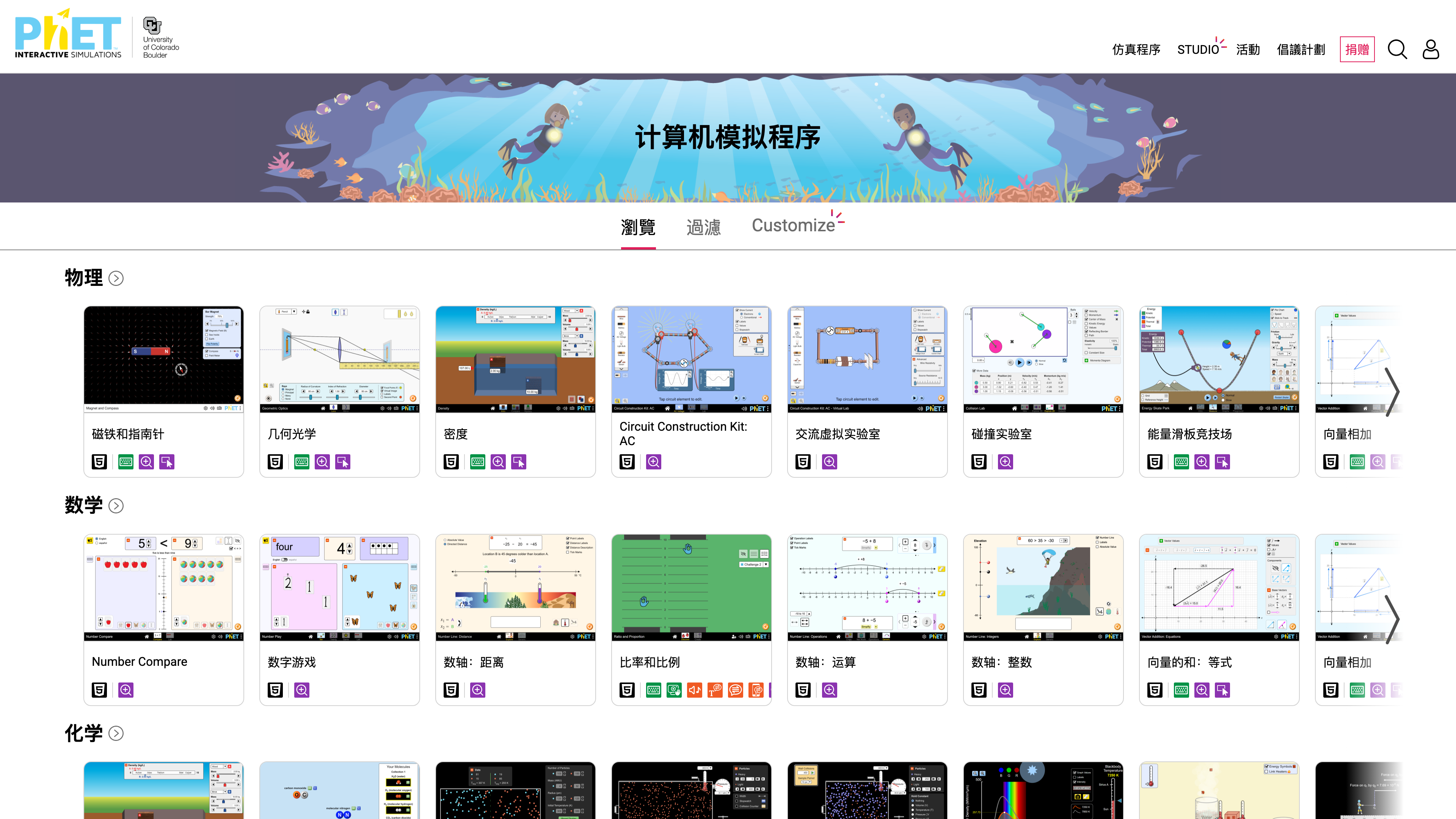
Simulations are organized into five subjects: physics, math and statistics, chemistry, earth and space, and biology. The catalog page adds a "newest releases" strip and filters by subject, type (HTML5 or Java) and accessibility features; each simulation page lists learning goals, links for teachers, related community activities, available translations and the current version number.
Using the Simulations and Language Support
- In the browser: clicking the play button on a simulation page runs the HTML5 simulation directly, with no plug-ins; the official guidance says HTML5 sims run on iPads, Chromebooks, PCs, Macs and Linux (Offline Access).
- Offline: individual HTML5 or Java simulations can be downloaded from their pages for offline use, and the PhET Desktop App bundles all HTML5 and Java simulations with their translations for Windows and macOS.
- Embedding: simulation pages offer an embed-code dialog, with width and height adjustable before pasting into a course page.
- Languages: as of 2026-08-31 the translated-sims table lists 169 simulations translated into Traditional Chinese (zh_TW), 151 into Simplified Chinese (zh_CN) and 35 into Cantonese (zh_HK); the simulation language can also be set at startup via a locale code (Translated Sims).
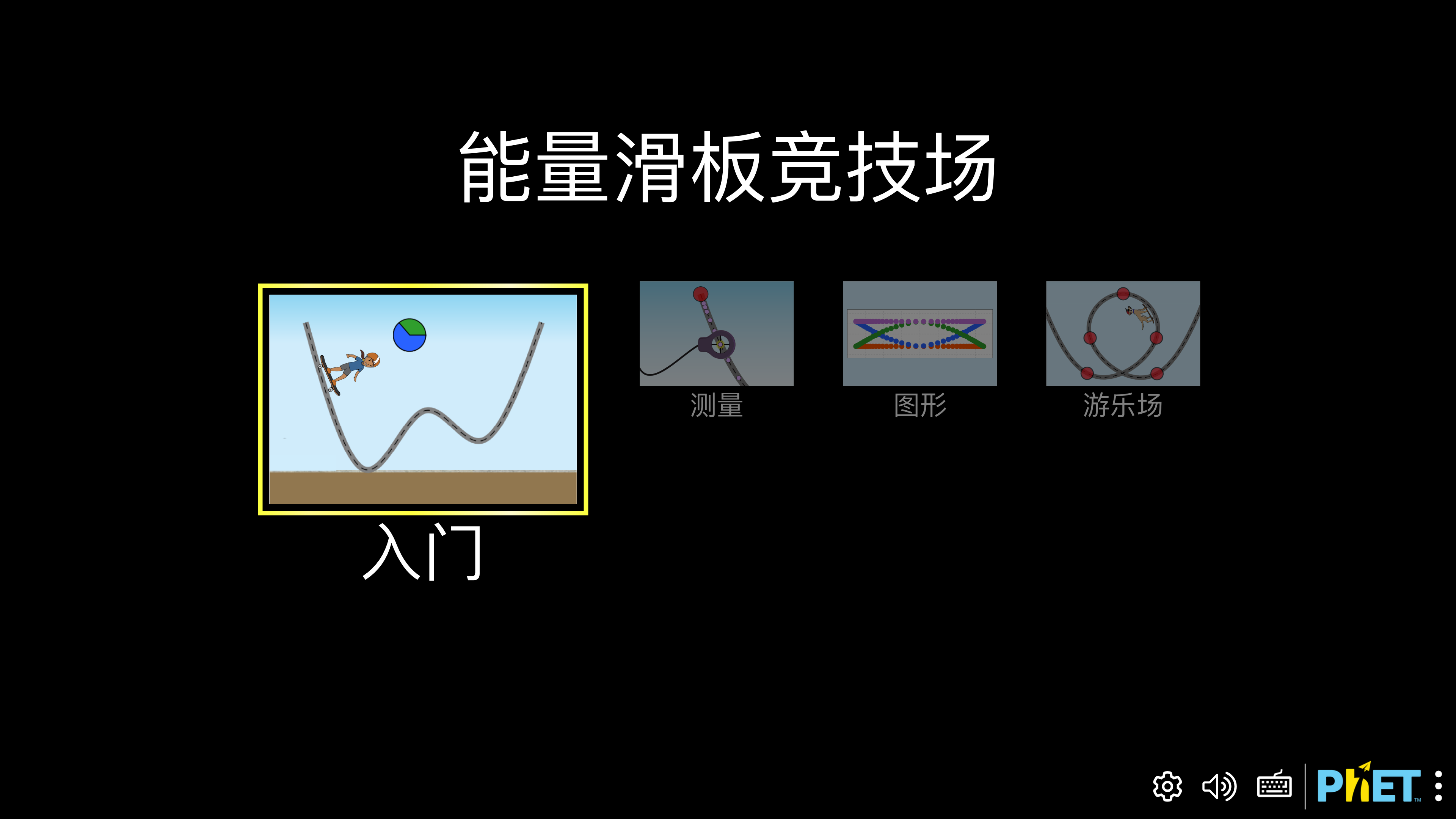
Two running examples: in "Energy Skate Park" you adjust the skater's mass, track friction and gravity while watching live bar charts of kinetic, potential and thermal energy.
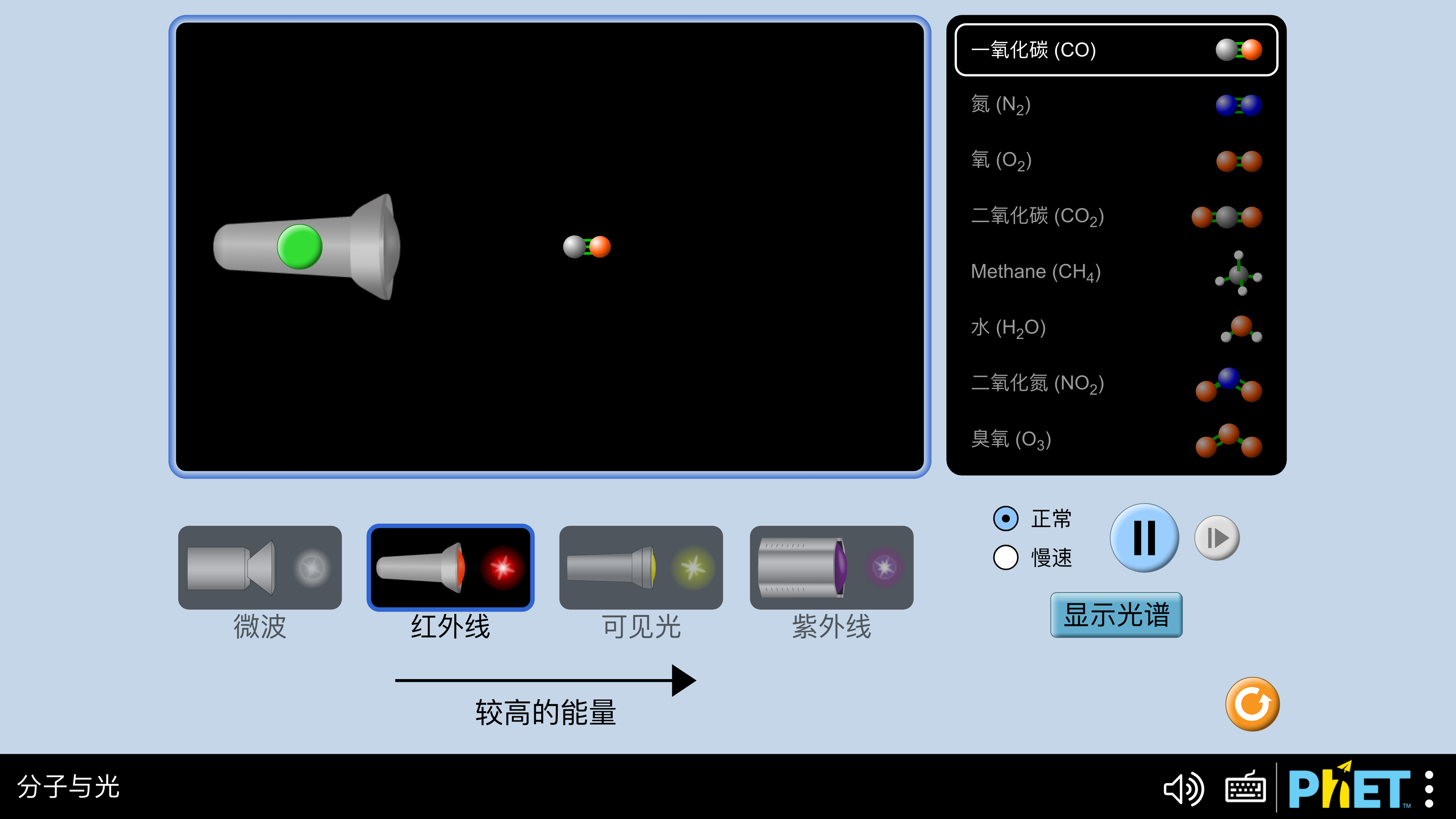
"Molecules and Light" shows how photon energy relates to absorption: drag across the spectrum from ultraviolet through visible to infrared and watch which molecules absorb photons and convert them into motion.
Accessibility
PhET treats multimodality as a design goal: simulations are built to express objects, states and changes through visual, auditory and tactile channels, with the stated aim of being "as effective non-visually as visually" (Inclusive Design). Inclusive features being added to the HTML5 simulations include alternative input, sound and sonification, interactive auditory descriptions, pan and zoom, and interactive highlights; simulation pages and the catalog label which features each sim provides, and a separate accessibility statement is published (Accessibility Statement). The project notes that these features cover HTML5 simulations only, and that not every simulation yet has every feature.
Teaching Resources and Accounts
Teacher-contributed lessons now number 3,690 (as of 2026-08-31), searchable by subject and activity type, and teachers can submit their own activities under contribution guidelines; the site also runs virtual workshops and teaching guidance (Teaching with PhET). A free account unlocks bookmarks, contribution management and presets; running the simulations themselves never requires one.
Open Offerings and Paid Products
- Source code: the simulations and their underlying frameworks are developed in the open under the phetsims organization on GitHub (more than 100 repositories at the time of checking, with core repositories still active), and simulation source code is licensed under GPL v3 or later (Source Code, Licensing).
- PhET Studio: a tool for configuring and customizing simulations, for example saving preset parameters; it is free during the trial period and then requires a paid license (Studio Overview).
- Mobile apps: the "PhET Simulations" apps for iOS and Android include all HTML5 simulations and their translations, priced at USD 0.99 in the US store (regional prices vary), with proceeds funding new simulations; a school-managed deployment is available under Apps for Schools (Offline Access, App Store).
Licensing and Content Policy
- The regular HTML5 simulation files are licensed CC BY-NC 4.0: non-commercial use, including teaching, is free with attribution, while commercial use requires separate permission from the project (Licensing).
- Prototype ("Starter") versions are licensed CC BY-NC-ND 4.0 and may not be modified and redistributed.
- Simulation source code is available under GPL v3 or later; site content is marked "© 2026 University of Colorado", and the trademark belongs to the university.
Use Cases
- Demonstrations and inquiry activities in secondary and university science courses, especially experiments that are expensive, hazardous or hard to repeat (circuits, radioactivity, gas behavior).
- Self-directed learners who want interactive feedback on abstract concepts instead of passive video.
- Teachers embedding simulations into online course pages, or reusing the subject-indexed lesson library.
- Learners who need keyboard operation, auditory descriptions or sound cues, using the accessibility filters to find suitable sims.
- Classrooms with unreliable networks, via the Desktop App or single-file downloads.
Limitations
- The simulations are CC BY-NC 4.0, i.e. non-commercial: embedding them in commercial products requires a separate license, and prototype versions additionally prohibit modification and redistribution.
- Inclusive features cover HTML5 simulations only, not every simulation has every feature, and the project notes some features have platform limitations.
- The accessibility and research documentation is English only; the Simplified Chinese interface contains a small number of untranslated or mixed-script strings (observed on the homepage and simulation pages on 2026-08-31).
- Legacy Java and Flash simulations age poorly in modern browsers: Flash versions are no longer supported, and running Java sims in the desktop app additionally requires JDK 8 (Offline Access).
- The simulations target conceptual understanding and do not cover every goal of hands-on labs, such as equipment-handling skills; the project's own research FAQ recommends choosing "sims only" or "sims plus real equipment" according to the learning goal (Research).
- Simulation counts, language counts and lesson counts change over time; every figure here reflects the 2026-08-31 check.
- The mobile apps and Studio are paid products alongside the free website, and current pricing should be verified before purchase.
References
- PhET homepage (project description, founder, statistics) (checked 2026-08-31)
- What is PhET? - About (introduction, design principles, awards) (checked 2026-08-31)
- Licensing Information (simulation and source licensing) (checked 2026-08-31)
- Offline Access (offline installers, desktop and mobile apps) (checked 2026-08-31)
- Translated Sims (per-language translation counts) (checked 2026-08-31)
- Inclusive Design (accessibility and multimodal design) (checked 2026-08-31)
- Research (design process and student interview studies) (checked 2026-08-31)
- PhET Studio Overview (checked 2026-08-31)
- Wikipedia: Carl Wieman (2001 Nobel Prize in Physics) (checked 2026-08-31)