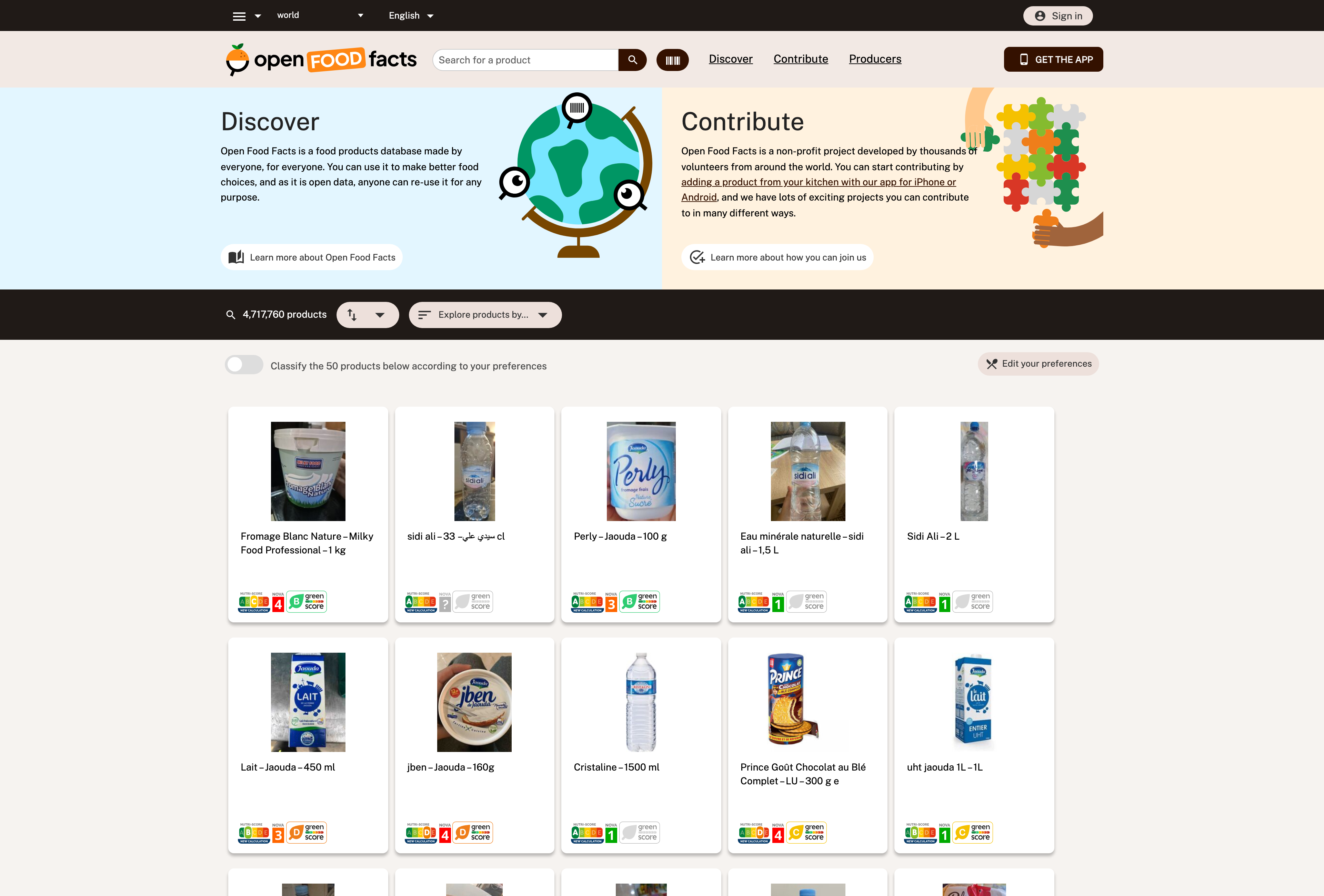
Open Food Facts (world.openfoodfacts.org) is a free, crowdsourced database of food products built around one practical question: what exactly is in the package in your hand? Enter or scan a barcode on the website or the mobile app and the product page shows photos of the packaging, the ingredient list and the nutrition declaration, together with scores the database computes itself: the Nutri-Score nutrition grade, the NOVA processing group and the Green-Score environmental grade. The data is accumulated by volunteers who photograph packaging in shops and at home and type the details into structured fields, and the whole database is published daily under the Open Database License (ODbL) so anyone can download and reuse it. The project is run by a French nonprofit association registered under the country's 1901 association law and funded by donations, with a stated policy of independence from the food industry.
Site overview
- URL: https://world.openfoodfacts.org/ (plus country-specific sites such as cn.openfoodfacts.org)
- Type: crowdsourced food ingredient and nutrition database
- Cost: free, no advertising; donations accepted
- Registration: not needed to look products up; adding or editing data requires a free account
- Interface language: multilingual UI (a Chinese interface exists, with uneven translation coverage); product data follows the language printed on the source packaging
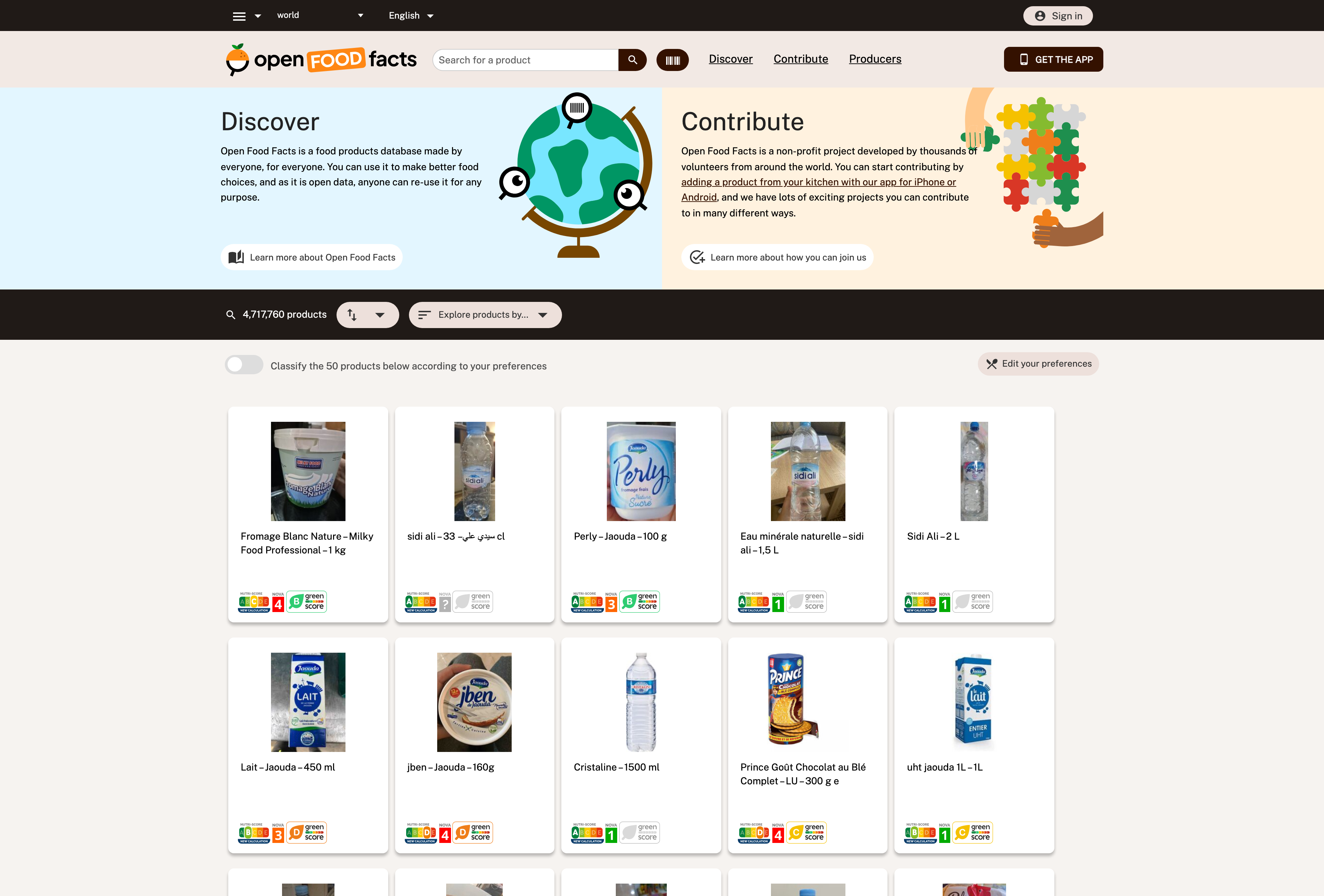
- Scale: 4,712,460 products as of 2026-08-31; the homepage stats card reports 380k+ contributors and around 8 million monthly visitors
Background
The project was started in 2012 by Stéphane Gigandet, who previously ran a French food-blog portal; as the database grew quickly, a supporting NGO was created in 2014, and in 2019 Stéphane and Pierre began working on it full time, with the French public-health agency Santé publique France as the first sponsor (Who we are). The association is registered in Saint-Maur des Fossés, France (Terms of use), and today has a permanent team of about seven people covering infrastructure, core software, product management, fundraising and community work, while volunteer teams organise themselves around topics from taxonomies to prices. Fundraising is public: the end-of-2026 banner showed a remaining gap of about €120,000 (checked 2026-08-31).
The server code is open source on GitHub (openfoodfacts/openfoodfacts-server, AGPL-3.0, around 1.1k stars as of 2026-08-31 with a commit the day before this check), and the mobile clients and supporting tools are separate open-source projects.
Looking up a product
The homepage offers keyword search over products, brands and categories, the navigation bar's "Scan a product" opens a camera-based scanner in the browser, and barcodes can also be typed by hand. Product pages are organised in sections (Product, Your criteria, Health, Environment):
- Basics: front and back photos, name, brand, quantity and the countries where the product is sold;
- Ingredients: the ingredient text from the packaging, extracts, additives with E numbers and allergens, plus clues about ingredient origins;
- Nutrition: a nutrition table normalised per 100 g / 100 ml, with qualitative flags for fat, sugar and salt;
- Scores: the Nutri-Score, NOVA group and Green-Score grades with their calculation details, including warnings when missing data affects the result;
- History: full edit history of photos and fields, so every data point can be traced.
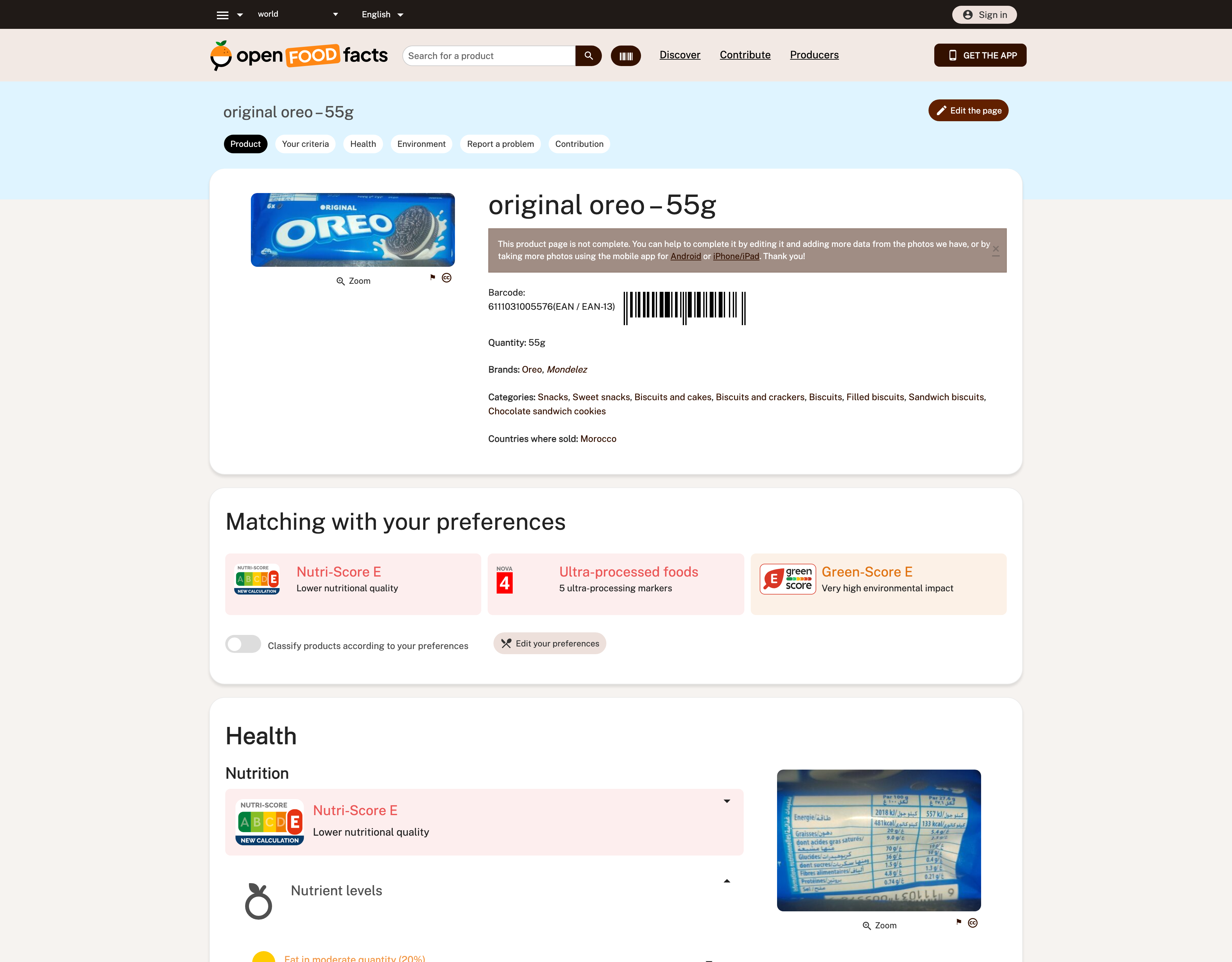
In the screenshot below, the US-barcode Oreo original (6111031005576) shows a Nutri-Score E, an "ultra-processed" marker and qualitative nutrition statements, alongside an explicit notice that "this product page is not complete" — a normal state for a crowdsourced database; the warning stays at the top until the fields are filled in.
Beyond the website, official iOS and Android apps support scanning, allergen alerts and adding products on the spot; the app page presents them as a gateway to the sister projects for cosmetics (Open Beauty Facts), pet food (Open Pet Food Facts), general products (Open Products Facts) and price tracking (Open Prices) (app page, checked 2026-08-31).
The scoring systems: Nutri-Score, NOVA and Green-Score
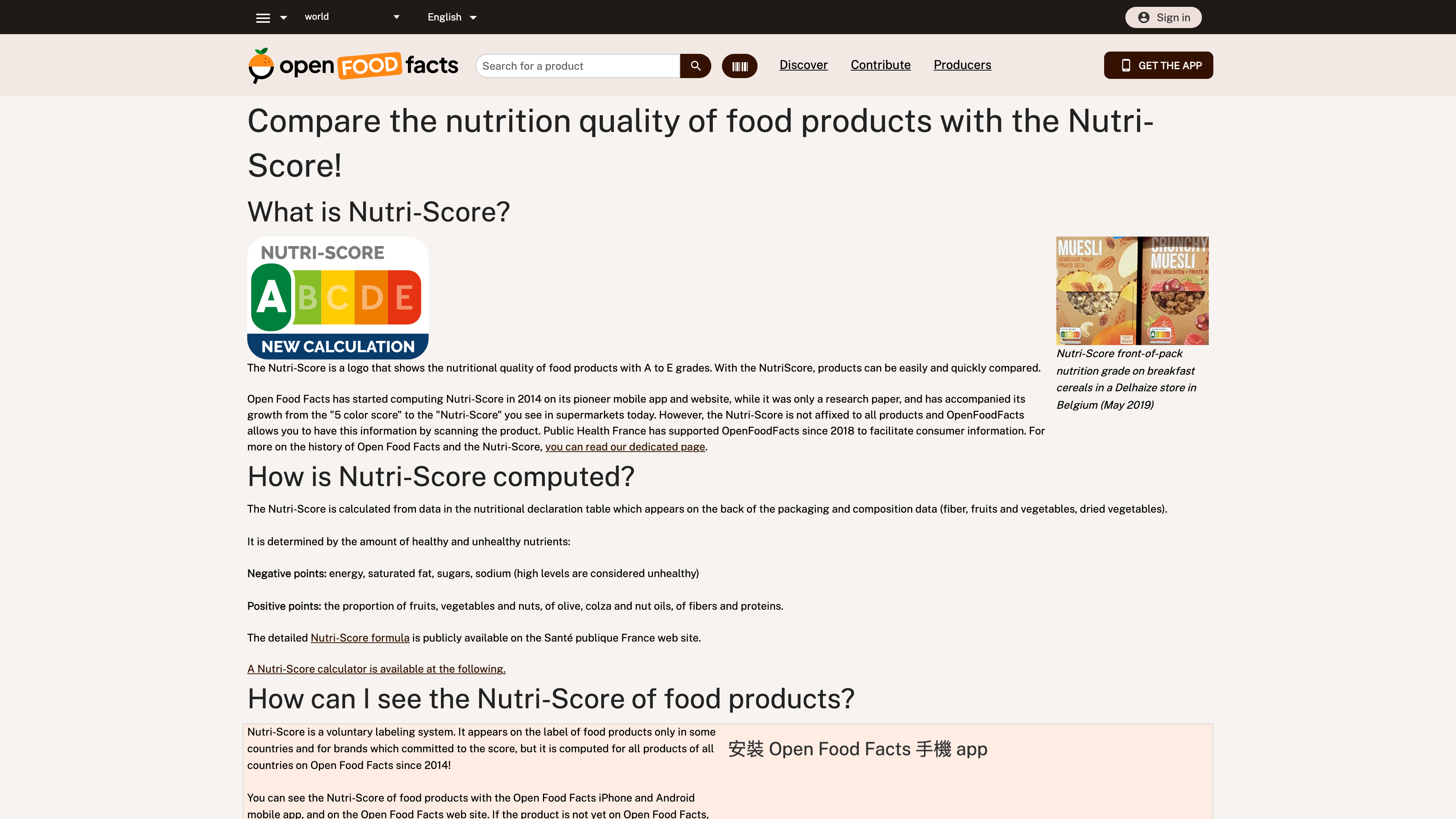
Nutri-Score is a five-level nutrition grade from A to E, designed by French research teams with the algorithm published by Santé publique France: energy, saturated fat, sugars and sodium score negative points, while the share of fruits, vegetables and nuts, dietary fibre, protein and certain vegetable oils score positive points (official page). Open Food Facts has computed it on its app and website since 2014, when it existed only as the "5-colour score" in a research paper, which means products whose packaging carries no logo can still get a grade when scanned. The algorithm's scope and politics are worth knowing: the updated algorithm entered into force in France on 1 January 2024 (Santé publique France), France, Belgium, Spain, Germany, Switzerland, Luxembourg and the Netherlands allow voluntary use, while Italy and six other EU member states publicly oppose it as unfavourable to the Mediterranean diet, and the EU reportedly dropped plans to make it mandatory in 2025 (Wikipedia: Nutri-Score, checked 2026-08-31).
NOVA is the academic classification that sorts foods into four groups by degree of processing (1 unprocessed or minimally processed, 2 culinary ingredients, 3 processed foods, 4 ultra-processed), proposed by Carlos Monteiro and colleagues; Open Food Facts labels each product with its group and the reasoning behind it (official page). The Green-Score, renamed from Eco-Score at the end of 2024, is an environmental grade from A to E with a leaf-shaped logo, built on the Agribalyse life-cycle-assessment data from ADEME and INRAE and adjusted with bonuses and penalties for production mode, ingredient origin, endangered species and packaging (official page). Both scores depend on the relevant fields having been entered; products without enough data show up as "not computed".
Contributing and data quality
Anyone with a free account can add a product: photograph the front, the ingredient list and the nutrition table, then fill in the structured fields. A machine-learning component called Robotoff reads nutrition tables and ingredient text from the photos and suggests edits for volunteers to review; manufacturers can also import data directly through the producers platform at no cost, with documented rules for how producer data merges with contributor data (Producers guide). Product pages keep a full revision history, so incorrect entries can be corrected by later contributions.
Uneven quality is the direct consequence of the crowdsourced model: product pages for popular countries and brands are detailed, while long-tail items may have a single photo, or just a barcode. As of 2026-08-31, counting via the API by country, the database holds about 1.26 million products tagged France and about 961,000 tagged United States, but only 1,666 tagged China.
Open data and the API
The database as a whole is open under ODbL, individual database contents under the Database Contents License, and product photos under CC BY-SA; the site cautions that photos may contain packaging artwork subject to copyright or trademark rights and asks reusers to make their own assessment (Data, Terms of use). There are three ways to get the data:
- Bulk exports: nightly MongoDB dumps plus JSONL and CSV files, with a field reference and checksums, and daily delta exports covering the previous 14 days;
- API:
/api/v2/product/<barcode>.jsonfor a single product and/api/v2/searchfor filtered queries, both returning JSON; the FAQ mentions peak loads around 15,000 requests per second and a MongoDB collection of roughly 470 GB; - Third-party ecosystem: the project reports more than 1,000 apps and projects building on the data (checked 2026-08-31); the scanning app Yuka is a well-known example.
Copyright and content policy
- Data licensing: the database is open under ODbL, which requires attribution and share-alike obligations from reusers; individual contents are under the Database Contents License; product images are published as CC BY-SA, but packaging artwork and logos inside them may carry separate trademark or copyright claims — the site states this explicitly and leaves quotation and fair-use judgements to the reuser (Terms of use, checked 2026-08-31).
- Photos are uploaded by contributors: packaging photos come from volunteers who license them to the platform on upload; photos can incidentally capture things like handwritten price tags, and the platform handles personal data under a published GDPR-aligned privacy policy.
- Quality depends on crowdsourcing: entries can be outdated, incomplete or wrong, and recipe changes are not propagated automatically; the "not complete" banner and the revision history are the main quality signals offered, and serious use should be checked against the original packaging photos.
- What the scores do and do not claim: Nutri-Score, NOVA and Green-Score are population-level simplifications, not personalised dietary advice; Nutri-Score is contested between EU member states (see above), the NOVA definition of "ultra-processed" remains debated in nutrition science, and Green-Score leans on Agribalyse data rooted in French agriculture, which limits how representative it is elsewhere.
- Governance: the operator is a French nonprofit association with a permanent team of about seven, funded by donations and public-institution sponsors; the site states that it does not take food-industry money in order to stay independent (Who we are, checked 2026-08-31).
When it is useful
- Checking ingredients, allergens and nutrition at the shelf, especially for products whose packaging carries no Nutri-Score;
- Comparing sugar, salt and fat across similar products, or filtering by Nutri-Score, NOVA and Green-Score;
- Getting food data for research or development directly from the ODbL exports or the API;
- Photographing local products that are missing from the database to improve coverage.
Limitations
- Thin coverage in Chinese-speaking regions: only 1,666 products are tagged China (as of 2026-08-31), against roughly 1.26 million for France and 961,000 for the United States; products sold in Asian supermarkets are likely missing or thinly documented.
- Uneven data quality: completeness varies wildly between product pages; ingredient and nutrition entries can be wrong or stale, and recipe changes do not propagate; check the packaging photos before relying on a figure.
- Multilingual but incomplete interface: a Chinese interface exists (for example cn.openfoodfacts.org), but the FAQ notes that around 20 languages are actively maintained while others wait for translators; product data follows the packaging language, so pages can mix languages.
- Scores are population-level heuristics: Nutri-Score ignores individual nutritional needs, the NOVA "ultra-processed" label is debated among researchers, and Green-Score's environmental assessment is based mostly on European, particularly French, data.
- Site performance fluctuates: repeated temporary 503 responses from pages and the API were observed on the check date (2026-08-31), and infrastructure work is ongoing; for bulk queries, prefer the full exports over live API paging.
Similar services
- Yuka: a consumer scanning app built on Open Food Facts data, more polished but commercial and not open data.
- USDA FoodData Central: the official US Department of Agriculture food-composition database, laboratory-analysed but limited to products distributed in the United States.
- Sister projects Open Beauty Facts (cosmetics ingredients) and Open Products Facts: adjacent-category databases run by the same association.
References
- Open Food Facts (homepage) (checked 2026-08-31)
- The Open Food Facts Team (checked 2026-08-31)
- Frequently Asked Questions (checked 2026-08-31)
- Terms of use, contribution and re-use (checked 2026-08-31)
- Data (exports and licensing) (checked 2026-08-31)
- Nutri-Score, NOVA, Green-Score (checked 2026-08-31)
- Guide for producers (checked 2026-08-31)
- Santé publique France - Nutri-Score (checked 2026-08-31; the page blocks scripted access, conclusion verified via search snippets)
- Nutri-Score - Wikipedia (checked 2026-08-31)
- openfoodfacts/openfoodfacts-server - GitHub (checked 2026-08-31)
- Product counts by country: Open Food Facts API
api/v2/search?countries_tags_en=...(checked 2026-08-31)