Online-Go.com (OGS) is a free server for playing Go online. It runs entirely in the browser and combines live and correspondence games, anonymous spectating, game study tools, tsumego practice and an interactive course that starts from the rules. The problem it solves: playing, reviewing and solving life-and-death problems without installing a desktop client. Verifiable characteristics: the site is funded by player subscriptions and shows no advertising on its core pages (the terms of service reserve the right to add some); the web client source code is open under AGPL-3.0 and actively maintained; the interface ships in 32 languages including Simplified and Traditional Chinese; and the puzzle library holds about 59,000 user-created problems.
At a glance
- URL: https://online-go.com/
- Type: online Go (baduk/igo) game server
- Cost: free; optional supporter subscriptions from USD 5/month, mainly buying deeper automatic AI reviews and longer vacation time (Supporter)
- Registration: browsing games, spectating and the puzzle list require no account; playing and saving progress need a free registration, with username/password or Google, Facebook, Twitter, Apple and GitHub sign-in
- Interface languages: 32, including Simplified and Traditional Chinese (i18n/languages.json)
Background
The official About page states that the site is kept running by financial support from hundreds of individual supporters and translated by volunteers from around the world (About). A community-compiled timeline based on Internet Archive screenshots traces online-go.com back to November 2005, with a merger against the Go server nova.gs in October 2013 (OGS forums).
The web client source is hosted on GitHub (online-go/online-go.com) under AGPL-3.0. As of 2026-08-31 the repository has about 1.6k stars and 407 forks, with its most recent commit on 2026-08-29; supporting components such as the goban board library, the score estimator, the bot bridge gtp2ogs and the joseki service godojo-server are open sourced separately. Note the scope: what is open is the web client and its companion components, not the main server program.
Playing and spectating
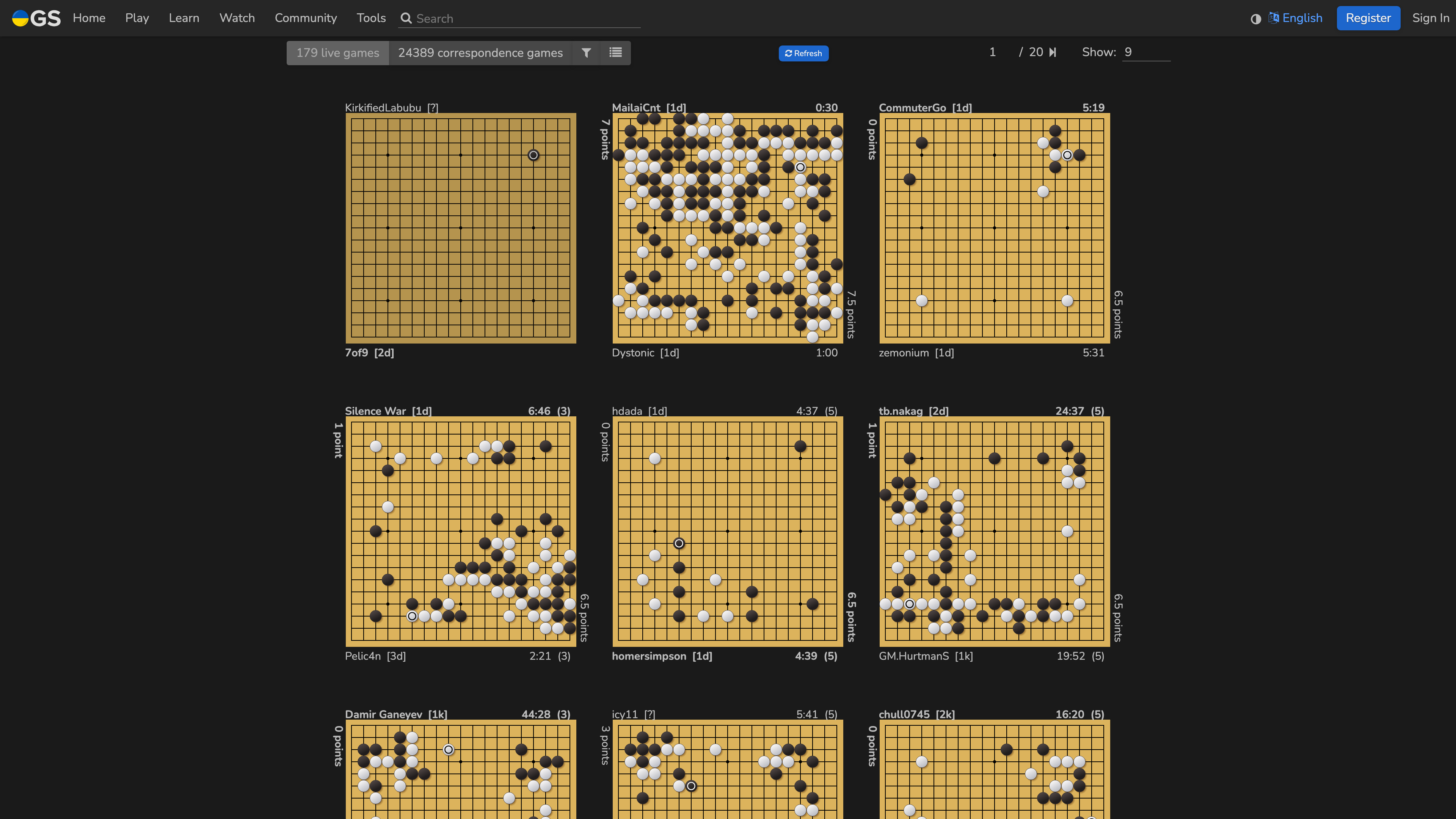
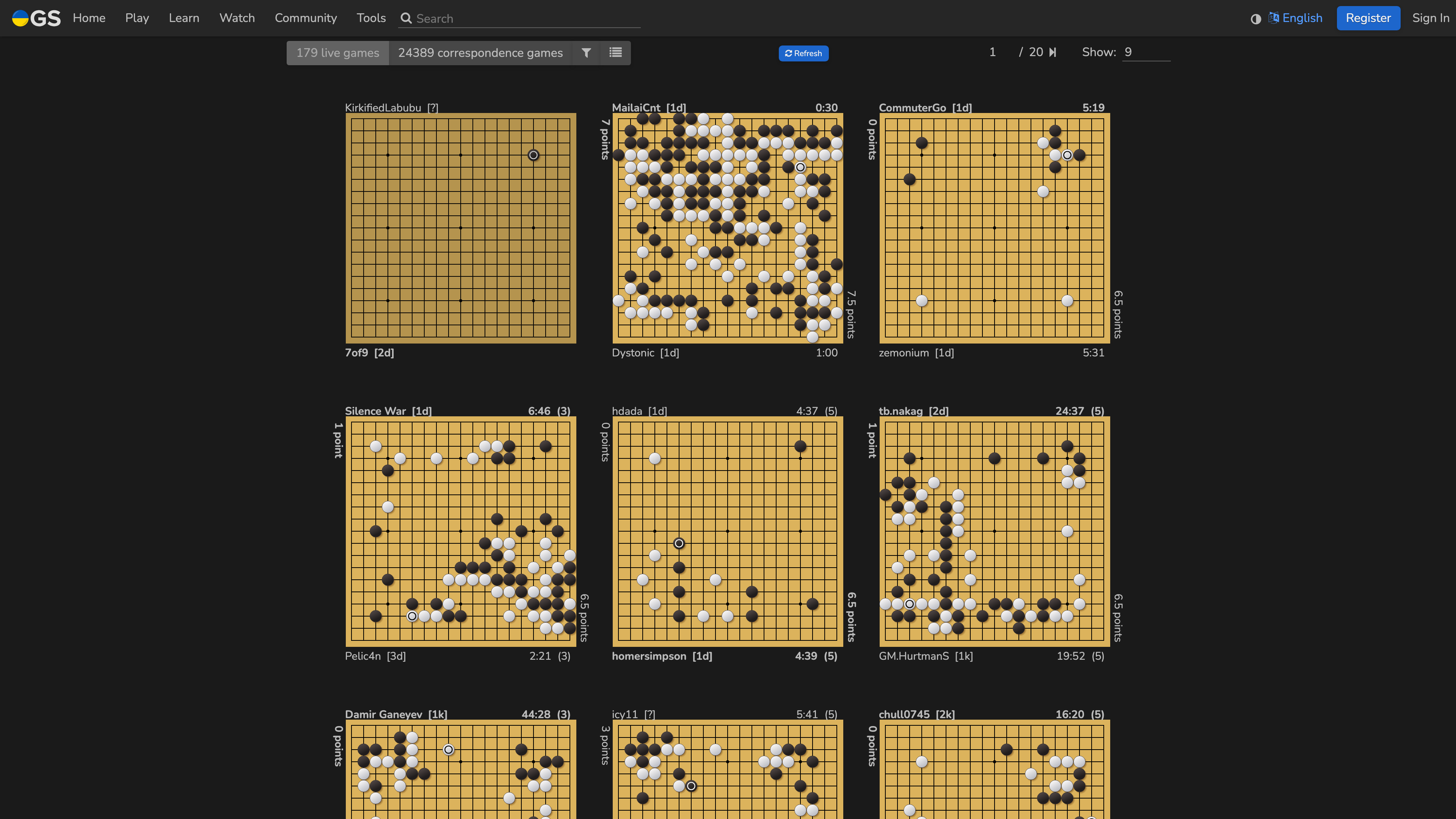
The lobby is reachable without signing in: the front page lists ongoing live and correspondence games (179 and 24,389 respectively at the time of checking), each showing both players' ranks, remaining time and komi; clicking one opens it as a spectator.
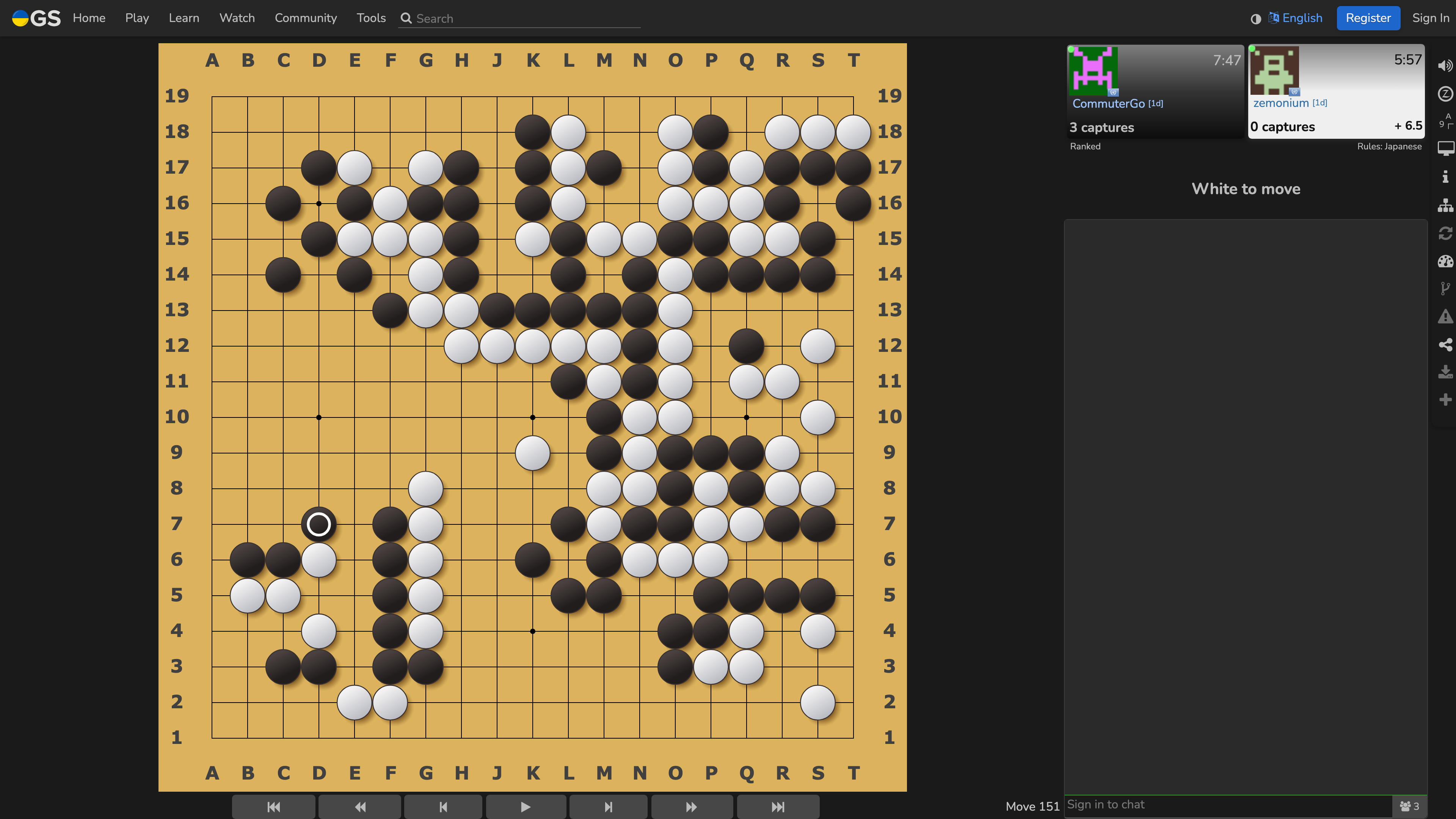
Playing requires a free account. The play page offers automatch and custom challenges: 9x9, 13x13 or 19x19 boards; time controls from about 5-minute blitz presets up to "3 days + 1 day" correspondence with byo-yomi; handicap, komi and opponent-rank filters. You can also challenge members directly or play bots. The game view shows both names, ranks, clocks, captures, move number and rules (Japanese rules with 6.5 komi in the screenshot), plus Zen mode and coordinate toggles.
Game study and puzzles
Finished games open in an analysis mode with a win-rate graph, and completed games can get an AI review that grades every move from Excellent down to Blunder. SGF download and upload, demo boards and a public game library are built in, alongside a joseki dictionary for browsing and playing out corner patterns. Automation and depth of AI reviews are tied to supporter tiers, and some parts are reserved for paying supporters (wiki: Understanding the AI Review).
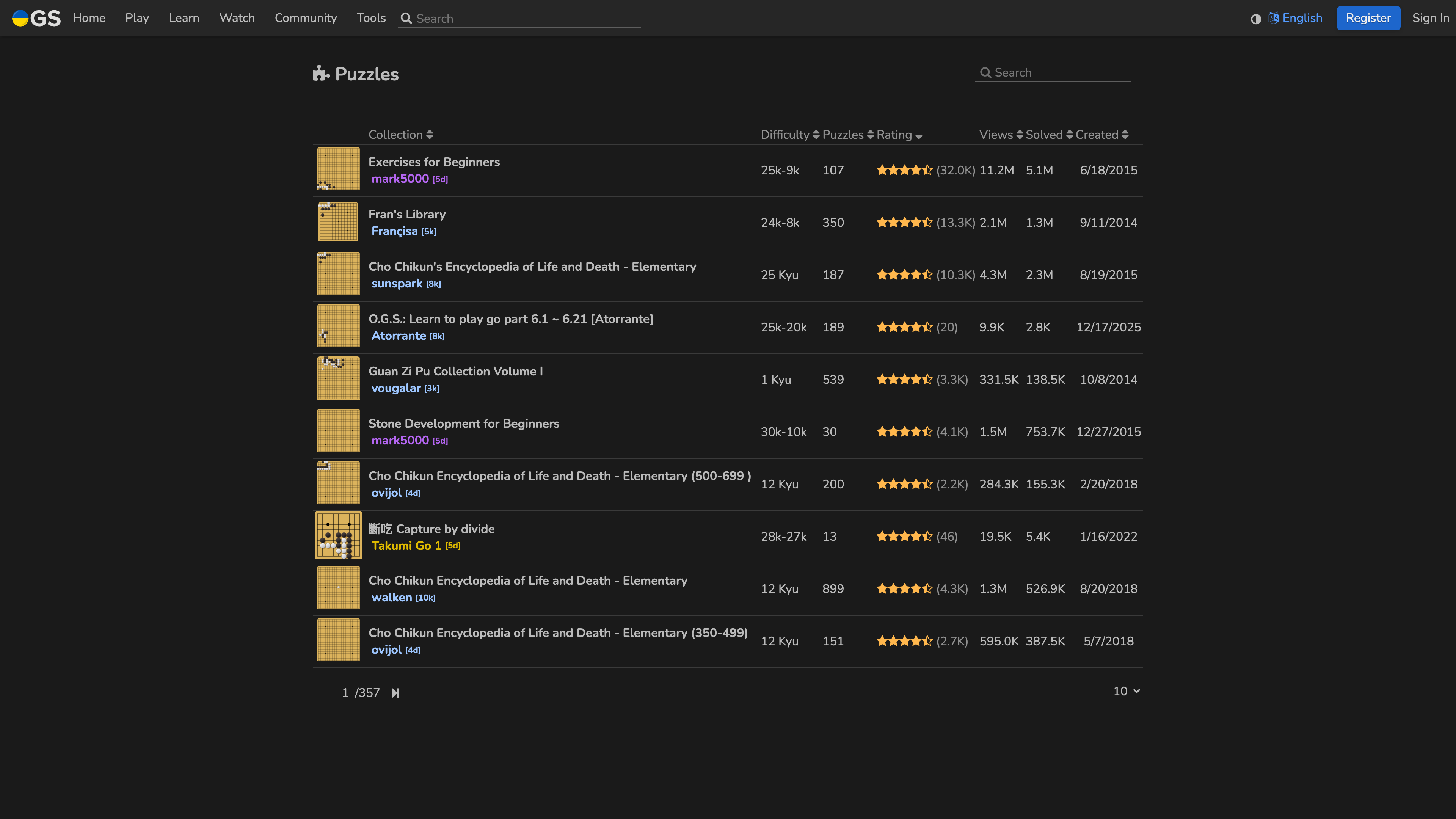
The tsumego library is entirely user-created and maintained: 59,002 problems as of 2026-08-31 (public API), rated from 30 kyu up to dan level and browsable by collection. Alongside classics such as mark5000's beginner exercises and Cho Chikun's Life and Death encyclopedia, there are Chinese-language topic collections; each puzzle shows difficulty, rating and solve statistics.
Learning Go
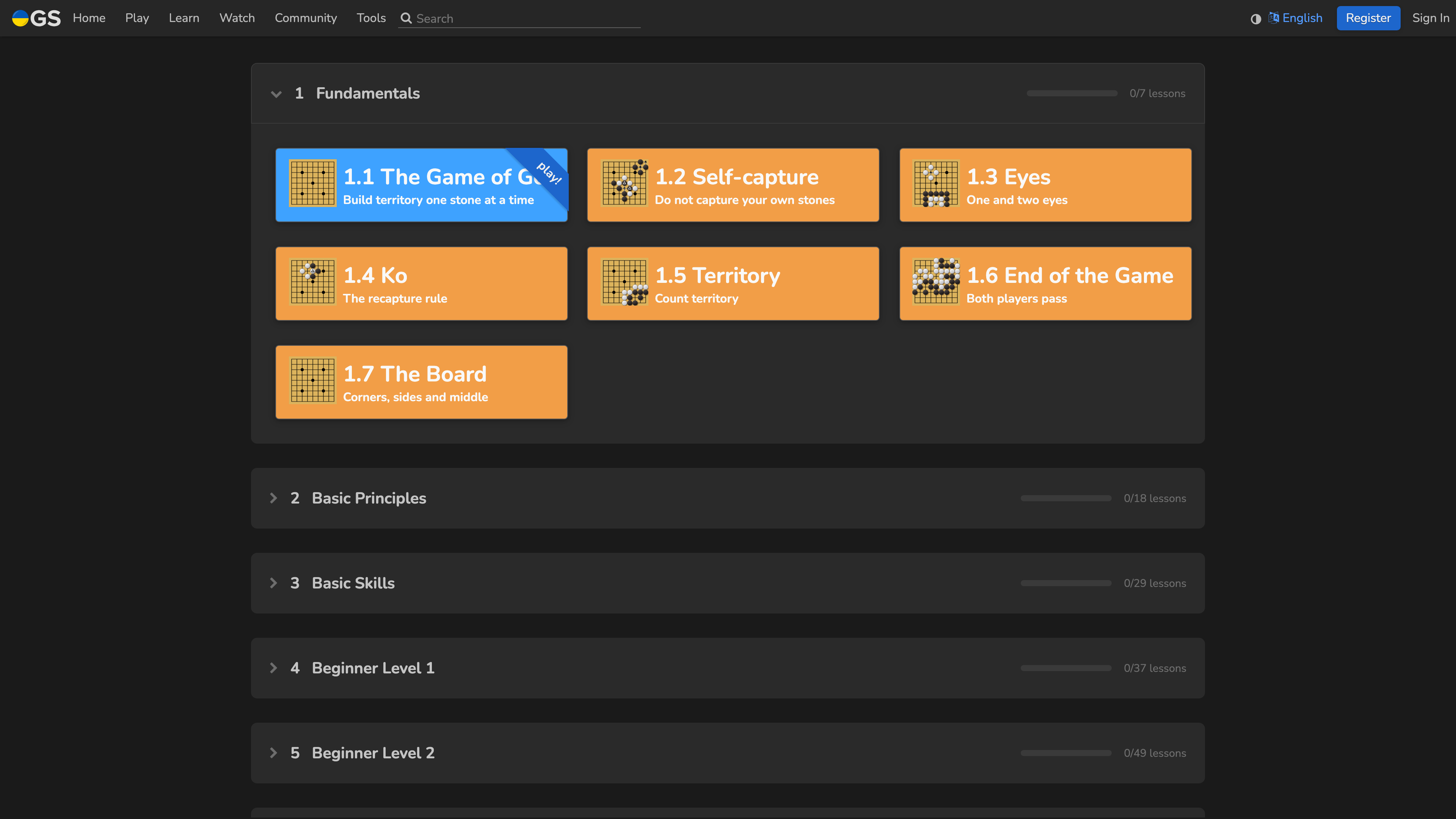
Learn to play Go is a free interactive course that starts with the board and stones and covers ko, eyes, counting territory and the end of the game, in 7 sections totalling 248 lessons answered directly on the board. The course links to the puzzle library and to the children-focused sister site KidsGoServer.com (an open-source project by the same team). Player strength is measured with a Glicko-2 rating system, displayed as kyu/dan ranks with an uncertainty band; new accounts start with high uncertainty, so their ratings move quickly (wiki: Ranks and rating).
Community, tournaments and openness
The site has groups, chat rooms, private messages and official forums (forums.online-go.com), with community moderators and public guidelines for handling stalling and score cheating. Tournaments can be automatic or custom (including OpenGotha events), alongside ladders and rengo (pair Go).
For developers, OGS exposes a public REST API (players, puzzles, tournaments, ladders, groups, reviews, demos and more), real-time game protocol documentation and an OAuth2 application manager (developer docs); gtp2ogs lets GTP engines connect as bots. The repository README notes that contributors who link their GitHub account receive three months of top-tier supporter status after a merged commit.
Rules and content policy
The terms of service prohibit cheating, harassment and unlawful or abusive content, and state the anti-engine rules plainly: no Go program or neural network may be used to analyze an ongoing game, correspondence play may only consult opening and joseki databases, and live or blitz games may receive no outside assistance at all. The site reserves the right to delete content and freeze accounts (Terms of Service). Puzzles, game comments and group content are user-generated; separate privacy and refund policies are published.
When it fits
- Playing Go straight in the browser without a desktop client, especially mixing blitz with long-running correspondence games.
- Self-study from zero: the interactive course plus graded puzzles carries a beginner from the rules toward a first rank.
- Review work for stronger players: AI reviews, SGF management, the joseki dictionary and demo boards.
- Spectator use: anonymous viewing of high-level games, tournaments and ladders at any time.
- Developers building Go bots or analytics, with a public API and an open client lowering the barrier.
Limitations
- Playing and saving progress require registration; anonymous visitors can only browse and spectate.
- The open-source scope is the web client and companion components; the main server program is not published, so a full self-hosted OGS is not possible from this code.
- Automation and depth of AI reviews depend on paid supporter tiers; the free scope is limited.
- All 32 interface languages are community translations with uneven coverage; the terminology quality of the Chinese variants was not reviewed line by line.
- The official client is a web app and the repository contains no official native mobile client; mobile use depends on the browser.
- The site positions itself around the Western Go community (Supporter page); the Chinese-speaking player base is comparatively small, and East Asian servers such as Fox and Tygem are separate worlds.
- The figure of over 2.08 million registered accounts (public API, as of 2026-08-31) is a cumulative total, not a measure of current activity.
Comparable services
- Lichess: the chess counterpart, likewise free, community-funded and browser-based, but fully open source including the server and with no paid tiers; OGS differs in the game, the scope of its open code (client only) and its supporter subscriptions.
- KGS Go Server: a long-running Go server centred on desktop/Java clients with a strong spectating and commentary culture.
- Fox Weiqi: a commercial Go platform aimed at Chinese players, dense with professional game broadcasts, unlike the subscription-funded OGS.
References
- OGS lobby (front page) (checked 2026-08-31)
- Play - game setup page (checked 2026-08-31)
- Learn to play Go - interactive course (checked 2026-08-31)
- Puzzles - tsumego library (checked 2026-08-31)
- Supporter - subscription details (checked 2026-08-31)
- About / Terms of Service (checked 2026-08-31)
- online-go/online-go.com - GitHub repository (checked 2026-08-31)
- OGS usage wiki (features and community guidelines) (checked 2026-08-31)
- Ranks and rating - OGS wiki (checked 2026-08-31)
- i18n/languages.json - interface language list (checked 2026-08-31)
- Puzzles and players public API (checked 2026-08-31)
- A short travel through OGS history - OGS forums (checked 2026-08-31)