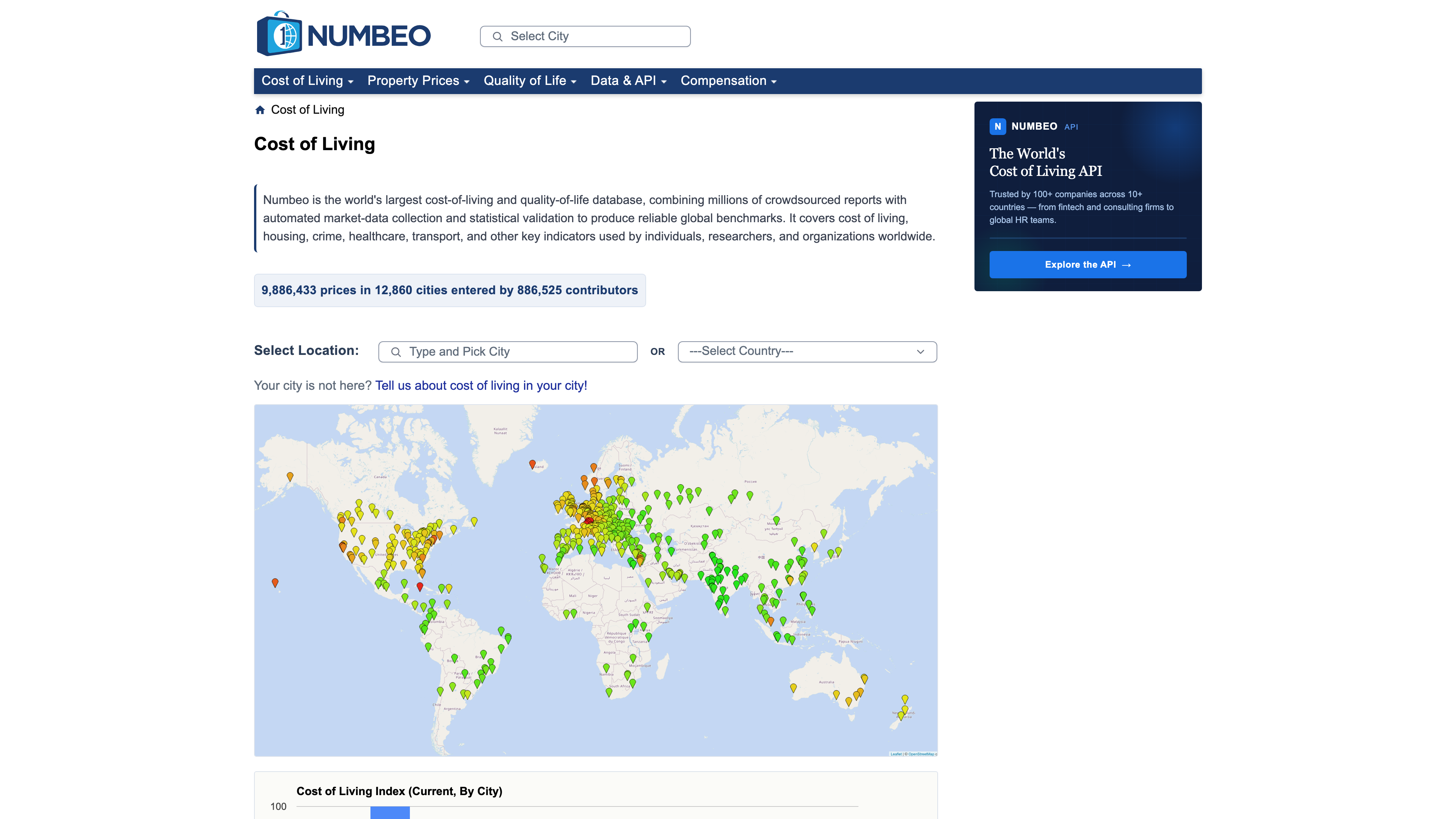
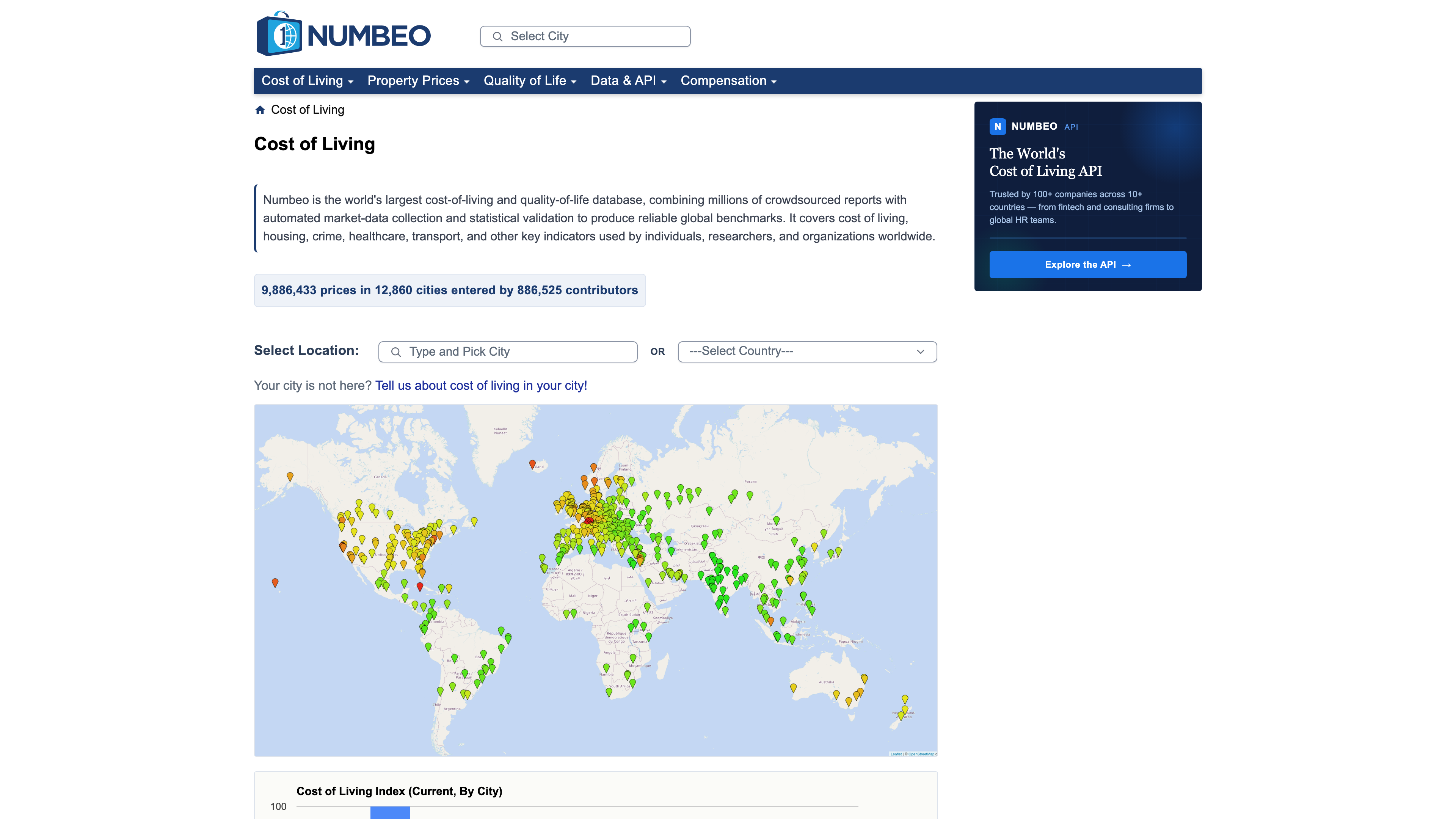
Numbeo (numbeo.com) is a crowdsourced cost-of-living and quality-of-life database built to answer one question with structured data: how much does it actually cost to live in a given city? It collects prices for restaurants, groceries, transport, utilities, rent, property and after-tax salaries in cities worldwide, turns them into comparable indices benchmarked against New York City, and offers a side-by-side city comparison tool. Unlike corporate-oriented reports such as the Economist Intelligence Unit's or Mercer's cost-of-living surveys, everything on Numbeo is free to browse with no registration, and anyone can contribute data. According to its official About page, the site launched in April 2009; as of 2026-09-03, the homepage reports 9,886,433 prices in 12,860 cities entered by 886,525 contributors. Its strengths are free access, broad coverage and fast updates — but readers should understand what crowdsourcing means here: these are not official statistics.
At a Glance
- URL: https://www.numbeo.com/
- Type: Crowdsourced cost-of-living and quality-of-life database, indices and comparison tools
- Cost: Browsing is free; personal, academic and news-media use of the data is free with attribution; commercial use requires a paid subscription (from US$260/month) or a separate API subscription
- Registration: None required for browsing or contributing data
- Interface languages: English, plus German, Spanish, French, Italian and Portuguese subdomains; no Chinese version
Background
Numbeo was founded by Mladen Adamović, who remains its CEO. Per the biography on the official About page, he worked as a software engineer at Google from 2007 to 2009 after teaching at the University of Banja Luka. In the site's own account on its methodology page, he noticed on the eve of the 2007–2009 financial crisis how the real-estate bubble was shaping relocation decisions, while the freely available cost-of-living reports of the time offered only blunt indices, hid data behind paywalls and covered few cities. Numbeo launched in April 2009 to fill that gap, opening structured prices for roughly 60 everyday goods and services so that individuals could estimate expenses based on their own household size and spending habits.
The site is operated by Numbeo doo, a private limited company registered in Serbia (registration number 20853514, headquartered in Belgrade). The footer notice "Copyright © 2009-2026 Numbeo" marks more than seventeen years of continuous operation.
Because it is free and easy to cite, Numbeo is widely used as a data source by international media. The official press page lists the BBC, The Economist, The New York Times, Reuters, Bloomberg, the Financial Times, CNN, Al Jazeera and The Telegraph among its citers, and a Wired entry notes that Numbeo won an Ars Electronica prize. Typical uses include Reuters citing its Seoul housing-price figures, The Economist citing its Berlin purchasing-power data, and Al Jazeera citing its crime index when describing Doha as one of the world's safest cities.
Data and Indices
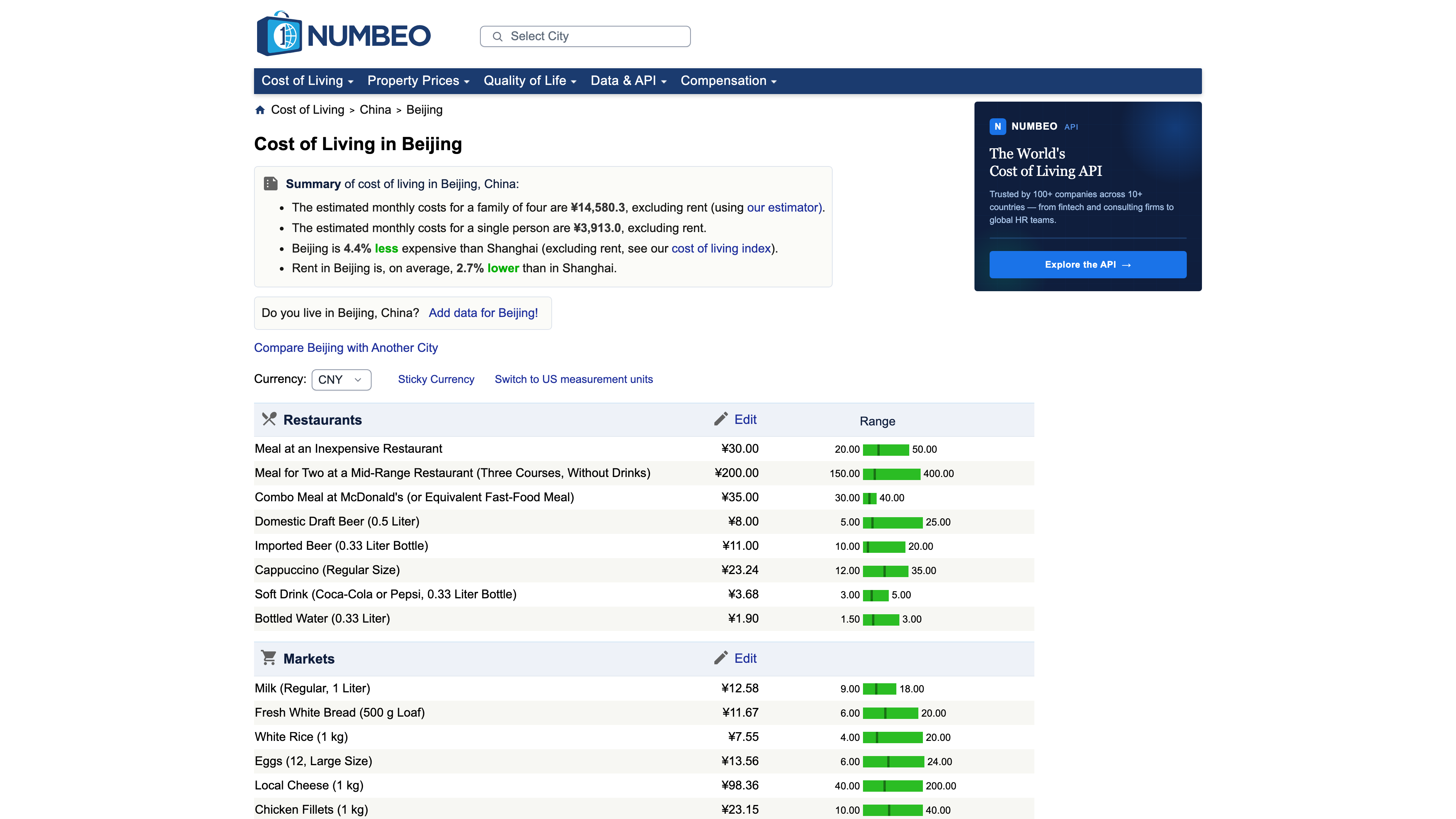
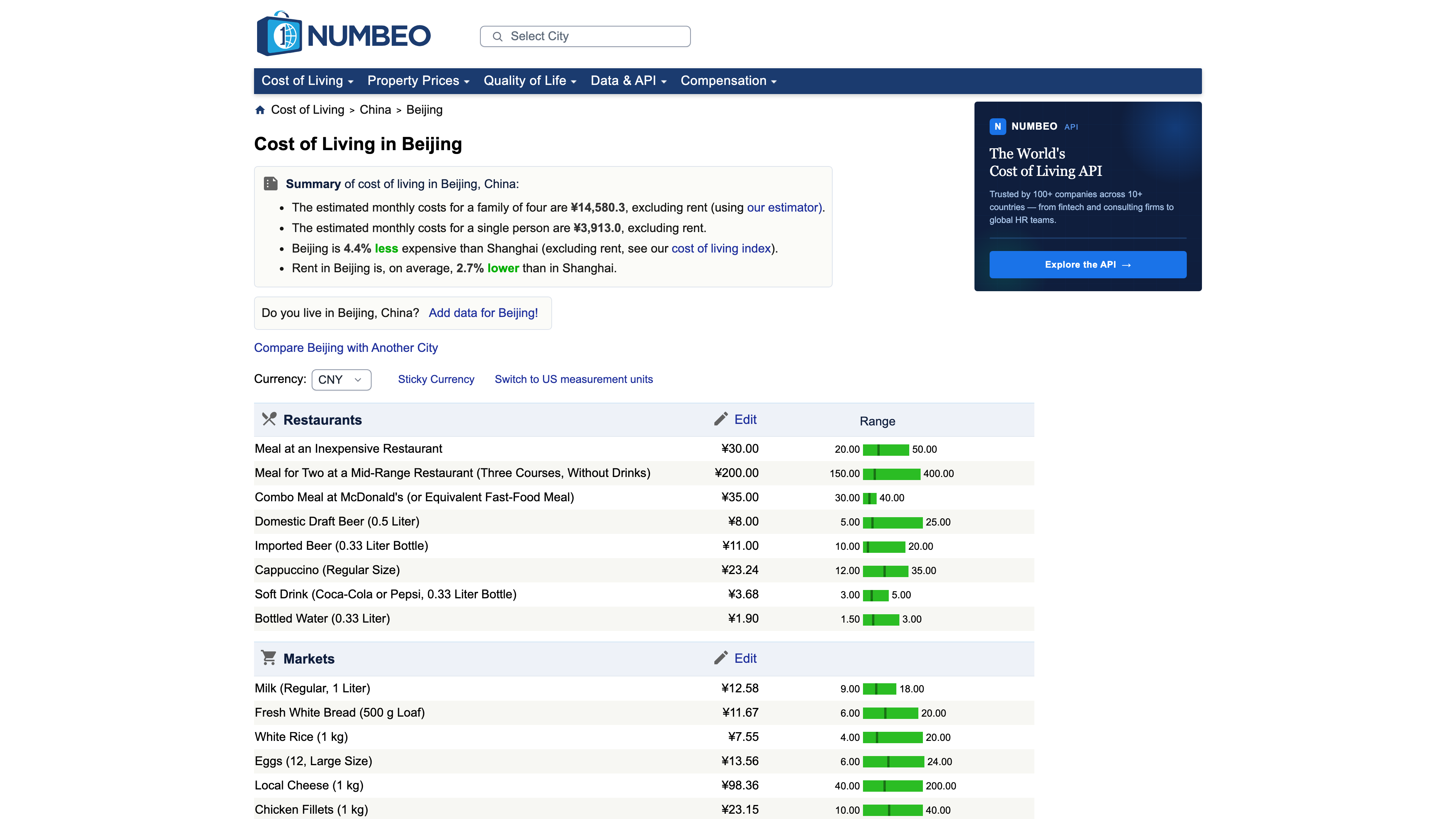
The main cost-of-living section tracks around 60 everyday items (the API page says "~60 everyday items") across ten categories: restaurants, markets, transportation, utilities, sports and leisure, childcare, clothing, monthly rent, apartment purchase prices, and salaries and financing. Each city's page lists average prices with typical ranges and states the sample size and last update — Beijing's page, for example, reports "1,270 entries in the past 12 months by 130 different contributors, last update: 2 September 2026" (checked 2026-09-03), along with headline estimates of roughly ¥14,580 per month for a family of four and ¥3,913 for a single person, both excluding rent.
On top of raw prices, Numbeo computes six comparable indices, all benchmarked to New York City = 100: the Cost of Living Index (excluding rent), Rent Index, Groceries Index, Restaurants Index, Cost of Living Plus Rent Index, and a Local Purchasing Power Index based on average after-tax salaries. In the 2026 Mid-Year snapshot (checked 2026-09-03), Zurich leads globally at 123.1, New York sits at 100 in 12th place, and Beijing, Shanghai, Taipei and Hong Kong score 37.9, 40.5, 54.5 and 76.4 respectively. The index weights are published on the methodology page: the Cost of Living Index is based on a weighted basket representing average expenses for a four-person family, and the weights may change over time.
Beyond prices, Numbeo runs six thematic sections: crime (crime and safety indices), health care, pollution, traffic, a composite quality-of-life index, and property prices (including ratios such as price-to-income). These sections are built from users' survey-style subjective ratings rather than official records.
The City Comparison Tool
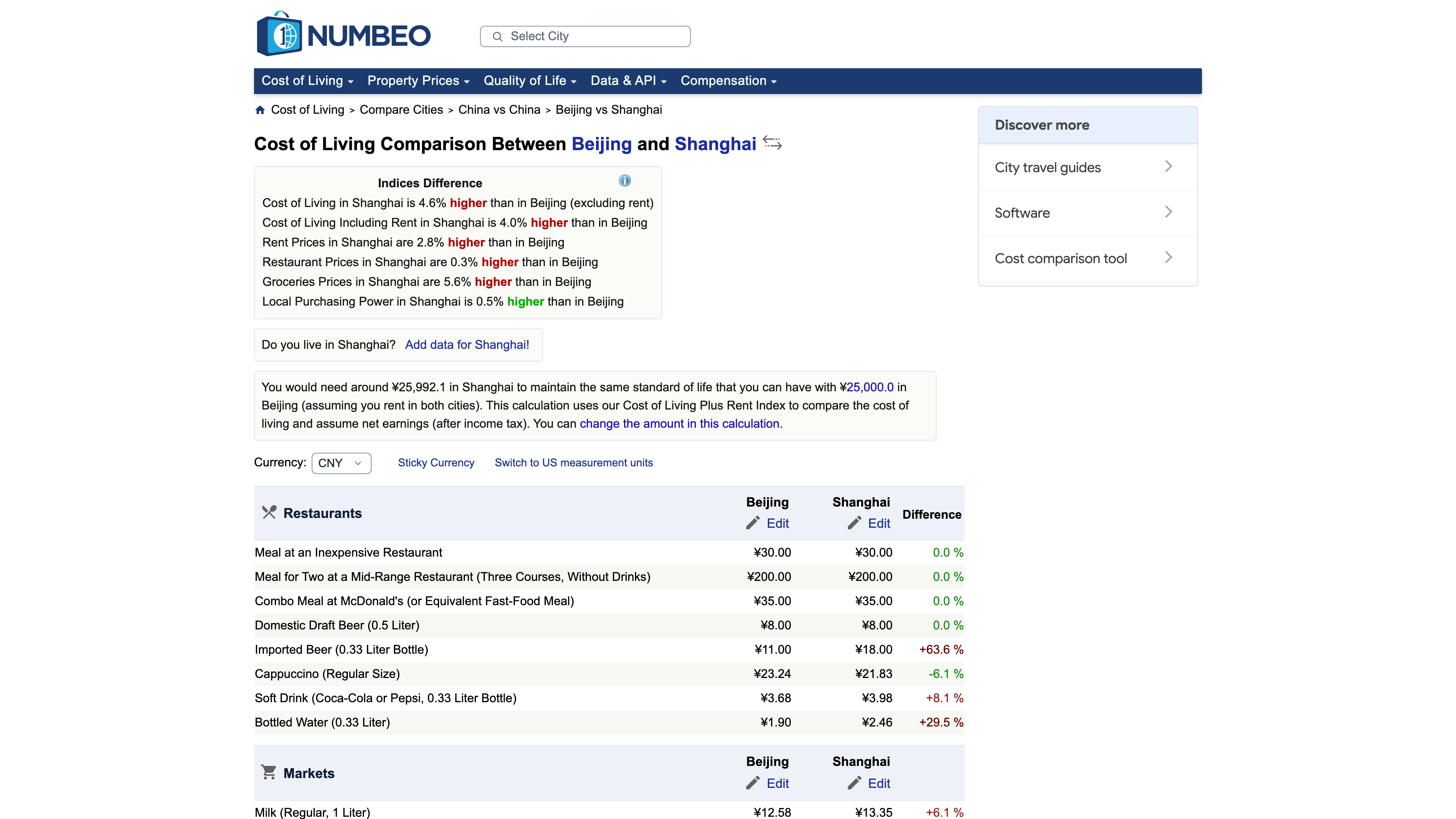
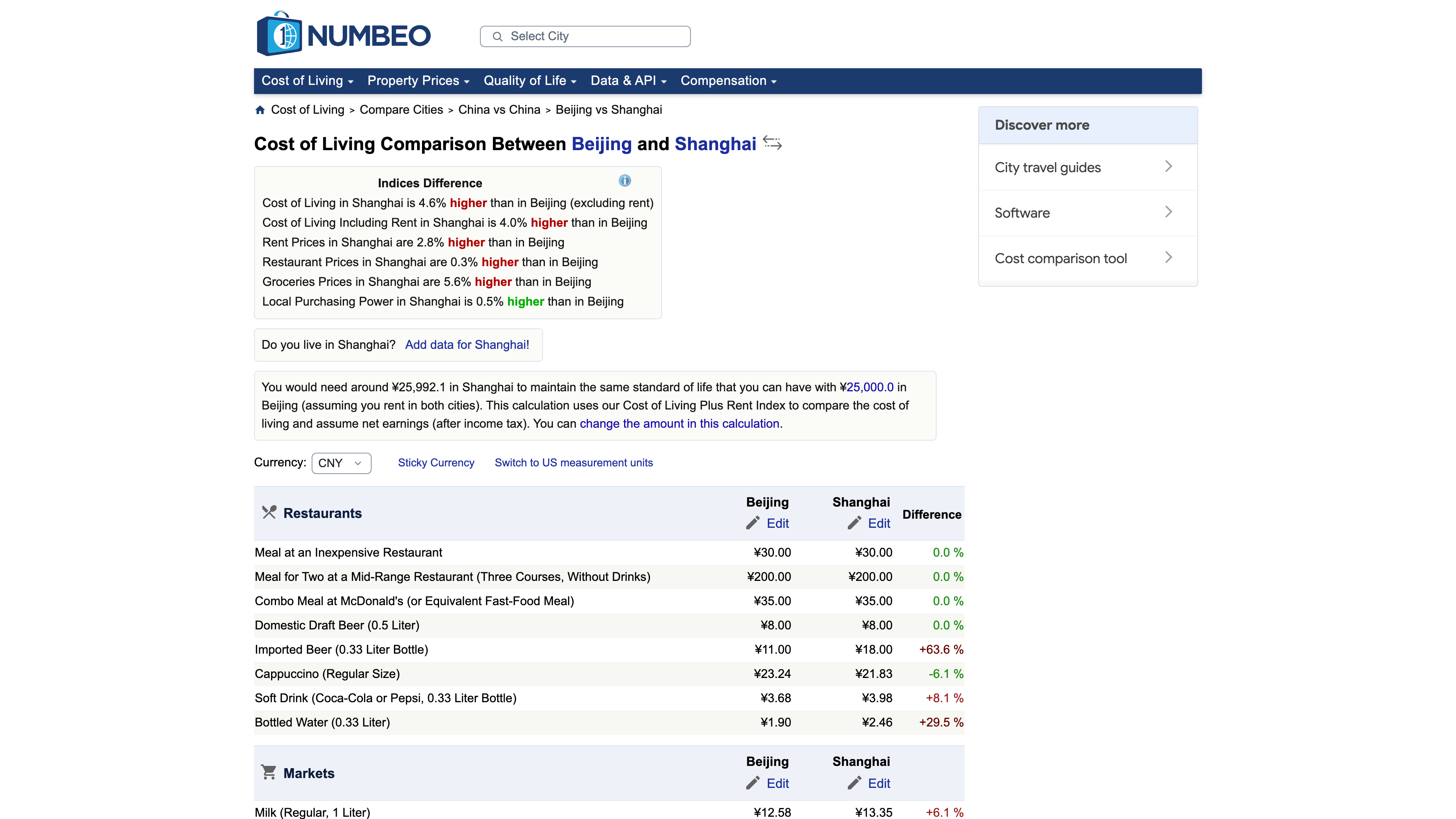
The Cost of Living Comparison tool lets you pick any two cities. It first shows the percentage difference in each index, then converts that into a "money needed to maintain the same standard of living" figure, and finally lists item-by-item price differences. Comparing Beijing and Shanghai (as of 2026-09-03): Shanghai is 4.6% more expensive excluding rent, rents are 2.8% higher and groceries 5.6% higher; the tool estimates that a lifestyle costing ¥25,000 per month in Beijing requires about ¥25,992 in Shanghai (assuming you rent in both cities), computed with the Cost of Living Plus Rent Index on after-tax net earnings.
Where the Data Comes From
Numbeo documents its data pipeline in unusual detail on its methodology page:
- Two sources. User-contributed submissions are the backbone, supplemented by manually gathered data from supermarket websites, taxi company websites and government institutions. The manually collected data is entered twice a year and weighted three times higher than user input.
- Spam filtering. Numbeo says it runs more than 30 automatic and semi-automatic filters to flag anomalous entries, blocks IPs identified as spammers (including public proxies and Tor nodes), and even re-examines discarded data that later looks statistically relevant. The algorithms themselves are proprietary.
- Freshness rules. Data older than 12 months is removed by default; in popular cities the window can shrink to three months. Where contributors are scarce, data up to 24 months old may still be shown — Numbeo's stance is that old data is better than none. Frequently contributed items trigger adaptive archiving (for example, more than 153 contributors in three months archives data older than three months).
- Aggregation and currencies. Country-level figures weight each city by its number of contributors rather than averaging cities equally. Exchange rates update almost hourly (drawing on feeds including the European Central Bank), and every entry is stored in EUR, USD and the original currency.
- Tax treatment. Prices include sales taxes such as VAT or GST; salary figures are after income tax.
Anyone can submit prices for their city anonymously through the Contribute page — no account needed — and a downloadable Collection Sheet helps prepare entries in advance.
Accounts and Open Access
Numbeo has no consumer account system: browsing, searching, comparing and contributing all work without registration. Its business model targets organizations, along two tracks:
- Premium subscriptions (pricing page, checked 2026-09-03): the Advantage plan costs US560 per month for multiple users within an organization, excluding VAT, renewing automatically and cancellable anytime. Both tiers include a commercial data license, data-quality reports (contributor counts, confidence intervals, standard deviation and more), bulk downloads, a historical data explorer, and a suite of compensation tools (cost-of-living estimator, market-basket comparison, international salary equivalent calculator, relocation salary calculator, net-to-gross converter and per-diem allowance calculator).
- Data API (overview, full documentation): a separate paid subscription billed on monthly request quotas; pricing is not published on the public pages and is handled via api@numbeo.com. The API returns JSON across roughly 35 endpoints covering city and item catalogs, current prices, the six indices, cost estimation, exchange rates, historical prices (including archived raw data), crime/health-care/pollution/traffic data, and current and historical rankings, with lookup by city name, ISO country code or coordinates and a choice of response currency.
Copyright and Content Policy
Under the Terms of Use, Numbeo's original content is licensed in three tiers. Personal use is free with a link back to Numbeo.com. Use in academic works, newspapers, books, and radio or TV broadcasts is free with appropriate credit. Companies and other entities need a Data License, an Advantage/Premier plan or the API for a limited commercial license; they may not republish Numbeo data through other APIs or public data feeds, and derivative works must differ significantly from the original. Unauthorized scraping or crawling is explicitly prohibited. Contributors, for their part, grant Numbeo permission to use, reuse and distribute their submissions and derivative works under a license of Numbeo's choosing.
The disclaimers deserve attention: the terms state that nothing on the site "has necessarily been reviewed by people with the expertise required," that no warranty is made that any data is accurate, and that you use the content at your own risk, with aggregate liability capped at US$1,000; the terms are governed by Serbian law. This is consistent with the nature of a crowdsourced platform, and it is the right posture to keep when citing its numbers.
When It Is Useful
- Comparing prices, rents and purchasing power across candidate cities before relocating, taking an expat assignment, studying abroad or choosing a remote-work base.
- Salary and budgeting reference: estimating the income needed to maintain an equivalent standard of living in another city (bearing in mind it is a crowdsourced estimate).
- Getting a feel for everyday expenses such as meals and transport before traveling.
- Citing city cost-of-living rankings in media, academic or blog writing (free with attribution).
- Feeding cost-of-living signals into compensation, global mobility, fintech or real-estate products via the API or a data license.
Limitations
- Crowdsourced, not official statistics. Anyone can submit anonymously, and the terms explicitly disclaim accuracy. Sample sizes vary enormously — Beijing drew 130 contributors in twelve months, while small cities may have only a handful of entries, and low-sample cities may display data up to 24 months old, so figures can be stale or skewed.
- Index methodology needs care. Indices are computed from a four-person-family basket with New York = 100, the weights change over time, and your own spending pattern may differ greatly. The crime, health-care and pollution sections are perception surveys, not official records.
- Free does not mean commercially usable. Personal, academic and press citations are free with attribution; commercial use requires a subscription (from US$260/month) or the API, and scraping is prohibited.
- No Chinese interface — English plus five European-language subdomains only.
- Third-party ads are served on the site (per its privacy policy).
Alternatives
- Expatistan: another crowdsourced cost-of-living comparison site, frequently cited alongside Numbeo in press coverage.
- For official or commercial benchmarks to cross-check against: national statistical offices' CPI series, the Economist Intelligence Unit's Worldwide Cost of Living and Mercer's cost-of-living survey (the latter two are corporate-oriented and paid).
References
- Numbeo homepage (Cost of Living) (checked 2026-09-03)
- About This Website - Numbeo (checked 2026-09-03)
- Methodology and Motivation - Numbeo (checked 2026-09-03)
- Understanding our Cost of Living Indexes (checked 2026-09-03)
- Cost of Living Index 2026 Mid-Year (checked 2026-09-03)
- Cost of Living in Beijing (checked 2026-09-03)
- Cost of Living Comparison (checked 2026-09-03)
- Contribute data for your city (checked 2026-09-03)
- Cost of Living API (checked 2026-09-03)
- Numbeo API Documentation (checked 2026-09-03)
- Download Data (Premium pricing) (checked 2026-09-03)
- Data License (checked 2026-09-03)
- Terms of Use - Numbeo (checked 2026-09-03)
- Privacy Policy - Numbeo (checked 2026-09-03)
- Numbeo in the News (checked 2026-09-03)