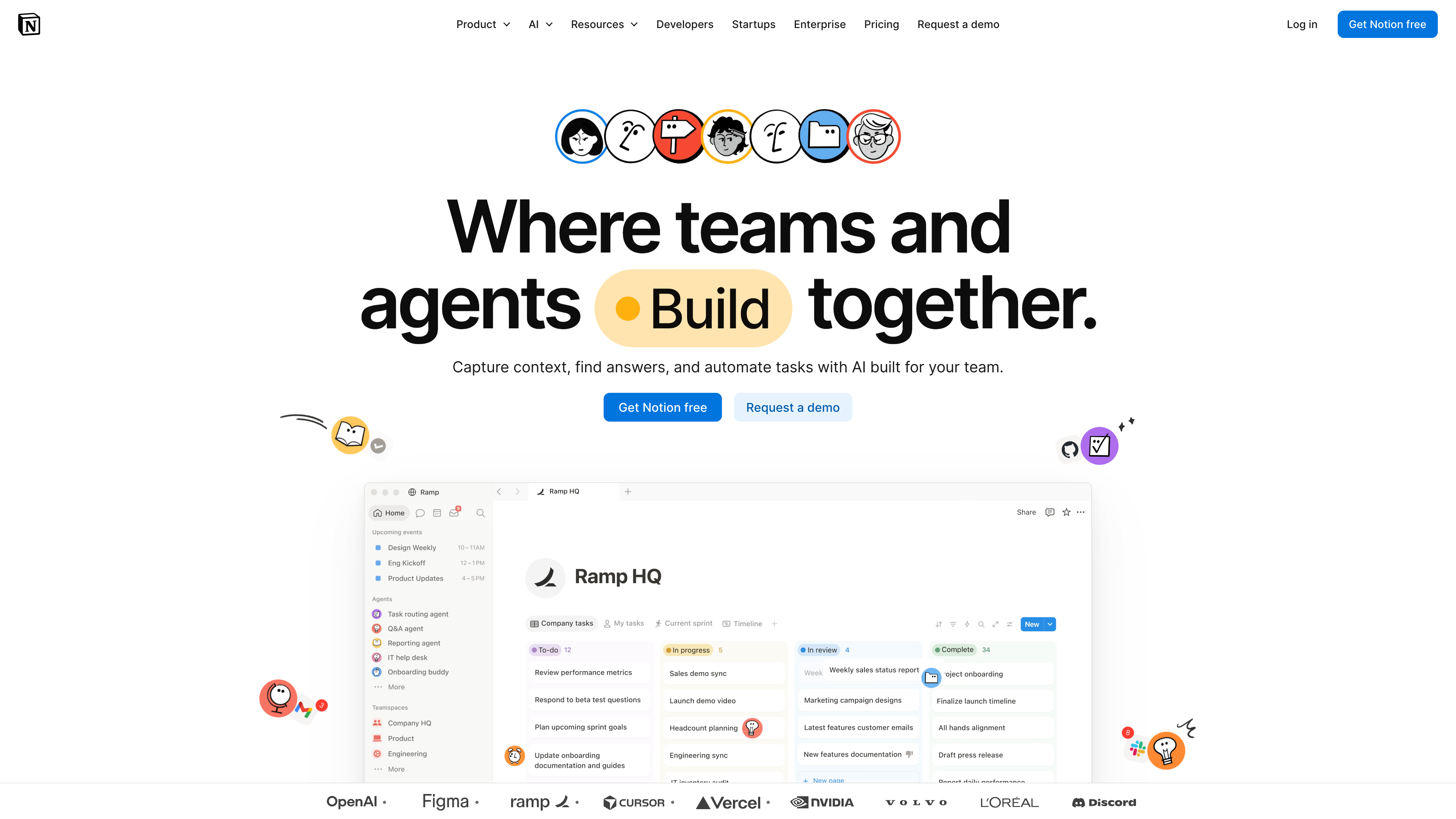
Notion (notion.com) is an all-in-one workspace built by Notion Labs, a San Francisco company: documents, wikis, databases, and project management live inside a single block-based editor, where every page is assembled from draggable content blocks that can nest subpages and databases. The problem it targets is tool sprawl — instead of jumping between Google Docs, Trello, and Confluence, a team writes, tracks tasks, and builds its knowledge base in one place. Its verifiable differences from single-purpose tools: database entries are themselves pages, the same data can switch between table, kanban, calendar, and timeline views, there is a public REST API, and the template marketplace lists more than 70,000 templates. The product launched in 2016 and, per the company's own blog, passed 100 million users in August 2024.
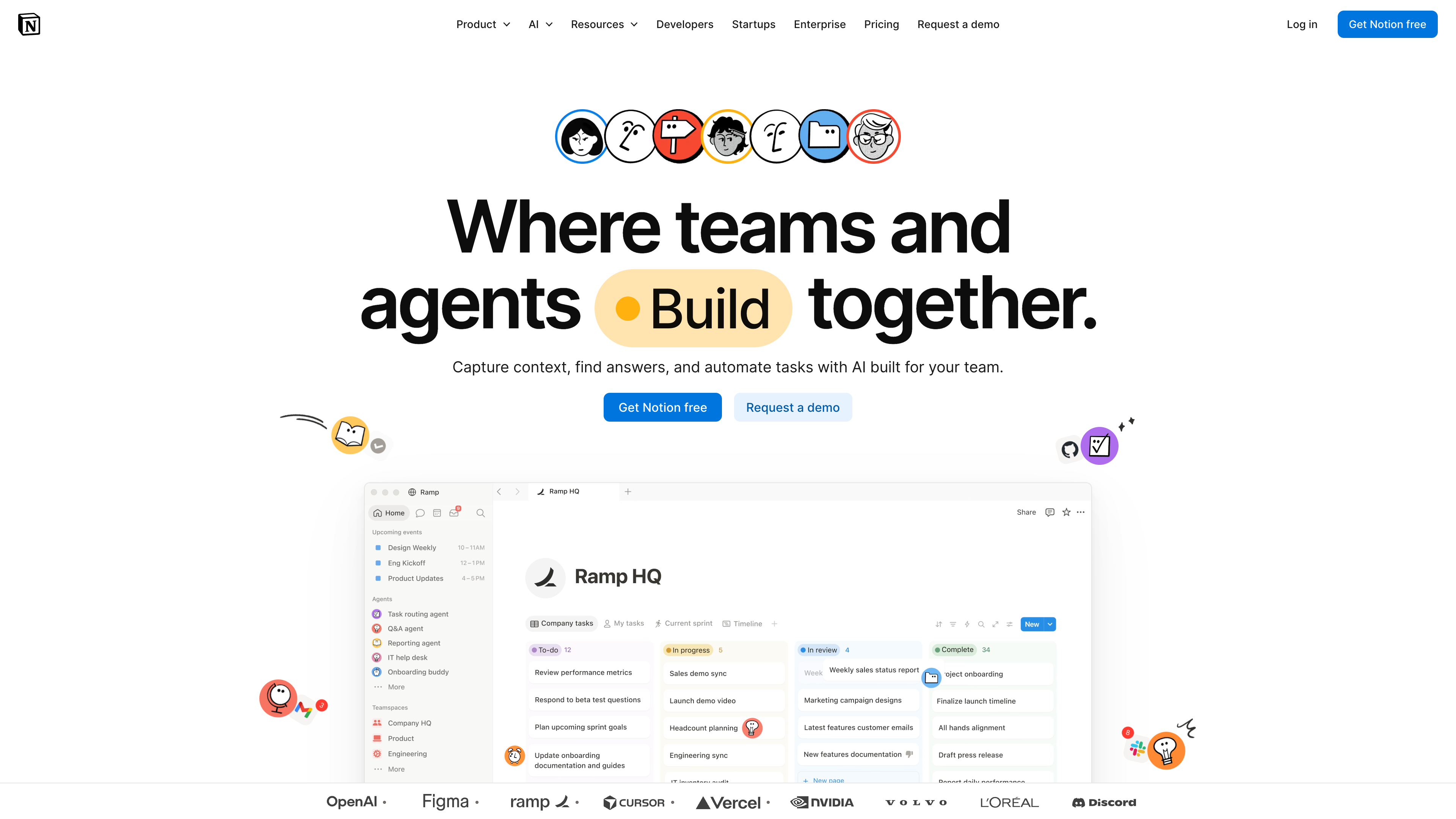
The homepage headline "Where teams and agents … together" signals the post-3.0 repositioning: the workspace is meant not just for people but also for AI agents that act with workspace context.
At a glance
- URL: https://www.notion.com/
- Type: All-in-one workspace (docs / wiki / databases / project management)
- Cost: Free plan plus per-member paid tiers (as of 2026-09-08, per the official pricing page: Plus 12 monthly; Business 24 monthly; Enterprise custom)
- Sign-up: Public pages can be read without an account; creating content requires registration via email, Google, or Apple
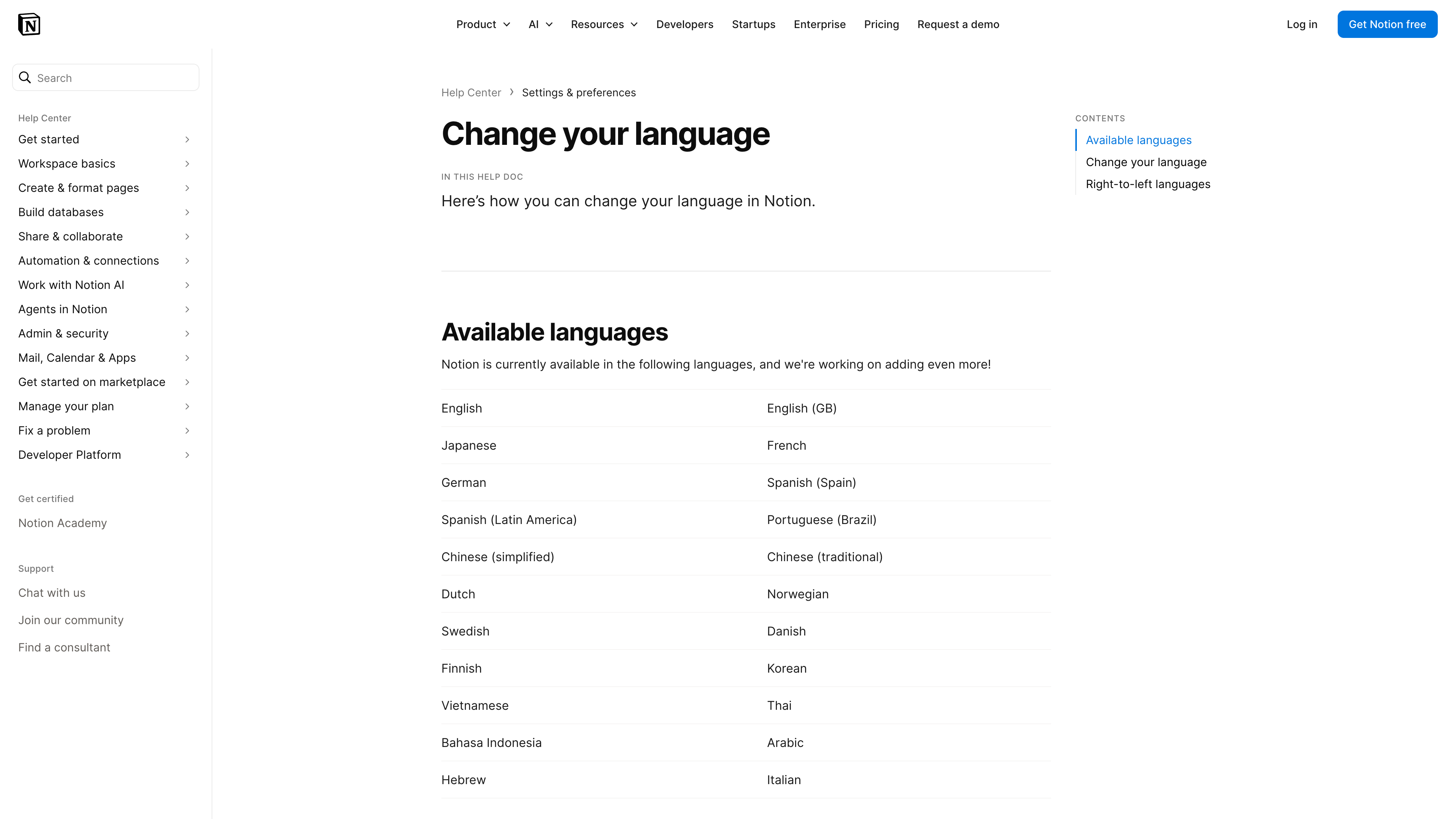
- Interface languages: 22, including Simplified and Traditional Chinese (official Help Center list)
- Platforms: Web, Windows, macOS, iOS, Android
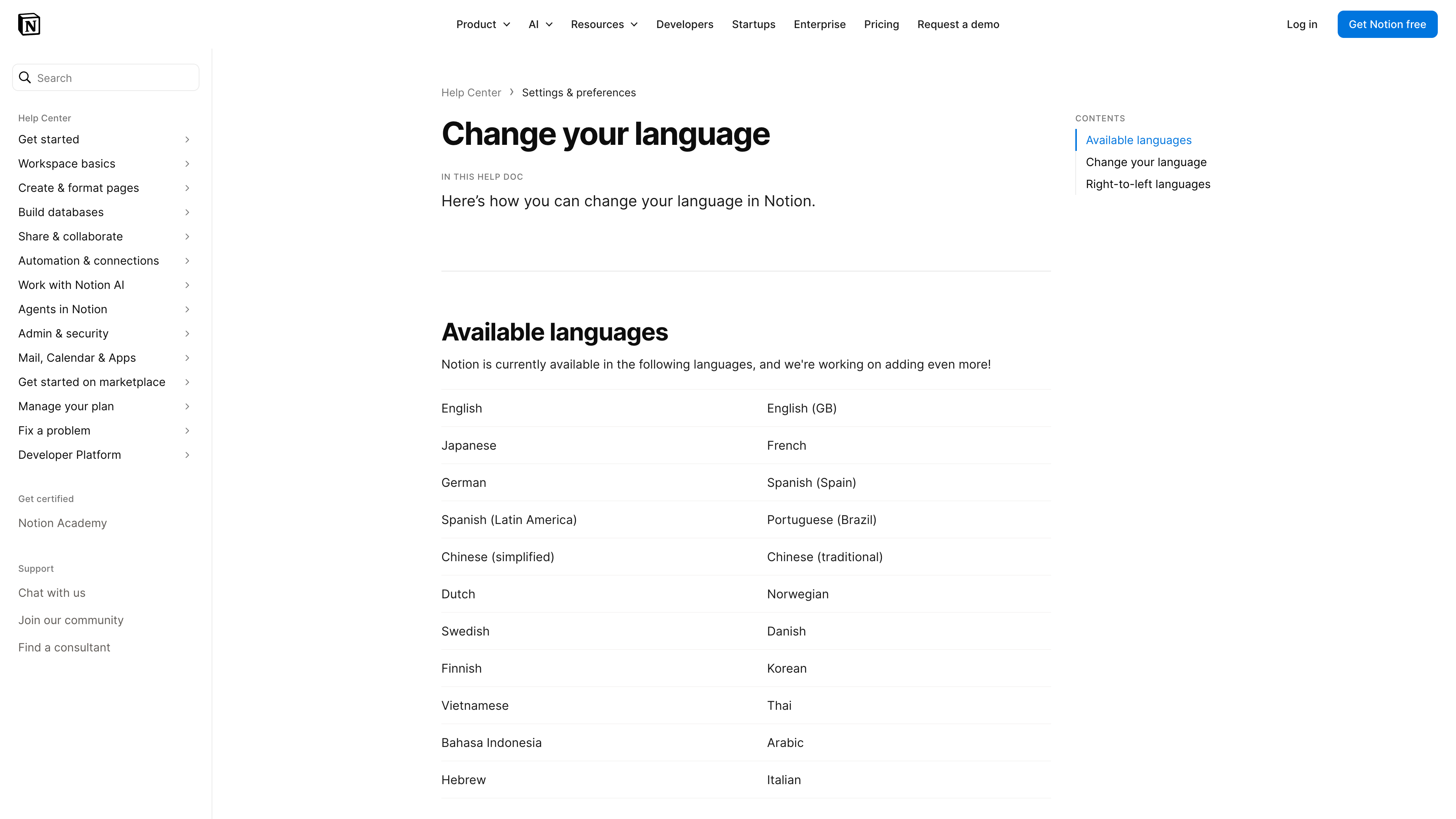
The Help Center is itself a public Notion site. Its "Change your language" article lists all 22 interface languages; Arabic and Hebrew additionally get a mirrored right-to-left interface.
Background
Notion Labs was founded in San Francisco in 2013 by a team including Ivan Zhao and Simon Last. Early development nearly exhausted its roughly $2 million seed round; the product was rewritten before Notion 1.0 shipped in August 2016, and the company still had fewer than ten employees when 2.0 launched in March 2018 (Wikipedia, drawing on New York Times and other primary reporting). Key milestones since:
- 1 million users in September 2019; a 2 billion valuation in January 2020; in May 2020 the free plan dropped its 1,000-block cap for individuals.
- Acquired Indian integration startup Automate.io in September 2021; raised 10 billion valuation a month later, with about 20 million users.
- Acquired calendar app Cron in June 2022, shipped as the standalone Notion Calendar in January 2024; Notion AI launched in February 2023.
- Acquired encrypted-mail service Skiff in February 2024, released as Notion Mail in April 2025; passed 100 million users in August 2024.
- Notion 3.0 shipped in September 2025 with an AI agent that executes multi-step tasks; CNBC reported annualized revenue of about $500 million at the time.
- A Developer Platform followed in May 2026, adding Workers (custom code running on Notion's cloud) and database syncs from external sources; in June 2026 the company announced Notion Mail would shut down on September 22, 2026, roughly a year and a half after launch.
Core capabilities: docs, databases, and wikis in one editor
- Block editor: paragraphs, to-dos, headings, images, code blocks, and embedded files are all draggable blocks, and pages nest indefinitely — the official About page calls them "building blocks".
- Databases: custom properties, filters, subtasks, and dependencies; every entry is a page, and the same data can switch between table, board, calendar, timeline, and chart views or be assembled into dashboards.
- Wikis and teamspaces: hierarchical pages for knowledge bases, teamspaces per department or topic, with permission groups, private spaces, and a "verified page" badge on paid plans.
- Collaboration: real-time co-editing, comments, per-page external guests, and forms whose responses write straight into a database.
- Sites: any page can be published as a public website; the free plan includes one notion.site subdomain, and paid plans add SEO settings and custom domains ($8–10 per domain per month).
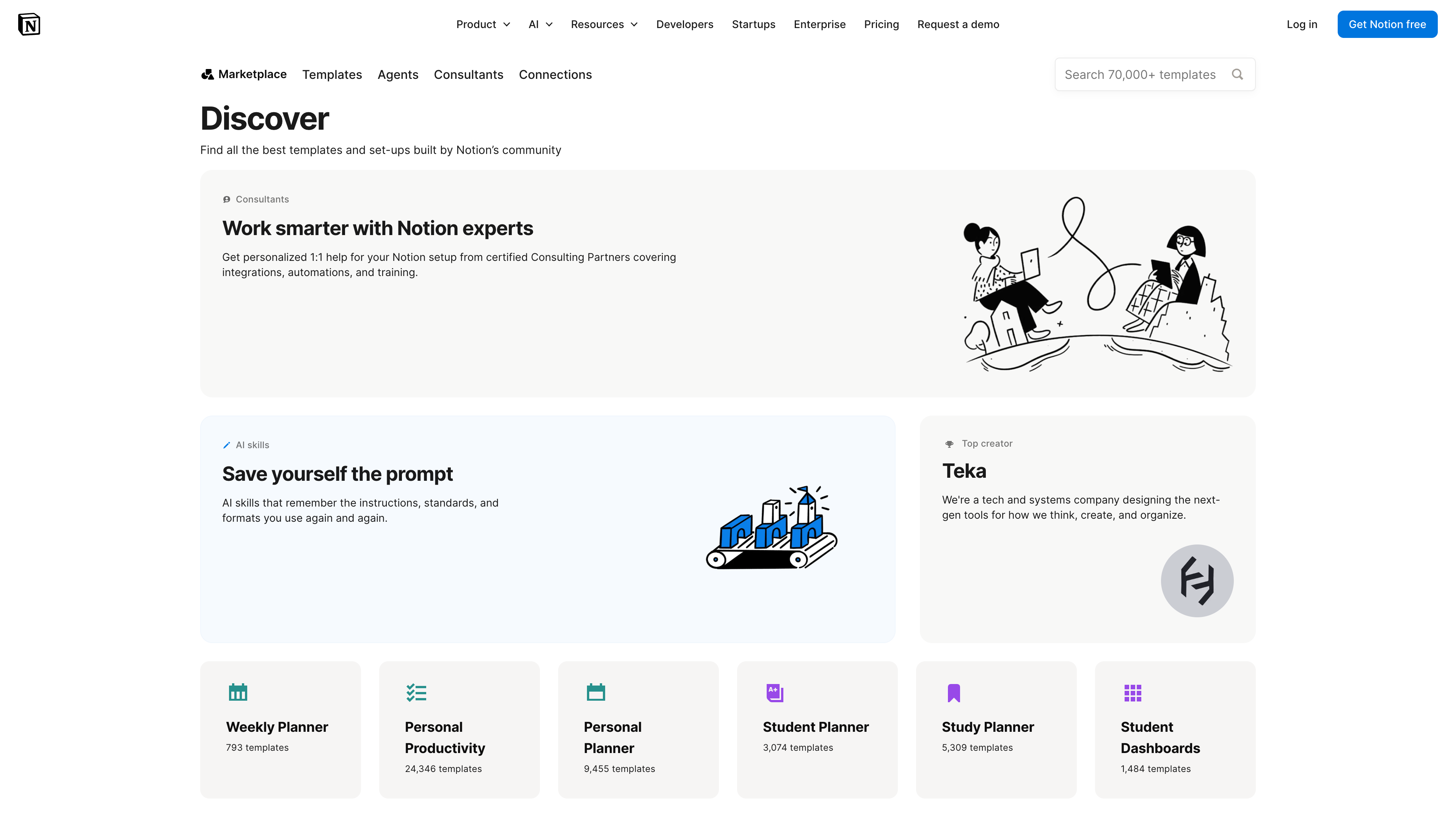
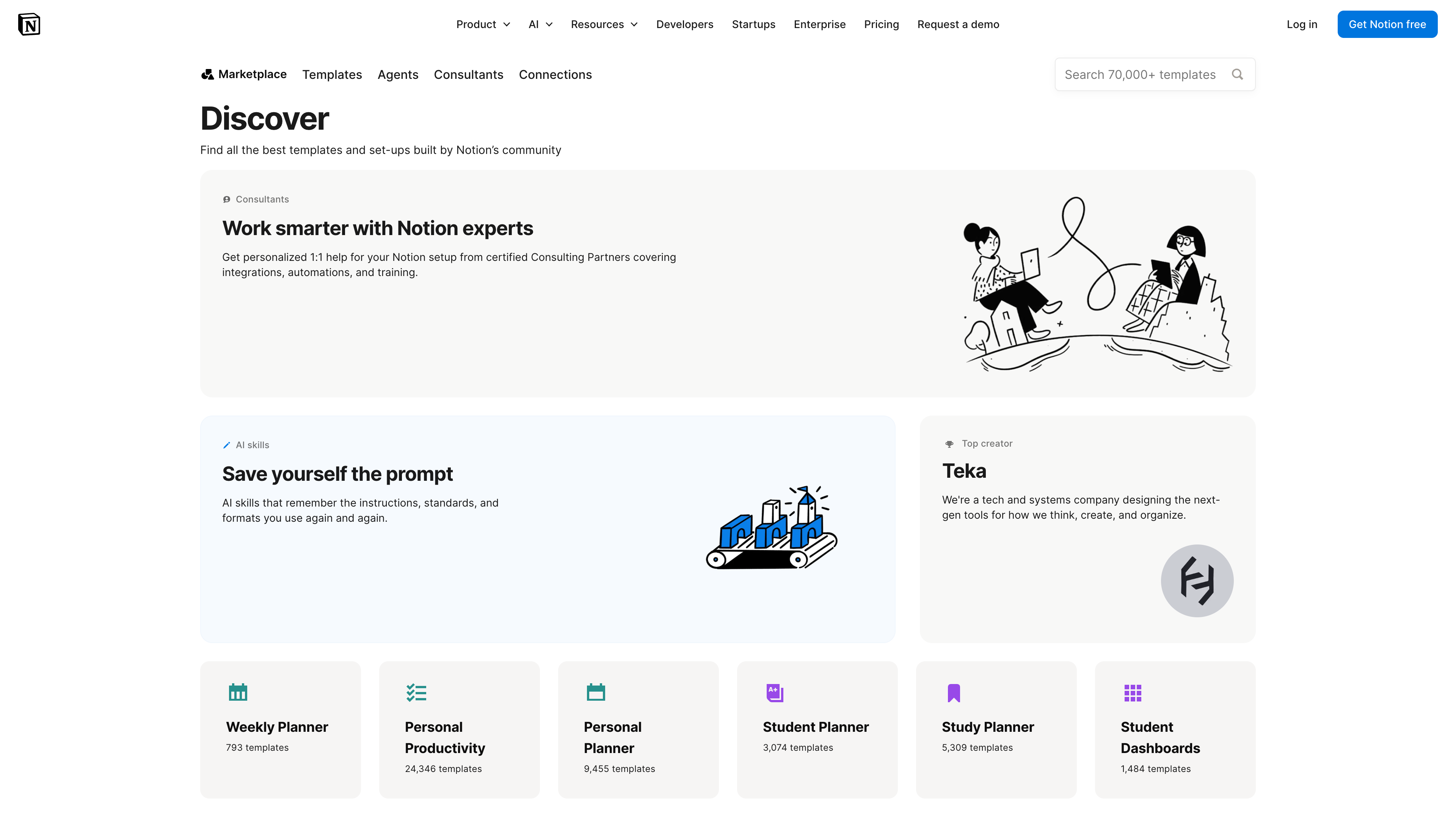
On the ecosystem side, the official marketplace advertises 70,000+ templates (as of 2026-09-08), spanning personal planners, student workflows, and team OKRs; the same page lists a directory of certified consultants (235 shown), evidence that building Notion systems has become a consulting niche of its own.
AI and the open platform
Notion AI launched in February 2023 with writing, summarization, translation, and database autofill. Version 3.0 (September 2025) turned it into an agent that executes multi-step tasks, alongside AI meeting notes (no meeting bot required) and Enterprise Search (beta) across connected apps such as Slack and GitHub. Free and Plus plans get only a limited AI trial; the full AI feature set starts at Business, and autonomous Custom Agents are metered separately in Notion credits ($10 per 1,000 credits).
Developer capabilities are documented at developers.notion.com: a public REST API reads and writes pages, databases, users, and comments; connections come in three forms — internal connections with a static token scoped to one workspace, public OAuth 2.0 connections, and personal access tokens that act with the creator's permissions; webhooks deliver content-change events, and a CLI plus Workers (beta) run custom code.
Pricing and the free tier's boundaries
The free plan is genuinely usable for one person: unlimited blocks for individual use. A workspace with two or more members, however, hits a shared block limit (existing content stays editable, but new blocks cannot be added), file uploads are capped at 5 MB each, page history lasts 7 days, external guests are limited to 10, one chart is allowed, and AI is trial-only. Plus removes the upload (≈5 GB per file) and chart limits and extends history to 30 days; students and educators get Plus free with a school email address (one-member workspaces). Business extends history to 90 days and unlocks the full AI suite, SAML SSO, granular database permissions, and private teamspaces. Enterprise adds unlimited history, SCIM provisioning, an audit log, zero data retention with LLM providers, and DLP/SIEM connections. For portability, every plan can export the entire workspace as HTML, Markdown, or CSV; bulk PDF export is a paid-plan capability. Paid plans are billed per member — guests are free — and monthly billing costs roughly 20% more than annual.
Security and data policy
According to the official security page, Notion holds a SOC 2 Type 2 report and four ISO certifications (27001, 27701, 27017, 27018), signs HIPAA Business Associate Agreements for healthcare customers, runs on AWS and Cloudflare, commits to 99.9% uptime, and operates a public bug bounty. For AI, the company states its AI subprocessors are contractually barred from training models on customer data, with a 30-day AI data retention window (zero retention on Enterprise). The boundary worth noting: Notion is proprietary software, data lives in Notion's cloud, there is no self-hosting option, and content is not end-to-end encrypted.
Good fits
- Personal notes and knowledge bases where docs, tables, and to-dos belong in one place rather than scattered across apps.
- Small teams consolidating project management and the team wiki into a single subscription.
- Quickly publishing a public docs site, help center, or personal homepage (Sites plus a free notion.site subdomain).
- Prototyping lightweight internal systems — content calendars, hiring pipelines, a simple CRM — from templates and the API.
Limitations
- Proprietary and cloud-only: no self-hosting and no end-to-end encryption, so organizations with strict data-sovereignty requirements should not store sensitive content here.
- The free plan constrains collaboration: shared block limits for multi-member workspaces, 5 MB attachments, and 7-day history are real thresholds for teams hoping to collaborate free long-term.
- AI is tied to the higher tiers: full AI requires Business or above, and per-member pricing adds up for larger teams; individuals who only need docs and databases may feel they are subsidizing AI they do not use.
- Limited offline support: desktop and mobile apps work offline only for pre-selected pages, a fundamental difference from local-first tools like Obsidian, and usability degrades on unreliable networks.
- Export fidelity is limited: exports come out as HTML/Markdown/CSV, and database views and layout structures do not migrate cleanly — the deeper you build, the higher the switching cost.
- Product lines move fast: Notion Mail is being shut down (September 22, 2026) about a year and a half after launch, a reminder to watch the lifecycle of any single feature you adopt.
Alternatives worth knowing
- Coda: likewise merges documents with table automation, with stronger formulas and automations, but a smaller template ecosystem and community.
- Obsidian: local-first Markdown notes with data on your own disk and a huge plugin ecosystem, but nothing like Notion's real-time collaborative databases.
- Confluence: Atlassian's enterprise wiki, deeply integrated with Jira, but less flexible in editing and database modeling.
References
- Notion homepage (checked 2026-09-08)
- About - Notion (checked 2026-09-08)
- Pricing - Notion (checked 2026-09-08)
- Notion security (checked 2026-09-08)
- Change your language - Notion Help Center (checked 2026-09-08)
- Notion Templates (checked 2026-09-08)
- Overview - Notion Developers (checked 2026-09-08)
- 100 Million of You - Notion Blog (checked 2026-09-08)
- Notion (productivity software) - Wikipedia (checked 2026-09-08)