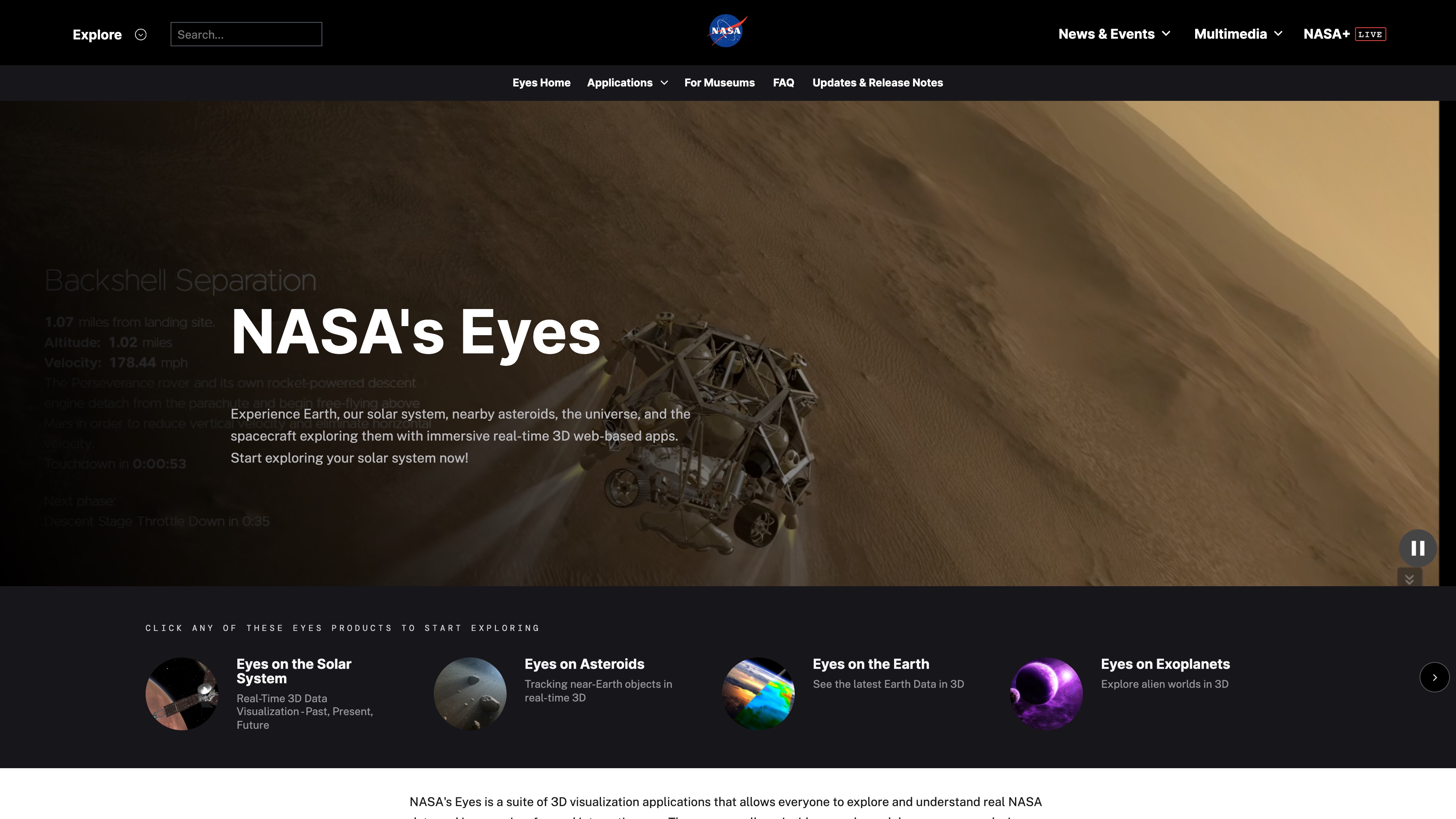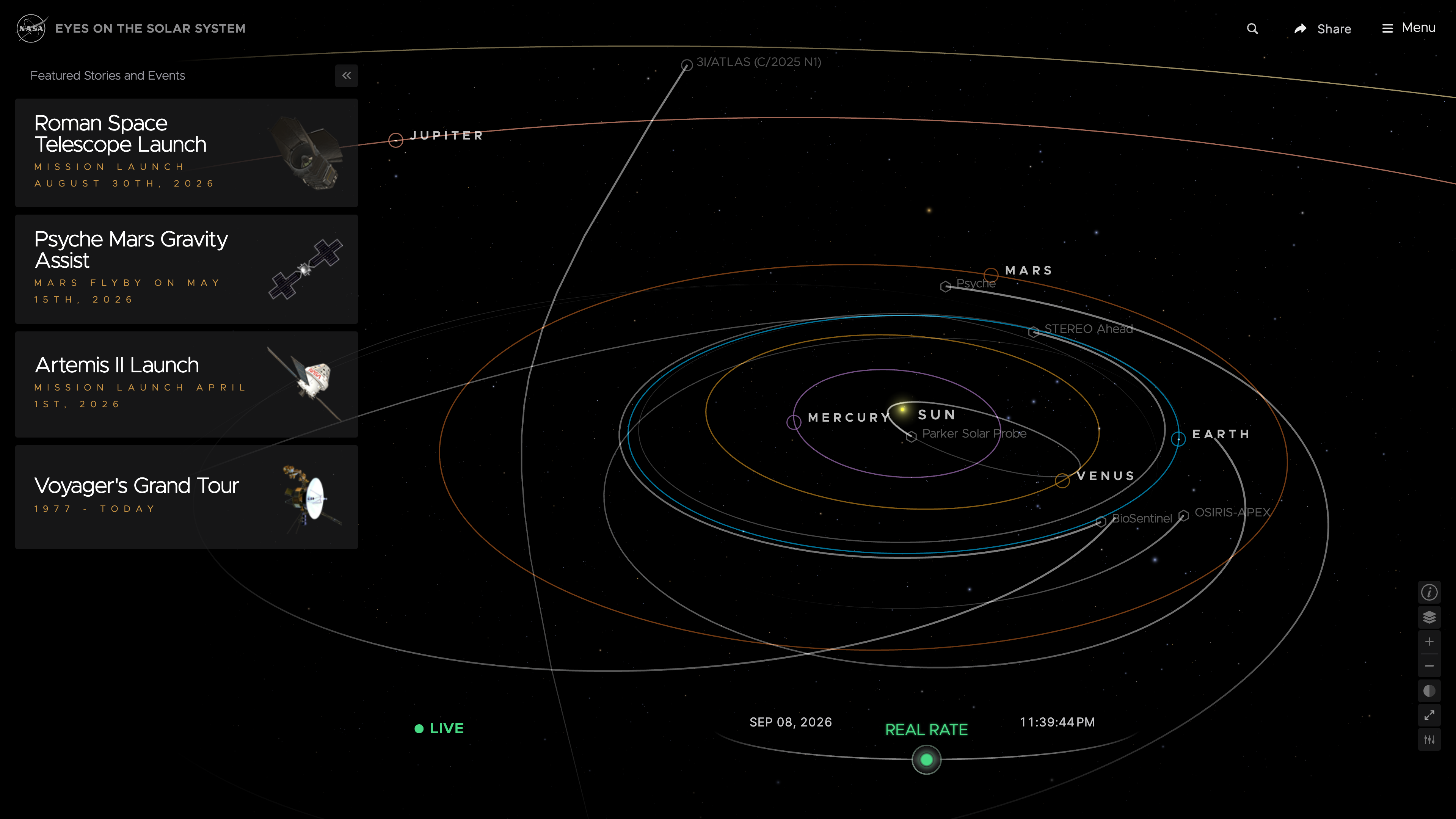
NASA Eyes on the Solar System (eyes.nasa.gov/apps/solar-system/) is a browser-based 3D simulation of the solar system developed by the visualization technology team at NASA's Jet Propulsion Laboratory (JPL). It rebuilds the entire solar system inside a web page: the eight planets and their moons, dwarf planets, asteroids and comets, plus the spacecraft of more than 150 NASA missions (as listed on the official site on 2026-09-08), all positioned according to real mission data. A time slider lets you fast-forward or rewind anywhere from 1950 to 2050 — check where the Voyagers, launched in 1977, are today, or preview a flyby or landing that has not happened yet. Its verifiable differences from illustrated science websites or installable planetarium software: it is completely free, requires no account and no download, and its orbits and trajectories come directly from JPL's solar system dynamics data, updated as missions evolve.
At a Glance
- URL: https://eyes.nasa.gov/apps/solar-system/ (suite homepage: https://eyes.nasa.gov/)
- Type: In-browser 3D solar system visualization (WebGL; the page canvas identifies itself as Three.js r185 in testing)
- Cost: Completely free
- Sign-up: None; there is no account system at all
- Interface language: English only
- Operator: Visualization Technology Applications and Development team, NASA Jet Propulsion Laboratory (JPL)
Background
Eyes on the Solar System was the first product in the NASA's Eyes family, initially released in 2010. Early versions required the Unity web plugin; a Java-based version followed in mid-2012. The app saw heavy use during the Curiosity rover's entry, descent and landing in August 2012: per Wikipedia's summary of JPL mission briefings, that landing weekend brought 739,000 additional visits and 20 TB of data streamed from JPL servers, while the touchdown time predicted in the simulation was accurate to within a fraction of a second.
The app is built by JPL's Visualization Technology Applications and Development team, led by Kevin Hussey, a former technology manager at Walt Disney Animation Studios, with Jason Craig as producer. The family has won two Webby Awards: Eyes on the Earth in 2009 (Global Climate Change) and Experience Curiosity in 2016 (Government & Civil Innovation), per Wikipedia citing the Webby Awards site.
The team launched the web-based Eyes on Asteroids in December 2021, then a fully rewritten Eyes on the Solar System in September 2022 after more than two years of work. The whole suite has since moved entirely into the browser; the old Windows/Mac desktop downloads still run but are no longer supported, per the official FAQ. The 2022 relaunch covered 126 missions over 1949–2049; as of 2026-09-08 the official figures are 150+ missions and 1950–2050. Maintenance remains frequent: the April 2026 release notes record that after Artemis II's actual launch, the team replaced the nominal simulation with the real trajectory supplied by the mission (liftoff occurred about 11 minutes later than scheduled) and adjusted the spacecraft's simulated solar-panel pointing.
Core Features
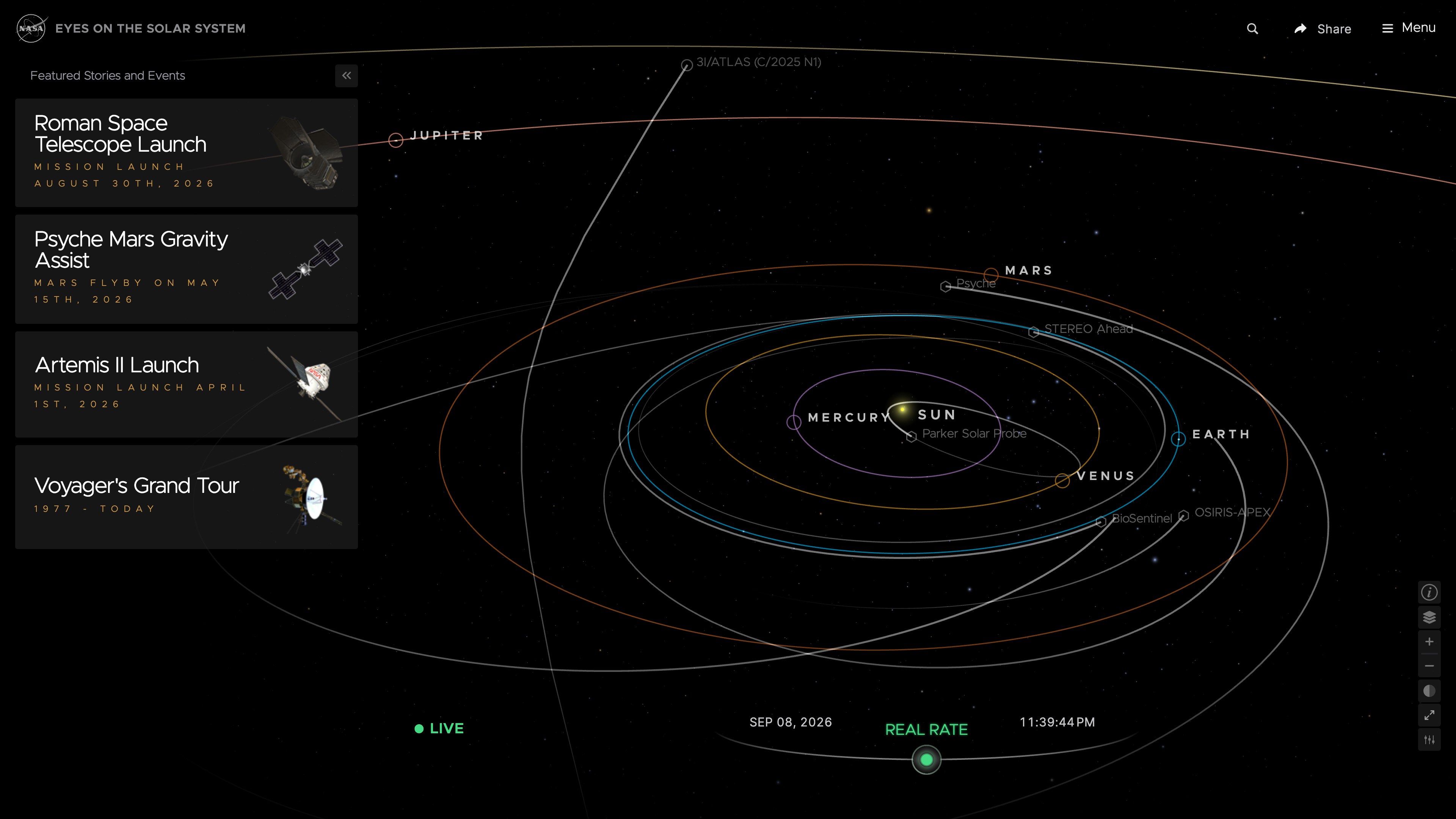
The app opens on a live, Sun-centered 3D view: planets move along their orbit lines, active spacecraft (visible in testing on 2026-09-08: Parker Solar Probe, Psyche, OSIRIS-APEX, STEREO Ahead, and the interstellar comet 3I/ATLAS, among others) are marked with models or labels, and the time bar at the bottom shows LIVE, real-rate playback.
Verifiable capabilities include:
- Time controls: drag the time slider or use rate buttons to replay or fast-forward anywhere between 1950 and 2050; a LIVE button snaps back to the present, and the time parameter can be encoded directly into a share link.
- Destination catalog: the menu covers the eight planets and Pluto; asteroids and comets such as Bennu, Dimorphos, 16 Psyche, Vesta, 3I/ATLAS (C/2025 N1), Halley, Tempel 1, 67P, and Hartley 2; and spacecraft including Europa Clipper, NISAR, Psyche, Lucy, Voyager 1, Artemis I and II, the International Space Station, and the James Webb Space Telescope (menu as tested on 2026-09-08). Clicking any body or spacecraft flies to it and opens an info panel.
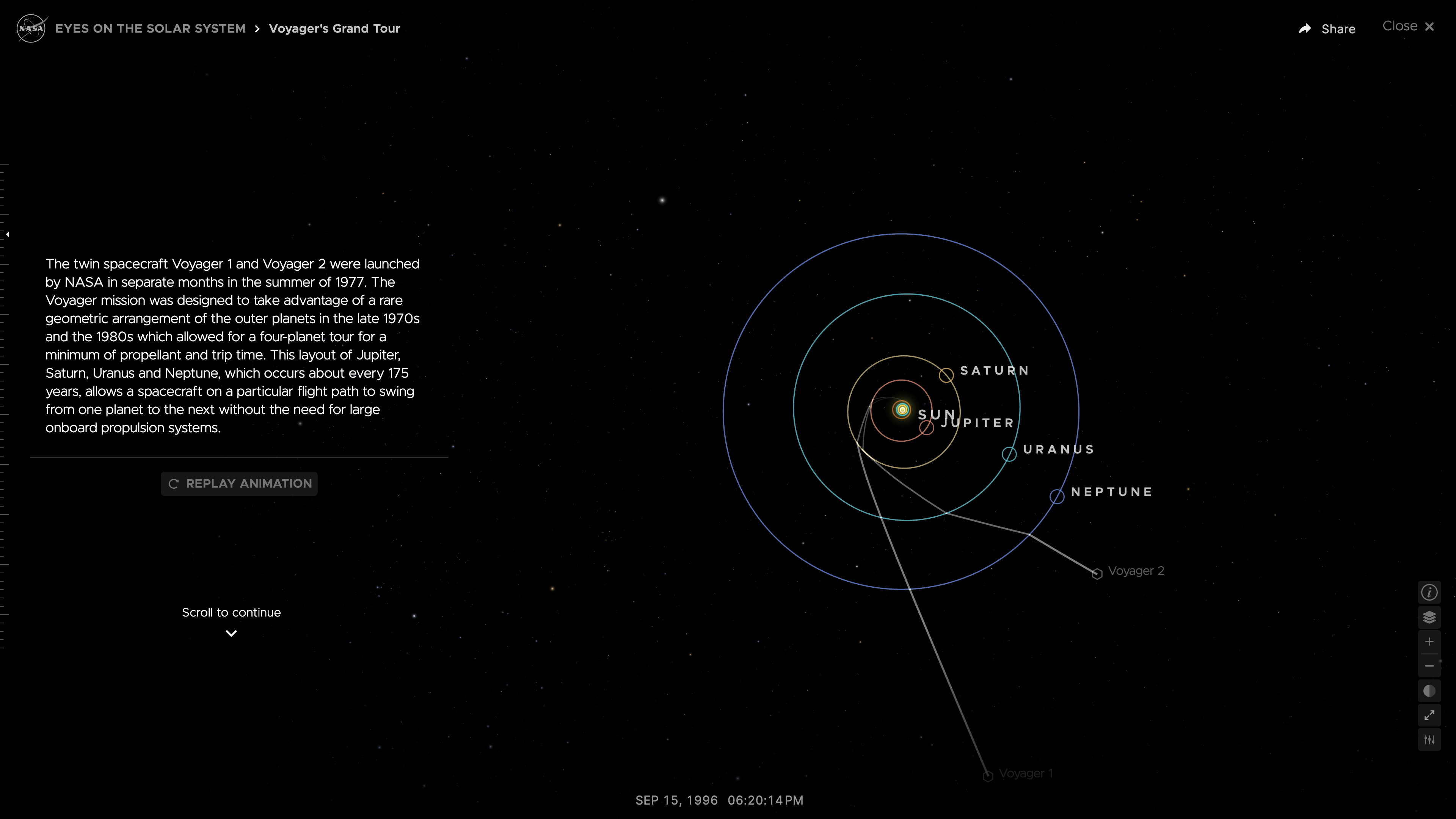
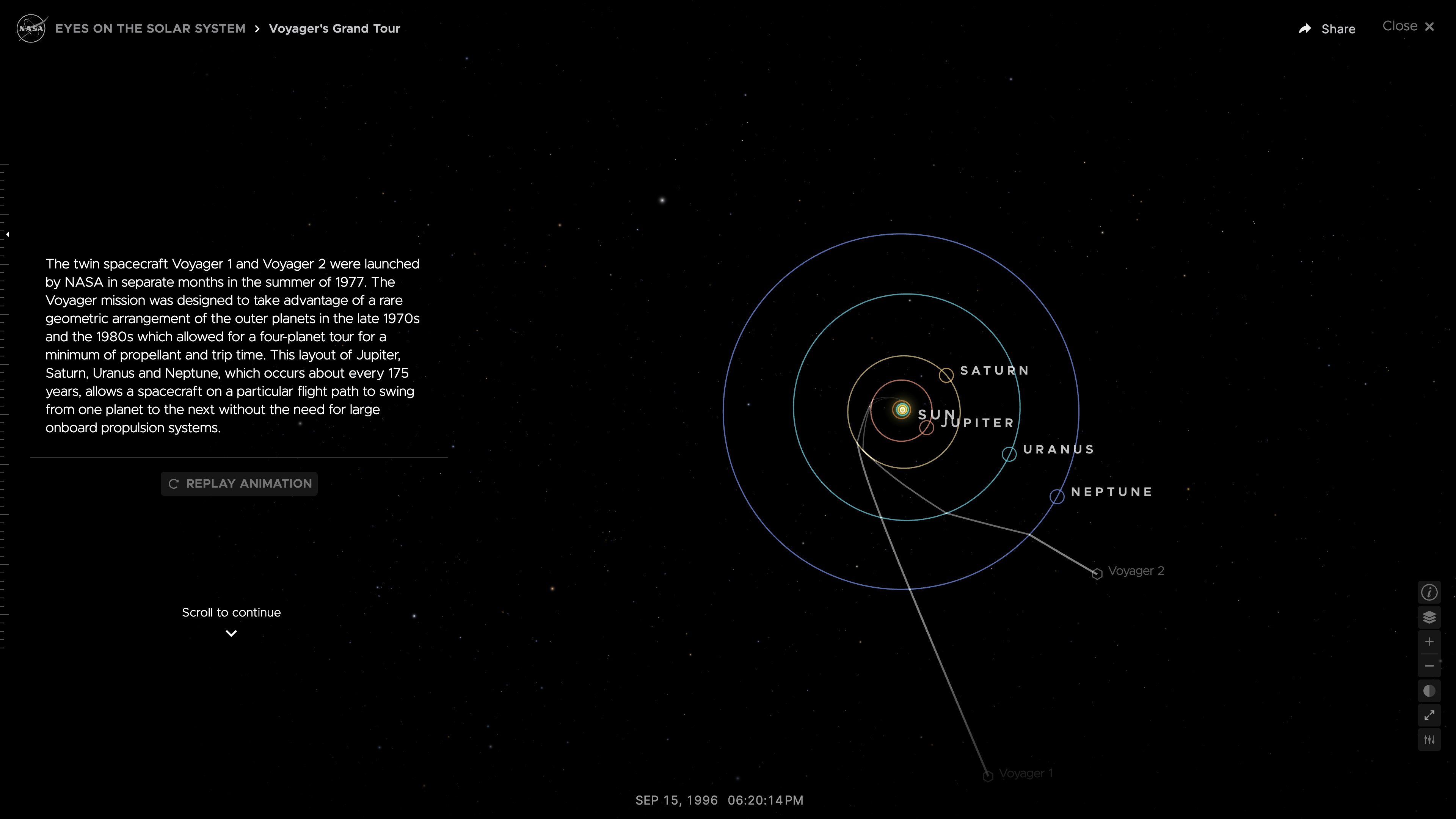
- Featured Stories and Events: interactive scrolly-telling journeys through missions. On 2026-09-08 the panel listed four: the Roman Space Telescope launch (2026-08-30), the Psyche Mars gravity-assist flyby (2026-05-15), the Artemis II launch (2026-04-01), and Voyager's Grand Tour (1977–present).
- Sharing and embedding: the Share button produces a deep link carrying camera and time parameters, or an iframe embed code, so an exact historical view can be embedded in another web page.
- Museum and education use: an official kiosk entry point (eyes.nasa.gov/apps/kiosk/) supports idle timeouts, interface locking, and removal of external links for museum touchscreens; the page also provides embed snippets, QR codes, and lesson-plan examples.
- 3D model resources: the Eyes team converts mission CAD models into lightweight web models; these and other NASA assets are free to download from NASA 3D Resources, some of them 3D-printable.
The NASA's Eyes Family
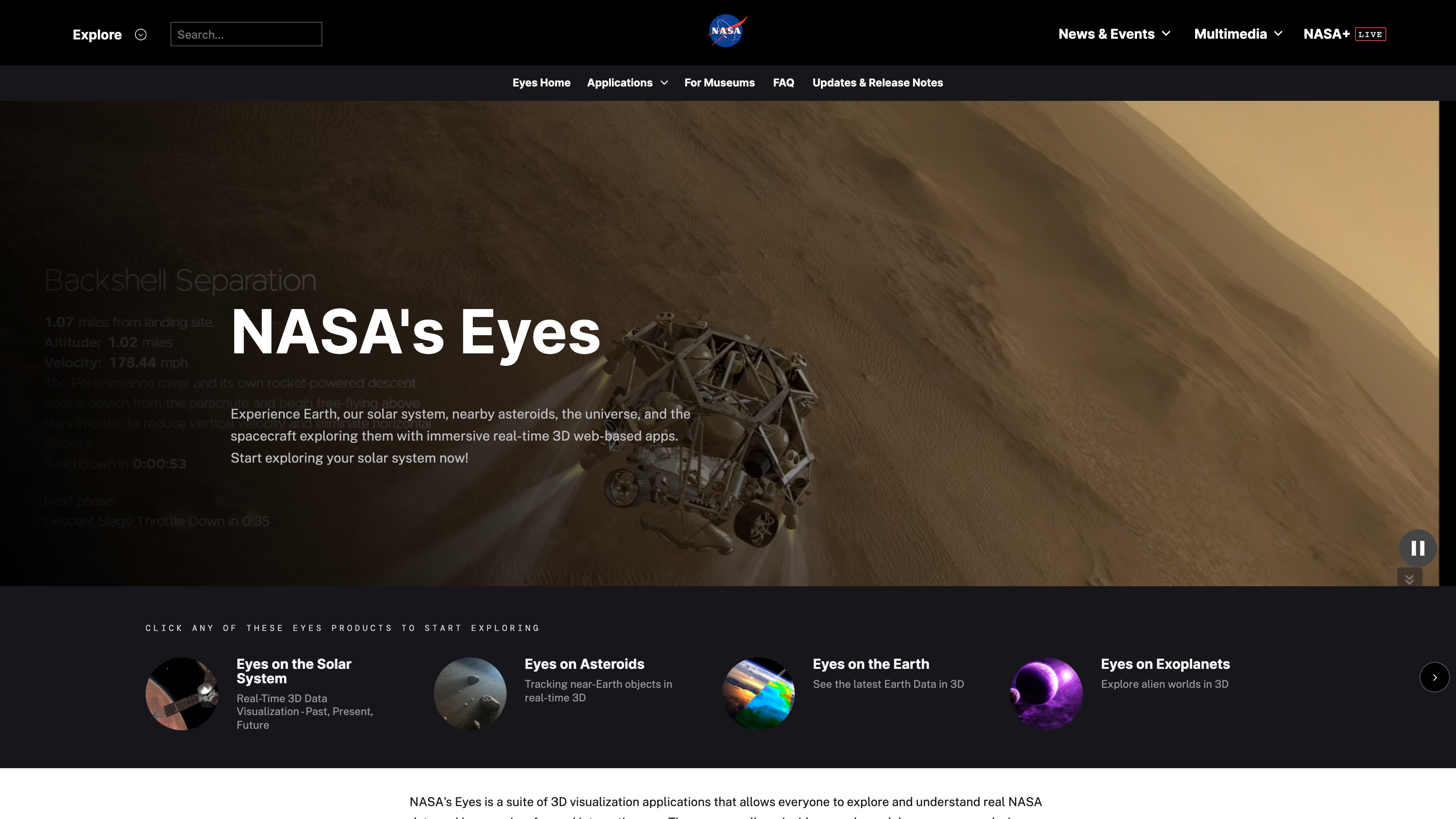
Eyes on the Solar System is one entry point in a larger suite. The suite homepage (as of 2026-09-08) lists the main apps:
- Eyes on Asteroids: a real-time view of every cataloged near-Earth object (NEO). The in-app welcome screen reports roughly 43,000 NEOs as of 2026-09-08, with data updated daily; for comparison, at launch in December 2021 it tracked about 28,000 objects with twice-daily updates — the catalog grows as new objects are discovered. It also offers Asteroid Watch (a countdown of the next five closest approaches) and a filter for potentially hazardous objects.
- Eyes on the Earth: fly along with NASA's Earth-observing satellites in real time and monitor "vital signs" such as carbon dioxide, ozone, and sea level, with imagery of major weather events going back about twenty years.
- Eyes on Exoplanets: explore more than 5,500 confirmed exoplanet systems (official site, as of 2026-09-08) from the NASA Exoplanet Archive, filterable by planet type, detection method, or missions such as Kepler and TESS.
- DSN Now: refreshed every five seconds, showing which spacecraft each Deep Space Network ground antenna is communicating with right now.
- The suite also includes the Mars Relay Network, the Mars 2020 entry-descent-landing "seven minutes of terror" simulation, the Experience Curiosity and Experience InSight rover interactives, and the mobile apps Spacecraft AR (iOS/Android) and Earth Now.
Accounts and Privacy
The suite has no account system; every feature is free and anonymous. Under the NASA web privacy policy, the sites use Google Analytics and collect standard access logs (IP address, browser type, pages visited, timestamps), and NASA states it never creates individual profiles. Information you voluntarily submit is used only for its stated purpose, and data concerning children under 13 is handled under COPPA rules.
Copyright and Content Policy
Under NASA's media usage guidelines, NASA imagery, audio, video, and 3D model assets (textures and polygon data) are generally not subject to copyright in the United States and may be used for educational or informational purposes — including personal web pages, textbooks, exhibits, and computer graphical simulations — provided NASA is acknowledged as the source and no endorsement is implied. The NASA insignia (the "meatball") and logotype (the "worm") are protected by law and are not covered by this general permission. Some third-party material on NASA sites is separately marked as copyrighted and requires contacting the rights holder.
Good For
- Checking where any NASA deep-space mission is — or was, or will be — at a given moment: where Voyager 1 is right now, or the geometry of asteroid Apophis's close approach on April 13, 2029.
- Teaching and outreach: ready-made Featured Stories for mission history, or embedding views into slides, exhibits, and museum kiosks.
- Following mission events: watching simulations synchronized with real mission data around launches, flybys, and landings, as visual context alongside news coverage.
- Building intuition for orbital mechanics concepts such as planetary alignments, gravity assists, and orbital inclination.
Limitations
- English only, with no other interface languages.
- Hardware and bandwidth demands: as a real-time WebGL app it needs a modern WebGL-capable browser; in testing, first load streams models and textures for a while, and low-end devices will struggle with smoothness.
- Simulation, not photography: body sizes in the default view are exaggerated for legibility (the app offers size comparisons against a human, a school bus, or a stadium as reference), and lighting modes such as "natural" and "shadow" are display choices, not what the naked eye would see.
- Future trajectories are nominal plans: events that have not happened yet are shown on currently planned trajectories and are revised when missions change — as when Artemis II's trajectory was updated to the actual April 2026 launch time — so previews are not guarantees of future reality.
- NASA-centric catalog: missions from other agencies (outside partnerships) are largely absent, so it is not a complete archive of human spaceflight.
- No offline use: the web apps require a connection, and the old desktop downloads are no longer supported.
Alternatives
- Stellarium Web: the online edition of the open-source Stellarium planetarium, showing the sky from an Earth-based observer's perspective; focused on stargazing rather than mission-level spacecraft trajectories.
- Solar System Scope: an independent online 3D solar system model that also runs in the browser with polished renderings of the bodies themselves, but without official mission data or real spacecraft trajectories.
References
- NASA's Eyes suite homepage (checked 2026-09-08)
- Eyes on the Solar System app (checked 2026-09-08)
- Eyes on Asteroids in-app welcome screen (checked 2026-09-08)
- Explore the Solar System With NASA's New-and-Improved 3D 'Eyes' - NASA JPL (checked 2026-09-08)
- NASA's 'Eyes on Asteroids' Reveals Our Near-Earth Object Neighborhood - NASA JPL (checked 2026-09-08)
- Eyes Frequently Asked Questions - NASA Science (checked 2026-09-08)
- NASA's Eyes for Museums - NASA Science (checked 2026-09-08)
- NASA's Eyes software: April release notes - NASA Science (checked 2026-09-08)
- NASA's Eyes software: May release notes - NASA Science (checked 2026-09-08)
- NASA Web Privacy Policy and Important Notices (checked 2026-09-08)
- NASA Images and Media Usage Guidelines (checked 2026-09-08)
- NASA 3D Resources (checked 2026-09-08)
- NASA's Eyes - Wikipedia (checked 2026-09-08)